A L I G N I N G
S E N T E N C E S
I N P A R A L L E L
C O R P O R A
Peter F. Brown, Jennifer C. Lai, a, nd Robert L. Mercer
IBM T h o m a s J. Watson Research Center
P.O. Box 704
Yorktown Heights, NY 10598
A B S T R A C T
In this paper we describe a statistical tech- nique for aligning sentences with their translations in two parallel corpora. In addition to certain anchor points that are available in our da.ta, the only information about the sentences that we use for calculating alignments is the number of tokens that they contain. Because we make no use of the lexical details of the sentence, the alignment com- putation is fast and therefore practical for appli- cation to very large collections of text. We have used this technique to align several million sen- tences in the English-French Hans~trd corpora and have achieved an accuracy in excess of 99% in a random selected set of 1000 sentence pairs that we checked by hand. We show that even without the benefit of anchor points the correlation between the lengths of aligned sentences is strong enough that we should expect to achieve an accuracy of between 96% and 97%. Thus, the technique may be applicable to a wider variety of texts than we have yet tried.
I N T R O D U C T I O N
Recent work by Brown
et al.,
[Brownet
al.,
1988, Brownet al.,
1990] has quickened anew the long dormant idea of using statistical techniques to carry out machine translation from one natural language to another. The lynchpin of their approach is a. large collection of pairs of sentences that. are mutual transla- tions. Beyond providing grist to the sta.tisti- cal mill, such pairs of sentences are valuable to researchers in bilingual lexicography [I(la.- va.ns and Tzoukerma.nn, 1990, Warwick and Russell, 1990] and may be usefifl in other ap- proaches to machine translation [Sadler, 1989].In this paper, we consider the problem of extra.cting from pa.raJlel French and F, nglish
corpora pairs sentences that are translations of one another. The task is not trivial because at times a single sentence in one language is translated as two or more sentences in the other language. At other times a sentence, or even a whole passage, may be missing from one or the other of the corpora.
If a person is given two parallel texts and asked to match up the sentences in them, it is na.tural for him to look at the words in the sen- tences. Elaborating this intuitively appealing insight, researchers at Xerox and at ISSCO [Kay, 1991, Catizone
et al.,
1989] have devel- oped alignment Mgodthms that pair sentences according to the words that they contain. Any such algorithm is necessarily slow and, despite the potential for highly accurate alignment, may be unsuitable for very large collections of text. Our algorithm makes no use of the lexical details of the corpora, but deals only with the number of words in each sentence. Although we have used it only to align paral- lel French and English corpora from the pro- ceedings of the Canadian Parliament, we ex- pect that our technique wouhl work on other French and English corpora and even on other pairs of languages. The work of Gale and Church , [Gale and Church, 1991], who use a very similar method but measure sentence lengths in characters rather than in words, supports this promise of wider applica.bility.T I I E H A N S A R D C O R P O R A
Our Hansard corpora consist of the llansards from 1973 through 1986. There are two files for each session of parliament: one English and one French. After converting the obscure text markup language of the raw data. to TEX , we combined all of the English files into a sin- gle, large English corpus and all of the French files into a single, large French corpus. We then segmented the text of each corpus into tokens and combined the tokens into groups that we call sentences. Generally, these con- form to the grade-school notion of a sentence: they begin with a capital letter, contain a. verb, and end with some type of sentence-final punctuation. Occasionally, they fall short of this ideal and so each corpus contains a num- ber of sentence fragments and other groupings of words that we nonetheless refer to as sen- tences. With this broad interpretation, the English corpus contains 85,016,286 tokens in 3,510,744 sentences, and the French corpus contains 97,857,452 tokens in 3,690,425 sen- tences. The average English sentence has 24.2 tokens, while the average French sentence is
about 9.5% longer with 26.5 tokens.
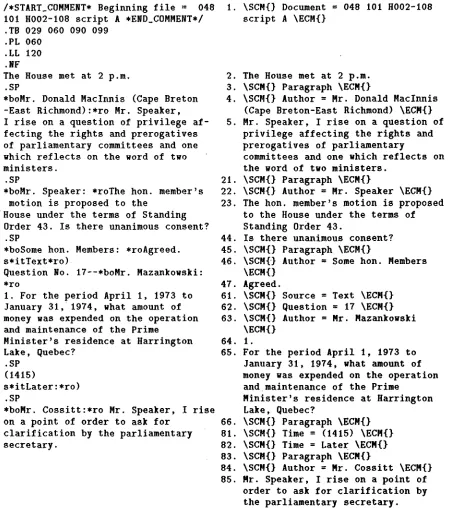
The left-hand side of Figure 1 shows the raw d a t a for a portion of the English corpus, and the right-hand side shows the same por- tion after we converted it to TEX and divided it up into sentences. The sentence numbers do not advance regularly because we have edited the sample in order to display a variety of phe-
n o l n e n a .
In addition to a verbatim record of the proceedings and its translation, the ttansards include session numbers, names of speakers, time stamps, question numbers, and indica- tions of the original language in which each speech was delivered. We retain this auxiliary information in the form of comments sprin- kled throughout the text. Each comment has the form \ S C M { } . . . \ E C M { } as shown on the right-hand side of Figure 1. ]n ad- dition to these comments, which encode in- formation explicitly present in the data, we inserted Paragraph comments as suggested by the space command of which we see aa exam- ple in the eighth line on the left-hand side of
Figure 1.
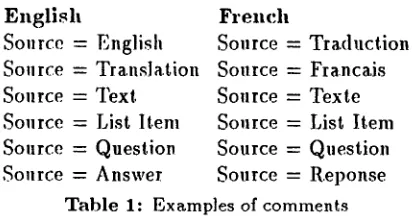
We mark the beginning of a parliamentary session with a D o c u m e n t comment as shown in Sentence 1 on the right-hand side of Fig- ure 1. Usually, when a member addresses the parliament, his name is recorded and we en- code it in an A u t h o r comment. We see an ex- ample of this in Sentence 4. If the president speaks, he is referred to in the English cor- pus as Mr. Speaker and in the French corpus as M. le Prdsideut. If several members speak at once, a shockingly regular occurrence, they are referred to as S o m e Hon. M e m b e r s in the English and as Des Voix in the French. Times are recorded either ~ exact times on a. 24-hour basis as in $entencc 8], or as inexact times of which there are two forms: T i m e = Later, and T i m e = Recess. These are rendered in French as T i m e = P l u s Tard and T i m e = Re- cess. Other types of comments that appear are shown in Table 1.
A L I G N I N G A N C H O R P O I N T S
After examining the Hansard corpora, we realized that the comments laced throughout would serve as uscflll anchor points in any alignment process. We divide the comments into major and minor anchors as follows. The comments A u t h o r = Mr. Speaker, A u t h o r = ill. le P r ( s i d e n t , A u t h o r = S o m e Hon. M e m - bers, and A u t h o r = Des Voix are called minor anchors. All other comments are called major anchors with the exception of the Paragraph comment which is not treated as an anchor at all. The minor anchors are much more com- mon than any particular major anchor, mak- ing an alignment based on them less robust against deletions than one based on the ma- jor anchors. Therefore, we have carried out the alignment of anchor points in two passes, first aligning the major anchors and then the minor anchors./*START_COMMENT* Beginning file = 048 101 H002-108 script A *END_COMMENT*/ .TB 029 060 090 099
.PL 060 .LL 120 .NF
The House met at 2 p.m. .SP
*boMr. Donald MacInnis (Cape Breton -East Richmond):*ro Mr. Speaker, I rise on a question of privilege af- fecting the rights and prerogatives of parliamentary committees and one which reflects on the word of two ministers.
.SP
*boMr. Speaker: *roThe hon. member's motion is proposed to the
H o u s e under the terms of Standing Order 43. Is there unanimous consent?
.SP
*boSome hon. Members: *roAgreed. s*itText*ro)
Question No. 17--*boMr. Mazankowski: * t o
I. For the period April I, 1973 to
J a n u a r y 3 1 , 1 9 7 4 , what amount o f money was e x p e n d e d on t h e o p e r a t i o n
and maintenance o f the Prime Minister's residence at Harrington Lake, Quebec?
.SP
( 1 4 1 5 )
s * i t L a t e r : * r o ) .SP
*boMr. C o s s i t t : * r o Mr. S p e a k e r , I r i s e on a p o i n t o f o r d e r t o a s k f o r
c l a r i f i c a t i o n b y t h e p a r l i a m e n t a r y
secretary.
1. \ S C M { } D o c u m e n t = 048 101 H002-108 script A \ECM{)
2. The House m e t a t 2 p . m .
3. \SCM{} Paragraph \ECM{}
4. \SCM{} Author = Mr. Donald MacInnis (Cape Breton-East Richmond) \ECM{} 5. Mr. Speaker, I rise on a question of
privilege affecting the rights and prerogatives of parliamentary
committees and one which reflects on the word of two ministers.
21. \SCM{} Paragraph \ECM{}
22. \SCM{} Author = Mr. Speaker \ECM{} 23. The hon. member's motion is proposed
to the House under the terms of Standing Order 43.
44. Is there unanimous consent? 45. \SCM{} Paragraph \ECM{)
46. \SCM{-} Author = Some hon. Members
\ECM{}
47. Agreed.
61. \SCM{} Source = Text \ECM{} 62. \SCM{} Question = 17 \ECM{} 63. \SCM{} Author = Mr. Mazankowski
\ECMO
64. I.
65. For the period April I, 1973 to
J a n u a r y 3 1 , 1974, . h a t a m o u n t o f money was e x p e n d e d on t h e o p e r a t i o n a n d m a i n t e n a n c e o f t h e P r i m e
M i n i s t e r ' s r e s i d e n c e a t H a r r i n g t o n L a k e , Q u e b e c ?
66. \SCM{} P a r a g r a p h \ECN{}
81. \SCM{) Time = (1415) \ECM{} 82. \SCM{) Time = Later \ECM{) 83. \SCM{} Paragraph \ECM{}
84. \SCM{} Author = Mr. Cossitt \ECM{} 85. Mr. Speaker, I rise on a point of
order to ask for clarification by the parliamentary secretary.
[image:3.612.63.528.96.604.2]a cost that favors exact matches and penalizes omissions or garbled matches. Thus, for ex- ample, we assign a cost of 0 to the pair T i m e = L a t e r and T i m e = P l u s Tard, but a cost of 10 to the pair T i m e = L a t e r and A u t h o r = M r . B a t e m a n . We set the cost of a dele- tion at 5. For two names, we set the cost by counting the number of insertions, deletions, and substitutions necessary to transform one name, letter by letter, into the other. This value is then reduced to the range 0 to 10.
Given the costs described above, it is a standard problem in dynamic programming to find t h a t alignment of the major anchors in the two corpora with the least total cost [Bellman, 1957]. In theory, the time and space required to find this alignment grow as the product of the lengths of the two sequences to be aligned. In practice, however, by using thresholds and the partial traceback technique described by Brown, Spohrer, Hochschild, and Baker , [Brown et al., 1982], the time required can be made linear in the length of the se- quences, and the space can be made constant. Even so, the computational demand is severe since, in places, the two corpora are out of alignment by as many as 90,000 sentences ow- ing to mislabelled or missing files.
This first pass renders the d a t a as a se- quence of sections between aligned major an- chors. In the second pass, we accept or reject each section in turn according to the popula- tion of minor anchors that it contains. Specifi- cally, we accept a section provided that, within the section, both corpora contain the same number of minor anchors in the same order. Otherwise, we reject the section. Altogether, we reject about 10% of the d a t a in each cor- pus. The minor anchors serve to divide the remaining sections into subsections thai. range in size from one sentence to several thousand sentences and average about ten sentences.
A L I G N I N G S E N T E N C E S
A N D
P A R A G R A P H
B O U N D A R I E S
We turn now to the question of aligning the individual sentences in a subsection be- tween minor anchors. Since the number ofE n g l i s h
Source = English Source = Translation Source = Text Source = List Item Source = Question Source = Answer
Fren(;h
Source = Traduction Source = Francais Source = Texte Source = List Item Source = Question Source = Reponse
Table 1: Examples of comments
sentences in the French corpus differs from the number in the English corpus, it is clear that they cannot be in one-to-one correspondence throughout. Visual inspection of the two cor- pora quickly reveals that although roughly 90% of the English sentences correspond to single French sentences, there are many instances where a single sentence in one corpus is rep- resented by two consecutive sentences in the other. Rarer, but still present, are examples of sentences that appear in one corpus but leave no trace in the other. If one is moder- ately well acquainted with both English and French, it is a simple matter to decide how the sentences should be aligned. Unfortunately, the sizes of our corpora make it impractical for us to obtain a complete set of alignments by hand. Rather, we must necessarily employ some automatic scheme.
It is not surprising and further inspection verifies that tile number of tokens in sentences that are translations of one another are corre- lated. We looked, therefore, at the possibility of obtaining alignments solely on the basis of sentence lengths in tokens. From this point of view, each corl)us is simply a sequence of sen- tence lengths punctuated by occasional para- graph markers. Figure 2 shows the initial por- tion of such a pair of corpora. We have circled groups of sentence lengths to show the cor- rect alignment. We call each of the groupings
[image:4.612.327.536.58.166.2]F i g u r e 2: Division of aligned corpora into beads
Bead
e
/
,f
ee/
eft
¶!
¶o¶t
Text
one English sentence one French sentence
one English and one French sentence two English and one French sentence one English and two French sentences one English paragraph
one French paragraph
one English and one French paragraph Table 2: Alignment Beads
ducing a sequence of beads and the second choosing the lengths of the sentences in each
bead.
Figure 3 shows the two-state Markov model that we use for generating beads. -We assume that a single sentence in one language lines up with zero, one, or two sentences in the other and that paragraph markers may be deleted. Thus, we allow any of the eight beads shown in Table 2. We also assume that Pr (e) = Pr ( f ) , Pr ( e f t ) = e r (ee/), and Pr (¶¢) = P r ( ¶ t ) .
BEAD
... s-L-°--P- ... ;!:::O
F i g u r e 3: Finite state model for generating beads
Given a bead, we determine the lengths of the sentences it contains as follows. We a.s- sume the probability of an English sentence of length g~ given an e-bead to be the same as the probability of an English sentence of length ee in the text as a whole. We denote
this probability by Pr(ee). Similarly, we as- sume the probability of a French sentence of length g! given an f-bead to be Pr (gY)" For an el-bead, we assume that the English sentence has length e, with probability Pr (~e) and that log of the ratio of length of the French sen- tence to the length of the English sentence is uormMly distributed with mean /t and vari- ance a 2. Thus, if r = log(gt/ge), we assume that
er(ts[e, ) = c exp[-(r-
(1)
with 0¢ chosen so that the sum of
Pr(tllt, )
over positive values of gI is equal to unity. Foran eel-bead, we assume that each of the En- glish sentences is drawn independently from the distribution
Pr(t.)
and that the log of the ratio of the length of the French sentence to the sum of the lengths of the English sen- tences is normally distributed with the same mean and variance as for an el-bead. Finally, for an eft-bead, we assume that the length of the English sentence is drawn from the distri- bution Pr (g,) and that the log of the ratio of the sum of the lengths of the French sentences to the length of the English sentence is nor- mally distributed a s b e f o r e . Then, given the sum of the lengths of the French sentences, we assume that tile probability of a particular pair of lengths,/~11 and ~12, is proportional to Vr (ef,) Pr (~S~) .Together, these two random processes form a hidden Markov model [Baum, 1972] for the generation of aligned pairs of corpora.. We de- termined the distributions, Pr (g,) and Pr (aS), front the relative frequencies of various sen- tence lengths in our data. Figure 4 shows for each language a. histogram of these for sen- tences with fewer than 81 tokens. Except for lengths 2 and 4, which include a large num- ber of formulaic sentences in both the French and the English, the distributions are very smooth.
[image:5.612.66.239.67.157.2]I 80 mentenee length
1 80
.entenea length
[image:6.612.130.414.397.619.2]of greater lengths by fitting the observed fre- quencies of longer sentences to the tail of a Poisson distribution.
We determined M1 of the other parameters by applying the EM algorithm to a large sam- pie of text [Baum, 1972, Dempster
et al.,
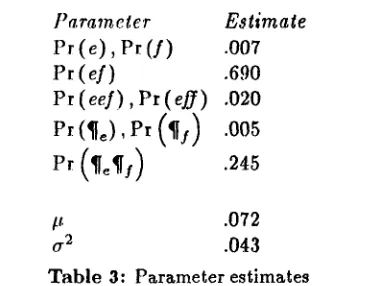
1977]. The resulting values are shown in Table 3. From these parameters, we can see that 91% of the English sentences and 98% of the En- glish paragraph markers line up one-to-one with their French counterparts. A random variable z, the log of which is normMly dis- tributed with mean # and variance o ~, has mean value exp(/t + a2/2). We can also see, therefore, that the total length of the French text in an el-,eel-,
oreft-bead
should be about 9.8% greater on average than the total length of the corresponding English text. Since most sentences belong to el-beads, this is close to the value of 9.5% given in Section 2 for the amount by which the length of the average French sentences exceeds that of the average English sentence.We can compute from the parameters in Table 3 that the entropy of the bead produc- tion process is 1.26 bits per sentence. Us- ing the parameters # and (r 2, we can combine the observed distribution of English sentence lengths shown in Figure 4 with the conditional distribution of French sentence lengths given English sentence lengths in Equation (1) to obtain the joint distribution of French a n d English sentences lengths in
el-, eel-,
andeft-
beads. From this joint distribution, we can compute that the mutual information between French and English sentence lengths in these beads is 1.85 bits per sentence. We see there- fore that, even in the absence of the anchor points produced by the first two pa.sses, the correla.tion in sentence lengths is strong enough to allow alignment with an error rate that is asymptotically less than 100%. lh;arten- ing though such a result may be to the theo- retician, this is a sufficiently coarse bound on the error rate to warrant further study. Ac- cordingly, we wrote a program to Simulate the alignment process that we had in mind. Using Pr(e¢), P r ( ( ¢ ) , and the parameters from Ta-
Parameter
Estimate
e r ( e ) , P r ( / ) .007 Pr ( e / ) .690
Pr
(eel),
Pr(eft)
.020 Pr (¶~), Pr ( ¶ f ) .005It. .072
tr 2 .043
Table 3: P~rameter estimates
ble 3, we generated an artificial pair of aligned corpora. We then determined the most prob- able alignment for the data. We :recorded the fraction of el-beads in the most probable alignment that did not correspond to el-beads in the true Mignment as the error rate for the process. We repeated this process many thou- sands of times and found that we could ex- pect an error rate of about 0.9% given the frequency of anchor points from the first two pa,sses.
By varying the parameters of the hidden Markov model, we explored the effect of an- chor points and paragraph ma.rkers on the ac- curacy of alignment. We found that with para- graph markers but no ~tnchor points, we could expect an error rate of 2.0%, with anchor points but no l)~tra.graph markers, we could expect an error rate of 2.3%, and with neither anchor points nor pa.ragraph markers, we could ex- pect an error rate of 3.2%. Thus, while anchor points and paragraph markers are important, alignment is still feasible without them. This is promising since it suggests that one may be able to apply the same technique to data where frequent anchor points are not avail- able.
R E S U L T S
[image:7.612.337.526.53.196.2]And love and kisses to you, too.
... mugwumps who sit on the fence with
their mugs on one side and their
wumps on the other side and do not
know which side to come down on.
At first reading, she may have.
Pareillelnent.
... en voulant m&lager la ch~vre et le choux
ils n'arrivent 1)as k prendre patti.
Elle semble en effet avoir un grief tout a
fait valable, du moins au premier
abord.
Table 4: Unusual but correct alignments
examine a random sample of 1000 of these
beads, and we found 6 in which sentences were
not translations of one another. This is con-
sistent with the expected error rate ol 0.9%
mentioned above. In some cases, the algo-
rithm correctly aligns sentences with very dif-
ferent lengths. Table 4 shows some interesting
examples of this.
R E F E R E N C E S
[Baum, 1972] Baum, L. (1972). An inequality
and associated maximization technique in
statistical estimation of probabilistic func-
tions of a Markov process.
Inequalities,
3:1-
8.
[Bellman, 1957] Bellman, R. (1957).
Dy-
namic Programming.
Princeton University
Press, Princeton N.J.
[Brown
et al.,
1982] Brown, P., Spohrer, J.,
Hochschild, P., and Baker, J. (1982). Par-
tial traceback and dynamic programming.
In
Proceedings of the IEEE International
Conference on Acoustics, Speech and Signal
Processing,
pages 1629-1632, Paris, France.
[Brown
et ai.,
1990] Brown, P. F., Cocke, J.,
DellaPietra, S. A., DellaPietra, V. J., Je-
linek, F., Lafferty, J. D., Mercer, R. L.,
and Roossin, P. S. (1990). A statisticM ap-
proach to machine translation.
Computa-
tional Linguistics,
16(2):79-85.
[Brown
et al.,
1988] Brown, P. F., Cocke, J.,
DellaPietra, S. A., DellaPietra., V. J., .le-
linek, F., Mercer, R. L., and Roossin, P. S.
(1988). A statistical approach to language
translation. In
Proceedings of the I2th In-
ternational Conference on Computational
Linguisticsl
Budapest, Hungary.
[Catizone
et al.,
1989] Catizone, R., Russell,
G., and Warwick, S. (1989). Deriving trans-
lation data [rom bilingual texts. In
Proceed-
ings of the First International Acquisition
Workshop,
Detroit, Michigan.
[Dempster
et al.,
]977] Dempster, A., Laird,
N., and Rubin, D. (1977). Maximum likeli-
hood from incomplete data via the EM al-
gorithm.
Journal of the Royal Statistical
Society,
39(B):1-38.
[Gale and Church, 1991] Gale, W. A. and
Church, K. W. (1991). A program for align-
ing sentences in bilingual corpora. In
Pro-
ceedings of the 2gth Annual Meeting of the
A ssociation for Computational Linguistics,
Berkeley, California.
[Kay, ]991] Kay, M. (1991). Text-translation
alignment.
In ACII/ALLC '91: "Mak-
in.q Connections" Conference Handbook,
Tempe, Arizona.
[Klavans and Tzoukermann, 1990]
Kiavans, .l. and Tzoukermann, E. (1990).
The bicord system. ]n
COLING-90,
pages
174-179, Ilelsinki, Finland.
[Sadler, 19~9] Sadler, V. (1989).
The Bilin-
gual Knowledge B a n k - A New Conceptual
Basis for MT.
BSO/Research, Utrecht.
[Warwick and Russell, 1990] Wa.rwick, S. and
Russell, G. (1990). Bilingual concordancing
and bilingnM lexicography. In