F R O M N - G R A M S T O C O L L O C A T I O N S
A N E V A L U A T I O N O F X T R A C T
Frank A. Smadja
D e p a r t m e n t of C o m p u t e r ScienceC o l u m b i a University N e w York, N Y 1 0 0 2 7
A b s t r a c t
In previous papers we presented methods for retrieving collocations from large samples of texts. We described a tool, X t r a c t , that im- plements these methods and able to retrieve a wide range of collocations in a two stage process. These methods a.s well as other re- lated methods however have some limitations. Mainly, the produced collocations do not in- clude any kind of functional information and many of them are invalid. In this paper we i n t r o d u c e methods that address these i s s u e s .
These methods are implemented in an added third stage to X t r a c t that examines the set of collocations retrieved during the previous two stages to both filter out a number of invalid col- locations and add useful syntactic information to the retained ones. By combining parsing and statistical techniques the addition of this third stage has raised the overall precision level of X t r a c t from 40% to 80% With a precision of 94%. In the paper we describe the methods and the evaluation experiments.
1
I N T R O D U C T I O N
In the past, several approaches have been proposed to retrieve various types of collocations from the analysis of large samples of textual data. Pairwise associations (bigrams or 2-grams) (e.g., [Smadja, 1988], [Church and Hanks, 1989]) as well as n-word (n > 2) associations (or n-grams) (e.g., [Choueka el al., 1983], [Smadja and McKeown, 1990]) were retrieved. These techniques auto- matically produced large numbers of collocations along with statistical figures intended to reflect their relevance. However, none of these techniques provides functional in- formation along with the collocation. Also, the results produced often contained improper word associations re- flecting some spurious aspect of the training corpus that did not stand for true collocations. This paper addresses these two problems.
Previous papers (e.g., [Smadja and McKeown, 1990]) introduced a. set of tecl)niques and a. tool, X t r a c t ,
that produces various types of collocations from a two- stage statistical analysis of large textual corpora briefly sketched in the next section. In Sections 3 and 4, we show h o w robust parsing technology can be used to both filter out a number of invalid collocations as well as add useful syntactic information to the retained ones. This
filter/analyzer is implemented in a third stage of Xtract that automatically goes over a the output collocations to reject the invalid ones and label the valid ones with syn- tactic information. For example, if the first two stages of Xtract produce the collocation
"make-decision,"
the goal of this third stage'is to identify it as a verb-object collocation. If no such syntactic relation is observed, then the collocation is rejected. In Section 5 we present an evaluation of Xtract as a collocation retrieval sys- tem. The addition of the third stage of Xtract has beenevaluated to raise the precision of X t r a c t from 40% to 80°£ and it has a recall of 94%. In this paper we use ex- amples related to the word "takeover" from a 10 million word corpus containing stock market reports originating from the Associated Press newswire.
2
F I R S T 2 S T A G E S O F X T R A C T ,
P R O D U C I N G N - G R A M S
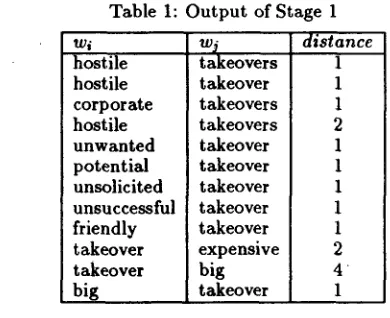
In a f i r s t stage, X t r a c t uses statistical techniques to retrieve pairs of words (or bigrams) whose common a p - pearances within a single sentence are correlated in the corpus. A bigram is retrieved if its frequency of occur- rence is above a certain threshold and if the words are used in relatively rigid ways. Some bigrams produced by the first stage of X t r a c t are given in T a b l e 1: the bigrams all contain the word "takeover" and an adjec- tive. In the table, the distance parameter indicates the usual distance between the two w o r d s . For example, distance = 1 indicates that the two words are fre- quently adjacent in the corpus.
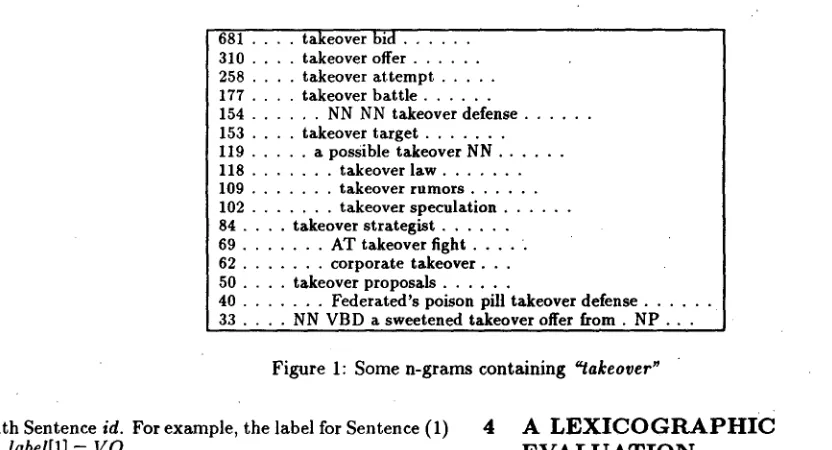
threshold. For example, the bigram "average-industrial" produces the n-gram "the Dow Jones industrial average" since the words are always used within this compound in the training corpus. Example. outputs of the second stage of X t r a e t are given in Figure 1. In the figure, the numbers on the left indicate the frequency of the n-grams in the corpus, NN indicates that. a noun is expected at this position, AT indicates that an article is expected, NP stands for a proper noun and VBD stands for a verb in the past tense. See [Smadja and McKeown, 1990] and [Smadja, 1991] for more details on these two stages.
Table 1: O u t p u t of Stage 1
Wi hostile hostile corporate hostile unwanted potential unsolicited unsuccessful friendly takeover takeover big wj takeovers takeover takeovers takeovers takeover takeover takeover takeover takeover expensive big takeover distance 1 1 1 2 1 1 1 1 1 2 4 1
3 S T A G E T H R E E : S Y N T A C T I C A L L Y L A B E L I N G C O L L O C A T I O N S
In the past, Debili [Debili, 1982] parsed corpora of French texts to identify non-ambiguous predicate argument rela- tions. He then used these relations for disambiguation in parsing. Since then, the advent of robust parsers such as C a s s [Abney, 1990], F i d d i t e h [Itindle, 1983] has made it possible to process large amounts of text with good per- formance. This enabled Itindle and Rooth [Hindle and Rooth, 1990], to improve Debili's work by using bigram statistics to enhance the task of prepositional phrase at- tachment. Combining statistical and parsing methods has also been done by Church and his colleagues. In [Church et al., 1989] and [Church'et ai., 1991] they con- sider predicate argument relations in the form of ques- tions such as What does a boat typically do? They are preprocessing a corpus with the F i d d l t e h parser in order to statistically analyze the distribution of the predicates used with a given argument such as "boat."
Our goal is different, since we analyze a set of collocations automatically produced by X t r a c t to either enrich them with syntactic information or reject them. For example, i f , bigram collocation produced by X t r a c t involves a noun and a verb, the role of Stage 3 of X t r a c t is to determine whether it is a subject-verb or a verb- object collocation. If no such relation can be identified, then the collocation is rejected. This section presents the algorithm for X t r a c t Stage 3 in some detail. For illustrative purposes we use the example words takeover
and thwart with a distance of 2.
3.1 D E S C R I P T I O N O F T H E A L G O R I T H M
I n p u t : A bigram with some distance information in- dicating the most probable distance between the two words. For example, takeover and thwart with a distance of 2.
O u t p u t / G o a h Either a syntactic label for the bigram or a rejection. In the case of takeover and thwart the collocation is accepted and its produced label is V O for verb-object.
The algorithm works in the following 3 steps:
3.1.1 S t e p 1: P R O D U C E T A G G E D C O N C O R D A N C E S
All the sentences in the corpus that contain the two words in this given position are produced. This is done with a concord,acing program which is part of X t r a e t (see [Smadja, 1991]). The sentences are labeled with part of speech information by preprocessing the cor- pus with an automatic stochastic tagger. 1
3.1.2 S t e p 2: P A R S E T H E S E N T E N C E S
Each sentence is then processed by C a s s , a bottom-up incremental parser [Abney, 1990]. 2 C a s s takes input sentences labeled with part of speech and attempts to identify syntactic structure. One of C a s s modules identifies predicate argument relations. We use this module to produce binary syntactic relations (or la- bels) such as "verb-object" (VO), %erb-subject" (VS), "noun-adjective" ( N J), and "noun-noun" ( N N ). Con- sider Sentence (1) below and all the labels as produced by C a s s on it.
(1) "Under the recapitalization plan it proposed to t h w a r t the t a k e o v e r . "
label bigrarn S V it proposed N N recapitalization plan
V O thwart takeover
For each sentence in the concordance set, from the output of C a s s , X t r a c t determines the syntactic relation of the two words among VO, SV, N J, N N and assigns this label to the sentence. If no such relation is observed, X t r a c t associates the label U (for undefined) to the sentence. We note label[ia~ the label associated
1For this, we use the part of speech tagger described in [Church, 1988]. This program was developed at Bell Labora- tories by Ken Church.
[image:2.612.75.270.186.345.2]681 . . . . takeover bid . . . 310 . . . . takeover offer . . . 258 . . . . takeover attempt . . . 177 . . . . takeover battle . . .
154 . . . NN NN takeover defense . . . 153 . . . . takeover target . . .
119 . . . a possible takeover NN . . . 118 . . . takeover law . . . 109 . . . takeover rumors . . . 102 . . . takeover speculation . . . 84 . . . . takeover strategist . . . 69 . . . AT takeover fight . . . . . 62 . . . corporate t a k e o v e r . . . 50 . . . . takeover proposals . . .
40 . . . Federated's poison pill takeover defense . . . 33 . . . . NN VBD a sweetened takeover offer from . N P . . .
F i g u r e 1: Some n - g r a m s containing
"takeover"
with Sentence
id.
For e x a m p l e , the label for Sentence (1) is:label[l] - VO.
4 A L E X I C O G R A P H I C E V A L U A T I O N
3 . 1 . 3 S t e p 3: R E J E C T O R L A B E L C O L L O C A T I O N
T h i s last s t e p consists o f deciding on a label for the b i g r a m from the set of
label[i~'.s.
For this, we count the frequency of each label for the b i g r a m and perform a s t a t i s t i c a l analysis o f this d i s t r i b u t i o n . A collocation is accepted if the two seed words are consistently used with the s a m e s y n t a c t i c relation. More precisely, the collocation is accepted if and only if there is a label 12 ~: U satisfying the following inequation:[probability(labeliid ] = £ ) > T I
in which T is a given threshold to be d e t e r m i n e d by the e x p e r i m e n t e r . A collocation is thus rejected if no valid label satisfies the inequation or if U satisfies it.
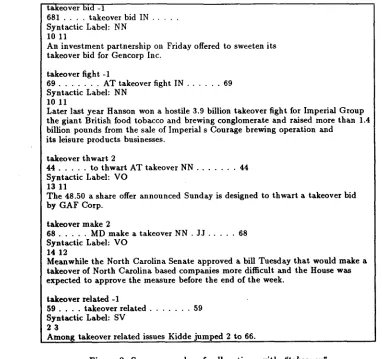
F i g u r e 2 lists some accepted collocations in the f o r m a t p r o d u c e d by X t r a c t with their s y n t a c t i c labels. For these examples, the threshold T was set to 80%. For each collocation, the first line is the o u t p u t of the first stage of X t r a c t . It is the seed b i g r a m with the distance between the two words. T h e second line is the o u t p u t of the second stage of X t r a c t , it is a multiple word collocation (or n-gram). T h e n u m b e r s on the left indicate the frequency of occurrence of the n - g r a m in the corpus. T h e t h i r d line indicates the s y n t a c t i c label as d e t e r m i n e d b y the t h i r d stage of X t r a c t . Finally, the last lines s i m p l y list an e x a m p l e sentence and the position of the collocation in the sentence.
Such collocations can then be used for vari- ous purposes including lexicography, spelling correction, speech recognition and language generation. Ill [Smadja and McKeown, 1990] and [Smadja, 1991] we describe how they are used to build a lexicon for language gener- ation in the d o m a i n of stock m a r k e t reports.
T h e third s t a g e of X t r a c t can t h u s be considered as a retrieval s y s t e m which r e t r i e v e s valid collocations from a set of c a n d i d a t e s . T h i s section describes an evaluation e x p e r i m e n t of the t h i r d s t a g e of X t r a c t as a retrieval system. E v a l u a t i o n of retrieval s y s t e m s is usually done with the help of two p a r a m e t e r s :
precision
andrecall
[Salton, 1989]. Precision of a r e t r i e v a l s y s t e m is defined as the r a t i o o f r e t r i e v e d valid e l e m e n t s d i v i d e d by the t o t a l n u m b e r o f r e t r i e v e d e l e m e n t s [Salton, 1989]. It measures the q u a l i t y o f the r e t r i e v e d m a t e r i a l . Recall is defined as the r a t i o of r e t r i e v e d valid e l e m e n t s divided by the t o t a l n u m b e r of valid elements. I t measures the effectiveness o f the s y s t e m . T h i s section p r e s e n t s an eval- u a t i o n of the retrieval p e r f o r m a n c e o f the t h i r d s t a g e of X t r a c t .4 . 1 T H E E V A L U A T I O N E X P E R I M E N T
Deciding w h e t h e r a given word c o m b i n a t i o n is a valid or invahd collocation is a c t u a l l y a difficult task t h a t is b e s t done b y a lexicographer. Jeffery Triggs is a lexicographer working for O x f o r d English D i c t i o n a r y ( O E D ) c o o r d i n a t i n g the N o r t h A m e r i c a n Readers pro- g r a m of O E D at Bell C o m m u n i c a t i o n Research. Jef- fery Triggs agreed to m a n u a l l y go over several t h o u s a n d s collocations, a
We r a n d o m l y selected a s u b s e t o f a b o u t 4,000 collocations t h a t c o n t a i n e d t h e i n f o r m a t i o n compiled by X t r a c t after the first 2 stages. T h i s d a t a set was then the s u b j e c t of t h e following e x p e r i m e n t .
We gave the 4,000 collocations to e v a l u a t e to the lexicographer, asking him to select the ones t h a t he
[image:3.612.73.489.48.273.2]t a k e o v e r bid -1
681 . . . . t a k e o v e r bid IN . . . S y n t a c t i c Label: NN
10 11
A n i n v e s t m e n t p a r t n e r s h i p on Friday offered to sweeten its t a k e o v e r bid for G e n c o r p Inc.
t a k e o v e r fight -1
69 . . . A T t a k e o v e r fight IN . . . 69 S y n t a c t i c Label: NN
10 11
L a t e r l a s t y e a r H a n s o n won a hostile 3.9 billion t a k e o v e r fight for I m p e r i a l G r o u p t h e g i a n t B r i t i s h food t o b a c c o a n d brewing c o n g l o m e r a t e a n d raised m o r e t h a n 1.4 billion p o u n d s from t h e sale of I m p e r i a l s C o u r a g e brewing o p e r a t i o n a n d
i t s leisure p r o d u c t s businesses.
t a k e o v e r t h w a r t 2
44 . . . to t h w a r t A T t a k e o v e r NN . . . 44 S y n t a c t i c Label: V O
13 11
T h e 48.50 a share offer a n n o u n c e d S u n d a y is designed to t h w a r t a t a k e o v e r bid b y G A F Corp.
t a k e o v e r m a k e 2
68 . . . MD m a k e a t a k e o v e r NN . J J . . . 68 S y n t a c t i c Label: V O
14 12
M e a n w h i l e t h e N o r t h C a r o l i n a S e n a t e a p p r o v e d a bill T u e s d a y t h a t would m a k e a t a k e o v e r of N o r t h C a r o l i n a b a s e d c o m p a n i e s m o r e difficult a n d t h e House was e x p e c t e d t o a p p r o v e t h e m e a s u r e before t h e end of t h e week.
t a k e o v e r r e l a t e d -1
59 . . . . t a k e o v e r related . . . 59 S y n t a c t i c Label: SV
2 3
A m o n g t a k e o v e r r e l a t e d issues Kidde j u m p e d 2 t o 66.
F i g u r e 2: S o m e e x a m p l e s o f c o l l o c a t i o n s w i t h "takeover"
Y Y = J 2 0 % Y = 2 0 % N = 6 0 % T = 4 0 % U = 6 0 %
T w. 9 4 % T = 9 4 %
U O
U = 9,5%
Y ---- t 0 %
Y Y = 4 0 %
N - - 9 2 %
[image:4.612.102.484.60.419.2] [image:4.612.126.508.466.641.2]would consider for a domain specific dictionary and to cross out the others. The lexicographer came up with three simple tags, Y Y , Y and N. Both Y and Y Y are good collocations, and N are bad collocations. The dif- ference between Y Y and Y is that Y collocations are of better quality than Y Y collocations. Y Y collocations are often too specific to be included in a dictionary, or some words are missing, etc. After Stage 2, about 20% of the collocations are Y, about 20% are Y Y , and about 60% are N. This told us that the precision of X t r a c t at Stage 2 was only about 40 %.
Although this would seem like a poor precision, one should compare it with the much lower rates cur- rently in practice in lexicography. For the OED, for example, the first stage roughly consists of reading nu- merous documents to identify new or interesting expres- sions. This task is performed by professional readers. For the OED, the readers for the American program alone produce some 10,000 expressions a month. These lists are then sent off to the dictionary and go through several rounds of careful analysis before actually being submitted to the dictionary. The ratio of proposed can- didates to good candidates is usually low. For example, out of the 10,000 expressions proposed each month, less than 400 are serious candidate for the OED, which rep- resents a current rate of 4%. Automatically producing lists of candidate expressions could actually be of great help to lexicographers and even a precision of 40% would be helpful. Such lexicographic tools could, for example, help readers retrieve sublanguage specific expressions by providing them with lists of candidate collocations. The lexicographer then manually examines the list to remove the irrelevant data. Even low precision is useful for lexicographers as manual filtering is much faster than manual scanning of the documents [Marcus, 1990]. Such techniques are not able to replace readers though, as they are not designed to identify low frequency expressions, whereas a human reader immediately identifies interest- ing expressions with as few as one occurrence.
The second stage of this experiment was to use X t r a c t Stage 3 to filter out and label the sample set of collocations. As described in Section 3, there are several valid labels (VO, VS, N N , etc.). In this experiment, we grouped them under a single label: T. There is only one non-valid label: U (for unlabeled}. A T collocation is thus accepted by X t r a c t Stage 3, and a U collocation is rejected. The results of the use of Stage 3 on the sample set of collocations are similar to the manual evaluation in terms of numbers: about 40% of the collocations were labeled (T) by X t r a c t Stage 3, and about 60% were rejected (U).
Figure 3 shows the overlap of the classifications made by X t r a c t and the lexicographer. In the figure, the first diagram on the left represents the breakdown in T and U of each of the manual categories (Y - YY and N). The diagram on the right represents the breakdown in Y - YY and N of the the T and U categories. For example, the first column of the diagram on the left rep- resents the application of X t r a c t Stage 3 on the Y Y col-
locations. It shows that 94% of the collocations accepted by the lexicographer were also accepted by X t r a c t . In other words, this means that the recall o f t h e third stage of X t r a c t is 94%. The first column of the diagram on the right represents the lexicographic evaluation of the collo- cations automatically accepted by X t r a c t . It shows that about 80% of the T collocations were accepted by the lexicographer and that about 20% were rejected. This shows that precision was raised from 40% to 80% with the addition of X t r a c t Stage 3. In summary, these ex- periments allowed us to evaluate Stage 3 as a retrieval system. The results are:
I P r e c i s i o n = 80% R e c a l l = 94% ]
5
S U M M A R Y A N D
C O N T R I B U T I O N S
In this paper, we described a new set of techniques for syntactically filtering and labeling collocations. Using such techniques for post processing the set of colloca- tions produced by X t r a c t has two major results. First, it adds syntax to the collocations which is necessary for computational use. Second, it provides considerable im- provement to the quality of the retrieved collocations as the precision of X t r a c t is raised from 40% to 80% with a recall of 94%.
By combining statistical techniques with a sophis- ticated robust parser we have been able to design and implement some original techniques for the automatic extraction of collocations. Results so far are very en- couraging and they indicate that more efforts should be made at combining statistical techniques with more sym- bolic ones.
A C K N O W L E D G M E N T S
The research reported in this paper was partially sup- ported by DARPA grant N00039-84-C-0165, by NSF grant IRT-84-51438 and by O N R grant N00014-89-J- 1782. Most of this work is also done in collaboration with Bell Communication Research, 445 South Street, Mor- ristown, N3 07960-1910. I wish to express my thanks to Kathy McKeown for her comments on the research presented in this paper. I also wish to thank Dor~e Seligmann and Michael Elhadad for the time they spent discussing this paper and other topics with me.
R e f e r e n c e s
[Abney, 1990] S. Abney. Rapid Incremental Parsing with Repair. In Waterloo Conference on Electronic
Text Research, 1990.
pus. Journal for Literary and Linguistic computing,
4:34-38, 1983.
[Church and Hanks, 1989] K. Church and K. Hanks. Word Association Norms, Mutual Information, and Lexicography. In Proceedings of the 27th meeting of the A CL, pages 76-83. Association for Computational Linguistics, 1989. Also in Computational Linguistics,
vol. 16.1, March 1990.
[Church et at., 1989] K.W. Church, W. Gale, P. Hanks, and D. Hindle. Parsing, Word Associations and Typ- ical Predicate-Argument Relations. In Proceedings of the International Workshop on Parsing Technologies,
pages 103-112, Carnegie Mellon University, Pitts- burgh, PA, 1989. Also appears in Masaru Tomita (ed.), Current Issues in Parsing Technology, pp. 103- 112, Kluwer Academic Publishers, Boston, MA, 1991.
[Church et
at.,
1991] K.W. Church, W. Gale, P. Hanks, and D. Hindle. Using Statistics in Lexical Analysis. In Uri ~ernik, editor, Lexical Acquisition: Using on-line resources to build a lexicon. Lawrence Erlbaum, 1991. In press.[Church, 1988] K. Church. Stochastic Parts Prograln and Noun Phrase Parser for Unrestricted Text. In
Proceedings of the Second Conference on Applied Nat- ural Language Processing, Austin, Texas, 1988.
[Debili, 1982] F. Debili. Analyse Syntactico-Sdmantique Fondde sur une Acquisition Automatique de Relations Lexicales Sdmantiques. PhD thesis, Paris XI Univer- sity, Orsay, France, 1982. Th~se de Doctorat D'~tat.
[Hindle and Rooth, 1990] D. Hindle and M. Rooth. Structural Ambiguity and Lexieal Relations. In
DARPA Speech and Natural Language Workshop, Hid- den Valley, PA, June 1990.
[Hindle, 1983] D. Hindle. User Manual for Fidditch, a Deterministic Parser. Technical Memorandum 7590- 142, Naval Research laboratory, 1983.
[Marcus, 1990] M. Marcus. Tutorial on Tagging and Processing Large Textual Corpora. Presented at the 28th annual meeting of the ACL, June 1990.
[Salton, 1989] J. Salton. Automatic Text Processing, The Transformation, Analysis, and Retrieval of In- formation by Computer. Addison-Wesley Publishing Company, NY, 1989.
[Smadja and McKeown, 1990] F. Smadja and K. McKe- own. Automatically Extracting and Representing Col- locations for Language Generation. In Proceedings of the 28th annual meeting of the ACL, Pittsburgh, PA, June 1990. Association for Computational Linguistics.
[Smadja, 1988] F. Smadja. Lexical Co-occurrence, The Missing Link in Language Acquisition. Ill Program and abstracts of the 15 th International ALLC, Con- ference of the Association for Literary and Linguistic
Computing, Jerusalem, Israel, June 1988.
[Smadja, 1991] F. Smadja. Retrieving Collocational Knowledge from Textual Corpora. An Application: