Glass Transition within Cluster Variation and Path Probability Methods
Tetsuo Mohri
Division of Materials Science and Engineering, Graduate School of Engineering, Hokkaido University, Sapporo 060-8628 Japan
Thermodynamic framework of Crystal-Glass transition is described within the Cluster Variation Method (CVM). Free energy is calculated as a function of order parameter at various temperatures andT0diagram is obtained. It is demonstrated that the glass transition temperature can
be interpreted as the spinodal ordering temperature in the order-disorder transition. The advantage of the present description is that the kinetic behavior can be investigated within the same framework by employing Path Probability Method (PPM). Therefore, the combination of the CVM and PPM provides a unique theoretical tool to study Crystal-Glass transition in a consistent manner covering thermodynamics and kinetics.
(Received December 22, 2004; Accepted February 15, 2005; Published June 15, 2005)
Keywords: glass transition, cluster variation method, path probability method,T0-diagram, first order transition
1. Introduction
Bulk Metallic Glasses (BMG) have been attracting broad attentions for their superior mechanical, magnetic and corrosion properties. The bulk of the investigation, however, has been directed towards the development and applications of new BMG’s, and the understanding of fundamental properties of BMG is still far from satisfactory. In particular, the studies of thermodynamic stability and its structure correlation leave numerous subjects un-clarified. Since unique properties of BMG are exclusively owing to Crys-tal-Glass (CG) transition, fundamental studies of BMG and CG transitions are inseparable. Recalling that CG transition is not a fully equilibrium transition, a successful theory of CG transition should be capable of covering both thermodynam-ics and kinetthermodynam-ics aspects in a consistent manner.
Cluster Variation Method (CVM)1)has been recognized as one of the most reliable theoretical tools to investigate order-disorder transition. Path Probability Method2) which is the natural extension of the CVM to time domain clarifies various temporal behavior in the atomistic level. Then, the combination of the CVM and PPM is best suited to investigate the order-disorder transition from non-equilibri-um to equilibrinon-equilibri-um states. The limitation of the conventional CVM, however, is the fact that only uniform deformation of the system is allowed and no local displacement can be introduced. On the other hand, recent development of Continuous Displacement Cluster Variation Method (CDCVM)3–8) lifts such a limitation and opens up a possibility of investigating a topologically disordered struc-ture in addition to substitutionaly disordered phase. The investigation of thermodynamic stability of the BMG which forms non-Bravais lattice is, therefore, a potential candidate for the application of CDCVM.
Yet the thermodynamic framework of CG transition has not been described within the conventional CVM, and it is deemed indispensable to examine the capability of describing the essential thermodynamic feature of CG transition prior to the application of the CDCVM. Motivated by the excellent article of Okamotoet al.,9)the main objectives of the present study is to describe the thermodynamic frameworks of CG transition based on CVM and to clarify kinetic aspects by Path Probability Method (PPM). Thereby, a unified
inter-pretation of CG transition covering both thermodynamics and kinetics is attempted. The organization of the present work is as follows. In the next section, essential aspects of CVM and PPM are summarized. In the third section, independent configurational variables are introduced to correlate order-disorder transition with CG transition. Main results are presented in the last section and discussion follows.
2. Cluster Variation Method and Path Probability Method
CVM was devised by Kikuchi originally as a statistical mechanics methods to study interacting particles. It was van Baal10) who first applied the CVM to the calculation of a phase diagram. Then, Kikuchi and de Fontaine11,12) demon-strated that the Cu–Au type phase diagram was reproduced much more accurately as compared with the one13)obtained based on the traditional Bragg-Williams (BW) approxima-tion.14) The advantage of the CVM over the BW approx-imation is addressed not only in terms of the topology of the resultant phase boundaries but also the accuracy of the order of transition. In fact, BW approximation fails to reproduce the first-order nature of the L10-disorder transition at 1:1
stoichiometirc composition, while the CVM yields the correct order of the transition.
The advantage of the CVM is the fact that CVM is able to incorporate wide range of atomic correlations which play a significant role especially at the phase transition. The range of the correlation is characterized by the largest cluster involved in the entropy formula which is termedbasic cluster
and specifies the level of the approximation. For the Bragg-Williams approximation, a lattice point is the basic cluster and it is often called point approximation in the CVM hierarchy.
Within thetetrahedronapproximation,15)for instance, the largest cluster is the nearest neighbor tetrahedron cluster and the entropy for a fcc disorderd phase is written as
SdisT ¼kBln
Y
i;jðNyi jÞ!
n o6
ðN!Þ Y
iðNxiÞ!
n o5
Y
i;j;k;lðNwi jklÞ!
n o2 ð1Þ
where kB is the Boltzmann constant, N is the number of
Special Issue on Computer Modeling of Materials and Processes
lattice point, andxi;yi j andwi jklare cluster probabilities of
finding an atomic arrangement specified by subscript(s) on a lattice point, pair and tetrahedron clusters. This is the most often employed approximation in the CVM and even first-principles calculations by combining with electronic struc-ture calculations can be performed16–19) within this
approx-imation. For an ordered phase, one needs to distinguish sublattices and the exponents of the entropy formula are modified depending upon the phase of interest. For the L10
ordered phase which is the main concern of the present study, the entropy formula is given as
SL10
T ¼kBln
Y
i;jðNy
i jÞ!
n o Y
i;jðNy
i jÞ!
n o4 Y
i;jðNy
i jÞ!
n o
N!
Y
iðNx
iÞ!
n o5=2 Y
iðNx
iÞ!
n o5=2 Y
i;j;k;lðNw
i jkl Þ!
n o2 ð2Þ
where the superscripts and specify the sublattices. It is noted that the disordered phase is a limiting case where the distinction of the sublattices in an ordered phase vanishes. This can be easily seen that the sum of the exponents in eq. (2) is identical to the one for each cluster probability in eq. (1). In the following discussions, we focus only on L10ordered phase.
In order to describe the free energy, a nearest neighbor pair interaction model is applied for the internal energyEwhich is given by
EL10¼1 2N
X
i;j
ei j ðyi j þ4y
i j þy
i j Þ ð3Þ
whereei jis the atomic pair interaction energy between speciesiandjand the coefficient of the cluster probability describes the
degeneracy of each pair in the L10ordered phase. It is noted that the range of atomic correlation generally exceeds the one for
atomic interaction, hence the largest cluster in the internal energy term should be included in the basic cluster in the entropy formula. This criterion is certainly satisfied in the present study,i.e.yi j2wi jkl.
By combining eqs. (2) and (3), the free energies of an L10ordered phase is obtained as
FL10¼1 2N
X
i;j
ei j ðyi j þ4y
i j þy
i j Þ
kBTln
Y
i;jðNy
i j Þ!
n o Y
i;jðNy
i j Þ!
n o4 Y
i;jðNy
i j Þ!
n o
N!
Y
iðNx
iÞ!
n o5=2 Y
iðNx
iÞ!
n o5=2 Y
i;j;k;lðNw
i jkl Þ!
n o2: ð4Þ
The equilibrium state is determined by minimizing the free energy with respect to the cluster probabilities,
@FL10
@i j......¼0 ð5Þ
whererepresents a cluster probability and the subscripts and superscripts denote the atomic configuration and the sublattices, respectively.
Path Probability Method (PPM) was devised as the natural extension of the CVM to time domain by Kikuchi. The time evolution of each cluster probability is described by thepath variablewhich constitutesPath Probability Function, P, which is a counter part of the free energy of the CVM and is given as a product of the following three terms,
P1¼
Y
¼
ðtÞ N 2X
;
1;11ðtÞ
N 2X
;
11;1ð1tÞ
N 2X
;
1;1ð1tÞ
N 2X
;
11;11 ð6Þ
P2¼exp
E
2kBT
; ð7Þ
and
P3¼kBln
Y
i;jðNY
i j;klÞ!
n o Y
i;jðNY
i j;klÞ!
n o4 Y
i;jðNY
i j;klÞ!
n o
N!
Y
iðNX
i;jÞ!
n o5=2 Y
iðNX
i;jÞ!
n o5=2 Y
i;j;k;lðNW
i jkl;mnopÞ!
n o2 ð8Þ
where is the spin flipping probability per unit time that corresponds to the diffusivity of an alloy system, andEis the change of the internal energy duringt given by
E¼1
2N
X
;
!X
i;j
ei j fyi jðtþtÞ y
i jðtÞg ð9Þ
where ! is the degeneracy factor of each pair which is equivalent to the coefficient of pair probability in eq. (3).Xi;j, Yi j;kl and Wi jkl;mnop are path variables for point, pair and
correspond-ing to cluster probabilities of the CVM.
It may be easier to grasp the physical meaning of a path variable by exemplifying a simple point cluster. The first subscriptiinX
i;jindicates the configuration on a point cluster
at time t, while the second subscript jindicates the one at timetþt, and the cluster probabilityx
1 at time tcan be
written as,
x1ðtÞ ¼X1;1ðt;tþtÞ þX1;1ðt;tþtÞ: ð10Þ
Note that 1 and 11ð1Þ in the subscript indicate A and B atoms, respectively, throughout this study. Likewise, the cluster probabilityx1 at timetþtcan be written as
x1ðtþtÞ ¼X1;1ðt;tþtÞ þX11;1ðt;tþtÞ: ð11Þ
It is noticed that these are generalized geometrical conditions in the time-space which will be introduced soon. One can easily extend the relationships to the time evolution of the pair configuration as follows,
y1;1ðtÞ ¼Y11;11ðt;tþtÞ þY
11;111ðt;tþtÞ
þY11;111ðt;tþtÞ
ð12Þ
and
y1;1ðtþtÞ ¼Y11;11ðt;tþtÞ þY
111;11ðt;tþtÞ
þY111;11ðt;tþtÞ
ð13Þ
P1 in eq. (6) describes the non-correlated spin flipping
events over an entire lattice point andP2in eq. (7) suggests
the probability of gaining the thermal activation energyE
by a system interacting with a heat reservoir. The character-istic feature of the PPM is written in the third term,P3, which
is quite similar to the entropy term of the CVM given in eq. (2). In fact, P3 describes the microscopic freedom of
atomic transition paths, which is the extension of the configurational freedom in the lattice written in the entropy term. Such a parallel formalism with the CVM is the natural consequence of the PPM devised as the extension of the CVM to the time domain.
The key criterion claimed in the PPM is that the most probable transition path is determined so that the PPF is maximized with respect to the path variables,
@P
@ffi j......g;fg;fkl......gg¼0 ð14Þ
wherePis the PPF given by
P¼P1P2P3 ð15Þ
and ffi j......g;fg;fkl......gg indicates a path variable describing the transition fromfij. . .gtofkl. . .gduring the infinitesimal time stept. This condition is the counterpart of the minimization condition of the free energy of the CVM given in eq. (5).
Two points should be addressed. One is that, unlike other kinetic theories, PPM does not explicitly deal with the free energy or its derivative. This is a unique feature of the PPM and ensures the applicability of the PPM even for a far-from-equilibrium transition.20–26) The second point is that the present formulae given by eqs. (6)–(8) are applicable only to a spin kinetics.32)Although more appropriate for an alloy system are the exchange kinetics33) or vacancy mediated
kinetics, those kinetics demand formidably many microscop-ic paths and the formulation as well as numermicroscop-ical calculation become intractable. A critical deficiency of the spin kinetics when dealing with an alloy originates from the fact that the species is not conserved with time. However, at 1:1 stoichio-metric composition, it can be shown that the conservation of the spin species is observed without any additional con-straints. Hence, the present calculation confined to 1:1 stoi-chiometric composition simulates an alloy system.
3. Correlation Functions and Constrained Minimiza-tion
As was seen in the previous section, the cluster proba-bilities are the key quantities in both equilibrium and kinetics analysis. However, cluster probabilities are related through
X
i
xi ¼X
i;j
yi j ¼X
i;j;k;l
wi jkl ¼ ¼1 ð16Þ
and
xi ¼X
X
j
yi j ¼X
j;k;l
wi jkl ð17Þ
which are known as normalization condition and geometrical conditions, respectively. Therefore, cluster probabilities in the free energy in eq. (4) are not mutually independent, and in terms of mathematical transparency, it is more convenient to work with independent variables. Hence, the correlation functions27,28)are introduced in the following way.
The correlation functionJfor aJ-point cluster is defined
as the ensemble average of a product of spin variables h12 p Ji, where p is the spin variable which
takes eitherþ1or1depending upon A or B atom located at the lattice pointp. It has been shown that a cluster probability
XfJgðlÞof which configuration is specified bylcan be given by
a liner transformation of a set of correlation functions,
XfJgðlÞ ¼
1 2ne 1þ
X
l0
VfJgðl;l0Þ l0
( )
ð18Þ
where V is called V-matrix27,28) and involves the sum of products ofi;j;k. . ., andl0suggests a sub-cluster contained in
the cluster l. Since mathematical details have been amply demonstrated,27,28)we simply reproduce the specific exam-ples for a point, pair and tetrahedron clusters as follows,
xi¼
1
2ð1þi1Þ ð19Þ
yi j¼
1
22f1þ ðiþjÞ 1þij2g ð20Þ
and
wi jkl¼
1
24f1þ ðiþjþkþlÞ 1ðijþikþilþ þklÞ
2þ ðijkþ þjklÞ 3þijkl4g: ð21Þ
xi ¼1
2ð1þi
1Þ ð22Þ
and
yi j ¼ 1
22f1þi
1þj
1þij
2 g: ð23Þ
Then, the free energy of an L10 ordered phase given in
eq. (4) is rewritten as
FL10¼FðT;fe
i jg;xi;x
i;y
i j;y
i j ;y
i j;w
i jkl Þ
¼FF^L10ðT;fe
i jg;¼1;
1; 2 ; 2 ; 2 ; 3 ; 3 ;
4 Þ:
ð24Þ
Since the atomic interaction energies fei jg are kept to be
constant, they are omitted from the free energy in the following descriptions. TemperatureTin the present study is normalized with respect to effective pair interaction energy defined as,
v2¼
ðeAAþeBBÞ
2 eAB ð25Þ
and is given by
T ¼kBT
v2
: ð26Þ
Then, the free energy of an L10ordered phase is symbolically
expressed as
FL10¼FðT;
1; 1; 2 ; 2 ; 2 ; 3 ; 3 ;
4 Þ; ð27Þ
whereFF^L10 is replaced byFL10for the sake of convenience.
When our discussion is confined to a fixed 1:1 stoichiometry, which was required by PPM calculations for a spin kinetics, the number of independent correlation functions are reduced due to the symmetry of the L10 ordered phase which claims
1¼
1,2 ¼
2 and
3 ¼
3 . Hence, the final form
of the free energy is given as
FL10 ¼FðT;
1; 2 ; 2 ; 3 ;
4 Þ: ð28Þ
Note that the superscript * is omitted from the temperature to avoid unnecessary confusion. Among these five correlation functions,1serves as a Long Range Order parameter (LRO), since it is readily shown from eq. (22) that
1 ¼xAxA; ð29Þ
while the rest of the correlation functions are Short Range Order parameters (SRO).
When the free energy is minimized with respect to all the correlation functions at a given temperatureT,
@FL10
@f
mg
T
¼0; ð30Þ
one obtains the equilibrium state. In the present study, however, we performed a constrained minimization in which only SRO’s participate in minimization under a specified LRO at each temperature
@FL10
@f
mg
T;
1
¼0: ð31Þ
Then, one obtains the Free energy FL10 as a function ofT
and
1. The subscript * implies that the original free energy is
subject to the constrained minimization. For the latter purpose, we replace LRO
1 by , and the resultant function
is written as
FL10¼ fðT; Þ: ð32Þ
4. Crystal-Glass transition
A common approach to the crystal–glass (CG) transition within phenomenological studies is to describe the free energy in a power series expansion of an order parameter up to the six-th order. This assures the first-order character of the crystal–liquid transition. Mathematically, the present formal-ism of the free energy given in eq. (32) is not so trivial to ensure the first-order character of the transition. However, previous calculations of the L10-disorder phase
[image:4.595.324.530.561.696.2]dia-grams22,28,29)guaranteed the first-order character in eq. (32) in many other ways, including the existence of the two phase region, the discontinuity of the order parameter at the transition temperature, and the separation of the transition temperature and the spinodal ordering temperature. We reconfirmed this by representing the free energy as a function of the order parameter at various temperatures as shown in Fig. 1.30)
The horizontal axis is the order parameter , which represents a liquid phase at unity ( ¼1) and a perfect crystal at null ( ¼0). It is noted that unity (null) is generally assigned to a perfect ordered phase (a completely random phase) in the study of order-disorder transition. Hence, we convert in eq. (32) from 1 in eq. (29) through ¼
1:01. We interpret the finite value of the order parameter as the amount of generalized defects including impurities, dislocations, and lattice vibrations that induce breaking of the crystal symmetry and lead to the liquid transition. The specification of a particular kind of defect is not essential in the present study.
One notices the characteristic free energy curve in which
-0.2 -0.15 -0.1 -0.05 0 0.05 0.1
0 0.2 0.3 0.4 0.5 0.6 0.7 0.8 0.9 1
0.845 0.861 0.972 1 1.025 1.07 1.13 η Free energy 0.1
Fig. 1 Free energyfð ;TÞas a function of the order parameter at various temperatures indicated on the right hand of the figure. ¼0 and 1 correspond to a perfect crystal and a liquid phase, respectively. A global minimum appears at ¼0:031, 0.036 and 0.109 atT¼0:845, 0.861 and 0.972, respectively. At T¼0:972, a local maximum is found at ¼ 0:613. Two global minima coexist at ¼0:153and 1.00 atT¼1:00. At
two free energy minima have the same value and a common tangent line has a null slope. The curve is indicated by 1 on the right hand side of the figure. This is the free energy curve,
fðTt; Þ, at the melting point or equilibrium crystal–liquid
transition temperature, Tt. The free energy barrier between
the two minima suggests the first-order character of the liquid–crystal transition. The number on the right hand side of the figure is the normalized temperature. Note that the temperature T throughout this section is normalized with respect to Tt, and the normalized temperatures of the
corresponding free-energy curves are described on the right hand side of Fig. 1.
At temperatures less thanT ¼1, the free energy minimum appears at closed to null, indicating that the most stable state is a crystal. The deviation of the minima from the null is due to the entropy effect, suggesting that some defects are unavoidable in the crystal at a finite temperature. At the high temperatures greater than T ¼1, the minima are shifted to ¼1. There are two characteristic temperaturesTL¼0:861 andTH¼1:025at which the inflection points defined by the following equations appear/disappear in the free energy curve.
@2fð ;T
LÞ
@ 2 ¼
@2fð ;T
HÞ
@ 2 ¼0: ð33Þ
Hence, for the temperature T satisfying TL<T <1 (1<T<TH), liquid (crystal) is in a metastable state at a local minimum, while belowTL(aboveTH) liquid (crystal) is unstable. We call these characteristic instability temperatures ‘‘spinodal ordering30)/disordering25) temperatures’’ in the case of order-disorder transition.
By following the work of Okamoto,9) we plot the free energy of FL10¼ fðT; Þ as the function of T for various
values of , expressed as g ðTÞ ¼ fðT; Þ for the sake of convenience. The results are shown in Fig. 2. g ¼1ðTÞ ¼ fðT; ¼1Þexpresses the temperature dependency of a liquid free energy. The intersection of g ðTÞ withg ¼1ðTÞdefines
theT0temperature which is regarded as the melting
temper-ature of a defective crystal characterized by the order parameter . An interesting feature in Fig. 2 is that g ðTÞ merges to g ¼1ðTÞ at a critical temperature without an
intersection. This implies that the entropy of the defective crystal, given as the slope ofg ðTÞcurve, becomes identical to that of the liquid.
T0 temperature is plotted as the function of in Fig. 3.30)
This is a type of phase diagram but it is more appropriate to call it aT0 diagram because the equality of the free energy
expressed in the diagram does not necessarily guarantee the transition at the equilibrium state. One sees that the melting point deceases with the amount of defects ( ). Also, important is the fact that theT0curve terminates at a certain
critical point Tc¼0:861 and c¼0:976, forming a tri-critical point. This is exactly the temperature at which the entropy of the defective crystal becomes identical to that of the liquid, and this is identified as the ideal glass transition temperature. When the defect is further introduced into the crystal at a tri-critical state, the defective crystal transforms into an ideal glass, but upon raising the temperature aboveTc, the ideal glass becomes a super cooled liquid. One realizes thatTcis nothing butTL which was discussed earlier and is characterized as the temperature at which spontaneous loss of the stability begins.
The critical distinction of the physical significance of
TcðTLÞ, however, should be made between an order–disorder transition and a CG transition. For the latter, kinetics plays a crucial role, and the enhanced viscosity virtually blocks the transition to the equilibrium state. The discussions have so far centered around thermodynamic aspects. For the theoretical treatment to be consistent, it is deemed necessary that the kinetics aspects can be described within the same theoretical framework. As mentioned above, the Path Probability Method is the extension of the CVM to the time domain and the CVM inherits advantages in the PPM. We attempted to calculate the time evolution of the order parameters at an aging period following the quenching operation from the liquid state atT ¼1:09.
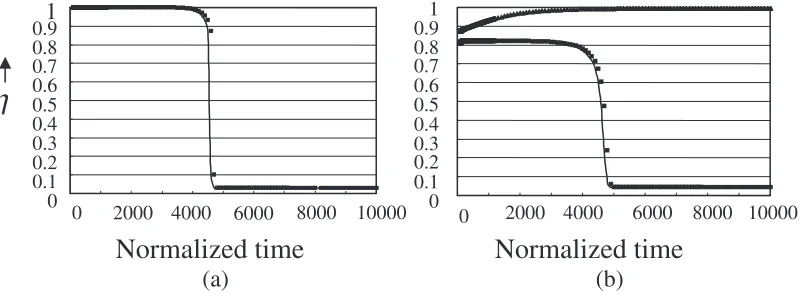
Shown in Fig. 4(a)30)is the aging curve of atT ¼0:845 which is below TL. One sees that the value of decreases with time, finally followed by the transition to crystal. The steady state value of in the long time limit is confirmed to be the equilibrium which is independently calculated by the CVM. While for an aging temperature atT¼0:90, aboveTL, as shown in Fig. 4(b),30)one of two different aging behaviors occur, depending upon the initial deviation of from the equilibrium value at T ¼1:09. Imposing an additional chemical potential at the initial time induces such a deviation. With a sufficiently large fluctuation (deviation) tramsition takes place, while for a small deviation, the super-cooled liquid returns to the metastable liquid state. The difference −0.15
−0.1 −0.05 0 0.05 0.1
0.8 0.85 0.9 0.95 1 1.05 1.1 1.15
T
Free energy
0.2 0.4 0.6 0.8 1 0.976
Fig. 2 Free energy curve,gðTÞ ¼fð ;TÞ. The intersection ofgðTÞwith
g¼1ðTÞ(liquid phase) providesT0temperature.
Temperature
0 0.1 0.2 0.3 0.4 0.5 0.6 0.7 0.8 0.9 1
0 0.2 0.3 0.4 0.5 0.6 0.7 0.8 0.9 1
η
( ηc, Tc)
0.1
Fig. 3 T0diagram indicating a tricritical point which is the glass-transition
[image:5.595.322.531.72.192.2] [image:5.595.68.269.622.757.2]between these two modes of transition atT¼0:845and 0.90 originated from the absence (0.845) or presence (0.90) of the free energy barrier, which is similar to the difference between spinodal ordering and nucleation-growth ordering for the order-disorder transition. In both modes, what is to be emphasized for CG transition is that the time of transition is formidably long on the ordinary lab scale.
Finally, we calculate the relaxation time by fitting the aging curve into the following equation,
ðtÞ ¼ eq ð eq 0Þ exp t
: ð34Þ
Shown in Fig. 5 is the temperature dependence of the relaxation time when the system is up-quenched to each temperature. One sees that the relaxation time increases with temperature despite the thermal activation event is to be enhanced. This has nothing to do with any atomistic mechanism, but is a natural consequence of the flattening of the free energy surface that leads to a loss of the thermodynamic driving force in the transition. In an order-disorder transition, this is known as a slowing-down phenomenon, and it occurs near the spinodal disordering temperature (transition temperature) for the first order (second order) transitions. In fact, the slowing-down in Fig. 5 occurs near TH¼1:025. To the best of author’s knowledge, slowing-down behavior has not been reported in connection with BMG. Examination of the present theoret-ical result will require further study. In particular, the theoretical investigation of relaxation mechanisms associated
with the CG transition is at the core of future study. The present study demonstrates that a conventional CVM clearly describes the thermodynamic framework of the CG transition. This is quite encouraging to employ the Contin-uous Displacement Cluster Variation Method (CDCVM) in future studies of atomistic displacement and its correlation with structural and thermal stabilities. Although the applica-tion of CDCVM to a realistic alloy system is still at a primitive stage, it is a potential theoretical tool in considering the structural features of BMG, and it may takes us one step further towards analysis of the structural CG transition. The key ability of CDCVM, however, depends on the extent to which we can incorporate topological randomness. This depends crucially on the development of both a sufficient numerical scheme and a powerful computational tool. We emphasize that the advantage of the CVM-based study is that we can investigate the kinetic aspects within the same framework, and thereby perform a consistent study associ-ated with CG transition from thermodynamics to kinetics.
Acknowledgements
The author is grateful to Professor Emeritus T. Takahashi of Hokkaido University for his stimulating discussion and to Mr. Y. Kobayashi for his assistance of preparing the manuscript. The present work is supported by Grant-in-Aid for Scientific Research on Priority Areas, ‘‘Materials Science of Bulk Metallic Glasses’’ from Ministry of Education, Culture, Sports, Science and Technology.
REFERENCES
1) R. Kikuchi: Phys. Rev.81(1951) 998.
2) R. Kikuchi: Prog. Theor. Phys. Suppl.35(1966) 1. 3) R. Kikuchi and A. Beldjenna: Physica A182(1992) 617. 4) R. Kikuchi: J. Phase. Equilibria19(1998) 412–421.
5) R. Kikuchi and K. Masuda-Jindo: Comp. Mater. Sci.14(1999) 295. 6) H. Uzawa and T. Mohri: Mater. Trans.42(2001) 422.
7) H. Uzawa and T. Mohri: Mater. Trans.42(2001) 1866. 8) H. Uzawa and T. Mohri: Mater. Trans.43(2002) 2185.
9) P. R. Okamoto, N. Q. Lam and L. E. Rehn:Solid State Physics, vol.52. ed. by H. Ehrenreich (Elsevier Academic Press, San Diego, 1999). 10) C. M. van Baal: Physica, Utrecht64(1973) 571.
11) R. Kikuchi and D. de Fontaine: (NBS PublicationSP-4961978) 967. 12) D. de Foantine and R. Kikuchi: (NBS PublicationSP-4961978) 999. 0
0.1 0.2 0.3 0.4 0.5 0.6 0.7 0.8 0.9
1
0 2000 4000 6000 8000 10000 0 2000 4000 6000 8000 10000
Normalized time
0 0.1 0.2 0.3 0.4 0.5 0.6 0.7 0.8 0.91
Normalized time
(a)
(b)
η
Fig. 4 Time evolution of order parameter at (a)T¼0:845belowTLand (b) 0.90 aboveTL. The pre-quenching temperature isT¼1:09. The horizontal time axis is normalized with respect to spin flipping probability.30)
0 50 100 150 200 250 300 350 400
0.88 0.9 0.92 0.94 0.96 0.98 1 1.02 1.04
Normalized temperature
τ
[image:6.595.101.501.75.224.2] [image:6.595.71.271.280.385.2]13) W. Schckley: J. Chem. Phys.6(1938) 130.
14) W. L. Bragg and E. J. Williams: Proc. R. Soc. A145(1934) 69. 15) R. Kikuchi, J. Chem. Phys.60(1974) 1071.
16) T. Mohri and Y. Chen: Mater. Trans.43(2002) 2104. 17) Y. Chen, S. Iwata and T. Mohri: Calphad26(2002) 583. 18) T. Mohri and Y. Chen: Mater. Trans.45(2004) 1478. 19) T. Mohri and Y. Chen: J. Alloys Comp.383(2004) 23.
20) T. Mohri, Y. Ichikawa, T. Nakahara and T. Suzuki: Theory and Applications of the Cluster Variation and Path Probability Methods, ed. J. L. Moran-Lopez, (Plenum Press, New York, 1996) 37. 21) T. Mohri, Y. Ichikawa and T. Suzuki: J. Alloys Compd.247(1997) 98. 22) T. Mohri: Properties of Complex Inorganic Solids, ed. A. Gonis,
(Plenum Press, New York, 1997) 83.
23) T. Mohri and S. Miyagishima: Mater. Trans., JIM39(1998) 154.
24) T. Mohri: Z. Metallkunde90(1999) 71.
25) T. Mohri: Modelling Simul. Mater. Sci. Eng.8(2000) 239.
26) T. Mohri:Properties of Complex Inorganic Solid 2, ed. A. Meike, (Kluwer Academic/Plenum Publishers, 2000) 123.
27) J. M. Sanchez and D. de Fontaine: Phys. Rev. B17(1978) 2926. 28) T. Mohri, J. M. Sanchez and D. de Fontaine: Acta Metall.33(1985)
1463.
29) T. Mohri, J. M. Sanchez and D. de Fontaine: Acta Metall.33(1985) 1711.
30) T. Mohri: submitted to The Science of Complex Alloy Phases, Proceeding of TMS 2005 meeting.