SNOOPIE : DEVELOPMENT OF A LEARNING SUPPORT TOOL FOR NOVICE PROGRAMMERS WITHIN A CONCEPTUAL
FRAMEWORK
Natalie J. Coull
A Thesis Submitted for the Degree of PhD at the
University of St. Andrews
2008
Full metadata for this item is available in the St Andrews Digital Research Repository
at:
https://research-repository.st-andrews.ac.uk/
Please use this identifier to cite or link to this item: http://hdl.handle.net/10023/522
This item is protected by original copyright This item is licensed under a
SNOOPIE: Development of a Learning
Support Tool for Novice Programmers
within a Conceptual Framework
A thesis to be submitted to the UNIVERSITY OF ST ANDREWS
for the degree of DOCTOR OF PHILOSOPHY
by Natalie J. Coull
School of Computer Science University of St Andrews
Author’s Declaration
I, Natalie J. Coull hereby certify that this thesis, which is approximately 68000 words in length, has been written by me, that it is the record of work carried out by me, and that it has not been submitted in any previous application for a higher degree.
date_____________________________signature of candidate_______________________________
I was admitted as a research student in October 2002 and as a candidate for the degree of Doctor of Philosophy; the higher study for which this is a record was carried out in the University of St Andrews between 2002 and 2006.
date_____________________________signature of candidate_______________________________
I hereby certify that the candidate has fulfilled the conditions of the Resolution and Regulations appropriate for the degree of Doctor of Philosophy in the University of St Andrews and that the candidate is qualified to submit this thesis in application for that degree
date____________________________signature of supervisor_______________________________
In submitting this thesis to the University of St Andrews I understand that I am giving permission for it to be made available for use in accordance with the regulations of the University Library for the time being in force, subject to any copyright vested in the work not being affected thereby. I also understand that the title and abstract will be published, and that a copy of the work may be made and supplied to any bona fide library or research worker.
Abstract
Table of Contents
Chapter 1 Introduction... 10
1.1 Background ... 10
1.1.1 The Student’s Experience of Learning to Program... 10
1.1.2 The Tutor’s Experience of Teaching Students to Program ... 12
1.1.3 Problem Definition... 13
1.2 Thesis Statement ... 14
1.3 Methodology ... 17
Chapter 2 Literature Review... 20
2.1 The Learning Process... 20
2.2 Learning to Program ... 21
2.3 Models of Student Learning... 25
2.4 Existing Tools for Supporting Learning to Program... 30
2.5 Summary ... 46
Chapter 3 Towards a Supportive Framework ... 47
3.1 Analysis of Teaching Tools ... 47
3.2 Emergent Requirements... 50
3.3 A Conceptual Framework ... 52
3.4 Summary ... 56
Chapter 4 Exploring Student Feedback ... 58
4.1 Introduction... 58
4.2 Methodology ... 61
4.3 Object Oriented Programming at the University of St Andrews ... 62
4.4 Object Oriented Programming at the University of Abertay Dundee ... 65
4.5 Categorisation of Recorded Errors... 67
4.6 Results... 69
4.7 Discussion ... 73
4.8 Implications for Feedback... 78
Chapter 5 SNOOPIE... 80
5.1 Overview... 80
5.2 Version 1: Syntax Support ... 82
Chapter 6 Evaluation... 124
6.1 Introduction ... 124
6.2 Problems with Evaluating Teaching Support Tools ... 124
6.3 Evaluation Methods... 126
6.4 Experiments... 132
6.5 Module Performance ... 150
6.6 Questionnaire Results from University of Abertay students ... 152
6.7 Student Interviews ... 153
6.8 Staff comments... 157
6.9 Discussion ... 161
6.10 Summary ... 164
Chapter 7 Summary and Future Work ... 168
7.1 Summary ... 168
7.2 SNOOPIE Developments ... 170
7.3 Future Developments... 180
Appendix A Table of Priority Checks... 186
Appendix B University of St Andrews experiment questions ... 198
Appendix C University of Abertay Dundee experiment questions... 200
Appendix D Questionnaire... 207
Appendix E Interview with Student A... 213
Appendix F Interview with Student B... 217
Appendix G Interview with Student C... 219
Appendix H Module Leader Comments ... 223
Appendix I Lab Demonstrator Comments... 225
List of Figures
Figure 3-1 Conceptual Framework ... 53
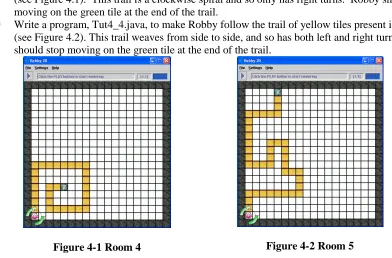
Figure 4-1 Room 4 ... 66
Figure 4-2 Room 5 ... 66
Figure 4-3 Observed errors at the University of St Andrews in session 2002-2003... 70
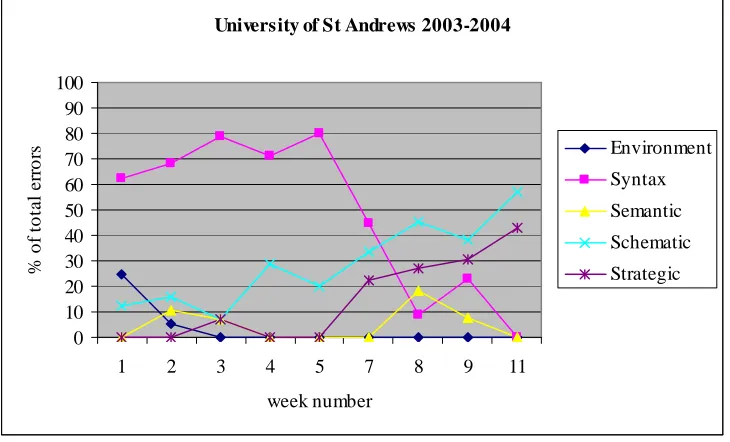
Figure 4-4 Observed errors at the University of St Andrews in session 2003-2004... 70
Figure 4-5 Observed errors at the University of Abertay Dundee in session 2002-2003 ... 71
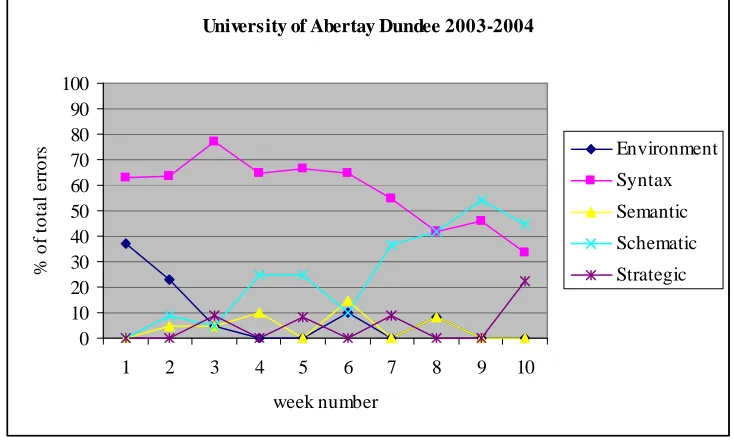
Figure 4-6 Observed errors at the University of Abertay Dundee in session 2003-2004 ... 71
Figure 5-1 Original Java Compiler Error Example 1... 82
Figure 5-2 Extended Java Compiler Error Example 1 ... 82
Figure 5-3 Original Java Compiler Error Example 2... 83
Figure 5-4 Extended Java Compiler Error Example 2 ... 83
Figure 5-5 Original Java Compiler Error Example 3... 83
Figure 5-6 Extended Java Compiler Error Example 3 ... 84
Figure 5-7 Message Warning Of Misplaced Semi-Colon... 89
Figure 5-8 Message Warning of Single Equals in Boolean Expression ... 90
Figure 5-9 Message Warning of Incorrect ‘for loop’ Iterations... 90
Figure 5-10 Message Warning of ‘while loop’ Counter Not Updating ... 91
Figure 5-11 Fragment of XML generated by Java2XML ... 95
Figure 6-1 Percentage Results Per Category From Question 1 Of The Experiment... 139
Figure 6-2 Percentage Results Per Category From Question 4 Of The Experiment... 140
Figure 6-3 Percentage Results Per Category From Question 2, Blink.Java... 141
Figure 6-4 Percentage Results Per Category From Question 3, Buzz.Java ... 142
Figure 6-5 Percentage Results Per Category From Question 5, Narf.Java ... 143
Figure 6-6 Percentage Results Per Category From Question 6, Blimp.Java... 144
Figure 6-7 Percentage Results Per Category From Question 7, Ping.Java ... 145
Figure 6-8 Percentage Results Per Category From Question 8, Matrix.Java... 146
Figure 6-9 Cumulative Average times taken per group to ideal solution ... 149
Figure 6-10 Average Module Grades at the University Of Abertay Dundee... 151
Figure 6-11 SNOOPIE Usage Throughout the Term as Indicated by the Questionnaire Results... 153
Figure 7-1 Screen shot of Menu Driven interface... 171
Figure 7-4 Proposed Interface For Example Feedback ... 175
Figure 7-5 PowerPoint Slide, Linked From ‘If Statement’ Hyperlink ... 176
Figure 7-6 PowerPoint Slide, Linked From ‘Else branch’ Hyperlink ... 177
Figure 7-7 PowerPoint Slide, Linked From ‘if, else if, else statement’ Hyperlink ... 178
List of Tables
Table 2-1 McGill and Volet (1997): A Conceptual Framework ... 26
Table 2-2 Mayer (1997): Four kinds of programming knowledge . ... 27
Table 3-1 Core Requirements of an Effective Support Tool ... 51
Table 3-2 Requirements met by Existing Tools... 52
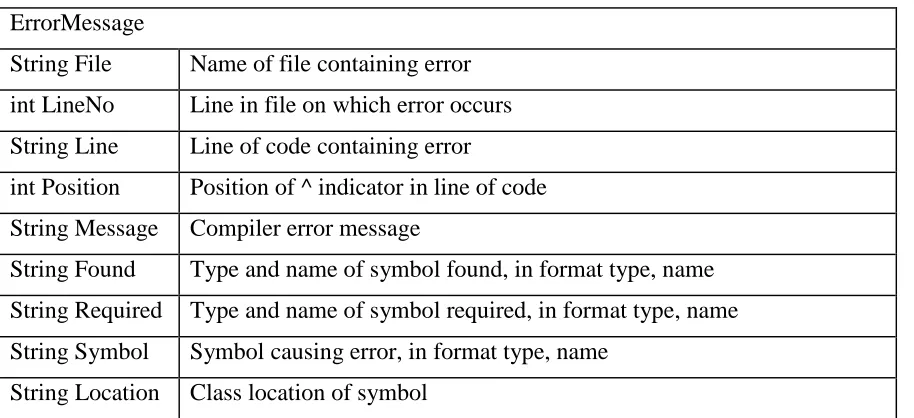
Table 5-1 Summary operation of Error message capture phase ... 85
Table 5-2 Data Structure Elements of Error Message ... 85
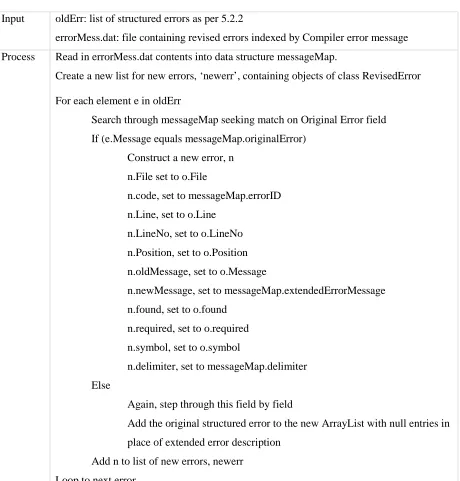
Table 5-3 Summary operation of Error message pre-processing phase... 86
Table 5-4 ArrayList Elements of Generic Extended Error Messages ... 87
Table 5-5 ArrayList Elements of Repackaged Error Messages ... 87
Table 5-6 Summary Operation of Error Message Repackaging Phase ... 88
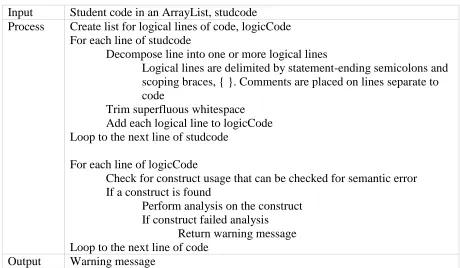
Table 5-7 Summary Operation of Semantic Error Checks ... 92
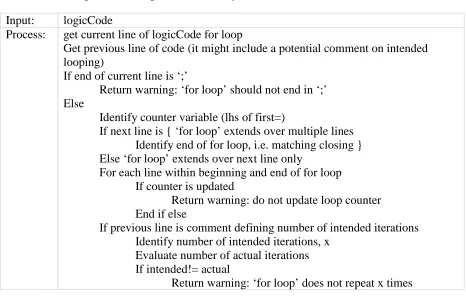
Table 5-8 Example of ‘for loop’ Semantic Analysis ... 93
Table 5-9 Summary of Priority Checks of XML Represented Student Program... 96
Table 5-10 Case 1. Example of Feedback from Stage 3 Analyses ... 97
Table 5-11 Case 2. Example of Feedback from Stage 3 Analyses ... 101
Table 5-12 Case 3. Example of Feedback from Stage 3 Analyses ... 108
Table 5-13 Examples Of Priority Checks ... 120
Table 6-1 Results Of Assessment Coincident to Experiment ... 136
Table 6-2 Selected Comments from Interview with Student A ... 155
Table 6-3 Selected Comments from Interview with Student B ... 156
Table 6-4 Selected Comments from Interview with Student C ... 157
Table 6-5 Selected Comments from Staff A. ... 158
Table 6-6 Selected Comments from Staff B. ... 161
Table 6-7 Core Requirements of an Effective Support Tool ... 164
Chapter 1 Introduction
1.1 Background
1.1.1 The Student’s Experience of Learning to Program
Novice programmers, and specifically first year university students in the context of this thesis, are faced with a number of challenges that impact on their experience of learning to program. Many students have no previous experience of programming and those who have programmed at secondary school level have used languages such as True Basic, Comal or Visual Basic 6 but rarely a sophisticated language such as Java, Scheme or VB.NET. Java, for example, is the most commonly used language in Higher Education (Lund, G. 2006, pers. comm. 6thJune). To use Java, first year students must familiarise themselves with both a new language and new software to support program development, typically in the form of an Integrated Development Environment (IDE), or use a command line interface. Indeed the first practical classes of the programming modules studied in this research are spent showing the students how to use the new environment, including learning how to create projects and link to external library files, and ensuring that they are able to open and save files to their network space. While this is a complex activity that students find difficult, be it an IDE or command line this is a transient issue (Kölling, 2003). Students face more substantial difficulties in learning to program than are associated with using the software, and the root of the difficulties lies in the multi-faceted nature of learning to program.
solution and the articulation of the problem in terms of program design. For example, if a student is required to write a program to read in three numbers and print out an average they must be able to, in a general sense, declare variables, define arithmetic operations, make assignments and employ mechanisms for user input and program output. Additionally, these syntactic elements must be utilised in such a way that the required program behaviour is implemented: Variables should exist for each number, a total and the resulting average; those variables for user input are linked to user input statements; arithmetic operations make use of those variables to determine a total and an average; etc. The details of how those general syntactic elements are orchestrated to effect a solution are specific to the problem considered. A further challenge to the learning of programming is that students are expected to be able to assimilate effectively new syntax that relates to often only partial exposure to complex programming concepts, since novices lack a fully integrated view of the underlying paradigm of program development. For example, in Java when learning method invocation it is difficult for students to engage with the syntactic mechanisms of parameters, return types, return values and scope of variables, together with (concurrently) understanding the rationale for methods and the division of computation within a program into cohesive program blocks that constitute individual methods. The former relates to general use of the mechanism; the latter its exploitation in program design.
1.1.2 The Tutor’s Experience of Teaching Students to Program
The development of programming ability in students requires support in a taught context, for example a laboratory session, together with periods of self-study and exploration. In the taught environment, a tutor must face the challenge of delivering a syntactic rule-base and the semantics of single statements together with more abstract concepts relating to the integration of programming components such as variable declarations and loop constructs to implement a particular program behaviour. The aim is to develop a model in the mind of the student of how to develop programs and of program operation. Three operational aspects impede the establishment of this conceptual model during laboratory activity.
First, during practical programming classes, much of the tutor’s time may be dedicated to solving trivial syntactic problems, especially at the beginning of the module when the students are not yet familiar with the syntax rules and compiler error messages or when new syntax is introduced – i.e. at the earliest stages of model formulation. The time spent on this activity with any individual student may be substantial. The time taken to assist an individual student, and therefore the time that any student must wait for help, is further extended since students tend to make mistakes similar to those of their peers at particular stages, and so at similar times, in a practical activity and tutors often find themselves solving the same problems for several individuals independently.
Third, students can often feel so dependent on the tutor for helping them solve problems relating to their practical exercises that they are often reluctant to work on their programming outside of class time, obviating the benefits of self-study and reflection. Thus, the tutor can often be the only source of academic support. As a result, for some students, class contact is the only mechanism for conceptual model progression. This is such a widely recognised problem that several conferences and workshops focus attention on supporting the novice programmer. For example the recent Disciplinary Commons programme of research (Fincher et al., 2006) chose to focus on the teaching of introductory programming as a challenging study area for its review of teaching practice across a number of higher education institutes in the UK. Further, the number of international conferences and workshops that target the challenges posed by teaching novice programmers, such as the Higher Education Academy’s annual workshop on Teaching Programming and the annual ICER conference, highlight the extent of interest in this area.
1.1.3 Problem Definition
Based on the challenges facing both student and tutor in developing programming expertise, three underlying obstacles emerge. First is the engagement with each of language rules and program operation. A combination of reference material, programming practice and the compiler all help the student learn the correct syntax for a given construct and resolve errors made in that syntax. However, exploitation of (static) reference material in the (dynamic) process of writing a program is challenging for students. Further, practice is impeded by frustrations with errors as noted previously. Additionally, the compiler is well recognised as an expert tool for expert users, and so inappropriate for novices. Understanding the operation of a statement such as a for loop or a variable declaration, i.e. its semantics,depends on the development of an operational model. This can be achieved only through trial and error or exploration of the relation between the syntax and how the syntax is executed, and this is impeded by the introduction of syntax errors (which are difficult to resolve).
requires first an array definition, second a for loop to iterate through the array, and third an input statement within that for loop. Determination of an appropriate program structure depends on knowing how each individual programming construct may contribute to a solution to a given problem and in what order those constructs should be arranged. This in turn depends on the ability to determine the contribution of that component to the solution (semantics) and the successful integration of those components, which depends on their correct formulation (syntax). Consequently, the student may not develop solutions successfully without the underpinning syntactic and semantic knowledge. Importantly, this underlying knowledge of syntax and semantics is most strongly promoted by development of solutions to specific problems, yet a limited architectural understanding impedes this solution development.
Thirdly, the difficulty introduced by the need to concurrently engage across these cognitive/ conceptual levels to develop programs means that novice programmers are unwilling to learn on their own. This then means that, because of lack of practice on the part of the student, tutors devote too much time to the (often repetitive) correcting of syntax and this limits time available for the exploration of the generic semantic aspects and specific problem-based structural and design levels of programming for implementing solutions.
1.2 Thesis Statement
This thesis considers the development of programming expertise as two interrelated aspects of learning. For one aspect, hereafter referred to as program formulation, the novice must learn to formulate individual lines of code that are in accordance with language rules and perform an intended operation. For the other aspect, hereafter referred to as problem formulation, the novice must learn how to arrange these individual lines of code within the context of a larger program to form a solution to a prescribed problem.
The thesis presents SNOOPIE (Supporting Novices in an Object Oriented Programming
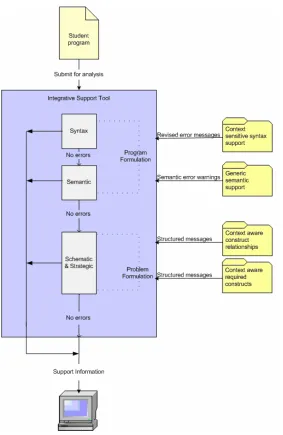
instantiation of, a novel conceptual framework that defines how holistic support across program and problem formulation may be developed. The framework is a synthesis of two bodies of existing literature. First, three current models of student learning are unified into a single model that defines four knowledge levels at which students encounter problems when learning to program, i.e. syntactic and semantic levels defining program formulation, and schematic and strategic levels defining problem formulation. Second, a wide range of existing learning support tools are reviewed and used to define nine requirements for holistic support of student learning in programming. The framework defines the component parts required in any program development tool that provides support consistent with both the four knowledge levels and the nine requirements.
SNOOPIE has been developed, deployed and evaluated within the classroom context over two consecutive academic sessions. SNOOPIE performs generalised checks on the student’s program and provides advice and feedback on compiler errors and common semantic mistakes in student-friendly terminology. These generic checks implement the program formulation support in SNOOPIE. Additionally, SNOOPIE has knowledge of the programming exercises that the students are trying to complete and may then provide hints and tips on missing constructs or relationships between constructs for a given exercise. It is this exercise-specific support that effects the support for problem formulation.
Existing tools have supported program formulation or problem formulation alone, even though this is at odds with the existing literature on the knowledge levels associated with programming. This framework, and so SNOOPIE, is the first approach to integrate program and problem formulation into a holistic support tool. Consequently, this thesis demonstrates, through evaluation of SNOOPIE, that combined support for both program and problem formulation improves student performance over short and long timescales in developing programmed solutions to problems. To demonstrate this, four hypotheses are tested:
2.The problem formulation support provided by SNOOPIE improves short-term student performance.
3.The problem formulation support provided by SNOOPIE reduces the time taken to complete an ideal solution.
4.A combination of problem and program formulation improves long-term student performance when compared with program formulation alone.
The thesis demonstrates that support with program formulation alone improves short-term student performance (H1). The additional inclusion of problem formulation support is seen to further improve short-term student performance in terms of task completion (H2) but not time taken (H3). In fact the results demonstrate that problem formulation support allows more students to complete a given task than would have done so without that support, even though the mean time to completion increases. Finally, program and problem formulation combined is shown to improve long-term student performance relative to program formulation alone (H4). A fifth hypothesis is tested to determine the impact that SNOOPIE is perceived to have on the students’ experience of learning:
5.Students perceive that SNOOPIE has a positive impact on the learning process.
The key contributions of this thesis are:
A conceptual framework that integrates both the four knowledge levels required to learn to program and the nine requirements for holistic support;
An implementation of that framework, SNOOPIE, that highlights the operational aspects of the tool, i.e. the analyses of student code undertaken, the feedback given and the way in which the knowledge associated with a question is encapsulated within SNOOPIE;
An evaluation of that framework, via SNOOPIE, that demonstrates the impact of holistic support, i.e. program and problem formulation, on student performance.
1.3 Methodology
The conceptual architecture and nine requirements are informed by a review of the relevant literature. The review (Chapter 2) considers the nature of learning generally and the specific challenges posed by learning to program. Drawing on existing work, these challenges are encapsulated into the two distinct but interrelated activities of program formulation and problem formulation. Models of student learning are used to refine further the programming activities into four distinct levels of knowledge: syntactic, semantic, schematic and strategic, where syntactic and semantic contribute to program formulation and schematic and strategic to problem formulation.
The components of the conceptual framework are defined (Chapter 3). The analyses necessary to identify the learning support required may be mapped directly on to one of program or problem formulation activities depending on the state of the program undergoing that analysis, and in the case of program formulation be further separated into syntactic and semantic levels of knowledge. However, the assumption that any feedback given to the student to support a given difficulty may also be mapped on to only one of program or problem formulation, depending on where that difficulty is manifest in the analysis, seems at odds with the recognised interrelations between program and problem formulation.
To explore the complex relationship between manifest problem and the underlying root-cause of that problem, an extended observational study was undertaken at both universities associated with this programme of research in the academic sessions 2002-2003 and 2003-2004 (Chapter 4). The study identifies a wide range of problems which students are unable to resolve without assistance and, with individual students, explores the underlying cause of the problem encountered and in turn identifies the knowledge needed to solve the problem. The observation reveals, as evidenced by a series of case study examples, that problems identified at one knowledge level may have a root cause at one or more different knowledge levels. In addition to recognising that multi-level feedback is required to support students, the dialogue observed by students in posing questions and staff in framing guidance is shown to make a valuable contribution to the form of the feedback offered by a support tool.
In line with the conceptual framework and feedback study, the SNOOPIE implementation of that framework (Chapter 5) is described in two phases: Version 1, which offers program formulation support, and Version 2, which offers problem formulation support. The range of support provided and its implementation and feedback given are detailed. For support tool evaluation, and following the observational studies of 2002-2003 and 2003-2004, Version 1 was used within the class context in the academic session 2004 -2005.
be assessed for both the presence of key constructs, e.g. a ‘for loop’ and an ‘if statement’, and the interrelations among those constructs, e.g. the ‘if statement’ is placed within the ‘for loop’. Further, as per the identified requirements, this assessment must be sensitive to both the context, i.e. the question, and the progress that the student has made with that question. This latter sensitivity determines the implementation strategy: support is effected in terms of a series of increasingly fine-scaled composition and structural tests that steer the student toward a solution. Where appropriate, the tool accommodates support for variant solutions to a given problem. The overall scheme is presented and indicative case study examples are worked through to support a detailed description, including one example that explicitly highlights the capacity of the approach to support multiple solutions to a given problem. For evaluation, Version 2 was used within the class context in the academic session 2005-2006.
Chapter 6 describes the evaluation of each version of SNOOPIE. The challenges associated with evaluating any learning support tool for introductory programming are discussed and, by drawing on established literature, a suite of evaluation mechanisms is identified. The evaluation of SNOOPIE using these mechanisms, including formal questionnaires, module results and experiments, is described independently. Additionally, the manner in which SNOOPIE meets each of the nine requirements is addressed. Shortcomings of the SNOOPIE implementation are also identified from this evaluation.
Chapter 2 Literature Review
2.1 The Learning Process
Learning is “the acquisition of knowledge or skills through experience, practice, study or by being taught” (Hanks, 1998). The methods necessary for successful learning depend very much on the nature of the task. For a relatively simple cognitive task, learning may simply involve reviewing the steps often enough for them to pass through short-term memory into long-term memory (Ellington and Earl, 1996). However, Clark and Harrelson (2002) state that for learning of a more complex activity to occur the student must initially form a coherent idea of the concept being taught. This idea then has to be integrated into schemas (existing memories) stored in long-term memory. The student must then be able to review and practice this complex activity to reinforce its integration with existing schemas so that the student can successfully perform the activity at a later date.
Two recognised approaches are evident in the strategies employed to address the task of learning: surface and deep. Surface learning is simply the practice of storing new facts and ideas without any attempt to connect or process information. Ellington and Earl (1996) note that: “Students who adopt such a surface approach tend to work according to the following general pattern:
Concentrating purely on assessment requirements
Accepting information and ideas passively
Memorising facts and procedures routinely
Ignoring guiding principles or patterns
Failing to reflect on underlying purpose or strategy.”
Deep learning in contrast involves a distinct effort to engage with the material being learned, by critically examining each new fact or idea and linking them to existing knowledge. Ellington and Earl (1996) characterise deep learners as:
“Attempting to understand material for themselves
Interacting vigorously and critically with content
Relating new ideas to previous knowledge and experience
Using organisation principles to integrate ideas
The Higher Education Academy, Engineering Subject Centre (2000) state that students should be encouraged to adopt a deep approach to learning. This can be achieved by concentrating on key concepts and acknowledging students’ misconceptions. Students need to be engaged in the learning process and able to relate new material to existing ideas. Students should also be allowed to make mistakes without penalty.
There are additional factors, which affect learning. Individual student learning will be affected to a greater or lesser extent by factors such as motivation, interest, age, maturity, background and confidence in personal ability (Jenkins, 2001). Many of these factors are intrinsically related and academic research has been conducted in the area of motivation, which is undoubtedly a key aspect of student learning and particularly so in self-study practices of first year university students (Watson et al., 2004). Academic motivation and the differences shown among students are a reflection of many influences, ranging from experiences of upbringing to success and failure of activities in previous learning environments. The learning approach chosen by the student will also depend on their personality and how this suits the chosen teaching method and style used by the tutor. In summary, learning any complex subject material requires regular and repeated engagement with that material and the activities comprising that engagement promote learning beyond the surface level.
2.2 Learning to Program
This treatment of learning is general and therefore true for all subject domains. The specific task of learning to program attracts particular challenges, and it is well recognised as a time-consuming and frustrating process for the majority of novice programmers (Johnson, 1990). Hereafter, in line with other work (e.g. Mayer, 1997), the term “novice programmers” is taken to mean those who are learning to program, and the term “expert programmers” is taken to mean those who can program.
Solway and Ehrlich (1989) explored the difference between novice programmers and experts. They state that the process of programming requires at least two different skill sets: program comprehension (i.e. the ability to understand each program part) and secondly plan recognition (i.e. the ability to understand the interactions among each program part). To demonstrate these two skill sets they introduce the notion of a program narrative, where well-structured programs in terms of constructs and naming conventions are easier to understand. In an observational study, both experts and novices were exposed to well structured and poorly structured programs and assessed on their program comprehension. In the case of well-structured programs, expert programmers performed significantly better than novices. In the case of poorly structured programs there was no significant difference between the performances of the two groups. Clearly program comprehension is dependent on an understanding of the form and meaning of each symbol and each line, and this skill is necessarily evident in experts. This study also demonstrates that understanding arises as a result of recognition of the interaction among program lines in the form of a systematic plan. This plan recognition is evidently present in experts but not in novices.
Mayer (1981) presents a useful analogy to programming in terms of playing chess. Citing Chase (1973), Mayer discusses a study where subjects were presented with chessboard configurations and then asked to reconstruct them from memory. Although chess masters performed much better than less experienced players when the chessboards came from real games, there was little difference when the chessboards contained randomly placed pieces. This demonstrates that the chess masters do not have better memories than the less experienced players, but an understanding of the patterns that can exist among pieces on the board. Mayer compares this to a study by Shneiderman (1980) where expert programmers were better able to recall lines of code than novices in a meaningful program but performed no better than novices when the program contained random lines. Mayer suggests that it could be useful to teach novices to program using “chunks” or “schemas” to help them learn the patterns evident in programming.
must see the purpose of programming. This clearly relates to the importance of motivation in learning as above. Two challenges relate to the general process of developing programs: the “notional machine” and programming “pragmatics”. The notional machine represents the abstraction of computer operations into a programming language, an editor and a compilation process. It was noted that students find difficulty in identifying the exact relationship between these three artefacts and the running program. Pragmatics relates to the broad lifecycle of program development, including testing and debugging. Two challenges are analogous to those presented by Soloway and Ehrlich (1989): “notation”, relating to syntax and underlying semantics and “structures”, relating to the development of plans to implement solutions.
Ebrahimi (1994) undertakes a review of existing work on the difficulties faced by novice programmers and clearly states that the two challenges noted by both studies above impact most on the learning process for novices. That knowledge of the syntax and underlying semantics is required to develop programs is clear. Ebrahimi states unambiguously that program plans are a fundamental requirement to successful program development. Ebrahimi further shows, through observational study, that the concepts of “language constructs” and “plan composition” are central to programmer development and intimately linked. Ebrahimi concludes that programmers cannot form plans without language and cannot use language without plans and that, consequently, these must be taught concurrently.
To address the problem of poor hypothesis formulation (relating to syntax error messages) by novice programmers, Chmiel and Loui (2004) conducted a study demonstrating that formal training in debugging (which they use to describe syntax error removal) helps students develop skills in diagnosing and removing defects from computer programs. The activities used to enhance the students’ debugging skills included debugging exercises, logs and reflective memos. The debugging exercises involved identifying and solving errors in existing programs. All students were required to document each program development process in a log, including designs, plans and debugging experiences. Based on these logs each student was required to submit a reflective memo for each programming exercise stating time spent on the exercise and describing defects identified in their program. As a result of the study, the students agreed that the exercises had enhanced their debugging skills. In particular, they found that novice problem solvers fall victim to problems without making reference to the context, even though this context is simplistic initially. In contrast experts generate measurable criteria such as cause-effect relationships and procedures, which they use to make informed choices in order to solve problems. Further, Spohrer and Soloway (1986) observed that many novice programmers inject high-frequency defects into their programs. Debugging training, which focuses on those high frequency defects, could help students reduce the occurrences of these defects in their programs. While the details of the activity of debugging are different to those of programming, program and problem formulation present themselves in the activity of debugging. Clearly debugging requires exploitation of strategies to identify and address errors in individual lines of code, for example using simple output statements and program breaks to trace values. Additionally, debugging requires problem formulation level activities which potentially extend over the whole program and must take account of the properties of the specific problem being addressed, for example the construction of test sets and execution of those test sets.
second, here termed problem formulation, is the concept of “structures” from Soloway and Erlich and the “plan compositions” of Ebrahimi. Problem formulation is therefore the challenge of identifying and structuring the necessary program components to formulate a programmed solution to a specific problem.
Clearly, fundamental to the development of programming ability is the establishment of knowledge of the rules of program formulation and skills in problem formulation in long-term memory. The learning of program formulation may be effected through regular reviews of the available teaching material. Syntax and program operation, e.g. scope, the rules of a particular language may be learned by a surface learning approach, such as memory of the ‘shape’ of constructs. The development of problem formulation skills may come about only by a deep approach. Crucially, being able to recognise and reuse patterns depends on being able to integrate across different programs. Students then require distinct support for each program and problem formulation skill development, but this support must be integrated since, as noted by Ebrahimi (1994), concurrent teaching is required. Lahtinen et al. (2005) similarly comment that concept knowledge, i.e. program formulation, and strategies, i.e. problem formulation, must be combined but that they do represent both different aspects of programming and different levels of learning – surface and deep respectively.
2.3 Models of Student Learning
In order to improve the learning process, which underpins the development of expertise in programming, a number of models of student learning have been devised. These models are typically formulated in terms of stages in progressing from a novice to an expert programmer and can be used to identify and describe the composite aspects of the activity of learning to program. In turn, these activities, and the accordant skill base, can be used to determine the direction that we expect students will follow and provide guidance and structure on how we need to help students begin this process of learning.
recognition of meaningful patterns, access to relevant information and generation of appropriate solutions based on that knowledge. McGill and Volet categorise the knowledge required for programming into declarative and procedural, i.e. know what and know how.
Table 2-1 McGill and Volet (1997): A Conceptual Framework of the Various Components of Programming Knowledge
Declarative Knowledge Procedural Knowledge Syntactic Knowledge Knowledge of syntactic facts related to a
particular language
Ability to apply rules of syntax when programming
Conceptual Knowledge
Understanding of and ability to explain the semantics of the actions that take place as a program executes
Ability to design solutions to programming problems
Strategic/Conditional Knowledge
Ability to design, code, and test a program to solve a novel problem
Table 2-1 clearly identifies Syntactic knowledge as a separate, independent knowledge level that relates to a specific programming language. Conceptual knowledge makes reference to the student’s understanding of operation of program statements and complete solutions to a problem. Strategic/ Conditional knowledge is the ability to recognise how a problem can be solved using the existing building blocks available from Syntactic and Conceptual knowledge. McGill and Volet conclude that students should be explicitly guided through the development of Conceptual and Strategic/ Conditional knowledge through teaching materials and add that this is particularly useful for low-ability students.
novices and experts across all knowledge levels and that the transition to expert arises only from extended experience. Regardless of the specific levels, Mayer, like McGill and Volet, goes on to highlight that teaching approaches should target directly each level to promote that transition.
Table 2-2 Mayer (1997): Four kinds of programming knowledge (examples are omitted here).
Knowledge Definition Common Tests Syntactic Language units and rules for
combining language units
Recognise whether or not a line of code is correct
Semantic Mental model of the major locations, objects and actions in the system
Rating pairs of terms for relatedness; providing thinking aloud protocol
Schematic Categories of routines based on function
Recalling program code or keywords; sorting routines or problems, recognising or naming routines
Strategic Techniques for devising and monitoring plans
Providing thinking aloud protocols; answering comprehension questions
clearly distinguished from the higher level activity of how combinations of those statements may be exploited to produce a solution to a problem.
Lund (2002) recognises the utility of the work by Mayer (1997) in particular and has proposed a unified framework of programming expertise to underpin the development of a teaching support tool, which clearly defines the categories of knowledge, required to program. These categories are identified, as per Mayer (1997), as Syntactic, Semantic, Schematic and Strategic. Here, these levels form the foundations of the learning support offered to students and can be mapped explicitly on to the two challenges presented in 2.2, program formulation and problem formulation. The existing description of each challenge is further refined by the use of Mayer’s learning model.
2.3.1 Program Formulation
Program formulation encapsulates both the Syntactic and Semantic knowledge levels of Mayer (1997). According to Lund (2002), Syntactic knowledge is specifically concerned with the syntax, or form, of a programming language and the ability to apply that knowledge. Correct syntactic expression of constructs within a particular programming language allows development ofSemantic knowledge, i.e. the operation of those individual constructs, which will enable them to develop a mental model of program execution or “what goes on inside the computer as a result of a line of code” (Lund, 2002). This mental model, combined with knowledge of the underlying syntax, represents the skill set needed for program formulation.
2.3.2 Problem Formulation
syntactic and semantic levels maps directly on to program formulation and knowledge at the schematic and strategic levels maps directly on to problem formulation.
2.3.3 Knowledge Levels and the novice programmer
While it is assumed that the expert programmer will be confident in all areas of the framework, the abilities of the novice programmer cannot be so easily described. Lund (2002) has identified three categories of novice programmer based on a series of experiments. Novices in the first of these categories are typically unsuccessful in completing a working program without assistance from peers or teaching staff and are therefore unable to do either program or problem formulation. Their solutions show no patterns or evidence of planning. The novices are therefore lacking in the relevant knowledge to solve a given problem and their solution development is usually impeded by a lack of knowledge across all four levels of the model. Novices in the second category are able to produce a working solution but their programs lack sophistication, therefore novices in this category have sufficient program formulation but are unable to undertake successful problem formulation. These students tend to write the complete program and then attempt to debug it in stages, rather than think about the program development stages before writing These students typically possess sufficient knowledge at the syntactic and semantic stage but lack schematic and strategic knowledge. Novice students in the third category write their programs in stages, similar to the expert programmer. Novices in this category however tend to use fewer stages than an expert but are still able to produce a successful program with evidence of a planned approach. These students possess sufficient knowledge across all four levels of the model.
Clearly, within the context of an introductory programming class, novice programmers in the first category are the most demanding. Lund (2002) notes that teaching staff spend most of their time with these students, assisting them in the following areas:
Helping the student understand the given problem they have been asked to solve, i.e Strategic;
Helping students identify an approach to solve the problem, i.e. Schematic;
Helping the students solve semantic (execution) errors, i.e. Semantic;
Therefore novices require support at all four levels of programming across program and problem formulation.
2.4 Existing Tools for Supporting Learning to Program
Boufaida (1996) indicates that the activity of programming incorporates multiple tasks including problem comprehension, development of a plan or formula to address the problem, program development including code production and (syntax) error correction, and “memorization of the designed programs”, i.e. identification of underlying patterns across problem sets. From this description it is clear that program development extends over all phases of the software development lifecycle from analysis through to testing.
To support this programming activity, and in recognition of the problems faced by novice programmers, introductory programming tutors have developed a wide range of support tools. The majority of development effort has gone into supporting the design and implementation phases. Sections 2.4.1 to 2.4.4 review some support tools from across the lifecycle, and so include other phases of software development, to capture both the common, underlying set of goals and the diversity of the approaches taken. This review abstracts above specific language and methodologies, and categorises these tools based on their provision of support at lifecycle phases. The review informs the establishment of a set of requirements and a conceptual framework to integrate those requirements into a single framework that supports both program and problem formulation in Chapter 3. Consideration is also given to those tools that take a broader view of the program development process (Section 2.4.5).
2.4.1 Support for Analysis and Design
question. Using these extractions, SOLVEIT then assists the student in developing a data model of the program requirements and subsequent structure chart. Students are further prompted to extract the functional requirements of their program. Students are then required to produce appropriate syntax to solve the problem in a programming environment. SOLVEIT allows students to test their solution by helping them to create a set of test cases based on their program design. After a successful program has been created, SOLVEIT then supports the student in producing accompanying documentation for their program. SOLVEIT operates independently of the programming environment and does not support the student in program formulation, i.e. writing the syntax or solving syntactic or semantic errors. SOLVEIT has no external knowledge of the programming exercise other than that specified by the student. Therefore if the student has made some incorrect assumptions about the requirements of the program, SOLVEIT will blindly support the student in problem formulation based on these assumptions.
Ziegler and Crews demonstrate that problem formulation may be decoupled from program formulation, and the authors recognise that program formulation can impede problem formulation and so remove the details of programming to allow students to concentrate on solving the problem. It is not clear from their work, if concentrating on problem formulation eases the difficulties with program formulation as the work assesses only the reading of programs. Indeed the authors note that their aim is not to develop programming skills per se in their students but to develop generic problem-solving skills for which programming-centric exercises are a useful domain. Consequently, the benefits of separating out problem formulation entirely from program formulation remain uncertain.
2.4.2 Support for Implementation
CAP recognises the expert nature of the compiler and repackages the compiler errors in a more user-friendly language. CAP also provides support for simple (semantic) program formulation problems such as failing to update a loop counter within the scope of the loop. CAP was also shown to contribute to a reduction in marking time by performing many routine checks including style analyses on indentation and commenting, to give an example. An underlying problem with CAP is that some students chose not to read the error messages fully, and Schorsch (1995) states that this reduces their learning experience. With regards to programming style, it was perceived that some students used CAP as a “crutch”: rather than learning from the CAP feedback. Some did not trouble to follow any style rules as they knew that CAP would fix it for them. These students became dependent on CAP and could not program to the (style) standards without it.
Datlab (MacNish, 2000) is a system to provide automated progress monitoring and feedback of students’ Java programs. The tool was developed in recognition of the time spent by tutors and supporting staff undertaking routine checks of student work. This checking time was a consequence of a weekly marking scheme, which itself was introduced in recognition of the need to structure student submissions over the term. The system aims to provide immediate feedback, and to support students working on their own in completing assignments by allowing multiple submissions of the work – and feedback each time – without prejudice. MacNish (2000) notes that this increases confidence in programming skills. Datlab is automatically invoked when a student emails their program to the tutor. This program compiles the file and creates an instance of the submitted program. Java’s reflection capability is used to assess the content of the program in terms of method signatures and instance and class variable declarations. The profile of the student program is compared to a model solution and feedback is given based on omissions of constructs. Additionally, the operation of the program is assessed in case of run-time exceptions and against known test data.
provided, and that this raises a pedagogical issue underlying all support tools, i.e. what degree of help is beneficial to the student learning process and what degree compromises that process. NacNish (2000) offers no clear view on this but does note that this support tool is not aiming to replace tutor feedback. Indeed the feedback given should complement staff activity in the laboratory sessions. As a result, the degree of help offered to an individual student is a mix of fixed tool support and staff judgement.
Odekirk-Hash and Zachary (2001) have developed an online tutoring system called InStep which is designed to help students in an introductory programming class. InStep is a web-based application, which presents template solutions to specific problems. The template includes partial program code and comments indicating what the student has to do to complete the program. InStep compiles the completed program and reports on any compiler errors. If the program is syntactically correct, InStep runs it against a set of pre-defined test cases. If the program fails the test cases, InStep attempts to examine the code inserted by the student for common errors and reports these discrepancies to the student. If InStep cannot identify the source of the error it attempts to highlight the line of code causing the error. InStep also displays the program output to the user. An experiment to measure the effectiveness of InStep showed a significant difference in the amount of time tutors had to spend helping those students who used InStep against those students who did not.
Lang (2002) has developed a less ambitious tool suite to support novice programmers in some of the areas provided by CAP. The tool suite consists of three applications: Pre-Scanner, Instant Scanner and Pretty Printer. The Pre-Scanner provides revised error messages and identifies some simple logic (as per CAP) errors. Instant Feedback “reports any problems with coding style, layout and comment coverage” (Lang, 2002). Finally, the Pretty Printer reformats and indents student source code. A distinguishing feature of this work from CAP is that the tool support is integrated into the development environment, whereas CAP invocation is initiated through a separate environment to program development. Lang (2002) also notes “as students gain experience … they will find the tool’s rigidity too constraining and so will use it less frequently”. This will result in a reduction in usage as the academic programme progresses.
Hristova et al. (2003) have developed an educational tool called Expresso that operates as a pre-compiler to provide the student programmer with detailed error messages relating to Java programs. The tool has been designed to deal with only a small sub-set of Java syntax errors. In order to develop the tool, a survey was conducted among college professors and students in the U.S. to identify relevant Java programming mistakes. This survey involved distributing a questionnaire, which asked people to list the error messages they found difficult to solve.
CMeRun (Etheredge, 2004) is a tool developed specifically for novice programmers. It attempts to help them develop coding and debugging skills by allowing the student to “see each statement in a program as it executes … to show the flow of control and the current status of all variables … during execution”. CMeRun works by taking a syntactically correct program and produces a new program containing the original code together with interleaved statements to display each line and variable value during execution. CMeRun has been evaluated informally with the academic staff and teaching assistants who rated it favourably, especially as a demonstration aid in teaching program operation.
2.4.3 Support for Design and Implementation
parts or all of the program could not be interpreted as being part of a possible plan to solve the problem.
Three clear strengths in the PROUST approach are: i) the system may accommodate variant solutions to a problem; ii) the feedback is sensitive to the difference between the intended plan and the correct (variant) plan closest to that intended plan; and iii) the analysis and feedback may contribute to the tutoring process. However, to be of benefit the approach requires that the student is sufficiently advanced in their program and problem formulation. For program formulation, the system requires syntactically correct code. With regard to problem formulation, a fundamental assumption in both the methodology and the feedback is that the results of the analysis of the intended plans relate directly to the student’s understanding of the problem. Therefore the student must understand the problem to the extent that they are able to articulate a plan comparable with the set of plans in the knowledge base.
Anderson and Skwarecki (1986) note that the Lisp Tutor does improve assessed student performance. However, they do also recognise that the Lisp Tutor is designed to support students who write their programs in a top-down, left-to-right process. For example, a student cannot create the body of a ‘for loop’ before the initialisation. Similarly, the tutor provides feedback for each possible symbol as and when it is typed, meaning that a student cannot write a block of code before receiving feedback. Anderson and Skwarecki further point out that the two extremes of feedback – delayed until the program is completed, as in PROUST above, and immediate feedback as here – are not ideal for supporting the learning process. They suggest development of a system able to choose more strategically when to give feedback, based on the context, or extent, of the developed solution.
EXPLAINER has been developed by Redmiles (1993) to assist programmers in performing new tasks using previously completed exercises based on the cognitive theory of learning by example. Redmiles recognises that learners with good mental models of example programs can successfully apply that knowledge to new programming tasks. EXPLAINER is designed to assist students in developing that mental model. EXPLAINER uses code examples, sample execution, component diagrams and text to help demonstrate new concepts to the user. This software operates independently of the programming IDE. EXPLAINER was tested with 23 (conversion) masters-level computer science students and results indicate that those students using EXPLAINER did perform better than those using an on-line manual to explain programming concepts. The study was undertaken with post-graduate students who already have an established skill set in knowledge acquisition, although the benefits of interactive support over a static (on-line) manual most likely applies to first year students enrolled on introductory programming courses.
that they can make to solve their programming error. It detects discrepancies between the actual and expected program behaviour and offers the novice a set of operators which may be used to fix the error. Specifically, SWANN suggests a range of alternate ways of fixing the error for a known problem.
Brna and Mathieson (1993) recognise that supporting novices by providing feedback related to errors during the development of programs may reduce the complexity of programming. They do this by encapsulating knowledge of the particular programming task within the analysis and feedback. This feedback is not in specific code but in suggestions on the operation of the program. They, like PROUST (Johnson and Soloway, 1985), acknowledge variance in programming implementations and so provide a range of suggested solutions. However, students must develop a program of sufficient substance for SWANN to construct an abstract representation, which may be compared meaningfully with existing non-programming plans. Moreover, it is possible that this error support can contain suggested fixes, which are not plausible. The authors recognise that the programs in SWANN’s knowledge domain are very small and do not allow the novice to work with more challenging problems. Further, the support extends only to those programs in the knowledge base so students cannot benefit from the SWANN system while working on independent problems.
distinct but related areas of learning: conceptual, syntactic and semantic. The conceptual support is introduced to provide support for the transition from serial programming within Java to the parallel environment of Verilog. The Syntactic Support extends from rule-based difficulties, i.e. syntax errors, to variable declarations. This is a simplified version of program formulation. Semantic Support relates to the overall operation of the program in terms of addressing the requirements of the problem, and so is analogous to problem formulation.
2.4.4 Support for Program Operation and Testing
VINCE (Rowe and Thorburn, 2000) is a tutorial tool, which graphically displays the execution of a program to help students develop a mental model of control flow and data structures. VINCE can be used with a set of pre-written programs or with a (syntactically correct) student program. The tool provides “a simulated map of the computer’s memory, showing where pointers and variables are stored”. Although students’ perceptions of their programming abilities did not change after using VINCE, a study did demonstrate that the students performed better on programming questions which indicates that the visualisation of program execution did facilitate the learning process.
2.4.5 Broader Support
LearnOOP is an agent-based approach to providing educational support. Wang (1997) describes an agent as a computer system that provides support to the user by reacting to patterns in the student activity via text-based dialogue. LearnOOP provides a student agent and a teacher agent. The Student Agent builds a history of a particular student and allows the student to “navigate sections and topics”. This operates in terms of monitoring those sections of notes that have been read and those exercises that have been completed. LearnOOP continuously checks a student’s progress and provides guidance and exercises where necessary. The Teacher Agent facilitates creating and editing teaching material, marking assignments and reviewing individual student learning histories. The Teacher Agent also allows interactions between the student and the teacher by providing question and answer forms which can be passed between the two. While LearnOOP is not able to provide constructive feedback for the programming development in itself, it does recognise the importance of facilitating discussions between student and tutors, prompting individuals to seek feedback from peers and human tutors.
the current problem being addressed. Additionally, Paine recognises that a student may need additional support in understanding programming concepts and Coach is able to link to specific teaching materials. These links are context sensitive to the current activity, although Coach is dependent on the student initiating the support.
Shah and Kumar (2002) have developed a tutoring system specifically aimed at supporting the teaching of parameter passing. The approach asks students to match pre-written program code with program output of key variables. The system is able to generate at random a complete program, according to a prescribed template, consisting of functions, variables and arrays. Students are asked to predict, by typing in values, the expected result of running the program. The system can provide minimal feedback, i.e. whether the student is right or wrong, or detailed feedback, which includes an explanation or the correct answer by describing the program behaviour. The authors attempt to evaluate their system to determine i) that learning of parameter passing had improved and ii) that detailed feedback supported learning better than minimal feedback. The design of the evaluation undertaken by Shah and Kumar (2002) is questionable. Students were given a set of pen and paper tests to undertake in an eight-minute period, termed pre-test, then allowed to use the tutor for twelve minutes, and then given another set of pen and paper tests to carry out for a further eight minutes, termed post-test. Shah and Kumar state that the improved performance in post-test over pre-test is a systematic improvement in their learning as a result of their tool. The authors take no account of the time spent prior to each post-test undertaking related activities, a difference of 20 minutes. Further, because of a small sample size they are unable to identify whether the detailed feedback is (statistically) significantly better than minimal feedback. However, two things are made clear from this work. First, repeated engagement with tasks relating to a specific programming aspect, together with pertinent feedback, will promote learning and confidence in the task. Second, in the informal feedback commentary students responded positively to the detailed feedback and noted that the minimal feedback offered no indicator as to why their answer may have been wrong.
Objectives (Bloom, 1956) as a guide to structure different styles of interaction according to different levels of cognitive development. JKarelRobot utilises an ‘Inside/Out’ pedagogy that gradually exposes students to more complex programming structures. JKarelRobot can support Java, Pascal and Lisp environments. The system offers various levels of control to the user from minimal command button control for orientation to the world of the robot to program writing in terms of method calls. Additionally, flowcharting is used to present the design of the implemented solution. Karel and its descendents are many and varied, ranging from direct robot analogues in alternate languages such as JKarelRobot to variant contexts including kangaroos (Sanders and Dorn, 2003), pigs (Lister, 2004) and submarines (Culwin et al., 2005). They all promote a reduced programming world, or microworld (Garner, 2003), which offers students the opportunity to explore problem formulation with limited program formulation development. The approaches all successively release details to support exposure to new concepts in a progressive manner. The microworld approach has been recognised to add value to existing teaching methods during the problem analysis stage (Garner, 2003).
BlueJ (Kölling and Rosenberg, 1996, Kölling et al, 2003) is a fully integrated programming environment designed to teach object-oriented programming to novices using a graphical representation of the relevant classes and objects. BlueJ is a reduced development environment, which removes the complexity of testing and syntax. The main goal of BlueJ is to encourage novices to “think in terms of objects” and not code. BlueJ has been fully evaluated and results show that students believe BlueJ has helped them learn object-oriented programming (Haaster and Hagan, 2004). Further, one of the new BlueJ plug-ins possible under an Extensions API (Utting, 2006) allows checks for semantic errors in the use of variables. Variables are allocated roles (Sajaniemie, 2005), e.g. steppers for use in for loops, and the program is checked to ensure the variable usage is consistent with the allocated roles (Johnson, 2006). Kölling (2003) acknowledges that students need to learn to use professional programming tools before leaving university and recognises the problems that students encounter when moving away from the BlueJ environment.
programmers. This development recognises two issues with Eclipse. First, it is an industry standard IDE and so houses many functions not needed by novices. Second, it is important that novices learn to use a real programming environment. By using a combination of student questionnaires and both focus groups and interviews for tutors the GILD project has been developed with a specific list of features that are required by novice programmers. Included in these features is access to a file editor with syntax highlighting and line numbering abilities. Support for program operation, in terms of a (semantic) debugger that focuses on the current method call, was also recognised as important. Storey et al. (2003) acknowledge the developmental power of Eclipse yet state that many of its features need to be simplified for the novice user, for example integrating the debugger into the GILD perspective. Some features of Eclipse have been removed to simplify its operation, for example wizards and refactoring, or enhanced, such as the resource view. To further support the novice programmer an HTML browser has been incorporated into the tool set allowing students to navigate course notes within their programming environment.
Gomez-Martin et al. (2003) are currently developing a case-based reasoning system called Javy that is designed to provide an engaging learning environment for students. Javy is an animated pedagogical agent, which monitors the student in order to offer guidance when an error is made and produce a working solution to a given problem with step-by-step instructions. It is assumed that students already have programming experience. Hence Javy is not used with novices. Javy has not yet been implemented in the classroom environment.
tool to assist students in their understanding of complex programming concepts through visualisations.
2.5 Summary
Chapter 3 Towards a Supportive Framework
3.1 Analysis of Teaching Tools
Program development spans all phases of the software lifecycle and tools exist to support each of these phases. However, most conventional, introductory courses focus on implementation (Robins, 2003). Further, the problems studied are so small that structured problem analysis in particular is not needed. Additionally, the practice of building programs is an appropriate starting point since it involves a clear process of engagement to motivate students through small-scale software development. Consequently, the majority of tools exist to support the design or implementation phases, with the most sophisticated tools addressing both, and here the focus is on these.
FLINT, by Ziegler and Crews (1999) helps students develop problem-solving and critical thinking skills. Through the use of flowcharts students work in a reduced syntax environment. It is clear that the focus of FLINT is to help students with problem formulation as opposed to program formulation. Importantly, FLINT has been developed within a dedicated programming module aimed at non-computer science students. The purpose of the module is to teach problem-solving skills and programming is chosen as a vehicle to teach these skills. However, the aim of the majority of programming modules is to teach programming, and primarily to computer science students. Although problem formulation is critical these students still need to be taught program formulation, which cannot be done in a reduced syntax environment.
example missing loop counters and the benefit in providing support for these errors. Schorsch (1995) acknowledges that students could become dependent on this level of support and recognises that a tool should give less directed support as the module progresses.
Datlab (MacNish, 2000) was developed in recognition of the students’ dependency on class tutors to solve trivial mistakes. Datlab aims to provide feedback to the students and support them in resolving their own mistakes. MacNish (2000) raises the issue of providing the student with too much help and acknowledges that a support tool could be used to complement rather than replace existing teaching methods. InStep (2001) takes advantage of the common errors that students make to predict the likely cause of a problem in a novice program. However, InStep is limited to a small problem base with ‘fill-in-the-blank’ questions that do not fully support students in program formulation. Lang (2002) also recognised the need to provide students with simplified error messages. Lang suggests that as students gain confidence in their programming abilities they will become less dependent on a support tool.
Expresso (Hristova et al., 2003) has also been developed through recognition of the advantage in replacing compiler errors with more simplified messages for the novice programmer. Similar to CAP, Expresso also detects some common logic errors that novice programmers are known to make. CMeRun (Etheredge, 2004) is recognised as a useful demonstration aid in the classroom, specifically to support the need for one-to-one teaching. CMeRun allows the student to see each statement and variable value during execution. On execution CMeRun indiscriminately interleaves the code with print statements to indicate program state. This is not needed for all program parts and not suitable for all problems, e.g. small world teaching as in Karel the Robot, and is something that the students could do themselves using their own print statements.