A Recursive Software Architecture for
Location-Aware Services
Alan Dearle1, Graham Kirby1, Ron Morrison1, Kevin Mullen1, Yanyan Yang1, Richard Connor2, Paula Welen2, and Andy Wilson2
1 School of Computer Science, University of St Andrews,
North Haugh, St Andrews, Fife KY16 9SS, Scotland
{al, graham, ron, kevin, yyyang}@dcs.st-and.ac.uk
2 Department of Computer Science, University of Strathclyde,
Livingstone Tower, 26 Richmond Street, Glasgow G1 1XH, Scotland
{firstname.lastname}@cis.strath.ac.uk
Abstract. A GLObal Smart Space (GLOSS) provides support for interaction amongst people, artefacts and places while taking account of both context and movement on a global scale. Crucial to the definition of a GLOSS is the provi-sion of a set of services, which we term location-aware services, that detect, convey, store and exploit location information. We first describe a framework (ontology), using a small set of concepts, for defining a GLOSS. This allows different services to be implemented without duplication of the basic mecha-nisms, and abstracts over specific details of the technologies used, thereby ac-commodating both heterogeneity and evolution. Secondly, we introduce a set of location-aware metaphors that are defined in terms of the GLOSS concepts. Thirdly, we propose a recursive software architecture to support the implemen-tation of the metaphors within the framework. Finally we outline how the soft-ware architecture may be applied recursively to provide scalability for location-aware services in the global context.
1 Introduction
The ubiquitous computing paradigm has the goal of providing information and ser-vices that are accessible anywhere, at any time and via any device [1]. Within this paradigm, a GLObal Smart Space (GLOSS) provides support for interaction amongst people, artefacts and places while taking account of both context and movement on a global scale.
automatically defaulting to the nearest printer in a print command [4]. The presenta-tion of contextual informapresenta-tion can be handled in a similar manner, where informapresenta-tion or annotations about a particular location or object is automatically displayed to a person on entering an area. Finally, systems have been proposed that monitor a user’s location and actions, and then utilise this information in an application such as an automatic diary [5].
Hitherto, research into smart spaces has almost exclusively concentrated on provid-ing interaction paradigms that hide the computer in small and highly constrained envi-ronments (LOSSes) [6]. Such systems are mostly focused either on a particular appli-cation or on a specific sensor technology with little or no general platform or infra-structure. As such the current state-of-the-art for smart spaces is, for the most part, complex, expensive to install, and optimised for the environment dynamics at installa-tion time. Since environment dynamics drift over time, these installed systems fre-quently atrophy and require reconfiguration, often at great expense.
Here we concentrate on the global context (a GLOSS) and in particular location– aware services. This has been made feasible by the recent advances in sensor and location technologies, the increased performance of miniature and embedded devices, and the increased availability of ubiquitous and wireless networking. Our approach is to define a GLOSS framework (ontology) [7] using a small set of concepts. The framework allows different services to be implemented without duplication of the basic mechanisms and also abstracts over specific details of the technologies used thereby accommodating both heterogeneity and evolution. Using the framework we introduce a set of location-aware metaphors and show how they interact with these concepts.
Additionally, we introduce a recursive software architecture that facilitates the im-plementation of the location-aware metaphors within the framework. Finally we out-line how the software architecture may be applied recursively to provide scalability for location-aware services in the global context.
1.1 GLOSS Concepts
The GLOSS framework describes a universe of discourse for understanding global smart spaces. The key concepts are people, artefacts and places. For the moment we will not model people and artefacts in great detail, save that: a particular type of arte-fact is identified, the conduit which is associated with a person, being an artefact that is part of, or in communication with, the general (connected) GLOSS fabric; and that people have profiles that define their context.
that occupies a region that may vary over time, such as a car or a train. A number of other auxiliary concepts are significant in the GLOSS framework but here we only require a profile, which defines the context for a person.
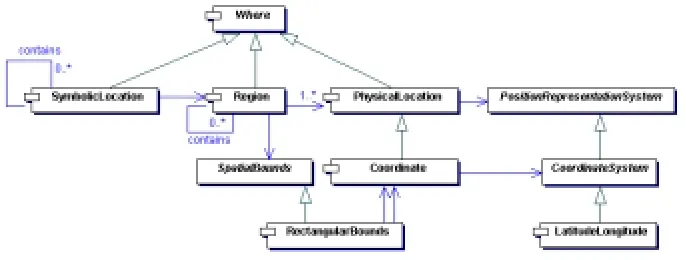
[image:3.595.127.470.208.338.2]A simplified UML model for location information is given in Fig 1.
Fig 1: UML class diagram for location information
1.2 Location–Aware Metaphors
Central to the definition of a GLOSS is the provision of a set of services, which we term location-aware services, that detect, convey, store and exploit location informa-tion. To illustrate these services we introduce three metaphors termed Radar, Trail
and Hearsay. These are described as compositions of the GLOSS concepts and form a
basis for the design of practical tools to support mobile users in a global context.
1.2.1 Radar
Radar was originally proposed [8] as follows:
“This is a tool that will give you an overview beyond the immediate
environ-ment. With this tool you will be able to locate low and high densities, crowds and groups in a larger area. This can help you find the special gap of freedom, the emptiness, you sometimes lack in a public environment. This instrument
can search the streets and spaces for you on a hunt for either noise or silence.”
Radar can be described in terms of the primitive concepts as:
Radar: Time X Region -> Set[GLOSSObject]
1.2.2 Trails
Trails were originally proposed [8] as follows:
“Trails: an ancient way of finding your way around in an area, known or
un-known. To find and navigate the way now you follow static landmarks and signs; if you lose sight of the signs or find something “off-trail” interesting, you lose your trail. We propose a Trail that is plastic, a trail that changes, grows and evolves with you. A morphic trail that guides you in your daily life. This is also a tool to be shared with other people. Trails could be borrowed,
given, bought or swapped.”
Three distinct varieties of trails are modelled: observed trails, archetypal trails and
intentional trails. To give the flavour of our reasoning we will only describe
ob-served trails here.
An observed trail is an ordered sequence of observations of a person or artefact, each recording a time, a place (coordinate, region or location) and optionally some additional information. It can be described in terms of the primitive concepts as:
ObservedTrail: GLOSSObject X Time X Time X Sequence[Where X Time X Information]
Thus an observed trail contains an observed entity (a specific person or artefact), a start time and end time, and a sequence of observations, each comprising an individual observation in space and time, together with some optional additional information.
1.2.3 Hearsay
Hearsay was originally proposed [8] as follows:
“This is an intimate, sensitive tool that will be there to remind and pick up
small notes in the environment left for you. It will make sure that you will only find the message left for you if the context is right. Some messages you will never find. We suggest a new form of “snail mail” that will give you the same experience the sender had when the message was composed. Posted or left in the global environment the message waits at the same place to be delivered at the right time for whom it’s left for. A mail where time is not an option but the
context is.”
Hearsay can be described in terms of the primitive concepts as:
Hearsay: Time X Where -> Set[Information]
1.3 Use-Case Hearsay Scenarios
To motivate our design decisions on the software architecture for implementing loca-tion-aware services we introduce two use-case scenarios based on hearsay. In general, two services are required for hearsay:
• placement of hearsay • delivery of hearsay
Hearsay placement allows a GLOSS user to insert a message into the GLOSS fabric at any point, parameterised by a where and a profile. The where describes the geo-spatial region in which the message should be delivered, and the profile restricts de-livery to certain GLOSS users.
In both use-cases we will concentrate on the delivery of hearsay except to note that the placement can originate from any GLOSS node. In each use-case the hearsay will be placed (stored) on the GLOSS node that corresponds to the where in which the hearsay should be delivered—if there is such a node—or, otherwise, on the GLOSS node whose where most closely contains the delivery where.
Hearsay delivery is triggered when a user enters a where that has associated, rele-vant hearsay attached to it. There are thus two separate implementation aspects: how the event describing that user movement reaches the hearsay delivery service, and how the hearsay is then delivered to the user. The communication channels used between the user and the GLOSS fabric may be the same in each case, or different.
The first use-case allows hearsay to be delivered at any point within a GLOSS-aware where, while the second allows hearsay to be delivered at a particular GLOSS-aware coordinate. The use-cases also illustrate different ways in which user move-ment events may be routed through the GLOSS fabric.
1.3.1 Use-Case One
In our first scenario, Anna places some hearsay relevant to Bob (about a café) at a
GPS Satellite
Event Bob is at
(x,y)
SMS Gateway Brussels
Brussels TranslatorLocation GLOSS Global
Architecture
Paris
Street
Trails
User Profile
User Profile Hearsay
Radar
Trails
Hearsay Radar
France
Trails
Hearsay Radar
User Profile
Belgium
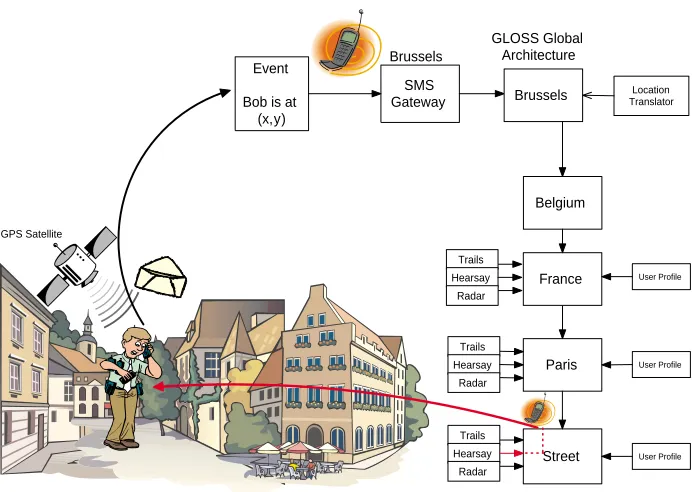
Fig 2: Hearsay delivery anywhere in a GLOSS-aware where, with location detection by user
Fig 2 gives a hint of the infrastructure that may be required to support a GLOSS.
We will develop this later, but emphasise here that the location information enters the GLOSS fabric at a remote point (Brussels) and that the hearsay is delivered when Bob enters any part of the street.
1.3.2 Use-Case Two
Our second scenario involves the staff at the Pompidou Centre placing hearsay rele-vant to all art lovers at a coordinate (the Eli Lotar III sculpture [9]) for delivery at precisely that coordinate.
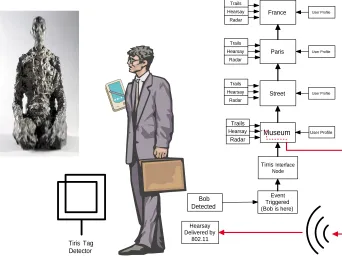
Fig 3 shows Bob receiving hearsay about the statue in the museum. The hearsay is
associated with the statue where, and it should only be delivered when Bob is in the immediate proximity of the statue. Here Bob’s PDA contains a passive TIRIS tag [10] that enables it to be detected within a short range. The TIRIS tag informs the museum that Bob is at the coordinate.
[image:6.595.125.471.143.389.2]Tiris Tag Detector
Bob Detected
Event Triggered (Bob is here)
Hearsay Delivered by
802.11
Tirris Interface Node
Museum User Profile Trails
Hearsay Radar
Paris
Street
Trails
User Profile
User Profile
Hearsay Radar
Trails
Hearsay Radar
France
Trails Hearsay
Radar
User Profile
Fig 3: Hearsay for delivery at a GLOSS-aware coordinate, with location detection by fabric
Fig 3 again hints at the GLOSS infrastructure but this time with the emphasis on
location information entering the GLOSS fabric locally, and that the hearsay is deliv-ered when Steve arrives at a specific coordinate.
2 Implementation Dimensions
When engineering a global smart space there are many implementation dimensions that must be considered, including:
• location detection • storage
• computation • communication
• identity of users and devices • user interface
• format and content of information
[image:7.595.126.468.149.412.2]2.1 Location Detection
Two broad classes of location detection devices are considered:
• those where the artefact being detected has knowledge of its position • those where the external fabric has knowledge of the artefact’s position
An example of the former is a GPS device being carried by a user. The GPS device is aware of the position of its user but that knowledge is not available in the environment without it being actively propagated. An example of the second is a RF tag such as TIRIS, which is capable of detecting a person or artefact carrying a tag, but the person or artefact has no knowledge of their own position. Hybrids of the two location detec-tion mechanisms exist, for example IEEE 802.11 [11] cards may be used to detect other cards in their proximity.
A GLOSS should be able to exploit whatever location detection technology is available. This will mean using different technologies in different contexts.
2.2 Storage
The cost, bandwidth and capacity of storage, and the durability of data stored vary considerably from device to device. Mobile phones are at one end of the spectrum having relatively low volumes of storage with data typically being stored in one place—the device itself. Server machines are at the other extreme with high volumes of low cost storage featuring high bandwidth access, which is easily and cheaply repli-cated. Data resident on servers tends to have better availability characteristics than data resident on hand-held devices.
A GLOSS may store information in the locations most appropriate for the use-case scenarios being supported. This may necessitate maintaining cached copies of client data on servers in order to (a) obviate high communication costs to devices, (b) have data available close to where computation will occur, and (c) make data available when client-devices are disconnected.
2.3 Computation
The GLOSS infrastructure needs to be able to find the most appropriate use of whatever computational power is available. This will often mean performing matching and searching tasks on servers and conserving battery life on handheld devices by only using them for the presentation of data. However, the placement of computation will always be balanced by the communication cost of moving data to an appropriate place for computation to occur.
2.4 Communication
In a GLOSS, a variety of communication mechanisms is required for inter-server, inter-client, and client-server communication. Inter-server communication is domi-nated by Internet protocols and this seems likely to continue. However, a variety of technologies are available for (mobile) inter-client, and client-server communication including GPRS, SMS, TCP/IP via a modem connection, 802.11 (using TCP/IP) and Bluetooth. These technologies have quite different characteristics in terms of end-point connections, cost and bandwidth.
A GLOSS may accommodate any communication technology; in this paper we show how 802.11 and SMS may be used to facilitate client-server communication.
3 Implementation of the Location-Aware Metaphors
3.1 Hearsay
Hearsay placement is a storage activity. However this begs the question as to where is the best place to store the association between a location and some information asso-ciated with it. There are a number of obvious choices:
• on the depositor’s machine
• on a central server offering a hearsay service
• broadcast the association and store the association somewhere on the network • on a machine associated with the location referred to in the hearsay message
appro-priate server. This has the benefits that it is relatively simple to add additional servers, making it scalable, and allowing hearsay discovery to be relatively simple.
Key decision: In our GLOSS prototype we have chosen to store hearsay on servers that are associated with particular geo-spatial areas. Each server will normally be located within the geo-spatial area with which it is associated.
Hearsay delivery is triggered when a user enters a where that has associated, relevant hearsay attached to it. The implementation of hearsay delivery has four technological dimensions:
• where the detection of the user’s location takes place
• the communication between where the detection has occurred and where the profile matching takes place
• where the computation matching the user’s location to the hearsay takes place • how the user is notified of the hearsay
The detection of the user’s location may occur in a number of places depending on the technological mix. In first use-case scenario, the event describing the user’s movement is triggered by the GPS device and is propagated to the GLOSS infrastructure via an SMS message. The SMS message is sent to a SMS gateway that is likely to be located on a machine that is not in proximity to the sender of the message or to the location of the hearsay information. In the second use-case scenario, the detection occurs in the fixed infrastructure when a tag reader detects a tag being carried by the user. In this case it is highly likely that the tag reader is associated with a computer that is in the proximity of the user, and may be in close proximity to a server on which the hearsay is stored.
In both cases the machines receiving the detection event must do something with it—again there are a number of choices. Each machine could:
• send the event to the hearsay service • send the event to the user’s home machine • broadcast the event
Before examining these choices, it is important to appreciate that the location detec-tion may be driving services other than hearsay—for example, it may also be feeding a trails service and a radar service. Consequently, the first choice, which appears to be the obvious candidate, may not be ideal, since the radar and trails services may not be co-located with the hearsay service.
The second choice assumes that each user has a designated home machine some-where on the network. This could be the user’s web server for example. This is an attractive option—it scales well—servers can be added on demand as users are added. It means that every user has a well known home to which all messages about that user can be sent. However, it does not solve the problem of hearsay matching—it only delays it. When the message is sent to the user’s home machine, another message must be sent elsewhere for the matching to occur.
the network would quickly saturate with messages of no interest to most servers. An-other problem with uncontrolled broadcast is that the messages would propagate until they had reached every node in the network—this is wasteful of resources and it is unlikely to deliver timely data. Some mechanisms therefore need to be provided to route messages to those servers that are interested in the events. We return to this later.
Next, we turn to the question of where the computation matching the user’s location to the hearsay takes place. There are three main contenders:
• on the user’s conduit
• on the user’s home machine on the network • on the machine storing the hearsay
For matching to occur on the user’s conduit, the user’s location, profile and all the hearsay from the hearsay server would have to be sent to the conduit machine. This wastes two precious resources on the conduit: network bandwidth and battery life. In addition to being wasteful, the memory and CPU resources on the conduit are likely to be limited, making it a poor choice. If matching is to occur on the user’s home ma-chine (if there is one), a message must be sent to the location on which the hearsay is stored. This message could request all the hearsay on the server (which may result in a large amount of network traffic) or it could send the user’s profile to the hearsay server, in which case the matching would occur on the machine storing the hearsay.
Key decision: In our GLOSS prototype we have chosen to perform the com-putation matching hearsay to the user’s location on the machines storing the hearsay.
If the user profile is large (we have empirical evidence to suggest it would not be) the option we have chosen appears a poor one. However, we believe that it is not, due to
the region transition hypothesis described in the next section.
The last issue is the delivery of hearsay to the user. Once the hearsay service has matched the user and the hearsay, it must send the hearsay to the user. There are two choices for this delivery:
• it may be sent to the user’s home machine • it may be sent directly to the user’s conduit
Key decision: Each user’s profile contains information about how to contact that user. This may include alternatives to deal with failure.
If the hearsay service has access to the user’s profile it may send the hearsay message directly to the user using whatever services are at its disposal. This may involves send-ing a message to a proxy server (in the case of an SMS attached user) or sendsend-ing the message directly (in the case of a TCP/IP 802.11 connected user).
3.1.1 Region Transition Hypothesis
The region transition hypothesis states that as the granularity of the geo-spatial region
increases, the total frequency of transitions between regions falls. Globally, there are billions of transitions occurring every second at a fine granularity: a user in France enters a café at the same instant that a user in the UK leaves a shop and a user in Ire-land goes into a bar. There may be 50 shops, cafés and other GLOSS locations in a street comprising a region, with frequent transitions between these locations, but the street itself has only a few access points (its junctions with other streets) and users move between streets less frequently. Similarly, the overall frequencies of transitions between cities and countries are still lower.
The region transition hypothesis has implications for the GLOSS architecture and
for caching. If servers are organised into a tree, with each server being associated with a smaller geo-spatial area than its parent, data may be effectively cached at the nodes of the tree and obviate the need for high volumes of data, for example profile data, to be shipped. However, tree architectures are not scalable—as the root node is ap-proached, the volumes of traffic increase—some mechanism is required to prevent network saturation close to the root. We will return to this problem later.
3.2 Approach to GLOSS Service Implementation
The use-case studies highlight two points:
• A local architecture is required to permit GLOSS clients and servers to be con-structed. Both clients and servers are essentially data-flow architectures. Data ar-rives at a user’s device from several sources—communications devices, position servers etc.—and passed to elements for processing which might include displaying information to a user, sending it to another device, or storing it for future presenta-tion or processing. Similarly on a server, data arrives from several devices is proc-essed and delivered to other devices for further processing or presentation to the user.
4 Local Architecture
Our prototype GLOSS architecture is designed with the following motivations:
• to abstract over any particular technology
• to make GLOSS components independent of each other • to allow components to be assembled into GLOSS applications
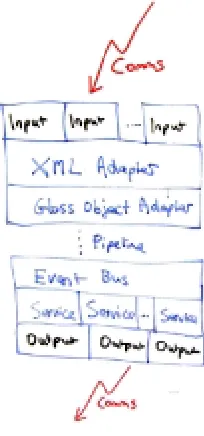
To permit GLOSS applications to be constructed, we arrange components into pipe-lines and register components with event buses. The local architecture is based on XML pipelines and an XML event bus. To abstract over location, GLOSS clients transparently pass messages to a server and vice-versa by plugging appropriate com-ponents into the pipelines and event buses of the client and server. A high level over-view of this architecture is shown in Fig 4.
Fig 4: Local architecture
Data enters the system from various devices in various formats. Most components in the system are compliant with the GOPipe(GLOSS Object Pipe) interface. This is a component that takes XML encoded GLOSS objects and processes them. GOPipe
objects can be assembled into pipelines of processing components. An interface
Ex-tensibleGOPipe is provided which provides GOPipe functionality and permits
down-stream GOPipe objects to be registered with it. In many GLOSS scenarios there is a requirement to distribute information about GLOSS actors and artefacts to several components. To accommodate this, an EventBus interface is provided. It presents the
GOPipe interface so that it may be inserted into a pipeline, and permits multiple
[image:13.595.246.348.319.537.2]interfaces described above achieve the first two objectives. In order to manage collec-tions of component instances we introduce another abstraction—an assembly. This is a collection of components that are linked together via pipes and buses.
4.1 Applying the Local Architecture to the Use-Cases
To accommodate use-case one, a pipeline is assembled on Bob’s conduit containing the GPS device, an adapter (not shown in the diagram) and an event bus. Two GOPipe
objects are attached to the event bus: a hearsay user interface tool and an SMS device. The SMS device is also attached to the event bus, permitting it to supply the bus with non-local events. In the use case, the GPS device passes events via the adapter to the event bus, which passes them to the GPS device. This device sends the events to Bob’s SMS server located in Brussels.
On the SMS server, another pipeline has been assembled, capable of processing in-coming SMS events. In this instance of the architecture, a location service (another
GOPipe compliant object) is plugged into the event bus. It passes location information
to an IP device which results in the message being passed to a street server located in the same street as Bob.
A third pipeline has been assembled on the street server. It contains a GOPipe
complaint IP module to supply GLOSS Object Events to the pipeline that contains an event bus with the hearsay service plugged into it. The hearsay service determines that Bob is in the street (determined by the event sent to it), and that a café recommended by Anna is close by (the hearsay). A message needs to be sent to Bob to inform him of this fact. The message could be sent to Bob using a variety of mechanisms. To ab-stract over these mechanisms, a GOPipe compliant proxy for Bob is provided. This component will send a message to Bob using the most appropriate technology—in this case, an SMS message.
The GSM/SMS card on Bob’s conduit receives the SMS message, where it is passed to the event bus and from there to the hearsay user interface tool, which will present the hearsay to Bob.
In use-case two, Bob is at the Pompidou Centre and looking at the Eli Lotar III
sculpture by Alberto Giacometti. In this scenario Bob is wearing a tag, which uniquely identifies him, and his PDA is equipped with an 802.11 card. Each exhibit in the exhi-bition has a tag reader that detects tags in its proximity. For simplicity we assume that there is a server associated with each exhibit, and a GLOSS server in the museum.
Bob’s tag is detected in the proximity of the exhibit by the tag reader, which sends a message to a serial port which is connected to a GO pipeline. After a GOAdapter has processed it, the event (containing Bob’s unique ID) is passed to an event bus where it is passed to the only component connected to the bus—an IP device that sends the event to the museum server.
The IP device on the museum server is connected to another pipeline and the event is passed to the hearsay service. This service locates Bob’s profile (using mechanisms not described here) and determines what information he may like to know about the statue which he is looking at. This is sent via another object implementing the GOPipe
5 Global Architecture
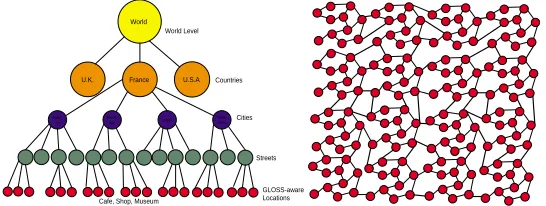
We have described a local architecture for GLOSS conduits and servers. Next we briefly outline how these components may be organized into a global architecture for smart spaces. As described above, tree architectures, such as the one shown in Fig 5
(a), are not scalable—as the root node is approached, the volumes of traffic increase [12]. An alternative to a hierarchical architecture, shown in Fig 5 (b) is a peer-to-peer (P2P) architecture composed entirely of peers, with no node in the network assuming any more responsibility than any other. Instances of this style of architecture, for ex-ample Gnutella [13] and Kazaa [14], have recently become popular for file sharing applications. Many of these architectures depend on searching a limited network cen-tric horizon of machines governed by a number of network hops from the point of query. Such an architecture is not perfectly suited to an environment in which mes-sages require routing to a specific destination. For example, in the SMS hearsay ex-ample, a SMS location message must be routed to an appropriate hearsay server to enable matching to occur. However, it may be injected into a GLOSS network a con-siderable distance (in terms of both hops and geo-spatial proximity) from a server storing hearsay.
World World Level
U.K. France U.S.A
Aving on
Borde
aux Paris Mars eilles
Countries
Cities
Streets
GLOSS-aware Locations Cafe, Shop, Museum
Fig 5: Possible global architectures: (a) hierarchical and (b) peer-to-peer
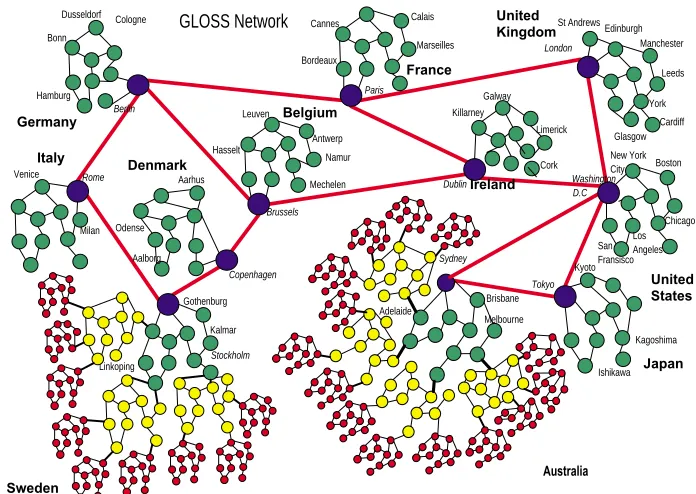
The network supporting the GLOSS infrastructure must therefore provide some mechanism to route messages to an appropriate location. Hybrid architectures offer the opportunity to tailor topologies and protocols in such a way that locality knowl-edge may be exploited. In [12], Carzaniga et al state that an acyclic peer-to-peer archi-tecture with subscription forwarding appears to scale well and predictably under all circumstances and is likely to represent a good choice to cover a wide variety of sce-narios. Consequently, we are currently exploring a global peer-to-peer architecture consisting of a hierarchy of peers such as that shown in Fig 6.
[image:15.595.162.435.376.479.2]Partitioning the network into a hierarchy of peers makes the routing of messages to appropriate locations with the GLOSS infrastructure relatively straightforward. As proof of concept we outline how the three technological aspects of communication, computation and storage in the two use-case scenarios relate to this architecture.
United Kingdom United States France Germany Belgium Japan Ireland Italy Denmark Sweden Washington D.C Tokyo Copenhagen Stockholm Rome Berlin Paris Brussels London Dublin Calais Marseilles Edinburgh Glasgow Manchester St Andrews Leeds Cardiff York New York City Boston Chicago San Fransisco Los Angeles Gothenburg Linkoping Kalmar Venice Milan Cologne Dusseldorf Bonn Hamburg Kyoto Kagoshima Ishikawa Cork Galway Killarney Limerick Aarhus Odense Aalborg Antwerp Hasselt Leuven Namur Mechelen Cannes Bordeaux GLOSS Network Australia Sydney Brisbane Adelaide Melbourne
Fig 6: Hybrid global architecture
In the first use-case, Bob’s conduit relays his position to an SMS server located in Belgium. As described above, the GLOSS object pipeline on that server examines location and determines that it must be sent elsewhere. Since the SMS server is part of a P2P network, it does not require a final destination address for the message. How-ever, it must determine if the message should be sent to its children, its parent, broad-cast to its peers or dealt with locally. This calculation may be performed by comparing the geo-spatial location of the user with that being managed by the server. In the case of the message about Bob’s location, the location in the message is about a location in Paris so it is passed to the Brussels server which either sends it directly to the Paris server (if it has knowledge of this server and the geo-spatial region it manages) or broadcasts it to its peers. When the Paris server receives this message, it is passed down the hierarchy until it reaches the street server where the computation matching the hearsay to Bob can occur.
[image:16.595.133.481.203.450.2]reply may be cached in servers at multiple levels in the network to obviate the need to repeatedly fetch this information. A similar technique under-pins the replicated docu-ment cache used in Freenet [15]. The use of different cache policies at different levels in the hierarchy is likely to be beneficial. For example, leaf servers (where change is fast) might only cache data for a short period but servers close to the root (where change is slow) might cache data for longer periods.
In use-case two, the location information is injected into the GLOSS architecture close to the location at which the hearsay is stored. In this case, the location event needs to propagate up the tree of peers. As propagation occurs, computation matching hearsay and the location of user’s occurs, triggering hearsay delivery to users as de-scribed above. If knowledge of Bob’s location is cached in the hierarchy as dede-scribed above, at some point the message will reach a node that already knows that Bob is in this locale. At this point the message need not propagate up the tree any further. If a match is not made as the message is sent up the tree, subject to policy, the message might propagate back to Bob’s home where his current location could be stored.
6 Status of Implementation
At the time of writing, instances of the GLOSS Object Pipeline architecture are run-ning on a mobile device (currently a laptop for ease of prototyping) and a server. A pipeline running on the laptop integrates a GPS device from Garmin, a Nokia GSM phone card and a prototype hearsay user-interface. We have developed Java based
GOPipe interfaces to the GPS device which supplies the pipeline with location
infor-mation, and another to the GSM device capable of sending and receiving SMS mes-sages. The sever pipeline contains a pipeline containing an SMS server and supplies messages to an event bus. Currently, this bus supplies a Trails capture tool with loca-tion data.
We are currently implementing the necessary algorithms for global message routing and plan to integrate these with the local pipeline architectures shortly.
7 Conclusions
8 Acknowledgements
The early part of this paper is based on, as yet unpublished, research conducted jointly in the EU-funded GLOSS project (5th Framework IST-2000-26070) [16], with part-ners at Strathclyde University, Trinity College Dublin, and Université Joseph Fourier. This will be published in full separately.
Joëlle Coutaz and Gaëtan Rey, in particular, contributed to the GLOSS ontology. Mark Dunlop and Paddy Nixon developed a prototype SMS/Hearsay implementation. Peter Barron and Álvaro Rebón-Portillo wrote parts of the current recursive software architecture prototype.
The work was also supported by EPSRC grants GR/M78403 and GR/M76225, “Supporting Internet Computation in Arbitrary Geographical Locations”.
9 References
1. Weiser M. The Computer for the 21st Century. Scientific American (1991),September 94-104
2. Pentland A. Smart Rooms. Scientific American (1996) 274,4 68-76
3. Elrod S., Hall G., Costanza R., Dixon M., Des Rivieres J. Responsive Office Environments. Communications of the ACM (1993) 36,7
4. Schilit B., Adams N., Want R. Context-Aware Computing Applications. In: Proc. Work-shop on Mobile Computing Systems and Applications, Santa Cruz, CA, USA (1994) 85-90 5. Lamming M., Brown P., Carter K., Eldridge M., Flynn M., Louie G. The Design of a
Hu-man Memory Prosthesis. The Computer Journal (1994) 37,3 153-163
6. Nixon P., Lacey G., Dobson S. Managing Interactions in Smart Environments. In: Proc. Workshop on Software Engineering for Wearable and Pervasive Computing, 22nd Interna-tional Conference on Software Engineering (ICSE2000), Limerick, Ireland (2000) 251 7. Working Document on Gloss Ontology. GLOSS Consortium (2002)
8. Munro A., Welen P., Wilson A. Interaction Archetypes. GLOSS Consortium (2001) 9. Giacometti A. Eli Lotar III,
http://www.rmn.fr/gb/01rmn/01missions/giacometti.html
10. Texas Instruments. Radio Frequency Identification Systems,
http://www.ti.com/tiris/ (2002) 11. IEEE. IEEE 802.11 Wireless Local Area Networks,
http://grouper.ieee.org/groups/802/11/ (2002)
12. Carzaniga A., Rosenblum D.S., Wolf A.L. Design and Evaluation of a Wide Area Notifica-tion Service. ACM TransacNotifica-tions on Computer Systems (2001) 19,3 332-383
13. Kan G. Chapter 8: Gnutella. In: A. Oram (ed) Peer-to-Peer: Harnessing the Power of Dis-ruptive Technologies. O'Reilly (2001)
14. Kazaa, http://www.kazaa.com/en/technology.htm (2002)
15. Clarke I., Miller S.G., Hong T.W., Sandberg O., Wiley B. Protecting Free Expression Online with Freenet. IEEE Internet Computing (2002) 6,1 40-49
16. GLOSS Consortium. Global Smart Spaces,