Proceedings of the 2019 Conference on Empirical Methods in Natural Language Processing
165
Knowledge-Enriched Transformer for Emotion Detection in Textual
Conversations
Peixiang Zhong1,2, Di Wang1, Chunyan Miao1,2,3
1Joint NTU-UBC Research Centre of Excellence in Active Living for the Elderly
2Alibaba-NTU Singapore Joint Research Institute
3School of Computer Science and Engineering
Nanyang Technological University, Singapore
[email protected],{wangdi, ascymiao}@ntu.edu.sg
Abstract
Messages in human conversations inherently convey emotions. The task of detecting emo-tions in textual conversaemo-tions leads to a wide range of applications such as opinion mining in social networks. However, enabling ma-chines to analyze emotions in conversations is challenging, partly because humans often rely on the context and commonsense knowledge to express emotions. In this paper, we address these challenges by proposing a Knowledge-Enriched Transformer (KET), where contex-tual utterances are interpreted using hierarchi-cal self-attention and external commonsense knowledge is dynamically leveraged using a context-aware affective graph attention mech-anism. Experiments on multiple textual versation datasets demonstrate that both con-text and commonsense knowledge are consis-tently beneficial to the emotion detection per-formance. In addition, the experimental results show that our KET model outperforms the state-of-the-art models on most of the tested datasets in F1 score.
1 Introduction
Emotions are “generated states in humans that re-flect evaluative judgments of the environment, the self and other social agents” (Hudlicka, 2011). Messages in human communications inherently convey emotions. With the prevalence of social media platforms such as Facebook Messenger, as well as conversational agents such as Amazon Alexa, there is an emerging need for machines to understand human emotions in natural conversa-tions. This work addresses the task of detecting emotions (e.g., happy, sad, angry, etc.) in textual conversations, where the emotion of an utterance is detected in the conversational context. Being able to effectively detect emotions in conversa-tions leads to a wide range of applicaconversa-tions rang-ing from opinion minrang-ing in social media platforms
No emotion
socialize What do you plan to do for your
birthday?
I want to have a picnic with my friends, Mum.
How about a party at home? That way we can get together and celebrate it.
OK, Mum. I'll invite my friends home.
party movie No emotion
Happiness
Happiness
Context
[image:1.595.318.514.225.333.2]Response
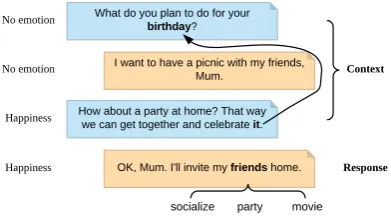
Figure 1: An example conversation with annotated la-bels from the DailyDialog dataset (Li et al.,2017). By referring to the context, “it” in the third utterance is linked to “birthday” in the first utterance. By lever-aging an external knowledge base, the meaning of “friends” in the forth utterance is enriched by associ-ated knowledge entities, namely “socialize”, “party”, and “movie”. Thus, the implicit “happiness” emotion in the fourth utterance can be inferred more easily via its enriched meaning.
(Chatterjee et al.,2019) to building emotion-aware conversational agents (Zhou et al.,2018a).
However, enabling machines to analyze emo-tions in human conversaemo-tions is challenging, partly because humans often rely on the context and commonsense knowledge to express emotions, which is difficult to be captured by machines. Fig-ure1shows an example conversation demonstrat-ing the importance of context and commonsense knowledge in understanding conversations and de-tecting implicit emotions.
features in memory networks to model contextual utterances. However, these methods require sepa-rate feature extraction and tuning, which may not be ideal for real-time applications. In addition, to the best of our knowledge, no attempts have been made in the literature to incorporate commonsense knowledge from external knowledge bases to de-tect emotions in textual conversations. Common-sense knowledge is fundamental to understand-ing conversations and generatunderstand-ing appropriate re-sponses (Zhou et al.,2018b).
To this end, we propose a Knowledge-Enriched Transformer (KET) to effectively incorporate con-textual information and external knowledge bases to address the aforementioned challenges. The Transformer (Vaswani et al., 2017) has been shown to be a powerful representation learning model in many NLP tasks such as machine trans-lation (Vaswani et al.,2017) and language under-standing (Devlin et al., 2018). The self-attention (Cheng et al., 2016) and cross-attention ( Bah-danau et al., 2014) modules in the Transformer capture the intra-sentence and inter-sentence cor-relations, respectively. The shorter path of in-formation flow in these two modules compared to gated RNNs and CNNs allows KET to model contextual information more efficiently. In ad-dition, we propose a hierarchical self-attention mechanism allowing KET to model the hierarchi-cal structure of conversations. Our model sepa-rates context and response into the encoder and de-coder, respectively, which is different from other Transformer-based models, e.g., BERT (Devlin et al., 2018), which directly concatenate context and response, and then train language models us-ing only the encoder part.
Moreover, to exploit commonsense knowledge, we leverage external knowledge bases to facili-tate the understanding of each word in the utter-ances by referring to related knowledge entities. The referring process is dynamic and balances between relatedness and affectiveness of the re-trieved knowledge entities using a context-aware affective graph attention mechanism.
In summary, our contributions are as follows:
• For the first time, we apply the Transformer to analyze conversations and detect emotions. Our hierarchical self-attention and cross-attention modules allow our model to exploit contextual information more efficiently than existing gated RNNs and CNNs.
• We derive dynamic, context-aware, and emotion-related commonsense knowledge from external knowledge bases and emotion lexicons to facilitate the emotion detection in conversations.
• We conduct extensive experiments demon-strating that both contextual information and commonsense knowledge are beneficial to the emotion detection performance. In addi-tion, our proposed KET model outperforms the state-of-the-art models on most of the tested datasets across different domains.
2 Related Work
Emotion Detection in Conversations: Early studies on emotion detection in conversations fo-cus on call center dialogs using lexicon-based methods and audio features (Lee and Narayanan, 2005; Devillers and Vidrascu, 2006). Devillers et al.(2002) annotated and detected emotions in call center dialogs using unigram topic modelling. In recent years, there is an emerging research trend on emotion detection in conversational videos and multi-turn Tweets using deep learning methods (Hazarika et al.,2018b,a;Zahiri and Choi,2018; Chatterjee et al.,2019;Zhong and Miao,2019; Po-ria et al.,2019).Poria et al.(2017) proposed a long short-term memory network (LSTM) (Hochreiter and Schmidhuber, 1997) based model to capture contextual information for sentiment analysis in user-generated videos. Majumder et al. (2019) proposed the DialogueRNN model that uses three gated recurrent units (GRU) (Cho et al.,2014) to model the speaker, the context from the preced-ing utterances, and the emotions of the precedpreced-ing utterances, respectively. They achieved the state-of-the-art performance on several conversational video datasets.
knowledge graphs to enrich the interpretation of input sentences and help generate knowledge-aware responses using graph attentions. The graph attention in the knowledge interpreter (Zhou et al., 2018b) is static and only related to the recognized entity of interest. By contrast, our graph attention mechanism is dynamic and selects context-aware knowledge entities that balances between related-ness and affectiverelated-ness.
Emotion Detection in Text: There is a trend moving from traditional machine learning meth-ods (Pang et al.,2002;Wang and Manning,2012; Seyeditabari et al.,2018) to deep learning methods (Abdul-Mageed and Ungar, 2017; Zhang et al., 2018b) for emotion detection in text. Khanpour and Caragea (2018) investigated the emotion de-tection from health-related posts in online health communities using both deep learning features and lexicon-based features.
Incorporating Knowledge in Sentiment Anal-ysis: Traditional lexicon-based methods detect emotions or sentiments from a piece of text based on the emotions or sentiments of words or phrases that compose it (Hu et al., 2009; Taboada et al., 2011;Bandhakavi et al., 2017). Few studies in-vestigated the usage of knowledge bases in deep learning methods.Kumar et al.(2018) proposed to use knowledge from WordNet (Fellbaum,2012) to enrich the text representations produced by LSTM and obtained improved performance.
Transformer: The Transformer has been applied to many NLP tasks due to its rich representa-tion and fast computarepresenta-tion, e.g., document machine translation (Zhang et al.,2018a), response match-ing in dialogue system (Zhou et al.,2018c), lan-guage modelling (Dai et al.,2019) and understand-ing (Radford et al., 2018). A very recent work (Rik Koncel-Kedziorski and Hajishirzi,2019) ex-tends the Transformer to graph inputs and propose a model for graph-to-text generation.
3 Our Proposed KET Model
In this section we present the task definition and our proposed KET model.
3.1 Task Definition
Let{Xi
j, Yji}, i= 1, ...N, j = 1, ...Nibe a collec-tion of{utterance,label}pairs in a given dialogue dataset, whereN denotes the number of conversa-tions andNi denotes the number of utterances in theith conversation. The objective of the task is to
maximize the following function:
Φ =
N
Y
i=1
Ni
Y
j=1
p(Yji|Xji, Xji−1, ..., X1i;θ), (1)
where Xi
j−1, ..., X1i denote contextual utterances
and θ denotes the model parameters we want to optimize.
We limit the number of contextual utterances to
M. Discarding early contextual utterances may cause information loss, but this loss is negligible because they only contribute the least amount of information (Su et al., 2018). This phenomenon can be further observed in our model analysis re-garding context length (see Section5.2). Similar to (Poria et al.,2017), we clip and pad each utter-anceXi
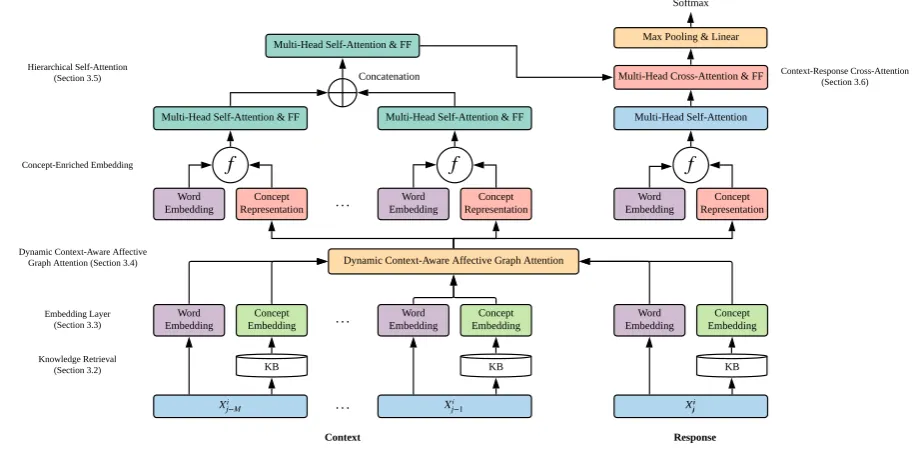
j to a fixedmnumber of tokens. The over-all architecture of our KET model is illustrated in Figure2.
3.2 Knowledge Retrieval
We use a commonsense knowledge base Con-ceptNet (Speer et al., 2017) and an emotion lex-icon NRC VAD (Mohammad, 2018a) as knowl-edge sources in our model.
ConceptNet is a large-scale multilingual seman-tic graph that describes general human knowledge in natural language. The nodes in ConceptNet are concepts and the edges are relations. Each
hconcept1, relation, concept2itriplet is an asser-tion. Each assertion is associated with a confi-dence score. An example assertion is hfriends, CausesDesire,socializeiwith confidence score of 3.46. Usually assertion confidence scores are in the [1,10] interval. Currently, for English, Con-ceptNet comprises 5.9M assertions, 3.1M con-cepts and 38 relations.
NRC VAD is a list of English words and their VAD scores, i.e., valence (negative-positive), arousal (calm-excited), and dominance (submissive-dominant) scores in the [0,1]
interval. The VAD measure of emotion is culture-independent and widely adopted in Psy-chology (Mehrabian,1996). Currently NRC VAD comprises around 20K words.
In general, for each non-stopword token t in
Xi
Embedding Layer (Section 3.3)
KB Word
Embedding EmbeddingConcept
KB Word
Embedding EmbeddingConcept
KB Word
Embedding EmbeddingConcept
. . .
Dynamic Context-Aware Affective Graph Attention Word
Embedding RepresentationConcept EmbeddingWord RepresentationConcept EmbeddingWord RepresentationConcept Multi-Head Self-Attention & FF Multi-Head Self-Attention & FF Multi-Head Self-Attention
Context Response
. . . . . . Multi-Head Self-Attention & FF
Multi-Head Cross-Attention & FF Softmax
Max Pooling & Linear
Concatenation
Concept-Enriched Embedding Hierarchical Self-Attention
(Section 3.5)
Knowledge Retrieval (Section 3.2) Dynamic Context-Aware Affective
Graph Attention (Section 3.4)
[image:4.595.74.531.73.298.2]Context-Response Cross-Attention (Section 3.6)
Figure 2: Overall architecture of our proposed KET model. The positional encoding, residual connection, and layer normalization are omitted in the illustration for brevity.
than 1 to reduce annotation noises. For each con-cept, we retrieve its VAD values from NRC VAD. The final knowledge representation for each to-ken t is a list of tuples: (c1, s1,VAD(c1)),
(c2, s2,VAD(c2)), ...,(c|g(t)|, s|g(t)|,VAD(c|g(t)|)),
where ck ∈ g(t) denotes thekth connected con-cept, sk denotes the associated confidence score, andVAD(ck)denotes the VAD values ofck. The treatment for tokens that are not associated with any concept and concepts that are not included in NRC VAD are discussed in Section3.4. We leave the treatment on relations as future work.
3.3 Embedding Layer
We use a word embedding layer to convert each tokentinXi into a vector representationt ∈
Rd,
whereddenotes the size of word embedding. To encode positional information, the position encod-ing (Vaswani et al.,2017) is added as follows:
t=Embed(t) +Pos(t). (2)
Similarly, we use a concept embedding layer to convert each conceptcinto a vector representation c∈Rdbut without position encoding.
3.4 Dynamic Context-Aware Affective Graph Attention
To enrich word embedding with concept represen-tations, we propose a dynamic context-aware af-fective graph attention mechanism to compute the
concept representation for each token. Specifi-cally, the concept representation c(t) ∈ Rd for tokentis computed as
c(t) =
|g(t)|
X
k=1
αk∗ck, (3)
where ck ∈ Rd denotes the concept embedding
of ck and αk denotes its attention weight. If
|g(t)| = 0, we setc(t) to the average of all con-cept embeddings. The attentionαk in Equation3 is computed as
αk =softmax(wk), (4)
wherewkdenotes the weight ofck.
Relatedness: Relatedness measures the strength of the relation betweenck and the conversational context. The relatedness factor inwkis computed as
relk=min-max(sk)∗abs(cos(CR(Xi),ck)), (5) where sk is the confidence score introduced in Section3.2,min-maxdenotes min-max scaling for each token t, abs denotes the absolute function,
cos denotes the cosine similarity function, and
CR(Xi) ∈
Rd denotes the context
representa-tion of theith conversationXi. Here we compute
CR(Xi)as the average of all sentence represen-tations inXi as follows:
CR(Xi) =avg(SR(Xi
j−M), ...,SR(Xji)), (6) where SR(Xi
j) ∈ Rd denotes the sentence rep-resentation of Xi
j. We computeSR(Xji) via hi-erarchical pooling (Shen et al., 2018) where n -gram (n≤3) representations inXi
j are first com-puted by max-pooling and then alln-gram repre-sentations are averaged. The hierarchical pooling mechanism preserves word order information to certain degree and has demonstrated superior per-formance than average pooling or max-pooling on sentiment analysis tasks (Shen et al.,2018). Affectiveness: Affectiveness measures the emo-tion intensity ofck. The affectiveness factor inwk is computed as
affk=min-max(||[V(ck)−1/2,A(ck)/2]||2), (7)
where ||.||k denotes lk norm, V(ck) ∈ [0,1] and A(ck) ∈[0,1]denote the valence and arousal val-ues ofVAD(ck), respectively. Intuitively,affk con-siders the deviations of valence from neutral and the level of arousal from calm. There is no es-tablished method in the literature to compute the emotion intensity based on VAD values, but em-pirically we found that our method correlates bet-ter with an emotion intensity lexicon comprising 6K English words (Mohammad,2018b) than other methods such as taking dominance into consider-ation or taking l1 norm. For concept ck not in NRC VAD, we setaffkto the mid value of0.5.
Combining both relk and affk, we define the weightwkas follows:
wk =λk∗relk+ (1−λk)∗affk, (8)
whereλk is a model parameter balancing the im-pacts of relatedness and affectiveness on comput-ing concept representations. Parameterλkcan be
fixed or learned during training. The analysis of
λkis discussed in Section5.2.
Finally, the concept-enriched word representa-tionˆtcan be obtained via a linear transformation:
ˆt=W[t;c(t)], (9)
where[; ]denotes concatenation and W ∈ Rd×2d
denotes a model parameter. Allm tokens in each
Xi
j then form a concept-enriched utterance em-beddingXˆij ∈Rm×d.
3.5 Hierarchical Self-Attention
We propose a hierarchical self-attention mecha-nism to exploit the structural representation of conversations and learn a vector representation for the contextual utterances Xi
j−1, ..., Xji−M. Specifically, the hierarchical self-attention follows two steps: 1) each utterance representation is computed using an utterance-level self-attention layer, and 2) a context representation is computed fromM learned utterance representations using a context-level self-attention layer.
At step 1, for each utterance Xi
n,n=j −1, ...,
j−M, its representationXˆ0i
n ∈ Rm×d is learned as follows:
ˆ
X0ni =FF(L0(MH(L(Xˆin),L(Xˆin),L(Xˆin)))),
(10) whereL(Xˆi
n)∈Rm×h×ds is linearly transformed fromXˆinto formhheads (ds =d/h),L
0
linearly transforms fromhheads back to 1 head, and
MH(Q, K, V) =softmax(QK
T
√
ds
)V, (11)
FF(x) =max(0, xW1+b1)W2+b2, (12)
where Q, K, andV denote sets of queries, keys and values, respectively, W1 ∈ Rd×p, b1 ∈ Rp, W2 ∈ Rp×d andb2 ∈ Rd denote model
pa-rameters, and p denotes the hidden size of the point-wise feedforward layer (FF) (Vaswani et al., 2017). The multi-head self-attention layer (MH) enables our model to jointly attend to information from different representation subspaces (Vaswani et al., 2017). The scaling factor √1
Dataset Domain #Conv. (Train/Val/Test) #Utter. (Train/Val/Test) #Classes Evaluation
[image:6.595.75.526.61.125.2]EC Tweet 30160/2755/5509 90480/8265/16527 4 Micro-F1 DailyDialog Daily Communication 11118/1000/1000 87170/8069/7740 7 Micro-F1 MELD TV Show Scripts 1038/114/280 9989/1109/2610 7 Weighted-F1 EmoryNLP TV Show Scripts 659/89/79 7551/954/984 7 Weighted-F1 IEMOCAP Emotional Dialogues 100/20/31 4810/1000/1523 6 Weighted-F1
Table 1: Dataset descriptions.
At step 2, to effectively combine all utter-ance representations in the context, the context-level self-attention layer is proposed to hierarchi-cally learn the context-level representationCi ∈
RM×m×das follows:
Ci =FF(L0(MH(L(Xˆi),L(Xˆi),L(Xˆi)))), (13)
whereXˆi denotes[Xˆ0ji−M;...;Xˆ0ji−1], which is the concatenation of all learned utterance representa-tions in the context.
3.6 Context-Response Cross-Attention
Finally, a context-aware concept-enriched re-sponse representation Ri ∈ Rm×d for
conversa-tion Xi is learned by cross-attention (Bahdanau et al., 2014), which selectively attends to the concept-enriched context representation as fol-lows:
Ri =FF(L0(MH(L(Xˆj0i),L(Ci),L(Ci)))), (14)
where the response utterance representationXˆ0ji∈
Rm×dis obtained via the MH layer:
ˆ
X0ji=L0(MH(L(Xˆij),L(Xˆij),L(Xˆij))), (15)
The resulted representationRi ∈ Rm×dis then fed into a max-pooling layer to learn discrimina-tive features among the positions in the response and derive the final representationO∈Rd:
O=max pool(Ri). (16)
The output probabilitypis then computed as
p=softmax(OW3+b3), (17)
where W3 ∈ Rd×q and b3 ∈ Rq denote model
parameters, andq denotes the number of classes. The entire KET model is optimized in an end-to-end manner as defined in Equation1. Our model is available at here1.
1https://github.com/zhongpeixiang/KET
4 Experimental Settings
In this section we present the datasets, evaluation metrics, baselines, our model variants, and other experimental settings.
4.1 Datasets and Evaluations
We evaluate our model on the following five emo-tion detecemo-tion datasets of various sizes and do-mains. The statistics are reported in Table1. EC(Chatterjee et al., 2019): Three-turn Tweets. The emotion labels include happiness, sadness, anger and other.
DailyDialog (Li et al., 2017): Human written daily communications. The emotion labels in-clude neutral and Ekman’s six basic emotions ( Ek-man,1992), namely happiness, surprise, sadness, anger, disgust and fear.
MELD(Poria et al.,2018): TV show scripts col-lected fromFriends. The emotion labels are the same as the ones used in DailyDialog.
EmoryNLP (Zahiri and Choi, 2018): TV show scripts collected from Friends as well. How-ever, its size and annotations are different from MELD. The emotion labels include neutral, sad, mad, scared, powerful, peaceful, and joyful. IEMOCAP(Busso et al., 2008): Emotional dia-logues. The emotion labels include neutral, happi-ness, sadhappi-ness, anger, frustrated, and excited.
In terms of the evaluation metric, for EC and DailyDialog, we follow (Chatterjee et al.,2019) to use the micro-averaged F1 excluding the majority class (neutral), due to their extremely unbalanced labels (the percentage of the majority class in the test set is over 80%). For the rest relatively bal-anced datasets, we follow (Majumder et al.,2019) to use the weighted macro-F1.
4.2 Baselines and Model Variants
Model EC DailyDialog MELD EmoryNLP IEMOCAP
cLSTM 0.6913 0.4990 0.4972 0.2601 0.3484 CNN (Kim,2014) 0.7056 0.4934 0.5586 0.3259 0.5218 CNN+cLSTM (Poria et al.,2017) 0.7262 0.5024 0.5687 0.3289 0.5587 BERT BASE (Devlin et al.,2018) 0.6946 0.5312 0.5621 0.3315 0.6119 DialogueRNN (Majumder et al.,2019) 0.7405 0.5065 0.5627 0.3170 0.6121
[image:7.595.100.264.195.257.2]KET SingleSelfAttn (ours) 0.7285 0.5192 0.5624 0.3251 0.5810 KET StdAttn (ours) 0.7413 0.5254 0.5682 0.3353 0.5861 KET (ours) 0.7348 0.5337 0.5818 0.3439 0.5956
Table 2: Performance comparisons on the five test sets. Best values are highlighted in bold.
Dataset M m d p h
EC 2 30 200 100 4 DailyDialog 6 30 300 400 4 MELD 6 30 200 100 4 EmoryNLP 6 30 100 200 4 IEMOCAP 6 30 300 400 4
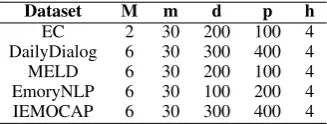
Table 3: Hyper-parameter settings for KET.M: con-text length. m: number of tokens per utterance. d: word embedding size. p: hidden size in FF layer. h: number of heads.
CNN (Kim, 2014): A single-layer CNN with strong empirical performance. This model is trained on the utterance-level without context. CNN+cLSTM (Poria et al., 2017): An CNN is used to extract utterance features. An cLSTM is then applied to learn context representations. BERT BASE(Devlin et al.,2018): Base version of the state-of-the-art model for sentiment classifi-cation. We treat each utterance with its context as a single document. We limit the document length to the last 100 tokens to allow larger batch size. We do not experiment with the large version of BERT due to memory constraint of our GPU. DialogueRNN(Majumder et al.,2019): The state-of-the-art model for emotion detection in textual conversations. It models both context and speak-ers information. The CNN features used in Dia-logueRNN are extracted from the carefully tuned CNN model. For datasets without speaker in-formation, i.e., EC and DailyDialog, we use two speakers only. For MELD and EmoryNLP, which have 260 and 255 speakers, respectively, we addi-tionally experimented with clipping the number of speakers to the most frequent ones (6 main speak-ers + an univspeak-ersal speaker representing all other speakers) and reported the best results.
KET SingleSelfAttn: We replace the hierarchi-cal self-attention by a single self-attention layer to learn context representations. Contextual utter-ances are concatenated together prior to the single self-attention layer.
KET StdAttn: We replace the dynamic context-aware affective graph attention by the standard graph attention (Velikovi et al.,2018).
4.3 Other Experimental Settings
We preprocessed all datasets by lower-casing and tokenization using Spacy2. We keep all tokens in the vocabulary3. We use the released code for BERT BASE and DialogueRNN. For each dataset, all models are fine-tuned based on their performance on the validation set.
For our model in all datasets, we use Adam opti-mization (Kingma and Ba,2014) with a batch size of 64 and learning rate of 0.0001 throughout the training process. We use GloVe embedding ( Pen-nington et al., 2014) for initialization in the word and concept embedding layers4. For the class weights in cross-entropy loss for each dataset, we set them as the ratio of the class distribution in the validation set to the class distribution in the training set. Thus, we can alleviate the problem of unbalanced dataset. The detailed hyper-parameter settings for KET are presented in Table3.
5 Result Analysis
In this section we present model evaluation results, model analysis, and error analysis.
5.1 Comparison with Baselines
We compare the performance of KET against that of the baseline models on the five afore-introduced datasets. The results are reported in Table2. Note that our results for CNN, CNN+cLSTM and Di-alogueRNN on EC, MELD and IEMOCAP are slightly different from the reported results in ( Ma-jumder et al.,2019;Poria et al.,2019).
2
https://spacy.io/
3
We keep tokens with minimum frequency of 2 for Daily-Dialog due to its large vocabulary size
4We use GloVe embeddings from Magnitude Medium:
0 1 2 0.72
0.74 0.76
0 5 10
0.525 0.550
0 5 10
0.500 0.525 0.550
0 5 10
0.34 0.36 0.38
0 5 10
0.50 0.55
0.0 0.5 1.0
EC
0.72 0.74 0.76
0.0 0.5 1.0
DailyDialog
0.52 0.54 0.56
0.0 0.5 1.0
MELD
0.52 0.54 0.56
0.0 0.5 1.0
EmoryNLP
0.34 0.36 0.38
0.0 0.5 1.0
IEMOCAP
[image:8.595.86.509.66.184.2]0.52 0.54
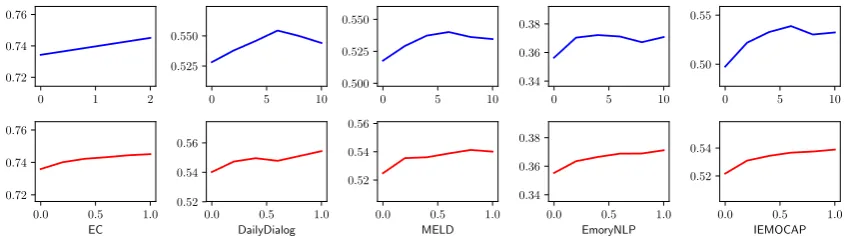
Figure 3: Validation performance by KET. Top: different context length (M). Bottom: different sizes of random fractions of ConceptNet.
cLSTM performs reasonably well on short conversations (i.e., EC and DailyDialog), but the worst on long conversations (i.e., MELD, EmoryNLP and IEMOCAP). One major reason is that learning long dependencies using gated RNNs may not be effective enough because the gradi-ents are expected to propagate back through in-evitably a huge number of utterances and tokens in sequence, which easily leads to the vanishing gradient problem (Bengio et al., 1994). In con-trast, when the utterance-level LSTM in cLSTM is replaced by features extracted by CNN, i.e., the CNN+cLSTM, the model performs signifi-cantly better than cLSTM on long conversations, which further validates that modelling long con-versations using only RNN models may not be sufficient. BERT BASE achieves very competi-tive performance on all datasets except EC due to its strong representational power via bi-directional context modelling using the Transformer. Note that BERT BASE has considerably more param-eters than other baselines and our model (110M for BERT BASE versus 4M for our model), which can be a disadvantage when deployed to devices with limited computing power and memory. The state-of-the-art DialogueRNN model performs the best overall among all baselines. In particular, DialogueRNN performs better than our model on IEMOCAP, which may be attributed to its detailed speaker information for modelling the emotion dy-namics in each speaker as the conversation flows.
It is encouraging to see that our KET model outperforms the baselines on most of the datasets tested. This finding indicates that our model is ro-bust across datasets with varying training sizes, context lengths and domains. Our KET vari-ants KET SingleSelfAttn and KET StdAttn per-form comparably with the best baselines on all
datasets except IEMOCAP. However, both vari-ants perform noticeably worse than KET on all datasets except EC, validating the importance of our proposed hierarchical self-attention and dynamic context-aware affective graph attention mechanism. One observation worth mentioning is that these two variants perform on a par with the KET model on EC. Possible explanations are that 1) hierarchical self-attention may not be crit-ical for modelling short conversations in EC, and 2) the informal linguistic styles of Tweets in EC, e.g., misspelled words and slangs, hinder the con-text representation learning in our graph attention mechanism.
5.2 Model Analysis
We analyze the impact of different settings on the validation performance of KET. All results in this section are averaged over 5 random seeds.
Analysis of context length: We vary the context lengthM and plot model performance in Figure3 (top portion). Note that EC has only a maximum number of 2 contextual utterances. It is clear that incorporating context into KET improves perfor-mance on all datasets. However, adding more con-text is contributing diminishing performance gain or even making negative impact in some datasets. This phenomenon has been observed in a prior study (Su et al.,2018). One possible explanation is that incorporating long contextual information may introduce additional noises, e.g., polysemes expressing different meanings in different utter-ances of the same context. More thorough investi-gation of this diminishing return phenomenon is a worthwhile direction in the future.
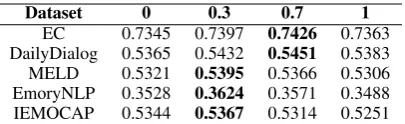
train-Dataset 0 0.3 0.7 1
[image:9.595.81.284.61.123.2]EC 0.7345 0.7397 0.7426 0.7363 DailyDialog 0.5365 0.5432 0.5451 0.5383 MELD 0.5321 0.5395 0.5366 0.5306 EmoryNLP 0.3528 0.3624 0.3571 0.3488 IEMOCAP 0.5344 0.5367 0.5314 0.5251
Table 4: Analysis of the relatedness-affectiveness tradeoff on the validation sets. Each column corre-sponds to a fixedλkfor all concepts (see Equation8).
Dataset KET -context -knowledge
EC 0.7451 0.7343 0.7359
DailyDialog 0.5544 0.5282 0.5402
MELD 0.5401 0.5177 0.5248
EmoryNLP 0.3712 0.3564 0.3553 IEMOCAP 0.5389 0.4976 0.5217
Table 5: Ablation study for KET on the validation sets.
ing and evaluating our model. The results are il-lustrated in Figure 3 (bottom portion). Adding more concepts consistently improves model per-formance before reaching a plateau, validating the importance of commonsense knowledge in detect-ing emotions. We may expect the performance of our KET model to improve with the growing size of ConceptNet in the future.
Analysis of the relatedness-affectiveness trade-off: We experiment with different values ofλk ∈
[0,1](see Equation8) for allkand report the re-sults in Table4. It is clear thatλkmakes a notice-able impact on the model performance. Discard-ing relatedness or affectiveness completely will cause significant performance drop on all datasets, with one exception of IEMOCAP. One possible reason is that conversations in IEMOCAP are emotional dialogues, therefore, the affectiveness factor in our proposed graph attention mechanism can provide more discriminative power.
Ablation Study:We conduct ablation study to in-vestigate the contribution of context and knowl-edge as reported in Table 5. It is clear that both context and knowledge are essential to the strong performance of KET on all datasets. Note that re-moving context has a greater impact on long con-versations than short concon-versations, which is ex-pected because more contextual information is lost in long conversations.
5.3 Error Analysis
Despite the strong performance of our model, it still fails to detect certain emotions on certain datasets. We rank the F1 score of each emotion per dataset and investigate the emotions with the
worst scores. We found that disgust and fear are generally difficult to detect and differentiate. For example, the F1 score of fear emotion in MELD is as low as 0.0667. One possible cause is that these two emotions are intrinsically similar. The VAD values of both emotions have low valence, high arousal and low dominance (Mehrabian, 1996). Another cause is the small amount of data avail-able for these two emotions. How to differentiate intrinsically similar emotions and how to effec-tively detect emotions using limited data are two challenging directions in this field.
6 Conclusion
We present a knowledge-enriched transformer to detect emotions in textual conversations. Our model learns structured conversation represen-tations via hierarchical self-attention and dy-namically refers to external, context-aware, and emotion-related knowledge entities from knowl-edge bases. Experimental analysis demonstrates that both contextual information and common-sense knowledge are beneficial to model perfor-mance. The tradeoff between relatedness and af-fectiveness plays an important role as well. In ad-dition, our model outperforms the state-of-the-art models on most of the tested datasets of varying sizes and domains.
Given that there are similar emotion lexicons to NRC VAD in other languages and ConceptNet is a multilingual knowledge base, our model can be easily adapted to other languages. In addition, given that NRC VAD is the only emotion-specific component, our model can be adapted as a generic model for conversation analysis.
Acknowledgments
References
Muhammad Abdul-Mageed and Lyle Ungar. 2017. Emonet: Fine-grained emotion detection with gated recurrent neural networks. InACL, volume 1, pages 718–728.
Nabiha Asghar, Pascal Poupart, Jesse Hoey, Xin Jiang, and Lili Mou. 2018. Affective neural response gen-eration. InECIR, pages 154–166. Springer.
Dzmitry Bahdanau, Kyunghyun Cho, and Yoshua Ben-gio. 2014. Neural machine translation by jointly learning to align and translate. arXiv preprint arXiv:1409.0473.
Anil Bandhakavi, Nirmalie Wiratunga, Stewart Massie, and Deepak Padmanabhan. 2017. Lexicon genera-tion for emogenera-tion detecgenera-tion from text. IEEE Intelli-gent Systems, 32(1):102–108.
Yoshua Bengio, Patrice Simard, Paolo Frasconi, et al. 1994. Learning long-term dependencies with gradi-ent descgradi-ent is difficult. IEEE Transactions on Neu-ral Networks, 5(2):157–166.
Carlos Busso, Murtaza Bulut, Chi-Chun Lee, Abe Kazemzadeh, Emily Mower, Samuel Kim, Jean-nette N Chang, Sungbok Lee, and Shrikanth S Narayanan. 2008. IEMOCAP: Interactive emotional dyadic motion capture database. Language Re-sources and Evaluation, 42(4):335.
Ankush Chatterjee, Umang Gupta, Manoj Kumar Chinnakotla, Radhakrishnan Srikanth, Michel Gal-ley, and Puneet Agrawal. 2019. Understanding emo-tions in text using deep learning and big data. Com-puters in Human Behavior, 93:309 – 317.
Jianpeng Cheng, Li Dong, and Mirella Lapata. 2016. Long short-term memory-networks for machine reading. InEMNLP, pages 551–561.
Kyunghyun Cho, Bart van Merrienboer, Caglar Gul-cehre, Dzmitry Bahdanau, Fethi Bougares, Holger Schwenk, and Yoshua Bengio. 2014. Learning phrase representations using rnn encoder–decoder for statistical machine translation. InEMNLP, pages 1724–1734.
Zihang Dai, Zhilin Yang, Yiming Yang, William W Cohen, Jaime Carbonell, Quoc V Le, and Ruslan Salakhutdinov. 2019. Transformer-xl: Attentive lan-guage models beyond a fixed-length context. arXiv preprint arXiv:1901.02860.
Laurence Devillers, Ioana Vasilescu, and Lori Lamel. 2002. Annotation and detection of emotion in a task-oriented human-human dialog corpus. In Pro-ceedings of ISLE Workshop.
Laurence Devillers and Laurence Vidrascu. 2006. Real-life emotions detection with lexical and par-alinguistic cues on human-human call center di-alogs. InNinth International Conference on Spoken Language Processing.
Jacob Devlin, Ming-Wei Chang, Kenton Lee, and Kristina Toutanova. 2018. Bert: Pre-training of deep bidirectional transformers for language understand-ing.arXiv preprint arXiv:1810.04805.
Emily Dinan, Stephen Roller, Kurt Shuster, Angela Fan, Michael Auli, and Jason Weston. 2019. Wizard of wikipedia: Knowledge-powered conversational agents. InICLR.
Paul Ekman. 1992. An argument for basic emotions.
Cognition & emotion, 6(3-4):169–200.
Christiane Fellbaum. 2012. Wordnet. The Encyclope-dia of Applied Linguistics.
Marjan Ghazvininejad, Chris Brockett, Ming-Wei Chang, Bill Dolan, Jianfeng Gao, Wen-tau Yih, and Michel Galley. 2018. A knowledge-grounded neural conversation model. InAAAI.
Sangdo Han, Jeesoo Bang, Seonghan Ryu, and Gary Geunbae Lee. 2015. Exploiting knowledge base to generate responses for natural language di-alog listening agents. In Proceedings of the 16th SIGDIAL, pages 129–133.
Yanchao Hao, Yuanzhe Zhang, Kang Liu, Shizhu He, Zhanyi Liu, Hua Wu, and Jun Zhao. 2017. An end-to-end model for question answering over knowl-edge base with cross-attention combining global knowledge. InACL, pages 221–231.
Devamanyu Hazarika, Soujanya Poria, Rada Mihal-cea, Erik Cambria, and Roger Zimmermann. 2018a. Icon: Interactive conversational memory network for multimodal emotion detection. In EMNLP, pages 2594–2604.
Devamanyu Hazarika, Soujanya Poria, Amir Zadeh, Erik Cambria, Louis-Philippe Morency, and Roger Zimmermann. 2018b. Conversational memory net-work for emotion recognition in dyadic dialogue videos. InNAACL, volume 1, pages 2122–2132.
Junqing He, Bing Wang, Mingming Fu, Tianqi Yang, and Xuemin Zhao. 2019. Hierarchical attention and knowledge matching networks with information en-hancement for end-to-end task-oriented dialog sys-tems. IEEE Access, 7:18871–18883.
Sepp Hochreiter and J¨urgen Schmidhuber. 1997. Long short-term memory. Neural Computation, 9(8):1735–1780.
Yajie Hu, Xiaoou Chen, and Deshun Yang. 2009. Lyric-based song emotion detection with affective lexicon and fuzzy clustering method. In ISMIR, pages 123–128.
Eva Hudlicka. 2011. Guidelines for designing compu-tational models of emotions. International Journal of Synthetic Emotions, 2(1):26–79.
Chlo´e Kiddon, Luke Zettlemoyer, and Yejin Choi. 2016. Globally coherent text generation with neu-ral checklist models. InEMNLP, pages 329–339.
Yoon Kim. 2014. Convolutional neural net-works for sentence classification. arXiv preprint arXiv:1408.5882.
Diederik P Kingma and Jimmy Ba. 2014. Adam: A method for stochastic optimization. arXiv preprint arXiv:1412.6980.
Abhishek Kumar, Daisuke Kawahara, and Sadao Kuro-hashi. 2018. Knowledge-enriched two-layered at-tention network for sentiment analysis. InNAACL, volume 2, pages 253–258.
Chul Min Lee and Shrikanth S Narayanan. 2005. To-ward detecting emotions in spoken dialogs. IEEE Transactions on Speech and Audio Processing, 13(2):293–303.
Yanran Li, Hui Su, Xiaoyu Shen, Wenjie Li, Ziqiang Cao, and Shuzi Niu. 2017. Dailydialog: A man-ually labelled multi-turn dialogue dataset. In IJC-NLP, volume 1, pages 986–995.
Shuman Liu, Hongshen Chen, Zhaochun Ren, Yang Feng, Qun Liu, and Dawei Yin. 2018. Knowledge diffusion for neural dialogue generation. In ACL, pages 1489–1498.
Andrea Madotto, Chien-Sheng Wu, and Pascale Fung. 2018. Mem2seq: Effectively incorporating knowl-edge bases into end-to-end task-oriented dialog sys-tems. InACL, volume 1, pages 1468–1478.
Navonil Majumder, Soujanya Poria, Devamanyu Haz-arika, Rada Mihalcea, Alexander Gelbukh, and Erik Cambria. 2019. Dialoguernn: An attentive rnn for emotion detection in conversations. InAAAI.
Albert Mehrabian. 1996. Pleasure-arousal-dominance: A general framework for describing and measuring individual differences in temperament. Current Psy-chology, 14(4):261–292.
Todor Mihaylov and Anette Frank. 2018. Knowledge-able reader: Enhancing cloze-style reading compre-hension with external commonsense knowledge. In
ACL, pages 821–832.
Nikita Moghe, Siddhartha Arora, Suman Banerjee, and Mitesh M Khapra. 2018. Towards exploiting back-ground knowledge for building conversation sys-tems. InEMNLP, pages 2322–2332.
Saif Mohammad. 2018a. Obtaining reliable human rat-ings of valence, arousal, and dominance for 20,000 english words. InACL, pages 174–184.
Saif M. Mohammad. 2018b. Word affect intensities. InLREC.
Bo Pang, Lillian Lee, and Shivakumar Vaithyanathan. 2002. Thumbs up?: sentiment classification using machine learning techniques. InEMNLP, pages 79– 86. Association for Computational Linguistics.
Prasanna Parthasarathi and Joelle Pineau. 2018. Ex-tending neural generative conversational model us-ing external knowledge sources. InEMNLP, pages 690–695.
Jeffrey Pennington, Richard Socher, and Christo-pher D. Manning. 2014. Glove: Global vectors for word representation. InEMNLP, pages 1532–1543.
Soujanya Poria, Erik Cambria, Devamanyu Hazarika, Navonil Majumder, Amir Zadeh, and Louis-Philippe Morency. 2017. Context-dependent sentiment anal-ysis in user-generated videos. In ACL, volume 1, pages 873–883.
Soujanya Poria, Devamanyu Hazarika, Navonil Ma-jumder, Gautam Naik, Erik Cambria, and Rada Mi-halcea. 2018. Meld: A multimodal multi-party dataset for emotion recognition in conversations.
arXiv preprint arXiv:1810.02508.
Soujanya Poria, Navonil Majumder, Rada Mihalcea, and Eduard Hovy. 2019. Emotion recognition in conversation: Research challenges, datasets, and re-cent advances.arXiv preprint arXiv:1905.02947.
Alec Radford, Karthik Narasimhan, Tim Salimans, and Ilya Sutskever. 2018. Improving language under-standing by generative pre-training.
Yi Luan Mirella Lapata Rik Koncel-Kedziorski, Dhanush Bekal and Hannaneh Hajishirzi. 2019. Text Generation from Knowledge Graphs with Graph Transformers. InNAACL.
Armin Seyeditabari, Narges Tabari, and Wlodek Zadrozny. 2018. Emotion detection in text: a re-view. arXiv preprint arXiv:1806.00674.
Dinghan Shen, Guoyin Wang, Wenlin Wang, Mar-tin Renqiang Min, Qinliang Su, Yizhe Zhang, Chun-yuan Li, Ricardo Henao, and Lawrence Carin. 2018. Baseline needs more love: On simple word-embedding-based models and associated pooling mechanisms. InACL, pages 440–450.
Robyn Speer, Joshua Chin, and Catherine Havasi. 2017. Conceptnet 5.5: An open multilingual graph of general knowledge. InAAAI.
Shang-Yu Su, Pei-Chieh Yuan, and Yun-Nung Chen. 2018. How time matters: Learning time-decay at-tention for contextual spoken language understand-ing in dialogues. InNAACL, volume 1, pages 2133– 2142.
Haitian Sun, Bhuwan Dhingra, Manzil Zaheer, Kathryn Mazaitis, Ruslan Salakhutdinov, and William Co-hen. 2018. Open domain question answering us-ing early fusion of knowledge bases and text. In
EMNLP, pages 4231–4242.
Ashish Vaswani, Noam Shazeer, Niki Parmar, Jakob Uszkoreit, Llion Jones, Aidan N Gomez, Łukasz Kaiser, and Illia Polosukhin. 2017. Attention is all you need. InNIPS, pages 5998–6008.
Petar Velikovi, Guillem Cucurull, Arantxa Casanova, Adriana Romero, Pietro Li, and Yoshua Bengio. 2018. Graph attention networks. InICLR.
Sida Wang and Christopher D Manning. 2012. Base-lines and bigrams: Simple, good sentiment and topic classification. InACL, pages 90–94. Association for Computational Linguistics.
Chien-Sheng Wu, Richard Socher, and Caiming Xiong. 2019. Global-to-local memory pointer networks for task-oriented dialogue. InICLR.
Tom Young, Erik Cambria, Iti Chaturvedi, Hao Zhou, Subham Biswas, and Minlie Huang. 2018. Aug-menting end-to-end dialogue systems with common-sense knowledge. InAAAI.
Sayyed M Zahiri and Jinho D Choi. 2018. Emotion de-tection on tv show transcripts with sequence-based convolutional neural networks. In Workshops at AAAI.
Jiacheng Zhang, Huanbo Luan, Maosong Sun, Feifei Zhai, Jingfang Xu, Min Zhang, and Yang Liu. 2018a. Improving the transformer translation model with document-level context. In EMNLP, pages 533–542.
Yuxiang Zhang, Jiamei Fu, Dongyu She, Ying Zhang, Senzhang Wang, and Jufeng Yang. 2018b. Text emotion distribution learning via multi-task convo-lutional neural network. In IJCAI, pages 4595– 4601.
Peixiang Zhong and Chunyan Miao. 2019. ntuer at SemEval-2019 task 3: Emotion classification with word and sentence representations in RCNN. In Se-mEval, pages 282–286.
Peixiang Zhong, Di Wang, and Chunyan Miao. 2019. An affect-rich neural conversational model with bi-ased attention and weighted cross-entropy loss. In
AAAI, pages 7492–7500.
Hao Zhou, Minlie Huang, Tianyang Zhang, Xiaoyan Zhu, and Bing Liu. 2018a. Emotional chatting ma-chine: Emotional conversation generation with in-ternal and exin-ternal memory. InAAAI.
Hao Zhou, Tom Young, Minlie Huang, Haizhou Zhao, Jingfang Xu, and Xiaoyan Zhu. 2018b. Com-monsense knowledge aware conversation generation with graph attention. InIJCAI, pages 4623–4629.