http://go.warwick.ac.uk/lib-publications
Original citation:
Shi, Lei, Gkotsis, George, Stepanyan, Karen, Al Qudah, Dana and Cristea, Alexandra I.
(2013) Social personalized adaptive E-learning environment : topolor -implementation
and evaluation. In: The 16th International Conference on Artificial Intelligence in
Education (AIED 2013), Memphis, USA, 9-13 Jul 2013 (Submitted)
Permanent WRAP url:
http://wrap.warwick.ac.uk/54272
Copyright and reuse:
The Warwick Research Archive Portal (WRAP) makes the work of researchers of the
University of Warwick available open access under the following conditions. Copyright ©
and all moral rights to the version of the paper presented here belong to the individual
author(s) and/or other copyright owners. To the extent reasonable and practicable the
material made available in WRAP has been checked for eligibility before being made
available.
Copies of full items can be used for personal research or study, educational, or
not-for-profit purposes without prior permission or charge. Provided that the authors, title and
full bibliographic details are credited, a hyperlink and/or URL is given for the original
metadata page and the content is not changed in any way.
A note on versions:
The version presented here is a working paper or pre-print that may be later published
elsewhere. If a published version is known of, the above WRAP url will contain details
on finding it.
Social Personalized Adaptive E-Learning Environment:
Topolor - Implementation and Evaluation
Lei Shi, George Gkotsis, Karen Stepanyan, Dana Al Qudah, Alexandra I. Cristea
Department of Computer Science, University of Warwick, CV4 7AL Coventry, UK
{lei.shi, gkotsis, kstepanyan, d.al-qudah, acristea}@dcs.warwick.ac.uk
Abstract. This paper presents a quantitative study on the use of Topolor - a prototype that introduces Web 2.0 tools and Facebook-like appearance into an adaptive educational hypermedia system. We present the system design and its evaluation using system usability scale questionnaire and learning behavior data analysis. The results indicate high level of student satisfaction with the learning experience and the diversity of learning activities.
Keywords: adaptive educational hypermedia, e-learning system, evaluation, learning behavior analysis, social learning.
1 Introduction
Adaptive Educational Hypermedia System (AEHS)[1] makes educational hypermedia adaptive and personalized. Web 2.0 tools enable learners to create, publish and share their study, and facilitate interaction and collaboration. The integration of Web 2.0 tools into AEHS may offer novel opportunities for learner engagement and user modeling. However, there has been a lack of empirical design and evaluation to elaborate methods for the integration. The goal of this research, therefore, is to investigate 1) the potential benefits to integrate Web 2.0 tools into AEHS, and 2) the balance between adaptation and social interaction in an AEHS. In this paper, we present the design and evaluation of an AEHS, Topolor, for web-based personalized learning environment that takes into account social interactions between learners.
2 The Topolor System
Topolor [2,3] is an adaptive personalized e-learning system developed at the University of Warwick. It is built on Yii Framework (http://yiiframework.com) and hosted on Github (https://github.com/aslanshek/topolor). The first version of Topolor (http://www.topolor.com) was launched in November 2012, and has been used as an online learning environment for MSc level students at the University of Warwick.
2.1 System Architecture
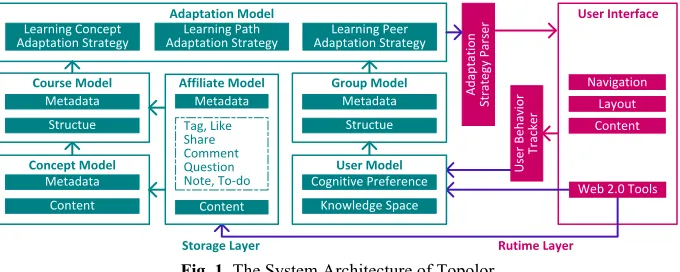
Storage Layer. The main difference from other system architectures is the Affiliate Model, designed for social annotation and collaborative learning. a) Concept Model presents the smallest knowledge unit containing metadata and concrete learning content. b) Course Model presents a self-contained module containing organized Concept Models. c) Affiliate Model is affiliated to a Course Model or a Concept Model. It can be instantiated to tag, share, comment, question, note and to-do. This mechanism can help learners easily interact with each other. d) User Model stores learner’s preference and knowledge space. It’s built on a well-established concept of overlay model [4]. e) Group Model presents a relatively isolated set of learners having the same learning goals. f) Adaptation Model contains adaptation strategies that determine if and how to present entities such as courses, concepts, and learning peers.
Adaptation Model
Learning Path Adaptation Strategy Learning Concept
Adaptation Strategy Adaptation StrategyLearning Peer
Storage Layer Rutime Layer
U
se
r B
eh av io r Tr ac ke r Ad ap ta tio
n
St ra te gy P ar se
r User Interface
Navigation Layout Content
Web 2.0 Tools Metadata
Course Model
Concept Model
Content Metadata
Structue
Affiliate Model
Metadata
Content Type
Tag, Like Share Comment Question Note, To-‐do
Group Model
Metadata Structue
User Model
[image:3.595.129.469.281.417.2]Knowledge Space Cognitive Preference
Fig. 1. The System Architecture of Topolor
Runtime Layer. a) Adaptation Strategy Parser analyzes adaptation strategies to
determine if and how to present learning topics, learning paths and peers. b) User BehaviorTracker monitors user activities and updates user models. c) User Interface consists of the navigation menu, the layout and the content controller. The core components are the Web2.0 tools for social annotation, discussion and collaboration.
3.2 Implementation
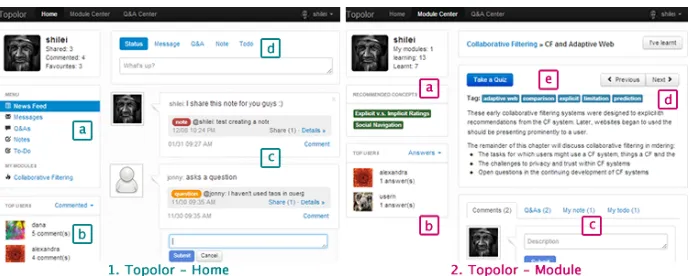
Topolor is implemented using mainly PHP, HTML, CSS, SQL and JavaScript. Fig. 2 shows the screenshot of the ‘Topolor Home’ and ‘Module Center’ sub-systems in Topolor. The numbers in the screenshot highlight the features and functionalities. 1. Topolor – Home page (Facebook-like appearance)
a. Left menu: to check messages, Q&A list, notes list and to-do list. b. Learning peer list: to send messages to recommended learning peers. c. Information flow wall: to share, comment on and favorite posts.
d. Posting tool: to post learning status, messages, questions, notes and to-dos. 2. Topolor – Module page
a. Learning topic adaptation. Topics are recommended according to the number of
tags, which are the same as the topic that the learner is currently learning. b. Learning peer adaptation & Messaging tool. Peers are recommended according
c. Web2.0 tools. Learners can a) comment on this topic, b) ask questions with tags, c) create/edit/tag/share notes, and d) create/edit/tag to-do.
d. By clicking the button ‘previous’ or ‘next’, a learner can review the prerequisite topic or go to the next topic according to the recommended learning path. e. Quiz. When clicking the button ‘Take a Quiz’, s/he will be redirected to the quiz
[image:4.595.126.474.222.360.2]sub-system, where s/he can answer the quiz related to this topic.
Fig. 2. The Screenshot of Topolor: 1. Home page; 2. Module page
4 Evaluation
21 postgraduate students studying computer science at the University of Warwick attended an intensive online course on “Collaborative Filtering”. Before the online course, a ‘functionality list’ was handed out to each student, to inform them about the existing functionalities and to make sure that as many functions as possible are tested.
4.1 Usability of Topolor
The online course lasted for two hours, after which the students were asked to fill in an optional SUS [5] questionnaire for the system usability evaluation. We received 10 (out of 21) students’ responses. The SUS score for the Topolor system was 75.75 out of 100 (σ=12.36, median=76.25). The results’ Cronbach’s alpha value was 0.85 (>0.8), meaning the questionnaire results were reliable. Therefore, we claim that the usability of Topolor meets our initial expectations. We received some qualitative feedbacks from the students as well. Consistently, their responses were positive and supported the SUS result. The qualitative feedback included a description of the system as “similar to known Social Network Sites; fast and responsive”. A student claimed s/he liked the process of asking and answering questions. Another student appraised the system for “providing updates about who else is learning the topic”.
4.2 Learning Behavior Analysis
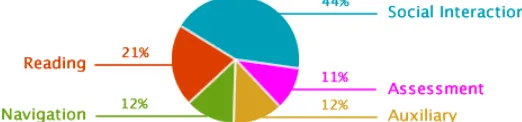
had performed only the social interaction actions. After the exclusion of these 5 students, 16 students ended up with a total sum of 2,175 actions (with an average of 136 actions and a standard deviation of 71 actions per student). In total, 41 different types of raw actions were identified from the log data. These actions were annotated following a higher-level categorization that divided the actions into a) assessment, b) auxiliary, c) social interaction, d) navigation, and e) reading, shown in Fig. 3.
Fig. 3. The proportions and categorizations of learner actions
5 Conclusion
In this paper, we have presented the design and evaluation of the Topolor system; reported a quantitative case study on its usability using SUS questionnaire and learning behavior data analysis. The significant discrepancies between Topolor and other e-learning systems are 1) Topolor provides the Affiliate Model for more convenient social interaction; and 2) Topolor emphasizes that learner familiarity of Web2.0 tools promotes engagement, participation and collaboration. The results from both the system usability evaluation and the learning behavior analysis are positive, which encourages us to continue working in this direction. We believe that the fact that a lot of provided features had a look and feel familiar to the popular Facebook environment, promoted the student engagement, participation and collaboration. It is important to take into consideration the familiarity in designing such systems.
Acknowledgements. This research is partially supported by the Blogforever Project,
funded by the European Commission FP7 (Contract No. 269963).
References
1. Brusilovsky, P.: Adaptive Educational Hypermedia: From generation to generation (Invited talk). In: Proc. of Hellenic Conference on Information and Communication Technologies in Education, Athens, Greece, pp. 19-33 (2004)
2. Shi, L., et al.: Topolor: A Social Personalized Adaptive E-Learning System. In: 21st Conference on User Modeling, Adaptation and Personalization (2013), accepted.
3. Shi, L., et al.: Evaluation of Social Interaction Features in Topolor - A Social Personalized Adaptive E-Learning System. In: 13th IEEE International Conference on Advanced Learning Technologies (2013), accepted.
4. Brusilovsky, P., Millán, E.: User models for adaptive hypermedia and adaptive educational systems. The adaptive web, pp. 3-53 (2007)