1442
Relation Extraction using Explicit Context Conditioning
Gaurav Singh∗
University College London [email protected]
Parminder Bhatia
Amazon
Abstract
Relation Extraction (RE) aims to label rela-tions between groups of marked entities in raw text. Most current RE models learn context-aware representations of the target en-tities that are then used to establish relation between them. This works well for intra-sentence RE and we call them first-order re-lations. However, this methodology can some-times fail to capture complex and long depen-dencies. To address this, we hypothesize that at times two target entities can be explicitly connected via a context token. We refer to such indirect relations as second-order rela-tions and describe an efficient implementation for computing them. These second-order rela-tion scores are then combined with first-order relation scores. Our empirical results show that the proposed method leads to state-of-the-art performance over two biomedical datasets.
1 Introduction
There are wide applications for Information Ex-traction in general (Jin et al.,2018) and Relation Extraction (RE) in particular, one reason why re-lation extraction continues to be an active area of research (Bach and Badaskar, 2007; Kambhatla,
2004;Kumar,2017). Traditionally, a standard RE model would start with entity recognition and then pass the extracted entities as inputs to a separate relation extraction model, which meant that the er-rors in entity recognition were propagated to RE. This problem was addressed by end-to-end mod-els (Miwa and Bansal, 2016; Zheng et al., 2017;
Adel and Sch¨utze,2017;Bhatia et al.,2018) that jointly learn both NER and RE.
Generally, these models consist of an encoder followed by a relationship classification (RC) unit (Verga et al., 2018; Christopoulou et al., 2018;
∗
G. Singh was an intern at Amazon at the time of work
College France
Bill ...
located_in located_in
located_in
Figure 1: Pictorial representation of a second-order re-lation between two entities (Bill&France) connected by a context token (College).
Su et al., 2018). The encoder provides context-aware vector representations for both target enti-ties, which are then merged or concatenated be-fore being passed to the relation classification unit, where a two layered neural network or multi-layered perceptron classifies the pair into different relation types.
Such RE models rely on the encoder to learn ‘perfect’ context-aware entity representations that can capture complex dependencies in the text. This works well for intra-sentence relation extrac-tion i.e. the task of extracting relaextrac-tion from enti-ties contained in a sentence (Christopoulou et al.,
2018;Su et al.,2018). As these entities are closer together, the encoder can more easily establish connection based on the language used in the sen-tence. Additionally, these intra-sentence RE mod-els can use linguistic/syntactical features for an improved performance e.g. shortest dependency path.
multiple sentences. This showed that reliance on the encoder alone to learn these complex depen-dencies does not work well.
In this work we address this issue of over-reliance on the encoder. We propose a model based on the hypothesis that two target entities, whether intra-sentence or cross-sentence, could also be explicitly connected via a third context to-ken (Figure1). More specifically, we find a token in the text that is most related to both target en-tities, and compute the score for relation between the two target entities as the summation of their relation scores with this token. We refer to these relations as second-order relations. At the end, we combine these second-order scores with first-order scores derived from a traditional RE model, and achieve state-of-the-art performance over two biomedical datasets. To summarize the contribu-tion of this work:
1. We propose using second-order relation scores for improved relation extraction.
2. We describe an efficient algorithm to obtain second-order relation scores.
2 Background
In this section we describe the encoder and rela-tion classificarela-tion unit of a SOTA RE model called BRAN (Verga et al.,2018). This model computes relation scores between two entities directly from their representations, therefore we refer to these as first-order relation scores.
2.1 Transformer Encoder
BRAN uses a variant of Transformer (Vaswani et al., 2017) encoder to generate token represen-tations.
The encoder contains repeating blocks and each such block consists of two sublayers: multi-head self-attention layer followed by position-wise con-volutional feedforward layer. There are residual connections and layer normalization (Ba et al.,
2016) after each sublayer. The only difference from a standard transformer-encoder is the pres-ence of a convolution layer of kernel width 5 be-tween two consecutive convolution layers of ker-nels width 1 in the feedforward sublayer. It takes as input word embeddings that are added with po-sitional embeddings (Gehring et al.,2017).
2.2 First-Order Relations
The relation classification unit takes as input to-ken representations from the described encoder. These are then passed through two MLPs to gen-erate head/tail representation eheadi /etaili for each token corresponding to whether it serves the first (head) or second (tail) position in the relation.
eheadi =Whead2(ReLU(Whead1bi)) (1)
etaili =Wtail2(ReLU(Wtail1bi)) (2)
wherebiis the representation of theithtoken
gen-erated by the encoder.
These are then combined with a bi-affine trans-formation operator to compute aN×R×N ten-sor A of pairwise affinity scores for every token pair and all relation types, scoring all triplets of the form(head, relation, tail):
Airj= (eheadi L)etailj , (3)
whereLis a learned tensor of dimensiond×R×d to map pairs of tokens to scores over each of theR relation types anddis the dimension of head/tail representations. Going forward we will drop the subscriptrfor clarity.
The contributions from different mention pairs are then aggregated to give us first-order re-lation scores. This aggregation is done using LogSumExp, which is a smooth approximation ofmaxthat prevents sparse gradients:
scores(1)(phead, ptail) = logX
i∈Phead j∈Ptail
exp(Aij), (4)
wherePhead(Ptail) contains mention indices for head (tail) entity.
3 Proposed Second-Order Relations
In this section we describe in detail our proposed method to obtain second-order relation scores.
Transformer Encoder Text Input
Head MLP-1
Tail MLP-1
Head MLP-2
Tail MLP-2
First Order Scores
Intermediate Scores
Second Order Scores add score
[image:3.595.93.263.64.272.2]with weight ( )α Final Scores
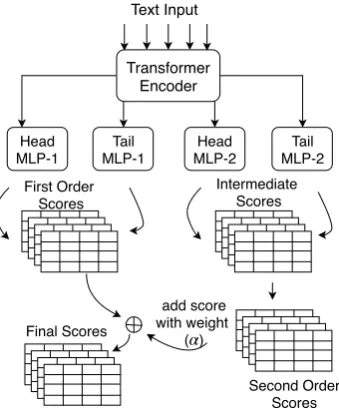
Figure 2: Schematic of the model architecture.
motivated by the need for representations focused on establishing relations with context tokens, as opposed to first-order relations (described in pre-vious section) that attempt to directly connect two target entities.
The head and tail representations are then com-bined with a d×R ×d bilinear transformation tensorM to get aN ×R×N tensorB of inter-mediate pairwise scores.
Bij = (eheadi M)etailj (5)
After that we arbitrarily define the scores be-tween tokensiandjwhen conditionedon a con-text tokenkas the sum of the scores of relations (i, k)and(k, j).
C(i, j|k) =Bik+Bkj (6)
These context-conditioned scores are computed for every triplet of the form(i, j, k).
Second-order relation scores are then derived by aggregating over all context tokens and men-tion pairs usingLogSumExp.
scores(2)(phead, ptail) = logX
k i∈Phead
j∈Ptail
exp(C(i, j|k))
(7)
HereLogSumExpensures that one specific men-tion pair connected via one specific context token is responsible for the relation. This is equivalent to
max-pooling over all context tokens that could po-tentially connect the two target entities, which re-duces over-fitting by removing contributions from noisy associations of the target entities with ran-dom tokens e.g. stopwords.
It is important to mention that a naive imple-mentation of this would require O(N3) space to store context-conditioned scores between all pairs of token i.e. C(i, j|k). To address this, we describe an efficient method in Section 3.1 that avoids explicitly storing these.
At the end, the final score for relation between two entities is given as a weighted sum of first (eq.
4) and second (eq.7) order scores.
scores(phead, ptail) = scores(1)(phead, ptail)
+α∗scores(2)(phead, ptail) (8)
whereαis a hyper-parameter denoting the weight of second-order relation scores.
Entity Recognition. We do entity recognition alongside relation extraction, as the transfer of knowledge between the two tasks has been shown to improve relation extraction performance (Verga et al.,2018;Miwa and Bansal,2016). For this we feed encoder output bi to a linear classifier Wer
that predicts scores for each entity type.
di =Wer(bi) (9)
3.1 Efficient Implementation
The problem lies in storing score for every in-termediate relation of the formC(i, j|k), as that would require space of the orderO(N3). Here we describe a space-time efficient method to compute final second-order relation scores.
The intermediate scores (eq. 5) are a tensor of dimension b×N ×R ×N comprising of pair-wise scores for b batches. We create two ten-sors out of these intermediate scores, namely T1
and T2. T1 computes the exponential of indices
({b, i∈ Phead, j ∈ C, R}) corresponding to pair-wise scores between head entity and all the con-text tokens (C i.e., all the tokens except the two target entities), and sets other indices to0. Simi-larly,T2 computes exponential of indices ({b, i∈
Data Model Pr Re F1
DCN BRAN 0.614 0.850 0.712
+ SOR 0.643 0.879 0.734
i2b2
HDLA 0.378 0.422 0.388
BRAN 0.396 0.403 0.395
+ SOR 0.424 0.419 0.407
CDR BRAN 0.552 0.701 0.618
[image:4.595.87.277.62.171.2]+ SOR 0.552 0.701 0.618
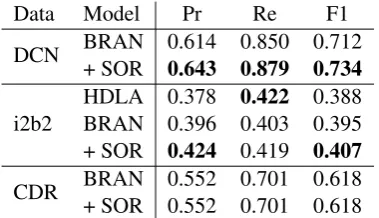
Table 1: The performance of proposed model using second-order relations. BRAN is the model used in (Verga et al.,2018) and +SOR is our proposed model with second-order relations. Results for HDLA are quoted fromChikka and Karlapalem (2018). Results on CDR are identical for both BRAN and our proposed model asαwas set to0after tuning over the dev set at which point our model is the same as BRAN. All the metrics are macro in nature.
Rtwo dimensional slices of sizeN ×N fromT1
and T2 along the dimension of context, but this
would be sequential inR. Instead we can permute T1andT2tob×R×N×N followed by
reshap-ing to bR×N ×N and perform a batch matrix multiplication along the context dimension to get bR×N ×N. Afterwards, we can sum along the last two dimensions to get a tensor of sizebR. Fi-nally, we can take the log succeeded by reshaping tob×Rto obtain second-order scores.
4 Experimentation
4.1 Datasets
We have used three datasets in this work, i2b2 2010 challenge (Uzuner et al., 2011) dataset, a de-identified clinical notes dataset and a chemical-disease relations dataset known as BioCreative V (CDR) (Li et al.,2016;Wei et al.,2016).
Firstis a publicly available subset of the dataset used for the i2b2 2010 challenge. It consists of documents describing relations between different diseases and treatments. Out of the 426 docu-ments available publicly, 10% are used each for both dev and test and the rest for training. There are 3244/409 relations in train/test set and 6 pdefined relations types including one negative re-lation e.g. TrCP (Treatment Causes Problem), TrIP (Tr Improves Pr), TrWP (Tr Worsens Pr). We have used the exact same dataset as Chikkaet al.
(Chikka and Karlapalem,2018).
Second is a dataset of 4200 de-identified clini-cal notes (DCN), with vocabulary size of 50K. It contains approximately 170K relations in the train
set and 50K each in dev/test set. There are 7 pdefined relation types including one negative re-lation type. These are mostly between medica-tion name and other entities e.g. “paracetamol ev-eryday”,“aspirin with dosage100mg”. The fre-quency of different relations in this dataset is fairly balanced.
Third is a widely used and publicly available dataset called CDR (Li et al., 2016; Wei et al.,
2016). It was derived from Comparative Toxi-cogenomics Database (CTD) and contains docu-ments describing the effect of chemicals (drugs) on diseases. There are only two relation types be-tween any two target entities i.e. positive/negative and these relations are annotated at the document level. It consists of 1500 documents that are di-vided equally between train/dev/test sets. There are 1038/1012/1066 positive and 4280/4136/4270 negative relations in train/dev/test sets respec-tively. We performed the same preprocessing as done in BRAN (Verga et al.,2018).
4.2 Experimental Settings
We jointly solve for NER and RE tasks using cross-entropy loss. During training we alternate between mini-batches derived from each task. We fix the learn rate to 0.0005and clip gradient for both tasks at5.0. For training, we used adams op-timizer withβ = (β1, β2) = (0.1,0.9). We tune
over the weight of second-order relations denoted by αto getα = 0.2for DCN/i2b2 and α = 0.0 for CDR dataset.
Our final network had two encoder layers, with 8 attention heads in each multi-head attention sublayer and 256 filters for convolution layers in position-wise feedforward sublayer. We used dropout with probability 0.3 after: embedding layer, head/tail MLPs, output of each encoder sub-layer. We also used a word dropout with probabil-ity0.15before the embedding layer.
4.3 Results
macro-F1 score of 0.388 on the same i2b2 dataset. It should be mentioned that HDLA used syntactic parsers for feature extraction but we do not use any such external tools.
In the case of CDR dataset we obtainedα = 0 after tuning, which means that the proposed model converged to BRAN and the results were identical for the two models. These results are summarized in Table1.
4.4 Ablation Study
We experimented with different ablations of BRAN and noticed an improvement in results for DCN dataset upon removing multi-head self-attention layer. Also, our qualitative analysis showed that relations between distant entities were often wrongly marked negative. We attribute these errors to the token representations generated by the encoder. To this effect, our experiments showed that incorporating relative position (Shaw et al.,2018) information in the encoder to improve token representations does not lead to superior RE. Separately, we observed that the proposed method improved results when using a standard CNN en-coder as well.
5 Conclusions and Future Work
We proposed a method that uses second-order re-lation scores to capture long dependencies for im-proved RE. These relations are derived by explic-itly connecting two target entities via a context to-ken. These second-order relations (SORs) are then combined with traditional relation extraction mod-els, leading to state-of-the-art performance over two biomedical datasets. We also describe an effi-cient implementation for obtaining these SORs.
Despite restricting ourselves to SORs, it should be noted that the proposed method can be general-ized to third and fourth order relations. We conjec-ture that these may serve well for cross-sentence relation extraction in long pieces of texts. Also, we only considered one relation type between each entity and bridge token but it is possible, and very likely that two different relation types may lead to a third relation type. We will explore both these aspects in future work.
Acknowledgements
We would like to thank Busra Celikkaya and Mo-hammed Khalilia of Amazon, Zahra Sabetsarves-tani and Sebastian Riedel of University College
London and the anonymous reviewers of NAACL for their valuable feedback on the paper.
References
Heike Adel and Hinrich Sch¨utze. 2017. Global normal-ization of convolutional neural networks for joint en-tity and relation classification. InProceedings of the 2017 Conference on Empirical Methods in Natural Language Processing, EMNLP 2017.
Jimmy Lei Ba, Jamie Ryan Kiros, and Geoffrey E Hin-ton. 2016. Layer normalization. arXiv preprint arXiv:1607.06450.
Nguyen Bach and Sameer Badaskar. 2007. A survey on relation extraction. Language Technologies In-stitute, Carnegie Mellon University.
Parminder Bhatia, Busra Celikkaya, and Mohammed Khalilia. 2018. End-to-end joint entity extraction and negation detection for clinical text. arXiv preprint arXiv:1812.05270.
Veera Raghavendra Chikka and Kamalakar Karla-palem. 2018. A hybrid deep learning approach for medical relation extraction. arXiv preprint arXiv:1806.11189.
Fenia Christopoulou, Makoto Miwa, and Sophia Ana-niadou. 2018. A walk-based model on entity graphs for relation extraction. InProceedings of the 56th Annual Meeting of the Association for Computa-tional Linguistics (Volume 2: Short Papers), vol-ume 2, pages 81–88.
Jonas Gehring, Michael Auli, David Grangier, De-nis Yarats, and Yann N Dauphin. 2017. Convolu-tional sequence to sequence learning.arXiv preprint arXiv:1705.03122.
Mengqi Jin, Mohammad Taha Bahadori, Aaron Co-lak, Parminder Bhatia, Busra Celikkaya, Ram Bhakta, Selvan Senthivel, Mohammed Khalilia, Daniel Navarro, Borui Zhang, et al. 2018. Im-proving hospital mortality prediction with medical named entities and multimodal learning. arXiv preprint arXiv:1811.12276.
Nanda Kambhatla. 2004. Combining lexical, syntactic, and semantic features with maximum entropy mod-els for extracting relations. In Proceedings of the ACL 2004 on Interactive poster and demonstration sessions, page 22. Association for Computational Linguistics.
Shantanu Kumar. 2017. A survey of deep learn-ing methods for relation extraction. arXiv preprint arXiv:1705.03645.
Makoto Miwa and Mohit Bansal. 2016. End-to-end re-lation extraction using lstms on sequences and tree structures. InProceedings of the Annual Meeting of the Association for Computational Linguistics, ACL 2016.
Peter Shaw, Jakob Uszkoreit, and Ashish Vaswani. 2018. Self-attention with relative position represen-tations. In Proceedings of the 2018 Conference of the North American Chapter of the Association for Computational Linguistics: Human Language Tech-nologies, NAACL-HLT.
Yu Su, Honglei Liu, Semih Yavuz, Izzeddin Gur, Huan Sun, and Xifeng Yan. 2018. Global relation embed-ding for relation extraction. In Proceedings of the 2018 Conference of the North American Chapter of the Association for Computational Linguistics: Hu-man Language Technologies, NAACL-HLT 2018.
¨
Ozlem Uzuner, Brett R South, Shuying Shen, and Scott L DuVall. 2011. 2010 i2b2/va challenge on concepts, assertions, and relations in clinical text. Journal of the American Medical Informatics Asso-ciation, 18(5).
Ashish Vaswani, Noam Shazeer, Niki Parmar, Jakob Uszkoreit, Llion Jones, Aidan N Gomez, Łukasz Kaiser, and Illia Polosukhin. 2017. Attention is all you need. InAdvances in Neural Information Pro-cessing Systems.
Patrick Verga, Emma Strubell, and Andrew McCallum. 2018. Simultaneously self-attending to all mentions for full-abstract biological relation extraction. In Proceedings of the 2018 Conference of the North American Chapter of the Association for Computa-tional Linguistics: Human Language Technologies, NAACL-HLT 2018.
Chih-Hsuan Wei, Yifan Peng, Robert Leaman, Al-lan Peter Davis, Carolyn J Mattingly, Jiao Li, Thomas C Wiegers, and Zhiyong Lu. 2016. Assess-ing the state of the art in biomedical relation extrac-tion: overview of the biocreative v chemical-disease relation (cdr) task. Database, 2016.