Human Centered NLP with User-Factor Adaptation
Veronica E. Lynn, Youngseo Son, Vivek Kulkarni Niranjan Balasubramanian and H. Andrew Schwartz
Stony Brook University Stony Brook, NY
{velynn, yson, vvkulkarni, niranjan, has}@cs.stonybrook.edu
Abstract
We pose the general task of user-factor adaptation — adapting supervised learn-ing models to real-valued user factors in-ferred from a background of their lan-guage, reflecting the idea that a piece of text should be understood within the con-text of the user that wrote it. We intro-duce a continuous adaptation technique, suited for real-valued user factors that are common in social science and bringing us closer to personalized NLP, adapting to each user uniquely. We apply this tech-nique with known user factors including age, gender, and personality traits, as well as latent factors, evaluating over five tasks: POS tagging, PP-attachment, sentiment analysis, sarcasm detection, and stance de-tection. Adaptation provides statistically significant benefits for 3 of the 5 tasks: up to +1.2 points for PP-attachment, +3.4 points for sarcasm, and +3.0 points for stance.
1 Introduction
Language use is personal. Knowing who wrote a piece of text can help to better understand it. For instance, knowing the age and gender groups of authors has been shown to improve document classification (Hovy, 2015) and sentiment ana-lysis (Volkova et al.,2013).
However, putting people into discrete groups (e.g. age groups, binary gender) often relies on arbitrary boundaries which may not correspond to meaningful changes in language use. A wealth of psychological research suggests people should not be characterized as discretetypes(or domains) but rather as mixtures of continuousfactors(McCrae
and Costa Jr., 1989; Ruscio and Ruscio, 2000;
Widiger and Samuel,2005).
Here, we ask how one can adapt NLP models to real-valued humanfactors– continuous valued attributes that capture fine-grained differences be-tween users (e.g. real-valued age, continuous gen-der scores). We refer to this problem as user-factor adaptation, and investigate a solution to it in the context of social media, a genre where lan-guage is generated by a particularly diverse set of users (Duggan and Smith, 2013). Importantly, user-factor adaptationbrings us closer to person-alized NLP in that with real-valued factors we can now adapt uniquely for each user.
Our approach composes user factor information with the linguistic features, similar to feature aug-mentation (Daum´e III, 2007), a widely used do-main adaptation technique which allows for easy integration with most feature-based learning mod-els. Since relevant user information often is not explicitly available, we use a background of tweets from the user to infer user factors. We evaluate our approach over five tasks — POS tagging, PP-attachment, sentiment analysis, sarcasm detection, and stance detection — and with a variety of in-ferred user factors including (a) known factors: age, gender, and personality traits, as well as (b) latent factorsderived from past user tweets.
Contributions. The main contributions of this work include (a) adaptation based simply on back-ground language (e.g. past tweets; no requireda prioriuser knowledge or “domain”), (b) a method for adapting models based on continuous vari-ables, (c) adaptation to other user attributes be-yond age and gender (personality and latent fac-tors), and (d) empirical evidence that standard NLP models can often be improved by user-factor adaptation with a range of inferred factors.
2 User-Factor Adaptation
User-factor adaptation is especially critical for so-cial media, where content is generated by a di-verse user base (Duggan and Smith,2013). Adap-tation requires two components: 1) a user factor representation that captures salient traits indicative of language differences between users, and 2) an adaptation technique that uses this representation to modify learning appropriately.
User factors, even simple ones such as age and gender, may not always be readily available. The messages posted by users, however, are often pub-lic and can be used to infer many known linguisti-cally relevant user traits including personality, as well as latent language factors (described next). Given this background information about users, the user-factor adaptation problem is to learn a single model that is sensitive to both the varia-tions and commonalities in language across differ-ent users.
3 User Factors
The first step in our adaptation approach is to cre-ate a representation of users that relcre-ates to their language use. To this end, we explore two sets of factors: 1) inferred demographics and personality traits, and 2) latent language factors that directly capture language use variations among users.
Different from prior work, we model these hu-man attributes as real-valued factors, as is com-mon in psychology literature. Although they may refer to discrete classes such as cluster member-ship, a factor representation is able to capture more nuanced differences and characteristics that are best understood as a continuum (McCrae and Costa Jr.,1989;Ruscio and Ruscio,2000;Widiger and Samuel, 2005). This is critical for our goal of moving beyond group-level adaptation toward personalization.
3.1 Demographic and Personality Factors Many studies have linked language variations with demographic (Argamon et al., 2007; Cheshire,
2005), occupational (Preot¸iuc-Pietro et al.,2016) and other psychosocial variables such as person-ality (Schwartz et al., 2013). We investigate the relevance of a subset of these social variables as user factors for adaptation.
However, we may not have direct access to such information. Unlike the tweets posted by a user,
their demographic and personality traits are not al-ways publicly available. We use automatic classi-fication models for obtaining real-valued age and gender estimates (Sap et al.,2014) and personality traits (Park et al.,2015). In addition to being rea-sonably accurate (e.g. age prediction has a Pear-sonrof .83 with true age), language based estima-tion of factor scores may capture linguistic prefer-ences more clearly. For instance,Bamman et al.
(2014b) found thatperceivedgender was strongly linked to the gender makeup of a user’s social net-work, and may be a better descriptor of linguistic preferences than self-reported gender.
3.2 Latent Language Factors
We also explore methods to derive latent factors that capture language use similarities and varia-tions across users. The main idea is to derive a la-tentd-dimensional representation of each user us-ing their background tweets. While there are many choices here, we explore a factorization technique (generative factor analysis), a clustering technique (k-means with TF-IDF), and a hybrid (word2vec with k-means).
Generative Factor Analysis. Factorization methods allow us to build latent representations of users by finding low-rank approximations of the original high-dimensional representations of their text. We use a general method called factor analysis (FA) (Lawley and Maxwell,1971). Intu-itively, FA seeks to capture the variability across correlated variables as a weighted linear combi-nation of a given number of latent dimensions, thus allowing a low-dimensional representation of words1.
Formally, letM|U|×|V|denote the user-term ma-trix, whose entries Mij indicate the number of
We produce a k-means clustering on this re-duced dimensional space to create clusters of users who have similar language use. We derive real-valued factors from these clusters using the dis-tance of the user to the centers of each cluster. Cluster membership yields the discrete represen-tation. Refer to section5.1for implementation de-tails.
4 Adaptation Models
Given a factor representation of each user, the adaptation task is to learn a model that is sen-sitive to both the differences and commonalities across all users. This is similar to the objective for domain adaptation tasks, where the task data is drawn from one or more underlying domains and learning needs to account for both the simi-larities and differences in the domains. We formu-late user-factor adaptation as a domain adaptation technique based on feature augmentation (Daum´e III,2007) but rather than force users into discrete domains, we develop a continuous formulation that allows us to make good use of the real-valued user factors.
Here we first describe a direct discrete formula-tion of feature augmentaformula-tion and then describe our proposed continuous formulation.
4.1 Discrete Adaptation
Feature augmentation uses domain information to transform instances into a new augmented space such that instances from the same domain have higher similarity in the augmented space com-pared to instances from different domains. A learner operating over this augmented space can now learn to model both domain-specific and domain-general influences of the features.
The discrete adaptation method is a direct ap-plication of this idea, where the training and test instances are mapped into domains based on some grouping that we induce from the user factors. For example, the user factorageinduces three discrete domains:low(age <24),middle(24< age <
28), andhigh(age >28).
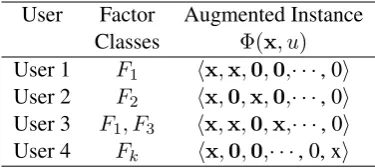
Given the instance domain mapping, feature augmentation transforms the instances based on their domain. Suppose the original instances have n features and suppose there are d discrete fac-tor classes (F1,· · · , Fd) i.e., d domains. Given
an instance which is mapped to a factor classFi,
augmentation creates a new feature vector that has
User Factor Augmented Instance Classes Φ(x, u)
User 1 F1 hx,x,0,0,· · ·, 0i
User 2 F2 hx,0,x,0,· · ·, 0i
User 3 F1, F3 hx,x,0,x,· · ·, 0i
User 4 Fk hx,0,0,· · ·, 0, xi
Table 1: Discrete Factor Adaptation: Augmen-tations of an original instance vectorxunder dif-ferent factor class mappings. Withkdomains the augmented feature vector is of lengthn(k+ 1).
d+ 1 feature sets of length n each. The origi-nal features are copied over to the first feature set for all instances regardless of their domain. For instances from domaini, the original features are copied over to feature seti+ 1. The other feature sets are zeroes. Table1shows some examples of this augmentation strategy for a single instance,x, under different factor class mappings.
These augmented instances are used for train-ing and testtrain-ing without any further modifications to the original learning formulation.
4.2 Continuous Adaptation
Discrete adaptation ignores the continuous nature of user factors. Unlike the commonly considered domains, people don’t fit neatly into discrete bins. Many psychological studies have shown the in-effectiveness of treating user factors as discrete types (McCrae and Costa Jr., 1989); we expect an adaptation method which does so to be sim-ilarly ineffective. For most factors the bound-aries for determining classes is unclear, and such arbitrarily-drawn boundaries may not correspond to big changes in language use.
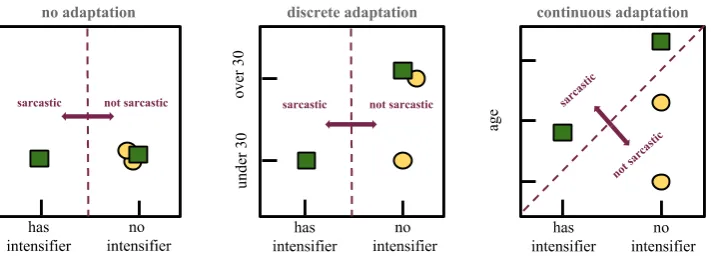
[image:3.595.322.510.62.146.2]Figure 1: Comparison of feature augmentation under discrete and continuous adaptations. Each shape represents a particular observation (e.g. a tweet) to be classified, each from a different user. The x-axis represents a particular boolean feature: whether the tweet has an intensifier. The y-x-axis represents how the feature is augmented by the users’ age using both discrete adaptation (middle) and continuous adaptation (right). Continuous adaptation allows us to distinguish observations where discrete may not.
separation as shown in the figure.
A compositional function c combines d user factor scoresfu,dwith original feature valuesx:
Φ(x, u) =hx, c(fu,1,x), c(fu,2,x),· · · , c(fu,d,x)i
Thus, a version of each feature exists with and without the factor information integrated. We will explore a simple multiplicative compositional function (i.e.,c(fu,d,x) =fu,d·x) but others can
be imagined (e.g. additive, multiplicative with ker-nel functions).
Multiplicative composition has the property of reducingΦto discrete adaptation when the factors are binary i.e., c(fu,d,x) = xwhen u ∈ Fd and
c(fu,d,x) = 0otherwise. As with discrete
adapta-tion, learning then proceeds unmodified with these augmented instances.
The augmented training data(trainaug) is thus
associated with the featuresxof the tweet, the task labelsy, and the user informationu. Following the feature augmentation formulation, any supervised learning task of finding a parametrized functionhθ
over the original labeled training data can now be specified in terms of the augmented training data along with the transformed instances:
arg min
θ
X
(x,y,u)∈trainaug
loss(hθ(Φ(x, u), y))
For test instances we apply the same transforma-tion functransforma-tionΦbefore prediction.
5 Evaluation
We apply user-factor adaptation to five popular NLP tasks: part-of-speech tagging,
prepositional-phrase attachment, sentiment analysis, sarcasm detection, and stance detection. These represent both syntactic and semantic tasks; include some of the key steps in an NLP application pipeline; and use different types of learning formulations including logistic regression, conditional random fields, and support vector machines.
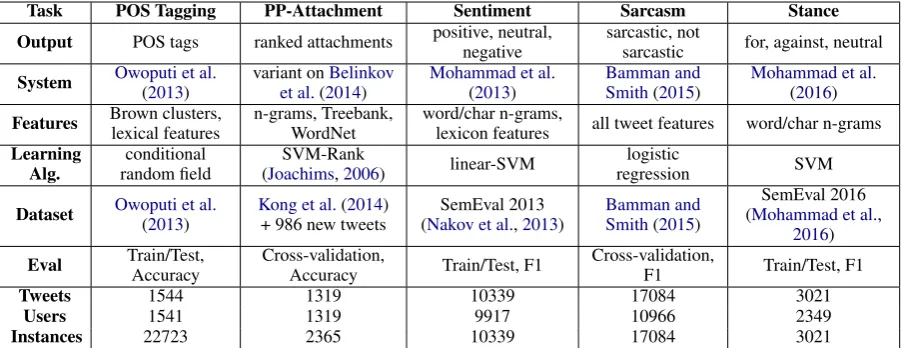
We demonstrate the value of user-factor adap-tation on strong baselines for each task. Table2
provides the specific details for each task includ-ing the systems used and their configurations.
5.1 Implementation Details
We learn factors from a user’s background lan-guage, or past tweets2. To do so, we collect up
to 200 tweets per user; users with fewer than 20 tweets were excluded. Retweets were not included and all tweets were tokenized using the Happier Fun Tokenizer3.
Demographics and Personality. We derive real-valued demographics and personality scores using the models introduced in section 3.1. For demographics, our model predicts continuous age and a gender score where higher values imply more “femaleness”. For personality, these scores represent the Big Five personality traits: open-ness to experience, conscientiousopen-ness, extraver-sion, agreeableness, and neuroticism (Goldberg,
1990;McCrae and Costa Jr.,1997). Age, gender, and the five personality dimensions are each a sin-gle factor.
Task POS Tagging PP-Attachment Sentiment Sarcasm Stance Output POS tags ranked attachments positive, neutral,negative sarcastic, notsarcastic for, against, neutral
System Owoputi et al.(2013) variant onet al.(2014Belinkov) Mohammad et al.(2013) Bamman andSmith(2015) Mohammad et al.(2016) Features Brown clusters,lexical features n-grams, Treebank,WordNet word/char n-grams,lexicon features all tweet features word/char n-grams
Learning
Alg. random fieldconditional (JoachimsSVM-Rank,2006) linear-SVM regressionlogistic SVM
Dataset Owoputi et al.(2013) Kong et al.+ 986 new tweets(2014) (Nakov et al.SemEval 2013,2013) Bamman andSmith(2015) (Mohammad et al.SemEval 2016 ,
2016)
Eval Train/Test,Accuracy Cross-validation,Accuracy Train/Test, F1 Cross-validation,F1 Train/Test, F1
Tweets 1544 1319 10339 17084 3021
Users 1541 1319 9917 10966 2349
Instances 22723 2365 10339 17084 3021
Table 2: Overview of the experimental setup for all tasks. Choices were dictated primarily by the literature on top performing systems for each task.
Latent Language Factors. We use three meth-ods to derive latent factors: (1)tf-idf: The TF-IDF approach uses unigrams, bigrams, and trigrams occurring in more than 20% but fewer than 80% of documents. (2)word2vec: The skip-grams al-gorithm (Mikolov et al.,2013) was used to pro-duce 50-dimensional word embeddings. (3) user-embed: d-dimensional user embeddings from generative factor analysis (Child, 1990) over rel-ative frequencies of n-grams per user-background. The TF-IDF and word2vec representations are then clustered to produce a low-dimensional repre-sentation of the users. Each dimension is a single factor. We primarily report results ford=5 for all latent factors, although we explore alternate values in Section5.3.
Discrete Adaptation. Each user is mapped to a single “domain” per factor. For inferred age, we select three equally-sized domains: age < 24,
24 < age < 28, and age > 28. TF-IDF and word2vec define their domains based on cluster membership. Gender, personality, and user em-beddings have two domains, above and below the mean, which is done on a per-dimension basis.
Continuous Adaptation. We apply transforma-tions to the raw factor scores before using them for adaptation. For demographic and personality factors, we apply a min-max transformation. Be-cause language often does not vary linearly with age (Pennebaker and Stone, 2003), we addition-ally use the square root of the predicted age. For the cluster based latent factors, we use the inverse of the Euclidean distance of the user-background
from the cluster centroid, amplifying the power of those users who are closest to each cluster. User embeddings from factor analysis are used with-out any transforms since they naturally produce a Gaussian distribution.
5.2 Results
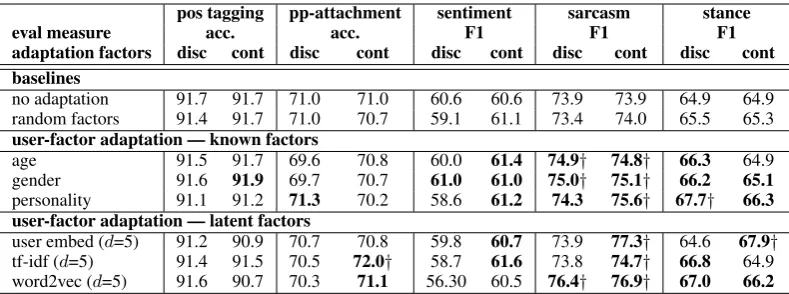
Table3 presents the main adaptation results. We compare the performance of adaptation techniques against two baselines: no inclusion of additional factors or adaptation, and models with factors ran-domly drawn from a Gaussian distribution – a sit-uation requiring learning the same number of pa-rameters as our most augmented models. For the random factor baseline, we take the average per-formance across five iterations for both discrete and continuous adaptation. To establish signifi-cance of difference in error between adaptation re-sults and the no-adaptation baseline, we use per-mutation testing for stance detection and McNe-mar’s test for the others. Our findings follow. While these conclusions were drawn from our own experiments, we encourage future researchers to see what works best on their own tasks and datasets.
[image:5.595.74.525.62.236.2]pos tagging pp-attachment sentiment sarcasm stance
eval measure acc. acc. F1 F1 F1
adaptation factors disc cont disc cont disc cont disc cont disc cont
baselines
no adaptation 91.7 91.7 71.0 71.0 60.6 60.6 73.9 73.9 64.9 64.9 random factors 91.4 91.7 71.0 70.7 59.1 61.1 73.4 74.0 65.5 65.3
user-factor adaptation — known factors
age 91.5 91.7 69.6 70.8 60.0 61.4 74.9† 74.8† 66.3 64.9
gender 91.6 91.9 69.7 70.7 61.0 61.0 75.0† 75.1† 66.2 65.1
personality 91.1 91.2 71.3 70.2 58.6 61.2 74.3 75.6† 67.7† 66.3 user-factor adaptation — latent factors
[image:6.595.101.496.61.208.2]user embed (d=5) 91.2 90.9 70.7 70.8 59.8 60.7 73.9 77.3† 64.6 67.9† tf-idf (d=5) 91.4 91.5 70.5 72.0† 58.7 61.6 73.8 74.7† 66.8 64.9 word2vec (d=5) 91.6 90.7 70.3 71.1 56.30 60.5 76.4† 76.9† 67.0 66.2
Table 3: Results of user-factor adaptation across all tasks. Adaptation results are shown in comparison with baseline performance (1) without adaptation and (2) with adaptation using randomly-assigned fac-tors.discdenotes discrete adaptation results, andcontdenotes continuous adaptation results.†indicates statistically significant results at0.05level, in comparison to the no-adaptation baseline.
et al.,2013), we hypothesize that the ambiguity in POS reduces greatly when conditioning on local context compared to demographic preferences. This coupled with the ceiling effect in a strong baseline may explain the lack of improvements. (ii) Continuous is better than discrete: For PP-attachment, sarcasm, and sentiment, continuous adaptation is better than discrete in all but three of the eighteen configurations. Binning people into discrete groups is hard and lossy; using continuous weights helps avoid this issue. Stance, however, is the one task where discrete works better for most factors. As we show in Section5.4, demographics and personality scores are them-selves highly predictive of stances on issues; we believe this makes the simpler binning approach more reliable than the continuous model.
(iii) Both known and latent factors are helpful: Sarcasm benefits from age, gender and personality based adaptations, while stance benefits from personality. The demographic and personality factors do not help PP-attachment. Language factors help all tasks except POS tagging.
(iv) Latent factors provide best gains: The latent language factors provide the best observed gains for all of the tasks where we saw a significant improvement: PP-attachment, sentiment, sarcasm, and stance. The language factors model users di-rectly in terms of the similarities (and differences) in their entire language use, whereas the inferred demographic and personality factors focus more on a subset of their language as it relates to the particular attribute.
(v) Expanding feature space alone is not enough:
One possible explanation for the gains with factors are that the expanded feature space could somehow provide more capacity for learners to generalize. However, adapting to random factors typically lowered results, suggesting that models using more features but not more information naturally take a hit.
5.3 Background Size and Number of Factors
(a) Background size effects for cases with large adaptation gains: sarcasm when using personality and user-embedding factors.
[image:7.595.310.524.68.185.2](b) Gains over unadapted baseline for sarcasm using TF-IDF, user embeddings, and word2vec with varying number of fac-tors.
Figure 2: Adaptation performance compared against background size and number of factors.
5.4 Factors as Direct Features
One way to use the factors is to add them as di-rect features to the instances, without adaptation. Table4compares how the most beneficial known factor, personality, performs when added directly as a feature to the two tasks where it had the high-est impact.
task base direct adapt best sarcasm 73.9 75.6† 75.6† 77.3†
[image:7.595.74.285.69.189.2]stance 64.9 65.5 67.7† 67.9†
Table 4: Effects of including personality scores as direct features, rather than doing adaptation. Other tasks had no benefit from direct features. Best col-umn shows best result achieved with adaptation using any factor.
For sarcasm, adding personality as a direct fea-ture itself leads to a strong improvement on par with using it for adaptation. For stance, however, we see that while there is an improvement over the baseline, it is not as large as that from adap-tation. We observed little-to-no improvement for POS tagging, sentiment or PP-attachment when using personality as direct features. This reflects the relative complexity of the relationships be-tween user factors and class labels for each task. Note that while direct features provide benefits, the overall possible gain with adaptation using any factor (shown in best column) is larger.
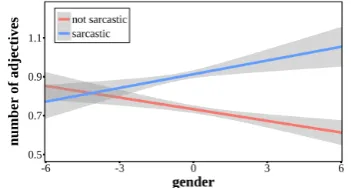
Including user factors as direct features is ben-eficial when there is a linear relationship with the class label, such as with gender and sarcasm use. In contrast, user-factor adaptation can capture more complex relationships between user groups and their language expression. Figure 3, for
in-Figure 3: There is a positive correlation between gender and adjective use for sarcastic tweets, and a negative correlation for non-sarcastic tweets. Higher gender scores indicate a greater degree of “femaleness”, whereas lower scores represent more “maleness” according to the gender predic-tion model.
stance, shows a three-way interaction between gender scores, adjective use and sarcasm. Increase in the number of adjectives is a positive indicator of sarcasm for women (high gender scores) but is a negative indicator for men (low gender scores). We observe similar trends for age: phrases such as “thanks” and “love it” tend to be meant sarcasti-cally by younger users and sincerely by older ones. User-factor adaptation can model these interaction relationships when direct features alone may not.
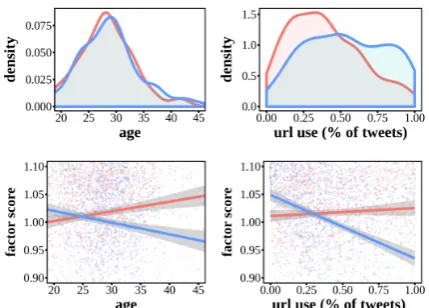
[image:7.595.327.503.270.364.2] [image:7.595.80.280.376.418.2]Figure 4: Kernel densities (top) and scatter plots (bottom) of users’ age and use of URLs broken down by TF-IDF latent dimension. Colors rep-resent each dimension and are consistent across plots. Lines in scatter plots represent best-fit linear regression. Shaded regions indicate standard er-ror. On the left, discrete latent factors do not seem to distinguish by age (top) but come apart when treated continuously (bottom). On the other hand, discrete and continuous seem to partially capture a dimension of how often someone mentions URLs. discrete representation: kernel density plots show age and URL use distributions for users binned into the two factor dimensions, shown here in red and blue. The bottom gives the continuous repre-sentation: scatter plots show the relationship be-tween age and URL use and the factor score for each dimension.
In the discrete view, age distributions are similar for both factors; there is no apparent relationship between factor membership and age. However, in the continuous view there is a clear negative corre-lation for age with the factor score for blue and a positive one for red. This indicates that the fac-tors are capturing meaningful information about user age: those with a high factor score for blue tend to be younger, whereas those with a low fac-tor score are older. The reverse is true for red. The URL use shows some difference between the two dimensions in the discrete view, and again we see strong and differing linear relationships with the continuous view.
Overall, the latent factors appear to capture both user attributes and posting behavior, with the con-tinuous version providing additional benefits in characterizing these relationships. The lack of a clear differentiation in the discrete case hints at the difficulty in capturing linguistic variance by split-ting users into discrete groups.
6 Related Work
Modeling users has a long history of successful applications in providing personalized informa-tion access (Dou et al.,2007;Teevan et al.,2005) and recommendations (Guy et al.,2009;Li et al.,
2010;Morales et al.,2012). In contrast, this work models users to better understand their content via language processing tasks following ideas from demographics-aware and domain adaptation.
User-level language variance affects lexical choices (Preot¸iuc-Pietro et al., 2016) and even syntactic aspects of language (Johannsen et al., 2015). Such variations can result in demographics-based bias in low-level tasks such as POS tagging (Hovy and Søgaard,2015) and can also impact high-level applications such as senti-ment analysis (Volkova et al.,2013) and machine translation (Mirkin et al.,2015), motivating demo-graphics and personality-based adaptations.
Consequently, recent works have explored demographics-aware NLP (Volkova et al., 2013;
Bamman et al., 2014a; Kulkarni et al., 2016;
Hovy,2015;Yang and Eisenstein,2015).Volkova et al. (2013) propose a gender-aware model and demonstrate superior performance over a gender-agnostic model on the task of sentiment ana-lysis. Bamman et al.(2014a) and Kulkarni et al.
(2016) analyze regional linguistic variation using region-specific word embeddings on online so-cial media. Hovy (2015) advances this line of research further and learns group-specific word embeddings, showing improvements over general embeddings on three types of text classification tasks. When author demographics are not avail-able,Yang and Eisenstein(2015) show that learn-ing community-specific embeddlearn-ings uslearn-ing social networks can help improve sentiment analysis. A similar approach with a social theory-based opti-mization also showed improvements for sentiment analysis (Hu et al.,2013). For sarcasm detection, historical information about the author and their past context (e.g. entities they discuss) have been shown to be helpful (Bamman and Smith,2015;
et al.,2013), and (c) only requires a background of language – by using inferred factors from a back-ground of language, we require noa priori knowl-edge of user traits.
7 Conclusion
Language on social media reflects the diversity in its user base and motivates the need for robust models that can handle the resulting variations by user attributes. We have introduced user-factor adaptation, a method to adapt typical supervised language classifiers based on factors of the user authoring the language. Our approach requires nothing more than a background of language by the user and only needs access to the features used by the supervised learner. Since it requires no other modifications to the learner, our approach can be easily applied to many NLP tasks.
To the best of our knowledge, this represents the first work to use the idea of continuous-valued variables for language processing adapta-tion. Continuous adaptation to a variety of user factors brings us closer to personalized NLP and outperforms discrete adaptation over four different tasks: part-of-speech tagging, preposition-phrase attachment, sentiment analysis, and sarcasm de-tection. Adaptations with data-driven latent fac-tors produced the largest gains. We see this work as part of a growing trend to put language not just within its document-wide context, but also within the context of the human being that wrote it. Acknowledgments
This publication was made possible, in part, through the support of a grant from the Temple-ton Religion Trust – TRT0048. We wish to thank the following colleagues for their annotation help for the PP-attachment task: Chetan Naik, Heey-oung Kwon, Ibrahim Hammoud, Jun Kang, Ma-soud Rouhizadeh, Mohammadzaman Zamani, and Samuel Louvan.
References
Shlomo Argamon, Moshe Koppel, James W. Pen-nebaker, and Jonathan Schler. 2007. Mining the blogosphere: Age, gender and the varieties of self-expression. First Monday, 12(9).
David Bamman, Chris Dyer, and Noah A. Smith. 2014a. Distributed representations of geographi-cally situated language. Proceedings of ACL, pages 828–834.
David Bamman, Jacob Eisenstein, and Tyler Schnoe-belen. 2014b. Gender identity and lexical varia-tion in social media. Journal of Sociolinguistics, 18(2):135–160.
David Bamman and Noah A Smith. 2015. Contextual-ized sarcasm detection on Twitter. InNinth Interna-tional AAAI Conference on Web and Social Media. Yonatan Belinkov, Tao Lei, Regina Barzilay, and Amir
Globerson. 2014. Exploring compositional architec-tures and word vector representations for preposi-tional phrase attachment.TACL, 2:561–572. Jenny Cheshire. 2005. Syntactic variation and
be-yond: Gender and social class variation in the use of discourse-new markers. Journal of Sociolinguis-tics, 9(4):479–508.
Dennis Child. 1990.The Essentials of Factor Analysis. Cassell Educational.
Hal Daum´e III. 2007. Frustratingly easy domain adap-tation. InProceedings of ACL.
Zhicheng Dou, Ruihua Song, and Ji-Rong Wen. 2007. A large-scale evaluation and analysis of personal-ized search strategies. InProceedings of WWW. Maeve Duggan and Aaron Smith. 2013. Demographics
of key social networking platforms. Pew Research on Social Media.
Lewis R. Goldberg. 1990. An alternative “descrip-tion of personality”: The Big-Five factor struc-ture. Journal of Personality and Social Psychology, 59(6):1216.
Ido Guy, Naama Zwerdling, David Carmel, Inbal Ro-nen, Erel Uziel, Sivan Yogev, and Shila Ofek-Koifman. 2009. Personalized recommendation of social software items based on social relations. In Proceedings of RecSys.
Dirk Hovy. 2015. Demographic factors improve clas-sification performance. InProceedings of ACL. Dirk Hovy and Anders Søgaard. 2015. Tagging
perfor-mance correlates with author age. InProceedings of ACL.
Xia Hu, Lei Tang, Jiliang Tang, and Huan Liu. 2013. Exploiting social relations for sentiment analysis in microblogging. InProceedings of WSDM.
Thorsten Joachims. 2006. Training linear SVMs in lin-ear time. InProceedings of KDD, pages 217–226. ACM.
Anders Johannsen, Dirk Hovy, and Anders Søgaard. 2015. Cross-lingual syntactic variation over age and gender. InProceedings of CONLL.
on Computational Approaches to Subjectivity, Senti-ment and Social Media Analysis (WASSA), page 25. Lingpeng Kong, Nathan Schneider, Swabha Swayamdipta, Archna Bhatia, Chris Dyer, and Noah A. Smith. 2014. A dependency parser for tweets. InProceedings of EMNLP.
Vivek Kulkarni, Bryan Perozzi, and Steven Skiena. 2016. Freshman or fresher? Quantifying the geo-graphic variation of language in online social media. InTenth International AAAI Conference on Web and Social Media.
Derrick Norman Lawley and Albert Ernest Maxwell. 1971. Factor analysis as a statistical method, vol-ume 18. JSTOR.
Lihong Li, Wei Chu, John Langford, and Robert E. Schapire. 2010. A contextual-bandit approach to personalized news article recommendation. In Pro-ceedings of WWW.
Robert R. McCrae and Paul T. Costa Jr. 1989. Rein-terpreting the Myers-Briggs type indicator from the perspective of the five-factor model of personality. Journal of Personality, 57(1):17–40.
Robert R. McCrae and Paul T. Costa Jr. 1997. Person-ality trait structure as a human universal. American Psychologist, 52(5):509.
Tomas Mikolov, Ilya Sutskever, Kai Chen, Greg Cor-rado, and Jeffrey Dean. 2013. Distributed represen-tations of words and phrases and their composition-ality. InProceedings of NIPS.
Shachar Mirkin, Scott Nowson, Caroline Brun, and Julien Perez. 2015. Motivating personality-aware machine translation. InProceedings of EMNLP. Saif M. Mohammad, Svetlana Kiritchenko, Parinaz
Sobhani, Xiaodan Zhu, and Colin Cherry. 2016. SemEval-2016 task 6: Detecting stance in tweets. InProceedings of SemEval-2016, volume 16. Saif M. Mohammad, Svetlana Kiritchenko, and
Xiao-dan Zhu. 2013. NRC-Canada: Building the state-of-the-art in sentiment analysis of tweets. In Proceed-ings of SemEval-2013.
Gianmarco De Francisci Morales, Aristides Gionis, and Claudio Lucchese. 2012. From chatter to head-lines: Harnessing the real-time web for personalized news recommendation. InProceedings of WSDM. Preslav Nakov, Zornitsa Kozareva, Alan Ritter, Sara
Rosenthal, Veselin Stoyanov, and Theresa Wilson. 2013. SemEval-2013 task 2: Sentiment analysis in Twitter.
Olutobi Owoputi, Brendan O’Connor, Chris Dyer, Kevin Gimpel, Nathan Schneider, and Noah A. Smith. 2013. Improved part-of-speech tagging for online conversational text with word clusters. In Proceedings of NAACL-HLT.
Gregory Park, H. Andrew Schwartz, Johannes C. Eich-staedt, Margaret L. Kern, Michal Kosinski, David J. Stillwell, Lyle H. Ungar, and Martin E. P. Seligman. 2015. Automatic personality assessment through social media language. Journal of Personality and Social Psychology, 108(6):934.
James W. Pennebaker and Lori D. Stone. 2003. Words of wisdom: Language use over the life span. Jour-nal of PersoJour-nality and Social Psychology, 85(2):291. Daniel Preot¸iuc-Pietro, Wei Xu, and Lyle Ungar. 2016. Discovering user attribute stylistic differences via paraphrasing. InProceedings of AAAI.
Ashwin Rajadesingan, Reza Zafarani, and Huan Liu. 2015. Sarcasm detection on twitter: A behavioral modeling approach. InProceedings of WSDM. John Ruscio and Ayelet Meron Ruscio. 2000.
Inform-ing the continuity controversy: A taxometric ana-lysis of depression. Journal of Abnormal Psychol-ogy, 109(3):473–487.
Maarten Sap, Gregory J. Park, Johannes C. Eichstaedt, Margaret L. Kern, David Stillwell, Michal Kosinski, Lyle H. Ungar, and Hansen Andrew Schwartz. 2014. Developing age and gender predictive lexica over so-cial media. InProceedings of EMNLP.
H. Andrew Schwartz, Johannes C. Eichstaedt, Mar-garet L. Kern, Lukasz Dziurzynski, Stephanie M. Ramones, Megha Agrawal, Achal Shah, Michal Kosinski, David Stillwell, Martin E. P. Seligman, and Lyle H. Ungar. 2013. Personality, gender, and age in the language of social media: The open-vocabulary approach. PloS ONE, 8(9):e73791. Jaime Teevan, Susan T. Dumais, and Eric Horvitz.
2005. Personalizing search via automated analysis of interests and activities. InSIGIR.
Svitlana Volkova, Theresa Wilson, and David Yarowsky. 2013. Exploring demographic lan-guage variations to improve multilingual sentiment analysis in social media. InProceedings of EMNLP. Thomas A. Widiger and Douglas B. Samuel. 2005. Diagnostic categories or dimensions? A question for the Diagnostic and Statistical Manual of Men-tal Disorders—Fifth Edition. Journal of Abnormal Psychology, 114(4):494.