Proceedings of the 2007 Joint Conference on Empirical Methods in Natural Language Processing and Computational
Using Semantic Roles to Improve Question Answering
Dan Shen
Spoken Language Systems Saarland University Saarbruecken, Germany
Mirella Lapata
School of Informatics University of Edinburgh
Edinburgh, UK
Abstract
Shallow semantic parsing, the automatic identification and labeling of sentential con-stituents, has recently received much atten-tion. Our work examines whether seman-tic role information is beneficial to question answering. We introduce a general frame-work for answer extraction which exploits semantic role annotations in the FrameNet paradigm. We view semantic role assign-ment as an optimization problem in a bipar-tite graph and answer extraction as an in-stance of graph matching. Experimental re-sults on the TREC datasets demonstrate im-provements over state-of-the-art models.
1 Introduction
Recent years have witnessed significant progress in developing methods for the automatic identification and labeling of semantic roles conveyed by senten-tial constituents.1The success of these methods, of-ten referred to collectively asshallow semantic pars-ing(Gildea and Jurafsky, 2002), is largely due to the availability of resources like FrameNet (Fillmore et al., 2003) and PropBank (Palmer et al., 2005), which document the surface realization of semantic roles in real world corpora.
More concretely, in the FrameNet paradigm, the meaning of predicates (usually verbs, nouns, or ad-jectives) is conveyed by frames, schematic repre-sentations of situations. Semantic roles (or frame
1The approaches are too numerous to list; we refer the inter-ested reader to Carreras and M`arquez (2005) for an overview.
elements) are defined for each frame and corre-spond to salient entities present in the evoked situ-ation. Predicates with similar semantics instantiate the same frame and are attested with the same roles. The FrameNet database lists the surface syntactic realizations of semantic roles, and provides anno-tated example sentences from the British National Corpus. For example, the frameCommerce Sellhas three core semantic roles, namelyBuyer,Goods, and
Seller— each expressed by an indirect object, a di-rect object, and a subject (see sentences (1a)–(1c)). It can also be attested with non-core (peripheral) roles (e.g.,Means, Manner, see (1d) and (1e)) that are more generic and can be instantiated in sev-eral frames, besidesCommerce Sell. The verbssell, vend, and retail can evoke this frame, but also the nounssale and vendor.
(1) a. [Lee]Seller sold a textbook [to Abby]Buyer.
b. [Kim]Sellersold [the sweater]Goods. c. [My company]Seller has sold [more
than three million copies]Goods. d. [Abby]Seller sold [the car]Goods[for
cash]Means.
e. [He]Seller [reluctanctly]Manner sold [his rock]Goods.
By abstracting over surface syntactic configura-tions, semantic roles offer an important first step to-wards deeper text understanding and hold promise for a range of applications requiring broad cover-age semantic processing. Question answering (QA) is often cited as an obvious beneficiary of semantic
role labeling (Gildea and Jurafsky, 2002; Palmer et al., 2005; Narayanan and Harabagiu, 2004). Faced with the question Q: What year did the U.S. buy Alaska? and the retrieved sentence S:. . .before Rus-sia sold Alaska to the United States in 1867, a hypo-thetical QA system must identify thatUnited States is theBuyerdespite the fact that it is attested in one instance as a subject and in another as an object. Once this information is known, isolating the correct answer (i.e.,1867 ) can be relatively straightforward. Although conventional wisdom has it that seman-tic role labeling ought to improve answer extraction, surprising little work has been done to this effect (see Section 2 for details) and initial results have been mostly inconclusive or negative (Sun et al., 2005; Kaisser, 2006). There are at least two good reasons for these findings. First, shallow semantic parsers trained on declarative sentences will typi-cally have poor performance on questions and gen-erally on out-of-domain data. Second, existing re-sources do not have exhaustive coverage and recall will be compromised, especially if the question an-swering system is expected to retrieve answers from unrestricted text. Since FrameNet is still under de-velopment, its coverage tends to be more of a prob-lem in comparison to other semantic role resources such as PropBank.
In this paper we propose an answer extraction model which effectively incorporates FrameNet-style semantic role information. We present an auto-matic method for semantic role assignment which is conceptually simple and does not require extensive feature engineering. A key feature of our approach is the comparison of dependency relation paths at-tested in the FrameNet annotations and raw text. We formalize the search for an optimal role assignment as an optimization problem in a bipartite graph. This formalization allows us to find an exact, globally op-timal solution. The graph-theoretic framework goes some way towards addressing coverage problems re-lated with FrameNet and allows us to formulate an-swer extraction as a graph matching problem. As a byproduct of our main investigation we also exam-ine the issue of FrameNet coverage and show how much it impacts performance in a TREC-style ques-tion answering setting.
In the following section we provide an overview of existing work on question answering systems that
exploit semantic role-based lexical resources. Then we define our learning task and introduce our ap-proach to semantic role assignment and answer ex-traction in the context of QA. Next, we present our experimental framework and data. We conclude the paper by presenting and discussing our results.
2 Related Work
Question answering systems have traditionally de-pended on a variety of lexical resources to bridge surface differences between questions and potential answers. WordNet (Fellbaum, 1998) is perhaps the most popular resource and has been employed in a variety of QA-related tasks ranging from query expansion, to axiom-based reasoning (Moldovan et al., 2003), passage scoring (Paranjpe et al., 2003), and answer filtering (Leidner et al., 2004). Besides WordNet, recent QA systems increasingly rely on syntactic information as a means of abstracting over word order differences and structural alternations (e.g., passive vs. active voice). Most syntax-based QA systems (Wu et al., 2005) incorporate some means of comparison between the tree representing the question with the subtree surrounding the answer candidate. The assumption here is that appropriate answers are more likely to have syntactic relations in common with their corresponding question. Syn-tactic structure matching has been applied to pas-sage retrieval (Cui et al., 2005) and answer extrac-tion (Shen and Klakow, 2006).
SemStruc ac1
SemStruc ac2
SemStruc aci
SemStruc q
Sent. Model I Q Model I
Model II
[image:3.612.75.288.65.156.2]Answer
Figure 1: Architecture of answer extraction
question paraphrasing method based on FrameNet. Questions are assigned semantic roles by matching their dependency relations with those attested in the FrameNet annotations. The assignments are used to create question reformulations which are submitted to Google for answer extraction. The semantic role assignment module is not probabilistic, it relies on strict matching, and runs into severe coverage prob-lems.
In line with previous work, our method exploits syntactic information in the form of dependency re-lation paths together with FrameNet-like semantic roles to smooth lexical and syntactic divergences be-tween question and answer sentences. Our approach is less domain dependent and resource intensive than Narayanan and Harabagiu (2004), it solely employs a dependency parser and the FrameNet database. In contrast to Kaisser (2006), we model the semantic role assignment and answer extraction tasks numer-ically, thereby alleviating the coverage problems en-countered previously.
3 Problem Formulation
We briefly summarize the architecture of the QA system we are working with before formalizing the mechanics of our FrameNet-based answer extraction module. In common with previous work, our over-all approach consists of three stages: (a) determining the expected answer type of the question, (b) retriev-ing passages likely to contain answers to the tion, and (c) performing a match between the ques-tion words and retrieved passages in order to extract the answer. In this paper we focus on the last stage: question and answer sentences are normalized to a FrameNet-style representation and answers are re-trieved by selecting the candidate whose semantic structure is most similar to the question.
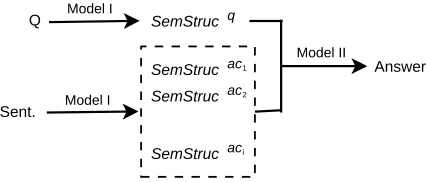
The architecture of our answer extraction
mod-ule is shown in Figure 1. Semantic structures for questions and sentences are automatically derived using the model described in Section 4 (Model I). A semantic structure SemStruc=hp,Set(SRA)i con-sists of a predicate p and a set of semantic role as-signments Set(SRA). p is a word or phrase evok-ing a frameF of FrameNet. A semantic role assign-mentSRA is a ternary structure hw,SR,si, consist-ing of frame element w, its semantic role SR, and scores indicating to what degreeSR qualifies as a label forw.
For a question q, we generate a semantic struc-tureSemStrucq. Question words, such aswhat, who, when, etc., are considered expected answer phrases (EAPs). We require that EAPs are frame elements of SemStrucq. Likely answer candidates are ex-tracted from answer sentences following some pre-processing steps detailed in Section 6. For each candidate ac, we derive its semantic structure
SemStrucac and assume that ac is a frame ele-ment of SemStrucac. Question and answer seman-tic structures are compared using a model based on graph matching detailed in Section 5 (Model II). We calculate the similarity of all derived pairs hSemStrucq,SemStrucaci and select the candidate with the highest value as an answer for the question.
4 Semantic Structure Generation
Our method crucially exploits the annotated sen-tences in the FrameNet database together with the output of a dependency parser. Our guiding assump-tion is that sentences that share dependency rela-tions will also share semantic roles as long as they evoke the same or related frames. This is motivated by much research in lexical semantics (e.g., Levin (1993)) hypothesizing that the behavior of words, particularly with respect to the expression and in-terpretation of their arguments, is to a large ex-tent determined by their meaning. We first describe how predicates are identified and then introduce our model for semantic role labeling.
pre-ferred to other parts of speech, (2) if there is more than one verb in the question, preference is given to the verb with the highest level of embedding in the dependency tree, (3) if no verbs are present, a noun is chosen. For example, inQ: Who beat Floyd Pat-terson to take the title away?, beat, take away, and title are identified as predicate candidates and beat is selected the main predicate of the question. For answer sentences, we require that the predicate is ei-ther identical or semantically related to the question predicate (see Section 5).
In the example given above, the predicate beat evoques a single frame (i.e.,Cause harm). However, predicates often have multiple meanings thus evo-quing more than one frame. Knowing which is the appropriate frame for a given predicate impacts the semantic role assignment task; selecting the wrong frame will unavoidably result in erroneous semantic roles. Rather than disambiguiting polysemous pred-icates prior to semantic role assignment, we perform the assignment for each frame evoqued by the pred-icate.
Semantic Role Assignment Before describing
our approach to semantic role labeling we define dependency relation paths. A relation path R is a relation sequence hr1,r2, ...,rLi, in which rl (l =
1,2, ...,L) is one of predefined dependency relations
with suffix of traverse direction. An example of a relation path is R=hsub jU,ob jDi, where the sub-scripts U and D indicate upward and downward movement in trees, respectively. Given an unanno-tated sentence whose roles we wish to label, we as-sume that words or phrases w with a dependency path connecting them topare frame elements. Each frame element is represented by anunlabeled depen-dency path Rw which we extract by traversing the dependency tree fromwto p. Analogously, we ex-tract from the FrameNet annotations all dependency pathsRSR that arelabeled with semantic role infor-mation and correspond to p. We next measure the compatibility of labeled and unlabeled paths as fol-lows:
s(w,SR) =
maxRSR∈M[sim(Rw,RSR)·P(RSR)]
(2)
where M is the set of dependency relation paths forSRin FrameNet,sim(Rw,RSR)the similarity be-tween paths Rw and RSR weighted by the relative
w SR
w SR
[image:4.612.352.495.64.184.2](a) (b)
Figure 2: Sample original bipartite graph (a) and its subgraph with edge covers (b). In each graph, the left partition represents frame elements and the right partition semantic roles.
frequency of RSR in FrameNet (P(RSR)). We con-sider both core and non-core semantic roles instan-tiated by frames with at least one annotation in FrameNet. Core roles tend to have more annotations in Framenet and consequently are considered more probable.
We measure sim(Rw,RSR), by adapting a string kernel to our task. Our hypothesis is that the more common substrings two dependency paths have, the more similar they are. The string kernel we used is similar to Leslie (2002) and defined as the sum of weighted common dependency rela-tion subsequences between Rw and RSR. For effi-ciency, we consider only unigram and bigram sub-sequences. Subsequences are weighted by a metric akin tot f·id f which measures the degree of asso-ciation between a candidateSRand the dependency relation rpresent in the subsequence:
weightSR(r) = fr·log
µ
1+N nr
¶
(3)
where fr is the frequency ofr occurring inSR;N is the total number ofSRs evoked by a given frame; andnris the number ofSRs containingr.
Q: Who discovered prions?
S: 1997: Stanley B. Prusiner, United States, discovery of prions, ...
SemStrucq
p: discover
Original SR assignments:
Optimized SR assignments: 0.06 Cognizer Phenomenon Ground State Evidence EAP prions 0 0 0 0 0.01 0.1 0.05 0.05 0.02 0.06 Cognizer Phenomenon Ground State Evidence EAP prions 0.1 0.05 0.05 0.02
SemStrucac(ac: Stanley B. Prusiner)
p: discovery
Original SR assignments:
[image:5.612.72.291.83.283.2]Optimized SR assignments: 0.25 Cognizer Phenomenon Topic Evidence ac prions 0.15 0.2 0.16 0.25 Cognizer Phenomenon Topic Evidence ac prions 0.15 0.2 0.16 0.12 0.07 0 0
Figure 3: Semantic structures induced by our model for a question and answer sentence
we could simply select the semantic role with the highest score. However, this decision procedure is
local, i.e., it yields a semantic role assignment for each frame element independently of all other ele-ments. We therefore may end up with the same role being assigned to two frame elements or with frame elements having no role at all. We remedy this short-coming by treating the semantic role assignment as aglobaloptimization problem.
Specifically, we model the interaction betweenall
pairwise labeling decisions as a minimum weight bipartite edge cover problem (Eiter and Mannila, 1997; Cormen et al., 1990). An edge cover is a sub-graph of a bipartite sub-graph so that each node is linked to at least one node of the other partition. This yields a semantic role assignment for all frame elements (see Figure 2b where frame elements and roles are adjacent to an edge). Edge covers have been success-fully applied in several natural language processing tasks, including machine translation (Taskar et al., 2005) and annotation projection (Pad´o and Lapata, 2006).
Formally, optimal edge cover assignments are so-lutions of following optimization problem:
max
Eis edge cover(ndw,
∏
ndSR)∈Es(ndw,ndSR)
(4)
where, s(ndw,ndSR) is the compatibility score
be-tween the frame element nodendwand semantic role nodendSR. Edge covers can be computed efficiently in cubic time using algorithms for the equivalent linear assignment problem. Our experiments used Jonker and Volgenant’s (1987) solver.2
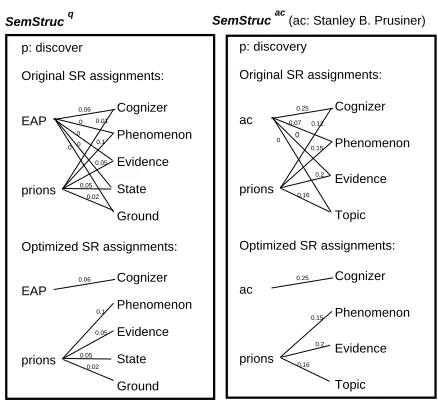
Figure 3 shows the semantic role assignments generated by our model for the question Q: Who discovered prions? and the candidate answer sen-tence S: 1997: Stanley B. Prusiner, United States, discovery of prions. . . Here we identify two predi-cates, namelydiscover and discovery. The expected answer phrase (EAP) who and the answer candi-dateStanley B. Prusiner are assigned the COGNIZER role. Note that frame elements can bear multiple se-mantic roles. By inducing a soft labeling we hope to render the matching of questions and answers more robust, thereby addressing to some extent the cover-age problems associated with FrameNet.
5 Semantic Structure Matching
We measure the similarity between a question and its candidate answer by matching their predicates and semantic role assignments. Since SRs are frame-specific, we prioritize frame matching to SR match-ing. Two predicates match if they evoke the same frame or one of its hypernyms (or hyponyms). The latter are expressed by theInherits FromandIs In-herited Byrelations in the frame definitions. If the predicates match, we examine whether the assigned semantic roles match. Since we represent SR assign-ments as graphs with edge covers, we can also for-malize SR matching as a graph matching problem.
The similarity between two graphs is measured as the sum of similarities between their subgraphs. We first decompose a graph into subgraphs consist-ing of one frame element node w and a set of SR nodes connected to it. The similarity between two subgraphsSubG1, andSubG2is then formalized as:
(5)
Sim(SubG1,SubG2) =
∑ ndSR
1 ∈SubG1
ndSR
2 ∈SubG2
ndSR
1 =nd2SR
1 |s(ndw,ndSR
1 )−s(ndw,nd2SR)|+1
where,ndSR
1 andndSR2 are semantic role nodes con-nected to a frame element node ndw inSubG
1 and
2The software is available fromhttp://www.magiclogic.
1757 [11, 20]
2117 [21, 50]
439 [51, 100]
40 [101, INF)
3380 0
1175 [1, 5]
1287 [6, 10]
Figure 4: Distribution of Numbers of Predicates and annotated sentences; each sub-pie, lists the number of predicates (above) with their corresponding range of annotated sentences (below)
SubG2, respectively. s(ndw,nd1sr) and s(ndw,ndSR2 ) are edge weights between two nodes in correspond-ing subgraphs (see (2)). Our intuition here is that the more semantic roles two subgraphs share for a given frame element, the more similar they are and the closer their corresponding edge weights should be. Edge weights are normalized by dividing by the sum of all edges in a subgraph.
6 Experimental Setup
Data All our experiments were performed on the TREC02–05 factoid questions. We excluded NIL questions since TREC doesn’t supply an answer for them. We used the FrameNet V1.3 lexical database. It contains 10,195 predicates grouped into 795 se-mantic frames and 141,238 annotated sentences. Figure 4 shows the number of annotated sentences available for different predicates. As can be seen, there are 3,380 predicates with no annotated sen-tences and 1,175 predicates with less than 5 anno-tated sentences. All FrameNet sentences, questions, and answer sentences were parsed using MiniPar (Lin, 1994), a robust dependency parser.
As mentioned in Section 4 we extract depen-dency relation paths by traversing the dependepen-dency tree from the frame element node to the predicate node. We used all dependency relations provided by MiniPar (42 in total). In order to increase cov-erage, we combine all relation paths for predicates
that evoke the same frame and are labeled with the same POS tag. For example, found and establish are both instances of the frameIntentionally create
but the database does not have any annotated sen-tences forfound.v. In default of not assigning any role labels forfound.v, our model employs the rela-tion paths for the semantically relatedestablish.v.
Preprocessing Here we summarize the steps of
our QA system preceding the assignment of seman-tic structure and answer extraction. For each ques-tion, we recognize its expected answer type (e.g., in Q: Which record company is Fred Durst with? we would expect the answer to be an ORGANIZA-TION ). Answer types are determined using classi-fication rules similar to Li and Roth (2002). We also reformulate questions into declarative sentences fol-lowing the strategy proposed in Brill et al. (2002).
The reformulated sentences are submitted as queries to an IR engine for retrieving sentences with relevant answers. Specifically, we use the Lemur Toolkit3, a state-of-the-art language model-driven search engine. We work only with the 50 top-ranked sentences as this setting performed best in previ-ous experiments of our QA system. We also add to Lemur’s output gold standard sentences, which con-tain and support an answer for each question. Specif-ically, documents relevant for each question are re-trieved from the AQUAINT Corpus4 according to TREC supplied judgments. Next, sentences which match both the TREC provided answer pattern and at least one question key word are extracted and their suitability is manually judged by humans. The set of relevant sentences thus includes at least one sentence with an appropriate answer as well as sentences that do not contain any answer specific information. This setup is somewhat idealized, however it allows us to evaluate in more detail our answer extraction mod-ule (since when an answer is not found, we know it is the fault of our system).
Relevant sentences are annotated with their named entities using Lingpipe5, a MUC-based named entity recognizer. When we successfully classify a question with an expected answer type
3Seehttp://www.lemurproject.org/ for details. 4This corpus consists of English newswire texts and is used as the main document collection in official TREC evaluations.
5The software is available from www.alias-i.com/
(e.g.,ORGANIZATION in the example above), we assume that all NPs attested in the set of relevant sentences with the same answer type are candidate answers; in cases where no answer type is found (e.g., as inQ: What are prions made of? ), all NPs in the relevant answers set are considered candidate answers.
Baseline We compared our answer extraction
method to a QA system that exploits solely syntac-tic information without making use of FrameNet or any other type of role semantic annotations. For each question, the baseline identifies key phrases deemed important for answer identification. These are verbs, noun phrases, and expected answer phrases (EAPs, see Section 3). All dependency relation paths con-necting a key phrase and an EAP are compared to those connecting the same key phrases and an swer candidate. The similarity of question and an-swer paths is computed using a simplified version of the similarity measure6 proposed in Shen and Klakow (2006).
Our second baseline employs Shalmaneser (Erk and Pad´o, 2006), a publicly available shallow se-mantic parser7, for the role labeling task instead of the graph-based model presented in Section 4. The software is trained on the FrameNet annotated sen-tences using a standard feature set (see Carreras and M`arquez (2005) for details). We use Shalmaneser to parse questions and answer sentences. The parser makes hard decisions about the presence or absence of a semantic role. Unfortunately, this prevents us from using our method for semantic structure match-ing (see Section 5) which assumes a soft labelmatch-ing. We therefore came up with a simple matching strat-egy suitable for the parser’s output. For question and answer sentences matching in their frame as-signment, phrases bearing the same semantic role as the EAP are considered answer candidates. The lat-ter are ranked according to word overlap (i.e., iden-tical phrases are ranked higher than phrases with no
6Shen and Klakow (2006) use a dynamic time warping al-gorithm to calculate the degree to which dependency relation paths are correlated. Correlations for individual relations are es-timated from training data whereas we assume a binary value (1 for identical relations and 0 otherwise). The modification was necessary to render the baseline system comparable to our an-swer extraction model which is unsupervised.
7The software is available from http://www.coli.
uni-saarland.de/projects/salsa/shal/ .
overlap at all).
7 Results
Our evaluation was motivated by the following ques-tions: (1) How does the incompleteness of FrameNet impact QA performance on the TREC data sets? In particular, we wanted to examine whether there are questions for which in principle no answer can be found due to missing frame entries or missing an-notated sentences. (2) Are all questions and their corresponding answers amenable to a FrameNet-style analysis? In other words, we wanted to assess whether questions and answers often evoke the same or related frames (with similar roles). This is a pre-requisite for semantic structure matching and ulti-mately answer extraction. (3) Do the graph-based models introduced in this paper bring any perfor-mance gains over state-of-the-art shallow semantic parsers or more conventional syntax-based QA sys-tems? Recall that our graph-based models were de-signed especially for the QA answer extraction task. Our results are summarized in Tables 1–3. Table 1 records the number of questions to be answered for the TREC02–05 datasets (Total). We also give infor-mation regarding the number of questions which are in principleunanswerablewith a FrameNet-style se-mantic role analysis.
Column NoFrame shows the number of questions which don’t have an appropriate frame or predicate in the database. For example, there is currently no predicate entry forsponsor or sink (e.g., Q: Who is the sponsor of the International Criminal Court? andQ: What date did the Lusitania sink? ). Column NoAnnot refers to questions for which no semantic role labeling is possible because annotated sentences for the relevant predicates are missing. For instance, there are no annotations forwin (e.g., Q: What divi-sion did Floyd Patterson win? ) or for hit (e.g., Q: What was the Beatles’ first number one hit?). This problem is not specific to our method which admit-tedly relies on FrameNet annotations for performing the semantic role assignment (see Section 4). Shal-low semantic parsers trained on FrameNet would also have trouble assigning roles to predicates for which no data is available.
Data Total NoFrame NoAnnot NoMatch Rest
TREC02 444 87 (19.6) 29 (6.5) 176 (39.6) 152 (34.2)
TREC03 380 55 (14.5) 30 (7.9) 183 (48.2) 112 (29.5)
TREC04 203 47 (23.1) 14 (6.9) 67 (33.0) 75 (36.9)
[image:8.612.101.504.63.134.2]TREC05 352 70 (19.9) 23 (6.5) 145 (41.2) 114 (32.4)
Table 1: Number of questions which cannot be answered using a FrameNet style semantic analysis; numbers in parentheses are percentages of Total (NoFrame: frames or predicates are missing; NoAnnot: annotated sentences are missing, NoMatch: questions and candidate answers evoke different frames.
mismatches. Consider Q: What does AARP stand for? whose answer is found in S: The American Association of Retired Persons (AARP) qualify for discounts. . .. The answer and the question evoke dif-ferent frames; in fact here a semantic role analysis is not relevant for locating the right answer. As can be seen NoMatch cases are by far the most frequent. The number of questions remaining after excluding NoFrame, NoAnnot, and NoMatch are shown under the Rest heading in Table 1.
These results indicate that FrameNet-based se-mantic role analysis applies to approximately 35% of the TREC data. This means that an extraction module relying solely on FrameNet will have poor performance, since it will be unable to find answers for more than half of the questions beeing asked. We nevertheless examine whether our model brings any performance improvements on this limited dataset which is admittedly favorable towards a FrameNet style analysis. Table 2 shows the results of our an-swer extraction module (SemMatch) together with two baseline systems. The first baseline uses only dependency relation path information (SynMatch), whereas the second baseline (SemParse) uses Shal-maneser, a state-of-the-art shallow semantic parser for the role labeling task. We consider an answer correct if it is returned with rank 1. As can be seen, SemMatch is significantly better than both Syn-Match and SemParse, whereas the latter is signifi-cantly worse than SynMatch.
Although promising, the results in Table 2 are not very informative, since they show performance gains on partial data. Instead of using our answer extrac-tion model on its own, we next combined it with the syntax-based system mentioned above (SynMatch, see also Section 6 for details). If FrameNet is indeed helpful for QA, we would expect an ensemble
sys-Model TREC02 TREC03 TREC04 TREC05
SemParse 13.16 8.92 17.33 13.16
SynMatch 35.53∗ 33.04∗ 40.00∗ 36.84∗ SemMatch 53.29∗† 49.11∗† 54.67∗† 59.65∗†
Table 2: System Performance on subset of TREC datasets (see Rest column in Table 1); ∗: signifi-cantly better than SemParse;†: significantly better than SynMatch (p<0.01, using aχ2test).
Model TREC02 TREC03 TREC04 TREC05
SynMatch 32.88∗ 30.70∗ 35.95∗ 34.38∗
+SemParse 25.23 23.68 28.57 26.70
+SemMatch 38.96∗† 35.53∗† 42.36∗† 41.76∗†
Table 3: System Performance on TREC datasets (see Total column in Table 1);∗: significantly better than +SemParse; †: significantly better than SynMatch (p<0.01, using aχ2test).
tem to yield better performance over a purely syn-tactic answer extraction module. The two systems were combined as follows. Given a question, we first pass it to our FrameNet model; if an answer is found, our job is done; if no answer is returned, the ques-tion is passed on to SynMatch. Our results are given in Table 3. +SemMatch and +SemParse are ensem-ble systems using SynMatch together with the QA specific role labeling method proposed in this pa-per and Shalmaneser, respectively. We also compare these systems against SynMatch on its own.
the shallow semantic parser performs considerably worse in comparison to our graph-based models and the syntax-based system. Inspection of the parser’s output highlights two explanations for this. First, the shallow semantic parser has difficulty assigning ac-curate semantic roles to questions (even when they are reformulated as declarative sentences). And sec-ondly, it tends to favor precision over recall, thus re-ducing the number of questions for which answers can be found. A similar finding is reported in Sun et al. (2005) for a PropBank trained parser.
8 Conclusion
In this paper we assess the contribution of semantic role labeling to open-domain factoid question an-swering. We present a graph-based answer extrac-tion model which effectively incorporates FrameNet style role semantic information and show that it achieves promising results. Our experiments show that the proposed model can be effectively combined with a syntax-based system to obtain performance superior to the latter when used on its own. Fur-thermore, we demonstrate performance gains over a shallow semantic parser trained on the FrameNet an-notated corpus. We argue that performance gains are due to the adopted graph-theoretic framework which is robust to coverage and recall problems.
We also provide a detailed analysis of the appro-priateness of FrameNet for QA. We show that per-formance can be compromised due to incomplete coverage (i.e., missing frame or predicate entries as well as annotated sentences) but also because of mismatching question-answer representations. The question and the answer may evoke different frames or the answer simply falls outside the scope of a given frame (i.e., in a non predicate-argument struc-ture). Our study shows that mismatches are rela-tively frequent and motivates the use of semantically informed methods in conjunction with syntax-based methods.
Important future directions lie in evaluating the contribution of alternative semantic role frameworks (e.g., PropBank) to the answer extraction task and developing models that learn semantic roles di-rectly from unannotated text without the support of FrameNet annotations (Grenager and Manning, 2006). Beyond question answering, we also plan to
investigate the potential of our model for shallow semantic parsing since our experience so far has shown that it achieves good recall.
Acknowledgements We are grateful to Sebastian Pad´o for running Shalmaneser on our data. Thanks to Frank Keller and Amit Dubey for insightful comments and suggestions. The authors acknowledge the support of DFG (Shen; PhD stu-dentship within the International Postgraduate College “Lan-guage Technology and Cognitive Systems”) and EPSRC (Lap-ata; grant EP/C538447/1).
References
E. Brill, S. Dumais, M. Banko. 2002. An analysis of the askMSR question-answering system. InProceedings of the EMNLP, 257–264, Philadelphia, PA.
X. Carreras, L. M`arquez, eds. 2005. Proceedings of the CoNLL shared task: Semantic role labelling, 2005. T. Cormen, C. Leiserson, R. Rivest. 1990. Introduction
to Algorithms. MIT Press.
H. Cui, R. X. Sun, K. Y. Li, M. Y. Kan, T. S. Chua. 2005. Question answering passage retrieval using de-pendency relations. InProceedings of the ACM SIGIR, 400–407. ACM Press.
T. Eiter, H. Mannila. 1997. Distance measures for point sets and their computation. Acta Informatica, 34(2):109–133.
K. Erk, S. Pad´o. 2006. Shalmaneser - a flexible toolbox for semantic role assignment. InProceedings of the LREC, 527–532, Genoa, Italy.
C. Fellbaum, ed. 1998. WordNet. An Electronic Lexical Database. MIT Press, Cambridge/Mass.
C. J. Fillmore, C. R. Johnson, M. R. Petruck. 2003. Background to FrameNet. International Journal of Lexicography, 16:235–250.
D. Gildea, D. Jurafsky. 2002. Automatic labeling of se-mantic roles. Computational Linguistics, 28(3):245– 288.
T. Grenager, C. D. Manning. 2006. Unsupervised dis-covery of a statistical verb lexicon. InProceedings of the EMNLP, 1–8, Sydney, Australia.
R. Jonker, A. Volgenant. 1987. A shortest augmenting path algorithm for dense and sparse linear assignment problems. Computing, 38:325–340.
M. Kaisser. 2006. Web question answering by exploiting wide-coverage lexical resources. InProceedings of the 11th ESSLLI Student Session, 203–213.
J. Leidner, J. Bos, T. Dalmas, J. Curran, S. Clark, C. Ban-nard, B. Webber, M. Steedman. 2004. The qed open-domain answer retrieval system for TREC 2003. In
Proceedings of the TREC, 595–599.
C. Leslie, E. Eskin, W. S. Noble. 2002. The spectrum kernel: a string kernel for SVM protein classification. In Proceedings of the Pacific Biocomputing Sympo-sium, 564–575.
X. Li, D. Roth. 2002. Learning question classifiers. In
Proceedings of the 19th COLING, 556–562, Taipei, Taiwan.
D. K. Lin. 1994. PRINCIPAR–an efficient, broad-coverage, principle-based parser. In Proceedings of the 15th COLING, 482–488.
D. Moldovan, C. Clark, S. Harabagiu, S. Maiorano. 2003. COGEX: A logic prover for question answer-ing. In Proceedings of the HLT/NAACL, 87–93, Ed-monton, Canada.
S. Narayanan, S. Harabagiu. 2004. Question answering based on semantic structures. InProceedings of the 19th COLING, 184–191.
S. Pad´o, M. Lapata. 2006. Optimal constituent alignment with edge covers for semantic projection. In Proceed-ings of the COLING/ACL, 1161–1168.
M. Palmer, D. Gildea, P. Kingsbury. 2005. The Propo-sition Bank: An annotated corpus of semantic roles.
Computational Linguistics, 31(1):71–106.
D. Paranjpe, G. Ramakrishnan, S. Srinivasa. 2003. Pas-sage scoring for question answering via bayesian infer-ence on lexical relations. InProceedings of the TREC, 305–210.
S. Pradhan, W. Ward, K. Hacioglu, J. Martin, D. Jurafsky. 2004. Shallow semantic parsing using support vector machines. InProceedings of the HLT/NAACL, 141– 144, Boston, MA.
D. Shen, D. Klakow. 2006. Exploring correlation of de-pendency relation paths for answer extraction. In Pro-ceedings of the COLING/ACL, 889–896.
R. X. Sun, J. J. Jiang, Y. F. Tan, H. Cui, T. S. Chua, M. Y. Kan. 2005. Using syntactic and semantic re-lation analysis in question answering. InProceedings of the TREC.
B. Taskar, S. Lacoste-Julien, D. Klein. 2005. A discrim-inative matching approach to word alignment. In Pro-ceedings of the HLT/EMNLP, 73–80, Vancouver, BC. M. Wu, M. Y. Duan, S. Shaikh, S. Small, T. Strzalkowski.
2005. University at albany’s ilqua in trec 2005. In