Proceedings of the 2019 Conference on Empirical Methods in Natural Language Processing 6076
WIQA: A dataset for "What if..." reasoning over procedural text
Niket Tandon*, Bhavana Dalvi Mishra∗, Keisuke Sakaguchi, Antoine Bosselut, Peter Clark
Allen Institute for Artificial Intelligence, Seattle, WA
{nikett,bhavanad,keisukes,antoineb,peterc}@allenai.org
Abstract
We introduce WIQA, the first large-scale dataset of "What if..." questions over proce-dural text. WIQA contains three parts: a col-lection of paragraphs each describing a pro-cess, e.g., beach erosion; a set of crowdsourced
influenct graphsfor each paragraph, describ-ing how one change affects another; and a large (40k) collection of "What if...?" multiple-choice questions derived from the graphs. For example, given a paragraph about beach ero-sion, would stormy weather result in more or less erosion (or have no effect)? The task is to answer the questions, given their asso-ciated paragraph. WIQA contains three kinds of questions: perturbations to steps mentioned in the paragraph; external (out-of-paragraph) perturbations requiring commonsense knowl-edge; and irrelevant (no effect) perturbations. We find that state-of-the-art models achieve 73.8% accuracy, well below the human perfor-mance of 96.3%. We analyze the challenges, in particular tracking chains of influences, and present the dataset as an open challenge to the community.
1 Introduction
Procedural text is common in language, but chal-lenging to comprehend because it describes a dy-namically changing world. While recent systems for procedural text comprehension can answer questions about what events happen, e.g., (Bosselut et al.,2018;Henaffet al.,2017;Dalvi et al.,2018), the extent to which they understand the influences betweenthose events remains unclear.
One important test of understanding is to pre-dict what would happen if a process wasperturbed in some way, requiring understanding and tracing
∗
*Niket Tandon and Bhavana Dalvi Mishra contributed
equally to this work.
Procedural Text(simplified):
Erosion by the ocean:
[image:1.595.308.528.225.464.2]1. Wind creates waves in the ocean. 2. The waves wash onto the beaches. 3. The waves hit rocks on the beach. 4. Tiny parts of the rock break off. 5. The rocks become smaller.
Figure 1: WIQA contains procedural paragraphs, crowdsourced influence graphs associated with them, and a large collection of “Does changeX result in
changeY?” (what-if) questions, derived from the graphs.
the chain of influences through a paragraph. How-ever, to date there is no dataset available to help develop this capability. We aim to fill this gap with WIQA1, the first large-scale dataset testing "What if..." reasoning over procedural text.
WIQA contains 40.7K questions, for 379 pro-cess paragraphs. To efficiently create the questions, crowdworkers created 2107influence graphs(IGs) for the paragraphs, describing how one perturbation positively or negatively influences another
ure1). Questions were then derived from paths in the graphs, each asking how the change described in one node affects another. Each question is a tem-plated, multiple choice (MC) question of the form Does changeX result in changeY? (A) Correct (B) Opposite (C) No effect, whereOppositeindicates a negative influence betweenchangeXandchangeY. To bound the task, perturbations are typically qual-itative (e.g., “the wind is blowing harder”), and possible effects are restricted to changes to enti-ties and events mentioned in the paragraph (e.g., “the waves are bigger”). Perturbations themselves include in-paragraph, out-of-paragraph, and irrel-evant (no effect) changes. The WIQA task is to answer the questions, given the paragraph (but not the IG).
We first describe the task and how the dataset was constructed, and then present results from base-lines and strong BERT-based models. We find that the best model is still 23% behind human perfor-mance and the gap further widens with indirect and out-of-paragraph effects, illustrating that the dataset is hard. We present a detailed analysis show-ing WIQA is rich in lshow-inguistic and semantic phe-nomena. Our contributions are: (1) the new dataset (2) performance measures and an analysis of its challenges, to support research on counterfactual, textual reasoning over procedural text.
2 Related Work
While there are several NLP datasets now available for procedural text understanding, e.g., (Kiddon et al.,2016;Dalvi et al.,2018;Weston et al.,2015), these have all targeted the task of tracking entity states throughout the text. WIQA takes the next step of asking how states mightchangeif a pertur-bation was introduced.
Predicting the effects of qualitative change has been studied in the qualitative reasoning (QR) com-munity, but primarily using formal models (Forbus,
1984;Weld and De Kleer,2013). Similarly, coun-terfactual reasoning has been studied in the logic community (Lewis,2013), but again using formal frameworks. In contrast, WIQA treats the task as a mixture of reading comprehension and common-sense reasoning, creating a new NLP challenge.
3 Dataset Construction
[image:2.595.309.534.65.185.2]To efficiently generate questions, we first asked crowdworkers to createinfluence graphs(IGs) for each paragraph. We then create questions from the
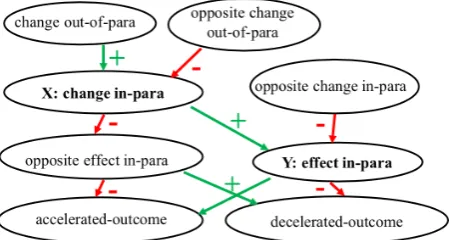
Figure 2: The template used to acquire influence graphs
IGs using paths in the IGs. We now describe this process.
Influence Graphs An influence graph G(V,E) for a procedural textT is an unweighted directed graph. Each vertexviis labeled with one or more text strings, each describing a change to the origi-nal conditions described or assumed inT, such that all those changes have the same influence on a con-nected nodevj. Each edge is labeled with apolarity,
+or-, indicating whether the influence is positive (causes/increases) or negative (prevents/reduces). Indirect effects can be found by traversingG. It is useful to distinguish two kinds of nodes: 1.Out-of-para nodes:denoting events or changes to entities/events not mentioned in the paragraph, e.g, “during storms” in Figure1.
2.In-para nodes:denoting events or changes to entities/events mentioned in the paragraph, e.g, “the wind is blowing harder” in Figure1.
(The alignment of X and xi, and whether X de-scribes an increase or decrease of xi, denoted by dX ∈ {+,−}, was also recorded.). This fills X and Y in Figure2. Similar questions populate the remain-ing nodes (see Appendix). 2107 influence graphs were collected in this way.
Generating Questions from Graphs Each path in a graph forms a “change→effect?” question, whose answer is either “correct” or “opposite” de-pending on the product of the polarities of the traversed edges. Questions are labeled with the number of edges traversed (1="1-hop", etc.). We also distinguishin-paraandout-of-paraquestions depending on the type of node they originated from. We then created a third category of question, whose answer is “no effect”, by selecting out-of-para changes fromotherparagraphs and asking for their effect on nodes in the current graph. Occa-sionally these changes did affect the selected node, resulting in an erroneous label of "no effect", but this was rare (and such cases were removed from the test partition, as we now describe).
Using a separate crowdsourcing task, questions in the test set were filtered to improve the test set quality. First, five workers independently an-swered each question, given the paragraph. The inter-annotator agreement between workers, us-ing Krippendorff’s alpha, was moderately high (0.6). We then retained only questions with ma-jority agreement (i.e., at least 3 out of 5 workers agreed), resulting in 88% of questions being re-tained.
Balancing the Dataset From the (many) ques-tions thus generated, we (randomly) selected a sub-set that approximately balanced the numbers of (a) in-para, out-of-para, and no-effect questions, and (b) questions with each answer (correct, opposite, no-effect), resulting in 40,695 questions. Train, dev, and test partitions do not share paragraphs about the same topic. Statistics are shown in Table1.
Explanations As each question is derived from a path in an IG, we can also generateexplanationsfor each answer using that path. Although explanation is not part of the WIQA task, we create an expla-nation database to support a possible explaexpla-nation task at a future date.
Consider a question “Does perturbationqpresult in qe?” with answerde ∈ {+,−}(as a shorthand for{correct,opposite}), created from an IG path:
qp rpX
−−→X−−→rXY Y −−→rYe qe
Here, rpX, rXY, and rYe denote the polarities (+/-) of the edges qpX, XY, and Xqe in the IG respectively. (As described earlier, answerdeis the product of the polaritiesrpX.rXY.rYe). To define an explanation in terms of the paragraph’s sentences x1, ...,xK, we define the gold explanationEgoldas the structure:
qp→dixi →djxj →deqe
where xi is the sentence corresponding to X, xj is the sentence corresponding to Y, and di, dj, and de denote the directions of influence (+/-, denoting {more,correct}/{less,opposite}). As workers already annotated the alignment between X and xi (similarly Y and xj) we knowxiand xj. Similarly, as workers also annotated whether X describes an increase of decrease ofxi, denoted by dX ∈ {+,−}, we can straightforwardly compute the directions of influence:
di=rpX.dX
dj =di(in-paragraph influence2) de=rpX.rXY.rYe=the answer
We can similarly generate explanations for answers derived from 1-hop and 2-hop paths.
We generated a full database of explanations for all the questions with answer “correct” or “oppo-site” (For “no effect” answers, there is no expla-nation as there is by definition no path of influ-ence). We then removed the (occasional) explana-tion where worker annotaexplana-tions were contradictory (e.g., j<i) or had no majority decision for an anno-tation. This database is available for a possible fu-ture explanation task (given question+paragraph, produce the answer+explanation).
4 Experiments
4.1 Models
We measured the performance of two baselines and three strong neural models on WIQA, to understand how it stresses these models:
Majority predicts the most frequent label,correct, in the training dataset.
Polarity is a rule-based baseline that assumes in-fluences of the form “more X→more Y" (sim-ilarly for “less”) arecorrect, hence “more X→
less Y” areopposite. A small lexicon of posi-tive (“more”) and negative (“less”) words is used to assign the more/less polarities. A ran-dom class label is chosen when assignments
2Paragraph sentences always describe correct, not opposite,
influences on later sentences, HENCE ifxiis more/accelerated,
Count of Train Dev Test Total
Topics 87 23 12 122 Paragraphs 261 77 41 379 Influence graphs 1453 424 230 2107 Questions 29808 6894 3993 40695
# Questions Train Dev Test Total
Question in-para 7303 1655 935 9893 type out-of-para 12567 2941 1598 17108 no-effect 9936 2298 1460 13694 Total 29808 6894 3993 40695
[image:4.595.73.288.63.262.2]Number #hops=1 6754 1510 835 9099 of hops #hops=2 8969 2145 1153 12267 (in- & out- #hops=3 4149 941 545 5635 of-para qns) Total 19872 4596 2533 27001
Table 1: Dataset statistics
cannot be made.
Adaboost (Freund and Schapire,1995) was used to make the 3-way classification using several bag-of-word features computed fromchange andeffect.
Decomp-Attn applies the Decomposable Atten-tion (DA) model of (Parikh et al., 2016) to our task. The original DA model com-putes entailment, i.e., the confidence that a premiseentails (or contradicts) ahypothesis. We recast WIQA as an entailment task where cause-effect becomes premise-hypothesis, and (correct/opposite/no-effect) correspond to (en-tailment/contradiction/neutral). We retrain the DA model on WIQA using this mapping. BERT (Devlin et al., 2018) is a pre-trained
transformer-based language model that has achieved state of the art performance on many NLP tasks. We supply questions to BERT as[CLS] paragraph [SEP] question [SEP] answer-optionfor each of the three options. The [CLS] token is then projected to a single logit and fed through a softmax layer across the three options, using cross entropy loss, and the highest-scoring option selected. We fine-tune BERT on the WIQA training data in this way. We also measure an ablated ver-sion where the paragraph is omitted (train and test).
Human Performance was estimated by having three people independently answering the same 100 questions (with paragraphs) drawn randomly from the test set. Krippendorff’s al-pha (nominal metric) for these answers was
Question Type in-para out-of-para no-effect Total
# questions 935 1598 1460 3993
Majority 45.46 49.47 0.55 30.66
Polarity 76.31 53.59 0.27 39.43
Adaboost 49.41 36.61 48.42 43.93
Decomp-Attn 56.31 48.56 73.42 59.48
BERT (no para) 60.32 43.74 84.18 62.41
BERT 79.68 56.13 89.38 73.80
[image:4.595.310.527.71.182.2]Human perf. 96.33
Table 2: Comparing models on WIQA test partition
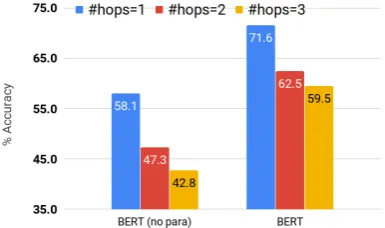
Figure 3: Accuracy of the best baselines drops as num-ber of hops increase, quicker for ‘no para’ version.
0.908 (high agreement) (Krippendorff,1970).
5 Results and Analysis
5.1 Prediction Accuracy
The results (Table2) provide several insights: 1.The dataset is hard.Our strongest model (73.8) is over 20 points behind human performance, sug-gesting WIQA poses significant challenges. Predic-tion of out-of-para effects is particularly challeng-ing, 37 points behind human performance.
2. BERT already “knows” some change-effect knowledge.Even without the paragraph, and even though the test paragraphs are on topics unseen in training, BERT scores substantially above the baselines. This suggests BERT has some type of cause-effect information embedded in it.
3.Supplying the paragraph helps, resulting in 10 points higher score, illustrating that WIQA con-tains questions that require understanding of the paragraph. This suggests more sophisticated read-ing strategies may further improve results.
5.2 Predicting Indirect Effects
[image:4.595.314.507.217.331.2]“indirect” (2/3-hop) effects are harder to pre-dict than “direct” (1-hop) effects. For example, it is easier to predict “cloudy day” results in “less sunshine” (direct) than “less photosynthesis” (in-direct). This suggests that some form of reasoning along influence chains may be needed to predict in-direct effects reliably, as those effects are less likely to be explicitly stated in corpora and embedded in pre-trained language models.
5.3 Consistency
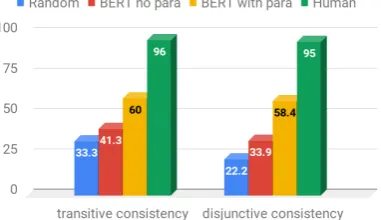
Are the models making consistent predictions? If a model predicts both X→Y and Y→Z are correct, it should, if it were consistent, also predictX→Z is correct. To measure a model’stransitivity consis-tency, for each influence graph, we measure how of-ten its indirect predictions (2/3-hop) are consistent3 with its 1-hop predictions. Similarly, we measure disjunctive consistency by how often its predic-tions for edges known to be opposite (eg X→Y and X→opp-effect-in-parain Fig2) are indeed so4. The results in Figure4illustrate that themodels are far from consistent. This suggests that reasoning with global consistency constraints may improve results, e.g., (Ning et al.,2017;Tandon et al.,2018).
5.4 Linguistic and Semantic Phenomena
We analyzed 200 descriptions of changes in 100 random questions, and observe the following chal-lenging (overlapping) phenomena to handle: 1. Qualitative Language: ≈65% of the change statements are expressed qualitatively, using a broad vocabulary of comparatives (e.g., more, fewer, smaller, larger, cooler, slower, higher, harder, decreased, hotter) or their corresponding adjectives (small, cool, etc.). In addition, whether the change is a positive or negative influence on the process is context-dependent (“more X” can be positive or negative, depending on X, and sometimes depend-ing on the paragraph topic itself).
2. Commonsense(≈45%): Exogenous influences are (by definition) not stated in the paragraph, and so require substantial commonsense to understand, e.g., that “heavy rainfall” (out of para) negatively influences “more wild fires” (in para); or that “over-fishing” (out of para) negatively influences “fish lay eggs” (in para).
3i.e., the polarity (+/-, for correct/opposite) of edge XZ=
the product of the polarities of edges chaining from X to Z. As models can also predict “no effect”, random score is 1/3.
4Only edge pairs with labels+&-, or -&+, are disjunctively
[image:5.595.316.507.72.182.2]consistent (of 9 possible labelings), hence random is 2/9.
Figure 4: The best models (red,yellow) make substan-tially less consistent predictions than humans (green).
3. Lexical matching≈15% of the in-para changes refer to paragraph entities using different terms, e.g., “insect” (para)↔“bee” (question), “becomes”
↔“forms”, “removes”↔“expels”, complicating aligning questions with the paragraph.
4. Negation(≈6%): Negation occurs in about 6% of the changes, e.g., “drought does not occur”, “soil is not fertile”, “magma does not get larger”. 5. Juxtaposed polarities (≈3%): Sometimes positive- and negative-related terms are juxtaposed, (e.g., “much less”, “increased deforestation”, “less severe”) again challenging to process.
These all illustrate the diversity of linguistic and semantic challenges in WIQA.
6 Conclusion
An important test of understanding procedural text is whether the effects ofperturbationsto the pro-cess can be predicted. To that end, we have in-troduced WIQA, the first large-scale dataset for “what if” reasoning over text. While our experi-ments suggest language models have some built-in knowledge of built-influences, and some ability to identify influences in paragraphs, these capabil-ities are limited, producing predictions that are over 20 points worse than humans, often incon-sistent, and particularly erroneous about indirect (multi-hop) effects. WIQA aims to improve this state of affairs, offering a new challenge and re-source to the community. The dataset is available at http://data.allenai.org/wiqa/.
Acknowledgements
References
Antoine Bosselut, Omer Levy, Ari Holtzman, Corin En-nis, Dieter Fox, and Yejin Choi. 2018. Simulating action dynamics with neural process networks. 6th International Conference on Learning Representa-tions (ICLR).
Bhavana Dalvi, Lifu Huang, Niket Tandon, Wen-tau Yih, and Peter Clark. 2018. Tracking state changes in procedural text: A challenge dataset and models for process paragraph comprehension. In NAACL-HLT’18.
Jacob Devlin, Ming-Wei Chang, Kenton Lee, and Kristina Toutanova. 2018. Bert: Pre-training of deep bidirectional transformers for language understand-ing. CoRR, abs/1810.04805.
Kenneth D. Forbus. 1984. Qualitative process theory.
Artificial Intelligence, 24:85–168.
Yoav Freund and Robert E. Schapire. 1995. A decision-theoretic generalization of on-line learning and an application to boosting. InEuroCOLT.
Mikael Henaff, Jason Weston, Arthur Szlam, Antoine Bordes, and Yann LeCun. 2017. Tracking the world state with recurrent entity networks. InICLR.
Chloé Kiddon, Luke S. Zettlemoyer, and Yejin Choi. 2016. Globally coherent text generation with neural checklist models. InEMNLP.
Klaus Krippendorff. 1970. Estimating the reliabil-ity, systematic error and random error of interval data. Educational and Psychological Measurement, 30(1):61–70.
David Lewis. 2013. Counterfactuals. John Wiley & Sons.
Qiang Ning, Zhili Feng, and Dan Roth. 2017. A struc-tured learning approach to temporal relation extrac-tion. InEMNLP, pages 1027–1037.
Ankur Parikh, Oscar Täckström, Dipanjan Das, and Jakob Uszkoreit. 2016. A decomposable attention model for natural language inference. In Proceed-ings of the 2016 Conference on Empirical Methods in Natural Language Processing, pages 2249–2255, Austin, Texas. Association for Computational Lin-guistics.
Niket Tandon, Bhavana Dalvi Mishra, Joel Grus, Wen-tau Yih, Antoine Bosselut, and Peter Clark. 2018. Reasoning about actions and state changes by inject-ing commonsense knowledge. EMNLP’18, arXiv preprint arXiv:1808.10012.
Daniel S Weld and Johan De Kleer. 2013. Readings in qualitative reasoning about physical systems. Mor-gan Kaufmann.
Jason Weston, Antoine Bordes, Sumit Chopra, Alexan-der M Rush, Bart van Merriënboer, Armand Joulin, and Tomas Mikolov. 2015. Towards AI-complete question answering: A set of prerequisite toy tasks.
arXiv preprint arXiv:1502.05698.
Appendix A: Topicwise consistency
We study trends in topic-wise accuracy of models as they read more context information. Bert no-para model does not have access to any context or paragraph, except the language model’s background knowledge from Wikipedia. By reading the paragraph context Bert with-para model performs much better on certain topics such as Pollination, blood, mountain, evaporationbut the impact of reading is much less on topics such asIgneous rocks, plant crops, solar eclipse, DNA replication. Topics such as blood are very popular on Wikipedia and distributed across several very different articles. These topics are harder for BERT as it requires additional paragraph context to understand the question.
topic BERT (no para) BERT
igneous rock 0.66 0.64
plant crops 0.61 0.61
solar eclipse 0.43 0.43
frog 0.59 0.62
DNA replication 0.58 0.63
water cycle 0.63 0.69
fish 0.5 0.57
pumpkin 0.61 0.69
pollination 0.62 0.75
blood 0.62 0.76
mountain 0.57 0.72
evaporation 0.42 0.67
Table 3: As the Bert model (that has access to the paragraph in context) reads more paragraphs in con-text, its accuracy is better. Reading helps certain topics such as Pollination, blood, mountain, evaporationmore than others
Appendix B: Crowdsourcing Influence Graphs
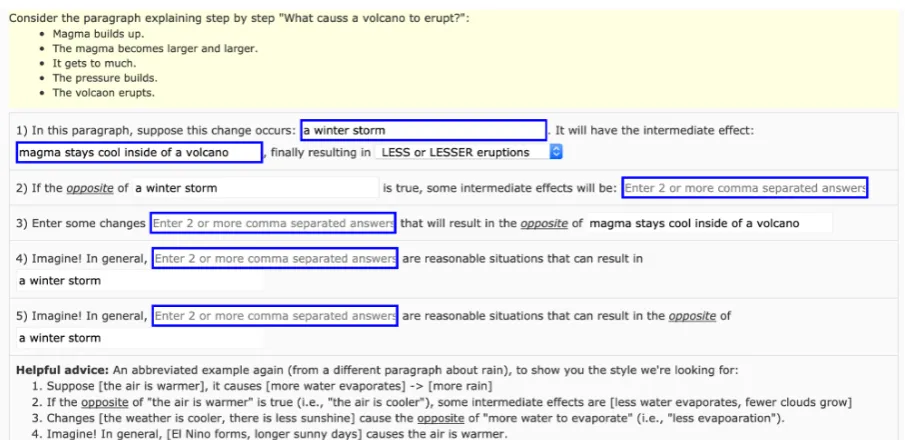
We crowdsource influence graphs by getting the graphs constructed progressively, with the help of five questions stated in Figure7. At first, the turkers see an empty graph in Figure5.
When the annotators answer the first question (shown in Fig.7), two nodes of the partial influence graph are filled (depicted in Fig.6).
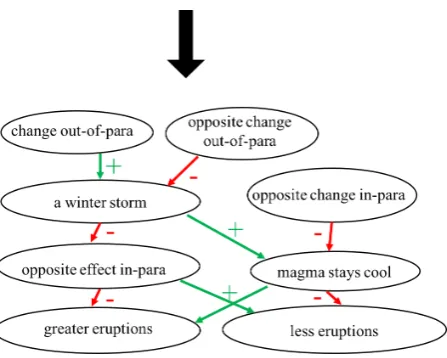
Figure 5: At the start of the process to annotate an in-fluence graph for a given paragraph, the annotators see a blank influence graph with the basic structure.
Figure 6: As the annotators answer questions in Fig.7, a partial influence graph emerges. As they answer ques-tions, the annotators found it useful to validate their an-swers by examining the emerged influence graph.
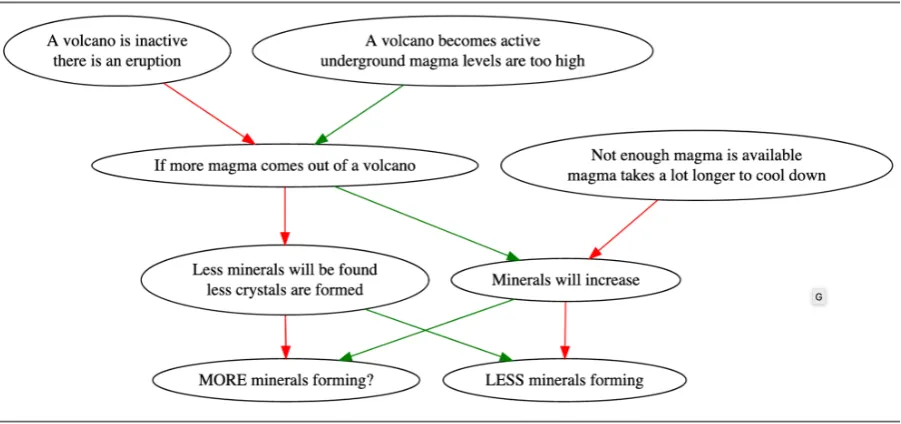
Appendix C: Sample Influence Graphs
[image:7.595.75.299.240.419.2]Figure 7: The interface shown to the annotators on Mechanical turk platform. Given a paragraph in yellow back-ground, the annotators answer the five questions and an influence graph emerges from their answers.
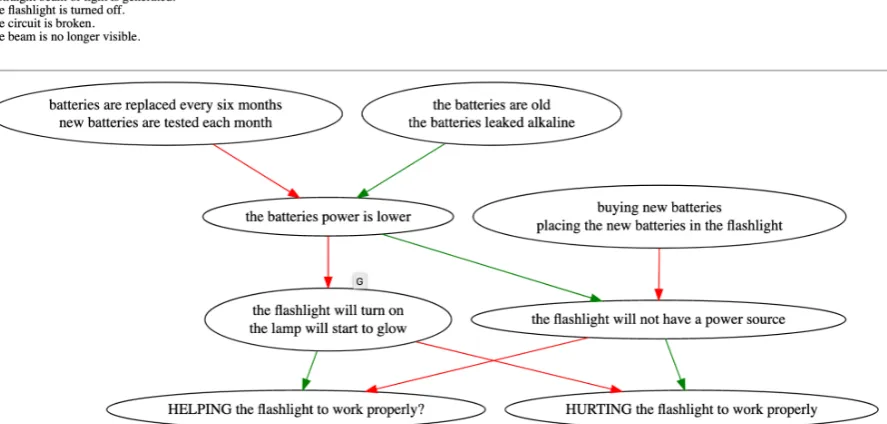
Figure 9: Influence graph for a paragraph from the topicflashlight
[image:9.595.76.525.504.690.2]