Proceedings of the 3rd Workshop on Neural Generation and Translation (WNGT 2019), pages 1–14 Hong Kong, China, November 4, 2019. c2019 Association for Computational Linguistics
1
Findings of the Third Workshop on
Neural Generation and Translation
Hiroaki Hayashi♦, Yusuke Oda♣, Alexandra Birch♠, Ioannis Konstas4, Andrew Finch♥, Minh-Thang Luong♣, Graham Neubig♦, Katsuhito Sudoh?
♦Carnegie Mellon University,♣Google Brain,♠University of Edinburgh 4Heriot-Watt University,♥Apple,?Nara Institute of Science and Technology
Abstract
This document describes the findings of the Third Workshop on Neural Generation and Translation, held in concert with the annual conference of the Empirical Methods in Nat-ural Language Processing (EMNLP 2019). First, we summarize the research trends of pa-pers presented in the proceedings. Second, we describe the results of the two shared tasks 1) efficient neural machine translation (NMT) where participants were tasked with creating NMT systems that are both accurate and effi-cient, and 2) document generation and trans-lation (DGT) where participants were tasked with developing systems that generate sum-maries from structured data, potentially with assistance from text in another language.
1 Introduction
Neural sequence to sequence models (Kalchbren-ner and Blunsom, 2013; Sutskever et al., 2014; Bahdanau et al., 2015) are now a workhorse be-hind a wide variety of different natural language processing tasks such as machine translation, gen-eration, summarization and simplification. The 3rd Workshop on Neural Machine Translation and Generation (WNGT 2019) provided a forum for research in applications of neural models to machine translation and other language genera-tion tasks (including summarizagenera-tion (Rush et al., 2015), NLG from structured data (Wen et al., 2015), dialog response generation (Vinyals and Le,2015), among others). Overall, the workshop was held with two goals.
First, it aimed to synthesize the current state of knowledge in neural machine translation and generation: this year we continued to encourage submissions that not only advance the state of the art through algorithmic advances, but also analyze and understand the current state of the art, point-ing to future research directions. Towards this
goal, we received a number of high-quality re-search contributions on both workshop topics, as summarized in Section2.
Second, the workshop aimed to expand the re-search horizons in NMT: we continued to organize the Efficient NMT task which encouraged partic-ipants to develop not only accurate but computa-tionally efficient systems. In addition, we orga-nized a new shared task on “Document-level Gen-eration and Translation”, which aims to push for-ward document-level generation technology and contrast the methods for different types of inputs. The results of the shared task are summarized in Sections3and4.
2 Summary of Research Contributions
We published a call for long papers, ex-tended abstracts for preliminary work, and cross-submissions of papers submitted to other venues. The goal was to encourage discussion and interac-tion with researchers from related areas.
We received a total of 68 submissions, from which we accepted 36. There were three cross-submissions, seven long abstracts and 26 full pa-pers. There were also seven system submission papers. All research papers were reviewed twice through a double blind review process, and avoid-ing conflicts of interest.
3 Shared Task: Document-level Generation and Translation
The first shared task at the workshop focused on document-level generation and translation. Many recent attempts at NLG have focused on sentence-level generation (Lebret et al.,2016;Gardent et al., 2017). However, real world language generation applications tend to involve generation of much larger amount of text such as dialogues or multi-sentence summaries. The inputs to NLG sys-tems also vary from structured data such as ta-bles (Lebret et al., 2016) or graphs (Wang et al., 2018), to textual data (Nallapati et al.,2016). Be-cause of such difference in data and domain, com-parison between different methods has been non-trivial. This task aims to (1) push forward such document-level generation technology by provid-ing a testbed, and (2) examine the differences be-tween generation based on different types of in-puts including both structured data and transla-tions in another language.
In particular, we provided the following 6 tracks which focus on different input/output require-ments:
• NLG (Data → En, Data → De): Gener-ate document summaries in a target language given only structured data.
• MT (De↔En): Translate documents in the source language to the target language.
• MT+NLG (Data+En → De, Data+De →
En): Generate document summaries given the structured data and the summaries in an-other language.
3.1 Evaluation Measures
We employ standard evaluation metrics for data-to-text NLG and MT along two axes:
Textual Accuracy Measures: We used BLEU (Papineni et al., 2002) and ROUGE (Lin, 2004) as measures for texutal accuracy com-pared to reference summaries.
Content Accuracy Measures: We evaluate the fidelity of the generated content to the input data using relation generation (RG), content selection (CS), and content ordering (CO) metrics (Wiseman et al.,2017).
Train Valid Test
# documents 242 240 241
Avg. # tokens (En) 323 328 329 Avg. # tokens (De) 320 324 325
Vocabulary size (En) 4163 -
-Vocabulary size (De) 5425 -
-Table 1: Data statistics of RotoWire English-German Dataset.
The content accuracy measures were calculated using information extraction models trained on re-spective target languages. We followed (Wiseman et al.,2017) and ensembled 6 information extrac-tion models (3 CNN-based, 3 LSTM-based) with different random seeds for each language.
3.2 Data
Due to the lack of a document-level parallel corpus which provides structured data for each instance, we took an approach of translating an existing NLG dataset. Specifically, we used a subset of the RotoWire dataset (Wiseman et al.,2017) and obtained professional German translations, which are sentence-aligned to the original English arti-cles. The obtained parallel dataset is called the RotoWire English-German dataset, and consists of box score tables, an English article, and its Ger-man translation for each instance. Table1shows the statistics of the obtained dataset. We used the test split from this dataset to calculate the evalua-tion measures for all the tracks.
We further allowed the following additional re-sources for each track:
• NLG: RotoWire, Monolingual
• MT: WMT19, Monolingual
• MT+NLG: RotoWire, WMT19, Monolingual
[image:2.595.315.520.63.156.2]Systems which follow these resource con-straints are marked constrained, otherwise uncon-strained. Results are indicated by the initials (C/U).
3.3 Baseline Systems
Considering the difference in inputs for MT and NLG tracks, we prepared two baselines for respec-tive tracks.
FairSeq-19 FairSeq (Ng et al., 2019) was used for MT and MT+NLG tracks for both direc-tions of transladirec-tions. We used the published WMT’19 single model and did not tune on in-domain data.
NCP+CC: A two-stage model from (Puduppully et al., 2019) was used for NLG tracks. We utilized the pretrained English model trained on RotoWire dataset for English article gen-eration, while the German model was trained on RotoWire English-German dataset.
3.4 Submitted Systems
Four teams, Team EdiNLG, Team FIT-Monash, Team Microsoft, Team Naver Labs Europe, and Team SYSTRAN-AI participated in the shared task. We note the common trends across many teams and discuss the systems of individual teams below. On MT tracks, all the teams have adopted a variant of Transformer (Vaswani et al., 2017) as a sequence transduction model and trained on corpora with different data-augmentation meth-ods. Trained systems were then fine-tuned on in-domain data including our RotoWire English-German dataset. The focus of data augmentation was two-fold: 1) acquiring in-domain data and 2) utilizing document boundaries from existing cor-pora. Most teams applied back-translation on vari-ous sources including NewsCrawl and the original RotoWire dataset for this purpose.
NLG tracks exhibited a similar trend for the se-quence model selection, except for Team EdiNLG who employed LSTM.
3.4.1 Team EdiNLG
Team EdiNLG built their NLG system upon (Puduppully et al., 2019) by extending it to fur-ther allow copying from the table in addition to generating from vocabulary and the content plan. Additionally, they included features indicating the win/loss team records and team rank in terms of points for each player. They trained the NLG
model for both languages together, using a shared BPE vocabulary obtained from target game sum-maries and by prefixing the target text with the tar-get language indicator.
For MT and MT+NLG tracks, they mined the in-domain data by extracting basketball-related texts from Newscrawl when one of the follow-ing conditions are met: 1) player names from the RotoWire English-German training set appear, 2) two NBA team names appear in the same docu-ment, or 3) “NBA” appears in titles. This resulted in 4.3 and 1.1 million monolingual sentences for English and German, respectively. The obtained sentences were then back-translated and added to the training corpora. They submitted their system EdiNLGin all six tracks.
3.4.2 Team FIT-Monash
Team FIT-Monash built a document-level NMT system (Maruf et al., 2019) and participated in MT tracks. The document-level model was initial-ized with a pre-trained sentence-level NMT model on news domain parallel corpora. Two strategies for composing document-level context were pro-posed: flat and hierarchical attention. Flat atten-tion was applied on all the sentences, while hier-archical attention was computed at sentence and word-level in a hierarchical manner. Sparse atten-tion was applied at sentence-level in order to iden-tify key sentences that are important for translating the current sentence.
To train a document-level model, the team fo-cused on corpora that have document boundaries, including News Commentary, Rapid, and the Ro-toWire dataset. Notably, greedy decoding was em-ployed due to computational cost. The submitted system is an ensemble of three runs indicated as FIT-Monash.
3.4.3 Team Microsoft
for NLG track. Specifically, they fine-tuned GPT-2 (Radford et al., 2019) on concatenated pairs of (template, target) summaries, while construct-ing templates followconstruct-ing (Wiseman et al., 2017). The two sequences are concatenated around a spe-cial token which indicates “rewrite”. At decod-ing time, they adopted nucleus sampldecod-ing (Holtz-man et al.,2019) to enhance the generation quality. Different thresholds for nucleus sampling were in-vestigated, and two systems with different thresh-olds were submitted: MS-GPT-50and MS-GPT-90, where the numbers refer to Top-pthresholds.
The generated summaries in English using the following systems were then translated with the MT systems which is described below. Hence, this marks Team Microsoft’s German NLG (Data → De) submission unconstrained, due to the us-age of parallel data beyond the RotoWire English-German dataset.
As for the MT model, a pre-trained system from (Xia et al.,2019) was fine-tuned on the Ro-toWire English-German dataset, as well as back-translated sentences from the original RotoWire dataset for the English-to-German track. Back-translation of sentences obtained fromNewscrawl
according to the similarity to RotoWire data (Moore and Lewis, 2010) was attempted but did not lead to improvement. The resulting system is shown asMSon MT track reports.
3.4.4 Team Naver Labs Europe
Team Naver Labs Europe (NLE) took the ap-proach of transferring the model from MT to NLG. They first trained a sentence-level MT model by iteratively extend the training set from the WMT19 parallel data and RotoWire English-German dataset to back-translated Newscrawl
data. The best sentence-level model was then tuned at document-level, followed by fine-tuning on the RotoWire English-German dataset (constrainedNLE) and additionally on the back-translated original RotoWire dataset (uncon-strainedNLE).
To fully leverage the MT model, input record values prefixed with special tokens for record types were sequentially fed in a specific order. Combined with the target summary, the pair of record representations and the target summaries formed data for a sequence-to-sequence model. They fine-tuned their document-level MT model on these NLG data which included the original RotoWire and RotoWire English-German dataset.
The team tackled MT+NLG tracks by concate-nating source language documents and the se-quence of records as inputs. To encourage the model to use record information more, they ran-domly masked certain portion of tokens in the source language documents.
3.4.5 Team SYSTRAN-AI
Team SYSTRAN-AI developed their NLG system based on the Transformer (Vaswani et al.,2017). The model takes as input each record from the box score featurized into embeddings and decode the summary. In addition, they introduced a content selection objective where the model learns to pre-dict whether or not each record is used in the sum-mary, comprising a sequence of binary classfica-tion decision.
Furthermore, they performed data augmenta-tion by synthesizing records whose numeric val-ues were randomly changed in a way that does not change the win / loss relation and remains within a sane range. The synthesized records were used to generate a summary to obtain new (record, sum-mary) pairs and were included added the train-ing data. To bias the model toward generattrain-ing more records, they further fine-tuned their model on a subset of training examples which contain
N(= 16) records in the summary. The
submit-ted systems are SYSTRAN-AI and SYSTRAN-AI-Detok, which differ in tokenization.
3.5 Results
We show the results for each track in Table 2 through7. In the NLG and MT+NLG tasks, we re-port BLEU, ROUGE (F1) for textual accuracy, RG (P), CS(P, R), and CO (DLD) for content accuracy. While for MT tasks, we only report BLEU. We summarize the shared task results for each track below.
generation using pre-trained language models is sensitive to how the sampling is performed; the results of MS-GPT-90 and MS-GPT-50 differ only in the nucleus sampling hyperparameter, which led to significant differences in every evaluation measure.
The NLG (De) track imposed a greater chal-lenge compared to its English counterpart due to the lack of training data. The scores has generally dropped compared to NLG (En) results. To alle-viate the lack of German data, most teams devel-oped systems under unconstrained setting by uti-lizing MT resources and models. Notably, Team NLE’s has achieved similar performance to the constrained system results on NLG (En). How-ever, Team EdiNLG achieved similar performance under the constrained setting by fully leveraging the original RotoWire using the sharing of vocab-ulary.
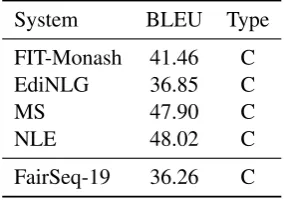
In MT tracks, we see the same trend that the system under unconstrained setting (NLE) out-performed all the systems under the constrained setting. The improvement observed in the un-constrained setting came from fine-tuning on the back-translated original RotoWire dataset, which offers purely in-domain parallel documents.
While the results are not directly comparable due to different hyperparameters used in systems, fine-tuning on in-domain parallel sentences was shown effective (FairSeq-19 vs others). When incorporating document-level data, it was shown that document-level models (NLE, FIT-Monash, MS) perform better than sentence-level models (EdiNLG, FairSeq-19), even if a sentence-level model is trained on document-aware corpora.
For MT+NLG tracks, interestingly, no teams found the input structured data useful, thus apply-ing MT models for MT+NLG tracks. Compared to the baseline (FairSeq-19), fine-tuning on in-domain data resulted in better performance over-all as seen in the results of Team MS and NLE. The key difference between Team MS and NLE is the existence of document-level fine-tuning, where Team NLE outperformed in terms of textual accu-racy (BLEU and ROUGE) overall, in both target languages.
4 Shared Task: Efficient NMT
The second shared task at the workshop focused on efficient neural machine translation. Many MT shared tasks, such as the ones run by the
Conference on Machine Translation (Bojar et al., 2017), aim to improve the state of the art for MT with respect to accuracy: finding the most accu-rate MT system regardless of computational cost. However, in production settings, the efficiency of the implementation is also extremely important. The efficiency shared task for WNGT (inspired by the “small NMT” task at the Workshop on Asian Translation (Nakazawa et al.,2017)) was focused on creating systems for NMT that are not only ac-curate, but also efficient. Efficiency can include a number of concepts, including memory efficiency and computational efficiency. This task concerns itself with both, and we cover the detail of the eval-uation below.
4.1 Evaluation Measures
We used metrics to measure several different as-pects connected to how good the system is. These were measured for systems that were run on CPU, and also systems that were run on GPU.
Accuracy Measures: As a measure of translation accuracy, we used BLEU (Papineni et al., 2002) and NIST (Doddington,2002) scores.
Computational Efficiency Measures: We mea-sured the amount of time it takes to translate the entirety of the test set on CPU or GPU. Time for loading models was measured by having the model translate an empty file, then subtracting this from the total time to trans-late the test set file.
Memory Efficiency Measures: We measured: (1) the size on disk of the model, (2) the number of parameters in the model, and (3) the peak consumption of the host memory and GPU memory.
These metrics were measured by having par-ticipants submit a container for the virtualization environment Docker1, then measuring from out-side the container the usage of computation time and memory. All evaluations were performed on dedicated instances on Amazon Web Services2, specifically of type m5.large for CPU evalu-ation, andp3.2xlarge (with a NVIDIA Tesla V100 GPU).
1
https://www.docker.com/
System BLEU R-1 R-2 R-L RG CS (P/R) CO Type
EdiNLG 17.01 44.87 18.53 25.38 91.41 30.91 64.13 21.72 C
MS-GPT-90 13.03 45.25 15.17 21.34 88.70 32.84 50.58 17.36 C
MS-GPT-50 15.17 45.34 16.64 22.93 94.35 33.91 53.82 19.30 C
MS-End-to-End 15.03 43.84 17.49 23.86 93.38 32.40 58.02 18.54 C
NLE 20.52 49.38 22.36 27.29 94.08 41.13 54.20 25.64 U
SYSTRAN-AI 17.59 47.76 20.18 25.60 83.22 31.74 44.90 20.73 C
SYSTRAN-AI-Detok 18.32 47.80 20.19 25.61 84.16 34.88 43.29 22.72 C
[image:6.595.92.508.238.349.2]NCP+CC 15.80 44.83 17.07 23.46 88.59 30.47 55.38 18.31 C
Table 2: Results on the NLG: (Data→En) track of DGT task.
System BLEU R-1 R-2 R-L RG CS (P/R) CO Type
EdiNLG 10.95 34.10 12.81 19.70 70.23 23.40 41.83 16.06 C
MS-GPT-90 10.43 41.35 12.59 18.43 75.05 31.23 41.32 16.32 U
MS-GPT-50 11.84 41.51 13.65 19.68 82.79 34.81 42.51 17.12 U
MS-End-to-End 11.66 40.02 14.36 20.67 80.30 28.33 49.13 16.54 U
NLE 16.13 44.27 17.50 23.09 79.47 29.40 54.31 20.62 U
NCP+CC 7.29 29.56 7.98 16.06 49.69 21.61 26.14 11.84 C
Table 3: Results on the NLG: (Data→De) track of DGT task.
System BLEU Type
FIT-Monash 47.39 C
EdiNLG 41.15 C
MS 57.99 C
NLE 62.16 U
NLE 58.22 C
[image:6.595.110.254.419.530.2]FairSeq-19 42.91 C
Table 4: DGT results on the MT track (De→En).
System BLEU Type
FIT-Monash 41.46 C
EdiNLG 36.85 C
MS 47.90 C
NLE 48.02 C
[image:6.595.110.254.615.715.2]FairSeq-19 36.26 C
Table 5: DGT results on the MT track (En→De)
4.2 Data
The data used was from the WMT 2014 English-German task (Bojar et al., 2014), using the pre-processed corpus provided by the Stanford NLP Group3. Use of other data was prohibited.
4.3 Baseline Systems
Two baseline systems were prepared:
Echo: Just send the input back to the output.
Base: A baseline system using attentional LSTM-based encoder-decoders with attention (Bah-danau et al.,2015).
4.4 Submitted Systems
Two teams, Team Marian and Team Notre Dame submitted to the shared task, and we will summa-rize each below.
4.4.1 Team Marian
Team Marian’s submission (Kim et al.,2019) was based on their submission to the shared task the previous year, consisting of Transformer mod-els optimized in a number of ways (Junczys-Dowmunt et al., 2018). This year, they made
3https://nlp.stanford.edu/projects/
System BLEU R-1 R-2 R-L RG CS (P/R) CO Type
EdiNLG 36.85 69.66 41.47 57.25 81.01 77.32 78.49 62.21 C
MS 47.90 75.95 51.75 65.61 80.98 76.88 84.57 67.84 C
NLE 48.24 75.89 51.80 65.90 80.65 75.10 88.72 69.17 C
[image:7.595.101.498.183.268.2]FairSeq-19 36.26 68.22 40.31 56.38 81.64 77.67 75.82 60.83 C
Table 6: Results on the MT+NLG: (Data+En→De) track of DGT task.
System BLEU R-1 R-2 R-L RG CS (P/R) CO Type
EdiNLG 41.15 76.57 50.97 66.62 91.40 78.99 63.04 51.73 C
MS 57.99 83.03 63.03 75.44 95.77 92.49 91.62 84.70 C
NLE 62.24 84.38 66.11 77.17 95.63 91.71 92.69 85.05 C
[image:7.595.90.517.324.686.2]FairSeq-19 42.91 77.57 52.66 68.66 93.53 83.33 84.22 70.47 C
Table 7: Results on the MT+NLG: (Data+De→En) track of DGT task.
101 102 103
Time [s] 24
25 26 27 28 29 30 31 32
BL
EU
%
Marian.cpu_base2Marian.cpu_medium1
Marian.cpu_small2 Marian.cpu_tiny11
(a) CPU Time vs. Accuracy
100 101 102
Time [s] 18
20 22 24 26 28 30 32
BL
EU
%
Marian.gpu_base4bit Marian.gpu_baseMarian.gpu_big
ndnlp.all-l21-01-small ndnlp.baseline-small
ndnlp.encoder-l21-01-small ndnlp.encoder-l21-1-small ndnlp.fc-l21-01-small ndnlp.fc-l21-1-small ndnlp.fc-l21-10-smallndnlp.fc-linf1-100-small
(b) GPU Time vs. Accuracy
102 103
Memory [MiB] 24
25 26 27 28 29 30 31 32
BL
EU
%
Marian.cpu_base2Marian.cpu_medium1
Marian.cpu_small2 Marian.cpu_tiny11
(c) CPU Memory vs. Accuracy
103 104
Memory [MiB] 18
20 22 24 26 28 30 32
BL
EU
%
Marian.gpu_base4bit Marian.gpu_baseMarian.gpu_big
ndnlp.all-l21-01-small ndnlp.baseline-small
ndnlp.encoder-l21-01-small ndnlp.encoder-l21-1-small ndnlp.fc-l21-01-small ndnlp.fc-l21-1-small ndnlp.fc-l21-10-small ndnlp.fc-linf1-100-small
(d) GPU Memory vs. Accuracy
a number of improvements. Improvements were made to teacher-student training by (1) creating more data for teacher-student training using back-ward, then forward translation, (2) using multiple teachers to generate better distilled data for train-ing student models. In addition, there were mod-eling improvements made by (1) replacing sim-ple averaging in the attention layer with an effi-ciently calculable “simple recurrent unit,” (2) pa-rameter tying between decoder layers, which re-duces memory usage and improves cache locality on the CPU. Finally, a number of CPU-specific op-timizations were performed, most notably includ-ing 8-bit matrix multiplication along with a flexi-ble quantization scheme.
4.4.2 Team Notre Dame
Team Notre Dame’s submission (Murray et al., 2019) focused mainly on memory efficiency. They did so by performing “Auto-sizing” of the trans-former network, applying block-sparse regulariza-tion to remove columns and rows from the param-eter matrices.
4.5 Results
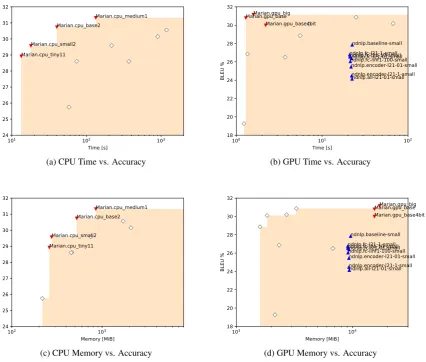
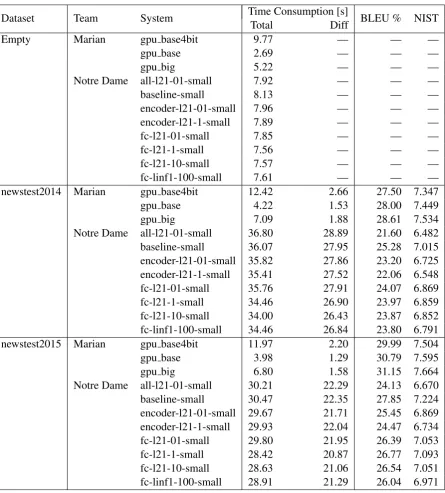
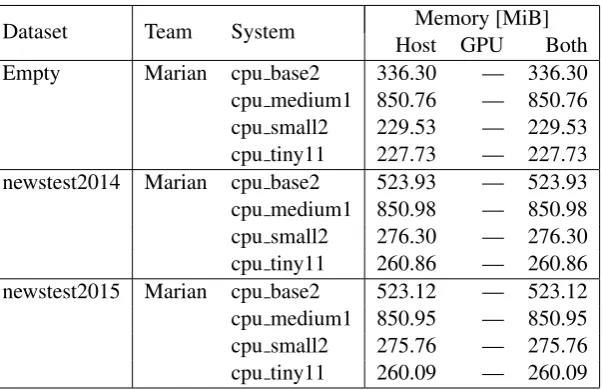
A brief summary of the results of the shared task (for newstest2015) can be found in Figure1, while full results tables for all of the systems can be found in Appendix A. From this figure we can glean a number of observations.
For the CPU systems, all submissions from the Marian team clearly push the Pareto frontier in terms of both time and memory. In addition, the Marian systems also demonstrated a good trade-off between time/memory and accuracy.
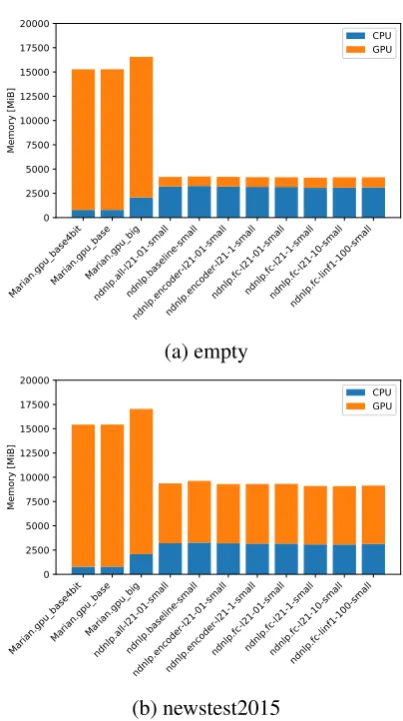
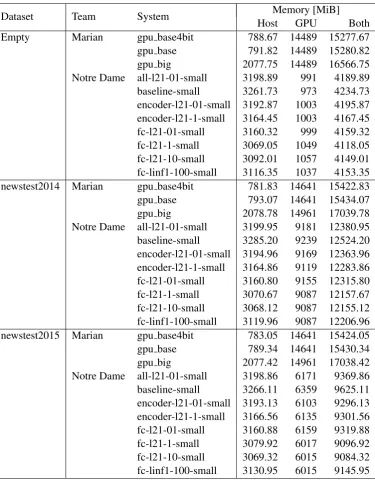
For the GPU systems, all systems from the Mar-ian team also outperformed other systems in terms of the speed-accuracy trade-off. However, the Marian systems had larger memory consumption than both Notre Dame systems, which specifically optimized for memory efficiency, and all previous systems. Interestingly, each GPU system by the Marian team shares almost the same amount of GPU memory as shown in Table 12 and Figure 2(b). This may indicate that the internal frame-work of the Marian system tries to reserve enough amount of the GPU memory first, then use the ac-quired memory as needed by the translation pro-cesses.
On the other hand, we can see that the Notre Dame systems occupy only a minimal amount of GPU memory, as the systems use much smaller
[image:8.595.313.515.220.581.2]Marian .gpu_b ase4bi t Marian .gpu_b ase Marian .gpu_b ig ndnlp.a ll-l21-0 1-small ndnlp.b aseline -small ndnlp.e ncoder -l21-01 -small ndnlp.e ncoder -l21-1-sm all ndnlp.f c-l21-0 1-small ndnlp.f c-l21-1 -small ndnlp.f c-l21-1 0-small ndnlp.f c-linf1-1 00-sm all 0 2500 5000 7500 10000 12500 15000 17500 20000 Me mo ry [ M iB] CPU GPU (a) empty Marian .gpu_b ase4bi t Marian .gpu_b ase Marian .gpu_b ig ndnlp.a ll-l21-0 1-small ndnlp.b aseline -small ndnlp.e ncoder -l21-01 -small ndnlp.e ncoder -l21-1-sm all ndnlp.f c-l21-0 1-small ndnlp.f c-l21-1 -small ndnlp.f c-l21-1 0-small ndnlp.f c-linf1-1 00-sm all 0 2500 5000 7500 10000 12500 15000 17500 20000 Me mo ry [ M iB] CPU GPU (b) newstest2015
amounts on the empty set (Figure 2(a)). These different approaches to constant or variable size memory consumption may be based on different underlying perspectives of “memory efficiency,” and it may be difficult to determine which policy is better without knowing the actual environment in which a system will be used.
5 Conclusion
This paper summarized the results of the Third Workshop on Neural Generation and Translation, where we saw a number of research advances. Particularly, this year introduced a new document generation and translation task, that tested the ef-ficacy of systems for both the purposes of transla-tion and generatransla-tion in a single testbed.
Acknowledgments
We thank Apple and Google for their monetary support of student travel awards for the workshop, and AWS for its gift of AWS credits (to Graham Neubig) that helped support the evaluation.
References
Dzmitry Bahdanau, Kyunghyun Cho, and Yoshua Ben-gio. 2015. Neural machine translation by jointly learning to align and translate. InProc. ICLR.
Ondˇrej Bojar, Rajen Chatterjee, Christian Federmann, Yvette Graham, Barry Haddow, Shujian Huang, Matthias Huck, Philipp Koehn, Qun Liu, Varvara Logacheva, et al. 2017. Findings of the 2017 con-ference on machine translation (wmt17). In Proc. WMT, pages 169–214.
Ondrej Bojar et al. 2014. Findings of the 2014 work-shop on statistical machine translation. In Proc. WMT, pages 12–58.
Jacob Devlin, Ming-Wei Chang, Kenton Lee, and Kristina Toutanova. 2019. BERT: Pre-training of Deep Bidirectional Transformers for Language Un-derstanding. InProceedings of the 2019 Conference of the North American Chapter of the Association for Computational Linguistics: Human Language Technologies, Volume 1 (Long and Short Papers), pages 4171–4186, Minneapolis, Minnesota. Associ-ation for ComputAssoci-ational Linguistics.
George Doddington. 2002. Automatic evaluation of machine translation quality using n-gram co-occurrence statistics. InProc. HLT, pages 138–145.
Claire Gardent, Anastasia Shimorina, Shashi Narayan, and Laura Perez-Beltrachini. 2017. The WebNLG Challenge: Generating Text from RDF Data. In Proceedings of the 10th International Conference on
Natural Language Generation, pages 124–133, San-tiago de Compostela, Spain. Association for Com-putational Linguistics.
Ari Holtzman, Jan Buys, Maxwell Forbes, and Yejin Choi. 2019. The Curious Case of Neural Text De-generation.arXiv:1904.09751 [cs].
Marcin Junczys-Dowmunt, Kenneth Heafield, Hieu Hoang, Roman Grundkiewicz, and Anthony Aue. 2018. Marian: Cost-effective high-quality neural machine translation in C++. In Proceedings of the 2nd Workshop on Neural Machine Translation and Generation, pages 129–135, Melbourne, Australia. Association for Computational Linguistics.
Nal Kalchbrenner and Phil Blunsom. 2013. Recurrent continuous translation models. In Proc. EMNLP, pages 1700–1709.
Young Jin Kim, Marcin Junczys-Dowmunt, and Hany Hassan. 2019. From research to production and back: Fast and accurate neural machine translation. InProceedings of the 3rd Workshop on Neural Gen-eration and Translation.
R´emi Lebret, David Grangier, and Michael Auli. 2016.
Neural Text Generation from Structured Data with Application to the Biography Domain. In Proceed-ings of the 2016 Conference on Empirical Methods in Natural Language Processing, pages 1203–1213, Austin, Texas. Association for Computational Lin-guistics.
Chin-Yew Lin. 2004. ROUGE: A Package for Auto-matic Evaluation of Summaries. InText Summariza-tion Branches Out, pages 74–81, Barcelona, Spain. Association for Computational Linguistics.
Sameen Maruf, Andr´e F. T. Martins, and Gholam-reza Haffari. 2019. Selective Attention for Context-aware Neural Machine Translation. In Proceed-ings of the 2019 Conference of the North American Chapter of the Association for Computational Lin-guistics: Human Language Technologies, Volume 1 (Long and Short Papers), pages 3092–3102, Min-neapolis, Minnesota. Association for Computational Linguistics.
Robert C. Moore and William Lewis. 2010. Intelligent selection of language model training data. InProc. ACL, pages 220–224.
Kenton Murray, Brian DuSell, and David Chiang. 2019. Auto-sizing the transformer network: Shrink-ing parameters for the wngt 2019 efficiency task. In Proceedings of the 3rd Workshop on Neural Gener-ation and TranslGener-ation.
Ramesh Nallapati, Bowen Zhou, Cicero dos Santos, C¸ a˘glar Gu˙lc¸ehre, and Bing Xiang. 2016. Ab-stractive Text Summarization using Sequence-to-sequence RNNs and Beyond. InProceedings of The 20th SIGNLL Conference on Computational Natural Language Learning, pages 280–290, Berlin, Ger-many. Association for Computational Linguistics.
Nathan Ng, Kyra Yee, Alexei Baevski, Myle Ott, Michael Auli, and Sergey Edunov. 2019. Facebook FAIR’s WMT19 news translation task submission. In Proceedings of the Fourth Conference on Ma-chine Translation (Volume 2: Shared Task Papers, Day 1), pages 314–319, Florence, Italy. Association for Computational Linguistics.
Kishore Papineni, Salim Roukos, Todd Ward, and Wei-Jing Zhu. 2002. BLEU: a method for automatic evaluation of machine translation. In Proc. ACL, pages 311–318.
Jeffrey Pennington, Richard Socher, and Christopher Manning. 2014. Glove: Global Vectors for Word Representation. In Proceedings of the 2014 Con-ference on Empirical Methods in Natural Language Processing (EMNLP), pages 1532–1543, Doha, Qatar. Association for Computational Linguistics.
Ratish Puduppully, Li Dong, and Mirella Lapata. 2019. Data-to-text generation with content selection and planning. In Proceedings of the AAAI Conference on Artificial Intelligence, volume 33, pages 6908– 6915.
Alec Radford, Jeffrey Wu, Rewon Child, David Luan, Dario Amodei, and Ilya Sutskever. 2019. Language Models are Unsupervised Multitask Learners.
Alexander M. Rush, Sumit Chopra, and Jason Weston. 2015. A neural attention model for abstractive sen-tence summarization. InProc. EMNLP, pages 379– 389.
Ilya Sutskever, Oriol Vinyals, and Quoc VV Le. 2014. Sequence to sequence learning with neural net-works. InProc. NIPS, pages 3104–3112.
Ashish Vaswani, Noam Shazeer, Niki Parmar, Jakob Uszkoreit, Llion Jones, Aidan N. Gomez, Lukasz Kaiser, and Illia Polosukhin. 2017. Attention is all you need. InProc. NIPS.
Oriol Vinyals and Quoc Le. 2015. A neural conversa-tional model. arXiv preprint arXiv:1506.05869.
Qingyun Wang, Xiaoman Pan, Lifu Huang, Boliang Zhang, Zhiying Jiang, Heng Ji, and Kevin Knight. 2018. Describing a Knowledge Base. In Proceed-ings of the 11th International Conference on Natural Language Generation, pages 10–21, Tilburg Uni-versity, The Netherlands. Association for Computa-tional Linguistics.
Tsung-Hsien Wen, Milica Gasic, Nikola Mrkˇsi´c, Pei-Hao Su, David Vandyke, and Steve Young. 2015.
Semantically conditioned lstm-based natural lan-guage generation for spoken dialogue systems. In Proc. EMNLP, pages 1711–1721.
Sam Wiseman, Stuart Shieber, and Alexander Rush. 2017. Challenges in Data-to-Document Generation. In Proceedings of the 2017 Conference on Empiri-cal Methods in Natural Language Processing, pages 2253–2263.
Yingce Xia, Xu Tan, Fei Tian, Fei Gao, Di He, We-icong Chen, Yang Fan, Linyuan Gong, Yichong Leng, Renqian Luo, Yiren Wang, Lijun Wu, Jinhua Zhu, Tao Qin, and Tie-Yan Liu. 2019. Microsoft Research Asia’s Systems for WMT19. In Proceed-ings of the Fourth Conference on Machine Transla-tion (Volume 2: Shared Task Papers, Day 1), pages 424–433, Florence, Italy. Association for Computa-tional Linguistics. WMT.
A Full Shared Task Results
Table 8: Image file sizes of submitted systems.
Team System Size [MiB]
Marian cpu base2 135.10
cpu medium1 230.22
cpu small2 93.00
cpu tiny11 91.61
gpu base4bit 322.68
gpu base 452.59
gpu big 773.27
Notre Dame all-l21-01-small 2816.63
baseline-small 2845.04
encoder-l21-01-small 2813.67 encoder-l21-1-small 2779.60
fc-l21-01-small 2798.94
fc-l21-1-small 2755.80
fc-l21-10-small 2755.76
fc-linf1-100-small 2759.10
Table 9: Time consumption and MT evaluation metrics (CPU systems).
Dataset
Team
System
Time Consumption [s]
BLEU %
NIST
Total
Diff
Empty
Marian
cpu base2
4.97
—
—
—
cpu medium1
6.03
—
—
—
cpu small2
4.67
—
—
—
cpu tiny11
4.71
—
—
—
newstest2014
Marian
cpu base2
57.52
52.55
28.04
7.458
cpu medium1
181.81
175.78
28.58
7.539
cpu small2
28.32
23.64
26.97
7.288
cpu tiny11
22.26
17.56
26.38
7.178
newstest2015
Marian
cpu base2
45.01
40.04
30.74
7.607
cpu medium1
139.06
133.03
31.32
7.678
cpu small2
22.64
17.97
29.57
7.437
[image:11.595.74.524.486.710.2]Table 10: Time consumption and MT evaluation metrics (GPU systems).
Dataset Team System Time Consumption [s] BLEU % NIST
Total Diff
Empty Marian gpu base4bit 9.77 — — —
gpu base 2.69 — — —
gpu big 5.22 — — —
Notre Dame all-l21-01-small 7.92 — — —
baseline-small 8.13 — — —
encoder-l21-01-small 7.96 — — —
encoder-l21-1-small 7.89 — — —
fc-l21-01-small 7.85 — — —
fc-l21-1-small 7.56 — — —
fc-l21-10-small 7.57 — — —
fc-linf1-100-small 7.61 — — —
newstest2014 Marian gpu base4bit 12.42 2.66 27.50 7.347
gpu base 4.22 1.53 28.00 7.449
gpu big 7.09 1.88 28.61 7.534
Notre Dame all-l21-01-small 36.80 28.89 21.60 6.482
baseline-small 36.07 27.95 25.28 7.015
encoder-l21-01-small 35.82 27.86 23.20 6.725
encoder-l21-1-small 35.41 27.52 22.06 6.548
fc-l21-01-small 35.76 27.91 24.07 6.869
fc-l21-1-small 34.46 26.90 23.97 6.859
fc-l21-10-small 34.00 26.43 23.87 6.852
fc-linf1-100-small 34.46 26.84 23.80 6.791
newstest2015 Marian gpu base4bit 11.97 2.20 29.99 7.504
gpu base 3.98 1.29 30.79 7.595
gpu big 6.80 1.58 31.15 7.664
Notre Dame all-l21-01-small 30.21 22.29 24.13 6.670
baseline-small 30.47 22.35 27.85 7.224
encoder-l21-01-small 29.67 21.71 25.45 6.869
encoder-l21-1-small 29.93 22.04 24.47 6.734
fc-l21-01-small 29.80 21.95 26.39 7.053
fc-l21-1-small 28.42 20.87 26.77 7.093
fc-l21-10-small 28.63 21.06 26.54 7.051
Table 11: Peak memory consumption (CPU systems).
Dataset Team System Memory [MiB]
Host GPU Both
Empty Marian cpu base2 336.30 — 336.30
cpu medium1 850.76 — 850.76
cpu small2 229.53 — 229.53
cpu tiny11 227.73 — 227.73
newstest2014 Marian cpu base2 523.93 — 523.93
cpu medium1 850.98 — 850.98
cpu small2 276.30 — 276.30
cpu tiny11 260.86 — 260.86
newstest2015 Marian cpu base2 523.12 — 523.12
cpu medium1 850.95 — 850.95
cpu small2 275.76 — 275.76
Table 12: Peak memory consumption (GPU systems).
Dataset Team System Memory [MiB]
Host GPU Both
Empty Marian gpu base4bit 788.67 14489 15277.67
gpu base 791.82 14489 15280.82
gpu big 2077.75 14489 16566.75
Notre Dame all-l21-01-small 3198.89 991 4189.89
baseline-small 3261.73 973 4234.73
encoder-l21-01-small 3192.87 1003 4195.87 encoder-l21-1-small 3164.45 1003 4167.45
fc-l21-01-small 3160.32 999 4159.32
fc-l21-1-small 3069.05 1049 4118.05
fc-l21-10-small 3092.01 1057 4149.01
fc-linf1-100-small 3116.35 1037 4153.35
newstest2014 Marian gpu base4bit 781.83 14641 15422.83
gpu base 793.07 14641 15434.07
gpu big 2078.78 14961 17039.78
Notre Dame all-l21-01-small 3199.95 9181 12380.95
baseline-small 3285.20 9239 12524.20
encoder-l21-01-small 3194.96 9169 12363.96 encoder-l21-1-small 3164.86 9119 12283.86 fc-l21-01-small 3160.80 9155 12315.80
fc-l21-1-small 3070.67 9087 12157.67
fc-l21-10-small 3068.12 9087 12155.12 fc-linf1-100-small 3119.96 9087 12206.96
newstest2015 Marian gpu base4bit 783.05 14641 15424.05
gpu base 789.34 14641 15430.34
gpu big 2077.42 14961 17038.42
Notre Dame all-l21-01-small 3198.86 6171 9369.86
baseline-small 3266.11 6359 9625.11
encoder-l21-01-small 3193.13 6103 9296.13 encoder-l21-1-small 3166.56 6135 9301.56
fc-l21-01-small 3160.88 6159 9319.88
fc-l21-1-small 3079.92 6017 9096.92
fc-l21-10-small 3069.32 6015 9084.32