Proceedings of the 2019 Conference on Empirical Methods in Natural Language Processing 3022
Enhancing Neural Data-To-Text Generation Models
with External Background Knowledge
Shuang Chen1∗, Jinpeng Wang2, Xiaocheng Feng1, Feng Jiang1,3, Bing Qin1, Chin-Yew Lin2
1 Harbin Institute of Technology, Harbin, China
2Microsoft Research Asia 3 Peng Cheng Laboratory
[email protected],{jinpwa, cyl}@microsoft.com,
{xcfeng, qinb}@ir.hit.edu.cn, [email protected]
Abstract
Recent neural models for data-to-text genera-tion rely on massive parallel pairs of data and text to learn the writing knowledge. They of-ten assume that writing knowledge can be ac-quired from the training data alone. However, when people are writing, they not only rely on the data but also consider related knowl-edge. In this paper, we enhance neural data-to-text models with external knowledge in a sim-ple but effective way to improve the fidelity of generated text. Besides relying on parallel data and text as in previous work, our model attends to relevant external knowledge, en-coded as a temporary memory, and combines this knowledge with the context representa-tion of data before generating words. This al-lows the model to infer relevant facts which are not explicitly stated in the data table from
an external knowledge source.
Experimen-tal results on twenty-one Wikipedia infobox-to-text datasets show our model, KBAtt, con-sistently improves a state-of-the-art model on most of the datasets. In addition, to quantify when and why external knowledge is effective, we design a metric, KBGain, which shows a strong correlation with the observed perfor-mance boost. This result demonstrates the rel-evance of external knowledge and sparseness of original data are the main factors affecting system performance.
1 Introduction
Automatic text generation from structured data (data-to-text) is a classic task in natural language generation which aims to automatically gener-ate fluent, truthful and informative texts based on structured data (Kukich,1983;Holmes-Higgin,
1994;Reiter and Dale,1997). Data-to-text is of-ten formulated into two subproblems: content se-lectionwhich decides what contents should be in-cluded in the text and surface realization which
∗
Contribution during internship at Microsoft Research.
Subject Relation Object
Guelma
(Q609871)
country
(P17)
Algeria
(Q262)
defender (Q336286)
instance of (P31)
association football position (Q4611891)
… … …
MC El Eulma
(Q2742749) league(P118) Algerian Ligue Professionnelle 1 (Q647746)
External Background Knowledge from Wikidata
Nacer Hammami (born December 28, 1980) is an Algerian football player who is currently playing for MC El Eulma in the
Algerian Ligue Professionnelle 1. Description Infobox
[image:1.595.309.526.226.378.2]Entity Linking
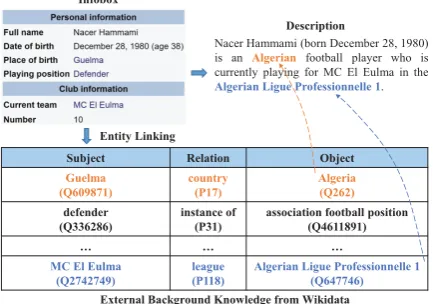
Figure 1: An example of generating description from a Wikipedia infobox. External background knowledge expanded from the infobox is helpful for generation.
determines how to generate the text based on se-lected contents. Traditionally, these two sub-problems have been tackled separately. In recent years, neural generation models, especially the encoder-decoder model, solve these two subprob-lems jointly and have achieved remarkable suc-cesses in several benchmarks (Mei et al., 2016;
Lebret et al., 2016;Wiseman et al., 2017;Duˇsek et al.,2018;Nie et al.,2018).
Such end-to-end data-to-text models rely on massive parallel pairs of data and text to learn the writing knowledge. They often assume that all writing knowledge can be learned from the train-ing data. However, when people are writtrain-ing, they will not only rely on the data contents themselves but also consider related knowledge, which is ne-glected by previous methods. For example, as shown in Fig.1, an infobox about a person called
in-fobox, we need to expand information based on external background knowledge from its related entities. For example, in the description: 1) “is an Algerianfootball player” indicates the nation-ality of Nacer Hammami which is not explicitly stated in the infobox. However, the place of birth,
Guelma, of Nacer Hammami is given, therefore the nationality can be inferred from the knowledge thatGuelmais a place inAlgeria. 2) “playing for
MC El Eulma in the Algerian Ligue Profession-nelle 1” describes the fact thatMC El Eulmais a club in theAlgerian Ligue Professionnelle 1which is also not explicitly stated in the infobox which can be expanded from external knowledge base.
One may argue that neural models can learn such knowledge when enough parallel co-occurrence pairs such as (Guelma, Algerian) and (MC El Eulma,Algerian Ligue Professionnelle 1) are available. However even in such case, neu-ral models still tend to make mistakes for sparse co-occurrence pairs as we will show in the experi-ments section.
In this paper we enhance neural-network-based data-to-text generation models with external knowledge in a simple but effective way. Besides learning the association between data and text from parallel data-text pairs as in previous work, our model attends to relevant external knowledge, encoded as a temporary memory, and combines this knowledge with the context representation of data before generating words. Specifically, both infobox and background knowledge facts are en-coded and a dual-attention mechanism is proposed to guide the decoder to generate text.
To verify the effectiveness of our proposed model, Knowledge Base enhanced Att ention-based sequence-to-sequence network (KBAtt), we conduct experiments on multiple Wikipedia infobox-to-text datasets including WikiBio ( Le-bret et al., 2016) and 20 new datasets1. Our ex-periment results show that KBAtt consistently im-proves a state-of-the-art neural data-to-text model to achieve higher performances on most of the datasets. To quantify when and why external knowledge is effective, we design a metric which shows a strong correlation with the observed per-formance boost. This result demonstrates the rel-evance of external knowledge and sparseness of original data are the main factors affecting system
1Available at https://github.com/hitercs/
WikiInfo2Text
performance.
The contributions of our work can be summa-rized as follows:
• We demonstrate that external knowledge base could be used to enhance the performance of neural data-to-text models.
• We propose a simple yet effective model, KBAtt, to integrate external knowledge using a dual-attention mechanism.
• We design a metric, KBGain, to quantify when and why external knowledge is effec-tive.
• We contribute twenty infobox-to-text datasets from a variety of domains.
2 The Proposed Model
Our model takes a data tableD(e.g., a Wikipedia infobox) and a relevant external knowledge base (KB) containing a set of factsF as input and gen-erates a natural language texty = y1, ..., yT con-sisting ofT words. To augment the infobox with external knowledge, we preserve the Wikipedia in-ternal hyperlink information in the field values of infobox, and track these hyperlinks to get their corresponding entities from Wikidata2 where we retrieve only one-hop facts. The backbone of our model is an attention based sequence-to-sequence model (Bahdanau et al.,2014) equipped with copy mechanism (See et al.,2017). As shown in Fig.2, the model consists of four main components: a table encoder, a KB encoder, the dual attention mechanism and a decoder. We describe each com-ponent in the following sections.
2.1 Table Encoder
In Fig. 2, the input data tableD consists of sev-eralfield name and field valuepairs. We follow (Sha et al.,2017;Liu et al.,2017) to tokenize the field values and transform the input table into a flattened sequence{(ni, vi)}Ni=1, where each ele-ment is a token vi from a field value paired with its corresponding field name ni. To encode the flattened table, we map each (ni, vi) to vector
xi = [eni;evi], where eni and evi are trainable
2
Field Name Field Value
Full name Nacer Hammami Place of birth Guelma Playing position Defender Current team MC El Eulma
Field Name ሺሻ Contentሺ࢜ሻ
Full name Nacer Full name Hammami
… …
Current team Eulma
Field Name ሺሻ Subject ሺ࢙ሻ Relation ሺ࢘ሻ Object ሺሻ
Place of birth (Q609871)Guelma country (P17) Algeria (Q262)
… … … …
Current team MC El Eulma(Q2742749) league (P118) Algerian Ligue Professionnelle 1(Q647746)
Entity Linking
GRU ࢎ
ࢎ
ࢎࡺ Flatten Table
ࢎࡺ
ࢎ
ࢎ
ࢉ࢚࢚ࢇ࢈ࢋ
ࢉ࢚࢈
GRU ࢊ࢚ MLP
ࢉ࢚ିࢉ࢚࢞ ࢊ࢚ି ࢚࢝ି Table Attention
KB Attention
softmax ࢚࢝ Table Encoder
KB Encoder
Decoder
Figure 2: A diagram of the knowledge base enhanced neural data-to-text generation model. First, we transform the table into a flattened sequence, extract entities mentioned in the field value of the infobox and link them to Wikidata where we can retrieve relevant facts. Then, the table contents and external knowledge base facts are carefully encoded. Finally, a single layer GRU decoder with a dual attention mechanism decides which part of information should be used for generation.
word embeddings ofniandvi, and[.;.]is the con-catenation of vectors. Then each xi is encoded into a hidden vectorhiusing a bi-directional GRU (Cho et al.,2014).
2.2 Knowledge Base Encoder
As shown in Fig.2, we extract entities mentioned in the field value of infobox and link them to Wikidata. Then we can retrieve relevant facts whose subject is the linked entity from Wikidata. These facts contain important background knowl-edge related to the infobox which is helpful for generation. The KB fact set is denoted by F =
{(nj, sj, rj, oj)}
|F|
j=1, where sj, rj, oj is the sub-ject, relation and object of the fact respectively, and field name nj indicates the current fact is linked by the field value of nj. In order to inte-grate such KB facts into the neural model, we ap-ply Multi-Layer Perceptron (MLP) to encode each fact into its representation:
fj = tanh(Wf[enj;esj;erj;eoj] +bf) (1)
whereWf andbf are trainable weights and bias, while enj, esj, erj and eoj is the embedding of
field name nj, subject sj, relation rj and object
oj respectively. To accommodate generation steps where no information from the external knowl-edge is needed, such as generating name field which is already stated in the table, we apply a simple strategy by padding a none fact in the knowledge base.
2.3 Dual Attention Mechanism
After encoding the table and background knowl-edge base facts, we apply a RNN-based decoder
to generate words conditioned on both table infor-mation and background knowledge fact informa-tion. In general, given a decoder hidden statedt at timestept, we apply dual attention mechanism including table attention and KB attention to de-termine which parts that it should pay attention to. Next we will introduce table attention and KB at-tention briefly.
2.3.1 Table Attention
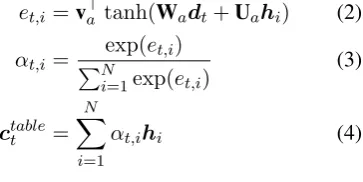
The table attention is based on similarity between decoder hidden statedt and table contents repre-sentation {hi}Ni=1. Specially we apply attention mechanism from (Bahdanau et al.,2014) to calcu-late the table context representationctable
t .
et,i=v>a tanh(Wadt+Uahi) (2)
αt,i=
exp(et,i)
PN
i=1exp(et,i)
(3)
ctablet =
N
X
i=1
αt,ihi (4)
where Wa, Ua and va are trainable parameters.
αt,i is the table attention weight.
2.3.2 KB Attention
[image:3.595.344.526.512.603.2]2.4 Decoder
The decoder is a single layer GRU equipped with copy mechanism. As for the generation mode, given a decoder hidden state dt, the decoder at-tends both table and knowledge base using mecha-nism described above, and get table context repre-sentationctablet and KB context representationckbt . So the context representation at time steptis given by:
ct= [ctablet ;ckbt ] (5) Then given tableDand knowledge base facts set
F, the probability of word yt generated from a fixed vocabulary at time stept is defined as fol-lows:
Pvocab= softmax(f(dt,yt−1,ct)) (6) wheref(·)is a non-linear function applying on the decoder hidden statedt, previous word embedding
yt−1and the current context vectorct.
To tackle the rare and unknown words problem, we adopt the copy mechanism (See et al.,2017). Specifically, a gatepgen ∈ [0,1]is introduced to switch between copy mode and generation mode. The generation probabilitypgenis defined as:
pgen=σ(w>cctablet +w
>
ddt+w>yyt−1+b) (7) whereσstands for the sigmoid function while vec-torswc,wd,wyand scalarbare trainable parame-ters. The joint probability for generatingytat time steptis formulated as follows:
P(yt|y<t, D, F) =pgenPvocab(yt) (8)
+ (1−pgen)
X
i:vi=yt αt,i
whereαt,i is the table attention weight defined in Equation 3.
2.5 Training
Given training dataset{(Dk, Fk, yk)}S
k=1 consist-ing ofSsamples, our goal is to maximize the prob-ability of target descriptiony=y1, ...yT given the input tableDand the background knowledge facts
F. So the objective function is to minimize the negative log-likelihood:
J(θ) =−1
S
S
X
k=1 Tk
X
t=1
logP(ytk|y<tk , Dk, Fk) (9)
The objective function is fully differentiable, so the entire model can be trained end-to-end through backpropagation. Adam (Kingma and Ba,2014) is used to optimize our model.
Subject Relation Object
Guelma
(Q609871) country (P17) Algeria(Q262) MC El Eulma
(Q2742749)
league (P118)
AlgerianLigue Professionnelle 1 (Q647746)
Algerian
Reference Infobox
Field Name Field Value Place of birth Guelma Current team MC ElEulma
KB
(1) String matching with KB (2) Track field in infobox (3) Select token with max PMI
Ligue Professionnelle 1 in the
[image:4.595.310.525.62.190.2]Learnable(KB-Ref ߛ) Unlearnable(KB-Ref ߛ) Learnable (Infobox-Ref ߛ) A: Infobox and KB are helpful B: Infobox is helpful Unlearnable (Infobox−Ref ߛ) C: KB is helpful D: not enough data
Figure 3: An illustration of KBGain metric.
3 When and Why External Knowledge is
Beneficial
In this section, we introduce KBGain to quan-tify when and why external knowledge (KB) is effective, and then show how KBGain corre-lates with the performance boost of KBAtt over Seq2Seq+Copy in 21 datasets in Section4.4. In-tuitively, incorporating an external KB should im-prove data-to-text generation performance. How-ever, to pinpoint the effect of the additional knowl-edge is not trivial since we know that (a) not all external knowledge is relevant and (b) neural mod-els may memorize certain inference patterns when parallel data is big enough. We assume (1) match-ing tokens between the external KB and the ref-erences indicate relevance of the tokens in the ex-ternal KB; (2) high frequency of co-occurrence of matching tokens between the infobox and the ref-erences indicate good potential for neural models to learn generation patterns which leads to less ef-fectiveness of an external KB, i.e. no data sparsity in the original data. To characterize these factors, we introduce KBGain.
KBGain measures the portion of learnable to-kens in the references co-occurred with their cor-responding external KB entries but filter out those tokens which could also co-occurred with the in-fobox. We say a token is learnable from one source (infobox or KB) when the co-occurrence frequency between them is higher than a thresh-oldγwhich is the minimum size of co-occurrence above which learning will be effective3. The top table in Fig. 3 summarizes learnable tokens in 4 possible cases. Among them, case C where the frequency of infobox and reference (Infobox-Ref) token co-occurrence does not exceed this thresh-old but its KB and reference (KB-Ref) token
co-3Here,γis set 25 by tuning on the development datasets,
Dataset WikiBio Album
Avg. # tokens per sentence 26.1 21.0
Avg. # tokens per table 53.0 57.1
Avg. # fields per table 19.7 15.9
Avg. # table tokens per sent. 11.6 9.7
Avg. # entities per table 5.9 5.5
Avg. # fact tuples per entity 19.0 7.2
[image:5.595.73.295.63.163.2]Dataset size 728, 321 76, 105
Table 1: Dataset statistics for two sample datasets.
occurrence does, then this is where the KB will be effective. KBGain is defined as the average ratio between count of the tokens falling into category
Cand the length of their corresponding reference on the test set.
Specifically, for all tokens in the reference ex-cept stop words and punctuation, we select those matched4 on string with the object tokens of KB but not with the infobox. For example, the to-ken Algerian in the reference is matched with the object of the last KB tuple. The KB-Ref to-ken pair is simply acquired by string matching while Infobox-Ref token pair can be tracked by firstly finding the corresponding field based on the matched tuple, and then selecting the token in its field value with the highest pointwise mutual in-formation (PMI).
4 Experiments
4.1 Datasets
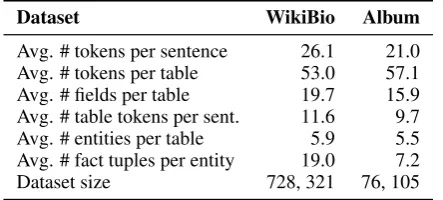
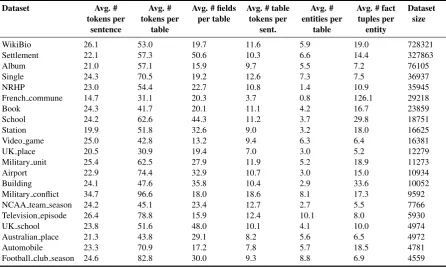
In the experiments, we adopt the WikiBio ( Le-bret et al.,2016) along with twenty new infobox-to-text datasets collected from Wikipedia5. The full statistics of these datasets could be found in the Appendix A.2. Table 1 shows the statistics of two sample datasets. Each dataset consists of infoboxes as input data and the first sentences of their corresponding Wikipeida articles as ref-erences. For example, on datasets WikiBio and Album, we extract 5.9 and 5.5 entities from each table, and each entity has 19.0 and 7.2 extended
4
To make it simple, we adopt strict string matching. This is acceptable for rough quantification of the intended mea-surement since precise and semantic-aware matching is still an active research area. We also try several popular stemmers to expand tokens e.g.,AlgeriatoAlgerian, but no stemmers have such capability.
5
These twenty datasets are similar to WikiBio but from different domains, e.g. Album, Book etc., which are charac-terized by infobox template category name. They are created with the similar procedure and the same Wikipedia dumps as outlined inLebret et al.(2016). For more details about data collection, please refer to the AppendixA.1.
Dataset Seq2Seq+Copy KBAtt ∆
Single 43.60 47.70 4.10
Station 54.30 56.77 2.47
Australian place 43.73 45.73 2.00
Album 41.04 42.77 1.73
NRHP 48.97 50.43 1.46
Airport 45.17 46.61 1.44
Book 36.07 37.49 1.42
Automobile 18.64 19.95 1.31
Building 24.13 25.21 1.08
UK school 33.64 34.72 1.08
School 37.30 38.33 1.03
Football club season 46.05 47.02 0.97
UK place 41.46 42.38 0.92
Military unit 37.74 38.58 0.84
Military conflict 18.58 19.21 0.63
WikiBio 44.28 44.59 0.31
Television episode 73.59 73.87 0.28
NCAA team season 87.37 87.58 0.21
French commune 90.14 90.33 0.19
Settlement 77.59 77.68 0.09
[image:5.595.309.524.66.284.2]Video game 29.54 29.48 -0.06
Table 2: BLEU-4 score with two generation models on 21 datasets.
facts tuples, on average. WikiBio and the other 20 datasets consist of 728,321 and 668,796 instances respectively, and they together cover 84.34% in-foboxes of the English Wikipedia6.
4.2 Experiment Setup
We conduct experiments on the datasets as in-troduced in Section 4.1. Seq2Seq+Copy is the main baseline: a sequence-to-sequence (Seq2Seq) model equipped with copy mechanism from See et al.(2017) which is one of the state of art meth-ods. We also compare our results with other pub-lished results using the WikiBio dataset. The model structure of our baseline model is most sim-ilar to Sha et al. (2017) by removing their spe-cialized design on order planning which is not the focus of this paper. Since our aim is to verify the effectiveness of external knowledge for data-to-text task, we keep our baseline model as gen-eral as possible without other specialized design. Our primary model is KBAtt: a model which in-tegrates the background knowledge into baseline model through a KB encoder and KB attention mechanism. We employ BLEU (Papineni et al.,
2002) as the automatic evaluation metric. In ad-dition to BLEU, we conduct human evaluation to assess the factual accuracy of generated sentences.
6Although the English Wikipedia has about 5 million
4.3 Training Details
The dimensions of all trainable word embeddings are set to 512, and the GRU hidden states sizes are set to 512. To limit the memory of our model, we set the maximum number of facts per table to 500. We initialize all the model parameters ran-domly using a uniform distribution between -0.08 and 0.08. For the model training, we use Adam (Kingma and Ba,2014) with initial learning rate of 0.001 as the optimization algorithm. The training batch size is set to 64. We also apply gradient clip-ping (Pascanu et al.,2013) with range [-1,1] dur-ing traindur-ing. We conduct experiments usdur-ing sdur-ingle card NVIDIA Tesla V100. The largest 15 datasets with more than 9500 training instances are trained for 20 epochs, while the remaining 6 datasets are trained for 40 epochs. All the models were se-lected based on BLEU-4 score on the development set. All the experiments use greedy search as the decoding algorithm during testing.
4.4 Main Results
4.4.1 Overall Results
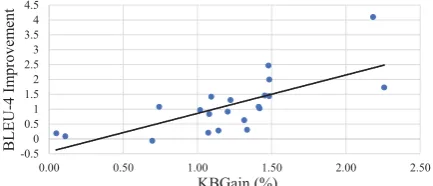
To verify the effectiveness of KBAtt, we con-duct experiments on 21 Wikipedia infobox-to-text datasets. Table 2 shows the performances of KBAtt and Seq2Seq+Copy in terms of BLEU-4 score. As we can see, KBAtt consistently out-performs Seq2Seq+Copy on most of the datasets, i.e., more than 0.5 BLEU-4 improvements on 15 out of 21 datasets, and comparable on the remain-ing 6 categories. To get a better understandremain-ing of when and why external knowledge will be effec-tive or not, we correlate the performance gains in terms of BLEU-4 withKBGainmetric described in Section3across 21 datasets, and plot their val-ues on the scatter plot in Fig. 4. The Pearson correlation coefficient (ρ) between BLUE-4 im-provements and KBGain is 0.716 which indicates a strong positive correlation between them. This confirms our analysis in Section 3 that KBAtt is effective when the external knowledge is relevant and the original data is sparse.
4.4.2 Results on WikiBio
To compare with state-of-the-art models, Table3
shows the results on the WikiBio dataset. Among them, our baseline Seq2Seq+Copy gains a perfor-mance of 44.28 which is comparable toSha et al.
(2017) andLiu et al.(2017) and significantly bet-ter thanLebret et al.(2016) andBao et al.(2018),
-0.5 0 0.5 1 1.5 2 2.5 3 3.5 4 4.5
0.00 0.50 1.00 1.50 2.00 2.50
BLEU-4
Im
provem
ent
[image:6.595.308.525.64.157.2]KBGain (%)
Figure 4: Strong correlation (ρ= 0.716) between KB-Gain (x) and absolute BLEU-4 improvement (y).
and this baseline model is general without specific design, e.g., order planning fromSha et al.(2017) or field-gating encoder from Liu et al. (2017). Our proposed model, namely KBAtt, obtains a BLEU-4 score of 44.59. Although the absolute improvement (+0.31 BLEU-4 points) of KBAtt over Seq2Seq+Copy is relative small, the differ-ence between them is statistically significant under the one-tailed paired t-test at the 99% significance level. The reason why the absolute improvement is relative small is that the full WikiBio dataset con-sists of 728,321 parallel data-to-text pairs which are enough for neural models to memorize certain inference patterns for high frequency pairs. How-ever, as will be shown in the Section4.5, the base-line fails on low co-occurrence frequency pairs, but the KBAtt avoids this problem with the con-tributions from the external knowledge.
4.4.3 Human Evaluation
We conduct human evaluation to assess the fac-tual accuracy of the generated sentences. Manu-ally evaluating the generated results of all datasets is labour intensive, so we choose to evaluate two sample datasets for case study purposes. Specifi-cally, we sample 50 instances each from the Wik-iBio and the Album datasets, and ask two anno-tators to extract facts tuples (subject, relation, ob-ject) from the references and the generated sen-tences7. In table4, precision P1, recall R1 and their overall scoreF1 measure the extent that the facts extracted from the generated sentences con-form to those from references. As we can see, KBAtt achieves 1.21%, 7.42% improvements in terms of F1 on WikiBio and Album respectively, which shows that KBAtt can generate more rel-evant facts with respect to the reference than the
7The generated sentences are shuffled to avoid model
Model BLEU-4
Table NLM (Lebret et al.,2016) 34.70
Table2Seq (Bao et al.,2018) 40.26
Order Planning, full model (Sha et al.,2017) 43.91 Field-gating Seq2Seq, full model (Liu et al.,2017) 44.71
Seq2Seq+Copy 44.28
KBAtt 44.59
Table 3: BLEU-4 scores (%) on WikiBio dataset.
Dataset Model P1 R1 F1 P2
WikiBio Seq2Seq+Copy 69.07% 62.45% 65.59% 88.35% WikiBio KBAtt 71.81% 62.45% 66.80% 91.85%
Album Seq2Seq+Copy 73.33% 71.84% 72.58% 84.38% Album KBAtt 81.70% 78.37% 80.00% 90.64%
Table 4: Human based evaluation results.
Seq2Seq+Copy baseline. We further ask the an-notators to judge whether the facts extracted from the generated texts are correct against informa-tion from the infobox, the external knowledge (eg. Wikidata), or even search engines. In table 4,
P2 measures the ratio of correct facts in the gen-erated results. We observe that KBAtt improves 3.50% and 6.26% over Seq2Seq+Copy in Wik-iBio and Album respectively. This shows that KBAtt is more likely to generate accurate facts than Seq2Seq+Copy.
4.5 Analysis of Few-Shot Learning Ability
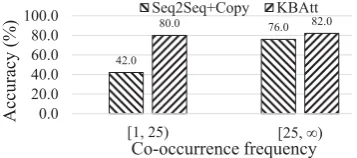
To examine the ability of learning writing knowl-edge from few examples, we design an experiment to compare the performance under different num-ber of training samples for the baseline and our model. In the training set of WikiBio, about 78.5% tables containplace of birthfield but only 19.0% tables include the nationality field. However, in the references,nationalityof a person is frequently mentioned. This means that the ability of inferring
nationality based on place of birth is important. We collect the cases from the test data with the fol-lowing conditions: (a) only city level information is given in the field of place of birth; (b) nation-ality is not specified in the table; (c) the reference mentions country name or nationality. From these cases, we get over 400 unique places of birth to nationality inference pairs and split them into two intervals[1,25)and[25,∞)according to their co-occurrence frequency in the training set8. For each interval, we randomly sample 50 test cases and
8The interval threshold 25 is set by following that for
KB-Gain.
42.0
76.0
80.0 82.0
0.0 20.0 40.0 60.0 80.0 100.0
[1, 25) [25,∞)
Accuracy
(%
)
[image:7.595.327.506.65.144.2]Co-occurrence frequency Seq2Seq+Copy KBAtt
Figure 5: Accuracy (%) of nationality information in the generated sentences w.r.t different co-occurrence frequency intervals.
manually assess the accuracy of nationality infor-mation mentioned in the generated sentences9.
Fig. 5shows the accuracy of nationality infor-mation in the generated text with respect to differ-ent co-occurrence frequency intervals: Firstly, we found that the baseline model struggles to learn the inference fromplace of birthtonationalitywhen their co-occurrence frequency in training set is less than 25, which shows the difficulty of this task; Secondly, in interval [1,25), the baseline model only gets 42.0% accuracy, but our model achieves 80.0% accuracy, a 38.0% absolute gain. This confirms our motivation that incorporating exter-nal knowledge into neural models can improve model performances especially when the original data is sparse; Finally, the accuracy of both mod-els increases as the frequency goes from[1,25)to
[25,∞), and the improvement of our model over the baseline model gradually narrows, from 38.0% to 6.0%. This shows that the baseline model could learn part of inference patterns when enough par-allel data is available.
4.6 Case Study
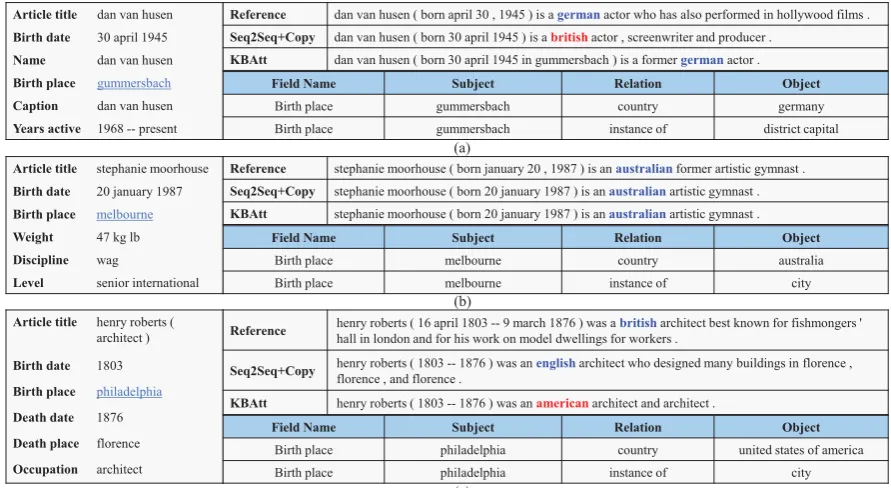
Fig. 6 shows three examples from the develop-ment set of WikiBio dataset which can demon-strate how KBAtt succeeds or fails. Fig.6(a) and (b) illustrate KBAtt is helpful when original data is sparse. However when original data is dense, the baseline model still can learn it. As shown in Fig.6(a), the baseline model struggles to learn di-rect association between “german”and “gummers-bach” (birth place in the table), since they only co-occur 12 times in the training data. But it is easy for KBAtt to learn since “german” co-occurs with “germany” in KB 12,437 times in the training data. As shown in Fig.6(b), although the
national-9In this experiment, a generated result is judged correct
[image:7.595.71.294.185.242.2]Article title dan van husen Birth date 30 april 1945 Name dan van husen Birth place gummersbach
Caption dan van husen Years active 1968 -- present
Reference dan van husen ( born april 30 , 1945 ) is agermanactor who has also performed in hollywood films . Seq2Seq+Copy dan van husen ( born 30 april 1945 ) is abritishactor , screenwriter and producer .
KBAtt dan van husen ( born 30 april 1945 in gummersbach ) is a former germanactor . Field Name Subject Relation Object
Birth place gummersbach country germany Birth place gummersbach instance of district capital
Article title stephanie moorhouse Birth date 20 january 1987 Birth place melbourne
Weight 47 kg lb Discipline wag
Level senior international
Field Name Subject Relation Object Birth place melbourne country australia Birth place melbourne instance of city Reference stephanie moorhouse ( born january 20 , 1987 ) is anaustralianformer artistic gymnast . Seq2Seq+Copy stephanie moorhouse ( born 20 january 1987 ) is anaustralianartistic gymnast . KBAtt stephanie moorhouse ( born 20 january 1987 ) is anaustralianartistic gymnast .
(a)
(b)
Article title henry roberts ( architect ) Birth date 1803 Birth place philadelphia
Death date 1876 Death place florence Occupation architect
Field Name Subject Relation Object Birth place philadelphia country united states of america Birth place philadelphia instance of city Reference henry roberts ( 16 april 1803 -- 9 march 1876 ) was a hall in london and for his work on model dwellings for workers .britisharchitect best known for fishmongers '
Seq2Seq+Copy henry roberts ( 1803 -- 1876 ) was anflorence , and florence . englisharchitect who designed many buildings in florence ,
KBAtt henry roberts ( 1803 -- 1876 ) was anamericanarchitect and architect .
[image:8.595.75.521.63.307.2](c)
Figure 6: Case study. Three generation examples from development set of WikiBio. Each example consists of the input infobox, parts of external knowledge base, the reference and two generated sentences by Seq2Seq+Copy and KBAtt. We mark correct fact information as blue and incorrect ones as red.
ity information is not explicitly stated in the table, both Seq2Seq+Copy and KBAtt generate correct nationality information (“australian”). The reason is that “australian” co-occurs with “melbourne” in the table 3,391 times in the training data. So, it is easy for the neural model to learn such infer-ence patterns. Fig.6 (c) illustrates the pattern of inferring nationality from birth place is not always correct. In this case, KBAtt makes a plausible in-ference on nationality from birth place, so it gen-erates “american”. However, this inference pattern doesn’t hold for this case, because he is British. Hopefully, such cases are rare since the birth place conforms to the nationality in most of cases, so our methods can bring improvement as indicated by the overall better performance across almost all Wikipedia categories.
5 Related Work
Data-to-text generation is an important task in nat-ural language generation which has been stud-ied for decades (Kukich, 1983; Holmes-Higgin,
1994;Reiter and Dale,1997). This task is broadly divided into two subproblems: content selection
(Kukich, 1983; Reiter and Dale, 1997; Duboue and McKeown,2003;Barzilay and Lapata,2005) andsurface realization(Goldberg et al.,1994;
Re-iter et al.,2005).
With the advent of neural text generation, the distinction between content selection and sur-face realization becomes blurred. For exam-ple, Mei et al. (2016) proposed an end-to-end encoder-aligner-decoder model to learn both con-tent selection and surface realization jointly which shows good results on WeatherGov and RoboCub datasets. Wiseman et al. (2017) generate long descriptive game summaries from a database of basketball games where they show the current state-of-the-art neural models are quite good at generating fluent outputs, but perform poorly in content selection and capturing long-term struc-ture. Our work falls into the task of single sen-tence generation from Wikipedia infoboxes. The model structure ranges from feed-forward net-works work (Lebret et al., 2016) to encoder-decoder models (Sha et al., 2017; Liu et al.,
knowledge into this task to improve the fidelity of generated text.
Our work is also relevant to recent works on in-tegrating external knowledge into neural models for other NLP tasks. The motivations of incor-porating external knowledge range from enrich-ing the context information (Mihaylov and Frank,
2018) in reading comprehension, improving the inference ability of models (Chen et al.,2018) in natural language inference, to providing the model a knowledge source to copy from in language modelling (Ahn et al.,2016). Our model, KBAtt, is most relevant to Mihaylov and Frank (2018), where they focus on similarity calculation but we focus on generation in this paper. Moreover, in ad-dition to demonstrating the positive effect of incor-porating external knowledge as previous work, we also design a new metric to quantify the potential gains of external knowledge for a specific dataset which can explain when and why our model is ef-fective.
6 Conclusion
In this paper, we propose a neural data-to-text generation model, KBAtt, that incorporates ex-ternal background knowledge in a simple but ef-fective way to improve fidelity of the generated text. Experiments on 21 Wikipedia infobox-to-text datasets show KBAtt consistently achieves better performance in BLEU than a state-of-the-art base-line on most of datasets. Meanwhile, to quantify when and why external knowledge is effective, we design a metric, KBGain, which shows a strong correlation with observed performance boost. This result indicates the relevance of external knowl-edge and sparseness of original data are the main factors affecting the effectiveness of KBAtt.
In the future, we plan to investigate integrat-ing multi-hops knowledge graph behind the data which has potential to further improve the infer-ence ability of neural models. It will be worth-while especially when we extend the task to multi-ple sentence generation. The main challenge in in-tegrating multi-hops knowledge graph is the large search space. We plan to employ reinforcement learning based techniques to allow the model to search the optimal inference paths by trial and er-ror. Besides, we are also interested in integrating external knowledge into other types of datasets be-yond Wikipedia infobox-to-text datasets.
7 Acknowledgement
We would like to thank the anonymous reviewers for their helpful comments. The work of this pa-per is funded by the project of National Key Re-search and Development Program of China (No. 2018YFC0832105).
References
Sungjin Ahn, Heeyoul Choi, Tanel P¨arnamaa, and
Yoshua Bengio. 2016. A neural knowledge
lan-guage model.arXiv preprint arXiv:1608.00318.
Dzmitry Bahdanau, Kyunghyun Cho, and Yoshua
Ben-gio. 2014. Neural machine translation by jointly
learning to align and translate. International Con-ference on Learning Representations.
Junwei Bao, Duyu Tang, Nan Duan, Zhao Yan, Yuan-hua Lv, Ming Zhou, and Tiejun Zhao. 2018. Table-to-text: Describing table region with natural lan-guage. AAAI.
Regina Barzilay and Mirella Lapata. 2005. Collective content selection for concept-to-text generation. In
Proceedings of the conference on Human Language Technology and Empirical Methods in Natural Lan-guage Processing, pages 331–338. ACL.
Qian Chen, Xiaodan Zhu, Zhen-Hua Ling, and Diana Inkpen. 2018. Natural language inference with
ex-ternal knowledge. Proceedings of the 56th Annual
Meeting of the Association for Computational Lin-guistics.
Kyunghyun Cho, Bart Van Merri¨enboer, Caglar Gul-cehre, Dzmitry Bahdanau, Fethi Bougares, Holger
Schwenk, and Yoshua Bengio. 2014. Learning
phrase representations using rnn encoder-decoder for statistical machine translation. Proceedings of the 2014 Conference on Empirical Methods in Nat-ural Language Processing.
Pablo A Duboue and Kathleen R McKeown. 2003. Sta-tistical acquisition of content selection rules for
nat-ural language generation. In Proceedings of the
2003 Conference on Empirical Methods in Natural Language Processing, pages 121–128. ACL.
Ondˇrej Duˇsek, Jekaterina Novikova, and Verena Rieser.
2018. Findings of the E2E NLG Challenge. In
Proceedings of the 11th International Conference on Natural Language Generation, Tilburg, The Nether-lands. ArXiv:1810.01170.
Eli Goldberg, Norbert Driedger, and Richard I Kit-tredge. 1994. Using natural-language processing to
produce weather forecasts. IEEE Intelligent
Sys-tems, (2):45–53.
Paul Holmes-Higgin. 1994. Text generation: using dis-course strategies and focus constraints to generate
natural language text. The Knowledge Engineering
Diederik P Kingma and Jimmy Ba. 2014. Adam: A
method for stochastic optimization. International
Conference on Learning Representations.
Karen Kukich. 1983. Design of a knowledge-based
re-port generator. In Proceedings of the 21st annual
meeting on Association for Computational Linguis-tics, pages 145–150. ACL.
R´emi Lebret, David Grangier, and Michael Auli. 2016. Neural text generation from structured data with
ap-plication to the biography domain. Proceedings of
the 2016 Conference on Empirical Methods in Nat-ural Language Processing.
Tianyu Liu, Kexiang Wang, Lei Sha, Baobao Chang, and Zhifang Sui. 2017. Table-to-text generation by structure-aware seq2seq learning. AAAI.
Christopher Manning, Mihai Surdeanu, John Bauer, Jenny Finkel, Steven Bethard, and David McClosky.
2014. The Stanford CoreNLP natural language
pro-cessing toolkit. In Proceedings of 52nd Annual Meeting of the Association for Computational Lin-guistics: System Demonstrations, pages 55–60, Bal-timore, Maryland. Association for Computational Linguistics.
Hongyuan Mei, Mohit Bansal, and Matthew R Walter. 2016. What to talk about and how? selective gen-eration using lstms with coarse-to-fine alignment.
NAACL.
Todor Mihaylov and Anette Frank. 2018. Knowledge-able reader: Enhancing cloze-style reading com-prehension with external commonsense knowledge.
Proceedings of the 56th Annual Meeting of the As-sociation for Computational Linguistics.
Preksha Nema, Shreyas Shetty, Parag Jain, Anirban Laha, Karthik Sankaranarayanan, and Mitesh M Khapra. 2018. Generating descriptions from struc-tured data using a bifocal attention mechanism and
gated orthogonalization. NAACL.
Feng Nie, Jinpeng Wang, Jin-Ge Yao, Rong Pan, and Chin-Yew Lin. 2018. Operations guided neural net-works for high fidelity data-to-text generation. Pro-ceedings of the 2018 Conference on Empirical Meth-ods in Natural Language Processing.
Kishore Papineni, Salim Roukos, Todd Ward, and Wei-Jing Zhu. 2002. Bleu: a method for automatic eval-uation of machine translation. InProceedings of the 40th Annual Meeting of the Association for Compu-tational Linguistics, pages 311–318. ACL.
Razvan Pascanu, Tomas Mikolov, and Yoshua Bengio. 2013. On the difficulty of training recurrent neural
networks. InThe 30th International Conference on
Machine Learning, pages 1310–1318.
Laura Perez-Beltrachini and Mirella Lapata. 2018.
Bootstrapping generators from noisy data. NAACL.
Ehud Reiter and Robert Dale. 1997. Building applied
natural language generation systems. Natural
Lan-guage Engineering, 3(1):57–87.
Ehud Reiter, Somayajulu Sripada, Jim Hunter, Jin Yu, and Ian Davy. 2005. Choosing words in computer-generated weather forecasts. Artificial Intelligence, 167(1-2):137–169.
Abigail See, Peter J Liu, and Christopher D Manning. 2017. Get to the point: Summarization with
pointer-generator networks. Proceedings of the 55th Annual
Meeting of the Association for Computational Lin-guistics.
Lei Sha, Lili Mou, Tianyu Liu, Pascal Poupart, Sujian Li, Baobao Chang, and Zhifang Sui. 2017. Order-planning neural text generation from structured data.
AAAI.
Sam Wiseman, Stuart M Shieber, and Alexander M Rush. 2017. Challenges in data-to-document
gener-ation. Proceedings of the 2017 Conference on
Em-pirical Methods in Natural Language Processing.
A Supplemental Material
A.1 Dataset Collection
Our dataset is an extension of WikiBio dataset (Lebret et al., 2016) where we extend previous single Biography domain to other twenty do-mains (e.g. Album, Book etc.) and augment the infoboxes with external knowledge from Wiki-data10. Our dataset consists of infoboxes as input data and the first sentence of their corresponding Wikipedia article as reference. The infoboxes are parsed from English Wikipedia dump (Sep 2015) while the reference sentences are tokenized with Stanford CoreNLP (Manning et al.,2014). Differ-ent from (Lebret et al., 2016), we keep the cap-italization information which we believe is im-portant for real-world application. To augment the infoboxes with external knowledge, we pre-serve the Wikipedia internal hyperlink informa-tion in the field values of infoboxes, and track these hyperlinks to get their corresponding enti-ties from Wikidata (dumps version: 20150831). Finally we retrieve one-hop facts from Wikidata. The dataset is aviliable at https://github. com/hitercs/WikiInfo2Text.
A.2 Full Dataset Statistics
Table5summarizes the full dataset statistics about the twenty-one datasets used in this paper. As you can see, WikiBio consists of 728,321 in-stances which is the largest infobox-to-text dataset
Dataset Avg. # tokens per
sentence
Avg. # tokens per
table
Avg. # fields per table
Avg. # table tokens per
sent.
Avg. # entities per
table
Avg. # fact tuples per
entity
Dataset size
WikiBio 26.1 53.0 19.7 11.6 5.9 19.0 728321
Settlement 22.1 57.3 50.6 10.3 6.6 14.4 327863
Album 21.0 57.1 15.9 9.7 5.5 7.2 76105
Single 24.3 70.5 19.2 12.6 7.3 7.5 36937
NRHP 23.0 54.4 22.7 10.8 1.4 10.9 35945
French commune 14.7 31.1 20.3 3.7 0.8 126.1 29218
Book 24.3 41.7 20.1 11.1 4.2 16.7 23859
School 24.2 62.6 44.3 11.2 3.7 29.8 18751
Station 19.9 51.8 32.6 9.0 3.2 18.0 16625
Video game 25.0 42.8 13.2 9.4 6.3 6.4 16381
UK place 20.5 30.9 19.4 7.0 3.0 5.2 12279
Military unit 25.4 62.5 27.9 11.9 5.2 18.9 11273
Airport 22.9 74.4 32.9 10.7 3.0 15.0 10934
Building 24.1 47.6 35.8 10.4 2.9 33.6 10052
Military conflict 34.7 96.6 18.0 18.6 8.1 17.3 9592
NCAA team season 24.2 45.1 23.4 12.7 2.7 5.5 7766
Television episode 26.4 78.8 15.9 12.4 10.1 8.0 5930
UK school 23.8 51.6 48.0 10.1 4.1 10.0 4974
Australian place 21.3 43.8 29.1 8.2 5.6 6.5 4972
Automobile 23.3 70.9 17.2 7.8 5.7 18.5 4781
[image:11.595.77.524.63.330.2]Football club season 24.6 82.8 30.0 9.3 8.8 6.9 4559
Table 5: Dataset statistics for all datasets used in this paper.
in Wikipedia. However, the size of remaining datasets ranges from 4,559 to 327,863 and more than 60% of them have less than 20,000 instances. So, the abundance of data such as WikiBio is not common among the Wikipedia infobox-to-text datasets. Meanwhile, these datasets vary in sen-tence length and length of tokens in table. In ad-dition, the number of entities extracted from each table ranges from 0.8 to 10.1 and the average num-ber of fact tuples per entity ranges from 5.2 to 126.1.
A.3 Threshold Tuning for KBGain metric
0.5 0.55 0.6 0.65 0.7 0.75 0.8
0 20 40 60 80 100
Pearson
Correlati
on
C
oef
ficien
t
[image:11.595.79.283.559.684.2]Co-occurrence frequency threshold
Figure 7: Pearson correlation coefficient w.r.t
Co-occurrence frequency threshold.
The threshold γ in KBGain metric denotes the minimum size of co-occurrence above which
learning will be effective. We tune this threshold by finding the maximumpearson correlation coef-ficient(ρ) between BLEU-4 improvements and the values of KBGain on the 21 development datasets. Fig.7shows the curve ofpearson correlation co-efficient w.r.t co-occurrence frequency threshold ranging from 5 to 100. As we can see,ρreaches peak value as 0.753 when the threshold is 25. So