Integrating Order Information and Event Relation for Script Event
Prediction
∗Zhongqing Wang†,‡,Yue Zhang‡andChing-Yun Chang‡ †Soochow University, Suzhou, China
‡Singapore University of Technology and Design, Singapore
[email protected], yue [email protected], [email protected]
Abstract
There has been a recent line of work au-tomatically learning scripts from unstruc-tured texts, by modeling narrative even-t chains. While even-the dominaneven-t approach group events using event pair relations, L-STMs have been used to encode full chain-s of narrative eventchain-s. The latter hachain-s the advantage of learning long-range tempo-ral orders1, yet the former is more
adap-tive to partial orders. We propose a neu-ral model that leverages the advantages of both methods, by using LSTM hid-den states as features for event pair mod-elling. A dynamic memory network is u-tilized to automatically induce weights on existing events for inferring a subsequen-t evensubsequen-t. Ssubsequen-tandard evaluasubsequen-tion shows subsequen-thasubsequen-t our method significantly outperforms both methods above, giving the best results re-ported so far.
1 Introduction
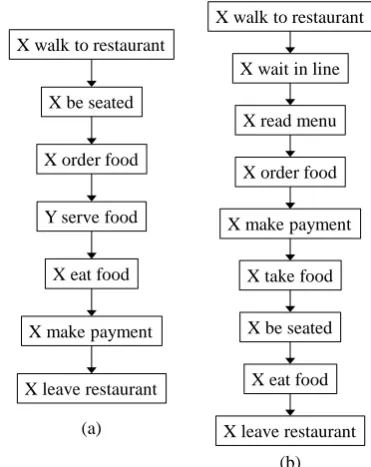
Frequently recurring sequences of events in pro-totypical scenarios, such as visiting a restauran-t and driving restauran-to work, are a useful source of world knowledge. Two examples are shown in Figure1, which are different variations of the “restaurant visiting” scenario, where events are partially or-dered and can be flexible. Such knowledge is useful for natural language understanding because texts typically do not include event details when mentioning a scenario. For example, the reader is expected to infer that the narrator could have been
∗This work has been done when the first author worked
at SUTD.
1The term “temporal order” is used throughout this work
to indicate the narrative order in texts, followingChambers and Jurafsky(2008). Strictly speaking, the event order we extract is the narrative order.
X walk to restaurant
X be seated
X order food
Y serve food
X eat food
X make payment
X leave restaurant
X walk to restaurant
X be seated
X eat food X make payment
X leave restaurant X wait in line
X read menu
X take food X order food
(a)
[image:1.595.318.504.226.460.2](b)
Figure 1: Event sequences for restaurant visiting.
driving or cycling given the text “I got flat tire”. Another typical use of event chain knowledge is to help infer what is likely to happen next given a previous event sequence in a scenario. We inves-tigate the modeling of stereotypical event chains, which is remotely similar to language modeling, but with events being more sparse and flexibly or-dered than words.
Our work follows a recent line of NLP re-search on script learning. Stereotypical knowl-edge about partially-orderedevents, together with their participant rolessuch as “customer”, “wait-er”, and “table”, is conventionally referred to as
scripts (Schank et al., 1977). NLP algorithms have been investigated for automatically inducing scripts from unstructured texts (Mooney and De-Jong,1985;Chambers and Jurafsky,2008). In par-ticular,Chambers and Jurafsky(2008) made a first attempt to learn scripts from test inducing event
chains by grouping events based on their narrative coherence, calculated based on Pairwise Mutual Information (PMI).Jans et al.(2012) showed that the method can be improved by calculating even-t relaeven-tions using skip bi-gram probabilieven-ties, which explicitly model the temporal order of pairs even-t. Jans et al.(2012)’s model is adopted by a line of subsequent methods on inducing event chains from text (Orr et al.,2014;Pichotta and Mooney, 2014;Rudinger et al.,2015).
While the above methods are statistical, neural network models have recently been used for event sequence modeling. Granroth-Wilding and Clark (2016) used a Siamese Network instead of PMI to calculate the coherence between two events. Rudinger et al. (2015) extended the idea of Jan-s et al.(2012) by using a log-bilinear neural lan-guage model (Mnih and Hinton, 2007) to calcu-late event probabilities. By learning embeddings for reducing sparsity, the above models give much better results compared to the models ofChambers and Jurafsky(2008) andJans et al.(2012). Simi-lar in spirit,Modi(2016) predicted the probability of an event belonging to a certain event chain by modeling known events in the chain as a bag of vectors, showing that it outperforms discrete sta-tistical methods. These neural methods are con-sistent with the earlier statistical models in lever-aging event-pair relations.
Pichotta and Mooney(2016) experimented with LSTM for script learning, using an existing se-quence of events to predict the probability of a next event, which outperformed strong discrete baselines. One advantage of LSTMs is that they can encode unbounded time sequences without losing long-term historical information. LSTMs capture significantly more order information com-pared to the methods of Granroth-Wilding and Clark (2016), Rudinger et al. (2015), and Mod-i(2016), which model the temporal order of only pairs of events. On the other hand, a strong-order LSTM model can also suffer the disadvantage of over-fitting, given the flexible order of event chain-s in a chain-script, achain-s demonchain-strated by the cachain-sechain-s of Fig-ure1. In this aspect, event-pair models are more adaptive for flexible orders. However, no direc-t comparisons have been repordirec-ted bedirec-tween LSTM and various existing neural network methods that model event-pairs.
We make such comparisons using the same benchmark, finding that the method of Pichotta
and Mooney (2016) does not necessarily outper-form event-pair models, such asGranroth-Wilding and Clark(2016). LSTM temporal ordering and event pair modeling have their respective strength. To leverage the advantages of both methods, we propose to integrate chain temporal order infor-mation into event relation measuring. In partic-ular, we calculate event pair relations by repre-senting events in a chain using LSTM hidden s-tates, which encode temporal information. The L-STM over-fitting issue is mitigated by using the temporal-order in a chain as a feature for event pair modeling, rather than the direct model out-put. In addition, observing that the importance of existing events can vary for inferring a subse-quent event, we use a dynamic memory network model to automatically induce event weights for each event for inferring the next event. In con-trast, previous methods give equal weights to ex-isting events (Chambers and Jurafsky,2008; Mo-di,2016;Granroth-Wilding and Clark,2016).
Results on a multi-choice narrative cloze bench-mark show that our model significantly outper-forms both Granroth-Wilding and Clark (2016) and Pichotta and Mooney(2016), improving the state-of-the-art accuracy from 49.57% to 55.12%. Our contributions can be summarized as follows:
• We make a systematic comparison of LSTM and pair-based event sequence learning meth-ods using the same benchmarks.
• We propose a novel dynamic memory net-work model, which combines the advantages of both LSTM temporal order learning and traditional event pair coherence learning.
• We obtain the best results in the standard multi-choice narrative cloze test.
Our code is released at https://github. com/wangzq870305/event_chain.
2 Related Work
Scripts have been a traditional subject in AI re-search (Schank et al., 1977), where event se-quences are manually encoded in knowledge bases, and used for end tasks such as inference. They are also connected with research in linguis-tics and psychology, and sometimes referred to as frames (Minsky, 1975; Fillmore, 1982) and
is also studied astemplatesin information extrac-tion (Sundheim, 1991). Chambers and Jurafsky (2008) pioneered the recent line of work on script induction (Jans et al.,2012;Pichotta and Mooney, 2016;Granroth-Wilding and Clark, 2016), where the focus is on modeling narrative event chains, a crucial subtask for script modeling from raw text. Below we summarize such investigations.
With respect to event representation, Cham-bers and Jurafsky (2008) casted narrative events as triples of the formhevent, dependencyi, where the event is typically represented by a verb and the dependency represents typed dependency relations between the event and a protagonist, such as “sub-ject” and “ob“sub-ject”.Chambers and Jurafsky(2008) organized narrative chains around a central actor, or protagonist, mining events that share a common protagonist from texts by using a syntactic parser and a coreference resolver.Balasubramanian et al. (2013) observed that the protagonist representa-tion of event chains can suffer from weaknesses such as lack of coherence, and proposed to repre-sent events asharg1, relation, arg2i, wherearg1
andarg2 represent the subject and object,
respec-tively. Such representation is inspired by open in-formation extraction (Mausam et al., 2012), and offers richer features for event pair modeling. Pi-chotta and Mooney(2014) adpoted a similar idea, using v(es, eo, ep)to represent an event, where v
is a verb lemma, es is the subject, eo is the
ob-ject, andep is an entity with prepositional relation
tov. Their representation is used by subsequent work such asModi (2016) andGranroth-Wilding and Clark(2016). We followPichotta and Mooney (2016) in our event representation form.
With respect tomodeling, existing methods can be classified into two main categories, namely
weak-ordermodels, which calculate relations be-tween pairs of events, and strong-order models, which consider the temporal order of events in a full sequence. Event-pair models have so far been the dominant method in the literature. Earlier work used discrete event representations and esti-mated event relations by statistical counting. As mentioned earlier,Chambers and Jurafsky(2008) used PMI to calculate event relations, and Jan-s et al. (2012) used skip bigram probabilites to the same end, which is order-sensitive. Most sub-sequent methods followed Jans et al. (2012) in using skip n-grams (Pichotta and Mooney,2014; Rudinger et al.,2015).
Events being multi-argument structures, counting-based methods can suffer from sparsity issues. Recent work employed embeddings to address this disadvantage. Rudinger et al.(2015) learned event embeddings as a by-product of training a log-bilinear language model for events; Granroth-Wilding and Clark (2016) leveraged the skip-gram model ofMikolov et al.(2013) for training the embeddings of event and arguments by ordering them into a pseudo sentence. Modi (2016) utilized word embeddings of verbs and arguments directly, using a hidden layer to au-tomatically consolidate word embedding into a single structured event embeddings. We follow Modi(2016) and use a hidden layer to learn event argument compositions given word embeddings, training the composition function as a part of the event chain learning process.
Mitigating the sparsity issue of event represen-tations, neural methods can capture temporal or-ders between events beyond skip n-grams. Our model integrates the advantages of strong-order learning and event-pair learning by using LSTM hidden states as feature representation of existing events in the calculation of event pair relationship-s. In addition, we use a memory network model to weigh existing events, which gives better results compared to the equal weighting method of exist-ing models.
With respect to evaluation, Chambers and Ju-rafsky(2008) proposed the Narrative Cloze Test, which asks for a missing event in a given even-t chain wieven-th a gap. The even-task has been adopeven-ted by various subsequent work for comparing result-s withChambers and Jurafsky(2008) (Jans et al., 2012;Pichotta and Mooney,2014;Rudinger et al., 2015). One issue of the narrative cloze test is that there can sometimes be multiple plausible answer-s, but only one gold-standard answer, which can make it overly expensive to manually evaluate sys-tem outputs. To address this issue, Modi (2016) proposed theAdversarial Narrative Cloze(ANC) task, which is to discriminate between pairs of real and corrupted event chains.Granroth-Wilding and Clark(2016) proposed theMulti-Choice Narrative Cloze(MCNC) task, which is to choose the most likely next event from a set of candidates given a chain of events. We choose MCNC for comparing different models.
Other related work includes learning
Uz-X = Customer, Y = Waiter
walk(X, restaurant), seat(X), order(X, food), serve(Y, food) eat(X, food), make(X, payment),
c1: receive(X, response)
c2: drive(X, mile) c3: seem(X) c4: discover(X, truth)
c5: leave(X, restaurant)
?
EntitiesContext(ei)
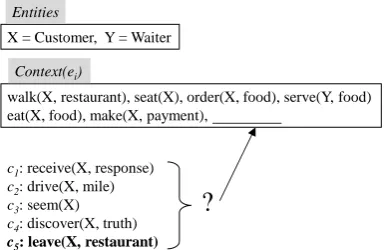
Figure 2: Multiple choice narrative cloze. The gold subsequent event is marked in bold.
Zaman et al.,2013;Abend et al., 2015), evaluat-ed using different metrics. There has also been work using graph models to induce frames, which emphasize more on learning event structures and less on temporal orders (Chambers,2013;Cheung et al., 2013). The above methods focus on one of the two subtasks we consider here. Frermann et al.(2014) used a Bayesian model to jointly clus-ter web collections of explicit event sequence and learn input event-pair temporal orders. However, their work is under a different input setting ( Reg-neri et al., 2010), not learning event chains from texts. Mostafazadeh et al.(2016) proposed the s-tory close task (SCT), which is to predict the end-ing given a unfinished story. Our narrative chain prediction task can be regarded as a sub task in the story close task, which can contribute as a major approach. On the other hand, information beyond event chains can be useful for the story close task.
3 Problem Definition
As shown in Figure 2, given a chain of narrative eventse1,e2, ...,en−1, our work is to predict the
likelihood of a next event candidateen. Formally,
an eventeis a structurev(a0, a1, a2), wherevis a verb describing the event,a0anda1are its subject
and direct object, respectively, anda2 is a
prepo-sitional object. For example, given the sentence “John brought Marry to the restaurant”, an
even-tbring{John,Marry,to the restaurant}can be
extracted.
We follow the standard script induction set-ting (Chambers and Jurafsky, 2008; Granroth-Wilding and Clark,2016), extracting events from a text corpus using a syntactic parser and a named entity resolver. A neural network is used to mod-el chains of extracted events for script learning. In particular, we model the probability of a
sub-sequent event given a chain of events. For eval-uation, we solve the multi-choice narrative cloze task: given a chain of events and a set of candidate next events, the most likely candidate is chosen as the output.
4 Model
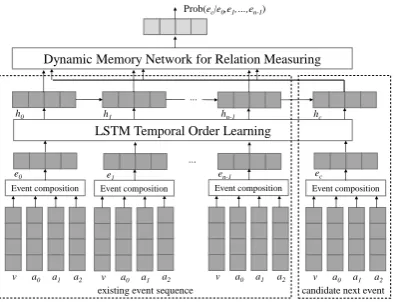
The overall structure of our model is shown in Fig-ure 3, which has three main components. First, given an eventv(a0, a1, a2), a representation
lay-er is used to compose the embeddings ofv,a0,a1, anda2 into a single event vectore. Second, a
L-STM is used to map a sequence of existing events
e1,e2, ..., en−1 into a sequence of hidden vectors h1, h2, ..., hn−1, which encode the temporal
or-der. Given a next event candidateec, the recurrent
network takes one further step from hn−1 to
de-rive its hidden vectorhc, which encodesec. Third,
hc is paired with h1, h2, ..., hn−1 individually,
and passed to a dynamic memory network to learn the relatedness score s. s is used to denote the connectedness between the candidate subsequent event and the context event chain.
4.1 Event Representation
We learn vector representations of standard events by composing pre-trained word embeddings of its verb and arguments. The skipgram mod-el (Mikolov et al.,2013) is used to train word vec-tors. For arguments that consist of more than one word, we use the averaged word for the represen-tation. OOV words are represented simply using zero vectors. For events with less than 3 argu-ments, such as “John fell”, wherev =fall, a0 = John, a1 =NULL, anda2 =NULL, the NULL
arguments are represented using all-zero vectors. Denoting the embeddings of v, a0, a1, and a2
ase(v),e(a0),e(a1), ande(a2), respectively, the
embedding ofeis calculated using atanh compo-sition layer
e(e) = tanh(Wev·e(v) +We0·e(a0)+
W1
e ·e(a1) +We2·e(a2) +be) (1)
Here Wv
e, We0, We1, We2, and b are model
parameters, which are randomly initialized and tuned during the training of the main network.
4.2 Modeling Temporal Orders
Given the embeddings of the existing chain of events e1, e2, ..., en−1, we use a standard
[image:4.595.86.281.65.190.2]Event composition
LSTM Temporal Order Learning
v a0 a1 a2 e0
Event composition
v a0 a1 a2 ec
e1 en-1
…
Dynamic Memory Network for Relation Measuring
h0 h1 hn-1 hc
…
Prob(ec|e0,e1,…,en-1)
candidate next event existing event sequence
Event composition
v a0 a1 a2 Event composition
[image:5.595.83.281.62.213.2]v a0 a1 a2
Figure 3: Overview of proposed model.
e0 e1 en-1
ec1
ec2
ecm hn-1
h2 h1
hc1
hc2
hcm … …
Figure 4: Temporal order modeling.
coupled input and forget gates or peephole con-nections to model the temporal order. We ob-tain a sequence of hidden state vectors h1, h2,
..., hn−1 by recurrently feeding e(e1), e(e2), ..., e(en−1) as inputs to the LSTM, where hi =
LSTM(e(ei), hi−1). The initial state hs and
al-l stand LSTM parameters are randomal-ly initiaal-lized and tuned during training.
Now for each candidate next event ec, we
ob-tain its vector representatione(ec)in the same way
as for e1 toen−1. e(ec) is then appended to the
existing event chain to obtain a temporal-order-sensitive feature vector hc, by advancing the
re-current encoding process for one step fromhn−1: hc = LSTM(e(ec), hn−1). With multiple next
event candidates e1
c, e2c, ..., ecm (m ∈ [1,∞]),m
feature vectors are obtained, as shown in Figure4, each being used as a basis for estimating the prob-ability of the corresponding event candidate.
4.3 Modeling Pairwise Event Relations
After obtaining the hidden states for events, we model event pair relations using these hidden s-tate vectors. A straightforward approach to model the relation between two events is using a Siamese network (Granroth-Wilding and Clark,2016). The order-sensitive LSTM features for existing events
h1, h2, ..., hn−1 and the candidate event hc are
used as event representations. Given a pair of eventshi (i ∈ [1..n−1]) andhc, the relatedness
score is calculated by
si = sigmoid(Wsihi+Wschc+bs), (2)
whereWsi,Wscandbsare model parameters.
Given the relation scoresibetweenhcand each
existing eventhi, the likelihood ofecgivene1,e2,
...,en−1can be calculated as the average ofsi:
s=
Pn−1 i=1 si
n−1 (3)
Weighting existing events. The drawback of
above approach is that it considers the contribu-tion of each event on the chain is same. How-ever, given a chain of existing events, some are more informative for inferring a subsequent event than others. For example, given the events “wait in queue”, “getting seated” and “order food”, “or-der food” is more relevant for inferring “eat food” compared with the other two given events. Given information over the full event chain, this link can be more evident since the scenario is likely restau-rant visiting.
We use an attentional neural network to calcu-late the relative importance of each existing event according to the subsequent event candidate, using
hi(i∈[1..n−1]) andhcfor event representations:
ui = tanh(Weihi+Wchc+bu) (4)
αi = Pexp(ui)
jexp(uj) (5)
whereαi ∈[0,1]is the weight ofhi, andPiαti =
1.Wei,Wc, andbu are model parameters.
After obtaining the weight αi of each existing
event hi, the relatedness of ec with the existing
events can be calculated as:
s=nX−1
i=1
αi·si (6)
Multi-layer attention using Deep memory
network. Memory network (Weston et al.,2014;
[image:5.595.83.284.240.351.2]h1 h2 hn-1
v(t)
Attention
he(t) g v(t+1)
∑
a(t) …
[image:6.595.81.280.70.192.2]…
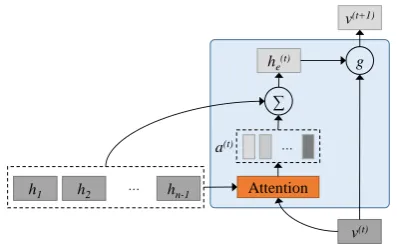
Figure 5: Memory network at hopt.hiis the
hid-den variable of the existing event chain,vtis the
semantic representation between context events and candidate event. at is the weight of
contex-t evencontex-ts, andg is the gated recurrent network on Eq.10.
the sense that deep semantic information can be necessary for making the most rational inference. Hence, we are motivated to use a deep memory network model to refine event weight and event relation calculation by recurrently modeling more abstract representations of the scenario. Different from the previous researches, we use the memo-ry network to model the event chain, refining the attention mechanism used to explore the pair-wise relation between events.
The memory model consists of multiple dynam-ic computational layers (hops). For the first layer (hop 1), the weightsα for existing eventse1, e2, ...,en−1can be calculated using the same attention
mechanism as Eq.4and Eq.5. Given the weights
α, we build a consolidated representation of con-text event chaine1,e2, ...,en−1as a weighted sum
ofh1,h2, ...,hn−1:
he=
nX−1
i−1
αi·hi (7)
The event candidate hc and the new
represen-tation of the existing chain he can be further
in-tegrated to deduce a deeper representation of the full event chain hypothesis to the next layer (hop 2), denoted asv.vcontains deeper semantic infor-mation compared withhc, which encode the
tem-poral order of the event chain[h1, h2, ..., hn−1, hc]
without differentiating the weights of each event. As a result, in the next hop, better event weights can potentially be deduced by using v instead of
hcin the calculation of attention:
uti = tanh(Weihi+Wvvt+bu) (8)
αti = Pexp(uti)
jexp(utj) (9)
In the same way, we stack multiple hops and repeat the steps multiple times, so that more ab-stract evidences can be extracted according to the chain of existing events. The above process can be performed recurrently, by takinghc as an
ini-tial scenario representationv0, and then
repeated-ly calculating ht
e given h1, h2, ..., hn−1 and vt,
and usinght
eandvtto find a deeper scenario
rep-resentation vt+1. Following Chung et al. (2014)
andTran et al.(2016), a gated recurrent network is used to this end:
z=σ(Wzhte+Uzvt)
r=σ(Wrhte+Urvt)
ˆ
h= tanh(W hte+U(rvt))
vt+1= (1−z)vt+zˆh
(10)
At any step, if the value of|vt+1−vt|is less than
the thresholdµ, we consider that the progress has reached convergence. Figure5shows an overview of the memory network at hopt.
4.4 Training
Given a set of event chains, each with a gold-standard subsequent event and a number of non-subsequent events, our training objective is to minimize the cross-entropy loss between the gold subsequent event and the set of non-subsequent events. The loss function of event chain predic-tion is that:
L(Θ) =XN
i=1
(si−yi)2+λ2||Θ||2 (11)
wheresiis the relation score,yiis the label of the
candidate (yi = 1for positive sample, andyi = 0
for negative sample),Θis the set of model param-eters and λ is a parameter for L2 regularization. We apply online training, where model parameter-s are optimized by uparameter-sing AdaGrad (Duchi et al., 2011). We train word embedding using the Skip-gramalgorithm (Mikolov et al.,2013)2.
5 Experiments
5.1 Datasets
FollowingGranroth-Wilding and Clark(2016), we extract events from the NYT portion of the Gi-gaword corpus (Graff et al., 2003). The C&C
tools (Curran et al., 2007) are used for POS tag-ging and dependency parsing, and OpenNLP3for
phrase structure parsing and coreference resolu-tion. The training set consists of 1,500,000 even-t chains. We followGranroth-Wilding and Clark (2016) and use 10,000 event chains as the test set, and 1,000 event chains for development. There are 5 choices of output event for event input chain, which are given by Granroth-Wilding and Clark (2016). This dataset is referred to asG&C16.
We also adapt the Chambers and Jurafsky (2008)’s dataset to the multiple choice setting, and use this dataset as the second benchmark. The dataset contains 69 documents, with 346 multiple choice event chain samples. We randomly sample 4 negative subsequent events for each event chain to make multiple-choice candidates. This dataset is referred to asC&J08. For both datasets, accu-racy (Acc.) of the chosen subsequent event is used to measure the performance of our model.
5.2 Hyper-parameters
There are several important hyper-parameters in our models, and we tune their values using the development dataset. We set the regularization weightλ = 10−8 and the initial learning rate to
0.01. The size of word vectors is set to 300, and the size of hidden vectors in LSTM to 128. In order to avoid over-fitting, dropout (Hinton et al., 2012) is used for word embedding with a ratio of 0.2. The neighbor similarity thresholdη is set to 0.25. The thresholdµof the memory network sets to 0.1.
5.3 Development Experiments
We conduct a set of development experiments on the G&C16 development set to study the influence of event argument representations and network configurations of the proposedMemNetmodel.
5.3.1 Influence of Event Structure
Existing literature discussed various structures to denote events, such asv(a0, a1)andv(a0, a1, a2). We investigate the influence of integrating argu-ment values of the subjecta0, objecta1and
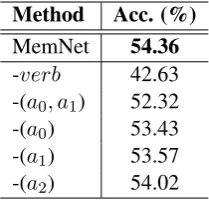
prepo-sition a2, by doing ablation experiments on the development data. The results are shown in Ta-ble1, where the system using all arguments gives a 54.36% accuracy. By removinga2, which exists in 17.6% of the events in our developmental data, the
3https://opennlp.apache.org/
Method Acc. (%)
MemNet 54.36
-verb 42.63
-(a0, a1) 52.32
-(a0) 53.43
-(a1) 53.57
-(a2) 54.02
Table 1: Influence of event arguments.
accuracy drops to 54.02%. In contrast, by remov-ing a0 and a1, which exist in 87.6% and 64.6%
of the events in the development data, respective-ly, the accuracies drop to 53.43% and 53.57%, re-spectively, which demonstrates the relative impor-tance ofa0 (i.e., the subject) and a1 (i.e., the
ob-ject) for event modelling. While most previous work (Chambers and Jurafsky, 2008; Balasubra-manian et al.,2013;Pichotta and Mooney,2014) modelled only a0 and a1, recent work (Pichotta
and Mooney, 2016;Granroth-Wilding and Clark, 2016) modelleda2also.
By removing botha1anda2, the accuracy drops
further to 53.32%. Interestingly, by removing the verb while keeping only the arguments, the accu-racy drops to 42.63%. While this demonstrates the central value of the verb in denoting a event, it al-so suggests that the arguments themselves play a useful role in inferring the stereotypical scenario.
5.3.2 Influence of Network Configurations
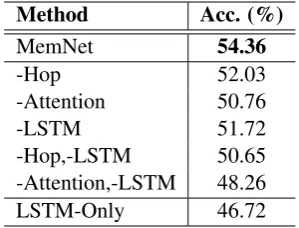
We study the influence of various network config-urations by performing ablation experiments, as shown in Table 2. MemNet is the full model of this paper;-LSTM denotes ablation of the LSTM layer, usinge(e1),e(e2), ...,e(en−1)instead ofh1, h2, ...,hn−1 to represent events;-Hopdenotes
ab-lation of the dynamic network model, using on-ly attention mechanism to calculate the weights of each existing event;-Attentiondenotes ablation of the attention mechanism, using the same weight on each existing event when inferring ec. The
model “-Attention, -LSTM” is hence similar to the method ofGranroth-Wilding and Clark(2016), al-though we used a different way of deriving even-t embeddings. The model “LSTM-only” shows a based by using LSTM hidden vectorhn−1 to
di-rectly predict the next event, which is similar to the method ofPichotta and Mooney(2016).
Influence of Temporal Order. By
[image:7.595.364.469.62.162.2]“-Method Acc. (%)
MemNet 54.36
-Hop 52.03
-Attention 50.76
-LSTM 51.72
[image:8.595.335.499.61.150.2]-Hop,-LSTM 50.65 -Attention,-LSTM 48.26 LSTM-Only 46.72 Table 2: Analysis of network structure.
Attention” with “-Attention, -LSTM”, one can find that temporal order information over the w-hole event chain does have significant influence on the results (p −value < 0.01 using t-test). On the other hand, using LSTM to directly pre-dict the subsequent event (“LSTM-only”) does not give better accuracies compared to model even-t pairs (“-Aeven-teven-teneven-tion, -LSTM”). This confirms our intuition that strong-oder modelling and event-pair modelling each have their own strength.
Influence of Attention. Comparison
be-tween Attention” and Hop”, and bebe-tween “-Attention, -LSTM” and “-Hop, -LSTM” shows that giving different weights to different events does lead to improving results. Our analysis in Section 4.3 gives more intuitions to this obser-vation. Finally, comparison between “-Hop” and “MemNet” and between Hop, -LSTM” and “-LSTM” shows that a multi-hop deep memory net-work can indeed enhance the model with single level attention by offering more effective semantic representation of the scenarios.
5.4 Final Results
Table3shows the final results on the C&C 16 and C&J08 datasets, respectively. We compare the re-sults of our final model with the following base-lines:
• PMI is the co-occurrence based model of Chambers and Jurafsky (2008), who calcu-late event pair relations based on Pointwise Mutual Information (PMI), scoring each can-didate eventecby the sum of PMI scores
be-tween the given eventse0, e1, ..., en−1 and
the candidate.
• Bigramis the counting based model ofJans
et al.(2012), calculating event pair relation-s barelation-sed on relation-skip bigram probabilitierelation-s, trained using maximum likelihood estimation.
Method G&C16 C&J08
PMI 30.52 30.92
Bigram 29.67 25.43 Event-Comp 49.57 43.28
RNN 45.74 43.17
[image:8.595.106.256.62.176.2]MemNet 55.12 46.67
Table 3: Final results.
• Event-Comp is the neural event relation
model proposed by Granroth-Wilding and Clark (2016). They learn event representa-tions by calculating pair-wise event scores using a Siamese network.
• RNNis the method ofPichotta and Mooney (2016), who model event chains by directly usinghcin Section4.2to predict the output,
rather than taking them as features for event pair relation modeling.
• MemNetis the proposed deep memory
net-work model.
Our reimplementation of PMI and Bigrams fol-lows (Granroth-Wilding and Clark, 2016). It can be seen from the table that the statistical counting-based models PMI and Bigram signif-icantly underperform the neural network models Event-Comp, RNN and MemNet, which is largely due to their sparsity and lack of semantic repre-sentation power. Under our event reprerepre-sentation, Bigram does not outperform PMI significantly ei-ther, although considering the order of event pairs. This is likely due to sparsity of events when all arguments are considered.
Direct comparison between Event-Comp and RNN shows that the event-pair model gives com-parable results to the strong-order LSTM model. AlthoughGranroth-Wilding and Clark(2016) and Pichotta and Mooney(2016) both compared with statistical baselines, they did not make direct com-parisons between their methods, which represen-t represen-two differenrepresen-t approaches represen-to represen-the represen-task. Our re-sults show that they each have their unique ad-vantages, which confirm our intuition in the in-troduction. By considering both pairwise rela-tions and chain temporal orders, our method sig-nificantly outperform both Event-Comp and RNN
(p−value < 0.01 using t-test), giving the best
6 Conclusion
We proposed a dynamic memory network to inte-grate chain order information into event relation measuring, calculating event pair relations by rep-resenting events in a chain using LSTM hidden s-tates, which encode temporal orders, and using a dynamic memory model to automatically induce event weights for each event. Standard evaluation showed that our method significantly outperforms state-of-the-art event pair models and event chain models, giving the best results reported so far. Acknowledgments
The corresponding author is Yue Zhang. We are grateful for the help of Fei Dong for his initial dis-cussion. We thank our anonymous reviewers for their constructive comments, which helped to im-prove the paper. This work is supported by the Temasek Lab grant IGDST1403012 at Singapore University of Technology and Design.
References
Omri Abend, Shay B. Cohen, and Mark Steedman. 2015. Lexical event ordering with an edge-factored model. In NAACL HLT 2015, The 2015 Confer-ence of the North American Chapter of the Associ-ation for ComputAssoci-ational Linguistics: Human Lan-guage Technologies, Denver, Colorado, USA, May 31 - June 5, 2015, pages 1161–1171.
Niranjan Balasubramanian, Stephen Soderland, Mausam, and Oren Etzioni. 2013. Generating coherent event schemas at scale. In Proceedings of the 2013 Conference on Empirical Methods in Natural Language Processing, EMNLP 2013, 18-21 October 2013, Grand Hyatt Seattle, Seattle, Washington, USA, A meeting of SIGDAT, a Special Interest Group of the ACL, pages 1721–1731. Nathanael Chambers. 2013. Event schema induction
with a probabilistic entity-driven model. In Pro-ceedings of the 2013 Conference on Empirical Meth-ods in Natural Language Processing, EMNLP 2013, 18-21 October 2013, Grand Hyatt Seattle, Seattle, Washington, USA, A meeting of SIGDAT, a Special Interest Group of the ACL, pages 1797–1807. Nathanael Chambers and Daniel Jurafsky. 2008.
Unsu-pervised learning of narrative event chains. InACL 2008, Proceedings of the 46th Annual Meeting of the Association for Computational Linguistics, June 15-20, 2008, Columbus, Ohio, USA, pages 789–797. Jackie Chi Kit Cheung, Hoifung Poon, and Lucy
Van-derwende. 2013. Probabilistic frame induction. In Human Language Technologies: Conference of the North American Chapter of the Association of
Computational Linguistics, Proceedings, June 9-14, 2013, Westin Peachtree Plaza Hotel, Atlanta, Geor-gia, USA, pages 837–846.
Junyoung Chung, C¸aglar G¨ulc¸ehre, KyungHyun Cho, and Yoshua Bengio. 2014. Empirical evaluation of gated recurrent neural networks on sequence model-ing.CoRR, abs/1412.3555.
James R. Curran, Stephen Clark, and Johan Bos. 2007.
Linguistically motivated large-scale NLP with c&c and boxer. InACL 2007, Proceedings of the 45th Annual Meeting of the Association for Computation-al Linguistics, June 23-30, 2007, Prague, Czech Re-public.
John C. Duchi, Elad Hazan, and Yoram Singer. 2011.
Adaptive subgradient methods for online learning and stochastic optimization. Journal of Machine Learning Research, 12:2121–2159.
Charles Fillmore. 1982. Frame semantics. Linguistics in the morning calm, pages 111–137.
Lea Frermann, Ivan Titov, and Manfred Pinkal. 2014.
A hierarchical bayesian model for unsupervised in-duction of script knowledge. In Proceedings of the 14th Conference of the European Chapter of the Association for Computational Linguistics, EA-CL 2014, April 26-30, 2014, Gothenburg, Sweden, pages 49–57.
David Graff, Junbo Kong, Ke Chen, and Kazuaki Mae-da. 2003. English gigaword. Linguistic Data Con-sortium, Philadelphia.
Mark Granroth-Wilding and Stephen Clark. 2016. What happens next? event prediction using a com-positional neural network model. InProceedings of the Thirtieth AAAI Conference on Artificial Intelli-gence, February 12-17, 2016, Phoenix, Arizona, US-A., pages 2727–2733.
Karl Moritz Hermann, Tom´as Kocisk´y, Edward Grefenstette, Lasse Espeholt, Will Kay, Mustafa Su-leyman, and Phil Blunsom. 2015. Teaching ma-chines to read and comprehend. In Advances in Neural Information Processing Systems 28: Annual Conference on Neural Information Processing Sys-tems 2015, December 7-12, 2015, Montreal, Que-bec, Canada, pages 1693–1701.
Geoffrey E. Hinton, Nitish Srivastava, Alex Krizhevsky, Ilya Sutskever, and Ruslan Salakhut-dinov. 2012. Improving neural networks by preventing co-adaptation of feature detectors. CoRR, abs/1207.0580.
Sepp Hochreiter and J¨urgen Schmidhuber. 1997.
Long short-term memory. Neural Computation, 9(8):1735–1780.
the Association for Computational Linguistics, Avi-gnon, France, April 23-27, 2012, pages 336–344. Ankit Kumar, Ozan Irsoy, Peter Ondruska, Mohit
Iyy-er, James Bradbury, Ishaan Gulrajani, Victor Zhong, Romain Paulus, and Richard Socher. 2016. Ask me anything: Dynamic memory networks for natural language processing. InProceedings of the 33nd In-ternational Conference on Machine Learning, ICM-L 2016, New York City, NY, USA, June 19-24, 2016, pages 1378–1387.
Mausam, Michael Schmitz, Stephen Soderland, Robert Bart, and Oren Etzioni. 2012. Open language learn-ing for information extraction. In Proceedings of the 2012 Joint Conference on Empirical Methods in Natural Language Processing and Computational Natural Language Learning, EMNLP-CoNLL 2012, July 12-14, 2012, Jeju Island, Korea, pages 523– 534.
Tomas Mikolov, Armand Joulin, Sumit Chopra, Micha¨el Mathieu, and Marc’Aurelio Ranzato. 2014.
Learning longer memory in recurrent neural net-works.CoRR, abs/1412.7753.
Tomas Mikolov, Ilya Sutskever, Kai Chen, Gregory S. Corrado, and Jeffrey Dean. 2013. Distributed rep-resentations of words and phrases and their com-positionality. In Advances in Neural Information Processing Systems 26: 27th Annual Conference on Neural Information Processing Systems 2013. Pro-ceedings of a meeting held December 5-8, 2013, Lake Tahoe, Nevada, United States., pages 3111– 3119.
Marvin Minsky. 1975. A framework for representing knowledge.
Andriy Mnih and Geoffrey E. Hinton. 2007.Three new graphical models for statistical language modelling. In Machine Learning, Proceedings of the Twenty-Fourth International Conference (ICML 2007), Cor-vallis, Oregon, USA, June 20-24, 2007, pages 641– 648.
Ashutosh Modi. 2016.Event embeddings for semantic script modeling. InProceedings of the 20th SIGNL-L Conference on Computational Natural SIGNL-Language Learning, CoNLL 2016, Berlin, Germany, August 11-12, 2016, pages 75–83.
Ashutosh Modi and Ivan Titov. 2014. Inducing neu-ral models of script knowledge. InProceedings of the Eighteenth Conference on Computational Nat-ural Language Learning, CoNLL 2014, Baltimore, Maryland, USA, June 26-27, 2014, pages 49–57. Raymond Mooney and Gerald DeJong. 1985. Learning
schemata for natural language processing. Urbana, 51:61801.
Nasrin Mostafazadeh, Nathanael Chambers, Xiaodong He, Devi Parikh, Dhruv Batra, Lucy Vanderwende, Pushmeet Kohli, and James F. Allen. 2016. A cor-pus and cloze evaluation for deeper understanding
of commonsense stories. InNAACL HLT 2016, The 2016 Conference of the North American Chapter of the Association for Computational Linguistics: Hu-man Language Technologies, San Diego California, USA, June 12-17, 2016, pages 839–849.
John Walker Orr, Prasad Tadepalli, Janardhan Rao Doppa, Xiaoli Fern, and Thomas G. Dietterich. 2014. Learning scripts as hidden markov models. In Proceedings of the Twenty-Eighth AAAI Conference on Artificial Intelligence, July 27 -31, 2014, Qu´ebec City, Qu´ebec, Canada., pages 1565–1571.
Karl Pichotta and Raymond J. Mooney. 2014. Statis-tical script learning with multi-argument events. In Proceedings of the 14th Conference of the European Chapter of the Association for Computational Lin-guistics, EACL 2014, April 26-30, 2014, Gothen-burg, Sweden, pages 220–229.
Karl Pichotta and Raymond J. Mooney. 2016. Learning statistical scripts with LSTM recurrent neural net-works. In Proceedings of the Thirtieth AAAI Con-ference on Artificial Intelligence, February 12-17, 2016, Phoenix, Arizona, USA., pages 2800–2806.
Michaela Regneri, Alexander Koller, and Manfred Pinkal. 2010. Learning script knowledge with web experiments. InACL 2010, Proceedings of the 48th Annual Meeting of the Association for Computation-al Linguistics, July 11-16, 2010, UppsComputation-ala, Sweden, pages 979–988.
Rachel Rudinger, Pushpendre Rastogi, Francis Ferraro, and Benjamin Van Durme. 2015. Script induction as language modeling. InProceedings of the 2015 Conference on Empirical Methods in Natural Lan-guage Processing, EMNLP 2015, Lisbon, Portugal, September 17-21, 2015, pages 1681–1686.
David E Rumelhart. 1975. Notes on a schema for sto-ries. Representation and understanding: Studies in cognitive science, 211(236):45.
Roger Schank, Roger Schank, and Robert P Abelson. 1977. Scripts, plans, goals and understanding; an inquiry into human knowledge structures. Technical report.
Sainbayar Sukhbaatar, Arthur Szlam, Jason Weston, and Rob Fergus. 2015. End-to-end memory net-works. InAdvances in Neural Information Process-ing Systems 28: Annual Conference on Neural In-formation Processing Systems 2015, December 7-12, 2015, Montreal, Quebec, Canada, pages 2440– 2448.
Beth Sundheim. 1991. Third message understanding evaluation and conference (muc-3): Phase 1 status report. InHLT.
modeling. InNAACL HLT 2016, The 2016 Confer-ence of the North American Chapter of the Associ-ation for ComputAssoci-ational Linguistics: Human Lan-guage Technologies, San Diego California, USA, June 12-17, 2016, pages 321–331.
Naushad UzZaman, Hector Llorens, Leon Derczynski, James F. Allen, Marc Verhagen, and James Puste-jovsky. 2013. Semeval-2013 task 1: Tempeval-3: Evaluating time expressions, events, and tem-poral relations. In Proceedings of the 7th In-ternational Workshop on Semantic Evaluation, SemEval@NAACL-HLT 2013, Atlanta, Georgia, USA, June 14-15, 2013, pages 1–9.
Jason Weston, Antoine Bordes, Sumit Chopra, and Tomas Mikolov. 2015. Towards ai-complete ques-tion answering: A set of prerequisite toy tasks. CoR-R, abs/1502.05698.