Proceedings of the 15th SIGMORPHON Workshop on Computational Research in Phonetics, Phonology, and Morphology, pages 161–166 161
Phonological Features for Morphological Inflection
Adam Wiemerslage and Miikka Silfverberg, and Mans Hulden
Department of Linguistics University of Colorado
University of Helsinki
Abstract
Modeling morphological inflection is an im-portant task in Natural Language Processing. In contrast to earlier work that has largely used orthographic representations, we experiment with this task in a phonetic character space, representing inputs as either IPA segments or bundles of phonological distinctive features. We show that both of these inputs, some-what counterintuitively, achieve similar ac-curacies on morphological inflection, slightly lower than orthographic models. We conclude that providing detailed phonological represen-tations is largely redundant when compared to IPA segments, and that articulatory distinc-tions relevant for word inflection are already latently present in the distributional properties of many graphemic writing systems.
1 Introduction
Models of morphology are important to many tasks in Natural Language Processing, but also present new challenges of their own. Morpholog-ically complex languages require analysis that is often only captured at the morpheme level, but is essential for syntactic or semantic representa-tions. This requires effective morphological anal-ysis, which often receives less attention than other subfields of Natural Language Processing. One relevant task in morphology is that of morpho-logical inflection: automatically generating the in-flected form of a lemma according to a given mor-phological specification. An example of this in English is00walk00+3+SG+PRES→ 00walks00. There has been recent success in adopting the encoder-decoder architecture (Kann and Sch¨utze,
2016), which has been effective in machine trans-lation (Cho et al.,2014), to this task.
In this work, we explore representing the in-puts to such an encoder-decoder model for mor-phological inflection in two additional ways: IPA
segments and bundles of phonological distinctive features. Representing the inputs to an inflec-tion model in phonetic space can unify the charac-ter inventory between languages with separate or-thographies. The shared character inventory could also enable transfer learning in some instances where it otherwise would be impossible. There are also confusing idiosyncrasies in some orthogra-phies that are not necessarily present in an IPA representation. For example, there are many in-stances of gemination in English that do not occur in the phonetic realizations of such words, as in hcontroli → hcontrolledi. English also exhibits several examples of the same sound expressed by completely different orthographic realizations as in hflyi → hfliesi, or conversely harchi (/tS/) ∼ hmonarchi (/k/). Furthermore, a phonetic repre-sentation serves as an interface to an even richer representation of characters: phonological distinc-tive features.
gener-ate this voicing assimilation, and produce the form /stApt/. That is, the model that learns from phono-logical features should quickly be able to general-ize that this English past tense is realgeneral-ized as /t/ be-fore voiceless segments. Similarly, in the example of ”rob”: /ôAb/→/ôAbd/, the generated /d/ can be conditioned on[+voice]rather than the individual segment /b/.
An alternative hypothesis is that the proposed distinctive feature representation may, however, not have such a profound effect on the inflection model. This is because distributional represen-tations of IPA segments or phonemic graphemes have been shown to capture good approximations of the distinctive feature space (Silfverberg et al.,
2018). In order to test these two hypotheses, we experiment on a subset of data provided by task 1 of the CoNLL-SIGMORPHON 2017 Shared Task on Universal Morphological Reinflection ( Cot-terell et al.,2017), which introduced 42 more lan-guages than the year before (Cotterell et al.,2016) for a total of 52 languages. We use an existing tool to perform G2P on the data, and, as a second step, to produce distinctive feature vectors from the re-sulting IPA segments. We evaluate the rere-sulting models on their ability to generate IPA segments.
Related Work Phonetic distributional vectors have been explored for their effectiveness in sev-eral NLP applications; especially for informing scenarios that utilize borrowing or transfer learn-ing (Tsvetkov et al.,2016). Phonological distinc-tive features have also been successfully used to inform NER (Bharadwaj et al.,2016). However, to our knowledge, there does not seem to be work in learning distributional properties of phonologi-cal features that compares them directly to vectors of IPA segments.
2 Encoder-Decoder Architecture
Our model is implemented as an RNN Encoder-Decoder with attention, built to imitate the model introduced by Kann and Sch¨utze (2016), varia-tions of which found much success in the 2017 CoNLL-SIGMORPHON shared task. The system, pictured in Figure1, works by learning an encoder RNN over a sequence of embeddings for the in-put characters or morphological tags. In practice, the encoder is bidirectional. The decoder RNN is initialized with a sequence boundary token, and each state of the decoder is predicted based on the state of the previous timestep, the previous
c a t N
c a t s
E E E E
E E E E
Encoder Bi-RNN
Decoder RNN <EOS>
E
<EOS>
E
<EOS>
E
PL
E
<EOS>
[image:2.595.308.525.60.187.2]E Attn
Figure 1: The encoder-decoder with an attention mechanism used for morphological inflection
[k,æ,t]
-syl
-son
…
-ant
+hi
+syl
+son
…
0ant
-hi
-syl
-son
…
+ant
-hi
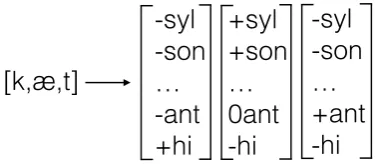
Figure 2: PanPhon transforms a sequence of IPA segments into a matrix of features
output embedding, and all of the encoder states
ei ∈ Encoder. We then use an attention
mecha-nism (Bahdanau et al., 2014) to ‘attend’ over the encoder states, assigning a score to eachei given
the previous decoder statedj−1. The scoring
func-tion (Luong et al.,2015) is calculated as
score(ei;dj−1) =tanh([dj−1;ei]×W) (1)
whereW is a parameter matrix that is learned dur-ing traindur-ing, and[x;y]indicates the concatenation ofxandy. These scores are then normalized by applying a softmax over all encoder states in En-coderto compute eachi,j−1.
Finally, the attention vector is computed as the weighted mean of all encoder states accord-ing to their normalized score: A(dj−1, E) = Pn
i=0i,j−1ei, which is concatenated to the
pre-viously decoded embedding before being passed through the decoder. We implement this model in PyTorch (Paszke et al.,2017), using Gated Recur-rent Units (GRU) (Cho et al.,2014) for the encoder and decoder, and optimize with stochastic gradient descent.
3 Embedding Inputs
[image:2.595.322.510.228.311.2]Medium High
Shared task Text IPA Features Shared task Text IPA Features
English 94.70 89.70 72.50 72.70 97.20 96.60 77.00 76.10 German 80.00 71.80 60.80 59.90 93.00 89.50 82.30 83.20 Hindi 97.40 84.80 89.80 86.50 100.00 99.80 99.60 99.90 Hungarian 75.10 67.10 65.50 63.90 86.80 83.70 82.80 82.60 Persian 91.90 84.10 85.00 82.30 99.90 99.10 99.20 98.70 Polish 79.90 67.10 63.40 64.30 92.80 88.20 88.20 88.90 Russian 84.10 66.90 66.80 67.60 92.80 89.20 86.50 88.90 Spanish 91.70 76.50 82.10 81.30 97.50 95.20 96.40 96.60
[image:3.595.117.483.63.203.2]AVG 86.85 76.21 72.61 72.73 95.0 92.66 89.00 89.36
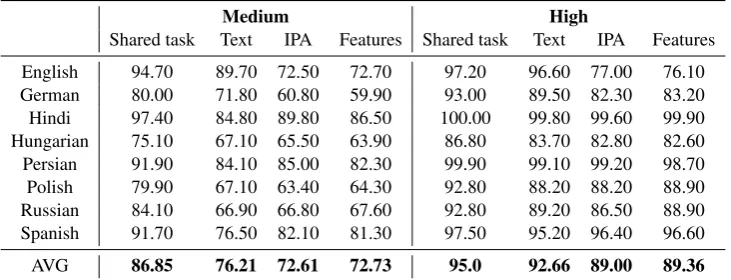
Table 1: Overall accuracy for each model (orthographic, IPA-based, and distinctive feature-based), and comparison with the CoNLL-SIGMORPHON 2017 shared task top performing system for each language.
computed to store the parameters that map the |Σ|-dimensional one-hot vectors to n-dimensional dense vectors, where Σ is the character and tag vocabulary. Similarly we use a matrix I ∈
R|ΣIP A|×n for embedding IPA segments, where ΣIP Ais the IPA segment and tag vocabulary. To
produce the IPA sequence, we use the Python library Epitran, which performs rule-based G2P on language specific mappings (Mortensen et al.,
2018).
We then use the Python library PanPhon (Mortensen et al., 2016), which maps IPA seg-ments to features as in Figure2, to obtain vectors of phonological distinctive features. The features are represented numerically whereby each index of the vector corresponds to a specific feature such as[±coronal]and stores a value from the set{1, 0, -1}. These values correspond to ‘exhibits feature’, ‘unspecified for given class of sounds’, and ‘does not exhibit feature’, respectively. In practice we map -1 to 0 to obtain strictly binary feature vec-tors. Now, each IPA segment can be represented as a vectorvwhich has a 1 for each feature that it exhibits, and a 0 otherwise. The embedding ma-trixF ∈R|p|×n, wherepis all features, tags, and
symbols is no longer just a lookup for IPA seg-ments. Tags are still one-hot vectors, and sym-bols are one-hot vectors for any character that has no phonological features (e.g. a space, or apostro-phe). But the vector for an IPA segment now has a one for each feature that it exhibits, in contrast to the one-hot vectors.
The operation vF is equivalent to summing eachFi for which vi = 1. In this way, an IPA
segment is the sum of all of its distinctive feature embeddings. In practice, we can take the matrix-matrix product of the entire sequence of feature
vectors and F to calculate the matrix that rep-resents a sequence of embeddings. The overall workflow involves passing from orthographic in-put sequences, through Epitran, and then PanPhon, and finally to phonological distinctive feature em-beddings.
4 Experiments and Results
ENSEMBLEORACLERESULTS
Medium High
All inputs Text All inputs Text English 94.20 94.20 97.90 97.50 German 79.50 81.20 93.10 94.30 Hindi 94.50 90.30 100.00 100.00 Hungarian 78.60 77.40 90.10 90.10
Persian 91.40 90.40 99.70 99.60 Polish 79.40 78.70 93.70 92.6 Russian 78.30 76.80 94.10 92.50 Spanish 89.2 86.90 98.5 97.0
[image:4.595.73.292.62.209.2]AVG 85.64 84.49 95.89 95.45
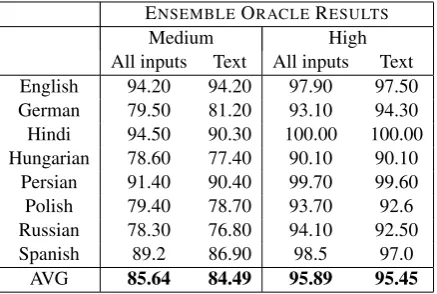
Table 2: Ensemble Oracles for each language. If the cor-rect word form is predicted by any of the 3 models, then it is classified as correct. This is compared against 3 text models.
which can be partially addressed by artificially ex-panding the training data, or enforcing some copy bias into the system.
For both phonetic representation experiments, the decoded outputs are in the inventory of IPA segments, the gold standard of which comes from the deterministic mappings implemented in Epi-tran. This means that they differ only in terms of the input representation in the encoder. Mod-els trained on both IPA and feature inputs perform comparably to the text model on both the medium and the high setting. There are two main points of interest in the results. (1) The lower performance on average of the IPA and feature models when compared to the text model is almost exclusively due to differences in accuracy for German and En-glish. We attribute this on the one hand to the fact that the orthography of English is often dis-similar to pronunciations and that their orthogra-phies reflect etymological information which is useful in determining a word’s inflectional behav-ior (Scragg,1974). An example of the discrepancy between spelling and pronunciation is that the En-glish vowel space has about 13 phonetic vowels (Ladefoged and Johnson, 2014), whereas in the orthographic alphabet, there are only 5. Further-more, the unstressed vowel, schwa (@), can essen-tially replace any vowel in an unstressed context. We observe that the majority of inaccuracies in the English predictions are related to vowels, and most commonly to a schwa. This indicates that convert-ing the character space to IPA can introduce some new complications. Regarding German, there is no obvious explanation for the lower accuracy, and we believe that a more detailed analysis of the G2P performance is needed in order to explore this.
Ex-periments on orthographically and morphophone-mically similar languages may also be revealing.
An Ensemble Oracle of all three models is given in Table2in order to check if the systems vary in what they learn to predict. The results show that this ensemble outperforms each individual system for any given language. However, when compared to an Ensemble Oracle of three text models, the results are rather similar. The increase in accuracy may simply be due to varying parameters from different random initializations, yielding an effect that is similar to the boosted scores that can be ob-served in many of the shared task results.
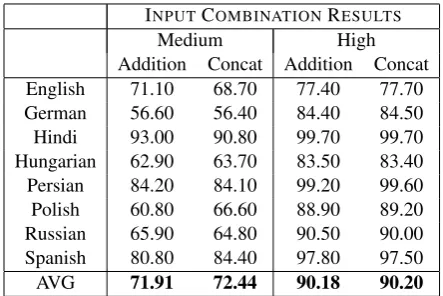
More interesting is the fact that (2) both the IPA and feature representation seem to yield extremely similar accuracies with a paired permutation test p-value of 0.43 over all languages. Even when the training data is rather sparse as in the medium setting, the accuracies remain extremely similar. This suggests that the distributional properties of IPA segments capture the information expressed by distinctive features. Any benefit that represent-ing a segment in terms of its features might have is already available in the IPA embeddings. To fur-ther compare these representations, we experiment with models that combine the IPA and feature rep-resentations. We attempt to simply add a ‘feature’ to the distinctive feature vectors for each IPA seg-ment. That is, the feature vector for /@/ would have a 1 for all of its distinctive features, and an addi-tional 1 for that specific segment. We also exper-iment with concatenation of the embedding found from the feature vector combination and the IPA embedding. The input to the model is a vector of double the embedding size to account for concate-nation. The results, given in Table 3, show that neither experiment seems to have much effect, and the accuracies reflect the initial results.
5 Conclusion and Future Work
ev-INPUTCOMBINATIONRESULTS
Medium High
Addition Concat Addition Concat English 71.10 68.70 77.40 77.70 German 56.60 56.40 84.40 84.50 Hindi 93.00 90.80 99.70 99.70 Hungarian 62.90 63.70 83.50 83.40 Persian 84.20 84.10 99.20 99.60 Polish 60.80 66.60 88.90 89.20 Russian 65.90 64.80 90.50 90.00 Spanish 80.80 84.40 97.80 97.50
[image:5.595.70.292.61.209.2]AVG 71.91 72.44 90.18 90.20
Table 3: Results for the combination of feature and IPA embeddings. Addition refers to the inclusion of a specific phoneme ‘feature’. Concat refers to concatenating the em-bedding of both input types.
ident that for many languages the results are still mostly redundant, and if there is a large discrep-ancy in accuracy it is in favor of the orthographic inputs.
There is still work to be done to explore if there are scenarios where bundles of distinctive features provide an advantage. That is, in the case of trans-fer learning where the phonology of a language is known, it becomes possible to approximate vector representations for unseen segments. Similarly, distinctive features may be better at representing segments that rarely appear in a training set for a given language.
Acknowledgements
The second author was supported by The Society of Swedish Literature in Finland (SLS). NVIDIA Corp. donated the Titan Xp GPU used for this re-search.
References
Dzmitry Bahdanau, Kyunghyun Cho, and Yoshua Ben-gio. 2014. Neural machine translation by jointly learning to align and translate. InICLR 2015.
Toms Bergmanis, Katharina Kann, Hinrich Sch¨utze, and Sharon Goldwater. 2017. Training data aug-mentation for low-resource morphological inflec-tion. InProceedings of the CoNLL SIGMORPHON 2017 Shared Task: Universal Morphological Rein-flection, pages 31–39, Berlin, Germany. Association for Computational Linguistics.
Akash Bharadwaj, David R. Mortensen, Chris Dyer, and Jaime G. Carbonell. 2016. Phonologically aware neural model for named entity recognition in low resource transfer settings. InProceedings of the 2016 Conference on Empirical Methods in Natural
Language Processing, EMNLP 2016, Austin, Texas, USA, November 1-4, 2016, pages 1462–1472.
Kyunghyun Cho, Bart Van Merri¨enboer, Caglar Gul-cehre, Dzmitry Bahdanau, Fethi Bougares, Holger Schwenk, and Yoshua Bengio. 2014. Learning phrase representations using RNN encoder-decoder for statistical machine translation. arXiv preprint arXiv:1406.1078.
Ryan Cotterell, Christo Kirov, John Sylak-Glassman, G´eraldine Walther, Ekaterina Vylomova, Patrick Xia, Manaal Faruqui, Sandra K¨ubler, David Yarowsky, Jason Eisner, and Mans Hulden. 2017. The CoNLL-SIGMORPHON 2017 shared task: Universal morphological reinflection in 52 languages. In Proceedings of the CoNLL-SIGMORPHON 2017 Shared Task: Universal Mor-phological Reinflection, Vancouver, Canada. Asso-ciation for Computational Linguistics.
Ryan Cotterell, Christo Kirov, John Sylak-Glassman, David Yarowsky, Jason Eisner, and Mans Hulden. 2016. The SIGMORPHON 2016 shared task: Mor-phological reinflection. InProceedings of the 14th SIGMORPHON Workshop on Computational Re-search in Phonetics, Phonology, and Morphology, Berlin, Germany. Association for Computational Linguistics.
Katharina Kann and Hinrich Sch¨utze. 2016. MED: The LMU system for the SIGMORPHON 2016 shared task on morphological reinflection. InProceedings of the 14th SIGMORPHON Workshop on Computa-tional Research in Phonetics, Phonology, and Mor-phology, Berlin, Germany. Association for Compu-tational Linguistics.
Katharina Kann and Hinrich Sch¨utze. 2017. The LMU system for the CoNLL-SIGMORPHON shared task on universal morphological reinflection. In
Proceedings of the CoNLL SIGMORPHON 2017 Shared Task: Universal Morphological Reinflec-tion, pages 40–48, Berlin, Germany. Association for Computational Linguistics.
Peter Ladefoged and Keith Johnson. 2014.A Course in Phonetics. Nelson Education.
Minh-Thang Luong, Hieu Pham, and Christo-pher D. Manning. 2015. Effective approaches to attention-based neural machine translation. CoRR, abs/1508.04025.
Peter Makarov, Tatiana Ruzsics, and Simon Clematide. 2017. Align and copy: UZH at SIGMORPHON 2017 shared task for morphological reinflection. In
Proceedings of the CoNLL SIGMORPHON 2017 Shared Task: Universal Morphological Reinflec-tion, pages 49–57, Berlin, Germany. Association for Computational Linguistics.
Interna-tional Conference on Language Resources and Eval-uation (LREC 2018), Paris, France. European Lan-guage Resources Association (ELRA).
David R. Mortensen, Patrick Littell, Akash Bharadwaj, Kartik Goyal, Chris Dyer, and Lori Levin. 2016. PanPhon: A resource for mapping IPA segments to articulatory feature vectors. In The 26th Inter-national Conference on Computational Linguistics: Technical Papers, page 34753484.
Garrett Nicolai, Bradley Hauer, Mohammad Motallebi, Saeed Najafi, and Grzegorz Kondrak. 2017. If you can’t beat them, join them: the University of Alberta system description. In Proceedings of the CoNLL SIGMORPHON 2017 Shared Task: Universal Mor-phological Reinflection, pages 79–84, Berlin, Ger-many. Association for Computational Linguistics.
Adam Paszke, Sam Gross, Soumith Chintala, Gre-gory Chanan, Edward Yang, Zachary DeVito, Zem-ing Lin, Alban Desmaison, Luca Antiga, and Adam Lerer. 2017. Automatic differentiation in PyTorch. InNIPS-W.
Donald George Scragg. 1974. A history of English spelling, volume 3. Manchester University Press.
Miikka Silfverberg, Lingshuang Jack Mao, and Mans Hulden. 2018. Sound analogies with phoneme em-beddings. InProceedings of the Society for Compu-tation in Linguistics (SCiL), volume 1, pages 136– 144.
Miikka Silfverberg, Adam Wiemerslage, Ling Liu, and Lingshuang Jack Mao. 2017. Data augmen-tation for morphological reinflection. In Proceed-ings of the CoNLL SIGMORPHON 2017 Shared Task: Universal Morphological Reinflection, pages 90–99, Berlin, Germany. Association for Computa-tional Linguistics.
Akhilesh Sudhakar and Anil Singh Kumar. 2017. Ex-periments on morphological reinflection: CoNLL-2017 shared task. InProceedings of the CoNLL SIG-MORPHON 2017 Shared Task: Universal Morpho-logical Reinflection, pages 71–78, Berlin, Germany. Association for Computational Linguistics.
Yulia Tsvetkov, Sunayana Sitaram, Manaal Faruqui, Guillaume Lample, Patrick Littell, David R. Mortensen, Alan W. Black, Lori S. Levin, and Chris Dyer. 2016. Polyglot Neural Language Models: A Case Study in Cross-Lingual Phonetic Representa-tion Learning. InNAACL HLT 2016, The 2016 Con-ference of the North American Chapter of the Asso-ciation for Computational Linguistics: Human Lan-guage Technologies, San Diego California, USA, June 12-17, 2016, pages 1357–1366.
Chunting Zhou and Graham Neubig. 2017. Morpho-logical inflection generation with multi-space vari-ational encoder-decoders. In Proceedings of the CoNLL SIGMORPHON 2017 Shared Task: Uni-versal Morphological Reinflection, pages 58–65,