Original Article
An easy and cost-effective colorimetric assay of
hydrogen peroxide based on iodide-catalyzed
oxidation of 3,3,5,5-tetramethylbenzidine
Juan Zhang*, Juan Peng*, Liyu Zhu, Chuntian Lai, Haiyan Wang, Wenda Zou, Hui Li
Reproductive Medicine Center, Zhuzhou Central Hospital, Zhuzhou, Hu’nan Province, China. *Equal contributors
and co-first authors.
Received June 15, 2018; Accepted July 29, 2018; Epub December 15, 2018; Published December 30, 2018
Abstract: Objective: Hydrogen peroxide (H2O2) is a key reactive oxygen species in industrial production and biologi-cal processes. Detection of H2O2 in an easy and cost-efficient way still remains challenging. Methods: Here we first reported a novel catalytic reaction system in which iodide could catalyze the oxidation reaction of a colorless peroxi-dase substrate 3,3,5,5-tetramethylbenzidine into a yellow product by H2O2. Since the noticeable color change can be distinguished by naked eye or spectrophotometric measurement, it can be utilized to establish a colorimetric detection method for H2O2. Results: The results of our study showed that using the iodide-mediated catalytic reac-tion strategy, a quantitative and selective assay of H2O2 in solution was successfully achieved with an incubation at 55°C for 10 min in the presence of 0.1 M H2SO4. It was found that a concentration of H2O2 as low as 0.5 μM could be discriminated by naked eye and a concentration as low as 0.2 μM could be detected using spectroscopic analysis. In addition, this testing approach could also be applied effectively to detect iodide with a detection limit of 0.25 μM. Conclusion: Our study demonstrated a simple, rapid, low-cost, sensitive and selective method for detection of both H2O2 and iodide, which can be used for the analysis of various H2O2-related substances.
Keywords: Hydrogen peroxide, iodide, catalytic oxidation, 3,3,5,5-tetramethylbenzidine, colorimetric detection
Introduction
Hydrogen peroxide (H2O2) has a strong oxidizing property and is widely used in various fields, including organic synthesis, food production, paper bleaching, as well as pharmaceutical, clinical and environmental analysis [1]. In addi-tion, as one of the major reactive oxygen spe-cies in living organisms, H2O2 also plays a sig-nificant role in many biological processes such as cell signaling [2]. At present, a variety of methods, including fluorimetric, chemilumines-cent, high performance liquid phase chroma-tography (HPLC)-based, and electrochemical assays have been developed for detecting H2O2 [3-9]. Although these techniques have been used in the H2O2-related studies, they still have some disadvantages. For example, the fluori-metric and chemiluminescent assays require fluorescent compounds or chemiluminescent nanoparticles (NPs) and the preparation pro-cesses are quite complicated [3, 4]; the instru-ments required in HPLC assays are expensive,
which can limit the application of this method; the electrochemical technique has unstable electrode modification and troublesome wash-ing steps, despite the fact that it has intrinsic sensitivity, high selectivity and low cost [7-9]. Thus, there is a great demand for an easy, inex-pensive, selective and sensitive method to detect H2O2.
researchers’ attention [13, 14]. Several novel enzyme mimic-mediated catalytic colorimetric reaction systems have also been reported and used for H2O2 analysis, which involve posi-tively-charged gold NPs, hollow Mn ferrite nano-structures, CoFe2O4 ferrite nanocubes, and prussian blue NPs [15-17]. Considering the catalytic effect of enzyme mimics on the oxida-tion-reduction reaction of H2O2, these approa- ches may serve as candidates for an easy and rapid colorimetric method to determine H2O2. However, they still exhibit some shortcomings such as troublesome preparation process (complicated NP synthesis and purification pro-cedure) and high detection limit.
Interestingly, we recently discovered for the first time that iodide could catalyze the oxida-tion of 3,3,5,5-tetramethylbenzidine (TMB) by H2O2. In this reaction system, iodide is a com-mercially available and low-cost reagent, while TMB is a commonly used substrate in peroxi-dase-based detection system due to its soluble oxidized product with high absorption coeffi-cients for color discrimination by naked eye and spectrophotometric quantification [18-21]. Therefore, with the aim of developing a simple, rapid and cost-efficient test method for H2O2, we investigated the iodide-mediated catalytic reaction of TMB and H2O2 for the first time and optimized a series of influence factors, includ-ing pH, temperature and time. A sensitive and selective colorimetric assay of H2O2 has thus been proposed based on the iodide-catalyzed oxidation of TMB in this study. In addition, we have also found that this reaction system can be applicable for detecting iodide.
Materials and methods
Chemicals and materials
TMB was purchased from Sigma-Aldrich (St. Louis, MO). Potassium iodide (KI) was obtained from Sinopharm Chemical Reagent Co., Ltd (Shanghai, China). Unless otherwise noted, all reagent-grade chemicals were used as received without further purification. Deionized water was prepared by the Milli-Q ultrapure water sys-tem (18.2 MΩ·cm-1, Millipore System Inc.).
Instruments
A multifunctional microplate reader (Infinite M1000, TECAN Austria GmbH) was used to
record the absorption spectra from 300 nm-600 nm and the absorbance intensity at 450 nm of the reaction product at room tem-perature [22]. The photographs were taken with an Olympus C-370 digital camera.
Investigation of iodide-catalyzed TMB-H2O2 reaction
Feasibility of iodide-catalyzed TMB-H2O2 reac-tion was first investigated, during which 125 μL of 0.4 mM KI and H2O (control) were mixed with 25 μL of 1 mM H2O2, 50 μL of 1.7 μM TMB and 50 μL of 5 M H2SO4, respectively. Next, all of the mixed solutions were incubated in a water bath at 45°C for 20 min and then cooled to room temperature. Photographs were taken immediately and 150 μL of the resulting solu-tions were added into a 96-well plate respec-tively. The absorption spectra of the oxidation product of TMB from 300 nm-600 nm were recorded.
Effect of the iodide concentration on the TMB-H2O2 reaction was analyzed as follows: 125 μL of 3 μM, 10 μM, 20 μM, 100 μM of KI were mixed respectively with 50 μL of 1.7 μM TMB, 50 μL of 0.5 M H2SO4 and 25 μL of 1 mM H2O2. Next, all of the mixed solutions were incubated in a water bath at 55°C for 10 min and then cooled to room temperature. Afterwards, 150 μL of the resulting solutions were added into a 96-well plate and the absorption spectra from 300 nm-600 nm were recorded. The specificity of the TMB-H2O2 reaction system for I- was
mea-sured by the method similar to the one described above. In this method, I- (10 μM) and
other ions (100 μM) were compared, 150 μL of the resulting solutions were added into a 96-well plate and the absorption spectra at 450 nm were recorded. The experiments were repeated for three times.
Optimization of reaction conditions
cooled to room temperature. Afterwards, 150 μL of the resulting solutions were added to a 96-well plate and the optical density of each well at 450 nm was measured. Reaction tem-perature and time were investigated under the optimal condition of pH. The experiments were repeated for three times.
[image:3.612.92.519.72.585.2]cooled to room temperature. Photographs were taken immediately and 150 μL of the resulting solution was added into a 96-well plate, followed by the recording of the absorp-tion spectra from 300 nm-600 nm and 450 nm. The experiments were repeated for three times.
Figure 2. Possible chemical reaction mechanism of TMB-H2O2 reaction. A, B:
I- was oxidized to IO
-3 in the presence of H2O2 and H+; C: IO-3 was reduced to
I- while TMB was oxidized to a colored product; D: Possible chemical equation
of TMB-H2O2 reaction. TMB, 3,3,5,5-tetramethylbenzidine.
Detection of H2O2 using the iodide-catalyzed TMB-H2O2 reaction system
A typical colorimetric analys- is for H2O2 detection was con-ducted as follows: 125 μL of 0 (H2O), 0.5, 1, 2, 3, 4, 5, 20, 50, 500, 1,000 μM of H2O2 were added with 50 μL of 1.7 μM TMB, 50 μL of 0.5 M H2SO4 and 25 μL of 4 mM KI respectively. Next, all of the mixed solutions were incubated in a water bath at 55°C for 10 min and then Figure 1. Investigation of
iodide-catalyzed TMB-H2O2 reaction. A. Absorption spectra of the resulting solutions of H2O2, TMB and H2SO4 without (a) or with (b) addition of 0.2 mM KI; B. Absorption spectra of the TMB-H2O2 reaction system added with different concentra-tions of I-; C. Catalytic effects of
Detection of iodide using the iodide-catalyzed TMB-H2O2 reaction system
Detection of iodide was conducted as follows: 125 μL of 0 (H2O), 1, 3, 4, 5, 10, 20, 40, 100, 200, 1,000 μM KI were mixed with 50 μL of 1.7 μM TMB, 50 μL of 0.5 M H2SO4 and 25 μL of 1 mM H2O2 respectively. Next, all of the mixed solutions were incubated in a water bath at 55°C for 10 min before cooled to room temperature. Afterwards, absorbance intensity at 450 nm of the resulting solution was record-ed. The experiments were repeated for three times.
result was in accord with the spectra variation mentioned above, demonstrating the ability of I- for catalytic oxidation of TMB in the presence
of H2O2. Absorption spectra of mixed solutions containing TMB, H2O2 and H2SO4 added with different concentrations of I- were measured.
As shown in Figure 1B, the absorbance inten-sity gradually changed from low to high with increasing I- concentration, indicating the
cata-lytic oxidization rate of TMB in the TMB-H2O2 reaction system was dependent on iodide con-centration. Furthermore, the specificity of the TMB-H2O2 reaction system for I- was measured.
[image:4.612.95.520.69.185.2]As displayed in Figure 1C, evident absorbance
Figure 3. Effects of different conditions on the iodide-catalyzed TMB-H2O2 reaction. A: pH; B: Reaction temperature; C: Reaction time. TMB, 3,3,5,5-tetramethylbenzidine.
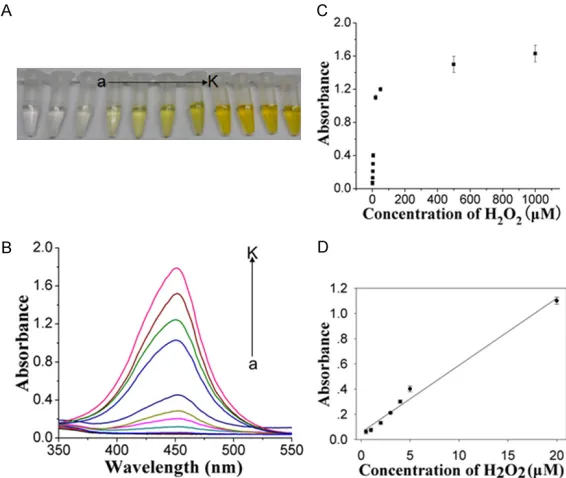
Figure 4. Detection of H2O2 with different concentrations based on the io-dide-catalyzed oxidation of TMB. A: Photographs; B: Absorption spectra; C: The relationship between the absorbance at 450 nm and the concentration of H2O2; D: The linear response at low concentrations of H2O2 (from a to k: 0, 0.5, 1, 2, 3, 4, 5, 20, 50, 500 and 1,000 μM). TMB, 3,3,5,5-tetramethyl-benzidine.
Results
Investigation of the iodide-catalyzed TMB-H2O2 reaction
In order to validate the cata-lytic activity of iodide in the TMB-H2O2 reaction, absorp-tion spectra of mixed solu-tions containing TMB, H2O2 and H2SO4 added with or with-out I- were measured and
[image:4.612.91.374.238.477.2]the corresponding photogra- phs were taken. As shown in Figure 1A, it was found that the solution added without I
-exhibited no evident adsorp-tion peak ranging from 300 to 600 nm, while with the addi-tion of I-, a noticeable peak
centered at 450 nm appeared, which could be attributed to the oxidation of TMB produc-ing a colored chemical TMB+
at 450 nm was observed in the presence of I
-compared with other ions, suggesting the dependent specificity of the catalytic system for I-. We speculated that I- was first oxidized to
IO
-3 in the presence of H2O2 and H+ (Figure 2A
and 2B) and IO
-3 was then reduced to I-, while
TMB was oxidized to a colored product (Figure 2C) [23]. Possible chemical equations are pre-sented in Figure 2D. As demonstrated above, iodide can obviously accelerate the reaction rate for catalytic oxidization of TMB and works as a catalyst in the TMB-H2O2 reaction system. Optimization of reaction conditions
The results of our study showed that factors such as pH, reaction temperature and reaction time all had impacts on the catalytic activity of iodide in the TMB-H2O2 reaction system. When we studied the effect of pH on the iodi- de-catalyzed TMB-H2O2 reaction, we recorded the relationship between A450 (the absorption intensity of the oxidization product of TMB at 450 nm) and different pH conditions. As shown in Figure 3A, the result showed that the cata-lytic oxidation rate of TMB by H2O2 in the pres-ence of iodide was much higher in acidic solu-tion than in neutral and basic solusolu-tion. In acidic solution, the reaction rate enhanced with increasing H2SO4 concentration up to 0.1 M and then decreased at higher concentrations. The reason for this may be due to the formation of IO
-3, which can promote TMB to be oxidized
to a colored product, depending on the co-exis-tence of H2O2 and H+. Therefore, a
concentra-tion of 0.1 M H2SO4 was chosen as the optimal acidic concentration for the colorimetric assay in the subsequent experiments.
Similarly, in order to obtain the optimal reaction temperature for this colorimetric assay, differ-ent temperatures ranging from 25°C to 75°C were explored and the relationship between A450 and temperature was examined. As shown in Figure 3B, it was found that A450 first
gradu-ally increased with the rise of temperature up to 55°C and then decreased at higher tempera-ture. The decrease in A450 at high temperature might be caused by the inhibition of the reac-tion or the destrucreac-tion of the TMB oxidareac-tion product. Thus, 55°C was chosen as the optimal reaction temperature for the colorimetric assay in the whole experiment.
Also, the reaction time was optimized as dis-played in Figure 3C. We found that an increa- se in reaction time from 1 to 10 min could lead to an increase in the absorption intensity. However, no further elevation of the absorption intensity was observed afterwards and the absorbance even dropped a little during a lon-ger reaction time (>10 min), showing the com-pletion of the reaction between TMB and H2O2 in the presence of iodide. Therefore, after the optimization for this catalytic reaction, 0.1 M H2SO4, 55°C and 10 min were used as the parameters for the subsequent experiments. Detection of H2O2 based on the iodide-cata-lyzed oxidation of TMB
In order to investigate the feasibility of the iodide-mediated TMB-H2O2 reaction system for H2O2 detection, absorption spectra of mixed solutions containing TMB, KI and H2SO4 add- ed with different concentrations of H2O2 were recorded and the corresponding photographs were taken. Figure 4A shows that the solution color changed from colorless to yellow as the concentration of H2O2 increased and a concen-tration of 0.5 μM H2O2 could even be observed by the naked eye. Figure 4B shows the corre-sponding absorbance spectrum change, which aligns with the result in Figure 4A. As shown in Figure 4C, it was found that the absorbance intensity at 450 nm increased with an increas-ing H2O2 concentration from 0.5 μM to 1 mM,
implying a broad response range using this catalytic reaction system. There was a good lin-ear correlation between absorbance intensity
and H2O2 concentration in the range of 0.5-20 μM (R2=0.987). The detection limit was 0.2 μM
(Figure 4D), which was lower than the limit reported in other colorimetric methods [15-17]. Our study results demonstrated that this colori-metric assay could be applied for quantitative and sensitive detection of H2O2.
In order to test the specificity of the colorimet-ric method for analyzing H2O2, we also used K3Fe(CN)6 (100 μM) and sufficient amount of dissolved O2 to replace H2O2 (10 μM) for com-parisons. Figure 5 shows the selectivity of this system toward H2O2. A yellow color solution was obtained in the presence of H2O2, however, no evident color change was observed for other interferent chemicals including K3Fe(CN)6 and dissolved O2, although the concentration of K3Fe(CN)6 was 10-fold that of H2O2 and the dis-solved O2 was saturated. Figure 5 shows the corresponding absorbance intensity at 450 nm for all of these samples and the results were consistent with the phenomenon detected above. Thus, the colorimetric method devel-oped here showed high selectivity toward H2O2
detection. In summary, the method we devel-oped here for the colorimetric detection of H2O2 based on the iodide-catalyzed TMB-H2O2 reac-tion. was easy, rapid, cost-efficient, sensitive and selective. The reagents used in this reac-tion system were commercially available and
low-cost. Furthermore, the reaction was simple, rapid and effective, and the oxidized product could be distinguished both by naked eye and spectrophotometric quantification. Therefore, this method has a great potential in the analy-sis of H2O2-related substances.
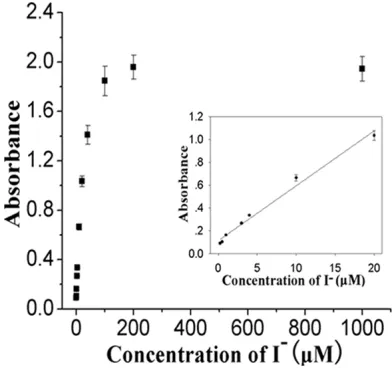
In addition, considering that the TMB-H2O2 reaction rate was iodide concentration-depen-dent, we further utilized this system to detect iodide, a substance that is of special interest due to its confirmed essential roles in neuro-logical activities and thyroid gland functions [24]. As displayed in Figure 6, it was revealed that the absorbance intensity at 450 nm increased with increasing I- concentration from
0.25 μM to 1 mM, indicating a broad response range. Furthermore, there was a good linear correlation between absorbance intensity and I- concentration in the range of 0.25-20 μM
(R2=0.986) (Figure 6). The detection limit was
0.25 μM, which was lower than the limit report-ed in the colorimetric iodide recognition meth-od using citrate-stabilized core/shell Cu@Au NPs (6 μM) [25].
Moreover, in order to ensure that the amounts of I- or H
2O2 added were sufficient, the
concen-tration for I- was 0.4 mM in the detection of
H2O2 and the concentration for H2O2 was 0.1 mM in the detection of I-. As shown in Figure 4,
0.4 mM of I-, which was 2.85 times the con-
centration (0.14 mM) used in the tests for opti-mizing reaction conditions, was enough for detecting 1 mM H2O2. The concentration of H2O2 (0.1 mM) was chosen to be used here based on the findings in Figure 4C. When the concentration of H2O2 reached 100 mM, the absorbance value was almost saturated; fur-thermore, the detection limit would be too high and the sensitivity would be low if excessive H2O2 was used.
Discussion
[image:6.612.90.286.73.257.2]In this study, we discovered that iodide could catalyze the oxidation of peroxidase substrate TMB by H2O2 to present a yellow color in an aqueous solution, which provided a key basis for a novel, facile, rapid, cost-efficient, sensitive and selective colorimetric assay for H2O2 detec-tion. Through condition optimization, it was found that the iodide-catalyzed TMB-H2O2 reac-tion could present a relatively high efficiency in the presence of 0.1 M H2SO4 after incubation
Figure 6. The relationship between the absorbance at 450 nm and the concentration of I-. Solutions of
0, 1, 3, 4, 5, 10, 20, 40, 100, 200, 1,000 μM I- were
at 55°C for 10 min. Under the optimal condi-tion, H2O2 in solution could be quantitatively and selectively determined by both naked eye and spectroscopy measure with low detection limits of 0.5 μM and 0.2 μM, respectively. Similarly, the catalytic colorimetric reaction sys-tem was also utilized for the measurement of iodide with excellent sensitivity and high selec-tivity. Considering H2O2 is a by-product in many enzyme catalytic reactions, such as glucose oxidase, cholesterol oxidase and oxalate oxi-dase, the iodide-mediated catalytic oxidation reaction of TMB might be applicable in detect-ing various H2O2-related substances as men-tioned above [26-28].
However, there are still some limitations to our study. For example, there have been only few reports on the hydrogen peroxide and iodide detection. We optimized the reaction condi-tions based on relevant literatures, followed by the analysis of hydrogen peroxide and iodide. However, in the future, we will consult some computational chemistry and statistical experts regarding the calculation of the optimal reac-tion condireac-tions via fitting curve for further verification.
In conclusion, iodide can catalyze the oxidation of TMB by H2O2 to a yellow product. The optimal condition for the reaction is a treatment with 0.1 M H2SO4 after incubation at 55°C for 10 min. This method is simple, rapid, low-cost, sensitive and selective, which can be applica-ble to the analysis of various H2O2-related substances.
Disclosure of conflict of interest
None.
Address correspondence to: Hui Li, Reproductive Medicine Center, Zhuzhou Central Hospital, No.116 Changjiang South Road, Zhuzhou 412007, Hu’nan Province, China. Tel: +86-0731-28561156; E-mail: [email protected]
References
[1] Usui Y, Sato K and Tanaka M. Catalytic dihy-droxylation of olefins with hydrogen peroxide: an organic-solvent- and metal-free system. An-gew Chem Int Ed Engl 2003; 42: 5623-5625. [2] Petersen OH, Spät A and Verkhratsky A.
Intro-duction: reactive oxygen species in health and disease. Philosophical Transactions of The
Royal Society B Biological Sciences 2005; 360: 2197.
[3] Albers AE, Okreglak VS and Chang CJ. A FRET-based approach to ratiometric fluorescence detection of hydrogen peroxide. J Am Chem Soc 2006; 128: 9640-9641.
[4] Shi C, Shan Y, Xu J and Chen H. Enhanced sol-id-state electrogenerated chemiluminescence of Au/CdS nanocomposite and its sensing to H2O2. Electrochimica Acta 2010; 55: 8268-8272.
[5] Steinberg SM. High-performance liquid chro-matography method for determination of hy-drogen peroxide in aqueous solution and ap-plication to simulated Martian soil and related materials. Environ Monit Assess 2013; 185: 3749-3757.
[6] Yeh TY, Wang CI and Chang HT. Photolumines-cent C-dots@RGO for sensitive detection of hy-drogen peroxide and glucose. Talanta 2013; 115: 718-723.
[7] Jia X, Hu G, Nitze F, Barzegar HR, Sharifi T, Tai CW and Wagberg T. Synthesis of palladium/ helical carbon nanofiber hybrid nanostructures and their application for hydrogen peroxide and glucose detection. ACS Appl Mater Inter-faces 2013; 5: 12017-12022.
[8] Liu M, Liu R and Chen W. Graphene wrapped Cu2O nanocubes: non-enzymatic electrochem-ical sensors for the detection of glucose and hydrogen peroxide with enhanced stability. Bio-sens Bioelectron 2013; 45: 206-212.
[9] Liu J, Han L, Wang T, Hong W, Liu Y and Wang E. Enzyme immobilization and direct elec- trochemistry based on a new matrix of phos-pholipid-monolayer-functionalized graphene. Chem Asian J 2012; 7: 2824-2829.
[10] Zhang X, Yin J and Yoon J. Recent advances in development of chiral fluorescent and colori-metric sensors. Chem Rev 2014; 114: 4918-4959.
[11] Lin Z, Xiao Y, Yin Y, Hu W, Liu W and Yang H. Facile synthesis of enzyme-inorganic hybrid nanoflowers and its application as a colorimet-ric platform for visual detection of hydrogen peroxide and phenol. ACS Appl Mater Interfac-es 2014; 6: 10775-10782.
[12] Li C, Hu J, Liu T and Liu S. Stimuli-triggered off/ on switchable complexation between a novel type of charge-generation polymer (CGP) and gold nanoparticles for the sensitive colorimet-ric detection of hydrogen peroxide and glu-cose. Macromolecules 2011; 44: 429-431. [13] Keyvanfard M.
[14] Keyvanfard M. Kinetic-photometric determina-tion of iodide based on its inhibitory effect on the bromate oxidation of indigo carmine in mi-cellar medium. Asian Journal of Chemistry 2009; 21: 2715-2720.
[15] Jv Y, Li B and Cao R. Positively-charged gold nanoparticles as peroxidase mimic and their application in hydrogen peroxide and glucose detection. Chem Commun (Camb) 2010; 46: 8017-8019.
[16] Hao J, Zhang Z, Yang W, Lu B, Ke X, Zhang B and Tang J. Controllable growth of CoFe O fer-rite nanocubes on graphene for colorimetric detection of hydrogen peroxide. Journal of Ma-terials Chemistry A 2013; 1: 4352-4357. [17] Zhang W, Ma D and Du J. Prussian blue
nanoparticles as peroxidase mimetics for sen-sitive colorimetric detection of hydrogen perox-ide and glucose. Talanta 2014; 120: 362-367. [18] Chen X, Zhou X and Hu J. Pt-DNA complexes as
peroxidase mimetics and their applications in colorimetric detection of H2O2 and glucose. Analytical Methods 2012; 4: 2183-2187. [19] Liu M, Li B and Cui X. Anionic polythiophene
derivative as peroxidase mimetics and their application for detection of hydrogen peroxide and glucose. Talanta 2013; 115: 837-841. [20] Sun C, Chen X, Xu J, Wei M, Wang J, Mi X, Wang
X, Wu Y and Liu Y. Fabrication of an inorganic-organic hybrid based on an iron-substituted polyoxotungstate as a peroxidase for colori-metric immunoassays of H2O2 and cancer cells. Journal of Materials Chemistry A 2013; 1: 4699-4705.
[21] Zhao Q, Chen S, Huang H, Zhang, Wang L. Col-orimetric and ultra-sensitive fluorescence res-onance energy transfer determination of H2O2
and glucose by multi-functional Au nanoclus-ters. Analyst 2014; 139: 1498-1503.
[22] Ingenhoven K, Kramer D, Jensen PE, Herman-rud C, Ryner M, Deisenhammer F, Pallardy M, Menge T, Hartung HP, Kieseier BC, Bertotti E, Creeke P, Fogdell-Hahn A and Warnke C. Devel-opment and validation of an enzyme-linked im-munosorbent assay for the detection of bind-ing anti-drug antibodies against interferon beta. Front Neurol 2017; 8: 305.
[23] Sheng YY, Xiang LC, Pingdingshan and Shiyan-shi F. Determination of trace manganese with ternary complex by floatation spectrophotom-etry. Analytical Laboratory 2000.
[24] Malongo TK, Patris S, Macours P, Cotton F, Nsangu J and Kauffmann JM. Highly sensitive determination of iodide by ion chromatography with amperometric detection at a silver-based carbon paste electrode. Talanta 2008; 76: 540-547.
[25] Zhang J, Xu X, Yang C, Yang F and Yang X. Colo-rimetric iodide recognition and sensing by ci-trate-stabilized core/shell Cu@Au nanoparti-cles. Anal Chem 2011; 83: 3911-3917. [26] Yoshimoto M, Miyazaki Y, Sato M, Fukunaga K,
Kuboi R and Nakao K. Mechanism for high sta-bility of liposomal glucose oxidase to inhibitor hydrogen peroxide produced in prolonged glu-cose oxidation. Bioconjug Chem 2004; 15: 1055-1061.
[27] Chen L, Lyubimov AY, Brammer L, Vrielink A and Sampson NS. The binding and release of oxygen and hydrogen peroxide are directed by a hydrophobic tunnel in cholesterol oxidase. Biochemistry 2008; 47: 5368-5377.