Learning Timeline Difference for Text Categorization
Fumiyo Fukumoto
Graduate Faculty of Interdisciplinary Research Univ. of Yamanashi, Japan [email protected]
Yoshimi Suzuki
Graduate Faculty of Interdisciplinary Research Univ. of Yamanashi, Japan [email protected]
Abstract
This paper addresses text categorization problem that training data may derive from a different time period from the test data. We present a learning framework which extends a boosting technique to learn accurate model for timeline adapta-tion. The results showed that the method was comparable to the current state-of-the-art biased-SVM method, especially the method is effective when the creation time period of the test data differs greatly from the training data.
1 Introduction
Text categorization supports and improves several tasks such as creating digital libraries, informa-tion retrieval, and even helping users to interact with search engines (Mourao et al., 2008). A growing number of machine learning (ML) tech-niques have been applied to the text categorization task (Xue et al., 2008; Gopal and Yang, 2010). Each document is represented using a vector of features/terms (Yang and Pedersen, 1997; Hassan et al., 2007). Then, the documents with category label are used to train classifiers. Once category models are trained, each test document is classi-fied by using these models. A basic assumption in the categorization task is that the distributions of terms between training and test documents are identical. When the assumption does not hold, the classification accuracy is worse. However, it is often the case that the term distribution in the training data is different from that of the test data when the training data may drive from a different time period from the test data. Manual annotation of tagged new data is very expensive and time-consuming. The methodology for accurate clas-sification of the new test data by making the max-imum use of tagged old data is needed in learning techniques.
In this paper, we present a method for text cat-egorization that minimizes the impact of tempo-ral effects. Our approach extends a boosting tech-nique to learn accurate model for timeline adap-tation. We used two types of labeled training data: One is the same creation time period with the test data. Another is different creation time period with the test data. We call the former same-period training, and the latter diff-period train-ing data. For the same-period traintrain-ing data, the learner shows the same behavior as the boosting. In contrast, for diff-period training data, once they are wrongly predicted by the learned model, these data would be useless to classify test data. We decreased the weights of these data by applying Gaussian function in order to weaken their im-pacts.
2 Related Work
The analysis of temporal aspects is a practical problem as well as the process of large-scale heterogeneous data since the World-Wide Web (WWW) is widely used by various sorts of peo-ple. It is widely studied in many text process-ing tasks. One attempt is concept or topic drift dealing with temporal effects (Klinkenberg and Joachims, 2000; Kleinberg, 2002; Lazarescu et al., 2004; Folino et al., 2007; Song et al., 2014). Wang et al. developed the continuous time dy-namic topic model (cDTM) (Wang et al., 2008). Heet al. proposed a method to find bursts, peri-ods of elevated occurrence of events as a dynamic phenomenon instead of focusing on arrival rates (He and Parker, 2010). They used Moving Aver-age Convergence/Divergence (MACD) histogram which was used in technical stock market analysis (Murphy, 1999) to detect bursts.
Another attempt is domain adaptation. The goal of this attempt is to develop learning algorithms that can be easily ported from one domain to an-other (Daum´e III, 2007; Sparinnapakorn and
bat, 2007; Glorot et al., 2011; Siao and Guo, 2013). Domain adaptation is particularly inter-esting in Natural Language Processing (NLP) be-cause it is often the case that we have a collec-tion of labeled data in one domain but truly de-sire a model that can work well for another do-main. Lots of studies addressed domain adapta-tion in NLP tasks such as part-of-speech tagging (Siao and Guo, 2013), named-entity (Daum´e III, 2007), and sentiment classification (Glorot et al., 2011) are presented. One approach to domain adaptation is to use transfer learning. The transfer learning is a learning technique that retains and ap-plies the knowledge learned in one or more tasks to efficiently develop an effective hypothesis for a new task. The earliest discussion is done by ML community in a NIPS-95 workshop1, and more
re-cently, transfer learning techniques have been suc-cessfully applied in many applications. Blitzer
et al. proposed a method for sentiment classi-fication using structural correspondence learning that makes use of the unlabeled data from the tar-get domain to extract some relevant features that may reduce the difference between the domains (Blitzer et al., 2006). Several authors have at-tempted to learn classifiers across domains us-ing transfer learnus-ing in the text classification task (Raina et al., 2006; Dai et al., 2007; Sparinna-pakorn and Kubat, 2007). Rainaet al. proposed a transfer learning algorithm that constructs an in-formative Bayesian prior for a given text classi-fication task (Raina et al., 2006). They reported that a 20 to 40% test error reduction over a com-monly used prior in the binary text classification task. Daiet al. presented a method called TrAd-aBoost which extends boosting-based learning al-gorithms (Dai et al., 2007). Their experimental results show that TrAdaBoost allows knowledge to be effectively transferred from the old data to the new one. All of these approaches aimed at utilizing a small amount of newly labeled data to leverage the old data to construct a high-quality classification model for the new data. However, the temporal effects are not explicitly incorporated into their models.
To our knowledge, there have been only a few previous work on temporal-based text categoriza-tion. Mourao et al. investigated the impact of temporal evolution of document collections on
1http://socrates.acadiau.ca/courses/comp/dsilver/ NIPS95 LTL/transfer.workshop.1995.html.
the document classification (Mourao et al., 2008). Salleset al. presented an approach to classify doc-uments in scenarios where the method uses infor-mation about both the past and the future, and this information may change over time (Salles et al., 2010). They address the drawbacks of which in-stances to select by approximating the Temporal Weighting Function (TWF) using a mixture of two Gaussians. However, their method needs tagged training data across full temporal range of training documents to construct TWF.
There are three novel aspects in our method. Firstly, we propose a method for text categoriza-tion that minimizes the impact of temporal effects in a learning technique. Secondly, from manual annotation of data perspective, the method allows users to annotate only a limited number of newly training data. Finally, from the perspective of ro-bustness, the method is automated, and can be applied easily to a new domain, or different lan-guages, given sufficient old labeled documents.
3 Learning Timeline Difference
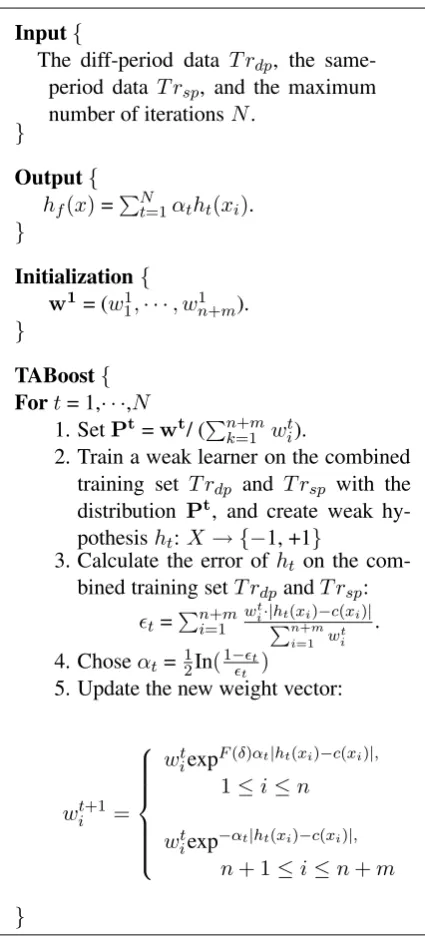
Our learning model, Timeline Adaptation by Boosting (TABoost) is based on AdaBoost (Fre-und and Schapire, 1997). AdaBoost aims to boost the accuracy of a weak learner by adjusting the weights of training instances and learn a classi-fier accordingly. The TABoost uses two types of training data, same-period and diff-period train-ing data. The assumption is that the quantity of the same-period data is limited, while diff-period training data is abundant. The TABoost aims at utilizing the diff-period training data to make up the deficit of a small amount of the same-period to construct a high-quality classification model for the test data. Similar to the TrAdaBoost presented by (Dai et al., 2007), TABoost is the same behav-ior as boosting for the same-period training data. In contrast, once diff-period training instances are wrongly predicted, we assume that these instances do not contribute to the accurate test data classifi-cation, and the weights of these instances decrease in order to weaken their impacts. The difference between TrAdaBoost and TABoost is a weight-ing manner, i.e. TABoost is a continuous time-line model, and it weights these instances by ap-plying Gaussian function in order to weaken their impacts. TABoost is illustrated in Figure 1.
Input{
The diff-period data T rdp, the same-period data T rsp, and the maximum number of iterationsN.
}
Output{
hf(x)=Nt=1αtht(xi). }
Initialization {
w1= (w1
1,· · ·, w1n+m). }
TABoost{
Fort= 1,· · ·,N
1. SetPt=wt/ (n+m k=1 wti).
2. Train a weak learner on the combined training set T rdp and T rsp with the distribution Pt, and create weak
hy-pothesisht:X→ {−1, +1}
3. Calculate the error of ht on the com-bined training setT rdpandT rsp:
t=n+mi=1 w
t
i·|ht(xi)−c(xi)| n+m i=1 wti .
4. Choseαt= 12In(1−tt)
5. Update the new weight vector:
wt+1
i =
⎧ ⎪ ⎪ ⎪ ⎪ ⎪ ⎨ ⎪ ⎪ ⎪ ⎪ ⎪ ⎩
wt
iexpF(δ)αt|ht(xi)−c(xi)|,
1≤i≤n
wt
iexp−αt|ht(xi)−c(xi)|, n+ 1≤i≤n+m
[image:3.595.73.286.59.528.2]}
Figure 1: Flow of the algorithm
shows the diff-period training data that T rdp = {(xdpi ,c(xdpi ))}, wherexdpi ∈Xdp (i= 1, · · ·,n), and Xdp refers to the diff-period instance space. Similarly, T rsp represents the same-period train-ing data thatT rsp={(xspi ,c(xspi ))}, wherexspi ∈ Xsp (i= 1, · · ·, m), and Xsp refers to the same-period instance space. nandmare the number of documents inT rdp andT rsp, respectively. c(xi) returns a label for the input instance xi. The com-bined training setT r={(xi,c(xi))}is given by:
xi=
xdpi i= 1,· · ·, n
xspi i=n+ 1,· · ·, n+m In each iteration round shown in Figure 1, if a
diff-period training instance is wrongly predicted, the instance may be useless to classify test data correctly. We decrease its training weight to re-duce the effect. To do this, we assume a standard lognormal distribution (Crow, 1988), i.e. F(δ)
= √1
2πexp(−δ
2
2). δ in F(δ) represents time dif-ference between diff-period training and test data. For instance, if the training data is 1999, and test data is 2000,δ equals to 1. Similarly, if the train-ing data is 2000, and test data is 1999, δ is −1. The greater the time difference value, the smaller the training weight. We fit the model according to the temporal range of the data. As shown in Figure 1, we decrease its training weightwt
i to re-duce its effect through multiplying its weight by expF(δ)αt|ht(xi)−c(xi)|.
We used the Support Vector Machines (SVM) as a learner. We represented each training and test document as a vector, each dimension of a vec-tor is a noun word appeared in the document, and each element of the dimension is a term frequency. We applied the algorithm shown in Figure 1. Af-ter several iAf-terations, a learner model is created by linearly combining weak learners, and a test doc-ument is classified by using a learner.
4 Experiments
We evaluated our TABoost by using the Mainichi Japanese newspaper documents.
4.1 Experimental setup
We choose the Mainichi Japanese newspaper corpus from 1991 to 2012. The corpus con-sists of 2,883,623 documents organized into 16 categories. We selected 8 categories, “Inter-national(Int)”, “Economy(Eco)”, “Home”, “Cul-ture”, “Reading”, “Arts”, “Sports”, and “Local news(Local)”, each of which has sufficient num-ber of documents. All documents were tagged by using a morphological analyzer Chasen (Mat-sumoto et al., 2000) and selected noun words. The total number of documents assigned to these cate-gories are 787,518. For each category within each year, we divided documents into three folds: 2% of documents are used as the same-period training data, 50% of documents are the diff-period train-ing data, and the remains are used to test our clas-sification method.2
Table 1: The error rates across categories
Cat TAB s SVM TrAdaB b-SVM TAB
Int 0.409 0.467 0.326 0.253 0.329
Eco 0.368 0.429 0.243 0.228 0.208
Home 0.475 0.649 0.312 0.460 0.172
Culture 0.468 0.848 0.440 0.559 0.196
Reading 0.358 0.520 0.298 0.357 0.337
Arts 0.402 0.684 0.330 0.588 0.331
Sports 0.226 0.212 0.107 0.075 0.123
Local 0.586 0.305 0.400 0.156 0.303
M-Avg 0.411 0.514 0.307 0.334 0.257
We used LIBLINEAR (Fan et al., 2008) as a basic learner in the experiments. We compared our method, TABoost with four baselines: (1) TABoost with the same-period training data only (TAB s), (2) SVM, (3) TrAdaBoost (Dai et al., 2007), and (4) biased-SVM (Liu et al., 2003) by SVM-light (Joachims, 1998). TAB s is the same behavior as boosting. TrAdaBoost (TrAdaB) is presented by (Dai et al., 2007). Biased-SVM (b-SVM) is known as the state-of-the-art SVMs method, and often used for comparison (Elkan and Noto, 2008). Similar to SVM, for biased-SVM, we used the first two folds as a training data, and classified test documents directly, i.e. we used closed data. We empirically selected values of two parameters, “c” (trade-off between training er-ror and margin) and “j”, i.e. cost (cost-factor, by which training errors on positive instances) that optimized result obtained by classification of test documents. Similar to (Liu et al., 2003), “c” is searched in steps of 0.02 from 0.01 to 0.61. “j” is searched in steps of 5 from 1 to 200. As a re-sult, we setcandjto 0.01 and 10, respectively. To make comparisons fair, all five methods including our method are based on linear kernel. Throughout the experiments, the number of iterations is set to 100. We used error rate as an evaluation measure (Dai et al., 2007).
4.2 Results
Categorization results for 8 categories (48% of the test documents, i.e. 378,008 documents) are shown in Table 1. Each value in Table 1 shows macro-averaged error rate across 22 years. “M-Avg” refers to macro-averaged error rate across categories. The results obtained by biased-SVM show minimum error rate obtained by varying the parameters, “c” and “j”.
As can be seen clearly from Table 1, the overall
0.15 0.2 0.25 0.3 0.35 0.4 0.45 0.5 0.55 0.6 0.65 0.7
-25 -20 -15 -10 -5 0 5 10 15 20 25
Error Rate
Temporal Distance
"SVM" "TrAdaB" "bSVM" "TAB"
Figure 2: Performance against temporal distance
performance obtained by TAB was the best among the five methods. The macro average error rates with TrAdaB and TAB were lower to those ob-tained by b-SVM, although b-SVM in Table 1 was the result obtained by using the closed data. In contrast, SVM did not work well. This demon-strates that once the training data drive from a dif-ferent time period from the test data, the distri-butions of terms between training and test docu-ments are not identical. The results obtained by TAB s were worse than those obtained by TrAd-aBoost, b-SVM, and TAB. This shows that (i) the same-period training data we used is not sufficient to train a model alone, and (ii) TAB demonstrates a good transfer ability.
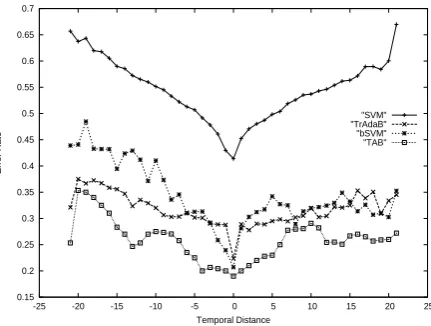
Figure 2 illustrates error rate against the tempo-ral difference between diff-period training and test data. Both training and test data are the documents from 1991 to 2012. For instance, “10” of the x-axis in Figure 2 indicates that the test documents are created 10 years later than the training docu-ments. We can see from Figure 2 that the result obtained by TAB was the best in all of the tempo-ral distances. There are no significant differences among three methods, bSVM, TrAdaB, and TAB when the test and training data are the same time period. The performance of these methods includ-ing SVM drops when the creation time of the test data differs greatly from the diff-period training data. However, the performance of TAB was still better to those obtained by other methods. This demonstrates that the algorithm with continuous timeline model works well for categorization.
0.2 0.25 0.3 0.35 0.4 0.45 0.5 0.55 0.6 0.65
0 10 20 30 40 50 60 70 80 90 100
Error Rate
Number of Iterations
[image:5.595.75.295.63.226.2]"diff_1" "diff_5" "diff_10" "diff_15" "diff_21"
Figure 3: Iteration curves by temporal distance
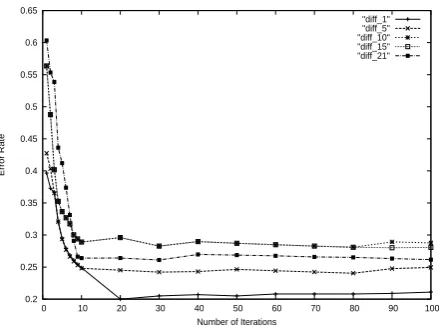
period training data. For example, “diff 10” indi-cates that the difference time period between same and diff training data is ±10 years. We can see from Figure 3 that all curves except for “diff 20” drop rapidly and converge around 10 iterations. “diff 20” converges around 20 iterations. This was the same behaviour as TrAdaBoost, i.e. TrAd-aBoost converges around 20 iterations. The fast convergence is not particularly surprising because we used a small number of same-period (2%) and a large number of diff-period (50%) training data. It is necessary to examine how the ratio between same-period and diff-period training data affects overall performance for further quantitative eval-uation, although a main contribution of TAB is in situations using by both of a small amount of la-beled new data which is not sufficient to train a model alone, and a large amount of old data.
5 Conclusion
We have presented a method for text catego-rizaiton that minimizes the impact of temporal ef-fects. The results using Japanese Mainichi News-paper corpus show that it works well for cate-gorization, especially when the creation time of the test data differs greatly from the training data. There are a number of interesting directions for future work. The rate of convergence of TAB (O(Inn/N)) is slow which can also be found in (Dai et al., 2007). Here,nis the number of train-ing data, and N is the number of iterations. In the future, we will try to extend the framework to address this issue. We used Japanese newspaper documents in the experiments. For quantitative evaluation, we need to apply our mehtod to other data such as ACM-DL and a large, heterogeneous
collection of web content in addition to the experi-ment to examine the performance agasint the ratio between same-period and diff-period training data.
References
J. Blitzer, R. McDonald, and F. Pereira. 2006. Domain Adaptation with Structural Correspondence
Learn-ing. InProc. of the Conference on Empirical
Meth-ods in Natural Language Processing, pages 120– 128.
S. K. Crow. 1988. Log-normal Distributions: Theory
and Application.NewYork: Dekker.
W. Dai, Q. Yang, G.R. Xue, and Y. Yu. 2007. Boost-ing for Transfer LearnBoost-ing. InProc. of the 24th In-ternational Conference on Machine Learning, pages 193–200.
H. Daum´e III. 2007. Frustratingly Easy Domain
Adaptation. InProc. of the 45th Annual Meeting of
the Association of computational Linguistics, pages 256–263.
C. Elkan and K. Noto. 2008. Learning Classifiers from
Only Positive and Unlabeled Data. InProc. of the
KDD’08, pages 213–220.
F. E. Fan, K. W. Chang, C. J. Hsieh, X. R. Wang, and C. J. Lin. 2008. LIBLINEAR: A Library for Large
Linear Classification. Machine Learning, 9:1871–
1874.
G. Folino, C. Pizzuti, and G. Spezzano. 2007. An Adaptive Distributed Ensemble Approach to Mine Concept-drifting Data Streams. InProc. of the 19th IEEE International Conference on Tools with Artifi-cial Intelligence, pages 183–188.
Y. Freund and R. E. Schapire. 1997. A Decision-Theoretic Generalization of On-Line Learning and
an Application to Boosting. Journal of Computer
and System Sciences, 55(1):119–139.
X. Glorot, A. Bordes, and Y. Bengio. 2011. Do-main Adaptation for Large-Scale Sentiment
Classifi-cation: A Deep Learning Approach. InProc. of the
28th International Conference on Machine Learn-ing, pages 97–110.
S. Gopal and Y. Yang. 2010. Multilabel Classification
with Meta-level Features. InProc. of the 33rd
An-nual International ACM SIGIR Conference on Re-search and Development in Information Retrieval, pages 315–322.
D. He and D. S. Parker. 2010. Topic Dynamics: An Alternative Model of Bursts in Streams of Topics. InProc. of the 16th ACM SIGKDD Conference on Knowledge discovery and Data Mining, pages 443– 452.
T. Joachims. 1998. SVM Light Support Vector
Ma-chine. InDept. of Computer Science Cornell
Uni-versity.
M. Kleinberg. 2002. Bursty and Hierarchical Structure
in Streams. InProc. of the Eighth ACM SIGKDD
International Conference on Knowledge Discovery and Data Mining, pages 91–101.
R. Klinkenberg and T. Joachims. 2000. Detecting Concept Drift with Support Vector Machines. In
Proc. of the 17th International Conference on Ma-chine Learning, pages 487–494.
M. M. Lazarescu, S. Venkatesh, and H. H. Bui. 2004. Using Multiple Windows to Track Concept Drift.
Intelligent Data Analysis, 8(1):29–59.
B. Liu, Y. dai, X. Li, W. S. Lee, and P. S. Yu. 2003. Building Text Classifiers using Positive and
Unla-beled Examples. InProc. of the ICDM’03, pages
179–188.
Y. Matsumoto, A. Kitauchi, T. Yamashita, Y. Hirano, Y. Matsuda, K. Takaoka, and M. Asahara. 2000.
Japanese Morphological Analysis System Chasen Version 2.2.1. In Naist Technical Report.
F. Mourao, L. Rocha, R. Araujo, T. Couto, M. Goncalves, and W. M. Jr. 2008. Understanding Temporal Aspects in Document Classification. In
Proc. of the 1st ACM International Conference on Web Search and Data Mining, pages 159–169.
J. Murphy. 1999. Technical Analysis of the Financial
Markets. Prentice Hall.
R. Raina, A. Y. Ng, and D. Koller. 2006. Construct-ing Informative Priors usConstruct-ing Transfer LearnConstruct-ing. In
Proc. of the 23rd International Conference on Ma-chine Learning, pages 713–720.
T. Salles, L. Rocha, and G. L. Pappa. 2010.
Temporally-aware Algorithms for Document Clas-sification. InProc. of the 33rd Annual International ACM SIGIR Conference on Research and Develop-ment in Information Retrieval, pages 307–314.
M. Siao and Y. Guo. 2013. Domain Adaptation for Sequence Labeling Tasks with a Probabilistic
Lan-guage Adaptation Model. InProc. of the 30th
In-ternational Conference on Machine Learning, pages 293–301.
M. Song, G. E. Heo, and S. Y. Kim. 2014. Analyzing topic evolution in bioinformatics: Investigation of dynamics of the field with conference data in dblp.
Scientometrics, 101(1):397–428.
K. Sparinnapakorn and M. Kubat. 2007. Combining Subclassifiers in Text Categorization: A DST-based
Solution and a Case Study. In Proc. of the 13th
ACM SIGKDD International Conference on Knowl-edge Discovery and Data Mining, pages 210–219. C. Wang, D. Blei, and D. Heckerman. 2008.
Contin-uous Time Dynamic Topic Models. InProc. of the
24th Conference on Uncertainty in Artificial Intelli-gence, pages 579–586.
G. R. Xue, W. Dai, Q. Yang, and Y. Yu. 2008. Topic-bridged PLSA for Cross-Domain Text Classifica-tion. InProc. of the 31st Annual International ACM SIGIR Conference on Research and Development in Information Retrieval, pages 627–634.