Exploiting language models for visual recognition
Dieu-Thu Le
DISI, University of Trento Povo, 38123, Italy [email protected]
Jasper Uijlings
DISI, University of Trento Povo, 38123, Italy [email protected]
Raffaella Bernardi
DISI, University of Trento Povo, 38123, Italy
Abstract
The problem of learning language models from large text corpora has been widely stud-ied within the computational linguistic com-munity. However, little is known about the performance of these language models when applied to the computer vision domain. In this work, we compare representative models: a window-based model, a topic model, a distri-butional memory and a commonsense knowl-edge database, ConceptNet, in two visual recognition scenarios: human action recog-nition and object prediction. We examine whether the knowledge extracted from texts through these models are compatible to the knowledge represented in images. We de-termine the usefulness of different language models in aiding the two visual recognition tasks. The study shows that the language models built from general text corpora can be used instead of expensive annotated images and even outperform the image model when testing on a big general dataset.
1 Introduction
Computational linguistics have created many tools for automatic knowledge acquisition which have been successfully applied in many tasks inside the language domain, such as question answering, ma-chine translation, semantic web, etc. In this paper we ask whether such knowledge generalizes to the observed reality outside the language domain, where we use well-known image datasets as a proxy for ob-served reality.
In particular, we aim to determine which language model yields knowledge that is most suitable for use
in Computer Vision. Therefore we test a variety of language models and a linguistically mined knowl-edge base within two computer vision scenarios:
Human action recognition : Recognizing <subject, verb, object> triples based on objects (e.g., car, horse) and scenes (the place that the actions occur, e.g., countryside, forest, office) recognized in images. In this scenario, we only consider images with human actions so the “human” subject is always present.
Objects in context : Predicting the most likely identity of an object given its context as ex-pressed in terms of co-occurring objects.
Computer vision can greatly benefit from natural language processing as learning from images re-quires a prohibitively expensive annotation effort. A major goal of natural language processing is to ob-tain general knowledge from text and in this paper we test which model provides the best knowledge for use in the visual domain.
Within the two visual scenarios, we compare three state-of-the-art language models and a knowledge base: (1) A window-based model, which counts co-occurrence frequencies within a fixed window; (2) R-LDA (S´eaghdha, 2010), an extension of LDA that enables generation of joint probabilities; (3) TypeDM (Baroni and Lenci, 2010), a strong Distri-butional Memory model; (4) ConceptNet (Speer and Havasi, 2013), an automatically generated semantic graph containing concepts with their relations.
We test the language models in two ways: (1) We directly compare the statistics of the linguistic mod-els with statistics extracted from the visual domain.
(2) We compare the linguistic models inside the two computer vision applications, leading to a direct es-timation of their usefulness.
To summarize, our main research questions are: (1) Is the knowledge from language compatible with the knowledge from vision? (2) Can the knowl-edge extracted from language help in computer vi-sion scenarios?
2 Related Work
Using high level knowledge to aid image under-standing has become a recent interest in the com-puter vision community. Objects, actions and scenes are detected and localized in images using low-level features. This detection and localization pro-cess is guided by reasoning and knowledge. Such knowledge is employed to disambiguate locations between objects in (Gupta and Davis, 2008). From the defined relationships between nouns (e.g., above, below, brighter, smaller), the system constrains which region in an image corresponds to which ob-ject/noun. Similarly, (Srikanth et al., 2005) ex-ploit ontologies extracted from WordNet to asso-ciate words and images and image regions. (Yu et al., 2011) employ relations between scenes and objects introducing an active model to recognize scenes through objects. The reasoning knowledge limits the detector to search for an object within a particular region rather than on the whole image.
Language models have also been employed to generate descriptive sentences for images. (Ushiku et al., 2012) introduce an online learning method for multi-keyphrase estimation to generate a sentence using a grammar model to describe an image. Simi-larly, from objects and scenes detected in an image, (Yang et al., 2011) estimated a sentence structure to generate a sentence description composed of a noun, verb, scene and preposition.
The studies most similar to ours are (Teo et al., 2012) and (Lampert et al., 2009). In (Teo et al., 2012), the Gigaword corpus is used to extract rela-tionships between tools and actions (e.g., knife - cut, cup - drink) by counting their co-occurences. These relationships are used to constrain and select the most plausible actions within a predefined set of ac-tions in cooking videos. Instead of using this knowl-edge as a guidance during recognition, we compare
different language models and build a general frame-work that is able to detect unseen actions through their components (verb - object - scene), hence our method does not limit the number of actions in im-ages. (Lampert et al., 2009) use attributes of nouns (e.g., an animal: white, eat fish, water, etc.). They can detect animals without having seen training ex-amples by manually defining the attributes of the tar-get animal. In this work, rather than relying on man-ual definitions, our aim is to find the best language models built automatically from available corpora to extract relations from natural language.
Currently, human action recognition is popular and mostly studied in video using the Bag-of-Visual-Words method (Delaitre et al., 2010; Everts et al., 2013; Kuehne et al., 2012; Reddy and Shah, 2012; Wang et al., 2013). In this method one extracts small local visual patches of, say, 24 by 24 pixels by 10 frames at every12th pixel at every 5th frame. For each patch local gradients or local movement (opti-cal flow) histograms are (opti-calculated. Then these lo(opti-cal visual features are mapped to abstract, predefined “visual words”, previously obtained using k-means clustering on a set of random features. While results are good, there are two main drawbacks with this approach. First of all, human actions are semantic and more naturally recognized through their compo-nents (human, objects, scene) rather than through a bag of local gradient/motion patterns. Hence we use a component-based method for human action recog-nition. Second, the number of possible human ac-tions is huge (the number of objects times the num-ber of verbs). Obtaining annotated visual examples for each action is therefore prohibitively expensive. So we learn from language models how components combine into human actions.
3 Two Visual Recognition Scenarios
We now describe the two computer vision scenarios: human action recognition and objects in context.
3.1 Human Action Recognition
predicting/disambiguating the human action and the final task is to define the human action triple. As in most work in human action recognition, we simplify the problem by considering only images in which human actions occur. This means that a human is always present, leaving the problem of predicting the verb given the object and the scene. While this may seem like a strong assumption, the possibility of having no action in the image at all is largely un-explored in computer vision due to its difficulty.
[image:3.612.83.292.214.360.2]
!
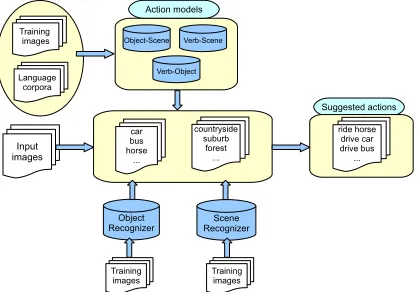
Figure 1: Human action suggestion: based on the objects and scenes recognized in an image, the system suggests the most plausible actions. The action models provide the relationships between objects - scenes - verbs
3.1.1 Human action recognition framework
Our general action recognition framework is pre-sented in Figure 1. Given an image, an object recog-nizer will predict the probability of each object (e.g, bike, horse) presented in that image. Furthermore, a scene recognizer will provide the probabilities of each scene (e.g., countryside, suburb, forest) given the image. The action model is composed of the conditional probabilities that relate verbs, objects and scenes, which have been learned from training images or language corpora. Given the object and scene probabilities recognized in the image, the ac-tion model will guide the acac-tion predicac-tion process and finally, the system will suggest the most proper actions (e.g., ride horse, drive car). We will now de-scribe each component in detail:
• Object and scene recognizers: To train the ject recognizer, we use a set of images where ob-jects have been annotated with bounding boxes (to
specify objects’ locations). We follow the state-of-the-art method of (Uijlings et al., 2013). The method is based on multiple hierarchical segmen-tations to sample a limited set of high quality ob-ject locations in terms of bounding boxes. A Bag-of-Visual-Words method (Uijlings et al., 2010) is applied to these boxes to localize and recognize objects. For the scene recognizer, we trained the same Bag-of-Visual-Words method on complete images on a dataset annotated with 15 scenes. In both cases we use Support Vector Machines to learn the object/scene models. We use Platt’s sig-moid function to obtain the final conditional prob-abilitiesP(oj|I)andP(sk|I).
• Action models: The model captures the relation-ship between Object - Scene, Verb - Scene and Verb - Object: the probability of an object given a sceneP(oj|sk), a verb given an objectP(vi|oj), and a verb given a sceneP(vi|sk). In one exper-iment we learn the probabilities from the train-ing images, where each image has been anno-tated with an object, a verb (of an action) and a scene. All three probabilities are computed using frequency counts in the training set, for example:
P(oj|sk) =
#images havingoj, sk #images havingsk (1)
We aim to replace this learning from annotated training images, which are expensive to obtain, with learning from language corpora. The de-tails of how to extract the probability distributions from language models are explained in section 4.
3.1.2 Component integration
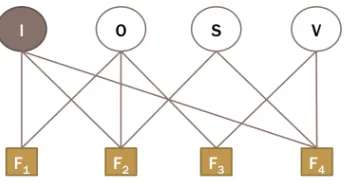
To combine these components in the framework, we use an energy-based model (Lecun et al., 2006) visualized in Figure 2, which includes the imageI (an observed variable) and objectO, scene S, and verbV. This energy-based formulation allows us to set different weights for energies which come from disparate sources (i.e. language and vision) using Gibbs measure.
Now given an imageI, we can compute the score functionS(aij;I)of an actionaij as:
S(aij;I) =S(vi, oj;I) = 1
Z exp −
X
F∈F
EFij
!
Figure 2: An energy-based model for action recognition
where we define each energy function EFij to give lower energies to correct answers and higher ener-gies to incorrect ones, withSis the set of all scenes:
EFij
1(O, I) =−wF1logP(oj|I) (2)
EFij
2(S, I) =−wF2log
X
S∈S
P(oj|S)×P(S|I)
(3)
EFij
3(V, O) =−wF3logP(vi|oj) (4)
EFij
4(V, S) =−wF4log
X
S∈S
P(vi|S)×P(S|I)
(5)
LetPi be the position of the correct action in the
ranked list of predicted actions for a certain image Ii. The ranked list is sorted in the order of the score
S. We evaluate human action recognition in terms of
this position average over all images, which we call Average Ranking (AR). Therefore we use Average Ranking as our loss-function:
L(wF) =ARN = 1
N
N
X
i=0
Pi. (6)
Training the energy model involves finding the fac-torswF∗ that minimizes the loss:
w∗F = argmin wF
L(wF) (7)
As we have only four parameters to learn in our energy model, we do this by performing an ex-haustive search and cross validation. We require wF ∈ {0.0,0.1,0.2, ...,0.9}and set the constraint
P
F∈FwF = 1. We note that the factor graph
for-mulation of our framework would allow us to use more advanced learning algorithms. We plan to look into this once the model becomes more complex by adding, for example, information about the position of the objects and the human.
3.1.3 Dataset
Recently, researchers have released many im-age action datasets such as the 7 everyday ac-tions (Delaitre et al., 2010), the Stanford 40 action dataset (Yao et al., 2011), the PASCAL action clas-sification competition (Everingham et al., 2012), and the 89 action dataset (Le et al., 2013). The 89 action dataset was originally created for the recognition of 20 objects. Afterwards also actions were annotated. Therefore, the actions occurring with these objects are mostly unbiased, unlike in other action datasets. Hence we choose to use the 89 action dataset.
In the 89 action dataset, every image has been an-notated with human actions, where each action is composed of a verb and an object. We addition-ally annotated every image with one of the 15 scenes from the 15 scene dataset (Lazebnik et al., 2006).
3.2 Objects in Context
Our other computer vision scenario is about objects in context. Context is useful in visual recognition for two reasons: Firstly, context can significantly reduce the number of possible object categories simplifying the problem. Secondly, when the object appearance is inconclusive for its identity, context can be used for disambiguation. For example, a grey rectangle on a desk may be recognized as a pen, while a grey rectangle on a table may be recognized as a knife. As the recognition systems are not always reliable, the use of context can greatly improve results.
For this scenario we choose a theoretical setting in which we want to predict the identity of one ob-ject given that the identities of all other obob-jects in the image are known. We believe that our main con-clusions on the linguistic models will transfer to a practical computer vision application where visual recognition systems predict the object identities.
Formally, we can describe this scenario as fol-lows: Given an image I with N objects O =
{o1, o2,· · ·, oN}, we want to predict the identity of objectoigiven all other objectsO \oi. In this paper we use a Naive Bayes assumption, leading to:
P(oi|O \oi) = P(O \oi|oi)×P(oi)
P(O \oi)
≈P(oi)× Y
oj∈O\oi
In this scenario, we need conditional relations P(oj|oi)and priors. We obtain these from language
data or from images directly.
3.2.1 Dataset
For the objects in context scenario, we use the SUN object dataset (Xiao et al., 2010), which con-tains more than 16 thousand images, more than 79,000 objects whose locations are annotated us-ing polygons. The dataset has been annotated by various people who could choose their own object categories, leading to duplicate categories such as “building” and “buildings”, “person” and “person walking”. Furthermore, for some images large parts are not annotated leading to an incomplete context. We therefore cleaned the object categories (mapping from around 7,500 objects to over 700 unique object categories) and considered only images whose con-tent was sufficiently annotated.
In our experiments, we used the predefined train-ing and testtrain-ing parts of the SUN dataset and obtained around 4,500 images for learning the object relations and 10,600 images for testing the object prediction. We obtain conditional probabilities P(oj|oi) from frequency counts.
4 Language models & distribution extraction
To extract probability distributions from texts, we use ConceptNet, the Window2 and 20 model, TypeDM and R-LDA. We will now describe how we estimate the four conditional probabilities P(V|O), P(V|S), P(O|S), P(O|O) needed in the two visual scenarios for each language model.
4.1 ConceptNet
ConceptNet (Speer and Havasi, 2013) is a large se-mantic graph containing concepts and relations be-tween them. It includes everyday basic, cultural and scientific knowledge, which have been automat-ically extracted from Internet using predefined rules. In this work we use the most current version, Con-ceptNet 5. As it was mined from free text using rules, the database has uncontrolled vocabulary and contains many false/nonesense statements.
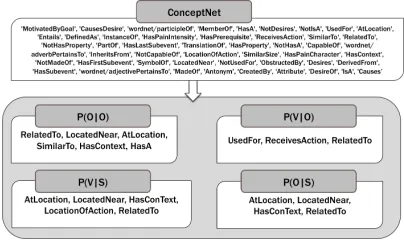
[image:5.612.324.526.64.184.2]To extract relations from ConceptNet5, we first examine all relations in the database and define those that are relevant to our scenarios (Figure 3). For
Figure 3: List of relations in ConceptNet
example, for the conditional probability of objects given scenes, relations such as “At Location”, “Lo-cated Near” are extracted. For the human action recognition scenario, we used a list of 19 objects, 15 scenes and around 5 thousand verbs for comput-ingP(V|O), P(O|S), P(V|S). For the objects in context scenario, we used 700 objects for comput-ingP(O|O). Examples of relations extracted from ConceptNet are illustrated in Table 1, such as: Oil -Located near - Car, Horse - Related to - Zebra. From these relations, we define the four conditional prob-abilities using their frequency counts. For example, to compute the conditional probability of an object given a sceneP(oi|sj), we extract all triples having
the form<object, rel, scene>, where “rel” can be “AtLocation”, “LocatedNear”, etc.
P(oi|sj) = P f req(< oi, rel, sj >) om∈Of req< om, rel, sj >
(9)
4.2 Window model
scor-LocatedNear RelatedTo UsedFor AtLocation oil car seatbelt car horse zebra plant garden bottle store liquid horse race bus city car city chair your bottom chair school horse pony sheep baa boat fish table eat off of bike street dog city plant everywhere muzzle dog plant green sheep cloud dog companionship chair rest bird countryside dog street
trailer car dog bark bone boat ship cow bull horse riding bus travel car street chair city salt table horse cowboy chair table horse riding chair sitting table eat meal cat store bus city stool table carriage horse dog wolf sheep farm chair sit on boat travel car street chair store pasture cow horse fence dog cat cow milk car transportation bottle hold liquid car street bicycle store
cat dog whisker cat sheep lamb table desk sheep wool boat float on water bird forest chair store horse zebra desk chair sheep wool cat feline table put thing on table eat at car city bottle store cat household train railroad dog a wolf dog canine boat travel on water cat catch mouse table kitchen chair office horsehair horse sheep wool cat dog plant flower chair sit cow milk chair office chair city
Table 1: Examples of relations extracted from ConceptNet 5
ing function provided by the models, for example:
P(vi|oj) = P LM Ivi,oj vm∈VLM Ivm,oj
(10)
4.3 Distributional Memory
Distributional Memory (Baroni and Lenci, 2010) (DM) is a multi-purpose framework for semantic modeling. This model is more complex than the Window models because it exploits different de-grees of lexicalization for each relation. Distribu-tional information is extracted as a set of weighted <word-link-word> tuples obtained from a depen-dency parse of corpora. In the Window model the relation between each word pair is decided by their co-occurences within a sliding window, while in DM this relation is defined by distributional properties of the two words. These distributional properties are based on a syntactic relation or lexico-syntactic pat-tern that links the two words. For example, the tu-ple<marine, use, bomb>encodes that marine co-occurs with bomb in the corpus, and the word “use” specifies the type of the syntagmatic link.
Distributional Memory contains three different models, corresponding to different ways to con-struct the weighted con-structure through the “link”. The first model, LexDM is the most heavily lexicalized model with the most variety of links, whereas the DepDM has the minimum degree of lexicalization, thus having the smallest number of links. TypeDM, which was reported to achieve the best performance in different tasks including selectional preferences, is laying somewhere in the middle of the other two models. It shares the same lexical information as in LexDM but use a different scoring function, which focuses on the variety of surface forms, rather than the frequency of a link. Hence we choose the best model, TypeDM, to learn the relationships between
verbs, objects and scenes. As in the window model, we compute conditional probabilities using the LMI scores provided by the model (Equation 10).
4.4 R-LDA
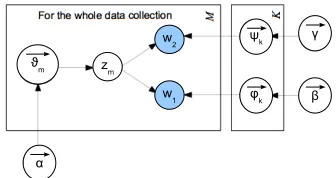
To model the relationships between verbs, objects and scenes, we adapt the R-LDA model (S´eaghdha, 2010) (ROOTH-LDA), which has been used for the selectional preference task in order to obtain con-ditional probabilities of two words. Each relationm of< w1, w2 >is generated by picking up a
distribu-tion over topics, then both elements of the reladistribu-tionm share the same topic assignmentzm, which keep two
differentw1-topic andw2-topic distributions sharing the same topic (Figure 4). The models are estimated by Gibbs sampling following (Heinrich, 2004). It is also noted that these models are generative, hence they also predict the probabilities of tuples that do not occur in the corpus.
[image:6.612.75.516.43.161.2]
Figure 4: Generative graphical model of R-LDA: model-ing the relations between two words
[image:6.612.338.506.469.558.2]Topic 8: Topic 14: Topic 0: Topic 54:
Noun Verb Noun Verb Noun Noun Noun Noun
[image:7.612.77.536.54.192.2]people 0.0208 have 0.157 year 0.0154 win 0.109 attention 0.0172 study 0.01 decision 0.02 case .0176 job 0.0167 work 0.108 Cup 0.0093 have 0.099 model 0.0147 research 0.0123 view 0.0244 fact .0096 work 0.0156 make 0.0262 team 0.0086 beat 0 study 0.014 work 0.0111 question 0.018 question .0096 class 0.014 take 0.0244 race 0.00772 take 0.025 role 0.0139 chapter 0.0085 issue 0.0124 law .0096 worker 0.0123 find 0.0194 season 0.0062 lose 0.0211 account 0.013 problem 0.0075 evidence 0.0104 decision .0092 staff 0.0111 pay 0.0156 time 0.006 run 0.0152 analysis 0.0123 issue 0.006 point 0.0099 time .0067 group 0.0089 say 0.0146 world 0.0058 finish 0.0135 aspect 0.012 system 0.0065 reason 0.0096 issue .0062 way 0.0086 get 0.0136 game 0.0055 make 0.0127 problem 0.0106 area 0.006 statement 0.0086 evidence .00617 service 0.008 leave 0.0114 champion 0.0053 lead 0.0122 effect 0.0105 process 0.006 doubt 0.008 interest .0059 company 0.0076 run 0.0102 seat 0.0049 follow 0.0098 pattern 0.0103 policy 0.0055 attention 0.0076 point .0058 day 0.0069 come 0.0101 match 0.0049 qualify 0.008 issue 0.0102 theory 0.00551 matter 0.00738 judge .0055 number 0.00615 help 0.0088 place 0.0047 compete 0.0074 range 0.0095 way 0.0053 policy 0.006 statement .005
Table 2: Random R-LDA topics with the relations between Noun-Verb (first 2 columns) and between Noun-Noun (last 2 columns)
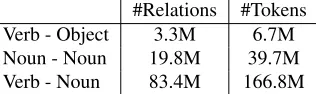
of sentences while scenes are all nouns occurring in the same sentence. For the relations between objects and scenes as well as objects and objects, we use all nouns to capture a general model1. The statistics of the BNC corpus with their corresponding relations are reported in Table 3.
#Relations #Tokens Verb - Object 3.3M 6.7M Noun - Noun 19.8M 39.7M Verb - Noun 83.4M 166.8M
Table 3: The statistics of the dataset used for estimating R-LDA models for each relation type
Samples of topics extracted through R-LDA are illustrated in Table 3. It shows that Noun and Object share many similar terms in the same topic while Noun and Verb sharing the same topics tend to go often together (e.g., win, cup, beat, race).
5 Experiments
In this section we want to answer our two main re-search questions: (1) Is knowledge from language compatible with knowledge from vision? (2) Can we use knowledge extracted from language in com-puter vision scenarios?
5.1 Is knowledge from language and vision compatible?
In this section we compare statistics mined from texts with those mined from visual sources. Ideally,
1Different from objects and verbs, which can be defined
ex-plicitly from the parsed corpora, scenes can only be defined from more restrained rules (e.g., followed by some preposi-tions), so here we take all nouns to have the most general model.
Chi statistics P(V|O) P(V|S) P(O|S)
R-LDA 17.8 11.6 11.9
Window2 11.6 11.4 32.6
Window20 11.7 11.4 23.7
TypeDM 11.5 13.3 23.2
[image:7.612.324.528.242.325.2]ConceptNet 17.5 11.5 34.4
Table 4:X2distance for relations between verbs, objects, scenes from different language models to image data
we want statistics from the language models to fol-low those of the image model, even though not all statistics from images can be reliably measured due to insufficient data. Therefore, we measure how well the estimated language models fit the estimated vi-sual distributions using the theχ2-distance:
X2= N
X
i=1
(PIi−PLi)2
PIi
(11)
wherePI andPLare the probability distribution
ob-tained from the image data and language models re-spectively.
[image:7.612.108.266.334.381.2]further away from the image model, followed by the Window2 model. Instead, human actions are found in language as the relation between verbs and their direct linguistic objects. Indeed, TypeDM is closest to the image model forP(V|O)as it makes explicit use of this linguistic link. The Window2 and 20 models are almost as close to the image model for P(V|O), while R-LDA is considerably further away due to its contextual nature. Finally, ConceptNet is the furthest away from the image model. To conclude, TypeDM is best for modelling direct verb-object relations, while R-LDA is better at capturing the more contextual object-scene relations.
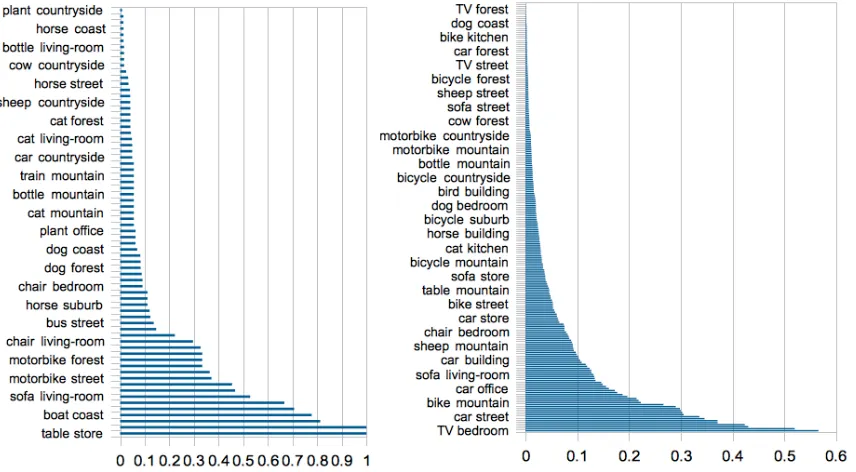
To look closer at the difference between the statis-tics obtained from the image and language data, we give an example of the conditional probabil-ities of an object given a scene P(O|S) in Fig-ure 5. We see that the distribution extracted from language (TypeDM) is much smoother and contains more relations than the image model since it has been trained on general and large text corpora. The distribution from image data on the other hand is more sparse and tailored to this specific dataset. For example, given a “store”, the probability that there is a “table” is 1, given “highway”, the probability of a “car” is also 1 in the image dataset, while the high-est conditional probability of the language model is
only less than 60%.
!"#$% !"#% !$#%
& ' (
)
*
+
,
)
[image:8.612.106.274.470.578.2]
Figure 6:χ2-distances between the tested language mod-els and the image model for conditional probabilities of objectsP(O|O).
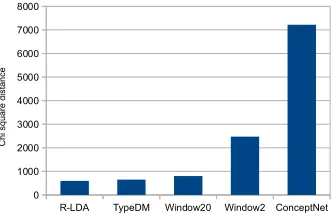
For the relations between objects and objects, we use the SUN dataset, which is much bigger and more general than the action dataset. As shown in Fig-ure 6, R-LDA is most similar to the image model, closely followed by TypeDM and the Window20
model. All these three models are good at captur-ing broad contextual relations. The Window2 model has a significantly larger distance to the image model as it captures a narrow context of 2 words, which is apparently not enough to find co-occurences of ob-jects. ConceptNet is the most inconsistent with this image data since not enough objects and their re-lations are extracted from it. To sum up, R-LDA achieves the best performance in modeling the re-lations between objects and objects among all lan-guage models.
5.2 Language Models for Visual Recognition
To measure the performance of the two visual recog-nition scenarios, we use the positionpiof the correct action found in the ranked list for each imagei.
We report the average ranking over all images (ARI) and over all objects or actions (ARO,ARA):
ARI =
PN
i=0pi
N ;ARO=
PNo j=0p
j o
No
(12)
whereN is the number of images,Nois the number
of objects andpjo is the average rank of all images
having objectj. The average rank over all actions ARAis defined similarly toARO. The average rank over all image measures the performance over the image dataset, but infrequent objects/events have lit-tle impact on this performance. The average rank over objects or actions gives more weight to rare ex-amples.
5.2.1 Human Action Recognition
We evaluate the performance of human action recognition in images based on objects and scenes individually, and then study the integration of them. The training set contains 1,104 images (for training the image relations) and the test set has 710 im-ages. First, we test how the model predicts an ac-tion knowing the actual object and/or scene appear-ing in an image (given object/scene gold standard), i.e.,Ogs,SgsandOgsSgsin the settings. After that, we test a complete model which is based on the out-put of our object recognizer and our scene recog-nizer (Orec,Srec,OrecSrec).
Figure 5: Probability distributions of scene over object extracted from: (left) image dataset; (right) TypeDM model (as there are many<object - scene>relations, only a few are shown on the Y-axises). The number of relations in the TypeDM is much bigger than in the image model, which shows a more general model than the image one.
Table 5 presents the average ranking over all im-ages. Results show that the action model learnt di-rectly from the training images achieves the best per-formance in all settings, even if we give more weight to infrequent actions by taking the average ranking over all actions, as presented in Table 6. One ex-planation may be that the action dataset has a lim-ited domain of only 19 objects, while the language models were learnt from broad knowledge (See Fig-ure 5). Another possibility is that verbs used for describing actions in images are more specific than verbs used in language. For example, in language one would “use the car”, while in images such ac-tion would be labelled “drive a car”.
If we look at the performance of the language models, TypeDM performs best by a significant mar-gin. This makes sense, as the most powerful term for predicting an action is obviouslyP(V|O), and we saw earlier that TypeDM produces probabili-tiesP(V|O)which are closest to the image model. For the same reason, the second and third best language model are the Window2 and Window20 models, although their performance is significantly lower when using the predictions for objects and/or scenes. This is somewhat surprising considering that TypeDM, Window2 and Window20 are all very close in distance to the image model. Of course,
Image TypeDM R-LDA Window2 Window20 C.Net
Ogs 0.3 16.1 63.4 16.4 18.3 86.1
Orec 14.9 26.9 66.7 44.7 54.9 115.6
Sgs 35.7 181.7 174.9 168.5 174.8 252.5
Srec 46.8 250.5 348 190.2 189.8 241.2
OgsSgs 0.28 10.2 15.2 13.8 13.6 81.9
OrecSrec 13.6 26.9 66.7 44.7 54.9 115.6
Table 5: Average rank over all imagesARIof the human
action recognition using different settings: Ogs, Orec
use only objects (gold standard and object recognizer);
Sgs, Srecuse only scenes,OgsSgsandOrecSrecintegrate
both objects and scenes together
the distance is just an indication. R-LDA performs poorly because it is much more contextual. Finally, ConceptNet performs the worst.
visual recognition system may not be strong enough for recognizing these 15 scenes. Another problem may be the limitation of 15 scenes only: while an-notating we frequently found that it was hard for nu-merous images to put them into one of the 15 scenes. So a bigger scene database may help.
The main problem with most available annotated human action datasets is that they are very restricted and domain-specific. For example, in this dataset with 19 objects and 15 scenes, there are many photos of a person riding a motorbike on rocky mountains as a kind of sport. Consequently, the probability of “riding” given “mountain” learnt from the image dataset is high according to the image data (78%) but is uncommon in general. So the image dataset might be too restricted or biased for general knowl-edge to work well. In the next section we therefore use a more general dataset.
Image TypeDM R-LDA Window2 Window20 C.Net ARI 13.6 26.9 66.7 44.7 54.9 115.6
ARA 16.4 30.8 64.7 45.3 51.9 131.7
Table 6: Average rank over all images vs. actions of the human action recognition using theOrecSrecsetting
5.2.2 Objects in Context
For every object in every image in the test set of the SUN database, we guess the identity of an object given the identity of all other objects in the image. In total, there are 78,306 object predictions within 10,652 images.
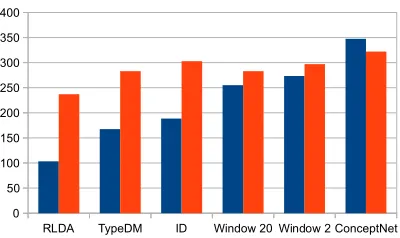
As shown in Figure 7, the R-LDA model outper-forms all other models for both average rank over images and over objects. Interestingly, both R-LDA and TypeDM are better at predicting the correct ob-jects in images than the model learnt from the image training set itself. It shows that for many cases, the relation statistics learnt from language data can help in visual recognition. These language models are even better than the information extracted from gen-eral, relatively unbiased image datasets, where an-notation is limited. For the limited anan-notation, this hypothesis is further supported by looking at the av-erage rank over objects, which gives more weight to rarely occurring objects. As seen in Figure 7, all language models except ConceptNet outperform the image model. We conclude that language models
[image:10.612.326.526.68.187.2]
!" # !" $% !" # !" &'%
Figure 7: Average rank over all images and objects using different language models and ID (image data)
can aid visual models in large-scale visual recogni-tion problems which use co-occurrence of objects as their context, especially when the annotation is lim-ited, as is often the case.
6 Conclusion
In this paper, we investigated the problem of ap-plying knowledge learnt from language corpora to visual recognition. We compared statistics of var-ious language models mined on general corpora with statistics observed in image datasets. It shows that the generative R-LDA model is good at relat-ing contextual relations (e.g., object - object, ob-ject - scene), while the syntactic based distributional model TypeDM is good at representing direct rela-tions such as verb - object in images.
We have evaluated the performance of the lan-guage models in two visual scenarios: human action recognition and object prediction. It suggests that the language models need some tailoring when ap-plied to restricted datasets, but for a bigger and more general dataset, the language models even outper-form the model learnt from annotated images itself. This shows that language models built from avail-able text corpora can be used for visual recognition instead of expensive annotated image data.
References
Marco Baroni and Alessandro Lenci. 2010. Distribu-tional memory: A general framework for corpus-based semantics.Computational Linguistics.
Elia Bruni, Gemma Boleda, Marco Baroni, and Nam-Khanh Tran. 2012. Distributional semantics in tech-nicolor. InProceedings of the 50th Annual Meeting of the Association for Computational Linguistics, ACL. ACL.
Vincent Delaitre, Ivan Laptev, and Josef Sivic. 2010. Recognizing human actions in still images: a study of bag-of-features and part-based representations. In
Proceedings of the British Machine Vision Conference. BMVA Press.
M. Everingham, L. Van Gool, C. K. I. Williams, J. Winn, and A. Zisserman. 2012. The PASCAL Visual Object Classes Challenge 2012 (VOC2012) Results.
I. Everts, J. van Gemert, and T. Gevers. 2013. Evaluation of color stips for human action recognition. InCVPR. Abhinav Gupta and Larry S. Davis. 2008. Beyond nouns: Exploiting prepositions and comparative adjec-tives for learning visual classifiers. InProceedings of the 10th European Conference on Computer Vision. Gregor Heinrich. 2004. Parameter estimation for text
analysis. Technical report.
H. Kuehne, D. Gehrig, T. Schultz, and R. Stiefelhagen. 2012. On-line action recognition from sparse feature flow. InVISAPP.
C.H. Lampert, H. Nickisch, and S. Harmeling. 2009. Learning to detect unseen object classes by between-class attribute transfer. InConference on Computer Vision and Pattern Recognition CVPR.
S. Lazebnik, C. Schmid, and J. Ponce. 2006. Beyond bags of features: Spatial pyramid matching for rec-ognizing natural scene categories. InConference on Computer Vision and Pattern Recognition CVPR, vol-ume 2, pages 2169–2178.
Dieu Thu Le, Raffaella Bernardi, and Jasper Uijlings. 2013. Exploiting language models to recognize un-seen actions. In Proceedings of the 3rd ACM con-ference on International concon-ference on multimedia re-trieval ICMR. ACM.
Yann Lecun, Sumit Chopra, Raia Hadsell, Fu J. Huang, G. Bakir, T. Hofman, B. Sch¨olkopf, A. Smola, and B. Taskar Eds. 2006. A tutorial on energy-based learning. InPredicting Structured Data.
Kevin Lund and Curt Burgess. 1996. Producing high-dimensional semantic spaces from lexical co-occurrence.Behavior Research Methods, Instruments, and Computers.
K. Reddy and M. Shah. 2012. Recognizing 50 human action categories of web videos. InMachine Vision and Applications.
Diarmuid ´O. S´eaghdha. 2010. Latent variable mod-els of selectional preference. In Proceedings of the 48th Annual Meeting of the Association for Computa-tional Linguistics, ACL, pages 435–444. Association for Computational Linguistics.
Robert Speer and Catherine Havasi. 2013. Conceptnet 5: A large semantic network for relational knowledge. In
The People’s Web Meets NLP. Springer Berlin Heidel-berg.
Munirathnam Srikanth, Joshua Varner, Mitchell Bowden, and Dan Moldovan. 2005. Exploiting ontologies for automatic image annotation. InSpecial Interest Group on Information Retrieval SIGIR. ACM.
C.L. Teo, Yezhou Yang, H. Daume, C. Fermuller, and Y. Aloimonos. 2012. Towards a watson that sees: Language-guided action recognition for robots. In
2012 IEEE International Conference on Robotics and Automation ICRA.
J R R Uijlings, A W M Smeulders, and R J H Scha. 2010. Real-time Visual Concept Classification.IEEE Trans-actions on Multimedia, 12.
J R R Uijlings, K.E.A. van de Sande, T. Gevers, and A.W.M. Smeulders. 2013. Selective search for ob-ject recognition. International Journal of Computer Vision.
Yoshitaka Ushiku, Tatsuya Harada, and Yasuo Ku-niyoshi. 2012. Efficient image annotation for auto-matic sentence generation. InACM International Con-ference on Multimedia ACM MM.
H. Wang, A. Kl¨aser, C. Schmid, and C. Liu. 2013. Dense trajectories and motion boundary descriptors for ac-tion recogniac-tion. International Journal of Computer Vision, 103:60–79.
Jianxiong Xiao, J. Hays, K.A. Ehinger, A. Oliva, and A. Torralba. 2010. Sun database: Large-scale scene recognition from abbey to zoo. In Conference on Computer Vision and Pattern Recognition CVPR. Yezhou Yang, Ching Lik Teo, Hal Daum´e, III, and
Yian-nis Aloimonos. 2011. Corpus-guided sentence gener-ation of natural images. InConference on Empirical Methods in Natural Language Processing EMNLP. Bangpeng Yao, Xiaoye Jiang, Aditya Khosla, Andy Lai
Lin, Leonidas J. Guibas, and Li Fei-Fei. 2011. Ac-tion recogniAc-tion by learning bases of acAc-tion attributes and parts. InInternational Conference on Computer Vision ICCV.
Xiaodong Yu, Cornelia Fermuller, Ching Lik Teo, Yezhou Yang, and Yiannis Aloimonos. 2011. Ac-tive scene recognition with vision and language. In