Proceedings of the Joint Conference on EMNLP and CoNLL: Shared Task, pages 113–117,
Illinois-Coref: The UI System in the CoNLL-2012 Shared Task
Kai-Wei Chang Rajhans Samdani Alla Rozovskaya Mark Sammons Dan Roth University of Illinois at Urbana-Champaign
{kchang10|rsamdan2|rozovska|mssammon|danr}@illinois.edu
Abstract
The CoNLL-2012 shared task is an extension of the last year’s coreference task. We partici-pated in the closed track of the shared tasks in both years. In this paper, we present the im-provements ofIllinois-Coref system from last year. We focus on improving mention detec-tion and pronoun coreference resoludetec-tion, and present a new learning protocol. These new strategies boost the performance of the system by 5% MUC F1, 0.8% BCUB F1, and 1.7% CEAF F1 on the OntoNotes-5.0 development set.
1 Introduction
Coreference resolution has been a popular topic of study in recent years. In the task, a system requires to identify denotative phrases (“mentions”) and to cluster the mentions into equivalence classes, so that the mentions in the same class refer to the same en-tity in the real world.
Coreference resolution is a central task in the Natural Language Processing research. Both the 2011 (Pradhan et al., 2011) and CoNLL-2012 (Pradhan et al., CoNLL-2012) shared tasks focus on resolving coreference on the OntoNotes corpus. We also participated in the CoNLL-2011 shared task. Our system (Chang et al., 2011) ranked first in two out of four scoring metrics (BCUB and BLANC), and ranked third in the average score. This year, we further improve the system in several respects. In Sec. 2, we describe the Illinois-Coref system for the CoNLL-2011 shared task, which we take as the baseline. Then, we discuss the improvements on mention detection (Sec. 3.1), pronoun resolu-tion (Sec. 3.2), and learning algorithm (Sec. 3.3).
Section 4 shows experimental results and Section 5 offers a brief discussion.
2 Baseline System
We use the Illinois-Coref system from CoNLL-2011 as the basis for our current system and refer to it as the baseline. We give a brief outline here, but fo-cus on the innovations that we developed; a detailed description of the last year’s system can be found in (Chang et al., 2011).
The Illinois-Coref system uses a machine learn-ing approach to coreference, with an inference pro-cedure that supports straightforward inclusion of do-main knowledge via constraints.
The system first uses heuristics based on Named Entity recognition, syntactic parsing, and shallow parsing to identify candidate mentions. A pair-wise scorer w generates compatibility scores wuv
for pairs of candidate mentions u and v using ex-tracted featuresφ(u, v)and linguistic constraintsc.
wuv=w·φ(u, v) +c(u, v) +t, (1)
wheretis a threshold parameter (to be tuned). An inference procedure then determines the optimal set of links to retain, incorporating constraints that may override the classifier prediction for a given mention pair. A post-processing step removes mentions in singleton clusters.
Last year, we found that a Best-Link decoding strategy outperformed an All-Link strategy. The
links is available, the highest-scoring link is selected and added to the set of coreference links. After the scan is complete, the transitive closure of edges is taken to generate the coreference clusters, each clus-ter corresponding to a single predicted entity in the document.
The formulation of this best-link solution is as fol-lows. For two mentions u andv, u < v indicates that the mentionuprecedesvin the document. Let
yuv be a binary variable, such thatyuv = 1only if uandv are in the same cluster. For a documentd,
Best-Linksolves the following formulation:
arg maxy X
u,v:u<vwuvyuv
s.t X
u<vyuv ≤1∀v, yuw ∈ {0,1}.
(2)
Eq. (2) generates a set of connected components and the set of mentions in each connected compo-nent constitute an entity. Note that we solve the above Best-Link inference using an efficient algo-rithm (Bengtson and Roth, 2008) which runs in time quadratic in the number of mentions.
3 Improvements over the Baseline System
Below, we describe improvements introduced to the baselineIllinois-Coref system.
3.1 Mention Detection
Mention detection is a crucial component of an end-to-end coreference system, as mention detection er-rors will propagate to the final coreference chain.
Illinois-Coref implements a high recall and low precision rule-based system that includes all noun phrases, pronouns and named entities as candidate mentions. The error analysis shows that there are two main types of errors.
Non-referential Noun Phrases. Non-referential noun phrases are candidate noun phrases, identified through a syntactic parser, that are unlikely to re-fer to any entity in the real world (e.g., “the same time”). Note that because singleton mentions are not annotated in the OntoNotes corpus, such phrases are not considered as mentions. Non-referential noun phrases are a problem, since during the coreference stage they may be incorrectly linked to a valid men-tion, thereby decreasing the precision of the system.
To deal with this problem, we use the training data to count the number of times that a candidate noun phrase happens to be a gold mention. Then, we re-move candidate mentions that frequently appear in the training data but never appear as gold mentions. Relaxing this approach, we also take the predicted head word and the words before and after the men-tion into account. This helps remove noun phrases headed by a preposition (e.g., the noun “fact” in the phrase “in fact”). This strategy will slightly degrade the recall of mention detection, so we tune a thresh-old learned on the training data for the mention re-moval.
Incorrect Mention Boundary. A lot of errors in mention detection happen when predicting mention boundaries. There are two main reasons for bound-ary errors: parser mistakes and annotation incon-sistencies. A mistake made by the parser may be due to a wrong attachment or adding extra words to a mention. For example, if the parser attaches the relative clause inside of the noun phrase ”Pres-ident Bush, who traveled to China yesterday” to a different noun, the algorithm will predict ”President Bush” as a mention instead of ”President Bush, who traveled to China yesterday”; thus it will make an er-ror, since the gold mention also includes the relative clause. In this case, we prefer to keep the candi-date with a larger span. On the other hand, we may predict ”President Bush at Dayton” instead of ”Pres-ident Bush”, if the parser incorrectly attaches the prepositional phrase. Another example is when ex-tra words are added, as in ”Today President Bush”.
re-moved. This strategy is similar to the method used to remove non-referential noun phrases.
As for annotation inconsistency, we find that in a few documents, a punctuation mark or an apostrophe used to mark the possessive form are inconsistently added to the end of a mention. The problem results in an incorrect matching between the gold and pre-dicted mentions and downgrades the performance of the learned model. Moreover, the incorrect mention boundary problem also affects the training phase be-cause our system is trained on a union set of the pre-dicted and gold mentions. To fix this problem, in the training phase, we perform a relaxed matching between predicted mentions and gold mentions and ignore the punctuation marks and mentions that start with one of the following: adverb, verb, determiner, and cardinal number. For example, we successfully match the predicted mention “now the army” to the gold mention “the army” and match the predicted mention “Sony ’s” to the gold mention “Sony.” Note that we cannot fix the inconsistency problem in the test data.
3.2 Pronoun Resolution
The baseline system uses an identical model for coreference resolution on both pronouns and non-pronominal mentions. However, in the litera-ture (Bengtson and Roth, 2008; Rahman and Ng, 2011; Denis and Baldridge, 2007) the features for coreference resolution on pronouns and non-pronouns are usually different. For example, lexi-cal features play an important role in non-pronoun coreference resolution, but are less important for pronoun anaphora resolution. On the other hand, gender features are not as important in non-pronoun coreference resolution.
We consider training two separate classifiers with different sets of features for pronoun and non-pronoun coreference resolution. Then, in the decod-ing stage, pronoun and non-pronominal mentions use different classifiers to find the best antecedent mention to link to. We use the same features for non-pronoun coreference resolution, as the baseline system. For the pronoun anaphora classifier, we use a set of features described in (Denis and Baldridge, 2007), with some additional features. The aug-mented feature set includes features to identify if a pronoun or an antecedent is a speaker in the
sen-Algorithm 1Online Latent Structured Learning for Coreference Resolution
Loop until convergence:
For each documentDtand eachv∈Dt
1. Letu∗= max u∈y(v)w
Tφ(u, v), and
2. u0 = max u∈{u<v}∪{∅}w
Tφ(u, v) + ∆(u, v, y(v))
3. Letw←w+ηwT(φ(u0, v)−φ(u∗, v)).
tence. It also includes features to reflect the docu-ment type. In Section 4, we will demonstrate the im-provement of using separate classifiers for pronoun and non-pronoun coreference resolution.
3.3 Learning Protocol for Best-Link Inference
The baseline system applies the strategy in (Bengt-son and Roth, 2008, Section 2.2) to learn the pair-wise scoring functionwusing the Averaged Percep-tron algorithm. The algorithm is trained on mention pairs generated on a per-mention basis. The exam-ples are generated for a mentionvas
• Positive examples: (u, v)is used as a positive example whereu < vis the closest mention to
vinv’s cluster
• Negative examples: for allwwithu < w < v,
(w, v)forms a negative example.
Although this approach is simple, it suffers from a severe label imbalance problem. Moreover, it does not relate well to the best-link inference, as the deci-sion of picking the closest preceding mention seems rather ad-hoc. For example, consider three men-tions belonging to the same cluster: {m1:
“Presi-dent Bush”, m2: “he”, m3:“George Bush”}. The
baseline system always chooses the pair (m2, m3)
as a positive example becausem2is the closet
men-tion ofm3. However, it is more proper to learn the
model on the positive pair(m1, m3), as it provides
more information. Since thebest linksare not given but are latent in our learning problem, we use an on-line latent structured learning algorithm (Connor et al., 2011) to address this problem.
Method Without Separating Pronouns With Separating Pronouns MD MUC BCUB CEAF AVG MD MUC BCUB CEAF AVG
Binary Classifier (baseline) 70.53 61.63 69.26 43.03 57.97 73.24 64.57 69.78 44.95 59.76
Latent-Structured Learning 73.02 64.98 70.00 44.48 59.82 73.95 65.75 70.25 45.30 60.43
Table 1: The performance of different learning strategies for best-link decoding algorithm. We show the results with/without using separate pronoun anaphora resolver. The systems are trained on the TRAIN set and evaluated on theCoNLL-2012 DEVset. We report the F1 scores (%) on mention detection (MD) and coreference metrics (MUC, BCUB, CEAF). The column AVG shows the averaged scores of the three coreference metrics.
System MD MUC BCUB CEAF AVG
Baseline 64.58 55.49 69.15 43.72 56.12 New Sys. 70.03 60.65 69.95 45.39 58.66
Table 2: The improvement ofIllinois-Coref. We report the F1 scores (%) on the DEV set from CoNLL-2011
shared task. Note that the CoNLL-2011 data set does not include corpora of bible and of telephone conversation.
in the equivalence class, otherwise it takes values from {u | u < v}. We define a loss function
∆(h(v), v, y(v))as
∆(h(v), v, y(v)) = (
0 h(v)∈y(v),
1 h(v)∈/ y(v).
We further define the feature vectorφ(∅, v)to be a zero vector andη to be the learning rate in Percep-tron algorithm. Then, the weight vectorwin (1) can be learned from Algorithm 1. At each step, Alg. 1 picks a mentionvand finds the Best-Link decision
u∗ that is consistent with the gold cluster. Then, it solves a loss-augmented inference problem to find the best link decisionu0with current model (u0 =∅
if the classifier decides thatv does not have coref-erent antecedent mention). Finally, the modelwis updated by the difference between the feature vec-torsφ(u0, v)andφ(u∗, v).
Alg. 1 makes learning more coherent with infer-ence. Furthermore, it naturally solves the data im-balance problem. Lastly, this algorithm is fast and converges very quickly.
4 Experiments and Results
In this section, we demonstrate the performance of
Illinois-Coref on the OntoNotes-5.0data set. A pre-vious experiment using an earlier version of this data
can be found in (Pradhan et al., 2007). We first show the improvement of the mention detection system. Then, we compare different learning protocols for coreference resolution. Finally, we show the overall performance improvement ofIllinois-Coref system.
First, we analyze the performance of mention de-tection before the coreference stage. Note that sin-gleton mentions are included since it is not possible to identify singleton mentions before running coref-erence. They are removed in the post-processing stage. The mention detection performance of the end-to-end system will be discussed later in this sec-tion. With the strategy described in Section 3.1, we improve the F1 score for mention detection from 55.92% to 57.89%. Moreover, we improve the de-tection performance on short named entity mentions (name entity with less than 5 words) from 61.36 to 64.00 in F1 scores. Such mentions are more impor-tant because they are easier to resolve in the corefer-ence layer.
Regarding the learning algorithm, Table 1 shows the performance of the two learning protocols with/without separating pronoun anaphora resolver. The results show that both strategies of using a pro-noun classifier and training a latent structured model with a online algorithm improve the system perfor-mance. Combining the two strategies, the avg F1 score is improved by 2.45%.
Finally, we compare the final system with the baseline system. We evaluate both systems on the CoNLL-11 DEV data set, as the baseline system is tuned on it. The results show that Illinois-Coref
Task MD MUC BCUB CEAF AVG
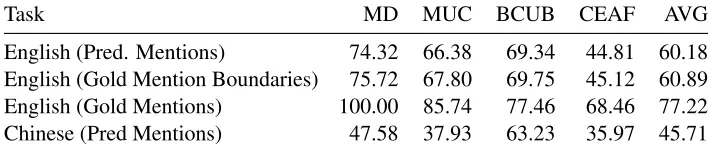
[image:5.612.128.486.71.146.2]English (Pred. Mentions) 74.32 66.38 69.34 44.81 60.18 English (Gold Mention Boundaries) 75.72 67.80 69.75 45.12 60.89 English (Gold Mentions) 100.00 85.74 77.46 68.46 77.22 Chinese (Pred Mentions) 47.58 37.93 63.23 35.97 45.71
Table 3: The results of our submitted system on the TEST set. The systems are trained on a collection of TRAIN and DEV sets.
4.1 Chinese Coreference Resolution
We apply the same system to Chinese coreference resolution. However, because the pronoun proper-ties in Chinese are different from those in English, we do not train separate classifiers for pronoun and non-pronoun coreference resolution. Our Chinese coreference resolution on Dev set achieves 37.88% MUC, 63.37% BCUB, and 35.78% CEAF in F1 score. The performance for Chinese coreference is not as good as the performance of the coreference system for English. One reason for that is that we use the same feature set for both Chinese and En-glish systems, and the feature set is developed for the English corpus. Studying the value of strong fea-tures for Chinese coreference resolution system is a potential topic for future research.
4.2 Test Results
Table 3 shows the results obtained on TEST, using the best system configurations found on DEV. We report results on both English and Chinese coref-erence resolution on predicted mentions with pre-dicted boundaries. For English coreference resolu-tion, we also report the results when using gold men-tions and when using gold mention boundaries1.
5 Conclusion
We described strategies for improving mention de-tection and proposed an online latent structure al-gorithm for coreference resolution. We also pro-posed using separate classifiers for making Best-Link decisions on pronoun and non-pronoun men-tions. These strategies significantly improve the
Illinois-Coref system.
1
Note that, in Ontonotes annotation, specifying gold tions requires coreference resolution to exclude singleton men-tions. Gold mention boundaries are provided by the task orga-nizers and include singleton mentions.
Acknowledgments This research is supported by the Defense Advanced Research Projects Agency (DARPA) Machine Reading Program under Air Force Research Laboratory (AFRL) prime contract no. FA8750-09-C-0181 and the Army Research Laboratory (ARL) under agreement W911NF-09-2-0053. Any opinions, findings, and conclusion or recommendations expressed in this ma-terial are those of the author(s) and do not necessarily reflect the view of the DARPA, AFRL, ARL or the US government.
References
E. Bengtson and D. Roth. 2008. Understanding the value of features for coreference resolution. InEMNLP. K. Chang, R. Samdani, A. Rozovskaya, N. Rizzolo,
M. Sammons, and D. Roth. 2011. Inference proto-cols for coreference resolution. InCoNLL.
M. Connor, C. Fisher, and D. Roth. 2011. Online latent structure training for language acquisition. InIJCAI. P. Denis and J. Baldridge. 2007. A ranking approach to
pronoun resolution. InIJCAI.
S. Pradhan, L. Ramshaw, R. Weischedel, J. MacBride, and L. Micciulla. 2007. Unrestricted Coreference: Identifying Entities and Events in OntoNotes. In ICSC.
S. Pradhan, L. Ramshaw, M. Marcus, M. Palmer, R. Weischedel, and N. Xue. 2011. CoNLL-2011 shared task: Modeling unrestricted coreference in OntoNotes. InCoNLL.
S. Pradhan, A. Moschitti, N. Xue, O. Uryupina, and Y. Zhang. 2012. CoNLL-2012 shared task: Modeling multilingual unrestricted coreference in OntoNotes. In CoNLL.