A Comparative Study of Bayesian Models for Unsupervised Sentiment
Detection
Chenghua Lin School of Engineering, Computing and Mathematics
University of Exeter Exeter, EX4 4QF, UK. [email protected]
Yulan He
Knowledge Media Institute The Open University
Milton Keynes MK7 6AA, UK [email protected]
Richard Everson School of Engineering, Computing and Mathematics
University of Exeter Exeter, EX4 4QF, UK. [email protected]
Abstract
This paper presents a comparative study of three closely related Bayesian mod-els for unsupervised document level senti-ment classification, namely, the latent sen-timent model (LSM), the joint sensen-timent- sentiment-topic (JST) model, and the Reverse-JST model. Extensive experiments have been conducted on two corpora, the movie re-view dataset and the multi-domain senti-ment dataset. It has been found that while all the three models achieve either bet-ter or comparable performance on these two corpora when compared to the exist-ing unsupervised sentiment classification approaches, both JST and Reverse-JST are able to extract sentiment-oriented topics. In addition, Reverse-JST always performs worse than JST suggesting that the JST model is more appropriate for joint senti-ment topic detection.
1 Introduction
With the explosion of web 2.0, various types of social media such as blogs, discussion forums and peer-to-peer networks present a wealth of infor-mation that can be very helpful in assessing the general public’s sentiments and opinions towards products and services. Recent surveys have vealed that opinion-rich resources like online re-views are having greater economic impact on both consumers and companies compared to the tradi-tional media (Pang and Lee, 2008). Driven by the demand of gleaning insights of such great amounts of user-generated data, work on new methodologies for automated sentiment analysis has bloomed splendidly.
Compared to the traditional topic-based text classification, sentiment classification is deemed to be more challenging as sentiment is often em-bodied in subtle linguistic mechanisms such as
the use of sarcasm or incorporated with highly domain-specific information. Although the task of identifying the overall sentiment polarity of a document has been well studied, most of the work is highly domain dependent and favoured in supervised learning (Pang et al., 2002; Pang and Lee, 2004; Whitelaw et al., 2005; Kennedy and Inkpen, 2006; McDonald et al., 2007), re-quiring annotated corpora for every possible do-main of interest, which is impractical for real applications. Also, it is well-known that senti-ment classifiers trained on one domain often fail to produce satisfactory results when shifted to an-other domain, since sentiment expression can be quite different in different domains (Aue and Ga-mon, 2005). Moreover, aside from the diversity of genres and large-scale size of Web corpora, user-generated contents evolve rapidly over time, which demands much more efficient algorithms for sentiment analysis than the current approaches can offer. These observations have thus motivated the problem of using unsupervised approaches for domain-independent joint sentiment topic detec-tion.
Some recent research efforts have been made to adapt sentiment classifiers trained on one domain to another domain (Aue and Gamon, 2005; Blitzer et al., 2007; Li and Zong, 2008; Andreevskaia and Bergler, 2008). However, the adaption perfor-mance of these lines of work pretty much depends on the distribution similarity between the source and target domain, and considerable effort is still required to obtain labelled data for training.
Intuitively, sentiment polarities are dependent on contextual information, such as topics or do-mains. In this regard, some recent work (Mei et al., 2007; Titov and McDonald, 2008a) has tried to model both sentiment and topics. However, these two models either require postprocessing to calcu-late the positive/negative coverage in a document for polarity identification (Mei et al., 2007) or
quire some kind of supervised setting in which review text should contain ratings for aspects of interest (Titov and McDonald, 2008a). More re-cently, Dasgupta and Ng (2009) proposed an unsu-pervised sentiment classification algorithm by in-tegrating user feedbacks into a spectral clustering algorithm. Features induced for each dimension of spectral clustering can be considered as sentiment-oriented topics. Nevertheless, human judgement of identifying the most important dimensions dur-ing spectral clusterdur-ing is required.
Lin and He (2009) proposed a joint sentiment-topic (JST) model for unsupervised joint senti-ment topic detection. They assumed that top-ics are generated dependent on sentiment distri-butions and then words are generated conditioned on sentiment-topic pairs. While this is a reason-able design choice, one may argue that the re-verse is also true that sentiments may vary ac-cording to topics. Thus in this paper, we studied the reverse dependence of the JST model called Reverse-JST, in which sentiments are generated dependent on topic distributions in the modelling process. We also note that, when the topic num-ber is set to 1, both JST and reversed-JST es-sentially become a simple latent Dirichlet alloca-tion (LDA) model with only S (number of sen-timent label) topics, each of which corresponds to a sentiment label. We called it latent senti-ment model (LSM) in this paper. Extensive ex-periments have been conducted on the movie re-view (MR)1(Pang et al., 2002) and multi-domain sentiment (MDS)2 (Blitzer et al., 2007) datasets to compare the performance of LSM, JST and Reverse-JST. Results show that all these three models are able to give either better or compara-ble performance compared to the existing unsu-pervised sentiment classification approaches. In addition, both JST and reverse-JST are able to ex-tract sentiment-oriented topics. Furthermore, the fact that reverse-JST always performs worse than JST suggests that the JST model is more appropri-ate for joint sentiment topic detection.
The rest of the paper is organized as follows. Section 2 presents related work. Section 3 de-scribes the LSM, JST and Reserver-JST models. Experimental setup and results on the MR and MDS datasets are discussed in Section 4 and 5
re-1
http://www.cs.cornell.edu/people/ pabo/movie-review-data
2
http://www.cs.jhu.edu/˜mdredze/ datasets/sentiment/index2.html
spectively. Finally, Section 6 concludes the paper and outlines the future work.
2 Related Work
As opposed to the work (Pang et al., 2002; Pang and Lee, 2004; Whitelaw et al., 2005; Kennedy and Inkpen, 2006) that only focused on senti-ment classification in one particular domain, re-cent research attempts have been made to address the problem of sentiment classification across do-mains. Aue and Gamon (2005) explored vari-ous strategies for customizing sentiment classifiers to new domains, where the training is based on a small number of labelled examples and large amounts of unlabelled in-domain data. However, their experiments achieved only limited success, with most of the classification accuracy below 80%. In the same vein, some more recent work focused on domain adaption for sentiment classi-fiers. Blitzer et al. (2007) used the structural corre-spondence learning (SCL) algorithm with mutual information. Li and Zong (2008) combined multi-ple single classifiers trained on individual domains using SVMs. However, the adaption performance in (Blitzer et al., 2007) depends on the selection of pivot features that used to link the source and tar-get domains; whereas the approach of Li and Zong (2008) heavily relies on labelled data from all the domains to train the integrated classifier and thus lack the flexibility to adapt the trained classifier to domains where label information is not available.
is practically infeasible. More recently, Dasgupta and Ng (2009) proposed an unsupervised sen-timent classification algorithm where user feed-backs are provided on the spectral clustering pro-cess in an interactive manner to ensure that text are clustered along the sentiment dimension. Features induced for each dimension of spectral cluster-ing can be considered as sentiment-oriented top-ics. Nevertheless, human judgement of identify-ing the most important dimensions duridentify-ing spectral clustering is required.
Among various efforts for improving senti-ment detection accuracy, one direction is to in-corporate prior information or subjectivity lexi-con (i.e., words bearing positive or negative sen-timent) into the sentiment model. Such sen-timent lexicons can be acquired from domain-independent sources in many different ways, from manually built appraisal groups (Whitelaw et al., 2005), to semi-automatically (Abbasi et al., 2008) and fully automatically (Kaji and Kitsure-gawa, 2006) constructed lexicons. When incor-porating lexical knowledge as prior information into a sentiment-topic model, Andreevskaia and Bergler (2008) integrated the lexicon-based and corpus-based approaches for sentence-level sen-timent annotation across different domains; Li et al. (2009) employed lexical prior knowledge for semi-supervised sentiment classification based on non-negative matrix tri-factorization, where the domain-independent prior knowledge was incor-porated in conjunction with domain-dependent un-labelled data and a few un-labelled documents. How-ever, this approach performed worse than the JST model on the movie review data even with 40% labelled documents as will be shown in Section 5.
3 Latent Sentiment-Topic Models
This section describes three closely related Bayesian models for unsupervised sentiment clas-sification, the latent sentiment model (LSM), the joint sentiment-topic (JST) model, and the joint topic sentiment model by reversing the generative process of sentiment and topics in the JST model, called Reverse-JST.
3.1 Latent Sentiment Model (LSM)
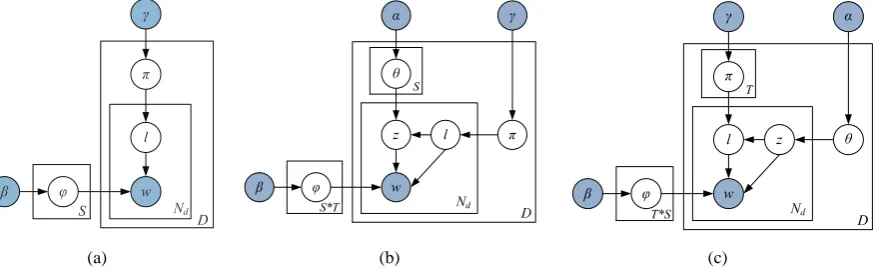
The LSM model, as shown in Figure 1(a), can be treated as a special case of LDA where a mixture of only three sentiment labels are modelled, i.e. positive, negative and neutral.
Assuming that we have a total number ofS sen-timent labels3; a corpus with a collection of D documents is denoted by C = {d1, d2, ..., dD};
each document in the corpus is a sequence ofNd
words denoted by d = (w1, w2, ..., wNd), and
each word in the document is an item from a vo-cabulary index with V distinct terms denoted by
{1,2, ..., V}. The procedure of generating a word in LSM starts by firstly choosing a distribution over three sentiment labels for a document. Fol-lowing that, one picks up a sentiment label from the sentiment label distribution and finally draws a word according to the sentiment label-word distri-bution.
The joint probability of words and sentiment la-bel assignment in LSM can be factored into two terms:
P(w,l) =P(w|l)P(l|d). (1)
Letting the superscript −t denote a quantity that excludes data from thetthposition, the conditional
posterior for lt by marginalizing out the random
variablesϕandπis
P(lt=k|w,l−t, β,γ)∝ N−t
wt,k+β
N−t
k +V β · N
−t
k,d+γk
N−t
d +
P
kγk
, (2)
whereNwt,k is the number of times word wt has
associated with sentiment label k; Nk is the the
number of times words in the corpus assigned to sentiment label k; Nk,d is the number of times
sentiment labelkhas been assigned to some word tokens in document d; Nd is the total number of
words in the document collection.
Gibbs sampling is used to estimate the poste-rior distribution of LSM, as well as the JST and Reverse-JST models that will be discussed in the following two sections.
3.2 Joint Sentiment-Topic Model (JST)
In contrast to LSM that only models document sentiment, the JST model (Lin and He, 2009) can detect sentiment and topic simultaneously, by modelling each document withS (number of sen-timent labels) topic-document distributions. It should be noted that when the topic number is set to 1, JST effectively becomes the LSM model with only three topics corresponding to each of the
3For all the three models, i.e., LSM, JST and
w
l
N d D
S
(a)
w
z
l
N d D
S
S *T
(b)
w
l
z
N d D
T
T *S
$
%
& '
(c)
Figure 1: (a) LSM model; (b) JST model; (c) Reverse-JST model.
three sentiment labels. Let T be the total num-ber of topics, the procedure of generating a word wiaccording to the graphical model shown in
Fig-ure 1(b) is:
• For each document d, choose a distribution πd∼Dir(γ).
• For each sentiment label l of document d, choose a distributionθd,l∼Dir(α).
• For each wordwiin documentd
– choose a sentiment label li ∼
Multinomial(πd),
– choose a topiczi ∼Multinomial(θd,li),
– choose a word wi from ϕlzii, a
Multi-nomial distribution over words condi-tioned on topicziand sentiment labelli.
In JST, the joint probability of words and topic-sentiment label assignments can be factored into three terms:
P(w,z,l) =P(w|z,l)P(z|l, d)P(l|d). (3)
The conditional posterior forztand ltcan be
ob-tained by marginalizing out the random variables ϕ,θ, andπ:
P(zt=j, lt=k|w,z−t,l−t, α, β,γ)∝
N−t
wt,j,k+β
N−t
j,k+V β · N
−t
j,k,d+α
N−t
k,d+T α · N
−t
k,d+γk
N−t
d +
P
kγk
, (4)
whereNwt,j,kis the number of times wordwt
ap-peared in topicjand with sentiment labelk;Nj,k
is the number of times words assigned to topic j and sentiment label k, Nk,j,d is the number of
times a word from document dhas been associ-ated with topic j and sentiment label k; Nk,d is
the number of times sentiment label k has been assigned to some word tokens in documentd.
3.3 Reverse Joint Sentiment-Topic Model (Reverse-JST)
We also studied a variant of the JST model, called Reverse-JST. As opposed to JST in which topic generation is conditioned on sentiment la-bels, sentiment label generation in Reverse-JST is dependent on topics. As shown in Figure 1(c), Reverse-JST is effectively a four-layer hierarchi-cal Bayesian model, where topics are associated with documents, under which sentiment labels are associated with topics and words are associated with both topics and sentiment labels.
The procedure of generating a word wi in
Reverse-JST is shown below:
• For each document d, choose a distribution θd∼Dir(α).
• For each topiczof documentd, choose a dis-tributionπd,z ∼Dir(γ).
• For each wordwiin documentd
– choose a topiczi ∼Multinomial(θd),
– choose a sentiment label li ∼
Multinomial(πd,zi),
– choose a word wi from ϕlzii, a
multi-nomial distribution over words condi-tioned on the topiczi and sentiment
la-belli.
Analogy to JST, in Reverse-JST the joint prob-ability of words and the topic-sentiment label as-signments can be factored into the following three terms:
P(w,l,z) =P(w|l,z)P(l|z, d)P(z|d), (5)
and the conditional posterior forzt and lt can be
[image:4.595.83.521.69.205.2]θ, andπ, yielding
P(zt=j, lt=k|w,z−t,l−t, α, β,γ)∝
N−t
wt,j,k+β
N−t
j,k+V β · N
−t
k,j,d+γk
N−t
j,d+
P
kγk · N
−t
j,d +α
N−t
d +T α
. (6)
It it noted that most of the terms in the Reverse-JST posterior is identical to the posterior of Reverse-JST in Equation 4, except thatNj,dis the number of times
topic jhas been assigned to some word tokens in documentd.
As we do not have a direct sentiment label-document distribution in Reverse-JST, a distribu-tion over sentiment label for document P(l|d) is
calculated asP(l|d) = P
zP(l|z, d)P(z|d). For
all the three models, the probability P(l|d) will
be used to determine document sentiment polar-ity. We define that a document d is classified as a positive-sentiment document if its probabil-ity of positive sentiment label given document P(lpos|d), is greater than its probability of
neg-ative sentiment label given document P(lneg|d),
and vice versa.
4 Experimental Setup
4.1 Dataset Description
Two publicly available datasets, the MR and MDS datasets, were used in our experiments. The MR dataset (also known as the polarity dataset) has become a benchmark for many studies since the work of Pang et al. (2002). The version 2.0 used in our experiment consists of 1000 positive and 1000 negative movie reviews drawn from the IMDB movie archive, with an average of 30 sentences in each document. We also experimented with an-other dataset, namely subjective MR, by removing the sentences that do not bear opinion information from the MR dataset, following the approach of Pang and Lee (2004). The resulting dataset still contains 2000 documents with a total of 334,336 words and 18,013 distinct terms, about half the size of the original MR dataset without perform-ing subjectivity detection.
First used by Blitzer et al. (2007), the MDS dataset contains 4 different types of product re-views taken from Amazon.com including books, DVDs, electronics and kitchen appliances, with 1000 positive and 1000 negative examples for each domain4.
4We did not perform subjectivity detection on the MDS
dataset since its average document length is much shorter
Preprocessing was performed on both of the datasets. Firstly, punctuation, numbers, non-alphabet characters and stop words were removed. Secondly, standard stemming was performed in order to reduce the vocabulary size and address the issue of data sparseness. Summary statistics of the datasets before and after preprocessing are shown in Table 1.
4.2 Defining Model Priors
In the experiments, two subjectivity lexicons, namely the MPQA5 and the appraisal lexicon6, were combined and incorporated as prior infor-mation into the model learning. These two lexi-cons contain lexical words whose polarity orien-tation have been fully specified. We extracted the words with strong positive and negative orienta-tion and performed stemming in the preprocess-ing. In addition, words whose polarity changed af-ter stemming were removed automatically, result-ing in 1584 positive and 2612 negative words, re-spectively. It is worth noting that the lexicons used here are fully domain-independent and do not bear any supervised information specifically to the MR, subjMR and MDS datasets. Finally, the prior in-formation was produced by retaining all words in the MPQA and appraisal lexicons that occurred in the experimental datasets. The prior information statistics for each dataset is listed in the last row of Table 1.
In contrast to Lin and He (2009) that only uti-lized prior information during the initialization of the posterior distributions, we use the prior infor-mation in the Gibbs sampling inference step and argue that this is a more appropriate experimental setting. For the Gibbs sampling step of JST and Reverse-JST, if the currently observed word token matches a word in the sentiment lexicon, a cor-responding sentiment label will be assigned and only a new topic will be sampled. Otherwise, a new sentiment-topic pair will be sampled for that word token. For LSM, if the current word token matches a word in the sentiment lexicon, a corre-sponding sentiment label will be assigned and skip the Gibbs sampling procedure. Otherwise, a new sentiment label will be sampled.
than that of the MR dataset, with some documents even hav-ing one sentence only.
5
http://www.cs.pitt.edu/mpqa/
6http://lingcog.iit.edu/arc/appraisal_
Table 1: Dataset and sentiment lexicon statistics. (Note:†denotes before preprocessing and * denotes after preprocessing.)
Dataset
# of words
MR subjMR MDS
Book DVD Electronic Kitchen Corpus size† 1,331,252 812,250 352,020 341,234 221,331 186,122 Corpus size* 627,317 334,336 157,441 153,422 95,441 79,654
Vocabulary† 38,906 34,559 22,028 21,424 10,669 9,525
Vocabulary* 25,166 18,013 14,459 14,806 7,063 6,252
# of lexicon
1248/1877 1150/1667 1000/1352 979/1307 574/552 582/504 (pos./neg.)*
Table 2: LSM sentiment classification results. Aaccuracy (%)
MDS
MR subjMR Book DVD Electronic Kitchen MDS overall
LSM (without prior info.) 61.7 57.9 51.6 53.5 58.4 56.8 55.1
LSM (with prior info.) 74.1 76.1 64.2 66.3 72.5 74.1 69.3
Dasgupta and Ng (2009) 70.9 N/A 69.5 70.8 65.8 69.7 68.9
Li et al.(2009) with 10% doc. label 60 N/A
N/A 62
Li et al.(2009) with 40% doc. label 73.5 N/A 73
5 Experimental Results
5.1 LSM Sentiment Classification Results
In this section, we discuss the sentiment classifica-tion results of LSM at document level by incorpo-rating prior information extracted from the MPQA and appraisal lexicon. The symmetry Dirichlet priorβwas set to 0.01, and the asymmetric Dirich-let sentiment prior γ was set to 0.01 and 0.9 for the positive and negative sentiment label, respec-tively. Classification accuracies were averaged over 5 runs for each dataset with 2000 Gibbs sam-pling iterations.
As can be observed from Table 2, the perfor-mance of LSM is only mediocre for all the 6 datasets when no prior information was incorpo-rated. A significant improvement, with an aver-age of more than 13%, is observed after incor-porating prior information, especially notable for subjMR and kitchen with 18.2% and 17.3% im-provement, respectively. It is also noted that LSM with subjMR dataset achieved 2% improvement over the original MR dataset, implying that the subjMR dataset has better representation of sub-jective information than the original dataset by fil-tering out the objective contents. For the MDS dataset, LSM achieved 72.5% and 74.1% accu-racy on electronic and kitchen domain respec-tively, which is much better than the book and DVD domain with only around 65% accuracy. Manually analysing the MDS dataset reveals that the book and DVD reviews often contain a lot of descriptions of book contents or movie plots,
which make the reviews from these two domains difficult to classify; whereas in the electronic and kitchen domain, comments on the product are of-ten expressed in a straightforward manner.
[image:6.595.91.507.229.301.2]7 0 .2
7 3 .4
6 6 .1
6 9 .1
7 1.2
6 5 .3 6 9 .3
7 2 .7
6 5 .9
6 8 .3
7 0 .9
6 4 .7 6 8 .1
7 1.9
6 4 .8
6 7
7 0 .1
6 3 .9
6 0 6 2 6 4 6 6 6 8 7 0 7 2 7 4
M R su bjM R M D S M R su b jM R M D S
Ac
c
u
r
ac
y
[image:7.595.114.487.66.265.2]T 3 0 T 5 0 T 10 0
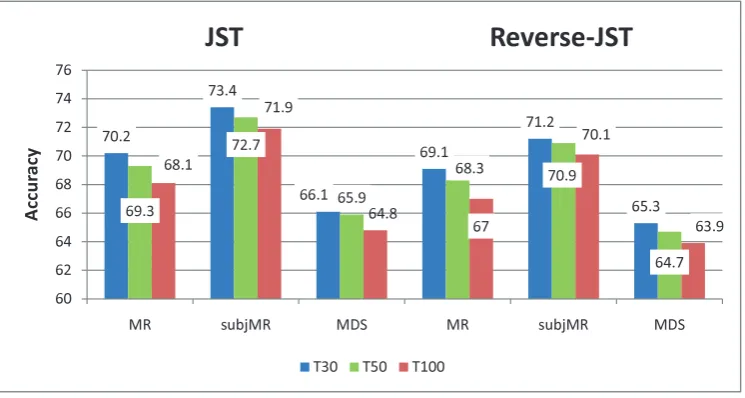
Figure 2: JST and Reverse-JST sentiment classification results with multiple topics.
5.2 JST and Reverse-JST Results with Multiple Topics
As both JST and Reverse-JST model document level sentiment and mixture of topic simulta-neously, it is worth to explore how the senti-ment classification and topic extraction tasks af-fect/benifit each other. With this in mind, we conducted a set of experiments on both JST and Reverse-JST, with topic number varying from 30, 50 to 100. The symmetry Dirichlet priorαand β were set to 50/T and 0.01 respectively for both models. The asymmetry sentiment prior γ was empirically set to (0.01, 1.8) for JST and (0.01, 0.012) for Reverse-JST, corresponding to positive and negative sentiment prior, respectively. Results were averaged over 5 runs with 2000 Gibbs sam-pling iterations.
As can be seen from Figure 2 that, for both mod-els, the sentiment classification accuracy based on the subjMR dataset still outperformed the results based on the original MR dataset, where an over-all improvement of 3% is observed for JST and about 2% for Reverse-JST. When comparing JST and JST, it can be observed that Reverse-JST performed slightly worse than Reverse-JST for all sets of experiments with about 1% to 2% drop in ac-curacy. By closely examining the posterior of JST and Reverse-JST (c.f. Equation 4 and 6), we no-ticed that the countNj,d (number of times topicj
associated with some word tokens in documentd) in the Reverse-JST posterior would be relatively small due to the factor of large topic number
set-ting. On the contrary, the countNk,d(number of
times sentiment labelkassigned to some word to-kens in documentd) in the JST posterior would be relatively large askis only defined over 3 differ-ent sdiffer-entimdiffer-ent labels. This essdiffer-entially makes JST less sensitive to the data sparseness problem and the perturbation of hyperparameter setting. In ad-dition, JST encodes an assumption that there is ap-proximately a single sentiment for the entire docu-ment, i.e. the documents are usually either mostly positive or mostly negative. This assumption is important as it allows the model to cluster different terms which share similar sentiment. In Reverse-JST, this assumption is not enforced unless only one topic for each sentiment is defined. Therefore, JST appears to be a more appropriate model de-sign for joint sentiment topic detection.
Table 3: Topic examples extracted by JST under different sentiment labels.
Book DVD Electronic Kitchen
pos. neg. pos. neg. pos. neg. pos. neg.
recip war action murder mous drive color fan
food militari good killer hand fail beauti room
cook armi fight crime logitech data plate cool
cookbook soldier right cop comfort complet durabl air
beauti govern scene crime scroll manufactur qualiti loud
simpl thing chase case wheel failur fiestawar nois
eat evid hit prison smooth lose blue live
famili led art detect feel backup finger annoi
ic iraq martial investig accur poorli white blow
kitchen polici stunt mysteri track error dinnerwar vornado varieti destruct chan commit touch storag bright bedroom good critic brilliant thriller click gb purpl inferior pictur inspect hero attornei conveni flash scarlet window
tast invas style suspect month disast dark vibrat
cream court chines shock mice recogn eleg power
5.3 Topic Extraction
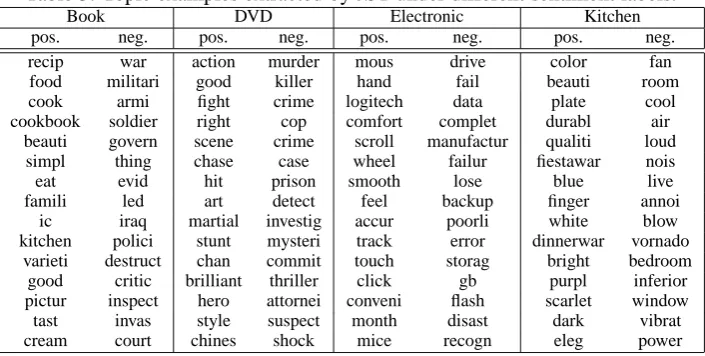
We also evaluated the effectiveness of topic sen-timent captured. In contrast to LDA in which a word is drawn from the topic-word distribution, in JST or Reverse-JST, a word is drawn from the distribution over words conditioned on both topic and sentiment label. As an illustration, Table 3 shows eight topic examples extracted from the MDS dataset by JST, where each topic was drawn from a particular product domain under positive or negative sentiment label.
As can be seen from Table 3, the eight extracted topics are quite informative and coherent, and each of the topics represents a certain product review from the corresponding domain. For example, the positive book topic probably discusses a good cookbook; the positive DVD topic is apparently about a popular action movie by Jackie Chan; the negative electronic topic is likely to be complains regarding data lose due to the flash drive failure, and the negative kitchen topic is probably the dis-satisfaction of the high noise level of the Vornado brand fan. In terms of topic sentiment, by examin-ing through the topics in the table, it is evident that topics under the positive and negative sentiment label indeed bear positive and negative sentiment respectively. The above analysis reveals the effec-tiveness of JST in extracting topics and capturing topic sentiment from text.
6 Conclusions and Future Work
In this paper, we studied three closed related Bayesian models for unsupervised sentiment de-tection, namely LSM, JST and Reverse-JST. As opposing to most of the existing approaches to
sentiment classification which favour in super-vised learning, these three models detect senti-ment in a fully unsupervised manner. While all the three models gives either better or comparable per-formance compared to the existing approaches on unsupervised sentiment classification on the MR and MDS datasets, JST and Reverse-JST can also model a mixture of topics and the sentiment as-sociated with each topic. Moreover, extensive ex-periments conducted on the datasets from differ-ent domains reveal that JST always outperformed Reverse-JST, suggesting JST being a more appro-priate model design for joint sentiment topic de-tection.
There are several directions we plan to inves-tigate in the future. One is incremental learn-ing of the JST parameters when faclearn-ing with new data. Another one is semi-supervised learning of the JST model with some supervised informa-tion being incorporating into the model parameter estimation procedure such as some known topic knowledge for certain product reviews or the doc-ument labels derived automatically from the user-supplied review ratings.
References
Ahmed Abbasi, Hsinchun Chen, and Arab Salem. 2008. Sentiment analysis in multiple languages: Feature selection for opinion classification in web forums. ACM Trans. Inf. Syst., 26(3):1–34.
Alina Andreevskaia and Sabine Bergler. 2008. When specialists and generalists work together: Overcom-ing domain dependence in sentiment taggOvercom-ing. In
Proceedings of (ACL-HLT), pages 290–298.
classifiers to new domains: a case study. In
Pro-ceedings of Recent Advances in Natural Language Processing (RANLP).
John Blitzer, Mark Dredze, and Fernando Pereira. 2007. Biographies, bollywood, boom-boxes and blenders: Domain adaptation for sentiment classi-fication. In Proceedings of the Association for
Com-putational Linguistics (ACL), pages 440–447.
S. Dasgupta and V. Ng. 2009. Topic-wise, Sentiment-wise, or Otherwise? Identifying the Hidden Dimen-sion for Unsupervised Text Classification. In
Pro-ceedings of the 2009 Conference on Empirical Meth-ods in Natural Language Processing, pages 580–
589.
Thomas Hofmann. 1999. Probabilistic latent semantic indexing. In Proceedings of the ACM Special
Inter-est Group on Information Retrieval (SIGIR), pages
50–57.
Nobuhiro Kaji and Masaru Kitsuregawa. 2006. Au-tomatic construction of polarity-tagged corpus from html documents. In Proceedings of the
COL-ING/ACL on Main conference poster sessions, pages
452–459.
A. Kennedy and D. Inkpen. 2006. Sentiment classi-fication of movie reviews using contextual valence shifters. Computational Intelligence, 22(2):110–
125.
Shoushan Li and Chengqing Zong. 2008. Multi-domain sentiment classification. In Proceedings of
the Association for Computational Linguistics and the Human Language Technology Conference (ACL-HLT), Short Papers, pages 257–260.
Tao Li, Yi Zhang, and Vikas Sindhwani. 2009. A non-negative matrix tri-factorization approach to senti-ment classification with lexical prior knowledge. In
Proceedings of (ACL-IJCNLP), pages 244–252.
Chenghua Lin and Yulan He. 2009. Joint senti-ment/topic model for sentiment analysis. In
Pro-ceedings of the ACM international conference on In-formation and knowledge management (CIKM).
Ryan McDonald, Kerry Hannan, Tyler Neylon, Mike Wells, and Jeff Reynar. 2007. Structured models for fine-to-coarse sentiment analysis. In Proceedings of
the Annual Meeting of the Association of Computa-tional Linguistics (ACL), pages 432–439.
Qiaozhu Mei, Xu Ling, Matthew Wondra, Hang Su, and ChengXiang Zhai. 2007. Topic sentiment mix-ture: modeling facets and opinions in weblogs. In
Proceedings of the conference on World Wide Web (WWW), pages 171–180.
Bo Pang and Lillian Lee. 2004. A sentimental ed-ucation: sentiment analysis using subjectivity sum-marization based on minimum cuts. In Proceedings
of the Annual Meeting on Association for Computa-tional Linguistics (ACL), page 271.
Bo Pang and Lillian Lee. 2008. Opinion mining and sentiment analysis. Found. Trends Inf. Retr., 2(1-2):1–135.
Bo Pang, Lillian Lee, and Shivakumar Vaithyanathan. 2002. Thumbs up?: sentiment classification using machine learning techniques. In Proceedings of the
Conference on Empirical Methods in Natural Lan-guage Processing (EMNLP), pages 79–86.
Ivan Titov and Ryan McDonald. 2008a. A joint model of text and aspect ratings for sentiment summariza-tion. In Proceedings of the Aunal Meeting on
Asso-ciation for Computational Linguistics and the Hu-man Language Technology Conference (ACL-HLT),
pages 308–316.
Ivan Titov and Ryan McDonald. 2008b. Modeling on-line reviews with multi-grain topic models. In
Pro-ceeding of the International Conference on World Wide Web (WWW 08’), pages 111–120.
Casey Whitelaw, Navendu Garg, and Shlomo Arga-mon. 2005. Using appraisal groups for sentiment analysis. In Proceedings of the ACM international