Exploiting CCG Structures with Tree Kernels for Speculation Detection
Liliana Mamani S´anchez, Baoli Li, Carl Vogel
Computational Linguistics Group Trinity College Dublin
Dublin 2, Ireland
{mamanisl,baoli.li,vogel}@tcd.ie
Abstract
Our CoNLL-2010 speculative sentence detector disambiguates putative keywords based on the following considerations: a speculative keyword may be composed of one or more word tokens; a speculative sentence may have one or more specula-tive keywords; and if a sentence contains at least one real speculative keyword, it is deemed speculative. A tree kernel classi-fier is used to assess whether a potential speculative keyword conveys speculation. We exploit information implicit in tree structures. For prediction efficiency, only a segment of the whole tree around a spec-ulation keyword is considered, along with morphological features inside the segment and information about the containing doc-ument. A maximum entropy classifier is used for sentences not covered by the tree kernel classifier. Experiments on the Wikipedia data set show that our system achieves 0.55 F-measure (in-domain).
1 Introduction
Speculation and its impact on argumentation has been studied by linguists and logicians since at least as far back as Aristotle (trans 1991, 1407a, 1407b), and under the category of linguistic “hedges” since Lakoff (1973). Practical appli-cation of this research has emerged due to the efforts to create a biomedical database of sen-tences tagged with speculation information: Bio-Scope (Szarvas et al., 2008) and because of the association of some kinds of Wikipedia data with the speculation phenomenon (Ganter and Strube, 2009). It is clear that specific words can be con-sidered as clues that can qualify a sentence as speculative. However, the presence of a specu-lative keyword not always conveys a speculation
assertion which makes the speculation detection a tough problem. For instance, the sentences below contain the speculative keyword “may”, but only the sentence (a) is speculative.
(a)These effectsmaybe reversible.
(b)Members of an alliancemaynot attack each other. The CoNLL-2010 Shared Task (Farkas et al., 2010), “Learning to detect hedges and their scope in natural language text” proposed two tasks re-lated to speculation research. Task 1 aims to detect sentences containing uncertainty and Task 2 aims to resolve the intra-sentential scope of hedge cues. We engaged in the first task in the biomedical and Wikipedia domains as proposed by the organizers, but eventually we got to submit only Wikipedia domain results. However, in this paper we include results in the biomedical domain as well.
The BioScope corpus is a linguistically hand an-notated corpus of negation and speculation phe-nomena for medical free texts, biomedical article abstracts and full biomedical articles. The afore-said phenomena have been annotated at sentence level with keyword tags and linguistic scope tags. Some previous research on speculation detection and boundary determination over biomedical data has been done by Medlock & Briscoe (2007) and ¨Ozg¨ur & Radev (2009) from a computational view using machine learning methods.
The Wikipedia speculation dataset was gener-ated by exploiting a weasel word marking. As weasel words convey vagueness and ambiguity by providing an unsupported opinion, they are dis-couraged by Wikipedia editors. Ganter & Strube (2009) proposed a system to detect hedges based on frequency measures and shallow information, achieving a F-score of 0.691.
We formulate the speculation detection prob-lem as a word disambiguation probprob-lem and de-veloped a system as a pipelined set of natural
1They used different Wikipedia data.
language processing tools and procedures to pre-process the datasets. A Combinatory Categorial Grammar parsing (CCG) (Steedman, 2000) tool and a Tree Kernel (TK) classifier constitute the core of the system.
The Section 2 of this paper describes the over-all architecture of our system. Section 3 depicts the dataset pre-processing. Section 4 shows how we built the speculation detection module, outlines the procedure of examples generation and the use of the Tree-kernel classifier. Section 5 presents the experiments and results, we show that sentence CCG derivation information helps to differentiate between apparent and real speculative words for speculation detection. Finally Section 6 gives our conclusions.
2 Speculation detection system
Our system for speculation detection is a machine learning (ML) based system (Figure 1). In the pre-processing module a dataset of speculative/non-speculative sentences goes through a process of information extraction of three kinds: specula-tive word or keyword extraction,2sentence
extrac-tion and document feature extracextrac-tion (i.e docu-ment section). Later the extracted keywords are used to tag potential speculative sentences in the training/evaluation datasets and used as features by the classifiers. The sentences are submitted to the tokenization and parsing modules in order to provide a richer set of features necessary for creat-ing the traincreat-ing/evaluation datasets, includcreat-ing the document features as well.
In the ML module two types of dataset are built: one used by a TK classifier and other one by a bag-of-features based maximum entropy classifier. As the first one processes only those sentences that contain speculative words, we use the second clas-sifier, which is able to process samples of all the sentences.
The models built by these classifiers are com-bined in order to provide a better performance and coverage for the speculation problem in the clas-sification module which finally outputs sentences labeled as speculative or non-speculative. Used tools are the GeniaTagger (Tsuruoka et al., 2005) for tokenization and lemmatization, and the C&C Parser (Clark and Curran, 2004). The next sec-tions explain in detail the main system compo-nents.
2Extraction of keywords for the training stage.
3 Dataset pre-processing for rich feature extraction
The pre-processing module extracts keywords, sentences and document information.
All sentences are processed by the tok-enizer/lemmatizer and at the same time specific in-formation about the keywords is extracted.
Speculative keywords
Speculative sentences are evidenced by the pres-ence of speculation keywords. We have the fol-lowing observations:
• A hedge cue or speculative keyword3may be
composed of one or more word tokens. • In terms of major linguistic categories, the
word tokens are heterogeneous: they may be verbs, adjectives, nouns, determiners, etc. A stop-word removing strategy was dismissed, since no linguistic category can be elimi-nated.
• A keyword may be covered by another longer one. For instance, the keywordmost can be seen in keywords likemost of all the heroes
orthe most common.
Considering these characteristics for each sen-tence, in the training stage, the keyword extraction module retrieves the speculative/non-speculative property of each sentence, the keyword occur-rences, number of keywords in a sentence, the ini-tial word token position and the number of word tokens in the keyword. We build a keyword lex-icon with all the extracted keywords and their frequency in the training dataset, this speculative keyword lexicon is used to tag keyword occur-rences in non-speculative training sentences and in all the evaluation dataset sentences.
The overlapping problem when tagging key-words is solved by maximal matching strategy. It is curious that speculation phrases come in de-grees of specificity; the approach adopted here favors “specific” multi-word phrases over single-word expressions.
Sentence processing
Often, speculation keywords convey certain in-formation that can not be successfully expressed by morphology or syntactic relations provided by phrase structure grammar parsers. On the other
Figure 1: Block diagram for the speculation detection system.
hand, CCG derivations or dependencies provide deeper information, in form of predicate-argument relations. Previous works on semantic role label-ing (Gildea and Hockenmaier, 2003; Boxwell et al., 2009) have used features derived from CCG parsings and obtained better results.
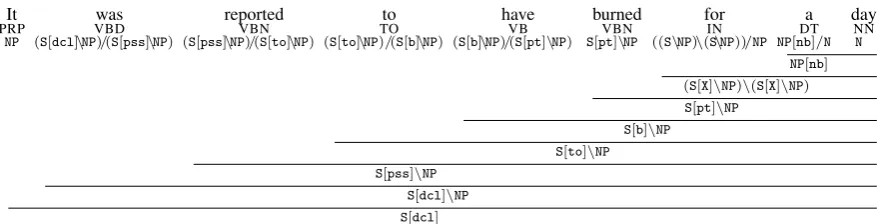
C&C parser provides CCG predicate-argument dependencies and Briscoe and Carroll (2006) style grammatical relations. We parsed the tokenized sentences to obtain CCG derivations which are binary trees as shown in the Figure 2. The CCG derivation trees contain function category and part-of-speech labels; this information is con-tained in the tree structures to be used in building a subtree dataset for the TK classifier.
4 Speculative sentence classifier 4.1 Tree Kernel classification
The subtree dataset is processed by a Tree Kernel classifier (Moschitti, 2006) based on Support Vec-tor Machines. TK uses a kernel function between two trees, allowing a comparison between their substructures, which can be subtrees (ST) or sub-set trees (SST). We chose the comparison between subset trees since it expands the kernel calculation to those substructures with constituents that are not in the leaves. Our intuition is that real specula-tive sentences have deep semantic structures that are particularly different from those ones in ap-parent speculative sentences, and consequently the comparison between the structures of well identi-fied and potential speculative sentences may en-hance the identification of real speculative key-words.
4.2 Extracting tree structures
The depth of a CCG derivation tree is propor-tional to the number of word tokens in the sen-tence. Therefore, the processing of a whole deriva-tion tree by the classifier is highly demanding and many subtrees are not relevant for the classifica-tion of speculative/non-speculative sentences, in particular when the scope of the speculation is a small proportion of a sentence.
In order to tackle this problem, a fragment of the CCG derivation tree is extracted. This frag-ment or subtree spans the keyword together with neighbors terms in a fixed-size window ofnword
tokens, (i.e. nword tokens to the left andnword
tokens to the right of the keyword) and has as root the lower upper bound node of the first and last tokens of this span. After applying the subtree ex-traction, the subtree can contain more word tokens in addition to those contained in then-span, which
are replaced by a common symbol.
Potential speculative sentences are turned into training examples. However, as described in Sec-tion 3, a speculative sentence can contain one or more speculative keywords. This can produce an overlapping between their respective n-spans of
individual keywords during the subtree extraction, producing subtrees with identical roots for both keywords. For instance, in the following sen-tence(c), the spans for the keywordssuggestsand
thoughtwill overlap ifn= 3.
(c)Thissuggeststhat diverse agentsthoughtto ac-tivate NF-kappa B ...
It was reported to have burned for a day
PRP VBD VBN TO VB VBN IN DT NN
NP (S[dcl]\NP)/(S[pss]\NP) (S[pss]\NP)/(S[to]\NP) (S[to]\NP)/(S[b]\NP) (S[b]\NP)/(S[pt]\NP) S[pt]\NP ((S\NP)\(S\NP))/NP NP[nb]/N N NP[nb] (S[X]\NP)\(S[X]\NP)
S[pt]\NP S[b]\NP
S[to]\NP S[pss]\NP
[image:4.595.83.522.59.171.2]S[dcl]\NP S[dcl]
Figure 2: CCG derivations tree forIt was reported to have burned for a day.
shared by terms belonging to the two different spans. We deal with this issue by extracting one training example if two spans have a common root and two different examples otherwise.
4.3 Bag of features model
By default, our system classifies the sentences not covered by the TK model using a baseline clas-sifier that labels a sentence as speculative if this has at least one keyword. Alternatively, a bag of features classifier is used to complement the tree kernel, aimed to provide a more precise method that might detect even speculative sentences with new keywords in the evaluation dataset. The set of features used to build this model includes:
a) Word unigrams; b) Lemma unigrams; c) Word+POS unigrams; d) Lemma+POS unigrams; e) Word+Supertag unigrams; f) Lemma+Supertag unigrams; g) POS+Supertag unigrams; h) Lemma bigrams;
i) POS bigrams; j) Supertag bigrams; k) Lemma+POS bigrams;
l) Lemma+Supertag bigrams; m) POS+Supertag bigrams;
n) Lemma trigrams; o) POS trigrams; p) Supertag trigrams; q) Lemma+POS trigrams;
r) Lemma+Supertag trigrams; s) POS+Supertag trigrams;
t) Number of tokens;
u) Type of section in the document (Title, Text, Section);
v) Name of section in the document;
w) Position of the sentence in a section starting from beginning;
Dataset Dev. Train. Eval. Biomedical 39 14541 5003 Wikipedia 124 11111 9634
Table 1: Datasets sizes.
x) Position of the sentence in a section starting from end.
Position of the sentence information, composed by the last four features, represents the information about the sentence relative to a whole document. The bag of features model is generated using a Maximum Entropy algorithm (Zhang, 2004).
5 Experiments and results 5.1 Datasets
In the CoNLL-2010 Task 1, biomedical and Wikipedia datasets were provided for develop-ment, training and evaluation in the BioScope XML format. Development and training datasets are tagged with cue labels and a certainty feature.4
The number of sentences for each dataset5 is
de-tailed in Table 1.
After manual revision of sentences not parsed by C&C parser, we found that they contain equa-tions, numbering elements (e.g. (i), (ii).. 1), 2) ), or long n-grams of named-entities, for in-stance: ...mannose-capped lipoarabinomannan ( ManLAM ) of Mycobacterium tuberculosis ( M. tuberculosis )... that out of a biomedical domain appear to be ungrammatical. Similarly, in the Wikipedia datasets, some sentences have many named entities. This suggests the need of a spe-cific pre-processor or a parser for this kind of sen-tences like a named entity tagger.
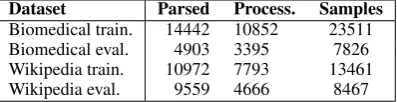
In Table 2, we present the number of parsed sen-tences, processed sentences by the TK model and examples obtained in the tree structure extraction.
4certainty=“uncertain” and certainty=“certain”.
5The biomedical abstracts and biomedical articles training
Dataset Parsed Process. Samples Biomedical train. 14442 10852 23511 Biomedical eval. 4903 3395 7826 Wikipedia train. 10972 7793 13461 Wikipedia eval. 9559 4666 8467
Table 2: Count of processed sentences.
5.2 Experimental results
The CoNLL-2010 organizers proposed in-domain and cross-domain evaluations. In cross-domain experiments, test datasets of one domain can be used with classifiers trained on the other or on the union of both domains. We report here our results for the Wikipedia and biomedical datasets.
So far, we mentioned two settings for our clas-sifier: a TK classifier complemented by a baseline classifier (BL) and TK classifier complemented by a bag of features classifier (TK+BF). Table 3 shows the scores of our submitted system (in-domain Task 1) on the Wikipedia dataset, whereas Table 4 gives the scores of the baseline system.
TP FP FN Precision Recall F Our system 1033 480 1201 0.6828 0.4624 0.5514 Max. 1154 448 1080 0.7204 0.5166 0.6017 Min. 147 9 2087 0.9423 0.0658 0.123
Table 3: Comparative scores for our system with CoNLL official maximum and minimum scores in Task 1, Wikipedia dataset in-domain.
TP FP FN Precision Recall F Biomedical 786 2690 4 0.2261 0.9949 0.3685 Wikipedia 1980 2747 254 0.4189 0.8863 0.5689
Table 4: Baseline results.
Additionally, we consider a bag of features clas-sifier (BF) and a clasclas-sifier that combines the base-line applied to the sentences that have at least one keyword plus the BF classifier for the remaining sentences (BL+BF). In Tables 5 to 10, results for the four classifiers (TK, TK+BF, BF, BL+BF) with evaluations in-domain and cross-domain are pre-sented6.
The baseline scores confirm that relying on just the keywords is not enough to identify speculative sentences. In the biomedical domain, the classi-fiers give high recall but too low precision result-ing in low F-scores. Still, the TK, TK+BF and BF (in-domain configurations) gives much better re-sults than BL and BL+BF which indicates that the information from CCG improves the performance
6It is worth to note that the keyword lexicons have been
not used in cross-domain way, so the TK and TK+BF models have not been tested in regards to keywords.
[image:5.595.306.524.63.112.2]TP FP FN Precision Recall F BL 1980 2747 254 0.4189 0.8863 0.5689 TK 1033 480 1201 0.6828 0.4624 0.5514 TK+BF 1059 516 1175 0.6729 0.4740 0.5560 BF 772 264 1462 0.7452 0.3456 0.4722 BL+BF 2028 2810 206 0.4192 0.9078 0.5735
Table 5: Results for Wikipedia dataset in-domain.
TP FP FN Precision Recall F BL 1980 2747 254 0.4189 0.8863 0.5689 TK 1776 2192 458 0.4476 0.7950 0.5727
[image:5.595.309.522.140.190.2]TK+BF 1763 2194 471 0.4455 0.7892 0.5695 BF 403 323 1831 0.5551 0.1804 0.2723 BL+BF 1988 2772 246 0.4176 0.8899 0.5685
Table 6: Wikipedia data classified with biomedical model scores (cross-domain).
TP FP FN Precision Recall F BL 1980 2747 254 0.4189 0.8863 0.5689 TK 1081 624 1153 0.6340 0.4839 0.5489 TK+BF 1099 636 1135 0.6334 0.4919 0.5538 BF 770 271 1464 0.7397 0.3447 0.4702 BL+BF 2017 2786 217 0.4199 0.9029 0.5733
Table 7: Wikipedia data classified with biomedical + Wikipedia model scores (cross-domain).
TP FP FN Precision Recall F BL 786 2690 4 0.2261 0.9949 0.3685 TK 759 777 31 0.4941 0.9606 0.6526 TK+BF 751 724 39 0.5092 0.9506 0.6631 BF 542 101 248 0.8429 0.6861 0.7565
[image:5.595.308.525.321.537.2]BL+BF 786 2695 4 0.2258 0.9949 0.3681
Table 8: Biomedical data scores (in-domain).
TP FP FN Precision Recall F BL 786 2690 4 0.2261 0.9949 0.3685 TK 786 2690 4 0.2261 0.9949 0.3685
TK+BF 771 2667 19 0.2243 0.9759 0.3647 BF 174 199 616 0.4665 0.2206 0.2992 BL+BF 787 2723 3 0.2242 0.9962 0.3660
Table 9: Biomedical data classified with Wikipedia model scores (cross-domain).
TP FP FN Precision Recall F BL 786 2690 4 0.2261 0.9949 0.3685 TK 697 357 93 0.6613 0.8823 0.7560 TK+BF 685 305 105 0.6919 0.8671 0.7697
BF 494 136 296 0.7841 0.6253 0.6958 BL+BF 786 2696 4 0.2257 0.9949 0.3679
Table 10: Biomedical data classified with biomed-ical + Wikipedia model scores (cross-domain).
of the classifiers when compared to the baseline classifier.
the complex processing made by tree kernels is more useful when disambiguating speculative key-words than BF. Nonetheless, the bag-of-features approach is also of importance for the task at hand when combined with TK. We observe that the TK classifer and BF classifier perform well making us believe that the CCG derivations provide relevant information for speculation detection. The use of tree kernels needs further investigations in order to evaluate the suitability of this approach.
6 Concluding remarks
Speculation detection is found to be a tough task given the high ambiguity of speculative keywords. We think these results can be improved by study-ing the influences of context on speculation asser-tions.
This paper presents a new approach for disam-biguating apparent speculative keywords by us-ing CCG information in the form of supertags and CCG derivations. We introduce the use of the tree kernel approach for CCG derivations trees. The inclusion of other features like grammatical rela-tions provided by the parser needs to be studied before incorporating this information into the cur-rent classifier and possibly to resolve the boundary speculation detection problem.
Acknowledgments
This research is supported by the Trinity College Research Scholarship Program and the Science Foundation Ireland (Grant 07/CE/I1142) as part of the Centre for Next Generation Localisation (www.cngl.ie) at Trinity College of Dublin.
References
Aristotle. trans. 1991. The Art of Rhetoric. Penguin Classics, London. Translated with an Introduction and Notes by H.C. Lawson-Tancred.
Stephen Boxwell, Dennis Mehay, and Chris Brew. 2009. Brutus: A semantic role labeling system in-corporating CCG, CFG, and dependency features. In Proceedings of the Joint Conference of the 47th Annual Meeting of the ACL and the 4th International Joint Conference on Natural Language Processing of the AFNLP, pages 37–45, Suntec, Singapore.
Ted Briscoe and John Carroll. 2006. Evaluating the accuracy of an unlexicalized statistical parser on the PARC DepBank. In Proceedings of the COL-ING/ACL on Main conference poster sessions, pages 41–48, Morristown, NJ, USA.
Stephen Clark and James R. Curran. 2004. Parsing the WSJ using CCG and log-linear models. InACL ’04: Proceedings of the 42nd Annual Meeting on As-sociation for Computational Linguistics, page 103, Morristown, NJ, USA.
Rich´ard Farkas, Veronika Vincze, Gy¨orgy M´ora, J´anos Csirik, and Gy¨orgy Szarvas. 2010. The CoNLL-2010 Shared Task: Learning to Detect Hedges and their Scope in Natural Language Text. In Proceed-ings of the Fourteenth Conference on Computational Natural Language Learning (CoNLL-2010): Shared Task, pages 1–12, Uppsala, Sweden, July. Associa-tion for ComputaAssocia-tional Linguistics.
Viola Ganter and Michael Strube. 2009. Finding hedges by chasing weasels: Hedge detection using Wikipedia tags and shallow linguistic features. In
Proceedings of the ACL-IJCNLP 2009 Conference Short Papers, pages 173–176, Suntec, Singapore. Daniel Gildea and Julia Hockenmaier. 2003.
Identi-fying semantic roles using combinatory categorial grammar. In Proceedings of 2003 Conference on Empirical Methods in Natural Language Processing (EMNLP), Sapporo, Japan.
George Lakoff. 1973. Hedges: A study in meaning criteria and the logic of fuzzy concepts. Journal of Philosophical Logic, 2(4):458–508.
Ben Medlock and Ted Briscoe. 2007. Weakly super-vised learning for hedge classification in scientific literature. InProceedings of the 45th Annual Meet-ing of the Association of Computational LMeet-inguistics, pages 992–999, Prague, Czech Republic.
Alessandro Moschitti. 2006. Making tree kernels prac-tical for natural language learning. InProceedings of the 11th Conference of the European Chapter of the Association for Computational Linguistics. Arzucan ¨Ozg¨ur and Dragomir R. Radev. 2009.
Detect-ing speculations and their scopes in scientific text. In Proceedings of the 2009 Conference on Empiri-cal Methods in Natural Language Processing, pages 1398–1407, Singapore.
Mark Steedman. 2000. The syntactic process. MIT Press, Cambridge, MA, USA.
Gy¨orgy Szarvas, Veronika Vincze, Rich´ard Farkas, and J´anos Csirik. 2008. The BioScope corpus: anno-tation for negation, uncertainty and their scope in biomedical texts. In Proceedings of the Workshop on Current Trends in Biomedical Natural Language Processing, pages 38–45, Columbus, Ohio.
Yoshimasa Tsuruoka, Yuka Tateishi, Jin-Dong Kim, Tomoko Ohta, John McNaught, Sophia Ananiadou, and Jun’ichi Tsujii. 2005. Developing a robust part-of-speech tagger for biomedical text. InAdvances in Informatics, pages 382–392.