Context-Dependent Sense Embedding
∗Lin Qiu† and Kewei Tu‡ and Yong Yu†
†Shanghai Jiao Tong University, Shanghai, China,{lqiu,yyu}@apex.sjtu.edu.cn ‡ShanghaiTech University, Shanghai, China, [email protected]
Abstract
Word embedding has been widely studied and proven helpful in solving many natural lan-guage processing tasks. However, the ambi-guity of natural language is always a prob-lem on learning high quality word dings. A possible solution is sense embed-ding which trains embedembed-ding for each sense of words instead of each word. Some re-cent work on sense embedding uses context clustering methods to determine the senses of words, which is heuristic in nature. Other work creates a probabilistic model and per-forms word sense disambiguation and sense embedding iteratively. However, most of the previous work has the problems of learning sense embeddings based on imperfect word embeddings as well as ignoring the depen-dency between sense choices of neighboring words. In this paper, we propose a novel probabilistic model for sense embedding that is not based on problematic word embedding of polysemous words and takes into account the dependency between sense choices. Based on our model, we derive a dynamic program-ming inference algorithm and an Expectation-Maximization style unsupervised learning al-gorithm. The empirical studies show that our model outperforms the state-of-the-art model on a word sense induction task by a 13% rela-tive gain.
1 Introduction
Distributed representation of words (aka word em-bedding) aims to learn continuous-valued vectors to ∗The second author was supported by the National Natural
Science Foundation of China (61503248).
represent words based on their context in a large cor-pus. They can serve as input features for algorithms of natural language processing (NLP) tasks. High quality word embeddings have been proven helpful in many NLP tasks (Collobert and Weston, 2008; Turian et al., 2010; Collobert et al., 2011; Maas et al., 2011; Chen and Manning, 2014). Recently, with the development of deep learning, many novel neural network architectures are proposed for train-ing high quality word embeddtrain-ings (Mikolov et al., 2013a; Mikolov et al., 2013b).
However, since natural language is intrinsically ambiguous, learning one vector for each word may not cover all the senses of the word. In the case of a multi-sense word, the learned vector will be around the average of all the senses of the word in the em-bedding space, and therefore may not be a good rep-resentation of any of the senses. A possible solution is sense embedding which trains a vector for each sense of a word. There are two key steps in training sense embeddings. First, we need to perform word sense disambiguation (WSD) or word sense induc-tion (WSI) to determine the senses of words in the training corpus. Then, we need to train embedding vectors for word senses according to their contexts.
Early work on sense embedding (Reisinger and Mooney, 2010; Huang et al., 2012; Chen et al., 2014; Neelakantan et al., 2014; Kageback et al., 2015; Li and Jurafsky, 2015) proposes context clus-tering methods which determine the sense of a word by clustering aggregated embeddings of words in its context. This kind of methods is heuristic in nature and relies on external knowledge from lexicon like WordNet (Miller, 1995).
Recently, sense embedding methods based on complete probabilistic models and well-defined learning objective functions (Tian et al., 2014; Bar-tunov et al., 2016; Jauhar et al., 2015) become more popular. These methods regard the choice of senses of the words in a sentence as hidden vari-ables. Learning is therefore done with expectation-maximization style algorithms, which alternate be-tween inferring word sense choices in the training corpus and learning sense embeddings.
A common problem with these methods is that they model the sense embedding of each center word dependent on the word embeddings of its context words. As we previously explained, word embed-ding of a polysemous word is not a good repre-sentation and may negatively influence the qual-ity of inference and learning. Furthermore, these methods choose the sense of each word in a sen-tence independently, ignoring the dependency that may exist between the sense choices of neighbor-ing words. We argue that such dependency is im-portant in word sense disambiguation and therefore helpful in learning sense embeddings. For exam-ple, consider the sentence “He cashed a check at the bank”. Both “check” and “bank” are ambiguous here. Although the two words hint at banking related senses, the hint is not decisive (as an alternative in-terpretation, they may represent a check mark at a river bank). Fortunately, “cashed” is not ambiguous and it can help disambiguate “check”. However, if we consider a small context window in sense em-bedding, then “cashed” cannot directly help disam-biguate “bank”. We need to rely on the dependency between the sense choices of “check” and “bank” to disambiguate “bank”.
In this paper, we propose a novel probabilistic model for sense embedding that takes into account the dependency between sense choices of neighbor-ing words. We do not learn any word embeddneighbor-ings in our model and hence avoid the problem with em-bedding polysemous words discussed above. Our model has a similar structure to a high-order hidden Markov model. It contains a sequence of observable words and latent senses and models the dependency between each word-sense pair and between boring senses in the sequence. The energy of neigh-boring senses can be modeled using existing word embedding approaches such as CBOW and
Skip-gram (Mikolov et al., 2013a; Mikolov et al., 2013b). Given the model and a sentence, we can perform ex-act inference using dynamic programming and get the optimal sense sequence of the sentence. Our model can be learned from an unannotated corpus by optimizing a max-margin objective using an al-gorithm similar to hard-EM.
Our main contributions are the following:
1. We propose a complete probabilistic model for sense embedding. Unlike previous work, we model the dependency between sense choices of neighboring words and do not learn sense embeddings dependent on problematic word embeddings of polysemous words.
2. Based on our proposed model, we derive an exact inference algorithm and a max-margin learning algorithm which do not rely on ex-ternal knowledge from any knowledge base or lexicon (except that we determine the numbers of senses of polysemous words according to an existing sense inventory).
3. The performance of our model on contex-tual word similarity task is competitive with previous work and we obtain a 13% relative gain compared with previous state-of-the-art methods on the word sense induction task of SemEval-2013.
The rest of this paper is organized as follows. We introduce related work in section 2. Section 3 de-scribes our models and algorithms in detail. We present our experiments and results in section 4. In section 5, a conclusion is given.
2 Related Work
to replace the most computationally expensive max-likelihood objective function. Recently proposed Skip-gram model, CBOW model and GloVe model (Mikolov et al., 2013a; Mikolov et al., 2013b; Pen-nington et al., 2014) were more efficient than tradi-tional models by introducing a log-linear layer and making it possible to train word embeddings with a large scale corpus. With the development of neu-ral network and deep learning techniques, there have been a lot of work based on neural network mod-els to obtain word embedding (Turian et al., 2010; Collobert et al., 2011; Maas et al., 2011; Chen and Manning, 2014). All of them have proven that word embedding is helpful in NLP tasks.
However, the models above assumed that one word has only one vector as its representation which is problematic for polysemous words. Reisinger and Mooney (2010) proposed a method for con-structing multiple sense-specific representation vec-tors for one word by performing word sense dis-ambiguation with context clustering. Huang et al. (2012) further extended this context cluster-ing method and incorporated global context to learn multi-prototype representation vectors. Chen et al. (2014) extended the context clustering method and performed word sense disambiguation according to sense glosses from WordNet (Miller, 1995). Nee-lakantan et al. (2014) proposed an extension of the Skip-gram model combined with context clustering to estimate the number of senses for each word as well as learn sense embedding vectors. Instead of performing word sense disambiguation tasks, Kage-back et al. (2015) proposed the instance-context em-bedding method based on context clustering to per-form word sense induction tasks. Li and Jurafsky (2015) introduced a multi-sense embedding model based on the Chinese Restaurant Process and applied it to several natural language understanding tasks.
Since the context clustering based models are heuristic in nature and rely on external knowledge, recent work tends to create probabilistic models for learning sense embeddings. Tian et al. (2014) proposed a multi-prototype Skip-gram model and designed an Expectation-Maximization (EM) algo-rithm to do word sense disambiguation and learn sense embedding vectors iteratively. Jauhar et al. (2015) extended the EM training framework and retrofitted embedding vectors to the ontology of
WordNet. Bartunov et al. (2016) proposed a non-parametric Bayesian extension of Skip-gram to au-tomatically learn the required numbers of represen-tations for all words and perform word sense induc-tion tasks.
3 Context-Dependent Sense Embedding Model
We propose the context-dependent sense embedding model for training high quality sense embeddings which takes into account the dependency between sense choices of neighboring words. Unlike pervi-ous work, we do not learn any word embeddings in our model and hence avoid the problem with embed-ding polysemous words discussed previously. In this section, we will introduce our model and describe our inference and learning algorithms.
3.1 Model
We begin with the notation in our model. In a sen-tence, letwi be theithword of the sentence andsi be the sense of theithword.S(w)denotes the set of
all the senses of wordw. We assume that the sets of
senses of different words do not overlap. Therefore, in this paper a word sense can be seen as a lexeme of the word (Rothe and Schutze, 2015).
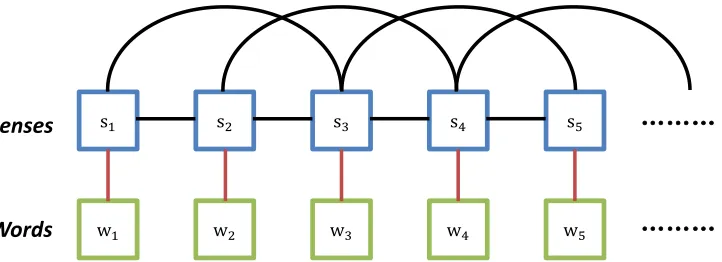
Our model can be represented as a Markov net-work shown in Figure 1. It is similar to a high-order hidden Markov model. The model contains a sequence of observable words (w1, w2, . . .) and
la-tent senses (s1, s2, . . .). It models the dependency
between each word-sense pair and between neigh-boring senses in the sequence. The energy function is formulated as follows:
E(w,s) =X
i
E1(wi, si) +E2(si−k, . . . , si+k)
(1)
Herew ={wi|1 ≤ i≤ l}is the set of words in a sentence with lengthlands ={si|1 ≤ i≤ l}is the set of senses. The function E1 models the
s1
w1
s2
w2
s3
w3
s4
w4
s5
w5
Senses
Words
………
[image:4.612.130.491.60.191.2]………
Figure 1:Context-Dependent Sense Embedding Model with window sizek= 1
E1(wi, si) =
(
0 si∈S(wi)
+∞ si∈/ S(wi)
(2)
Here we assume that all the matched word-sense pairs have the same energy, but it would also be interesting to model the degrees of matching with different energy values in E1. In Equation 1, the
functionE2models the compatibility of neighboring
senses in a context window with fixed size k.
Ex-isting embedding approaches like CBOW and Skip-gram (Mikolov et al., 2013a; Mikolov et al., 2013b) can be used here to defineE2. The formulation
us-ing CBOW is as follows:
E2(si−k, . . . , si+k) =
−σ
X
i−k≤j≤i+k,j6=i
VT(sj)V0(si)
(3)
HereV(s)andV0(s)are the input and output em-bedding vectors of sense s. The function σ is an
activation function and we use the sigmoid function here in our model. The formulation using Skip-gram can be defined in a similar way:
E2(si−k, . . . , si+k) =
− X
i−k≤j≤i+k,j6=i
σ
VT(sj)V0(si)
(4)
3.2 Inference
In this section, we introduce our inference algo-rithm. Given the model and a sentencew, we want
to infer the most likely values of the hidden variables (i.e. the optimal sense sequence of the sentence) that minimize the energy function in Equation 1:
s∗ = arg min
s E(w,s) (5)
We use dynamic programming to do inference which is similar to the Viterbi algorithm of the hidden Markov model. Specifically, for every valid assignment Ai−2k, . . . , Ai−1 of every
sub-sequence of senses si−2k, . . . , si−1, we define
m(Ai−2k, . . . , Ai−1)as the energy of the best sense
sequence up to position i − 1 that is consistent
with the assignmentAi−2k, . . . , Ai−1. We start with
m(A1, . . . , A2k) = 0and then recursively compute
min a left-to-right forward process based on the
up-date formula:
m(Ai−2k+1, . . . , Ai) = min Ai−2k
m(Ai−2k, . . . , Ai−1)
+E1(wi, Ai) +E2(Ai−2k, . . . , Ai)
(6)
Once we finish the forward process, we can retrieve the best sense sequence with a backward process. The time complexity of the algorithm is O(n4kl) wherenis the maximal number of senses of a word.
Because most words in a typical sentence have either a single sense or far less than n senses, the actual
running time of the algorithm is very fast. 3.3 Learning
input and output sense embedding vectors that opti-mize the following max-margin objective function:
Θ∗ = arg min
Θ X
w∈C
min
s
kwk X
i=1
X
sneg∈Sneg(wi)
max
1 +E1(wi, si) +E2(si−k, . . . , si+k)−
E2(si−k, . . . , si−1, sneg, si+1, . . . , si+k),0
(7)
Here Θ is the set of all the parameters
includ-ing V and V0 for all the senses. C is the set of
training sentences. Our learning objective is similar to the negative sampling and max-margin objective proposed for word embedding (Collobert and We-ston, 2008). Sneg(wi) denotes the set of negative samples of senses of wordwi which is defined with the following strategy. For a polysemous wordwi, Sneg(wi) =S(wi)\{si}. For the other words with a single sense,Sneg(wi)is a set of randomly selected senses of a fixed size.
The objective in Equation 7 can be optimized by coordinate descent which in our case is equivalent to the hard Expectation-Maximization algorithm. In the hard E step, we run the inference algorithm us-ing the current model parameters to get the optimal sense sequences of the training sentences. In the M step, with the sense sequencessof all the sentences fixed, we learn sense embedding vectors. Assume we use the CBOW model forE2 (Equation 3), then
the M-step objective function is as follows:
Θ∗= arg min
Θ X
w∈C
kwk X
i=1
X
sneg∈Sneg(wi)
max
1−σ( X
i−k≤j≤i+k,j6=i
V(sj)TV0(si))
+σ( X
i−k≤j≤i+k,j6=i
V(sj)TV0(sneg)),0
(8)
Here E1 is omitted because the sense sequences
produced from the E-step always have zero E1
value. Similarly, if we use the Skip-gram model for
E2(Equation 4), then the M-step objective function
is:
Θ∗ = arg min
Θ X
w∈C
kwk X
i=1
X
i−k≤j≤i+k,j6=i
X
sneg∈Sneg(wi)
max
1−σ(V(sj)TV0(si))
+σ(V(sj)TV0(sneg)),0
(9) We optimize the M-step objective function using stochastic gradient descent.
We use a mini batch version of the hard EM al-gorithm. For each sentence in the training corpus, we run E-step to infer its sense sequence and then immediately run M-step (for 1 iteration of stochas-tic gradient descent) to update the model parameters based on the senses in the sentence. Therefore, the batch size of our algorithm depends on the length of each sentence.
The advantage of using mini batch is twofold. First, while our learning objective is highly non-convex (Tian et al., 2014), the randomness in mini batch hard EM may help us avoid trapping into local optima. Second, the model parameters are updated more frequently in mini batch hard EM, resulting in faster convergence.
Note that before running hard-EM, we need to determine, for each word w, the size of S(w). In
our experiments, we used the sense inventory pro-vided by Coarse-Grained English All-Words Task of SemEval-2007 Task 07 (Navigli et al., 2007) to de-termine the number of senses for each word. The sense inventory is a coarse version of WordNet sense inventory. We do not use the WordNet sense in-ventory because the senses in WordNet are too fine-grained and are difficult to recognize even for human annotators (Edmonds and Kilgarriff, 2002). Since we do not link our learned senses with external sense inventories, our approach can be seen as performing WSI instead of WSD.
4 Experiments
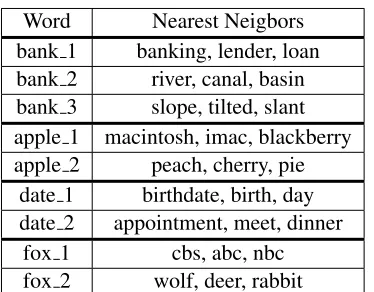
Word Nearest Neigbors bank 1 banking, lender, loan bank 2 river, canal, basin bank 3 slope, tilted, slant apple 1 macintosh, imac, blackberry apple 2 peach, cherry, pie
date 1 birthdate, birth, day date 2 appointment, meet, dinner
fox 1 cbs, abc, nbc
[image:6.612.94.281.61.207.2]fox 2 wolf, deer, rabbit
Table 1:The nearest neighbors of senses of polysemous words
Then, we perform a qualitative evaluation on our model by presenting the nearest neighbors of senses of some polysemous words. Finally, we introduce two different tasks and show the experimental re-sults on these tasks respectively.
4.1 Experimental Setup 4.1.1 Training Corpus
Our training corpus is the commonly used Wikipedia corpus. We dumped the October 2015 snapshot of the Wikipedia corpus which contains 3.6 million articles. In our experiments, we removed the infrequent words with less than 20 occurrences and the training corpus contains 1.3 billion tokens.
4.1.2 Configuration
In our experiments, we set the context window size to 5 (5 words before and after the center word). The embedding vector size is set to 300. The size of negative sample sets of single-sense words is set to 5. We trained our model using AdaGrad stochas-tic gradient decent (Duchi et al., 2010) with initial learning rate set to 0.025. Our configuration is simi-lar to that of previous work.
Similar to Word2vec, we initialized our model by randomizing the sense embedding vectors. The number of senses of all the words is determined with the sense inventory provided by Coarse-Grained En-glish All-Words Task of SemEval-2007 Task 07 (Navigli et al., 2007) as we explained in section 3.3.
4.2 Case Study
In this section, we give a qualitative evaluation of our model by presenting the nearest neighbors of the
senses of some polysemous words. Table 1 shows the results of our qualitative evaluation. We list sev-eral polysemous words in the table, and for each word, some typical senses of the word are picked. The nearest neighbors of each sense are listed aside. We used the cosine distance to calculate the distance between sense embedding vectors and find the near-est neighbors.
In Table 1, we can observe that our model pro-duces good senses for polysemous words. For exam-ple, the word “bank” can be seen to have three dif-ferent sense embedding vectors. The first one means the financial institution. The second one means the sloping land beside water. The third one means the action of tipping laterally.
4.3 Word Similarity in Context
This section gives a quantitative evaluation of our model on word similarity tasks. Word similar-ity tasks evaluate a model’s performance with the Spearman’s rank correlation between the similarity scores of pairs of words given by the model and the manual labels. However, traditional word similarity tasks like Wordsim-353 (Finkelstein et al., 2001) are not suitable for evaluating sense embedding models because these datasets do not include enough am-biguous words and there is no context information for the models to infer and disambiguate the senses of the words. To overcome this issue, Huang et al. (2012) released a new dataset named Stanford’s Contextual Word Similarities (SCWS) dataset. The dataset consists of 2003 pairs of words along with human labelled similarity scores and the sentences containing these words.
Model Similarity
Metrics ρ×100
Huang AvgSim 62.8
Huang AvgSimC 65.7
Chen AvgSim 66.2
Chen AvgSimC 68.9
Neelakantan AvgSim 67.2
Neelakantan AvgSimC 69.2
Li 69.7
Tian Model M 63.6
Tian Model W 65.4
Bartunov AvgSimC 61.2
Ours + CBOW HardSim 64.3
Ours + CBOW SoftSim 65.6
Ours + Skip-gram HardSim 64.9
[image:7.612.86.287.64.289.2]Ours + Skip-gram SoftSim 66.1
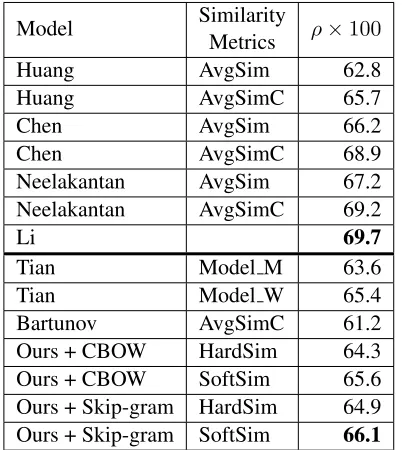
Table 2: Spearman’s rank correlation results on the SCWS dataset
second method is named SoftSim.
Table 2 shows the results of our context-dependent sense embedding models on the SCWS dataset. In this table,ρrefers to the Spearman’s rank correlation and a higher value ofρ indicates better
performance. The baseline performances are from Huang et al. (2012), Chen et al. (2014), Neelakan-tan et al. (2014), Li and Jurafsky (2015), Tian et al. (2014) and Bartunov et al. (2016). Here Ours + CBOW denotes our model with a CBOW based energy function and Ours + Skip-gram denotes our model with a Skip-gram based energy function. The results above the thick line are the models based on context clustering methods and the results below the thick line are the probabilistic models including ours. The similarity metrics of context clustering based models are AvgSim and AvgSimC proposed by Reisinger and Mooney (2010). Tian et al. (2014) propose two metrics Model M and Model W which are similar to our HardSim and SoftSim metrics.
From Table 2, we can observe that our model out-performs the other probabilistic models and is not as good as the best context clustering based model. The context clustering based models are overall bet-ter than the probabilistic models on this task. A possible reason is that most context clustering based methods make use of more external knowledge than
probabilistic models. However, note that Faruqui et al. (2016) presented several problems associated with the evaluation of word vectors on word simi-larity datasets and pointed out that the use of word similarity tasks for evaluation of word vectors is not sustainable. Bartunov et al. (2016) also suggest that SCWS should be of limited use for evaluating word representation models. Therefore, the results on this task shall be taken with caution. We consider that more realistic natural language processing tasks like word sense induction are better for evaluating sense embedding models.
4.4 Word Sense Induction
In this section, we present an evaluation of our model on the word sense induction (WSI) tasks. The WSI task aims to discover the different meanings for words used in sentences. Unlike a word sense disambiguation (WSD) system, a WSI system does not link the sense annotation results to an existing sense inventory. Instead, it produces its own sense inventory and links the sense annotation results to this sense inventory. Our model can be seen as a WSI system, so we can evaluate our model with WSI tasks.
We used the dataset from task 13 of SemEval-2013 as our evaluation set (Jurgens and Klapaftis, 2013). The dataset contains 4664 instances inflected from one of the 50 lemmas. Both single-sense instances and instances with a graded mixture of senses are included in the dataset. In this paper, we only consider the single sense instances. Jurgens and Klapaftis (2013) propose two fuzzy measures named Fuzzy B-Cubed (FBC) and Fuzzy Normalized Mu-tual Information (FNMI) for comparing fuzzy sense assignments from WSI systems. the FBC measure summarizes the performance per instance while the FNMI measure is based on sense clusters rather than instances.
Table 3 shows the results of our context-dependent sense embedding models on this dataset. Here HM is the harmonic mean of FBC and FNMI. The result of AI-KU is from Baskaya et al. (2013), MSSG is from Neelakantan et al. (2014), ICE-online and ICE-kmeans are from Kageback et al. (2015). Our models are denoted in the same way as in the previous section.
Model FBC(%) FNMI(%) HM
AI-KU 35.1 4.5 8.0
MSSG 45.9 3.7 6.8
ICE-online 48.7 5.5 9.9
ICE-kmeans 51.1 5.9 10.6
Ours + CBOW 53.8 6.3 11.3
[image:8.612.72.303.64.164.2]Ours + Skip-gram 56.9 6.7 12.0
Table 3: Results of single-sense instances on task 13 of SemEval-2013
outperform the previous state-of-the-art models and achieve a 13% relative gain. It shows that our mod-els can beat context clustering based modmod-els on re-alistic natural language processing tasks.
5 Conclusion
In this paper we propose a novel probabilistic model for learning sense embeddings. Unlike previous work, we do not learn sense embeddings dependent on word embeddings and hence avoid the problem with inaccurate embeddings of polysemous words. Furthermore, we model the dependency between sense choices of neighboring words which can help us disambiguate multiple ambiguous words in a sen-tence. Based on our model, we derive a dynamic programming inference algorithm and an EM-style unsupervised learning algorithm which do not rely on external knowledge from any knowledge base or lexicon except that we determine the number of senses of polysemous words according to an existing sense inventory. We evaluate our model both quali-tatively by case studying and quantiquali-tatively with the word similarity task and the word sense induction task. Our model is competitive with previous work on the word similarity task. On the word sense in-duction task, our model outperforms the state-of-the-art model and achieves a 13% relative gain.
For the future work, we plan to try learning our model with soft EM. Besides, we plan to use shared senses instead of lexemes in our model to improve the generality of our model. Also, we will study unsupervised methods to link the learned senses to existing inventories and to automatically determine the numbers of senses. Finally, we plan to evaluate our model with more NLP tasks.
References
Sergey Bartunov, Dmitry Kondrashkin, Anton Osokin, and Dmitry Vetrov. 2016. Breaking sticks and am-biguities with adaptive skip-gram.
Osman Baskaya, Enis Sert, Volkan Cirik, and Deniz Yuret. 2013. Ai-ku: Using substitute vectors and co-occurrence modeling for word sense induction and disambiguation. InSecond Joint Conference on Lexi-cal and Computational Semantics (*SEM), Volume 2: Seventh International Workshop on Semantic Evalua-tion (SemEval 2013), pages 300–306.
Yoshua Bengio, Holger Schwenk, Jean Sbastien Sencal, Frderic Morin, and Jean Luc Gauvain. 2003. A neu-ral probabilistic language model. Journal of Machine Learning Research, 3(6):1137–1155.
Danqi Chen and Christopher D Manning. 2014. A fast and accurate dependency parser using neural net-works. InEMNLP, pages 740–750.
Xinxiong Chen, Zhiyuan Liu, and Maosong Sun. 2014. A unified model for word sense representation and dis-ambiguation. InEMNLP, pages 1025–1035. Associa-tion for ComputaAssocia-tional Linguistics.
Ronan Collobert and Jason Weston. 2008. A unified ar-chitecture for natural language processing: Deep neu-ral networks with multitask learning. InProceedings of the 25th international conference on Machine learn-ing, pages 160–167. ACM.
Ronan Collobert, Jason Weston, L´eon Bottou, Michael Karlen, Koray Kavukcuoglu, and Pavel Kuksa. 2011. Natural language processing (almost) from scratch.
The Journal of Machine Learning Research, 12:2493– 2537.
John Duchi, Elad Hazan, and Yoram Singer. 2010. Adaptive subgradient methods for online learning and stochastic optimization. Journal of Machine Learning Research, 12(7):257–269.
Philip Edmonds and Adam Kilgarriff. 2002. Introduc-tion to the special issue on evaluating word sense dis-ambiguation systems. Natural Language Engineering, 8(4):279–291.
Manaal Faruqui, Yulia Tsvetkov, Pushpendre Rastogi, and Chris Dyer. 2016. Problems with evaluation of word embeddings using word similarity tasks. arXiv preprint arXiv:1605.02276.
Lev Finkelstein, Evgeniy Gabrilovich, Yossi Matias, Ehud Rivlin, Zach Solan, Gadi Wolfman, and Eytan Ruppin. 2001. Placing search in context: the concept revisited. InProceedings of international conference on World Wide Web, pages 406–414.
Eric H Huang, Richard Socher, Christopher D Manning, and Andrew Y Ng. 2012. Improving word representa-tions via global context and multiple word prototypes. InProceedings of the 50th Annual Meeting of the Asso-ciation for Computational Linguistics: Long Papers-Volume 1, pages 873–882. Association for Computa-tional Linguistics.
Sujay Kumar Jauhar, Chris Dyer, and Eduard Hovy. 2015. Ontologically grounded multi-sense represen-tation learning for semantic vector space models. In
Proc. NAACL, pages 683–693.
David Jurgens and Ioannis Klapaftis. 2013. Semeval-2013 task 13: Word sense induction for graded and non-graded senses. In Second Joint Conference on Lexical and Computational Semantics (*SEM), Vol-ume 2: Seventh International Workshop on Semantic Evaluation (SemEval 2013), pages 290–299.
Mikael Kageback, Fredrik Johansson, Richard Johans-son, and Devdatt Dubhashi. 2015. Neural context embeddings for automatic discovery of word senses. InProceedings of NAACL-HLT, pages 25–32.
Jiwei Li and Dan Jurafsky. 2015. Do multi-sense em-beddings improve natural language understanding? In
EMNLP, pages 1722–1732. Association for Computa-tional Linguistics.
Andrew L Maas, Raymond E Daly, Peter T Pham, Dan Huang, Andrew Y Ng, and Christopher Potts. 2011. Learning word vectors for sentiment analysis. In Pro-ceedings of the 49th Annual Meeting of the Associa-tion for ComputaAssocia-tional Linguistics: Human Language Technologies-Volume 1, pages 142–150. Association for Computational Linguistics.
Tomas Mikolov, Kai Chen, Greg Corrado, and Jeffrey Dean. 2013a. Efficient estimation of word representa-tions in vector space. In Workshop at ICLR.
Tomas Mikolov, Ilya Sutskever, Kai Chen, Greg S Cor-rado, and Jeff Dean. 2013b. Distributed representa-tions of words and phrases and their compositionality. InAdvances in neural information processing systems, pages 3111–3119.
George A Miller. 1995. Wordnet: a lexical database for english. Communications of the ACM, 38(11):39–41. Andriy Mnih and Geoffrey Hinton. 2007. Three new
graphical models for statistical language modelling. In
Proceedings of the Twenty-Fourth International Con-ference on Machine Learning, pages 641–648. Roberto Navigli, Kenneth C. Litkowski, and Orin
Har-graves. 2007. Semeval-2007 task 07: coarse-grained english all-words task. InInternational Workshop on Semantic Evaluations, pages 30–35.
Arvind Neelakantan, Jeevan Shankar, Alexandre Pas-sos, and Andrew McCallum. 2014. Efficient non-parametric estimation of multiple embeddings per
word in vector space. InEMNLP, pages 1059–1069. Association for Computational Linguistics.
Jeffrey Pennington, Richard Socher, and Christopher D. Manning. 2014. Glove: Global vectors for word rep-resentation. In Empirical Methods in Natural Lan-guage Processing (EMNLP), pages 1532–1543. Joseph Reisinger and Raymond J Mooney. 2010.
Multi-prototype vector-space models of word meaning. In
Human Language Technologies: The 2010 Annual Conference of the North American Chapter of the As-sociation for Computational Linguistics, pages 109– 117. Association for Computational Linguistics. Sascha Rothe and Hinrich Schutze. 2015.
Autoex-tend: Extending word embeddings to embeddings for synsets and lexemes. InProceedings of the 53rd An-nual Meeting of the Association for Computational Linguistics, pages 1793–1803. Association for Com-putational Linguistics.
David E. Rumelhart, Geoffrey E. Hinton, and Ronald J. Williams. 1986. Learning representation by back-propagating errors.Nature, 323(6088):533–536. Fei Tian, Hanjun Dai, Jiang Bian, Bin Gao, Rui Zhang,
Enhong Chen, and Tie-Yan Liu. 2014. A probabilistic model for learning multi-prototype word embeddings. InCOLING, pages 151–160.