Generating Coherent Summaries of Scientific Articles
Using Coherence Patterns
Daraksha Parveen Mohsen Mesgar
NLP Group and Research Training Group AIPHES Heidelberg Institute for Theoretical Studies gGmbH
Heidelberg, Germany
{daraksha.parveen|mohsen.mesgar|michael.strube}@h-its.org Michael Strube
Abstract
Previous work on automatic summarization does not thoroughly consider coherence while generating the summary. We introduce a graph-based approach to summarize scientific articles. We employ coherence patterns to en-sure that the generated summaries are coher-ent. The novelty of our model is twofold: we mine coherence patterns in a corpus of ab-stracts, and we propose a method to combine coherence, importance and non-redundancy to generate the summary. We optimize these fac-tors simultaneously using Mixed Integer Pro-gramming. Our approach significantly outper-forms baseline and state-of-the-art systems in terms of coherence (summary coherence as-sessment) and relevance (ROUGE scores).
1 Introduction
The growth in the scientific output of many differ-ent fields makes the task of automatic summariza-tion imperative. Automatic summarizers assist re-searchers to have an informative and coherent gist of long scientific articles. An automatic summarizer produces summaries considering three properties:
Importance: The summary should contain the
im-portant information of the input document.
Non-redundancy: The summary should contain
non-redundant information. The information should be diverse in the summary.
Coherence: Though the summary should comprise
diverse and important information of the input doc-ument, its sentences should be connected to one an-other such that it becomes coherent and easy to read.
If we do not ensure that a summary is coher-ent, its sentences may not be properly connected. This results in an obscure summary. In previous work coherence has not been thoroughly considered. Parveen and Strube (2015) use single sentence con-nectivity in the input document as a coherence mea-sure. They measure coherence by calculating the outdegree of a sentence in a graph representation of an input document. This has two disadvantages: first, since it is computed only based on one sen-tence, it is not sufficient to generate coherent sum-maries; second, it is obtained based on sentence con-nectivity in the input document rather than in the summary.
In this work, we focus on the coherence aspect of summarization. We use discourse entities as the unit of information that relate sentences. Here, discourse entities are referred to as head nouns of noun phrases (see Section 2). The main goal is to extract sentences which refer to those entities which are important and unique, and also to entities which connect the ex-tracted sentences in a coherent manner. Entities in connected sentences can be used to create linguis-tically motivated coherence patterns (Daneˇs, 1974). Recently, Mesgar and Strube (2015) modeled these coherence patterns by subgraphs of the graph repre-sentation (nodes represent sentences and edges rep-resent entity connections among sentences) of doc-uments. They show that the frequency of coherence patterns can be used as features for coherence.
The key idea of this paper is to apply coherence patterns to long scientific articles to extract (possi-bly) non-adjacent sentences which, however, are al-ready coherent. Based on the assumption that
c
b a
(i)
S1 Cardiometabolic diseases are a growing concern across sub-Saharan Africa (SSA).
S2 According to current estimates, the prevalence of diabetes among adults aged 20–79 y in Africa is 3.8% and
will increase to 4.6% by 2030.
S3 Urban environments and associated lifestyles, including diets high in salt, sugar, and fat, and physical inactivity, have been widely implicated as leading causes of the rise in cardiometabolic diseases.
S4 If and how these changes affect the health of rural residents, however, remains poorly understood.
S5 Existing research on lifestyle risk factors for cardiometabolic diseases has almost exclusively focused on exposures to urban environments.
a
b
c
[image:2.612.79.539.55.147.2](ii)
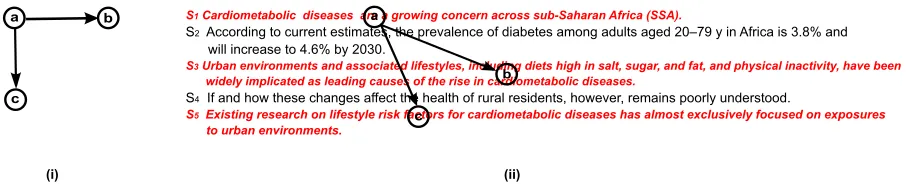
Figure 1: (i)A sample of mined coherence patterns from abstracts; nodes are sentences and edges are entity connections;(ii)
SentencesS1,S3andS5constitute the pattern in an input document.
stracts of scientific articles are similar in style to co-herent summaries, we obtain coherence patterns by analyzing a corpus of abstracts of articles from bio-medicine (PubMedcorpus). Then we apply the most frequent coherence patterns to input documents, i.e. long scientific articles from bio-medicine (PLOS Medicine dataset), extract corresponding sentences to generate coherent summaries, and evaluate them by comparing with summaries written by a PLOS Medicine editor. Figure 1 illustrates the extraction of sentences from an input document (Figure 1,(ii)) which constitute a coherence pattern (Figure 1,(i)). If we overlay the input document with coherence patterns and extract the sentences which constitute those patterns, then the extracted sentences are al-ready coherent. We also take into account impor-tance and non-redundancy. We capture all three fac-tors in an objective function maximized by Mixed Integer Programming (MIP) (Section 2).
We evaluate our method on two different datasets: PLOS Medicine (Parveen and Strube, 2015) and DUC 2002. We extract frequent coherence patterns from all abstracts in thePubMed corpus, and gen-erate summaries of unseen scientific articles of the PLOS Medicine dataset (Section 3.1). For DUC 2002 we extract coherence patterns from the human summaries of DUC 2005 (Dang, 2005). We evaluate our model on DUC 2002 to compare with state-of-the-art systems.
Our experimental results show that using coher-ence patterns for summarization produces more in-formative (but not redundant) and coherent sum-maries as compared to several baseline methods and state-of-the-art methods based on ROUGE scores and human judgements.
2 Method
We solve the task of creating coherent summaries by employing coherence patterns. We tightly integrate determining importance, non-redundancy and co-herence by applying global optimization, i.e., MIP.
2.1 Document Representation
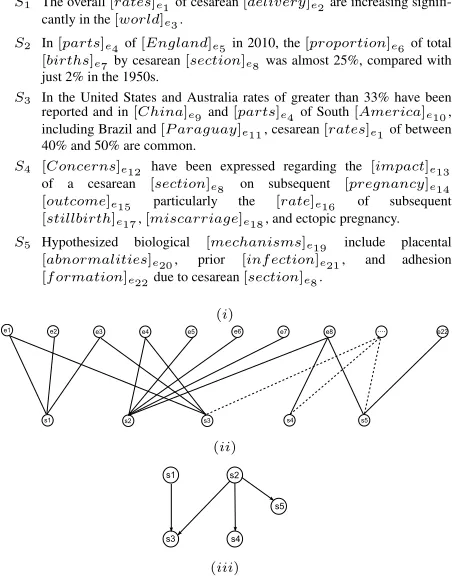
We use the entity graph (Guinaudeau and Strube, 2013) to represent scientific articles. The entity graph is a bipartite graph which consists of entities and sentences as two disjoint sets of nodes (Figure 2,
ii). Entity nodes are connected only with sentence
nodes and not among each other. An entity node is connected with a sentence node if and only if the en-tity is present in the sentence. Entities are the head nouns of noun phrases.
We perform a one-mode projection on sentence nodes to create a directed one-mode projection graph (Figure 2,iii). Two sentence nodes in the
one-mode projection graph are connected if they share at least one entity in the entity graph. Edge directions encode the sentence order in the input document.
2.2 Mining Coherence Patterns
We use one-mode projection graphs of abstracts in thePubMedcorpus (see Section 3.1) to mine coher-ence patterns. The weight of a cohercoher-ence pattern,
weight(patu), is its frequency in thePubMed
cor-pus normalized by the maximum number of its oc-currence in abstracts in thePubMed corpus (Equa-tion 1).
weight(patu) =
Pq
k=1f req(patu, gk) maxqk=1f req(patu, gk)
, (1)
whereqis the number of graphs associated with
ab-stracts in the corpus, andgkrepresents the graph of
S1 The overall[rates]e1of cesarean[delivery]e2are increasing
signifi-cantly in the[world]e3.
S2 In[parts]e4of[England]e5in 2010, the[proportion]e6of total
[births]e7by cesarean[section]e8was almost 25%, compared with
just 2% in the 1950s.
S3 In the United States and Australia rates of greater than 33% have been
reported and in[China]e9and[parts]e4of South[America]e10,
including Brazil and[P araguay]e11, cesarean[rates]e1of between
40% and 50% are common.
S4 [Concerns]e12 have been expressed regarding the [impact]e13
of a cesarean [section]e8 on subsequent [pregnancy]e14
[outcome]e15 particularly the [rate]e16 of subsequent [stillbirth]e17,[miscarriage]e18, and ectopic pregnancy.
S5 Hypothesized biological [mechanisms]e19 include placental
[abnormalities]e20, prior [inf ection]e21, and adhesion [f ormation]e22due to cesarean[section]e8.
(i)
s1 s2 s3 s4 s5
e2 e3 e4 e5 e6 e7 e8
e1 .... e22
(ii)
s1 s2
s3 s4 s5
[image:3.612.73.299.60.351.2](iii)
Figure 2: (i)A sample text fromPLOS Medicine;(ii)entity graph;(iii)projection graph of the text.
The weights of the coherence patterns are not on the same scale. We normalize the weights using the standard score x−µ
σ
, where µ is the mean andσ
is the standard deviation. A sigmoid function scales weights to the interval[0,1].
2.3 Summary Generation
We maximize importance, non-redundancy and pattern-based coherence with their respective weights λ to generate coherent summaries. The
objective function is:
max(λIfI(S) +λRfR(E) +λCfC(P)), (2)
whereS is a set of binary variables for sentences in
an article, E is a set of binary variables for entities
andP is a set of binary variables for coherence pat-terns.
Importance (fI(S)): The importance function
quantifies the overall importance of information in the summary, which is calculated by considering the
ranks of selected sentences for the summary:
fI(S) = n
X
i=1
Rank(senti)·si. (3)
In Equation 3,Rank(senti)represents the rank of
sentencesenti andsi is the binary variable of
sen-tencesenti.nis the number of sentences.
Kleinberg (1999) develops the Hubs and Author-ities algorithm (HITS) to rank web pages. He di-vides web pages into two sets: Hubs, pages which contain links to informative web pages, and Author-ities, informative web pages. Here, Hubs are entities and Authorities are sentences. We calculate the rank of sentences using the HITS algorithm (Parveen and Strube, 2015). Initial ranks for sentences and enti-ties are computed by Equations 4 and 5 in an entity graph:
Rankinit(senti) = 1 +sim(senti, title), (4)
Rankinit(entj) = 1. (5)
In Equation 4, sim(senti, title)is the cosine
sim-ilarity between the scientific article’s title and sen-tencesenti. In Equation 5, entj refers to the jth
entity in the entity graph. After applying the HITS algorithm on the entity graph using the above initial-ization, the final rank of a sentence is its importance.
Non-redundancy (fR(E)): In the objective
func-tion, fR(E) represents the non-redundancy of
in-formation in the summary. Intuitively, if the sum-mary has unique information in every sentence then the summary is redundant. We measure non-redundancy as follows:
fR(E) = m
X
j=1
ej, (6)
wheremis the number of entities andej is a binary
variable for each entity. The summary becomes non-redundant if we include only unique entities.
On the basis of fI(S) and fR(E) we define the
following optimization constraints:
n
X
i=1
|Senti| ·si≤lmax, (7)
X
j∈Ei
X
si∈Sj
si ≥ej forj= 1, . . . , m. (9)
The constraint in Equation 7 limits the length of the summary. lmax is the maximal length of the
sum-mary and|Senti|is the length of sentencesenti.
In Equation 8, the constraint ensures that if sen-tence senti is selected (si = 1), then all entities Ei present in sentence senti must also be selected.
In Equation 9,Sj represents the set of binary
vari-ables of sentences which contain entityentj. This
constraint prescribes that if entity entj is selected
(ej = 1), then at least one of the sentences in Sj
must be selected, too.
Coherence (fC(P)): We use the mined patterns
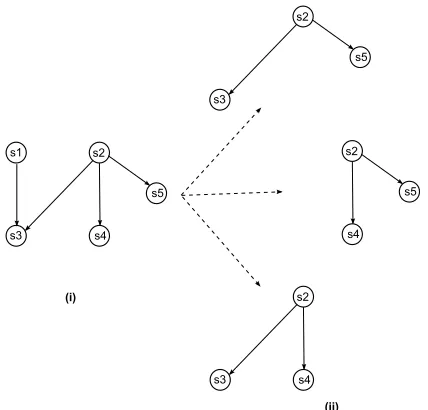
to extract sentences from the input document of PLOS Medicineto create a coherent summary. We extract sentences, if the connectivity among nodes in their projection graph matches the connectivity among nodes in a coherence pattern. In Figure 3 we overlay the projection graph from Figure 2, iiwith
the coherence pattern from Figure 1,i. This results
in three instances of this coherence pattern. How-ever, we select only one since we simultaneously op-timize for importance and non-redundancy.
s2
s3 s4
s2
s5
s4 s2
s5
s3
s1 s2
s3 s4
s5
(i)
[image:4.612.314.541.242.386.2](ii)
Figure 3: (i) A projection graph;(ii)several instances of a coherence pattern in Figure 1,ii.
In the objective function,fC(P)measures the
co-herence of the summary based on the weights of the
coherence patterns occurring in it (Section 2.2):
fC(P) = U
X
u=1
weight(patu)·pu, (10)
wherepu is a boolean variable associated with
co-herence patternpatu.
The optimization considers patternpatufor
sum-marizing the input article, ifpatu is a subgraph of
the projection graph of the article. To find the coher-ence pattern in a projection graph we apply a graph matching algorithm (Lerouge et al., 2015).
g patu
xa,s
2=1
xa,s
4=0
xc,s
2=0
xc,s=1
4
yac,s s
24=1
s1 s2
s3 s4
[image:4.612.79.293.421.626.2]s5
Figure 4:An illustration of mapping variables to overlay graph gwith coherence patternpatu.
To model the graph matching problem between projection graphg = (Vg, Eg)and patternspatu =
(Vpatu, Epatu), two kinds of mapping binary vari-ables are used: xi,k for the node map, andyij,klfor
the edge map. xi,k, = 1, if verticesi ∈ Vpatu and
k ∈ Vg match. yij,kl = 1, if for each pair of edges ij ∈ Epatu andkl ∈ Eg match (Figure 4). Con-straints for graph matching are as follows:
• Every node of the pattern matches at most one unique node of the graph:
X
k∈Vg
xi,k ≤1 ∀i∈Vpatu. (11)
• Every edge of the pattern matches at most one unique edge of the graph:
X
kl∈Eg
• Every node of the graph matches at most one node of the pattern:
X
i∈Vpatu
xi,k ≤1 ∀k∈Vg. (13)
• A node of patternpatu matches a node of graph g if an edge originating from the node ofpatu
matches an edge originating from the node ofg:
X
kl∈Eg
yij,kl = xi,k ∀k ∈ Vg,∀ij ∈ Epatu. (14)
• A node of patternpatu matches a node of graph gif an edge targeting the node ofpatu matches
an edge targeting the node ofg:
X
kl∈Eg
yij,kl = xj,l ∀l ∈ Vg,∀ij ∈ Epatu. (15)
• We need a constraint to extract induced
pat-terns1:
X
i∈Vpatu
xi,k+
X
j∈Vpatu
xj,l
− X
ij∈Epatu
yij,kl≤1 ∀kl∈Eg. (16)
The constraints in Equations11−16are defined to find patternpatuin projection graphgof the input
article. However these constraints do not ensure that the pattern is in the summary. For this, we define constraints in Equations 17−19 to assure that an existing pattern in an article is selected if there are some sentences in the summary which constitute the pattern.
• The constraint in Equation 17 ensures that if sentences sk and sl are selected for the
sum-mary then the edge between them is selected (zkl= 1), too:
sk·sl=zkl ∀k, l∈Vg. (17)
• Patternpatuis present in the summary (pu = 1)
if and only if one of its instances in the projec-tion graph is included in the summary, i.e., some
1Patternpatuis an induced subgraph of graphgifpatu
con-tains all possible edges which appear ing.
of the selected sentence nodes must be present in an instance of patternpatu. |Vpatu|is the num-ber of nodes in pattern patu, and|Epatu|is the number of edges in patternpatu. This constraint
is shown below:
X
i∈vpatu
X
k∈vg
sk·xi,k+
X
ij∈epatu
X
kl∈eg
zkl·yij,kl
=pu(|Vpatu|+|Epatu|). (18)
• If a sentence is selected then it has to match a node of at least one of the patterns:
X
patu∈P
X
i∈Vpatu
xi,k ≥sk ∀k∈Vg. (19)
3 Experiments
In this section we discuss the datasets and the experi-mental setup. We evaluate our model using ROUGE scores and human judgements.
3.1 Datasets
PLOS Medicine: This dataset contains 50
scien-tific articles. In this dataset every scienscien-tific article is accompanied by a summary written by an editor of the month. This editor’s summary has a broader perspective than the authors’ abstract. We use the editor’s summary as a gold summary for calculat-ing the ROUGE scores. We use700differentPLOS Medicinearticles from the PubMed2corpus to mine
coherence patterns from their abstracts and to calcu-late patterns’ weights.
DUC: The DUC 2002 dataset has been annotated for the Document Understanding Conference 2002. It contains 567 news articles for summarization. Every article is accompanied by at least two gold summaries. DUC 2002 articles are shorter than PLOS Medicine articles (25 vs. 154 sentences av-erage length). We use all (300) DUC 2005 human summaries to mine coherence patterns and to calcu-late their weights.
3.2 Experimental Setup
First, we extract the text of an article. We remove figures, tables, references and non-alphabetical char-acters. Then we use the Stanford parser (Klein and
2http://www.ncbi.nlm.nih.gov/pmc/tools/
Manning, 2003) to determine sentence boundaries. We apply the Brown coherence toolkit (Elsner and Charniak, 2011) to convert the articles into entity grids (Barzilay and Lapata, 2008) which then are transformed into entity graphs. We use gSpan (Yan and Han, 2002) to extract all subgraphs from the pro-jection graphs of the abstracts of the PubMed cor-pus.
It is possible that patterns with a large number of nodes are not at all present in the projection graph. Hence, we use coherence patterns with3and 4nodes, referred to asCP3 andCP4, respectively.
We use Gurobi (Gurobi Optimization, Inc., 2014) to solve the MIP problem. We use a pronoun resolution system (Martschat, 2013) to replace all pronouns in the summary with their antecedents.
We determine the best values forλI,λR, andλc
on the development sets. λI = 0.4,λR = 0.3, and λc= 0.3are the best weights for thePLOS Medicine
development set. Weights for the DUC 2002 devel-opment set areλI = 0.5,λR= 0.2andλc= 0.3.
3.3 Results
We evaluate our model in two ways. First, we use ROUGE scores to compare our model with other models. Second, we explicitly evaluate the coher-ence of the summaries by human judgements.
3.3.1 ROUGE Assessment
The ROUGE score (Lin, 2004) is a standard evalua-tion score in automatic text summarizaevalua-tion. It calcu-lates the overlap between gold summary and system summary. In automatic text summarization ROUGE 1, ROUGE 2 and ROUGE SU4 are usually reported (see Graham (2015) for an assessment of evaluation metrics for summarization).
We compare our system (CP3andCP4) with four
baselines: Lead, Random, Maximal Marginal Rel-evance (MMR) and TextRank. Lead selects adja-cent sentences from the beginning of an input ar-ticle. Random selects sentences randomly. MMR (Carbonell and Goldstein, 1998) uses a trade-off between relevance and redundancy. TextRank is a graph-based system using sentences as nodes and edges weighted by cosine similarity between sen-tences (Mihalcea and Tarau, 2004).
We compare our system with three state-of-the-art systems: ECoh (Parveen and Strube, 2015), TCoh
Systems R-SU4 R-2
Baselines
Lead 0.067 0.055
Random 0.048 0.031
MMR 0.069 0.048
TextRank 0.068 0.048
State-of-the-art
ECoh 0.131 0.098
TCoh 0.129 0.095
Mead 0.084 0.068
Our Model
[image:6.612.355.498.56.201.2]CP3 0.135 0.103
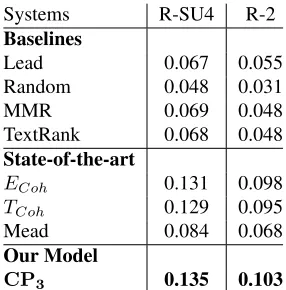
Table 1:PLOS Medicine, editor’s summaries with5 sentences.
(Parveen et al., 2015), and Mead (Radev et al., 2004). ECoh uses entity graphs which consists of
entities and sentences, andTCohuses topical graphs
where entities are replaced by the topics. They both use the outdegree of sentence nodes in the un-weighted and the un-weighted projection graph, respec-tively, as the coherence measure of each sentence. Mead employs a linear combination of three fea-tures: centroid score, position score and overlap score. The linear combination is used to add sen-tences to the summary up to the required length. The centroid score gives the highest score to the most central sentence in the cluster of sentences, the po-sition score gives a higher score to the sentences which are in the beginning of the document, and the overlap score computes the similarity between the sentences of a document. All three features do not take care of the coherence of a summary as they do not have any notion of the order and the structure of a summary.
To compare with the state-of-the-art systems on PLOS Medicine,ECoh (Parveen and Strube, 2015)
andTCoh (Parveen et al., 2015), we limit the length
of summaries to 5 sentences. Table 1 reports ROUGE scores of different systems. Our system outperforms baselines and state-of-the-art systems.
PLOS Medicine W OStop W OStop WStop WStop W OStop W OStop WStop WStop Editor’s summaries WStem W OStem WStem W OStem WStem W OStem WStem W OStem
ROUGE SU4 (*pvalue<0.05) ROUGE 2 (*pvalue<0.01)
Upper Bound 0.423 0.354 0.519 0.470 0.344 0.304 0.430 0.399
Baselines
Lead 0.191 0.158 0.246 0.222 0.158 0.140 0.185 0.171
Random 0.140 0.113 0.169 0.153 0.102 0.088 0.125 0.116
MMR 0.183 0.149 0.240 0.215 0.141 0.125 0.171 0.157
TextRank 0.148 0.104 0.161 0.159 0.115 0.084 0.126 0.118
State-of-the-art
ECoh 0.204* 0.167 0.254 0.228 0.160* 0.145 0.187 0.173
TCoh 0.195 0.161 0.231 0.206 0.157 0.140 0.169 0.165
Mead 0.197 0.165 0.246 0.222 0.156 0.139 0.186 0.172
Our Model
CP3 0.215* 0.178 0.268 0.241 0.172* 0.153 0.200 0.184
[image:7.612.73.540.57.252.2]CP4 0.218 0.179 0.270 0.245 0.175 0.156 0.201 0.187
Table 2:ROUGE scores onPLOS Medicinewith750 words. for With/Without. Here, W OStop means without
considering stopwords while calculating ROUGE scores, and W OStem means without applying the
Porter Stemmer on summaries while calculating ROUGE scores. Our models outperform baseline and state-of-the-art systems (Table 2). We compute statistical significance between ECoh and CP3 on
both scores, ROUGE SU4 is significantly different by 95%. ROUGE 2 is significantly different by 99%. Upper Bound in Table 2 represents maximum ROUGE scores that can be achieved in extractive summarization on thePLOS Medicinedataset. It is calculated by considering the whole scientific article as a summary and the corresponding editor’s sum-mary as the gold standard. TheUpper Boundscores are not very high showing that a significant im-provement in ROUGE scores on thePLOS Medicine dataset is difficult. Thus, the performance achieved by our systems,CP3andCP4, is a considerable
im-provement on thePLOS Medicinedataset.
Furthermore, we applyCP3 on the dataset
intro-duced by Liakata et al. (2013). The dataset con-sists of28scientific articles from the chemistry do-main. The state-of-the-art system on this dataset is CoreSC, which is developed by Liakata et al. (2013). CoreSCconsiders discourse information while sum-marizing a scientific article. The ROUGE-1 score of CP3 (0.96) is significantly better than CoreSC
(0.75) andMicrosoft Office Word 2007 AutoSuma-rize (0.73) (Garc´ıa-Hern´andez et al., 2009), in re-spect of abstracts. This shows that our system
per-forms well in other domains.
We further calculate the average number of sen-tences per summary obtained byMeadandCP3. On
averageMeadproduces17.5sentences per summary whereasCP3produces27.2sentences per summary.
The possibility of longer sentences containing more topic irrelevant entities is higher than shorter sen-tences (Jin et al., 2010).
We calculate the average percentage of sentences selected from the sections Introduction, Method, Re-sults and Discussion by different systems. CP3
ex-tracts sentences mainly from Introduction (32.5%) and Method (38.5%), but also a considerable num-ber of sentences from Results (17.67%) and Discus-sion (11.33%). The distribution is quite similar to TextRankandMMR.Lead, obviously, extracts only from Introduction (80.59%) and Method (19.41%). Meadextracts maximum sentences from the begin-ning of the document using its positional feature. The sentences in a summary extracted byCP3 are
evenly distributed indicating that they are not biased to any sections. This clearly represents that coher-ence patterns not only seeks for nearby sentcoher-ences but also for any distant sentences of a scientific article.
Table 3 shows the results on DUC 2002 to com-pare the results with state-of-the-art systems. There is no significant difference between the ROUGE scores of usingCP3 andCP4 on DUC 2002. Thus,
we only report the results of using CP3 on DUC
2002.
us-Systems R-1 R-2 R-SU4 Baselines
Lead 0.459 0.180 0.201
DUC 2002 Best 0.480 0.228
TextRank 0.470 0.195 0.217
LREG 0.438 0.207
State-of-the-art
Mead 0.445 0.200 0.210
ILPphrase 0.454 0.213
URANK 0.485 0.215
UniformLink (k = 10) 0.471 0.201
ECoh 0.485 0.230 0.253
TCoh 0.481 0.243 0.242
NN-SE 0.474 0.230
Our Model
[image:8.612.88.284.57.250.2]CP3 0.490 0.247 0.258
Table 3:ROUGE scores on DUC 2002.
ing logistic regression and hand-made features (Cheng and Lapata, 2016). We compare our model to previously published state-of-the-art sys-tems. These systems show reasonable performance on the DUC 2002 summarization task. ILPphrase
is a phrase-based extraction model, which selects important phrases and combines them via inte-ger linear programming (Woodsend and Lapata, 2010).URANKutilizes a unified ranking process for single-document and multi-document summariza-tion tasks (Wan, 2010). UniformLink (k=10), con-siders similar documents for document expansion in the single-document summarization task (Wan and Xiao, 2010). The more recent system, NN-SE, uti-lizes a neural network hierarchical document en-coder and an attention-based extractor to extract sen-tences from a document for a summary (Cheng and Lapata, 2016). ROUGE scores of our approach on this dataset are better than baselines and state-of-the-art systems. This shows that our system performs well even in a different genre (robust) and with con-siderably shorter input documents (scalable).
3.3.2 Coherence Assessment
ROUGE scores do not evaluate summary coher-ence, since ROUGE only calculates overlapping re-call scores and does not consider the structure of the summary. Haghighi and Vanderwende (2009), Ce-likyilmaz and Hakkani-T¨ur (2010) and Christensen et al. (2013) evaluate the overall summary quality by asking human subjects to rank system generated
summaries. Parveen and Strube (2015) and Parveen et al. (2015) assess the coherence by asking human assessors to rank system generated summaries and compare their system with baseline systems.
We perform summary coherence assessment by asking one Postdoc, two PhD students and one Mas-ters student from the field of natural language pro-cessing. We provide them with the output sum-maries of four different systems for ten articles. We ask them to rank the summaries, i.e., the best sum-mary gets rank1, the second best gets rank2, the third best gets rank3, and the worst gets rank4.
The four systems assessed areCP3,ECoh,
Text-Rank, andLead. We apply the Kendall concordance coefficient (W) (Siegel and Castellan, 1988) to mea-sure whether the human assessors agree in ranking the four systems. With W = 0.6725 the correla-tion between the human assessors is high. Applying theχ2 test shows that W is significant at least at the
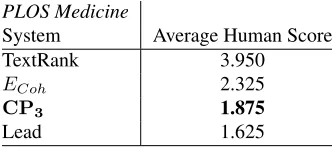
99% level indicating that the ranks provided by the human assessors are reliable and informative. Table 4 shows the overall average rank of a system given by the four human assessors. The lower the value of average human scores the more coherent the sum-mary. UnsurprisinglyLeadgets the best overall
av-PLOS Medicine
System Average Human Score
TextRank 3.950
ECoh 2.325
CP3 1.875
Lead 1.625
Table 4:The average human scores.
erage rank. Lead extracts adjacent sentences from the beginning of the document. Hence, these sum-maries are as coherent as the author intends them to be, but they are not informative. However, CP3
is very close in coherence to Lead indicating that our strategy is successful. It also performs substan-tially better thanTextRankandECoh. This confirms
that using coherence patterns for sentence extraction yields more coherent summaries.
4 Related Work
[image:8.612.343.509.411.488.2]infor-mation is spread all over the article unlike informa-tion in news articles (Teufel and Moens, 2002).
There are various approaches for summarizing scientific articles. Citations have been used by many researchers for summarization in this domain (Elkiss et al., 2008; Mohammad et al., 2009; Qazvinian and Radev, 2008; Abu-Jbara and Radev, 2011). Nanba and Okumura (2000) develop rules for categoriz-ing citations by analyzcategoriz-ing citation sentences. New-man (2001) analyzes the structure using a citation network. Similarly, Siddharthan and Teufel (2007) discover scientific attributions using citations. Dis-course structure (but not necessarily coherence) has been used by Teufel and Moens (2002), Liakata et al. (2013) and others for summarizing scientific arti-cles.
Several state-of-the-art extractive summarization systems implement summarization as maximizing an objective function using constraints. McDonald (2007) interprets text summarization as a global in-ference problem, where he is maximizing the im-portance score of a summary by considering the length constraint. Similarly, various approaches for summarization are based on optimization using ILP (Gillick et al., 2009; Nishikawa et al., 2010; Galanis et al., 2012; Parveen and Strube, 2015).
Until now, only few works have considered co-herence while summarizing scientific articles. Abu-Jbara and Radev (2011) work on citation based summarization. They preprocess the citation sen-tences to filter out irrelevant sensen-tences or sentence fragments, then extract sentences for the summary. Eventually, they refine the summary sentences to im-prove readability. Jha et al. (2015) consider Min-imum Independent Discourse Contexts (MIDC) to solve the problem of non-coherence in extractive summarization. However, none of them deals with the problem of coherence within the task of sentence selection. Sentence selection and ensuring the co-herence of summaries are not tightly integrated in their techniques. They model coherence in summa-rization by only considering adjacent sentences.
There are few methods (Hirao et al., 2013; Parveen and Strube, 2015; Gorinski and Lapata, 2015) which integrate coherence in optimization. These methods do not take into account the overall structure of the summary. Unlike earlier methods, we incorporate coherence patterns in optimization.
5 Conclusion
We introduce a novel graph-based approach to gen-erate coherent summaries of scientific articles. Our approach takes care of coherence distinctively by co-herence patterns. We have experimented withPLOS Medicine and DUC 2002. The results show that the approach is robust, works on both scientific and news documents and with input documents of dif-ferent length. It considerably outperforms state-of-the-art systems on both datasets. We collected hu-man assessments to evaluate the coherence of sum-maries. Our system substantially outperforms base-lines and state-of-the-art systems, i.e., incorporat-ing coherence patterns produces more coherent sum-maries. The results show that our approach performs well in human summary coherence assessment and relevance evaluation (ROUGE scores).
Acknowledgments
This work has been funded by the Klaus Tschira Foundation, Heidelberg, Germany. The first and second authors have been supported by a Heidel-berg Institute for Theoretical Studies Ph.D. schol-arship. This work has been supported by the Ger-man Research Foundation as part of the Research Training Group “Adaptive Preparation of Informa-tion from Heterogeneous Sources” (AIPHES) under grant No. GRK1994/1. We would like to thank our colleagues Alexander Judea, Isabell Wolter, Mark-Christoph M¨uller and Nafise Moosavi who became human subjects for coherence assessment evalua-tion.
References
Amjad Abu-Jbara and Dragomir Radev. 2011. Co-herent citation-based summarization of scientific pa-pers. InProceedings of the 49th Annual Meeting of the Association for Computational Linguistics (Vol-ume 1: Long Papers), Portland, Oreg., 19–24 June 2011, pages 500–509.
Regina Barzilay and Mirella Lapata. 2008. Modeling local coherence: An entity-based approach. Computa-tional Linguistics, 34(1):1–34.
Retrieval,Melbourne, Australia, 24–28 August 1998, pages 335–336.
Asli Celikyilmaz and Dilek Hakkani-T¨ur. 2010. A hy-brid hierarchical model for multi-document summa-rization. In Proceedings of the 48th Annual Meeting of the Association for Computational Linguistics, Up-psala, Sweden, 11–16 July 2010, pages 815–824. Jianpeng Cheng and Mirella Lapata. 2016. Neural
sum-marization by extracting sentences and words. In Pro-ceedings of the 54th Annual Meeting of the Associa-tion for ComputaAssocia-tional Linguistics (Volume 1: Long Papers), Berlin, Germany, 7–12 August 2016, pages 484–494.
Janara Christensen, Mausam, Stephen Soderland, and Oren Etzioni. 2013. Towards coherent multi-document summarization. InProceedings of the 2013 Conference of the North American Chapter of the Association for Computational Linguistics: Human Language Technologies, Atlanta, Georgia, 9–14 June 2013, pages 1163–1173.
Frantiˇsek Daneˇs, editor. 1974. Papers on Functional Sentence Perspective. Academia, Prague.
Hoa Trang Dang. 2005. Overview of DUC 2005. In Pro-ceedings of the 2005 Document Understanding ference held at the Human Language Technology Con-ference and ConCon-ference on Empirical Methods in Nat-ural Language Processing,Vancouver, B.C., Canada, 9–10 October 2005.
Aaron Elkiss, Siwei Shen, Anthony Fader, G¨unes¸ Erkan, David States, and Dragomir Radev. 2008. Blind men and elephants: What do citation summaries tell us about a research article? Journal of the Ameri-can Society for Information Science and Technology, 59(1):51–62.
Micha Elsner and Eugene Charniak. 2011. Extending the entity grid with entity-specific features. In Proceed-ings of the 49th Annual Meeting of the Association for Computational Linguistics (Volume 2: Short Papers),
Portland, Oreg., 19–24 June 2011, pages 125–129. Dimitrios Galanis, Gerasimos Lampouras, and Ion
An-droutsopoulos. 2012. Extractive multi-document summarization with integer linear programming and support vector regression. InProceedings of the 24th International Conference on Computational Linguis-tics,Mumbai, India, 8–15 December 2012, pages 911– 926.
Ren´e Arnulfo Garc´ıa-Hern´andez, Yulia Ledeneva, Griselda Mat´ıas Mendoza, ´Angel Hern´andez Dominguez, Jorge Chavez, Alexander Gelbukh, and Jos´e Luis Tapia Fabela. 2009. Comparing commercial tools and state-of-the-art methods for generating text summaries. InProceedings of Advances in Artificial Intelligence, 8th Mexican International Conference
on Artificial Intelligence, Guanajuato, Mexico, 9-13 November 2009, pages 92–96.
Daniel Gillick, Korbinian Riedhammer, Benoit Favre, and Dilek Hakkani-T¨ur. 2009. A global optimiza-tion framework for meeting summarizaoptimiza-tion. In Pro-ceedings of the 2009 IEEE International Conference on Acoustics, Speech, and Signal Processing,Taipei, Taiwan, 19–24 June 2009, pages 4769–4772.
Philip John Gorinski and Mirella Lapata. 2015. Movie script summarization as graph-based scene extraction. In Proceedings of the 2015 Conference of the North American Chapter of the Association for Computa-tional Linguistics: Human Language Technologies,
Denver, Col., 31 May – 5 June 2015, pages 1066– 1076.
Yvette Graham. 2015. Re-evaluating automatic sum-marization with BLEU and 192 shades of ROUGE. In Proceedings of the 2015 Conference on Empiri-cal Methods in Natural Language Processing,Lisbon, Portugal, 17–21 September 2015, pages 128–137. Camille Guinaudeau and Michael Strube. 2013.
Graph-based local coherence modeling. In Proceedings of the 51st Annual Meeting of the Association for Com-putational Linguistics (Volume 1: Long Papers),Sofia, Bulgaria, 4–9 August 2013, pages 93–103.
Gurobi Optimization, Inc. 2014. Gurobi optimizer refer-ence manual.
Aria Haghighi and Lucy Vanderwende. 2009. Exploring content models for multi-document summarization. In
Proceedings of Human Language Technologies 2009: The Conference of the North American Chapter of the Association for Computational Linguistics, Boulder, Col., 31 May – 5 June 2009, pages 362–370.
Tsutomu Hirao, Yasuhisa Yoshida, Masaaki Nishino, Norihito Yasuda, and Masaaki Nagata. 2013. Single-document summarization as a tree knapsack problem. In Proceedings of the 2013 Conference on Empiri-cal Methods in Natural Language Processing,Seattle, Wash., 18–21 October 2013, pages 1515–1520. Rahul Jha, Reed Coke, and Dragomir Radev. 2015.
Surveyor: A system for generating coherent survey articles for scientific topics. In Proceedings of the 29th Conference on the Advancement of Artificial In-telligence,Austin, Texas, 25–30 January 2015, pages 2167–2173.
Feng Jin, Minlie Huang, and Xiaoyan Zhu. 2010. A comparative study on ranking and selection strategies for multi-document summarization. InProceedings of Coling 2010: Poster Volume, Beijing, China, 23–27 August 2010, pages 525–533.
Linguistics, Sapporo, Japan, 7–12 July 2003, pages 423–430.
Jon M. Kleinberg. 1999. Authoritative sources in a hyperlinked environment. Journal of the ACM, 46(5):604–632.
Julien Lerouge, Pierre Le Bodic, Pierre H´eroux, and S´ebastien Adam. 2015. GEM++: A tool for solving substitution-tolerant subgraph isomorphism. In C.-L. Liu, B. Luo, W.G. Kropatsch, and J. Cheng, editors,
Graph-Based Representations in Pattern Recognition, pages 128–137. Springer, Heidelberg, Germany. Maria Liakata, Simon Dobnik, Shyamasree Saha, Colin
Batchelor, and Dietrich Rebholz-Schuhmann. 2013. A discourse-driven content model for summarising scientific articles evaluated in a complex question an-swering task. InProceedings of the 2013 Conference on Empirical Methods in Natural Language Process-ing,Seattle, Wash., 18–21 October 2013, pages 747– 757.
Chin-Yew Lin. 2004. ROUGE: A package for automatic evaluation of summaries. In Proceedings of the Text Summarization Branches Out Workshop at ACL ’04,
Barcelona, Spain, 25–26 July 2004, pages 74–81. Sebastian Martschat. 2013. Multigraph clustering for
unsupervised coreference resolution. In 51st Annual Meeting of the Association for Computational Linguis-tics: Proceedings of the Student Research Workshop,
Sofia, Bulgaria, 5–7 August 2013, pages 81–88. Ryan McDonald. 2007. A study of global inference
al-gorithms in multi-document summarization. In Pro-ceedings of the European Conference on Information Retrieval,Rome, Italy, 2-5 April 2007.
Mohsen Mesgar and Michael Strube. 2015. Graph-based coherence modeling for assessing readability. In Pro-ceedings of STARSEM 2015: The Fourth Joint Confer-ence on Lexical and Computational Semantics, Den-ver, Col., 4–5 June 2015, pages 309–318.
Rada Mihalcea and Paul Tarau. 2004. TextRank: Bring-ing order into texts. InProceedings of the 2004 Con-ference on Empirical Methods in Natural Language Processing,Barcelona, Spain, 25–26 July 2004, pages 404–411.
Saif Mohammad, Bonnie Dorr, Melissa Egan, Ahmed Hassan, Pradeep Muthukrishan, Vahed Qazvinian, Dragomir Radev, and David Zajic. 2009. Using ci-tations to generate surveys of scientific paradigms. In
Proceedings of Human Language Technologies 2009: The Conference of the North American Chapter of the Association for Computational Linguistics, Boulder, Col., 31 May – 5 June 2009, pages 584–592.
Hidetsugu Nanba and Manabu Okumura. 2000. Pro-ducing more readable extracts by revising them. In
Proceedings of the 18th International Conference on
Computational Linguistics,Saarbr¨ucken, Germany, 31 July – 4 August 2000, pages 1071–1075.
Mark E.J. Newman. 2001. Scientific collaboration net-works. I. Network construction and fundamental re-sults. Physical Review E, 64(1):016131.
Hitoshi Nishikawa, Takaaki Hasegawa, Yoshihiro Mat-suo, and Genichiro Kikui. 2010. Opinion summariza-tion with integer linear programming formulasummariza-tion for sentence extraction and ordering. In Proceedings of the 23rd International Conference on Computational Linguistics,Beijing, China, 23–27 August 2010, pages 910–918.
Daraksha Parveen and Michael Strube. 2015. Integrating importance, non-redundancy and coherence in graph-based extractive summarization. InProceedings of the 24th International Joint Conference on Artificial In-telligence,Buenos Aires, Argentina, 25–31 July 2015, pages 1298–1304.
Daraksha Parveen, Hans-Martin Ramsl, and Michael Strube. 2015. Topical coherence for graph-based ex-tractive summarization. In Proceedings of the 2015 Conference on Empirical Methods in Natural Lan-guage Processing,Lisbon, Portugal, 17–21 September 2015, pages 1949–1954.
Vahed Qazvinian and Dragomir R. Radev. 2008. Scien-tific paper summarization using citation summary net-works. InProceedings of the 22nd International Con-ference on Computational Linguistics, Manchester, U.K., 18–22 August 2008, pages 689–696.
Dragomir Radev, Timothy Allison, Sasha Blair-Goldensohn, John Blitzer, Arda Celibi, Stanko Dimitrov, Elliott Drabek, Ali Hakim, Wai Lam, Danyu Liu, Jahna Otterbacher, Hong Qi, Horacio Saggion, Simone Teufel, Michael Topper, Adam Winkel, and Zhu Zhang. 2004. MEAD – a platform for multidocu-ment multilingual text summarization. InProceedings of the 4th International Conference on Language Resources and Evaluation, Lisbon, Portugal, 26–28 May 2004.
Advaith Siddharthan and Simone Teufel. 2007. Whose idea was this, and why does it matter? Attributing sci-entific work to citations. In Proceedings of Human Language Technologies 2007: The Conference of the North American Chapter of the Association for Com-putational Linguistics, Rochester, N.Y., 22–27 April 2007, pages 316–223.
Sidney Siegel and N. John Castellan. 1988. Non-parametric Statistics for the Behavioral Sciences. McGraw-Hill, New York, 2nd edition.
Xiaojun Wan and Jianguo Xiao. 2010. Exploiting neigh-borhood knowledge for single document summariza-tion and keyphrase extracsummariza-tion. ACM Transactions on Information Systems, 28(2):8 pages.
Xiaojun Wan. 2010. Towards a unified approach to simultaneous single-document and multi-document summarizations. In Proceedings of the 23rd Interna-tional Conference on ComputaInterna-tional Linguistics, Bei-jing, China, 23–27 August 2010, pages 1137–1145. Kristian Woodsend and Mirella Lapata. 2010. Automatic
generation of story highlights. InProceedings of the 48th Annual Meeting of the Association for Computa-tional Linguistics,Uppsala, Sweden, 11–16 July 2010, pages 565–574.