Application Study on Multi-Vary Analysis
*
Xiaomin Xu
Business School, Shanghai Dianji University, Shanghai, China Email: [email protected]
Received August 11,2012; revised October 27, 2012; accepted November 8,2012
ABSTRACT
In this article, we studied the bearings made by one company in Shanghai. Through statistical process controlling the quality characteristic of bearings’ diameters and multi-vary analysis is applied to find the key variation factors which have an influence on the quality characteristic of the bearings, the quality level of the bearings of this company is im- proved.
Keywords: Statistical Process Control; Multi-Vary Analysis; Process Capability Index
1. Background and Signification
The manufacturing in China is developing fast through 30 years reform and opening up. China has firmly estab- lished itself as a manufacturing power in the world. At the same time, we should see that Chinese manufacturing is large but not strong. The improvement of product qua- lity lags behind the growth of economic scale. The whole level of product quality has a gap with the developed countries. With the bearing for instance, China is a power of bearings, but the most is belonging to medium or low- er end product. It is the lag of R&D capability, equip- ment and handcrafts that result in the precision of bearing unsure. If the precision of bearing can not meet the quail- fication, the steel plate is unqualified. Therefore, it is es- sential subject to study through technology improvement which can advance bearing quality and increase enter- prise benefit.
2. Literature Summary
SPC (statistical process control) is a tool of process con- trol by means of mathematical statistics method. It ana- lyses and controls the process by using the statistical law nature of figure fluctuation. Control chart becomes the one of most important tool of management after birth of the first control chart.
Zhen He, Ershi Qi, Shenghu Zhang [1] proposed that in practice, the control chart is always of on effect be- cause the sampling plan can not capture the key random variation in spite of the statistical characteristics of
xR chart is theoretically thorough studied. Zhonghua Yu, Shaotong Wu [2] pointed out the control chart me- thod proposed by W. A. Shewhart forecasts and controls
production by using the output of process; it is essentially lack of regularity description of process change itself. D. C. Montgomery [3] presented that the traditional control chart of W. A. Shewhart is an available tool only in con- trolling single variation source. S. W. Well, J. D. Smith [4] proposed that the control chart of W. A. Shewhart often gives a false warning when there are variations in batches of product or shifts of production of the process of production. The main reason is that the control chart of W. A. Shewhart is based on a single variation. M. Hamada, R. J. Mackay, and J. B. Whitney [5] proposed that the key is to determine the source of variation in the application of traditional Shewhart control chart.
As to how to control the problem of multiple variation sources, product quality problems caused by the variation source can be known if we can make sure of sources of variation and proportions in all variation factors. Then we can take relevant measures according to the relative size of variation source and proportion.
3. Empirical Study
In this article, the CHTD5/7 model bearings made by one company in Shanghai were taken for research objects. The quality remand of the diameter is considered as the key factor because it has a directly effect on the final assembly of pumps.
3.1. xR Control Chart and Process Capability Index
CHTD5/7-type self-bearing diameter quality requirements: Φ (60 ± 0.02) mm. When the products are processing, five samples per half hour are taken. And the data of its inner diameters are shown in the Table 1. So we can get
20 groups of data (Table 1).
Table 1. Bearing data.
xRControl Chart Data Number
X1 X2 X3 X4 X5 Average Range
1 60.008 60.001 59.998 59.996 59.986 59.9978 0.022
2 60.008 60.016 59.989 60.013 60.01 60.0072 0.027
3 59.993 59.992 60.004 60.004 60.006 59.9998 0.014
4 60.003 60.012 59.997 59.989 59.994 59.9990 0.023
5 59.992 60.009 60.006 59.993 60.002 60.004 0.017
6 60.006 60.013 60.007 60.006 60.012 60.0088 0.007
7 60.013 59.993 59.992 60.005 60.007 60.002 0.021
8 59.993 59.998 60.007 60.008 60.002 60.016 0.015
9 60.008 60.012 60.004 59.992 59.992 60.016 0.02
10 60.014 60.007 60.009 60.004 60.009 60.0086 0.01
11 59.987 59.993 59.993 60.004 60.014 59.9982 0.027
12 60.013 60.01 60.005 59.998 60.012 60.0076 0.015
13 59.991 59.993 60.001 59.998 60.006 59.9978 0.015
14 59.99 60.003 60.007 60.012 60.012 60.0048 0.022
15 60.001 60.007 60.001 60.003 60.003 60.003 0.016
16 60.003 60.012 60.006 60.016 60.006 60.0086 0.013
17 60.009 60.014 60.011 60.005 60.004 60.0086 0.01
18 60.013 60.001 59.998 60.003 59.990 60.001 0.023
19 60.007 60.006 60.011 59.998 59.995 60.0034 0.016
20 60.009 60.006 60.011 60.009 59.999 60.0086 0.012
a. Unit: mm
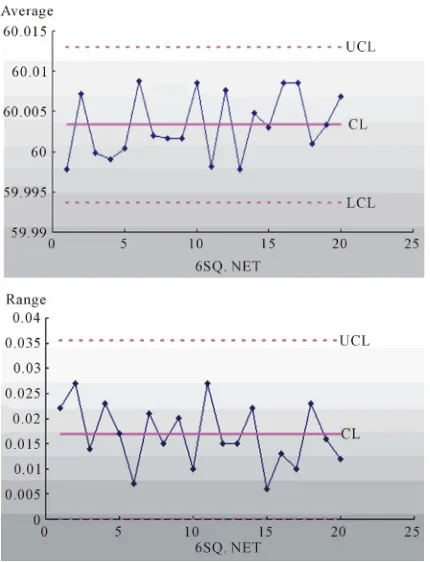
So we can get the xRcontrol Chart (see Figure 1).
From the Figure 1, we can see that all the sample
points are in the control limits and the arrangements of the points are not abnormal. So we come to the conclu- sion that the procedure of bearings is controlled.
From Table 1, we obtain the average value of samples
is 60.0033 mm and the Standard Deviation is 0.00717 mm2.
2 6
pk
T C
s
(1)
Following the above equation, we can obtain: Cpk ≈
0.77. It shows that the process capability is deficient be- cause 0.77 less than 1.
3.2. Application of Multi-Vary Method
[image:2.595.56.287.86.452.2]In multi-vary analysis (MVA), the variation sources of process quality characteristics are divided into time to time variation, piece to piece variation and within piece variation. After on-site analysis, the main factor affecting the diameter of bearings is the taper and the non-con- centricity. The different tapers of two ends of bearings
Figure 1. Average-range control.
can not make the bearings keep in parallel. It maybe has an influence on the contact area when bearings are used. And the different non-concentricity of bearings can make the circle centers of bearing two ends unsymmetrical and cause these bearings can not be assembly.
First, the systematic analysis chart of quality variation is drawn (see Figure 2).
3.2.1. Data Collection and Analysis
The sample data at 8:00, 9:00, 10:00, 11:00, 12:00 are collected to analyze the quality characteristics of diame- ters of bearings.
This can not only ensure the continuity of time, but also collect sufficient data.
Considering that the bearing itself has a certain errors and there are some errors existing in measure, we take three bearing samples in every time span.
We twirl each bearing to read the data of the maxi- mum and the minimum of the left and the right. Then we can get four data of every bearing.
There are data of monitoring as follows. (Tables 2-7)
The multi-vary data analysis at 8:00 is as follows: 1) Within piece variation:
Different tapers variation = |the value of the left aver- age diameter of samples – the value of the right average di- ameter of samples| = 60.014 − 60.010 = 0.004.
[image:2.595.57.287.96.458.2]Figure 2. Systematic analysis chart of quality variation.
Table 2. 8:00 data of bearing and corresponding figures.
Time 8:00
Sample Left Right Average
Maximum 60.018 60.015 1
Minimum 60.008 60.007 60.012
Maximum 60.020 60.015 2
Minimum 60.009 60.008 60.013
Maximum 60.018 60.017 3
Minimum 60.009 60.000 60.011
Average 60.014 60.010 60.012
8:00 the average diameter value of three samples = 60.012.
Table 3. 9:00 data of bearing and corresponding figures.
Time 9:00
Sample Left Right Average
Maximum 60.010 60.000 1
Minimum 59.998 59.992 60.000
Maximum 60.008 60.001 2
Minimum 60.000 59.995 60.001
Maximum 60.011 60.000 3
Minimum 60.000 59.997 60.002
Average 60.0045 59.9975 60.001
2) Piece to piece variation:
Sample 1 − 2 = |the average of sample 1 – the average of sample 2| = 60.013 − 60.012 = 0.001.
Sample 2 − 3 = |the average of sample 2 – the average of sample 3| = 60.013 − 60.011 = 0.002.
3) Time to time variation:
By parity of reasoning, five time span variation values are obtained. (Table 7)
By analogy, we can obtain five time variation values.
Table 4. 10:00 data of bearing and corresponding figures.
Time 10:00
Sample Left Right Average
Maximum 59.997 59.984 1
Minimum 59.992 59.979 59.988
Maximum 59.995 59.983 2
Minimum 59.985 59.981 59.986
Maximum 59.997 59.991 3
Minimum 59.987 59.981 59.989
Average 59.992 59.983 59.988
Table 5. 11:00 data of bearing and corresponding figures.
Time 11:00
Sample Left Right Average
Maximum 60.018 60.004 1
Minimum 60.006 60.000 60.007
Maximum 60.016 60.006 2
Minimum 60.010 60.000 60.008
Maximum 60.017 60.014 3
Minimum 60.009 60.000 60.009
Average 60.014 60.003 60.008
Table 6. 12:00 data of bearing and corresponding figures.
Time 12:00
Sample Left Right Average
Maximum 60.010 60.000 1
Minimum 60.000 59.998 60.002
Maximum 60.008 60.001 2
Minimum 60.000 59.995 60.001
Maximum 60.011 60.002 3
Minimum 60.002 59.997 60.003
Average 60.005 59.999 60.002
3.2.2. Process Improvement Suggestion
Through field analysis on the above sample data, we can offer a proposal on improving process quality of bearings. (Table 8)
3.2.3. Taking Data of Bearings Anew
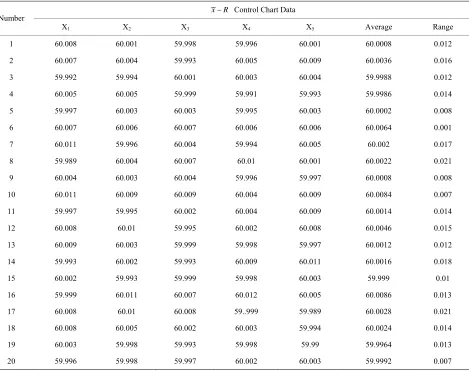
We take the inner diameter data of bearings of one proc- ess through the above adjustment. (Table 9)
From Table 9, we obtain the average value of samples
Table 7. Multi-vary data of bearing.
Variation kind 8:00 9:00 10:00 11:00 12:00
Tapers variation 0.004 0.007 0.009 0.011 0.006 Within piece
variation Non-concentricity variation 0.001 0.008 0.007 0.008 0.006
Sample 1 −2 0.001 0.001 0.002 0.001 0.001 Piece to piece
variation Sample 2 −3 0.002 0.001 0.003 0.001 0.002
Time to time variation 60.012 60.001 59.988 60.008 60.002
By analogy, we can obtain five time variation values.
Table 8. Quality variation reason and modification table.
Variation Group Variation Sub-Group Degree Variation Reason Variation Modification
Tapers variation Unbalance of bearing axis Adjust track Within piece variation
Non-concentricity variation wear of air connection Adjust non-concentricity or replace bearing
Piece to piece variation Bearing to bearing neglectable ---- ---
Time to time variation Hour to hour key Lack of coolant Add coolant
Table 9. Bearing data.
xR Control Chart Data Number
X1 X2 X3 X4 X5 Average Range
1 60.008 60.001 59.998 59.996 60.001 60.0008 0.012
2 60.007 60.004 59.993 60.005 60.009 60.0036 0.016
3 59.992 59.994 60.001 60.003 60.004 59.9988 0.012
4 60.005 60.005 59.999 59.991 59.993 59.9986 0.014
5 59.997 60.003 60.003 59.995 60.003 60.0002 0.008
6 60.007 60.006 60.007 60.006 60.006 60.0064 0.001
7 60.011 59.996 60.004 59.994 60.005 60.002 0.017
8 59.989 60.004 60.007 60.01 60.001 60.0022 0.021
9 60.004 60.003 60.004 59.996 59.997 60.0008 0.008
10 60.011 60.009 60.009 60.004 60.009 60.0084 0.007
11 59.997 59.995 60.002 60.004 60.009 60.0014 0.014
12 60.008 60.01 59.995 60.002 60.008 60.0046 0.015
13 60.009 60.003 59.999 59.998 59.997 60.0012 0.012
14 59.993 60.002 59.993 60.009 60.011 60.0016 0.018
15 60.002 59.993 59.999 59.998 60.003 59.999 0.01
16 59.999 60.011 60.007 60.012 60.005 60.0086 0.013
17 60.008 60.01 60.008 59..999 59.989 60.0028 0.021
18 60.008 60.005 60.002 60.003 59.994 60.0024 0.014
19 60.003 59.998 59.993 59.998 59.99 59.9964 0.013
20 59.996 59.998 59.997 60.002 60.003 59.9992 0.007
[image:4.595.68.537.355.726.2]According to the Equation (1), we can obtain Cpk =
1.11. For 1 ≤Cpk≤ 1.33, the process capability is normal.
The goal has now been finally attained through the multi- vary analysis of bearings.
4. Conclusion
In brief, the process capability is improved through the multi-vary analysis to the CHTD5/7 model bearings made by one company in Shanghai, so the quality of bearings is made better.
REFERENCES
[1] H. Zhen, E. S. Qi and S. H. Zhang, “Some Problems in the Application of xR Control Chart,” Journal of In- dustrial Engineering and Engineering Management in
China, Vol. 12, No. 1, 2000, pp. 4-5.
[2] Z. H. Yu and S. T. Wu, “Study on Quality Control Me- thod in Small Batch Manufacturing Process,” Chinese Journal of Mechanical Engineering, Vol. 22, No. 2, 2001,
pp. 3-4.
[3] D. C. Montgomery, “Design and Analysis of Experi- ments,” John Wiley and Sons, New York, 1996, pp. 25- 26.
[4] S. W. Well and J. D. Smith, “Making Control Chart Work for You,” Semiconductor International, Vol. 31, No. 4,
1991, pp. 24-25.
[5] M. Hamada, R. J. Mackay and J. B. Whitney, “Continu- ous Process Improvement with Observational Studies,”
Journal of Quality Technology, Vol. 25, No. 2, 1993, pp.