A Self-Adaptive Parallel Encryption Algorithm Based on
Discrete 2D-Logistic Map
Jing Wang1, Guoping Jiang2
1College of Computer, Nanjing University of Posts and Telecommunications, Nanjing, China 2College of Automation, Nanjing University of Posts and Telecommunications, Nanjing, China
Email: [email protected], [email protected]
Received December 4, 2012; revised January 6, 2013; accepted January 18,2013
ABSTRACT
A self-adaptive parallel encryption algorithm based on discrete 2D-Logistic map is developed according to the position scrambling and diffusion of multi-direction in variable space of spatial chaos. The binary sequences b1b2b3···bn are ob- tained according to the user key, in which the binary sequence 0 and 1 denote distribution mode of processors and the number of binary sequence n denotes cycle number. Then the pseudorandom 2D matrix is generated by 2D-Logistic map, and adaptive segmentation is applied in image matrix and pseudorandom matrix according to the value and the number of binary sequence. The parallel operation is used among blocks to improve efficiency and meet real-time de- mand in transmission processes. However, the pixel permutation is applied in partitioned matrix through ergodic matrix generated by pseudo-random matrix-block to decrease the correlation of adjacent pixels. Then the pixel substitution is used for fully diffusing through cipher block chaining mode until n cycles. The proposed algorithm can meet the three requirements of parallel operation in image encryption and the real-time requirement in transmission processes. The security is proved by theoretical analysis and simulation results.
Keywords: 2D-Logistic Map; Pseudo-Random Matrix; Theoretical Analysis; Simulation Results
1. Introduction
With the rapid development of computer technologies and communication networks, especially the wide appli- cation of different Internet services, more and more digi- tal information such as voice, image and critical data are transmitted on networks. However, much important data is stolen or destroyed in information transmission, it has been reported that there is one case of hacker invasion every 20 seconds in the world [1]. Chaos theory has been established since 1970s by many different research areas, such as physics, mathematics and chemistry, etc. During the last decades, the use of chaos in cryptography and se- cure communication has aroused great interest of re- searchers because of its sensitivity to initial condition and control parameters, ergodicity and mixing, which are ana- logous to the confusion and diffusion properties of a good cryptosystem [2-5]. As a response to this concern, a large number of chaotic cryptosystems have been pro- posed. An image scrambling encryption algorithm of pixel bit based on chaos map is proposed by Ye [6], in which each pixel is converted into binary numbers of 8 bits. However, Zhao pointed out that Ye’s cryptosystem can not resist chosen-plaintext attack and known-plain- text attack [7]. A chaos-based image encryption algo-
each sub-image is encrypted by advanced encryption standards algorithm (AES for short), but the short period and weak statistical characteristics of S-box is well known. A new image encryption method [14]: parallel sub-image encryption with hyper chaos is pro- posed by Mirzaei. In the algorithm, the original image is divided into four sub- images according to the up and down or so. Each sub- image is scrambled by logistic sequences, then the while image is permuted and CBC mode is applied in every sub-image, which has a high encryption speed, a large key space and weak difference characteristics. To over- come the drawbacks of the existing parallel encryption algorithm, we present a self-adaptive parallel encryption algorithm based on discrete 2D-Logistic map, which can meet real-time requirement with fast calculating speed. And the security is verified by differential analysis, cor- relation analysis, sensitivity test and information entropy analysis.
2. Self-Adaptive Parallel Encryption
Algorithm Based on Discrete 2D-Logistic
Map
2.1. Discrete 2D-Logistic Map
With the development of technology, more and more fields are related to discrete-time multivariable system which mathematical model is deviation equation. Those discrete-time multivariable systems are called space dis- crete dynamic system [15], that is, 2D-discrete dynamic system denoted as
1, , 1 , 1 ,
m n m n m n
x x f x (1)
where f() is a nonlinear function, also known as forcing function. Ω (–∞,+∞) is a real number. μ> 0 is a con- stant. m, n and xm,n are states of space system. In fact, difference Equation (1) is the discrete form of one-di- mensional convection Equation (2).
, 1v v f v
x y
(2)
Particularly, when n = n0, ω= 0, Equation (2) is de- noted as
0 0
1, 0 , 1 , 1 0 ,
m n m n m n
x x f x 0
m(3)
Because n is constant n0, Equation (3) can be ex- pressed as follows:
1 ,
m
x f x (4) Therefore, 1D-discrete dynamic system Equation (4) is a special case of 2D-discrete dynamic system Equation (1). When f
,xm
xm
1 xm
, Equation (4) is ex- pressed as
1 , 1
m m m
This is classic 1D-Logistic map. When
2, ,
, 1 m n 1 1 m n
f x x , 2D-discrete dynamic system is denoted as:
21, , 1 1 1 ,
m n m n m n
x x x
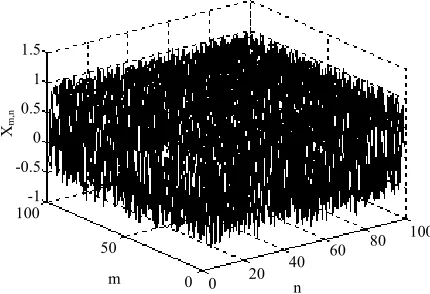
(6) Study shows that the system Equation (6) is chaotic state with 2 > μ>= 1.55 and ω (–1,1), and has two iteration variables which is known as 2D-Logistic map.There are two control parameters in space chaotic sys- tem. Space chaotic orbits are extremely sensitive to the change of control parameters. When μ= 1.96, ω= –0.05, the chaotic behavior of space chaotic system is described as Figure 1.
2.2. Demands of Parallel Encryption Algorithm
Parallel encryption algorithm refers to encrypting one image simultaneously by two or more processing ele- ments (PE for short). Each PE has its separate memory space and computing resource. One superior parallel en- cryption mode must meet the following demands [13]:
1) Good diffusion effect
Small changes in plain text or key have a big influence on cipher text is called diffusion which is known as ava- lanche effect. Generally CBC mode is used to realize fully diffusing in existing encryption algorithms. How- ever, the application of CBC makes algorithm steps be- come serial mode. Therefore, the encryption algorithm is not only parallel operation but also can achieve fully dif- fusing.
2) Load balance of computing quantity
Computing time depends on the PE with the longest running time. Therefore, the calculated quantity of every
PE should be equal for a good parallel encryption algo- rithm.
3) Critical section management
Two or more PE may read and write one memory area in parallel operation, and this memory area is called
0 20
40 60
80 100 100
50
0 n
m 1.5
1
0.5
0
-0.5
-1 Xm
,n
m [image:2.595.317.532.569.716.2]critical section. Therefore, one good parallel algorithm should avoid this situation.
2.3. Inter-Block Encryption Algorithm
It is assumed that one original image of size M M is encrypted by r processing elements 1 2 r,
and meets the divisibility of r dividing M. The encryption process is as follows:
,PE , , PE PE
Step 1. Key generation. The binary sequence
1 2 3 n is generated according to user key, where the
binary values 0 and 1 represent two distribution forms of processing elements, and the number of binary sequence is cycle number.
b b b b
Step 2. Image segmentation. The plain-text matrix is
divided into r blocks. If bn = 0, PEiencrypts the pixels of matrix block which is from the
i1
M r r
throw to the
iM r
th row of plain-text matrix. If bn = 1,PEiencrypts the pixels of matrix block which is from the
i1 M r r
th column to the
iM r
thcolumnof plain-text matrix, where i1, 2, , r.
Step 3. Each matrix block is scrambled and mixed by
one processing element.
Step 4. Go to Step 1 until the end of the loop.
2.4. Encryption Algorithm in Block
Assumed that the original image is P, and the pixel ma- trix is denoted as
1,1 1 2 1,
,1 ,2 ,
...
...
M
M M M M
p p p
P
p p p
, (7)
where i
1,M
,j
1,M
. A numerical matrix K of size M M is produced according to 2D-discrete dy- namical system, which is represented in Equation (8).1,1 1 2 1,
,1 ,2 ,
...
...
M
M M M M
k k k
K
k k k
, (8)
where i
1,M
,j
1,M
. In the following, the steps of the proposed algorithm are described in detail.Step 1. The distribution form of processing elements is
defined according to binary sequences 1 2 3 n. When bn = 0, the numerical matrix K is divided into r
blocks in row direction. The ith numerical matrix block
b b b b
0 i
K is denoted as
2 2 2
1 2
1 2
Equivalent to M
M M M
M M M
r r r M
r
k k k
k k k
1 1,1 1 1, 0
,1 ,
M M
i i M
r r
i
M M
i i M M
r r M
r k k K k k (9)
Then the numerical matrix block 0 i
K is transformed into ergodic matrix 0 in Equation (10).
i
Q
2 2 2
1 2
0
1 2
M i
M M M M M
M
r r r M
r
q q q
Q
q q q
(10)
where 1 2 2
1
M M
M
r r
q q q q
k k k k
2
.
When bn = 1, the numerical matrix K is divided into r
blocks in column direction. The ith numerical matrix block
1 i
K is denoted as
2 2
1, 1 1 1,
2, 1 1 2,
1
, 1 1 ,
1 2 1 1 Equivalent to M M i i r r M M i i r r i M M
M i M i M
r r M
r M
r
M M
r r
M M M
M
r r r M
r k k k k K k k k k k k k k (11)
Then the numerical matrix block 1 i
K is converted into ergodic matrix 1 in Equation (12).
i Q 2 2 1 2 1 1 1 M r M M r r i
M M M
M
r r r M
r q q q q Q q q
(12)
where 1 2 2
1
M M M M
r r r r
q q q q q
k k k k k
2
.
Step 2. Position scrambling. We assume that the ith
matrix block Pi is scrambled according to ergodic matrix in PEi.
If bn = 0, the ith matrix block is scrambled ac- cording to ergodic matrix , after scrambling the ma-
trix is denoted as 0 in Equation (13).
i
P
2 2 2
1 1,1 1 1,2 1 1, 0
,1 ,2 ,
1 2
1 2
Equivalent to
M M M
i M
r r r
i
M M M
i M M
r r r M
r
M
M M M M M
M
r r r
i i i i M r p P p
p p p
p p p
p p p p 1 2
2 2 2
1 2
0
M
M M M
M M
r r r
q q q
i
q q q
M M r
p p p
P
p p p
(13)
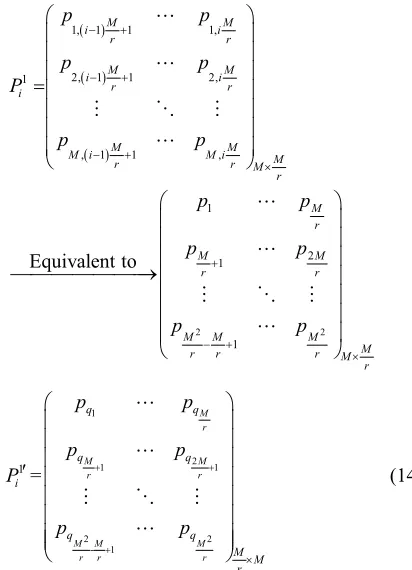
If , the ith matrix block is scrambled ac- cording to ergodic matrix , and after scrambling the matrix is denoted as in Equation (14).
1 n
b 1
i P 1 i Q 1 i P 2 2
1, 1 1 1, 2, 1 1 2, 1
, 1 1 ,
1 2 1 1 Equivalent to M M i i r r M M i i r r i M M
M i M i M
r r M
r M
r
M M
r r
M M M
M r r r M
r p p p p P p p p p p p p p 1 2 1 1 2 2 - 1 1= M r M M r r
M M M
r r r
q q q q i q q M M r p p p p P p p
(14)
Step 3. Image scrambling can destroy correlation be-
tween two adjacent pixels, but it cannot change pixel value thus the histogram is the same with original image. Therefore, the scrambled image should be further en- crypted. For example, to encrypt the ith scrambled matrix block 0
i
P with bn = 0, and the result is denoted as
in Equation (15).
0 i
C
2 2 2
1 2
0
1 2
M i
M M M
M M M
r r r M
r
c c c
C
c c c
(15)
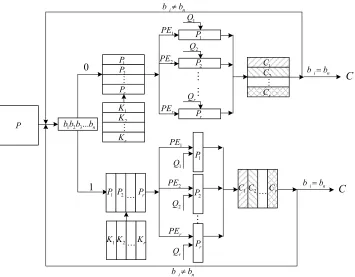
where cj pqj cj1 Go to step 1 until the end of the
[image:4.595.57.289.83.318.2]loop. The detailed encryption diagram is described in
Figure 2.
When n = 1, the pixel mixing based on chaining struc- ture can make a small change of one pixel have effect on other pixels in the same block. And when n = 2, the in- fluence can spread into whole image, which meet the demands of parallel encryption algorithms. In addition, the data volume is exactly same for every processing ele- mentwhich can realize load balance. Finally, there is no problem of critical section.
3. Theoretical Analysis and Experimental
Simulation
Experimental analysis of the proposed algorithm in this letter has been done. To estimate the performance of the proposed scheme, we carry out a series of experiments. The experimental simulation is all implemented using Matlab8.0 running on a personal computer with i7 – 3770 s 2.8 GHz*4 processor. The parameter is selected as = 1.96, ω= –0.05.
3.1. Statistical Analysis
The distribution of cipher image is very important be- cause it has to hide the redundancy of original image and should not leak any information about original image or any relation between encrypted image and original image. In statistical simulation, the parameters are selected as b1
= 0, b1 = 1 and b1b2 = 10 respectively. The simulation results are described in Figure 3. As can be seen form Figure 3, if n = 1, the proposed encryption in the paper
can hide the redundancy of plain image completely, i.e., it can resist statistical attack effectively.
3.2. Differential Analysis
[image:4.595.76.282.367.652.2]1 2 3...n
b b b b
0
1 1
P
2 P
r
P
P
1
P P2 Pr
1 PE
1
P
2 P
r
P
1
P
2 P
r
P
2 PE
r PE
1
PE
2
PE
r
PE
C
C i n b b
C i n b b i n
b b
i n b b
1
Q
2
Q
r
Q
1
Q
2
Q
r
Q
1
K
2 K
r
K
1 K K2 Kr
1
C
2
C
r
C
1
[image:5.595.120.475.85.362.2]C C2 Cr
Figure 2. Encryption diagram.
Plain image
Cipher image
Cipher image
Cipher image
(a) (b) (c) (d)
Cipher image
Cipher image
Cipher image
Cipher image
[image:5.595.113.483.388.591.2](e) (f) (g) (h)
Figure 3. Plain image and cipher image. (a) Plain image. (b) Cipher image with b1b2 = 10. (c) Cipher image with b1 = 0 for PE1. (d) Cipher image with b1 = 0 for PE3. (e) Cipher image with b1 = 1 for PE1. (f) Cipher image with b1 = 1 for PE3. (g) Cipher image with b1 = 0 for PE1, PE2, PE3 and PE4. (h) Cipher image with b1 = 1 for PE1, PE2, PE3 and PE4.
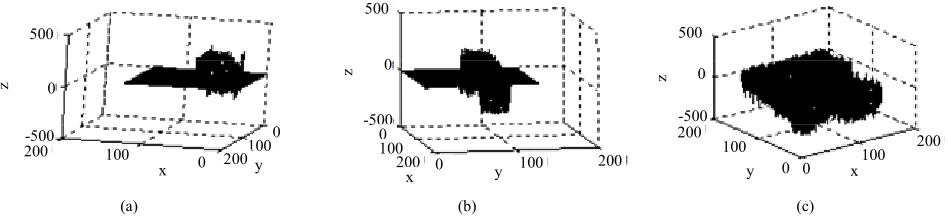
of Figure 3(a) from 113 to 116 in the position (69,98) to
illuminate the confusion and diffusion of Mirzaei’s sche- me and our proposed scheme. Some experiments are per- formed to study confusion and diffusion properties in
Figure 4, which there is only a tiny difference in plain-
image sequences, and then the difference values of ci- pher-image sequences are obtained correspondingly. For Mirzaei’s algorithm in Figure 4(a), we observe that if
there is only a tiny difference in plain image, and there is only some difference in the second block of cipher image correspondingly. However, for our proposed scheme (n = 1) in Figure 4(b), a tiny difference in plain image results
in all the other cipher image change in the third block. And the parameter n = 2 in Figure 4(c), all the other ci-
me are confirmed with n = 2.
In the following, we illustrate the performance of re- sistance on differential attack numerically. The number of pixels change rate (NPCR for short) and the unified average change intensity (UACI for short) are the sig- nificant measure of resistance on differential attack.NPCR and UACIdenote the number of pixels change and the unified average change intensity in cipher image respec- tively, while we change one pixel value in the plain im- age randomly. Assume that there are two cipher images ( X Y, X Y) whose plain images only have one dif-
ferent pixel. The pixels in position E E
i j,
j
of these two cipher images are denoted as and , res- pectively. Then one matrix D is defined with the same size of
,E i E i j
,
X Y , and we assume that if E i
,j E
i j, , then Di j, 0, otherwise, Di j, 1. Therefore, NPCR and UACIcan be represented as1 1
, 0 0
NPCR 100%
X Y
i j i j
D
X Y
(16)
1 1
0 0
1
UACI 100%
255
, ,
X Y
i j
E E
X Y
i j i j
(17)
We change the pixel value of Figure 3(a) from 81 to
85 in the position (169,236), and then based on Equation (16) and (17) with n = 2, NPCR and UACIcan be calcu- lated to be 99.63% and 31.26%, respectively. Therefore, one pixel change in plain image can lead to completely change of cipher image. We can draw conclusion that the
proposed encryption algorithm can resist differential at- tack effectively.
3.3. Key Sensitivity Test
An encryption scheme has to be key-sensitive, meaning that a tiny change in keys will cause decryption failure completely. The key sensitivity test is performed in detail according to the following steps:
Figure 3(a) is encrypted with the test key = 1.96, ω
= –0.05, respectively. And its corresponding decryp- ted image with the correct key is presented in Figure 5(a).
Then, the corresponding decrypted image with = 1.96001 is presented in Figure 5(b).
Again, when one pixel in PE3 is changed, the cor- responding decrypted image with the correct key is presented in Figure 5(c), while b1 is chosen as “1”.
Finally, when one pixel in PE3 is changed, the corre- sponding decrypted image with the correct key is pre- sented in Figure 5(d), while b1b2 are chosen as “10”, re-
spectively.
Based on the simulation mentioned above, we can draw a conclusion that if there is a tiny change in the key explained before, we can obtain a completely different image from the original image. And if there is a tiny change in the plain image, the decrypted image is com- pletely different form the original image, while b1b2 are chosen as “10” respectively. Those simulation results show high key-sensitivity and plain-text sensitivity of the
0
-500 0
y
z
100 200 x
200 500
0
-500 -500
200
200 200
100 100
y y
500
500
0 0
z z
100
100 200
0 100
x 0 0 0 x
[image:6.595.64.538.455.563.2](a) (b) (c)
Figure 4. Difference in cipher text changing the pixel value of Figure 3(a) from 113 to 116 in the position (69,98). (a) Mirzaei’s. (b) Ours: n = 1. (c) Ours: n >= 2.
Decrypted image
Decrypted image
Decrypted image
Decrypted image
[image:6.595.111.483.604.704.2](a) (b) (c) (d)
Figure 5. Decrypted image. (a) μ = 1.96. (b) μ = 1.96001. (c) One pixel in PE3 is changed with b1 = 1. (d) One pixel in PE3 is hanged with b1b2 = 10.
proposed algorithm.
3.4. Analysis of Information Entropy
Entropy H(x) was introduced by Shannon in 1949 firstly and can be obtained through the following formula:
log2
n i
i i
H x
p x p x,
(18)
where n is the number of gray scale levels in an image, is the occurrence probability of gray scale in the image and meets the following formula:
ip x
0 1, 1, 2,
1 i n
i i
p x i n
p x
(19)
The entropy value will be 8 for images that are pro- duced totally randomly. The closer the entropy of an al- gorithm is 8, the less predictable, and thus the more se- cure the scheme. The cipher-image entropy values have been measured using six plain images in USC-SIPI data
base and the results are shown in Table 1.
3.5. Analysis of Correlation of Two Adjacent Pixels
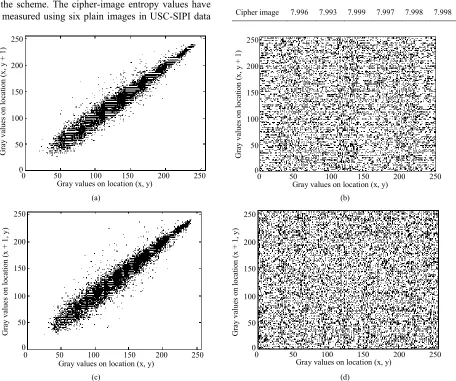
Each pixel in the digital image is not independent of other pixels, but has significant correlation. One of pur- pose for an encryption algorithm is to decrease correla- tion between adjacent pixels and realize zero co-correla- tion properties. To show correlation between adjacent pi- xels in encrypted images, we take Figure 4(a) for ex-
ample to analyze correlation between two vertically ad- jacent pixels, two horizontally adjacent pixels, and two diagonally adjacent pixels, respectively.
Table 1. The entropy of original gray scale image and its corresponding encrypted ones by the proposed algorithm.
H(x) 7.1.06 7.1.07 7.1.08 7.1.09 7.1.10 7.2.01
Plain image 6.695 5.991 5.053 6.189 5.908 5.641
Cipher image 7.996 7.993 7.999 7.997 7.998 7.998
250
200
150
100
50
0
G
ray va
lu
es
on
lo
ca
tio
n
(x
, y + 1)
0 50 100 150 200 250 Gray values on location (x, y)
250
200
150
100
50
0
G
ray va
lu
es
o
n
lo
ca
tio
n
(x
, y +
1)
0 50 100 150 200 250 Gray values on location (x, y)
(a) (b)
250
200
150
100
50
0
G
ray
va
lu
es
on
lo
ca
tio
n (
x +
1
, y)
0 50 100 150 200 250 Gray values on location (x, y)
0 50 100 150 200 250 Gray values on location (x, y)
250
200
150
100
50
0
G
ray
va
lu
es
on
lo
ca
tio
n (
x +
1
, y)
[image:7.595.77.533.318.699.2](c) (d)
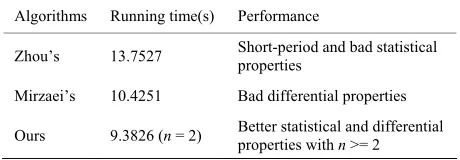
Table 2. Comparison of running time and theirs perform- ance.
Algorithms Running time(s) Performance
Zhou’s 13.7527 Short-period and bad statistical properties
Mirzaei’s 10.4251 Bad differential properties
Ours 9.3826 (n = 2) Better statistical and differential properties with n >= 2
3.6. Running Time Test
Three parallel algorithms are simulated in running time test. They are Zhou’s algorithm [13], Mirzaei’s algorithm [14] and the proposed algorithm. The encrypted image is gray 21.512 in USC-SIPI image database and the simula- tion results are described in Table 2.
4. Conclusion
In this paper, the security property of a class of image encryption algorithms based on chaotic maps bas been discussed. And some findings on the security problem of the existing parallel encryption algorithms have been re- ported. Based on discrete 2D-Logistic map, a self-adap- tive parallel encryption algorithm has been developed ac- cording to the position scrambling and diffusion of multi- direction in variable space of spatial chaos. The results of numerical analysis show that the proposed algorithm can meet the three requirements of parallel operation in im- age encryption and the real-time requirement in trans- mission processes. The security has been proved by the- oretical analysis and simulation results.
5. Acknowledgements
The authors are greatly indebted to anonymous reviewers for their valuable comments and suggestions. This re- search is supported in part by the National Natural Sci- ence Foundation of China under Grant No. 60874091, the Six Projects Sponsoring Talent Summits of Jiangsu Province under Grant No. SJ209006, the Foundation for Doctoral Program of High Education of China under Grant No. 20103223110003, the MOE Research in the Humanities and Social Sciences Planning Fund of China (Grant No. 12YJAZH120), and the Postgraduate Scien- tific Innovation Project for Universities of Jiangsu Prov- ince under Grant No. CXZZ11-0401.
REFERENCES
[1] X. Ma, C. Fu and W. M. Lei, “Novel Chaos-Based Image Encryption Scheme with an Improved Permutation Proc- ess,” International Journal of Advancements in Comput-
ing Technology, Vol. 3, No. 5, 2011, pp. 223-233. [2] Z. Z. Wang and Q. Y. Han, “Finite-Time Chaos Synchroni-
zation of Unified Chaotic System with Uncertain Para- meters,” Communications in Nonlinear Science and Nu- merical Simulation, Vol. 14, No. 5, 2009, pp. 2239-2247. [3] H. Wang, Z. Z. Han, Q. Y. Xie, et al., “Finite-Time Chaos
Control of Unified Chaotic Systems with Uncertain Pa- rameters,” Communications in Nonlinear Science and Nu- merical Simulation, Vol. 55, No. 4, 2009, pp. 323-328. [4] H. P. Lu and X. W. Wang, “A New Spatiotemporally Cha-
otic Cryptosystem and Its Security and Performance Ana- lyses,” Chaos: An Interdisciplinary Journal of Nonlinear Science, Vol. 14, No. 3, 2004, pp. 617-629.
[5] Y. Yang and X. F. Liao, “Cryptanalysis and Improvement on a Block Cryptosystem Based on Iteration a Chaotic Map,” Physics Letters A, Vol. 363, No. 4, 2007, pp. 277- 281.
[6] G. D. Ye, “Image Scrambling Encryption Algorithm of Pixel Bit Based on Chaos Map,” Pattern Recognition Letters, Vol. 31, No. 5, 2010, pp. 347-354.
[7] L. Zhao and A. Adhikari, “On the Security Analysis of an Image Scrambling Encryption of Pixel Bit and Its Im- proved Scheme Based on Self-Correlation Encryption,” Communications in Nonlinear Science and Numerical Simulation, Vol. 17, No. 8, 2012, pp. 3303-3327.
[8] Z. Guan, F. Huang and W. Guan, “Chaos-Based Image En- cryption Algorithm,” Physics Letters A, Vol. 346, No. 1, 2005, pp. 153-157.
[9] G. R. Chen, “A Symmetric Image Encryption Scheme Based on 3D Chaotic Cat Maps,” Chaos, Solitons and Fractals, Vol. 21, No. 7, 2004, pp. 749-761.
[10] P. Li, Z. Li and W. A. Halang, “A Multiple Pseudorandom- Bit Generator Based on a Spatiotemporal Chaotic Map,” Physics Letters A, Vol. 349, No. 6, 2006, pp. 467-473. [11] A. Kanso and M. Ghebleh, “A Novel Image Encryption
Algorithm Based on a 3D Chaotic Map,” Communica- tions in Nonlinear Science and Numerical Simulation, Vol. 17, No. 7, 2012, pp. 2943-2959.
[12] Y. Wang and C. Y. Han, “A Parallel Encryption Algorithm for Color Images Based on Lorenz Chaotic Sequences,” Conference Proceedings on 6th World Congress on Intel- ligent Control and Automation, Dalian, 21-23 June 2006, pp. 9744-9747.
[13] Q. Zhou, K. W. Wong and X. F. Liao, “Parallel Image En- cryption Algorithm Based on Discretized Chaotic Map,” Chaos Soliton & Fractals, Vol. 29, No. 11, 2008, pp. 1081-1092.
[14] O. Mirzaei, M. Yaghoobi and H. Irani, “A New Image En- cryption Method: Parallel Sub-Image Encryption with Hyper Chaos,” Nonlinear Dynamics, Vol. 67, No. 1, 2012, pp. 557-566.