ISSN Online: 1947-3818 ISSN Print: 1949-243X
A Transformer Replacement Decision
Method Based on Probability
Assessment of Failure Rate
Gang Liang
1, Shengwei Li
2*, Yan Qi
3, Jing Cao
3, Yi Hao
4, Wenfu Chen
41State Grid Tianjin Dongli Electric Power Supply Company, Tianjin, China 2State Grid Tianjin Economic Research Institute, Tianjin, China
3Tianjin Electric Power Research Institute, Tianjin, China
4State Grid Tianjin Dispatching and Control Center, Tianjin, China
Abstract
Reasonable probability assessment of transformer failure rate (FR) is a critical reference to the transformer replacement work. At present, the lack of support theory for transformer replacement usually causes reliability and economy is-sues for power companies. For this reason, a transformer replacement deci-sion method based on probability assessment of FR is proposed. Firstly, a first order model of transformer paper degradation is proposed. Then, the Weibull Distribution is used by Monte Carlo Simulation (MCS) to generate the varia-tions of Degree of Polymerization (DP) along with time based on the histori-cal data, and the transformer FR is determined. When the FR is higher than a pre-defined threshold value, the transformer should be replaced for reliability purpose. Finally, the effectiveness of the proposed method for the transformer replacement decision is verified by a typical engineering application.
Keywords
Transformer Replacement, Probability Assessment, Weibull Distribution, Degree of Polymerization
1. Introduction
The safe operation of power transformer is one of the important defenses to the reliability operation of power system. In order to ensure the transformer always works under a healthy operation status, it is critical to assess the failure rate (FR) of transformer and replace the old on eat a most suitable time [1]. As one of the most important equipment in power system, the transformer with a large
num-How to cite this paper: Liang, G., Li, S.W., Qi, Y., Cao, J., Hao, Y. and Chen, W.F. (2017) A Transformer Replacement Deci-sion Method Based on Probability
Assess-ment of Failure Rate. Energy and Power
Engineering, 9, 748-755.
https://doi.org/10.4236/epe.2017.94B080
ber accounts for a significant proportion of the total cost of power companies. As a result, determining a reasonable replacement time for the transformer can effectively reduce the cost of power companies.
At present, there usually exists two extremes in the replacement of transfor-mer. On the one side, the old transformer in service always working exceeds its service life limitation, which may lead to a high maintenance cost. On the other side, frequently replace transformer in pursuit of the high performance of new transformers will definitely results in unnecessary waste. The old transformer still occupies a large proportion in power system at the present time, and the re-placement work is very urgent. Therefore, considering the relationship between the healthy status and service life of transformer, it is critical to determine a transformer replacement decision method for providing the scientific basis for the power enterprises to carry out technology reconstruction of power transfor-mer.
A lot of studies have already been carried out in this area. In refs [2] [3], the method of transformer service life assessment based on large data analysis was proposed. In [4], a transformer life assessment method based on fuzzy theory and markov chain method was developed considering the transformer perfor-mance decline process. A transformer insulation life determination method based on insulation equivalent aging model was proposed in [5]. A method for transformer life assessment based on neural network was proposed in [6] [7]. A transformer state estimation method based on risk analysis method was devel-oped in [8] [9], in order to predict the service life of a transformer. In above re-searches, the service life of the transformer is assessed from different aspects. However, various kinds of uncertainties exist in the operation process of the transformer, which will seriously impact the security operation of the transfor-mer. As a result, there is always a contradiction between economic and reliabili-ty, when decide whether to replace a transformer or not. Therefore, consider the influences from many uncertainties, it is of great practical value to develop ade-cision method for transformer replacement, in order to guide the transformer technical transformation process.
For this reason, a transformer replacement decision method based on proba-bility assessment of FR is proposed. A first order model of transformer paper degradation is used to depict the mathematical relationship between service life and FR, and the Weibull Distribution is used to generate the variations of De-gree of Polymerization (DP) by Monte Carlo Simulation (MCS) along with time. The transformer FR is then determined. When the FR is higher than a pre-de- fined threshold value, the transformer should be replaced for high reliability purpose.
2. Transformer Aging Mechanism Modeling
reliabili-ty. The aging process of insulation paper can reflect the aging process of trans-former, which can be used to guide the life assessment of transformer. The main component of insulating paper is the cellulose, which is made up of many units. The average number of cellulose units contained in a chain is called the Degree of Polymerization (DP) of the insulation paper. The aging process of insulating paper is closely related to the shortening process of the molecular chain, that is, the DP value decreasing process [12]. A first order model of transformer paper degradation depicted in (1)-(3) was introduced to describe the aging process of insulation paper.
2
( ) / - ( )[ ( )]
dDP t dt= k t DP t (1)
0
0
0 ( ) ( )
1 ( ) t ( )
t
DP t DP t
DP t kτ τd
=
+
∫
(2)( ) exp( )
( )
a g
E
k t A
R T t
= (3)
where DP(t) is the DP value at time t; DP(t0) is initial value of DP; Ea is the initial
aging activation energy of insulating paper; A is the gas constant; T(t) is the ab-solute temperature varying with time, which is set to be 370 K in this paper.
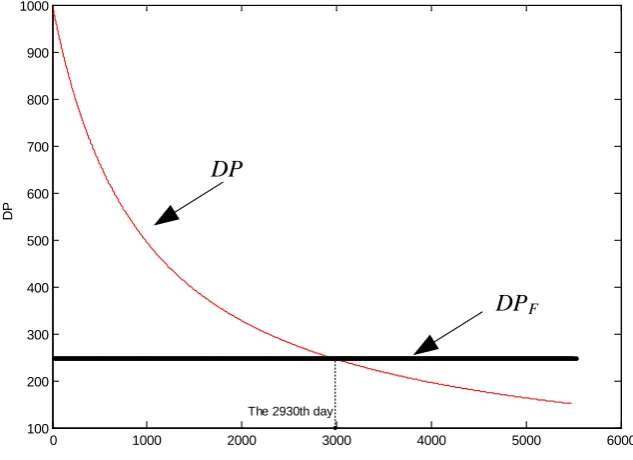
When Ea= 110.942 kJ/mol, Rg= 8.314, DP(t0) = 1000, A = 2 × 10⁸, and T =
370 K, the ideal DP curve changes with time is shown in Figure 1.
[image:3.595.210.527.489.719.2]As depicted in Figure 1, it can be seen that with the increasing of the opera-tion time, the insulaopera-tion performance of the transformer is decreased, which may lead to equipment failure and cause power interruption. Actually, the insu-lation strength of the internal insuinsu-lation of the transformer should be greater than the joint stress. When the insulation strength of the insulation paper is
Figure 1. DP curve with time ideally.
0 1000 2000 3000 4000 5000 6000 100
200 300 400 500 600 700 800 900 1000
DP
DP
DP
Flower than the joint stress (DPF), the breakdown of the insulation paper will lead
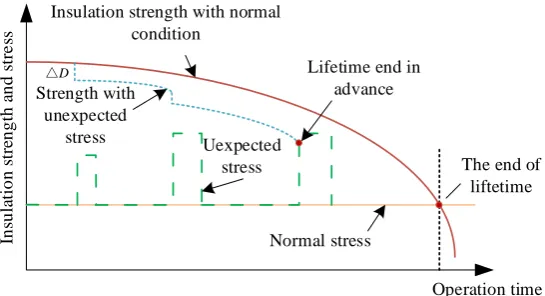
to the failure. At the same time, in the actual operation process, the life of the transformer will face a variety of uncertainties (also called unexpected stress), such as electrical stress, mechanical stress, thermal stress and chemical stress, which will significantly impact the insulation strength, just as shown in Figure 2.
It can be seen that under the normal condition, the insulation strength de-creases with time. When the insulation strength is equal to the normal stress, the service life of the transformer is terminated. When suffered from some unex-pected stresses, the insulation strength of the transformer is significantly re-duced, which may lead to the reduction of the service life. Therefore, it is neces-sary to simulate the random effects of the unexpected stress on the insulation strength for replacement of old transformers.
3. Replacement Decision Method Based on Probability
Assessment of Failure Rate
3.1. Simulation of Transformer State Using Weibull Distribution
The Weibull distribution is widely used to reflect the equipment failure rate changes with service age [13] [14]. By changing the shape parameter and scale parameter, it can be used to depicted the equipment failure rate tendency at dif-ferent operation periods. For this reason, the Weibull distribution depicted in (4) is used to randomly generate the deviation value of DP (ΔD) when the unex-pected stress happens.
exp[ ( ) ]t
R β
α
= − (4)
where α is the scale parameter;
β
is the shape parameter. Whenβ
>1, itmeans the transformer is at the aging stage [15]. We assume that the opera-tion data of transformer DP, can be obtained by on-line monitoring sensors. Thus, the difference between the DP value at a specific time and the DP ex-pected value, which is depicted using ΔD, is used as the statistical data for as-sessment. In the real application, the statistical data of ΔD is fitted by the
Operation time
I
ns
ul
at
ion
s
tr
engt
h
a
nd
st
re
ss
Normal stress
The end of liftetime Uexpected
stress Insulation strength with normal
condition
Strength with unexpected
stress
[image:4.595.232.505.553.701.2]Lifetime end in advance △D
Weibull distributionin (4). Then the fitted Weibull distribution function is used by MCS to generate ΔD a teach specific time.
3.2. Replacement Decision Method
The steps of the proposed replacement decision method based on probability assessment of failure rate are given as follows:
Step 1: Set the Monte Carlo simulation times as N. The iteration time icount = 1. The initial prediction time is t0. The aim is to predict the future service life of
the transformer within n days. The simulation changing step is set to be 1 day. The transformer fault statistical vector is given in (5)
[
inumt0,inumt0 1+, ,inumti, ,inumn]
= … …
inum (5)
where n is the forecast time period; inumti= 0, when ti= t0, (t0 ≤ ti≤ n).
Step 2: The transformer statistical data of ΔD is fitted by the Weibull distribu-tion with the corresponding scale and shape parameters using (4) at time ti.
Step 3: The fitted Weibull distribution at time ti is used to generate ΔDti (the
ΔD for iteration time icount at time ti).
Step 4: Using the value Dti in Figure 1 at time ti, the DP value at time ti in the
icount interation (DPti= Dti− ΔDti) is determined. If DPti≤ DPF, The expected
service life (tf) of the transformer is obtained (tf = ti), and the corresponding
failure times at ti, inumti = inumti+ 1. Then, renew the iteration time icount =
icount + 1. Go to step 5. Otherwise, ti= ti+ Δt, and go to step 2.
Step 5: if icount ≤ N, go to step 2. Otherwise, go to step 6.
Step 6: According to inum, the fault ratecurve of the transformer changing with time is determined. For a specific time ti, the fault ratepf_ti = inumti/N,
which is used to determine the service life of the transformer.
Step 7: Set the failure probability threshold (pfc) for determining the service
life of transformer. If pf_ti≥ pfc, the transformer is considered to be replaced and
reaches the termination of its service life.
3.3. Case Studies
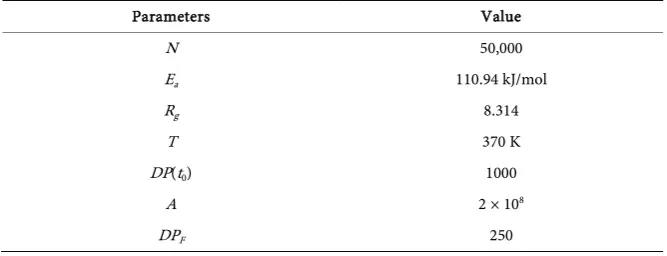
[image:5.595.206.540.609.737.2]In order to verify the validity of the method proposed in this paper, a distribu-tion transformer in a power supply company was used as a test case, and the si-mulation parameters are shown in Table 1.
Table 1. Simulation parameters.
Parameters Value
N 50,000
Ea 110.94 kJ/mol
Rg 8.314
T 370 K
DP(t0) 1000
A 2 × 10⁸
The comparison results of DP variation between the normal and unexpected stress conditions are given in Figure 3. Compared with Figure 1, for a specific simulation, the DP decreases significantly with time under unexpected stress condition. The service life of transformer drops to 1979 days from 2945 days, when DPF= 250 days.
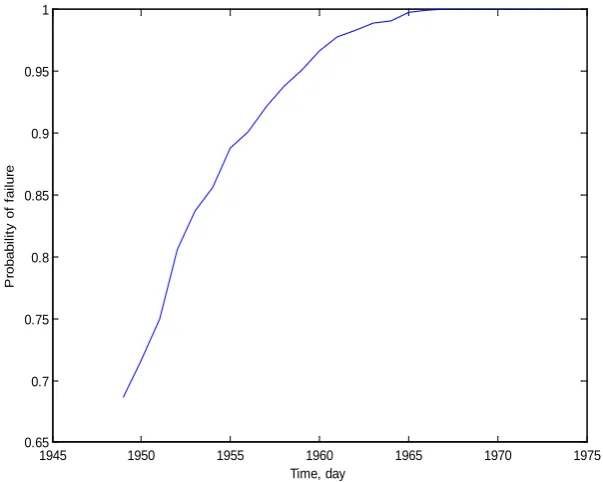
According to the method proposed in this paper, the failure rate in the last 25 days before the end of service life was analyzed. As seen in Figure 4, in the last
0 1000 2000 3000 4000 5000 6000 0
100 200 300 400 500 600 700 800 900 1000
Time, day
DP
normal condition
unexpected condition
2945 1979
[image:6.595.211.528.190.424.2]Figure 3. The comparison results of DP variation between the normal and unexpected stress conditions.
Figure 4. Failure rate before service life termination of a transformer.
1945 1950 1955 1960 1965 1970 1975 0.65
0.7 0.75 0.8 0.85 0.9 0.95 1
Time, day
P
robabi
li
ty
of
f
ai
lur
[image:6.595.222.524.474.715.2]25 days, the failure rate of the transformer is continuously increasing. At the end of day 1979, the failure rate is gradually approaching to 100%. It can be consi-dered that the service life of the transformer is terminated, and the transformer should be replaced.
4. Conclusion
The service life of a transformer is significantly influenced by unexpected stresses. As a result, it is of great practical value to put forward a decision me-thod for transformer replacement, in order to guide the transformer technical transformation process. For this reason, a transformer replacement decision method based on probability assessment of FR is proposed. A first order model of transformer paper degradation is firstly proposed. The Weibull Distribution is used by MCS to generate the variations of DP along time based on historical da-ta, and the transformer FR is determined. When the FR is higher than a pre-de- fined threshold value, the transformer should be replaced for reliability purpose. Case studies show that the method can effectively identify the influences of var-ious uncertainties on the service life of transformer, and improve the technical level and economic benefit of power company, which has a good engineering application prospect.
Acknowledgements
This work was supported by the project: Research on key techniques to the de-sign of smart substation in Tianjin (KJ15-1-08).
References
[1] Aldhubaib, H.A. and Salama, M.M.A. (2014) A Novel Approach to Investigate the Effect of Maintenance on the Replacement Time for Transformers. IEEE Transac-tions on Power Delivery, 42, 291-293. https://doi.org/10.1109/tpwrd.2014.2321409
[2] Zhou, D., Wang, Z.D., Jarman, P. and Li, C.R. (2014) Data Requisites for Transfor-mer Statistical Lifetime Modelling—Part II: Combination of Random and Aging- Related Failures. IEEE Transactions on Power Delivery, 29, 154-160.
https://doi.org/10.1109/TPWRD.2013.2270116
[3] Zhuang, Q., Morshuis, P.H.F., Chen, X. and Smit, J.J. (2012) Life Prediction of a Full-Scale Transformer Winding Insulation through Statistical Analysis of AC Vol-tage Endurance Test Data. IEEE Transactions on Dielectrics and Electrical Insula-tion, 19, 460-471. https://doi.org/10.1109/TDEI.2012.6180239
[4] Adoghe, A.U., Awosope, C.O.A. and Daramola, S.A. (2010) Modeling Distribution Component Deterioration: An application to Transformer Insulation. Advanced Materials Research, 367, 117-123.
https://doi.org/10.4028/www.scientific.net/AMR.367.117
[5] Shi, J., Wu, C.N. and Wang, X.J. (2016) Life Evaluation of Insulation Paper Used in Transformer by Determining the Activation Energy. Material Research Innovations, 19, 164-167.
[7] Zhang, K., Yuan, F., Guo, J. and Wang, G. (2016) A Novel Neural Network Ap-proach to Transformer Fault Diagnosis Based on Momentum-Embedded BP Neural Network Optimized by Genetic Algorithm and Fuzzy C-Means. Arabian Journal for Science and Engineering, 9, 1-11. https://doi.org/10.1016/j.msea.2016.04.010
[8] Liao, R., Bian, J., Yang, L. and Grzybowski, S. (2013) Cloud Model-Based Failure Mode and Effects Analysis for Prioritization of Failures of Power Transformer in Risk Assessment. International Transactions on Electrical Energy Systems, 23, 1172- 1190.
[9] Sun, Y.Y., Wang, X., Zheng, Y.H., Li, L.X. and Xu, Q.S. (2014) Power Transformer Life Analysis Based on Risk Assessment. Applied Mechanics & Materials, 672-674, 1151-1154. https://doi.org/10.4028/www.scientific.net/AMM.651-653.1151
[10]Guo, Y.J., Dai, Y.J. and Xi, Y.J. (1996) A New Methodology for Lifetime Evaluation of Transformer: Part I. Theory of Lifetime Evaluation. Proceedings of ICEE 96, Bei-jing.
[11]Pugh, P.F., Bernstein, B.S. and Brancato, E.L. (1994) Aging of Equipment in the Electric Utilities. IEEE Transactions on Dielectrics & Electrical Insulation, 1, 164- 165. https://doi.org/10.1109/94.300246
[12]Guo, Y.J. (2001) New Methodology for Lifetime Evaluation of Medium and Small Power Transformer. Automation of Electric Power Systems, 25, 38-41.
[13]Jiang, P., Lim, J.H., Zuo, M.J. and Guo, B. (2010) Reliability Estimation in a Weibull Lifetime Distribution with Zero-Failure Field Data. Quality and Reliability Engi-neering International, 26, 691-701. https://doi.org/10.1002/qre.1138
[14]Cheng, Y.F. and Sheu, S.H. (2016) Robust Estimation for Weibull Distribution in Partially Accelerated Life Tests with Early Failures. Quality and Reliability Engi-neering International, 32, 2207-2216. https://doi.org/10.1002/qre.1928
[15]Qin, M., Wu, S., Peng, X., et al. (2008) A Reliability Evaluation Method for Equip-ment with a Weibull Failure Distribution. Engineering Journal of Wuhan Universi-ty, 41, 100-102.
Submit or recommend next manuscript to SCIRP and we will provide best service for you:
Accepting pre-submission inquiries through Email, Facebook, LinkedIn, Twitter, etc. A wide selection of journals (inclusive of 9 subjects, more than 200 journals)
Providing 24-hour high-quality service User-friendly online submission system Fair and swift peer-review system
Efficient typesetting and proofreading procedure
Display of the result of downloads and visits, as well as the number of cited articles Maximum dissemination of your research work
Submit your manuscript at: http://papersubmission.scirp.org/