A Comparison of Control Methods for
Z-Source Inverter
Cong-Thanh Pham1,2, Anwen Shen1, Phan Quoc Dzung3, Nguyen Bao Anh3, Nguyen Xuan Phu3 1Department of Control Science and Engineering, Huazhong University of Science and Technology, Wuhan, China
2Electrical & Electronics Engineering Faculty, HCMC University of Transport, Ho Chi Minh City, Vietnam 3HCMC University of Technology, Ho Chi Minh City, Vietnam
Email: [email protected]
Received May 15, 2012; revised June 18, 2012; accepted June 29, 2012
ABSTRACT
In recent years, Z-source inverters (ZSI) have been proposed as a replacement power conversion concept which it has both voltage buck and boost abilities. In addition, ZSI doesn’t require dead-time to protection short circuit at two switches any of the same phase leg in the inverter bridge and to achieve optimal harmonic of current, voltage. This pa- per presents two different control methods (CM) for ZSI. The aim of this study to compare between two modulation methods, there are modified space vector pulse width modulation method (MSVM) and the simple boost control (SBC) about the unique harmonic performance features, the total average and peak switching device power of the inverter sys- tem. In addition, this paper also analyzes about the ability exceed modulation index in linear region of two CM using MATLAB/Simulink.
Keywords: Buck-Boost; Current Source Inverters (CSIs); Pulse-Width Modulation (PWM); Voltage Source Inverters (VSIs); Z-Source Inverters (ZSI)
1. Introduction
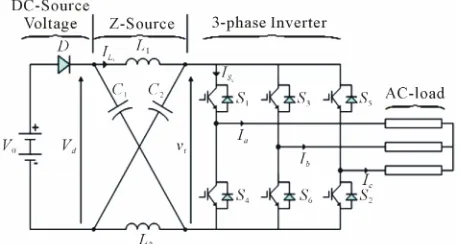
In a conventional voltage source inverter, the two switches of any phase leg cannot be gated at the same time be- cause this may cause a short circuit situation and thus destroy the inverter. In addition, the maximum output voltage cannot exceed the dc bus voltage. These limita- tions in such conventional voltage source inverter can be overcome by using ZSI [1], Figure 1.
A comparison among conventional pulse-width modu- lation (PWM) inverter, dc-dc boosted PWM inverter and ZSI but ZSI shows that higher efficiency and lower cost. Because of these reasons, ZSI has applied in hybrid elec- tric vehicles [2,3]. In addition, in [4] show comparison among the traditional I-source inverter and (VSI) with the Z-source network should require less capacitance, inductance and size smaller than traditional dc-dc boosted PWM inverter. Therefore, these results in increasing at- tention on ZSI, especially for the application where the dc input source has a wide voltage variation range such as fuel cell, battery, lead acid. Also, the ZSI has applied for direct-drive wind generation system and photovoltaic power system base on tracking algorithm maximum power and hybrid electric vehicles [5-7].
Additionally, the maximum boost control is alike the conventional carrier-based PWM method base on all zero
voltage vectors, shoot through state (the other zero vec- tors) and the six active states which are maintained un- changed but the main drawbacks of this modulation method is big inductor ripple and a large inductor when the output frequency is low. Therefor, they will increase the cost and size of the circuit [8].
Given its many benefits, many studies have been re- searched into CM of ZSI. Cosequently, how chose CM which highest efficiency is very important in control sys- tems of ZSI. Through detailed analysis, the aim of this study to show how various two CM for ZSI, there are MSVM and the SBC which they are analyzed and com- pared about the unique harmonic features of current, voltage and the total average switching device power, the total peak switching device power of the inverter system. In addition, this paper also analyzes about the ability exceed modulation index in linear region of two CM us- ing simulation MATLAB/Simulink.
2. Equivalent Circuit, Operating Principle
and Total Switching Device Power of ZSI
2.1. Equivalent Circuit, Operating Principle ofZSI
In Figure 1 show ZSI voltage-type configuration, which include inductors (L1 and L2) are similar inductance L,
Figure 1. ZSI voltage-type configuration.
simultaneously capacitors (C1 and C2) are similar capaci-
tance C. Where L and C are connected in X shape, the dc input voltage source which may be fuel cell, battery or diode rectifier. The general inverter have two zero volt- age vector and six active voltage vectors but in the three- phase ZSI has one additional zero voltage vector that is third zero state vector or the shoot-through zero state. The influence of this phase-leg shoot-through on the in- verter performance can be considered the equivalent cir- cuits shown in Figure 2. In operating principle of ZSI there are two operating modes: non-shoot-through mode and shoot-through mode. In non-shoot-through mode Figure2(a) that the ZSI operates under the conventional PWM. The shoot-through state is forbidden in the con- ventional inverter but in the ZSI the shoot-through mode are given in Figure 2(b). In Figure2(b) show that the load terminals of any phase legs are shorted both the up- per and lower. At that time, the dc capacitor voltage can be boosted to the desired value.
Where β is the angle between the reference voltage vector ref and voltage vector V1. Because assume in-
ductors (L1 and L2), capacitors (C1 and C2) have alike
inductance (L) and capacitance (C) respectively, we have
V
1 2
1 2
C C C
L L L
V V V v v v
0 2 L C L C V
v V V
(1)
Non shoot-through time internal of one period non shoot-through zero state for a period Tn in Figure 2(a), we have:
0
d
i C
V V v V v V
(2)
Shoot-through time internal of one period shoot- through zero state for a period Tsr in Figure 2(b), we have: 0 2 i L C d C v v V V V (3)
Figure 2. Equivalent circuits of ZSI. (a) Non-shoot-through mode; (b) Shoot-through mode.
where is the dc source voltage and one period swi-
tching cycle Tsf, where o
V
sf sr n
T T T and sr sr
sf
T T
M is
the shoot-through time duty ratio.
The average voltage of the inductors over one switch- ing period should be zero in steady state, from (2) and (3) thus capacitor voltage can expressed:
1 2 1 1 1 2 1 2 sr sf sr
C C C d d
sr sr
sf
T
T M
V V V V V
T M T (4)
0 2 1
1 2
sr n c d sr
i i d c
sf sr
T T V V M
V v V V
T M
(5)
1
ˆ 2
1 2
i c L c d d
sr
v V V V V V
M (6)
1 0 0 2 2 sf sr sr T M T
(7)
From (6), if Msr is increase then i is also increase, where is the voltage stress across switching devices.
ˆ
v
ˆi
v
2.2. Total Switching Device Power (TSDP)
[image:2.595.58.288.88.210.2]power is introduced to quantify the voltage and current stress of an inverter system [8]. TSDP is a measure of the total semiconductor device requirement.
The total average switching device power of the in- verter system
TSDP
av is given in [8]:
o ˆi
1
sr P v M
2 2 ˆ 4 ˆ π cos o i sr av op ac P TSDP v MV v
(8)
The total peak switching device power of the inverter system TSDP pk is also given in [8]:
4 2 ˆˆ cos
o o i
ac
P P v
V v ˆi pk op TSDP v
(9) where N is the number of switching devices used, IL the inductor current, ac the output peak phase voltage from the inverter and Pomaximum power output of the DC-source voltage.
ˆ
v
V
03. Proposed CM of MSVM and SBC
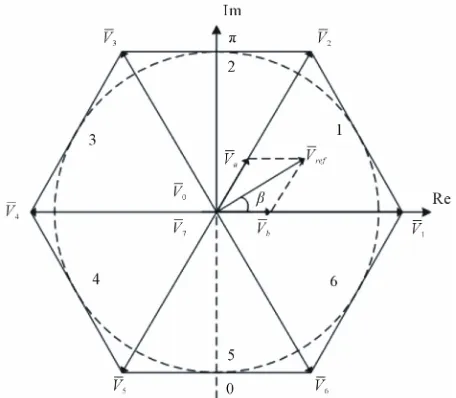
3.1. Proposed CM of MSVMNowadays, the space vector PWM (SVM) method have widely used at regulated PWM inverter due to a higher modulation index and lower current harmonics in [9]. The SVM is suitable to control the shoot-through time in ZSI. Where V0, V7 and shoot-through are zero vectors (in
ZSI), where V1 to V6 are the six active vectors. If the ref-
erence voltage vector Vref (the sinusoidal three-phase command voltage of output ZSI with minimum amount of harmonic distortion) is located between the arbitrary vector Va and Vb, the reference voltage vector is divided into the two adjacent voltage vectors (Va, Vb) and zero vectors (V0, V7 and shoot-through) in Figure 3. When
ref rotate around section (1 - 6) of hexagon while (a, b) are changed: (a, b) = (1, 2); (2, 3); (3, 4); (4, 5); (5, 6) in every sector, respectively. In one sampling interval, Va and Vb are applied at times Taand Tb, respectively, and the zero vector is applied at time Tsf Ta
T b s
T T T
ref
V
r where 0 sr 0.
Consequently, from (10), the reference voltage vector can be given by
T T
ref
V Va Ta V Tb b (10) π 3 sin 3 f ˆ ref a s i V T T v
(11) 3 f sf sin
i T ˆ re b V T v
(12)
[image:3.595.309.537.86.285.2]The conventional SVM in Figure4(a) and the MSVM in Figure4(b) where sr is shoot-through time has an extra for boosting the dc link voltage of the inverter be- side time intervals Ta, Tb and T0.
Figure 3. Voltage vector through conven-tional SVM of VSI.
From Figure 4 the shoot-through states (STS) are
evenly assigned to each phase with 2 3 T within zero voltage period T 0 4 T and 3 T
within active voltage period
2 a T and 3 T
within active voltage period 2
b
T
, where Ta
and Tb are unchanged. So the STS does not affect the SVM CM of the inverter, and it is limited to the zero state time T0. Where T are determined by (13). Therefore,
the STS should be inserted period intervals are main- tained at the start and end of the switching cycle to achieve alike optimal harmonic performance.
6.2 4 3 4 sr sr T T
T T T (13)
From (7) we have
0 8 sf T T
0M M
(14)
In the undermodulation region max . Figure3, Vref always remains within hexagon in [10]. Let us define a modified modulation factor M given by
1
ˆ ˆ
ˆ 2 ˆ
π ref ref sw i V V M V v ˆ V ˆ ref V (15)
where ref = vector magnitude (or phase peak value), in the linear region is the output peak phase voltage
ˆ
andˆac ref ˆac
v V v ˆ1
from the inverter Vsw = fundamen-
tal peak value 2 ˆ π vi
of the square-phase voltage
Figure 4. MSVM (a) Switching patterns for traditional SVM; (b) Switching patterns for MSVM.
wave. The maximum possible value of modulation factor
max at the end of the under modulation region can
derived. The radius Figure 3 of the inscribed circle can be given as
M
ˆrefm
V
max 1
ˆ cos ˆ
ˆ
i refm
sw
v V
M V
1
2 π ˆ
3
3 6
2 ˆ 2 ˆ
π π
i
i i
v
v v
(16)
This means that 90.7 percent of the fundamental at the square wave is available in the linear region.
[image:4.595.93.244.441.490.2]3.2. The Simple Boost Control (SBC)
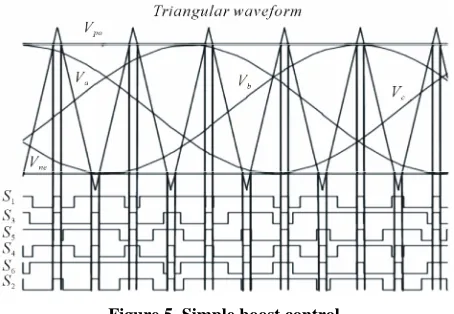
Figure 5. Simple boost control. The SBC method strategy inserts STS in all the PWM
conventional zero states during one switching period. The six active states are maintained unchanged as in the conventional carrier based PWM [2]. When the triangu- lar waveform is greater than the upper envelope, po, or lower than the bottom envelope, Vne, the circuit turns into shoot-through state, show Figure5. The output peak phase voltage from the inverter can be given by
where Mmax = maximum modulation factor determined
by
V
max 1
1 ˆ
ˆ 2
0.7855
ˆ 2 ˆ
π
i ac
sw i
v v
M
V v
1
a
M
(18)
At , the maximum value of fundamental peak voltage is
ˆ 1
2 2
i d
sr
v V
M
a
ˆ
2 1
ac a a
v M M (17) where M is the modulation index of magnitude
magnitude sine
0 1
carrier
Ma 1
magnitude
a
M
in [10]. At ,
M = modulation factor, in the linear region (0 ≤M≤Mmax)
1 ˆ
2vi, Which is 78.55 percent of peak voltage 2 ˆ
π vi
of the square wave. From (16), (18) we can see
Therefore, the MSVM method modulation index in linear can exceed more than the SBC method.
4. Simulation
To verify the validity of the above analysis, simulation models shown in Figure 1 use Matlab/Simulink for MSVM and SBC methods of z-source inverter are ana- lyzed. The simulation for two CMs with parameters are the same, see Table 1.
In Figure 6 shows the inverter’s dc link voltage, the ZSI’s capacitor voltage and comparison with maximum output voltage of DC-source. We observe from the figure that the inverter’s dc link voltage
vˆ
THD
i boosted to (500 V) greater than maximum output voltage of DC-source (400 V) is (100 V) see Table 2.
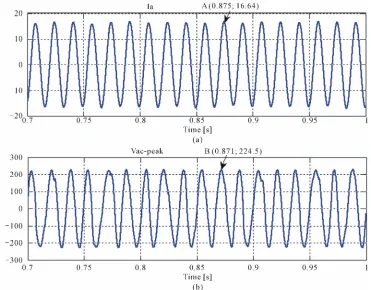
In Figure 7 shows the switching output line voltage and phases voltage waveform of ZSI with MSVM meth- ods. Figures 8 and 9 show output line voltage and cur-rent sine waveforms of ZSI with MSVM and SBC methods, respectively.
Output line peak voltage and peak current sine wave- forms of ZSI with MSVM method greater than output line peak voltage and peak current sine waveforms of ZSI with SBC method, respectively.
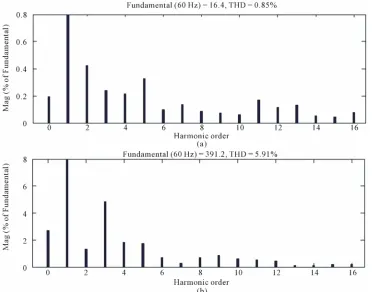
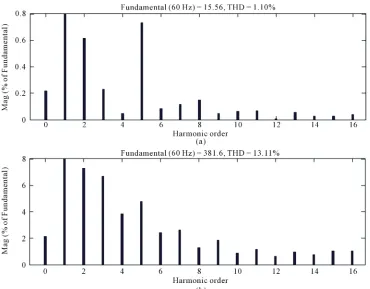
Figures 10 and 11 show total harmonic disturbance spectra of output line voltage
U and total har- monic disturbance spectra of output current
THD
Iwhich
THD
I
and U of MSVM method lessthan
THD
I
THD
TSDP
and U of SBC method. These re- sults are given in Table 2. Also in Table 2 show calcu- late results of MSVM and SBC methods use Equations (4)-(18). ,
THDav
pk of MSVM method lessthan ,
TSDP
TSDP
av
pkIn the future, we will apply MSVM for ZSI in many control systems (e.g. motor speed control system, hybrid electric vehicles, photovoltaic, direct-drive wind genera- tion system).In Figure12 shows the figure experiments for motor speed control system.
TSDP of SBC method.
5. Acknowledgements
I am extremely grateful to professors’ lecture speeches du- ring the course at Department of Control Science and En- gineering, Huazhong University of Science and Techno-
Table 1. Parameters are used for simulation of MSVM and SBC.
Parameter Value Z-source inductance (L1 and L2) 1.5 mH
Z-source capacitance (C1 and C2) 1000 μF
Load resistance 10 Ω
Load inductance 0.025 mH
Switching frequency (fsf) 10 kHz
Fundamental frequency (f1) 60 Hz
Maximum power output of the DC-source voltage (P0) 3700 W
Output DC-source voltage at maximun power (V0P) 250 V
Maximum output voltage of DC-source (V0) 400 V
Command output voltage 225 V
The shoot-through time duty ratio (Msr) 0.1
Table 2. Calculate results of MSVM and SBC.
Parameter MSVM SBC
THDI 0.85 1.1
THDD 5.95 12.11
ˆi
v V 500 500
c
V V 450 450
L
I A 10.8 10.8
TSDP av VA 8876.3116 9237.6003
TSDP pk VA 33322.2025 33952.7717
Figure 6. Simulation MSVM. DC-link voltage (vi), Capacitor voltage (Vc) and DC-source voltage (V0).
Figure 7. Switching output line voltage and phases voltage waveform of ZSI (MSVM). (a) Switching output phase voltage; (b) Switching output line voltage.
[image:6.595.112.483.415.705.2]Figure 9. Output line voltage and current wave-forms of ZSI (SBC). (a) Output current; (b) Output line voltage.
Figure 10. Harmonic spectra of Z-source inverter (MSVM). (a) Harmonic spectra of output current; (b) Harmonic spectra of output line voltage.
[image:7.595.114.486.412.704.2]Figure 11. Harmonic spectra of Z-source inverter (SBC). (a) Harmonic spectra of output current; (b) Harmonic spectra of output line voltage.
Figure 12. The figure experiments for motor speed control system.
logy (HUST), Wuhan 430074, China. Especially, pro- fessor Anwen Shen, associate professor Phan Quoc Dzung, and master Nguyen Bao Anh who offers me advice and help me to finish this paper.
6. Conclusion
This paper presents a comparison of two different MM there are MSVM and the SBC for ZSI. They show the
harmonic spectra of output voltage and output current with MSVM is less than harmonic spectra of output voltage and output current with SBC, the total average and peak switching device power of ZSI system with MSVM method is less than the total average and peak switching device power of ZSI system with SBC, the MSVM modulation index in linear can exceed more than the SBC. All of these comparisons are used simulation MATLAB/Simulink.
REFERENCES
[1] I. P. C. Loh, D. M. Vilathgamuwa, I. Senior, Y. S. Lai, G. T. Chua and I. Y. W. Li, “Pulse-Width Modulation of Z-Source Inverters,” IEEE Transactions on Power Elec- tronics, Vol. 20, No. 6, 2005, pp. 1346-1355.
doi:10.1109/TPEL.2005.857543
[2] M. Olzwesky, “Z-Source Inverter for Fuel Cell Vehicles,” US Department of Energy, Freedom CAR and Vehicles Technologies, EE-2G, Washington, 2005.
[3] K. Holland, M. Shen and F. Z. Peng, “Z-Source Inverter Control for Traction Drive of Fuel Cell-Battery Hybrid Vehicles,” Industry Applications Conference, 40th IAS Annual Meeting, Vol. 3, No. 4, 2005, pp. 1651-1656. [4] I. Fang and Z. Peng, “Z-Source Inverter,” IEEE Transac-
tions Industry Applications, Vol. 39, No. 2, 2003, pp. 990-997.
[image:8.595.59.287.414.594.2]Control Methods of Direct-Drive Wind Generation Sys- tem Based on Three-Phase Z-Source Inverter,” IPEMC, Shanghai, 17-20 May 2009.
[6] S. A. K. H. Mozafari Niapoor, S. Danyali and M. Sharifian, “Photovoltaic Power System Based mppt Z-Source In- verter to Supply a Sensorless BLDC Motor,” 1st Power Electronic, Drive Systems and Technologies Conference, University of Tabriz, Tabriz, 17-18 February 2010. [7] U. Ali and V. Kamaraj, “A Novel Space Vector pwm for
Z-Source Inverter,” Proceedings of ICETECT, Nagercoil, 23-24 March 2011.
[8] M. Shen, A. Joseph, J. Wang, F. Z. Peng and D. J. Adams, “Comparison of Traditional Inverters and Z-Source In- verter for Fuel Cell Vehicles,” IEEE Power Electronics Society, Vol. 22, No. 4, 2007, pp. 1453-1500.
doi:10.1109/TPEL.2007.900505
[9] T. Chun, Q. Tran, J. Ahn and J. Lai, “Ac Output Voltage Control with Minimization of Voltage Stress across De- vices in the Z-Source Inverter Using Modified svpwm,” PESC 37th IEEE, Jeju, 18-22 June 2006, pp. 1-5.
[10] B. K. Bose, “Modern Power Electronics and AC Driv-ers,” Pearson Education, Upper Saddle River, 2002.