RESEARCH ARTICLE
EFFECTIVE CONTROL OF IOP IN POAG: COMPARISON BETWEEN ONCE DAILY DOSE OF TIMOLOL
GFS AND TWICE DAILY DOSE OF TIMOLOL AQUEOUS SOLUTION
*Dr. Murali Mohan Gurram
Department of Ophthalmology, Kamineni Hospitals, Kamineni Academy of Medical Sciences and Research
Centre, L.B.Nagar, Hyderabad 500068, India
ARTICLE INFO ABSTRACT
Aim: To compare the long term (6 months) effect of once daily dose of Timolol in Gel Forming Solution (GFS) with twice daily dose of Timolol in aqueous solution, in control of Intra Ocular pressure (IOP), in cases of Primary Open Angle Glaucoma (POAG).
Material and methods: In a Prospective, Randomized Clinical trial, POAG or Ocular Hypertension patients diagnosed between April 2008 and September 2012 were studied. 750 eyes of 600 patients with age group 46-79 yrs. were selected. Diurnal variation of Tension (DVT) was done along with other investigations. Patients were divided into two groups A and B randomly. Group A was started on Timolol twice daily and group B on once daily Timolol GFS. 400 eyes of 310 patients were started on Timolol solution eye drops twice a day.120 eyes of 100 patients were lost to follow-up or unresponsive to timolol (8 eyes of 5 patients). 350 eyes of 290 patients were started on Timolol GFS once daily, of which 70 eyes of 50 patients were lost to follow up or unresponsive to timolol (7 eyes of 5 pa tients).So finally, after 6 months treatment, in Group A, 280 eyes of 210 patients and in Group B 280 eyes of 240 patients were analyzed. Analysis was done under following headings.
Amount of reduction of IOP at various timings of the day by Timolol and Timolol GFS, Amount of reduction of mean IOP by Timolol and Timolol GFS, Amount of reduction of peak IOP by Timolol and Timolol GFS, Change in systemic parameters after 6 months of treatment. Comparison was done between the two groups with respect to amount of IOP reduction at each time of the day, reduction in 'mean' IOP, and reduction in 'peak' IOP. 't' test was used for analysis.
Observations: In group A, the mean IOP before the treatment, at 8 am, 10 am, 12 noon, 2 pm, 4 pm, 6 pm, 8 pm, 10 pm, 12 am, 2 am, 4 am and 6 am decreased by
8.5±2.40, 8.85±2.68, 10.17±2.18, 10.32±2.05, 10.03±2.28, 9.28±3.04, 8.71±3.00, 8.36±2.31, 9.18±2.22, 9.39±1.96, 9.07±2.18 and 9.18±2.39 respectively with P value at each time of 0.00, showing that Timolol twice daily is effective in bringing down IOP. In group B, the mean IOP for the corresponding times came down by 7.95±2.40, 8.75±2.33, 9.49±1.64, 9.52±2.06, 8.93±2.50, 8.27±3.24, 7.59±3.04, 8.35±2.03, 8.36±2.36, 8.63±1.96, 8.45±1.98 and 7.30±2.86 respectively with P value at 0.00 showing that the Timolol GFS with OD dose significantly brings down the IOP. When the reduction in Mean IOP at the above timings were compared between group 1 and 2, the P values obtained were 0.402, 0.878, 0.192, 0.156, 0.092, 0.236, 0.171, 0.995, 0.188, 0.156, 0.275, 0.114 which shows that there is no statistical difference between two groups.
Mean reduction in Pulse, systolic BP and diastolic BP were 3.07 ± 1.39 , 2.64 ± 2.04 and 2.21±1.66 with P values of <0.001 for all three, in group A and 0.39 ± 1.23 0.57 ± 2.43 and 0.50 ± 2.01 respectively with P values of 0.10,0.22 and 0.20 in group B. The p value in intergroup comparison was <0.001 for all three parameters, showing that the Timolol GFS has less significant effect on systemic parameters. The mean percentage of missed doses in group A was 13.53±4.27 and in group B was 8.67± 6.33. P value was 0.002 suggesting that the patient, missing the medicine dosage is significantly high in group A.
Conclusions: Once daily dosage of Timolol in Gel Forming Solution is equally efficacious as twice daily timolol with less systemic effects and more compliance.
Copyright © Dr. Murali Mohan Gurram. This is an open access article distributed under the Creative Commons Attribution License, which permits unrestricted use, distribution, and reproduction in any medium, provided the original work is properly cited.
INTRODUCTION
Open angle glaucoma is the leading cause of irreversible blindness in sub-continent. Timolol maleate has been established as the first line of drug in the treatment of glaucoma. Even after advent of latest drugs
like prostaglandin analogues and α2 agonists, timolol remains first
choice due to cost effective reasons. Lifelong treatment with topical drops is usually required. Compliance is of utmost importance, to control IOP. Reduced dosage improves compliance of patient. Timolol in gel-forming solution is timolol maleate in combination with
*Corresponding author: Dr. Murali Mohan Gurram, Department of
Ophthalmology, Kamineni Hospitals, L.B.Nagar, Hyderabad 500068, India
a heteropolysaccharide derived from gellan gum. It is a liquid at room temperature and becomes a gel after reacting with cations in tears. This property of the formulation increases the corneal contact time allowing greater corneal penetration and thus requires less frequent administration. The primary objective of this study was to compare the ocular hypotensive effect and side effects of 0.5% timolol in gel-forming solution (Timolet GFS, Sun Pharmaceuticals Industries Ltd.) administered once daily, with 0.5% timolol solution (Iotim, FDC Ltd.) administered twice daily in open angle glaucoma. A number of systems have been used to prolong drug-cornea contact time. These
include soluble gels, 1 solid hydrophilic inserts 2 and binding to
polymers. 3 All the above methods of Drug Delivery Systems have
ISSN: 0975-833X
International Journal of Current Research
Vol. 5, Issue, 09, pp.2619-2624, September,2013
OF CURRENT RESEARCH
Article History: Received 14th June, 2013
Received in revised form 30th July, 2013
Accepted 15th August, 2013 Published online 14th September, 2013
Key words: Glaucoma, Timolol,
Gel Forming Solution, Gellan,
the disadvantages of poor patient acceptance or difficulties in administration. This has led ophthalmic researchers to seek other systems which would combine the ease of administration of liquid forms with the prolonged residence time of inserts. This has led
to the development of "phase transition systems" which are
instilled in a liquid form and which shift to the gel phase in the culde sac. These are also called "in situ Gel-forming systems". A new "phase transition system "was evaluated in 1987 by Mazuel, and Frileyre (center of research, Laboratories MSD, Chibret, France) which was trade named Gelrite. Gelrite is a polysaccharide, low acetyl gellan gum, which forms clear gel in the presence of mono or divalent
cations. It was first studied by Moorhouse et al in 1981.4
Mechanism of Gel Formation
Its gelling properties are independent of temperature, which is a big advantage over thermogelification systems. Therefore, an increase in ambient temperature will not cause gelling in ophthalmic solutions formulated with Gellan gum. Furthermore, Gellan gum solutions are thixotropic and thermoplastic. In other words, the fluidity of the solution increases by shaking or by warming slightly before
application to the eye.5
The gel formed by gellan gum is bio adhesive in nature. This unique property allows the compound to remain in contact with the conjunctiva long enough to maintain desired therapeutic levels over a
24 hour period.6,7 In a cross over study by Shedden etal in 1994,
patients who were on timolol solution BD were changed over to timolol gel. After 28 weeks, there was no significant difference in
IOP from baseline.8 Norman S Levy and Cynthia Alsbury, in their
study with 21 patients showed that timolol in gellan gum were comparable to timolol solution in lowering IOP. They reported
blurring of vision as major side effect with gel forming solution.9
Schenker etal compared patient preference, efficacy and compliance with timolol GFS vs. timolol aqueous solution in patients with ocular hypertension or OAG. In this crossover study, it was concluded that significantly more patients preferred timolol gel to timolol solution. Mean IOP lowering effect was similar
between the two groups. Drug related adverse experiences were
also similar.10 Netland et al showed in the same year, that timolol
in GFS has no significant effect, on pulse rate, systolic BP and diastolic BP. They also showed that, timolol in gel forming solution generally does not change the blood circulation in the
optic nerve head.11 Harsh kumar, Rajeev Sudan, Harinder, Parul
sony have done a study on Timolol GFS in Indian population.
They studied 104 eyes of 52 patients in a prospective, crossover study. 52 patients with OAG, who had well controlled IOP on 0.5% timolol maleate solution were switched over to Timolol GFS once a day, after a washout period of one month. A diurnal IOP measurement was done after 6 weeks and compared with patients on timolol maleate 0.5% BD. In addition, side effects reported or observed were compared. Statistically significant difference was not observed in ocular hypotensive effect of the two treatments. The side effects in both the treatment groups were similar except for higher incidence of blurring of vision in patients with timolol GFS. The compliance was better with timolol GFS, but was not
statistically significant.12 Morning dose of Timolol GFS was found
to be more effective in reducing IOP in asian eyes.13 A recent study
which compared Timolol in GFS and aqueous solution, concluded that timolol GFS OD is effective for 24 hours, with better safety
profile than timolol BD, and is well accepted by patients.14
MATERIAL AND METHODS
Patients attending the Ophthalmology department of a tertiary care hospital, in Hyderabad, between April 2008 to September 2012
were selected. Patients more than 45 years of age, and more than 21 mmHg of mean IOP with a clinical diagnosis of POAG and best corrected visual acuity of more than 6/60 were included in the study. The exclusion criteria included Past history of surgery to lower IOP, Previous usage of antiglaucoma medications, Anterior segment abnormalities like uveitis, hazy media precluding the visualization of optic disc, Pregnant /lactating females and usage of steroids, Patients with contra-indications to beta blockers like Myocardial infarction, Angina, Hypotension, Bronchial asthma, etc. were also excluded. 750 eyes of 600 patients were selected. (In early detected cases, it is the routine to start beta blockers in more affected eye as uni-ocular therapeutic trial. If the damage is gross in both eyes, then both eyes are started on treatment simultaneously). Age group of the patients was between 46-79 years (mean age 57.52 years). All the patients underwent thorough ophthalmological examination including visual acuity with best correction, thorough slit lamp biomicroscopy, Goldman Applanation Tonometry, Pachymetry (ultrasound pachymetry), gonioscopy, HFA 30-2 fields (at least 2 baseline fields taken), detailed dilated fundus examination with direct ophthalmoscope and 90 D indirect examination for optic nerve head
cupping. The IOP was corrected based on Ehler’s nomogram.15,16 The
[image:2.595.141.460.310.522.2]patients were divided into two groups. Group A and Group B.
Grouping was done alternatively. If one patient was grouped under A, the next patient was grouped under B. If the patient previously allotted to group A had not turned up for final follow-up, then the next patient was grouped under A, so that finally the number of eyes studied in either group were equal. After the preliminary ophthalmological examination, baseline diurnal variation of tension (DVT) was done, second hourly, on an inpatient basis. All the readings were taken by duty resident. Patient's systemic parameters which include systolic BP, diastolic BP and pulserate were recorded at 10 a.m. by the sister on duty. The timings used for DVT were 8 am, 10 am, 12 noon, 2 pm, 4 pm, 6 pm, 8pm, 10 pm, 12 am, 2 am, 4 am and 6 am. Thus 12 readings were taken in a day. Group A was started on Timolol 0.5% in aqueous solution (brand used was IOTIM) BD dosage (twice daily). 1 drop at 8 a.m and other at 8 p.m. Group B was started on Timolol 0.5% in gel forming solution (brand used was Timolet — GFS) OD (once daily), at 8 a.m. Patients were taught the
standard protocol of eye drop instillation, (Fraunfelder method)17.
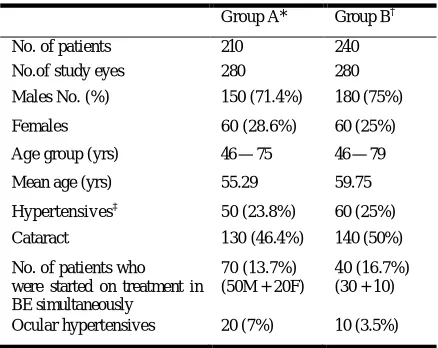
Group B patients were advised to shake the bottle once before instilling the drop. This is because of thermoplastic nature of gellan (fluidity increases by shaking or warming before use). 400 eyes of 310 patients were started on Timolol solution eye drops twice a day. 120 eyes of 100 patients were lost to follow-up or unresponsive to timolol (8 eyes of 5 patients). 350 eyes of 290 patients were started on Timolol GFS once daily, of which 70 eyes of 50 patients were lost to follow up or unresponsive to timolol (7 eyes of 5 patients). So finally in Group A, 280 eyes of 210 patients and in Group B 280 eyes of 240 patients were studied. Patient demographics are depicted in Table 1. All these patients who came for follow-up, 6 months later, were admitted. Diurnal variation of tension repeated, on treatment, second hourly. Systemic parameters also were noted.
Best corrected visual acuity was checked of all the patients before instillation of drops and 1 minute after instillation of drops. This was to know the effect of solution on vision. Patients were asked regarding any complaints after starting the topical drop therapy. Patients were asked to note down the number of times they missed the eye drops.
Observations
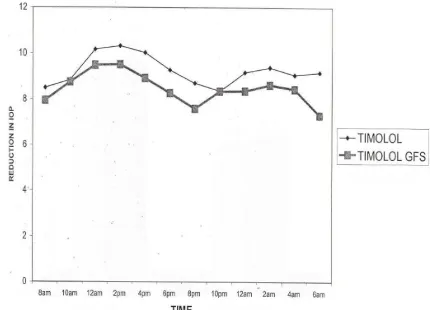
All patients in both groups showed some amount of IOP reduction after 6 months of treatment. In group A, the mean IOP before the treatment, at 8 am, 10 am, 12 noon, 2 pm, 4 pm, 6 pm, 8 pm, 10 pm, 12 am, 2 am, 4 am and 6 am decreased by 8.5±2.40, 8.85±2.68,
10.17±2.18, 10.32±2.05, 10.03±2.28, 9.28±3.04, 8.71±3.00,
[image:3.595.307.557.77.261.2]8.36±2.31, 9.18±2.22, 9.39±1.96, 9.07±2.18 and 9.18±2.39mmHg respectively. In group B, the mean IOP for the corresponding times came down by 7.95±2.40, 8.75±2.33, 9.49±1.64, 9.52±2.06, 8.93±2.50, 8.27±3.24, 7.59±3.04, 8.35±2.03, 8.36±2.36, 8.63±1.96, 8.45±1.98 and 7.30±2.86 respectively. These are depicted in Tables 2 and 3. Mean IOP in group A before treatment was 25.12 which reduced to 15.88 after six months. Mean IOP in group B reduced from 25.03 to 16.56. Peak IOP in group A reduced from 27.96 to 18.36 and in group B from 27.71 to 18.54. After the initiation of treatment, change in systemic parameters was noted. In group A the pulse rate, systolic BP and diastolic BP reduced by 3.07 ± 1.39, 2.64 ± 2.04 and 2.21±1.66. In group B the same reduced by 0.39 ± 1.23 0.57 ±
Table 2. Effect of Group A (Timolol in aqueous solution BD) at various timings (as shown by reduction in IOP after 6 months, at various timings)
Time BT*
(Mean ± SD†) mmHg N‡=280
AT§ (Mean ± SD) mmHg
Difference (reduction in
IOP||) (Mean ± SD)
P¶
8 am 25.71 ± 2.38 17.21 ± 1.83 8.50 ± 2.40 <0.001
10am 25.40 ± 2.45 16.53 ± 1.29 8.85 ± 2.68 <0.001
12 pm 25.86 ± 1.90 15.67 ± 1.38 10.17 ± 2.18 <0.001
2 pm 25.79 ± 1.81 15.46 ± 1.45 10.32 ± 2.05 <0.001
4 pm 25.39 ± 1.91 15.35 ± 1.66 10.03 ± 2.28 <0.001
6 pm 24.75 ± 2.84 15.46 ± 1.52 9.28 ± 3.04 <0.001
8 pm 24.50 + 2.92 15.78 ± 1.72 8.71 ± 3.00 <0.001
10 pm 25.28 ± 2.46 15.92 ± 1.86 8.36 ± 2.31 <0.001
12 am 24.82 ± 2.24 15.64 ± 1.80 9.18 ± 2.22 <0.001
2 am 25.00 ± 2.28 15.60 ± 2.07 9.39 ± 1.96 <0.001
4 am 25.03 ± 2.68 15.96 ± 1.71 9.07 ± 2.18 <0.001
6 am 25.07 ± 3.12 15.89 ± 1.81 9.18 ± 2.39 <0.001
*BT: Before Treatment, †SD: Standanrd Deviation,‡ N: Number of eyes,§ AT: After
[image:3.595.309.555.305.500.2]Treatment,|| IOP: Intra-Ocular Pressure,¶ P: P value
Table 3. Effect of Timolol GFS OD at various timings
Time BT
Mean ± SD (mmHg)
AT Mean ± SD
(mmHg)
Difference (reduction in IOP)
Mean + SD
P
8 am 25.22 ± 2.56 17.26±1.17 7.95± 2.40 <0.001
10am 24.76 ±2.45 16.01±1.61 8.75±2.33 <0.001
12 am 24.94 ±2.01 15.45±1.18 9.49±1.64 <0.001
2 pm 25.29 ±2.13 15.76±1.08 9.52±2.06 <0.001
4 pm 25.01 ±2.35 16.07±1.11 8.93±2.50 <0.001
6 pm 24.51 ±3.03 16.23±1.13 8.27±3.24 <0.001
8 pm 24.03 ±3.12 16.44±1.13 7.59±3.04 <0.001
10 pm 24.69 ±2.06 16.33±1.24 8.35±2.03 <0.001
12 am 25.05 ±2.17 16.69±1.39 8.36±2.36 <0.001
2 am 25.36 ±1.83 16.72±1.12 8.63±1.96 <0.001
4 am 25.79 ±1.93 17.33±.98 8.45±1.98 <0.001
6 am 25.69 ±.88 18.39±1.03 7.30±2.86 <0.001
Table 4. Comparison of effectiveness between the two groups, at various Timings
Time Timolol
Mea n ± SD
Timolol GFS
Mean ± SD P value
8 am 8.50 ± 2.40 7.95±2.40 .402
10am 8.85 ± 2.68 8.75±2.33 .878
12 am 10.17 ± 2.18 9.49±1.64 .192
2 pm 10.32 ± 2.05 9.52±2.06 .156
4 pm 10.03 ± 2.28 8.93±2.50 .092
6 pm 9.28 ± 3.04 8.27±3.24 .236
8 pm 8.71 ± 3.00 7.59±3.04 .171
10 pm 8.36 ± 2.31 8.35±2.03 .995
12 am 9.18 ± 2.22 8.36±2.36 .188
2 am 9.39 ± 1.96 8.63±1.96 .156
4 am 9.07 ± 2.18 8.45±1.98 .275
6 am 9.18 ± 2.39 8.30±2.86 .114
2.43 and 0.50 ± 2.01. 70 patient in group A and 90 patients in group B had ocular sideeffects. Blurring of vision was most common in Group B, which was transient, just after instillation of eye drops. Spontaneous recovery occurred with in 45 minutes. Foreing body
Table 1. Patient demographics
Group A* Group B†
No. of patients 210 240
No.of study eyes 280 280
Males No. (%) 150 (71.4%) 180 (75%)
Females 60 (28.6%) 60 (25%)
Age group (yrs) 46 — 75 46 — 79
Mean age (yrs) 55.29 59.75
Hypertensives‡ 50 (23.8%) 60 (25%)
Cataract 130 (46.4%) 140 (50%)
No. of patients who were started on treatment in BE simultaneously
70 (13.7%) (50M + 20F)
40 (16.7%) (30 + 10)
Ocular hypertensives 20 (7%) 10 (3.5%)
[image:3.595.57.276.384.558.2] [image:3.595.314.551.534.714.2]sensation, Hyperemia, and ocular discomfort were other side effects noted. None of them developed severe complications like conjuncivitis, Keratitis, uveitis etc. The visual acuities which were measured in snellens chart were converted to approx ETDRS letters as
described by Gregori. 18 Mean visual acuity changed from 64 to 62 in
[image:4.595.323.538.125.280.2]group A where as it changed from 63 to 48 in group B, one minute after instillation of eye drops. This shows that the Gel Forming Solution has blurring effect on vision temporarily.
Table 5. Side Effects
Adverse effect Timolol
(No.of patients)
Timolol GFS (No.of patients)
Hyperemia 10 10
Blepharitis 0 0
Dry eye 0 0
Foreign body sensation 20 20
Tearing 0 0
Transient blurring of vision 20 50
Discomfort 20 10
Eye discharge 0 0
total 70(25%) 90 (32%)
ANALYSIS AND RESULTS
Statistical Analysis were made with SPSS software (SPSS for Windows, version 13.0, SPSS Inc., Chicago, Illinois, USA). For the effect on IOP in each group, Paired sample statistics was done with 95% confidence interval. In Group A, 280 eyes of 210 patients, and in Group B, 280 eyes of 240 patients were analyzed. In each group the analysis was done for the amount of IOP reduction at various timings of the day, Amount of Mean IOP (average of all twelve IOP readings in a day) reduction, Amount of Peak IOP (Highest IOP recorded) reduction and change in systemic parameters. Paired-Sample T test was used for the above. Intergroup comparison was done with respect to IOP reduction at various timings, Mean IOP reduction and Peak IOP reduction. Independent-Samples T test was used for the above analysis. The P value for reduction of IOP at each second hourly timing, in both groups was <0.001 suggesting that both groups are effective in bringing down the IOP at all times of a day. GROUP A: the Mean IOP before treatment was 25.12 ±1.48 with standard error of mean (SEM) of 0.28. six months later the Mean IOP was 15.88±1.10 with standard error of mean of 0.21. P value was less than <0.001, suggesting the significant effect of Timolol BD in reduction of mean IOP. The Peak IOP beore treatment was 27.96±1.29 with SEM 0.24 and after treatment 18.36±1.40 with SEM 0.26. P value was <0.001. The pre treatment pulse, systolic BP and Diastolic BP were 74.89±1.73, 127.93±6.87 and 84.21±4.53 with SEM 0.33, 1.30 and 0.86 respectively. The post treatment values were 71.82±1.91, 125.29±5.92 and 82±3.61 with SEM 0.36, 1.12 and 0.68. P values for the all the above parameters were <0.001 suggesting significant systemic effect of timolol in aqueous solution. BCVA before instillation of eye drops was 62.64±6.62 with SEM 1.25. One minute after instillation of eye drops was 62.61±6.64 with SEM 1.25. P value was 0.57, showing that the timolol in aqueous solution has no blurring effect.
GROUP B: the Mean IOP before treatment was 25.03 ±1.26 with
SEM of 0.24. six months later the Mean IOP was 16.56±0.83 with SEM of 0.16. P value was less than <0.001, suggesting the significant effect of Timolol GFS OD in reduction of mean IOP. The Peak IOP beore treatment was 27.71±1.01 with SEM 0.19 and after treatment 18.54±1.04 with SEM 0.20. P value was <0.001. The pre treatment pulse, systolic BP and Diastolic BP were 74.29±3.16, 128.14±6.88 and 83.29±3.45 with SEM 0.60, 1.30 and 0.65 respectively. The post treatment values were 73.89±1.91, 127.57±7.47 and 82.79±3.37 with SEM 0.48, 1.41
and 0.64. P values were 0.10, 0.22 and 0.20 suggesting that Timolol GFS has no significant effect on systemic parameters. BCVA before instillation of eye drops was 52.64±11.28 with SEM 2.13. One minute after instillation of eye drops was 44.39±11.19 with SEM 2.11. P value was <0.001 showing that the timolol GFS has statistically significant blurring effect.
Chart 1. Line diagram comparing the effect of two drug formulations at various timings
Chart 2. Change in Mean IOP
Chart 4. Effect of Group A on systemic parameters: Pulse, Systolic BP and Diastolic BP
Chart 5. Effect of group B on Pulse, systolic BP and diastolic BP
Chart 6. Effect on vision. Before instillation of eye-drop and One minute after instillation
Chart 7. Percentage of missed doses
INTERGROUP COMPARISON: Independent-samples T test was
used with Levene’s test for equality fo variances with 95% confidence interval of the difference. The P value obtained for Mean and Peak IOP were 0.134 and 0.57 suggesting that there is no statistically significant difference between two groups in their effect on reducing mean and Peak IOP. P values obtained when both groups were compared for their effect on systemic parameters like Pulse, systolic BP nd Diastolic BP were <0.001, 0.001 and 0.001 suggesting that the systemic effect seen with timolol BD is statistically significant. Mean reduction in number of letters after instillation of drops were 0.04 and 8.25 for groups A and B respectively. The P value was <0.001 suggesting that there is statistically significant difference between both groups in their vision blurring effect. 10 and 20 patients in both groups had hyperemia and foreign body sensation respectively. Transient blurring of vision after instillation of eye drops was noted in 20 patients in group A, where as same was noted in 50 in group B. Discomfort was noted in 20 patients in Group A and 10 in group B. Percentage of missed doses was calculated to know the compliance. The mean percentage of missed doses in group A was 13.53±4.27 and in group B was 8.67± 6.33. P value was 0.002 suggesting that the patient, missing the medicine dosage is significantly high in group A.
DISCUSSION
Twice daily dosing is the recommended regimen with timolol solution. Timolol in "gel forming solution" formulation combines timolol maleate with a unique vehicle, a highly purified heteropolysacharide derived from gellan gum. This bio-adhesive
gel increases corneal contact time.19 This feature allows once daily
dosing with timolol gel. Because patients with primary open glaucoma must use topical ophthalmic medications for many years, this simplified regimen should make treatment more acceptable to patients. The lower systemic absorption also decreases the
incidence of systemic side effects.20.21 The results of this study show
that, the Timolol in GFS 0.5% administered once daily is equivalent to timolol 0.5% administered twice daily, in effectively controlling the IOP. This observation corresponds with the earlier reports
comparing these two drugs. 21,22,23, 12 The systemic effects like
found systemic absorption of both formulation but the timolol gellan has significantly less reduction of heart rate and less serum
concentration.24 This less systemic effect of GFS can be explained by
the viscous nature of solution. On topical instillation the solution gets converted into a gel and thus, less drained into the nasolacrimal duct.
The statistically significant change by timolol, in pulse rate (-3.07 beats /min), systolic BP (-2.64 mmHg) and diastolic BP (-2.21 mmHg) is not considered to be of clinical importance. Boger
et al. have provided preliminary evidence of eventual readjustment in pulse rate among patients undergoing long term therapy with timolol. 25 But this increase in viscosity on instillation into culdesac can form a thick film over cornea and blur the vision. Our patients have shown significant visual acuity reduction 1 min. after instillation of timolol GFS. Also 50 (20%), patients complained of blurring of vision. But none of the patients were troubled enough to discontinue the drug.
Blurring of vision was the most common adverse effect with timolol in GFS. Fifty patients had this problem. Blurring of vision was maximum immediately after instillation and stayed upto 30-60 minutes. But none of them discontinued the drug. Upto 16% of
blurring of vision has been reported in earlier studies.20,21 Our
study shows slightly increased frequency of this complication. Twenty five percent in group A and 32% in group B had complained of side effects. This difference between the two groups was not statistically significant. Most common adverse effects in group A were foreign body sensation (7%), discomfort (7%), and blurring of vision (7%). Most common adverse effect in group B was blurring of vision (20%).No serious side effects were complained of in either group. Reported adverse events were generally mild, usually resolved and did not interrupt continuation of
the study. In a study by Schenker et al., 20% in timolol solution
group, and 25% in Timolol gel group had some adverse events. The most common adverse effect noted was upper respiratory
tract infection in both the groups.10 The most prevalent adverse
ocular events in the study by" Timolol GFS study group" include
redness, blepharitis, discomfort and blurred vision.23 In a similar
study by Harsh, the main ocular adverse effects were redness, discomfort, blurred vision, foreign body sensation. The only symptom that showed a difference between the two medications
was blurring of vision.12About Thirteen percent of doses were
missed in group A out of 360 doses and 8.67% were missed in group B out of 180 doses. the P value of 0.002 suggests that group B has significantly less number of misses, and thus has more compliance Since the compliance is influenced by the drug regimen, lowering the drug frequency should improve the
compliance.26
Conclusion
Timolol 0.5% in Gel forming solution administered once daily is as effective as Timolol 0.5% in aqueous solution administered twice daily, in reducing IOP in open angle glaucoma, after six months of
treatment. Timolol GFS has less systemic effects and more
compliance. Our observations suggest that the more convenient 0.5% timolol in GFS once daily can be offered as an equally efficacious and well tolerated alternative to twice daily 0.5% timolol in aqueous solution in open angle glaucoma.
Acknowledgements: I thank all duty doctors who helped in
recording IOP around the clock.
REFERENCES
1. Goldberg, Ashburn, Kass, Becker: Efficacy and patient acceptance of pilocarpine gel. AJO 1979; 88 (5):843-6.
2. Katz, Blackman: A soluble sustained release ophthalmic delivery unit. AJO 1977; 93:728-34.
3. Ticho, Blumenthal, Zonis, Gal, Blank, Mazor: piloplex, a new long acting pilocarpine polymersalt: a long term study; BJO 1979: 63; 45-47.
4. Moorhouse R, Colegrove GT, Sandford PA, Baird JK, Kang KS. PS-60: a new gel forning polysaccharede. In: David A Brant, editor. Solution properties of polysaccharides: Washington DC, American Chemical Society 1981.111-124
5. Prajapati VD; Jani GK; Zala BS; Khutliwala TA. An insight into the emerging exopolysaccharide gellan gum as a novel polymer. Carbohydr Polym. 2013; 93(2):670-8.
6. Gupta H; Velpandian T; Jain S. Ion- and pH-activated novel in-situ gel system for sustained ocular drug delivery. J Drug Target. 2010; 18(7):499-505
7. Rupenthal ID; Green CR; Alany RG. Comparison of ion-activated in
situ gelling systems for ocular drug delivery. Part 2: Precorneal
retention and in vivo pharmacodynamic study. Int J Pharm. 2011;
411(1-2):78-85.
8. Shedden AH, Laurence JK, Sharma D. Switching patiens from 0.5% Timoptic BD to 0.5% Timoptic XE OD. Ophthalmology 1994: 26; 166-9
9. Norman S Levy, Cynthia Alsbury: Evaluation of timolol in gellan gum: a new vehicle to extend its duration of action; Annals of ophthalmology 1994: 26; 166-9
10.Schenker, Maloney, Gormley, Hartenbaum: Patient preference,
efficacy and compliance with timolol maleate GFS vs Timolol solution in patients with ocular hypertension and open angle glaucoma. Clinical Therapeutics 1999; 21:138.
11. Netland PA, Schwartz B. Feke GT, Takamoto T, Konno S, Goger DG. Diversity of response of optic nerve head circulation to
timolol maleate in gel forming solution. J-glaucoma
1999: 8(3); 164-71.
12. Kumar, Rajeevsudan, Harinder, Parulsony: Timolol 0.5% versus timolol in GFS in OAG in India. Preliminary safety and efficacy study: IJO 2002; 50:21.
13. Ong LB; Liza-Sharmini AT; Chieng LL; Cheong MT; Venga
dasalam SR; Shin HC; Balaravi P. The efficacy of timolol in gel-forming solution after morning or evening dosing in Asian
glaucomatous patients.J Ocul Pharmacol Ther. 2005; 21(5):388-94
14. Rolle T; Curto D; Alovisi C; Franzone M; Brogliatti B; Grignolo
FM. Timogel® vs timolol 0.5% ophthalmic solution: efficacy, safety,
and acceptance. Eur J Ophthalmol. 2012; 22(1):28-33.
15. Ehlers N, Bramsen T, Sperling S. Applanation tonometry and central corneal thickness. Acta Ophthalmol (Copenh). 1975; 53: 34-43. 16. Stodtmeister R. Applanation tonometry and correction according to
corneal thickness. Acta Ophthalmol Scand. 1998; 76:319-324. 17. Fraunfelder FT: Extraocular fluid dynamics: How best to apply topical
medication. Trans Am Ophthalmol Soc 1976:74:457.
18. Gregori NZ, Feuer W, Rosenfeld PJ. Novel method for analyzing
snellen visual acuity measurements. Retina 2010
Jul-Aug; 30(7):1046-50.
19.Greaves JL, Wilson CG, Rozier A, Grove J, Plazonnet B.
Scintigraphic assessment of an ophthalmic gelling vehicle in man and rabbit. Current Eye Research 1990;9(5):415-20.
20.Rosenlund: The IOP lowering effect of timolol in gel forming
solution. Acta Ophthal Scand 1996; 74:160.
21. Stewart WC, Leland TM, Cate EA, Stewart JA: Efficacy and safety of timolol solution OD vs Timolol gel in treating elevated IOP: J. Glaucoma 1998; 7:402.
22. Wallters TR, Maloney S, Slater D, Liss C, Wilson H, Hartenbaum D: Efficacy and tolerability of 0.5% timolol meleate GFS OD compared with 0.5% levebundol hydrochloride BD in patients with OAG or ocular hypertension: Clinical Ther 1998; 20:1170.
23. Schenker, Silver: Timolol gel forming solution study group: Long term IOP lowering efficacy and safety of timolol maleate GFS 0.5% compared with Timoptic XE 0.5% in a 12 month study: AJO 2000; 130:145.
24. Dickstein, Aarsland: Comparison of the effects of aqueous and gellan ophthalmic timolol on peak exercise performance in middle aged man. AJO 1996; 121:367.
25. Boger, Puliatito, Steinert, Langston: Long term experience with timolol "ophthalmic solution in patients with open angle glaucoma. Ophthalmology 1978; 85:259.
26. Kass M.A. Gordon, Morley, Meltzer, Godberg: Compliance with topical timolol treatment. AMJO 1987; 103:188.