http://www.scirp.org/journal/ns Natural Science, 2018, Vol. 10, (No. 7), pp: 278-287
https://doi.org/10.4236/ns.2018.107028 278 Natural Science
Co-Benefits and Risks of Implementation of Forestry
Activities for Climate Change Mitigation in India
Indu K. Murthy1,2, K. V. Devi Prasad2
1Centre for Sustainable Technologies, Indian Institute of Science, Bangalore, Karnataka, India; 2Department of
Ecology and Environmental Sciences, Pondicherry University, Kalapet, Puducherry, India Correspondence to: Indu K. Murthy,
Keywords: Forestry Mitigation, Co-Benefits, Climate Change, Risks, Sustainable Development Received: June 27, 2018 Accepted: July 27, 2018 Published: July 30, 2018 Copyright © 2018 by authors and Scientific Research Publishing Inc.
This work is licensed under the Creative Commons Attribution International License (CC BY 4.0). http://creativecommons.org/licenses/by/4.0/
ABSTRACT
Implementation of forestry activities as a climate change mitigation option is likely to result in a range of outcomes in addition to carbon sequestration and these include changes with respect to environmental, social and economic aspects. These impacts to the extent when positive are deemed “co-benefit” and if adverse and uncertain, imply risk. It is important to recognize that implementation of forestry mitigation activities can have varied environ-mental, socio-economic co-benefits and/or risks. Further, there is no general agreement on attribution of co-benefits and risks to specific forestry mitigation activities. An overarching risk to mitigation potential that could be realised by implementation of forestry activities is climate change. But, overall, forestry mitigation activities also contribute to the sustainable development agenda. Maximizing co-benefits of forestry mitigation measures can increase efficiency in achieving the objectives of other international agreements.
1. INTRODUCTION
Mitigation, in the context of anthropogenic climate change, is a human intervention to reduce the sources or enhance the sinks of greenhouse gases (GHGs). Mitigation is intended to slow or halt climate change and is part of a broader policy framework that includes adaptation to climate impacts. Limiting the rate at which climate change is happening and keeping check on its magnitude is necessary to achieve sus-tainable development and equity, including poverty eradication. Mitigation, and adaptation to climate change contribute to the objective expressed in Article 2 of the UNFCCC to stabilize “greenhouse gas concentrations in the atmosphere at a level to prevent dangerous anthropogenic interference with the cli-mate system ... within a time frame sufficient to allow ecosystems to adapt ... to ensure that food produc-tion is not threatened and to enable economic development to proceed in a sustainable manner”. Article 2 requires that “societies balance a variety of considerations some rooted in the impacts of climate change itself and others in the potential costs of mitigation and adaptation”. However, because mitigation and
https://doi.org/10.4236/ns.2018.107028 279 Natural Science socio-economic developmental goals intersect, there could be tradeoffs [1].
Mitigation scenarios of IPCC [2] indicate a potentially vital role for land-related mitigation measures. Globally, the COP 21 agreement relies heavily on forests to achieve zero carbon emissions in the next half of this century which is a pre-requisite for limiting warming to a rise below 2˚C. Opportunities for mitigation in the AFOLU sector include supply- and demand-side mitigation options [2]. Supply-side measures involve reducing emissions arising from land use change, particularly reducing deforestation, land and livestock management, increasing carbon stocks by sequestration in soils and biomass, or the substitution of fossil fuels by biomass for energy production and biochar or wood products for energy intensive building materials. Demand-side measures include dietary change and waste reduction in the food supply chain and increasing forestry and agricultural production without a commensurate increase in emissions. IPCC [2] in its Fifth Assessment Report concluded that: “land-related mitigation, including bioenergy, is projected to contribute 20% to 60% of total cumulative abatement by 2030, and 15% to 40% by 2100”.
Climate mitigation actions on land may have benefits that go beyond global climate change mitiga-tion and accrue at the local level [3]. These co-benefits tend to be local, rather than global. Identifying and accounting for them can reduce or partially compensate the costs of the mitigation measures. For-estry mitigation actions can have several environmental, social and economic effects [4-9]. The extent to which co-benefits and/or adverse side-effects or risks occur is dependent on local circumstances, imple-mentation practices, as well as the scale and pace of the deployment of the different mitigation measures [10-16].
Many mitigation activities in the forestry sector affect land use or land cover and therefore, have socio-economic as well as ecological consequences. These include food security, livelihoods, ecosystem services or emissions [17, 18]. These feedbacks make forestry mitigation challenging [19-23].
Thus, forestry mitigation activities are likely to result in a range of outcomes in addition to carbon sequestration and these include changes with respect to environmental, social and economic aspects. The extent to which co-benefits or trade-offs occur is dependent on local circumstances, implementation prac-tices, as well as the scale and pace of deployment of the different mitigation measures. In this paper, the co-benefits and risks of implementing forestry mitigation activities are discussed.
2. MATERIAL AND METHODS
In literature, several methodological approaches have been identified to characterize and analyse the interactions between sustainable development and climate change responses. Several authors have sug-gested that sustainable development can be addressed as a framework for jointly assessing social, human, environmental and economic dimensions [24]. One way to address these dimensions is to use several economic, environmental, and social indicators to assess the impacts of policies on sustainable develop-ment, including both quantitative and qualitative measurement standards. However, the Fifth Assessment Report of the IPCC [2] concluded that emerging knowledge on the importance of ecosystems services as a means for addressing climate change mitigation and adaptation has brought attention to the role of eco-system management for achieving several development goals, beyond climate change adaptation and mitigation. Different approaches are being adopted to valuate these services in some cases the individual components (both co-benefits and risks) are considered singly, while in other situations they are consid-ered together [25].
2.1. The Co-Benefits Framework
sustain-https://doi.org/10.4236/ns.2018.107028 280 Natural Science ability issues is hard to identify. However, it is possible to develop a broad framework spanning thematic areas that could be used for screening the various mitigation options or strategies. The key thematic areas relevant to assessment of co-benefits of forestry mitigation activities are:
- Ecological:
o Biodiversity;
o Watershed protection;
o Soil protection. - Social:
o Local community participation;
o Employment opportunity to local community;
o Gender representation;
o Competition for land for:
Food production;
Infrastructure and settlements.
- Economic:
o Increased employment;
o Increased income;
o Improved and increased flow of forest products: fuelwood, fodder, manure, Non-Timber Forest Products (NTFPs).
2.2. Forestry Mitigation Activities
In the context of global change and sustainable development, forest sector activities play a key role in mitigation of climate change. However, forests are also impacted by climate change and their contri-bution to mitigation may be influenced by stresses, possibly resulting from it. Socio-economically, for-ests are important because communities depend on the goods, services, and financial values provided by forests. Within this context, mitigation options must be formulated. It is important to note that carbon sequestration opportunities exist not only through afforestation and reforestation and forest conservation but also in agroforestry, farm forestry, homestead gardens and community fruit orchards, all of which qualify as forests under the UNFCCC. Potential mitigation activities and their co-benefits include:
- Afforestation on wastelands: Could potentially meet the fuelwood and industrial/structural wood re-quirements, generate non-timber forest products and reclaim land.
- Forest protection on moderately dense forests: Lead to conservation of the biomass of natural forest by halting deforestation and biodiversity conservation.
- Natural regeneration on open forests: Lead to regeneration and reclamation of degraded forest lands through protection and promotion of forest succession and biodiversity.
- Agroforestry on long fallow, marginal croplands and degraded pasture and grazing land: Produce timber species for economic returns and fruit yielding species for nutritional benefits and alternate and additional income. Afforestation on pasture lands provisions fodder species for livestock, recla-mation of degraded land, watershed protection, etc.
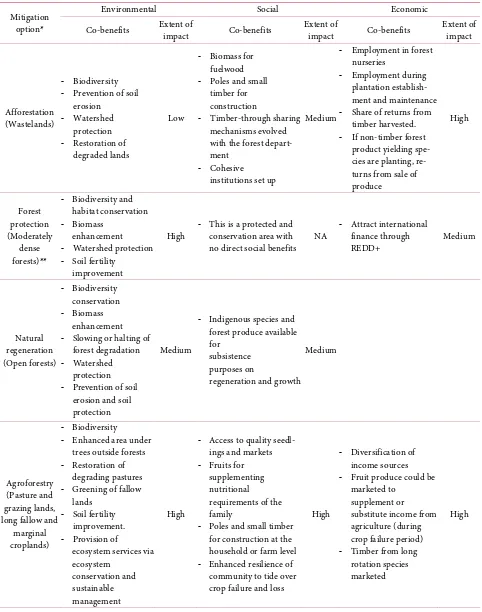
The mitigation options identified in this assessment viz., forest protection, natural regeneration, agroforestry, and afforestation-short and long-rotation forestry are screened using the above co-benefits framework to assess for ecological, social and economic benefits and for synergies and tradeoffs with sus-tainable development goals. Further, the extent of impact of the mitigation options is assessed and catego-rised as high, medium and low.
3. RESULTS AND DISCUSSION
https://doi.org/10.4236/ns.2018.107028 281 Natural Science
Table 1. Co-benefits of forestry mitigation activities and their impact.
Mitigation option*
Environmental Social Economic
Co-benefits Extent of impact Co-benefits Extent of impact Co-benefits Extent of impact
Afforestation (Wastelands)
- Biodiversity - Prevention of soil
erosion - Watershed
protection - Restoration of
degraded lands
Low
- Biomass for fuelwood - Poles and small
timber for construction
- Timber-through sharing mechanisms evolved with the forest depart-ment
- Cohesive institutions set up
Medium
- Employment in forest nurseries
- Employment during plantation establish-ment and maintenance - Share of returns from
timber harvested. - If non-timber forest
product yielding spe-cies are planting, re-turns from sale of produce High Forest protection (Moderately dense forests)**
- Biodiversity and habitat conservation - Biomass
enhancement - Watershed protection - Soil fertility
improvement
High
- This is a protected and conservation area with
no direct social benefits NA
- Attract international finance through
REDD+ Medium
Natural regeneration (Open forests) - Biodiversity conservation - Biomass enhancement - Slowing or halting of
forest degradation - Watershed
protection - Prevention of soil
erosion and soil protection
Medium
- Indigenous species and forest produce available for
subsistence purposes on
regeneration and growth
Medium
Agroforestry (Pasture and grazing lands, long fallow and
marginal croplands)
- Biodiversity
- Enhanced area under trees outside forests - Restoration of
degrading pastures - Greening of fallow
lands - Soil fertility
improvement. - Provision of
ecosystem services via ecosystem
conservation and sustainable management
High
- Access to quality seedl-ings and markets - Fruits for
supplementing nutritional requirements of the family
- Poles and small timber for construction at the household or farm level - Enhanced resilience of
community to tide over crop failure and loss
High
- Diversification of income sources - Fruit produce could be
marketed to supplement or substitute income from agriculture (during crop failure period) - Timber from long
rotation species marketed
High
https://doi.org/10.4236/ns.2018.107028 282 Natural Science assesses the extent of these impacts and categorises them as high, medium and low. Below the co-benefits and risks classified broadly as environmental, social and economic co-benefits and risks are discussed.
3.1. Environmental Benefits and Risks
Benefits: Environmental co-benefits of implementation of forestry mitigation options-afforestation, natural regeneration, forest protection and agroforestry include 1) maintenance, conservation and promo-tion of biodiversity, 2) reclamapromo-tion and restorapromo-tion of degraded lands, 3) improvement in soil fertility, and iv) watershed services. Additionally, due to improvement in biodiversity, ecosystems are likely to become more resilient to changes in climate.
Risks: A potential negative impact of afforestation as a mitigation activity is promotion of monocul-ture plantations. However, this risk is mitigated as Forest Departments in India strictly promote multi-species plantations alone. Afforestation activities however may negatively impact water yield [26] and lead to negative consequences, particularly in drier areas, which is controversial and debatable.
3.2. Social Benefits and Risks
Benefits: Forestry mitigation activities promote livelihoods and provide sustained income to poor communities. They further result in provisioning of forest products such as fuelwood, fibre, food and con-struction materials after the initial establishment and growth period, particularly in case of long-rotation species such as teak or fruit orchards. Such provisioning of fruits and nuts is likely to lead to dietary changes because of availability of fruits for consumption to the poor communities. This would lead to overall improvement in the health of the communities.
Risks: Inequity in benefit-sharing may become a trade-off if a clear institutional framework for har-vest and sharing of benefits is not formulated when forestry mitigation activities are implemented on pub-lic lands such as forestlands and wastelands. In cases, where agriculture land category is considered for forestry mitigation, food production may be impacted, causing food shortage and rise in price of food. However, in the case of Karnataka, it has been clearly demonstrated that such a negative impact is not likely to occur as agriculture production is unlikely to be affected given the past trends and the potential for producing more from existing area under agriculture.
3.3. Economic Benefits and Risks
Benefits: Forestry activities create employment opportunities. These include employment in nurser-ies where seedlings are to be raised, land preparation, planting of seedlings, thinning, maintenance and even harvest. Increased income from additional or new employment opportunities is yet another positive impact of forestry mitigation activities. Forestry mitigation activities to reduce forest loss and degradation are potential REDD+ activities that could draw financial incentives or attract financial mechanisms.
Risks: Potential negative impacts could be reduction in local income if communities are currently collecting timber and fuelwood and selling them in the market as a livelihood option. Communities would lose access to forest products, when forestry mitigation activities are implemented.
It is clear from this discussion and from Table 1 and discussions above that forestry mitigation op-tions deliver multiple environmental, social and economic benefits. The extent of benefits, range from high to low across all categories as well as mitigation options, depending on the land categories on which these options are implemented-their degradation status and tenure. There are risks as well in implement-ing these options on different land categories, which will have to be avoided through plannimplement-ing and appro-priate institutional and policy mechanisms.
3.4. Impact of Climate Change on Forestry Mitigation Potential
https://doi.org/10.4236/ns.2018.107028 283 Natural Science interlinked. There is a web of feedback-synergistic or conflicting between mitigation and adaptation [27-29]. The mitigation options and potential themselves may be vulnerable to climatic change [30]. Re-versals of mitigation benefits may be caused by natural events (such as forest fires and droughts) that affect growth. Such reversal effects may be temporary or short-term and will affect the annual increment of car-bon, without probably resulting in a permanent decline in carbon stocks. But in case of a forest fire or in-cidence of insect or disease outbreaks, or drought, mitigation potential may decline significantly.
Climate change impact on carbon stocks in soils and forests including their adaptive capacity is im-portant to actualize the mitigation potential [31]. Pervasive droughts and disturbances due to fire and in-sect outbreaks are likely to be exacerbated by climate extremes and long-term climate change [32-34] and these are a risk to the mitigation benefits of forests. Forest disturbances and climate extremes could impact the carbon balance and storage [35-39]. Thus, climate change could impact the potential and role land use sector can play in mitigating climate change.
3.5. Sustainable Development Goals
The Sustainable Development Goals (SDGs), officially known as Transforming Our World: The 2030 Agenda for Sustainable Development, are a set of seventeen aspirational “Global Goals”. Each goal has specific targets to be achieved over the next 15 years. As evident from the discussion in the previous sec-tion, forestry mitigation activities can potentially deliver multiple co-benefits. Maximizing co-benefits of forestry mitigation measures can increase efficiency in achieving the objectives of other international agreements. Forestry mitigation activities also have the potential to contribute to a broader global sustain-ability agenda [40]. Forestry mitigation activities clearly contribute to some of the SDGs of the United Na-tions.
The SDGs that the forestry mitigation activities directly contribute to include:
1) Goal 12.2: By 2030, achieve the sustainable management and efficient use of natural re-sources.
o Although the aim of forestry mitigation activities is carbon sink enhancement, the use of land catego-ries such as wastelands and agriculture fallow lands that are under-utilized or unused promotes effi-cient use of land resource which is the goal of SDG 12.2. In case of the forestland category, forestry mitigation activities promote sustainable management of this land category as it is aimed at reducing forest loss and degradation, again a goal of SDG 12.2.
2) Goal 13: Take urgent action to combat climate change and its impacts.
o The forestry mitigation activities envisaged directly contribute to this SDG, by sequestering carbon as a mitigation action. Further forest conservation, leading to biodiversity conservation and linking for-est corridors could reduce the impacts of climate change.
3) Goal 15: Protect, restore and promote sustainable use of terrestrial ecosystems, sustainably manage forests, combat desertification, and halt and reverse land degradation and halt biodiversity loss.
o All the forestry mitigation activities are promoting sustainable use of terrestrial ecosystems as well as forests. Inclusion of wasteland category for forestry mitigation directly contributes towards the target of halting and reversing land degradation and inclusion of degrading moderately dense forests and open forests for forest conservation and regeneration will halt biodiversity loss.
It is evident from this analysis that there are significant opportunities for synergistically promoting mitigation and adaptation to climate change (Ravindranath, 2007), while enhancing conservation of bio-diversity, and achieving other environmental as well as socio-economic benefits including meeting the sustainable development targets and goals.
4. CONCLUSIONS
https://doi.org/10.4236/ns.2018.107028 284 Natural Science have to be overcome through an integrated approach to realize the full potential. Forestry mitigation pro-jects would play a multifunctional role that includes biodiversity conservation, improvement of ecosystem and yields of goods and services to the community generally, in addition to the overarching goal of climate change mitigation. Forestry mitigation activities deliver multiple environmental, social and economic benefits. In addition, some of the forestry mitigation activities such as agroforestry provide adaptation benefits as well, giving an opportunity for increasing ecological efficiency (Robledo et al., 2011). Among the four mitigation options, agroforestry scores high when it comes to delivery of environmental, social and economic benefits. Mitigation options for forestland-forest protection and natural regeneration score medium across all the co-benefit categories, while afforestation shows a mixed pattern. All these options have some risks associated with their implementation. Mitigation actions that promote sustainable devel-opment are likely to be viewed positively (Smith and Wollenberg, 2012). It is interesting to note that the forestry mitigation actions also contribute to achievement of Sustainable Development Goals and Targets of the United Nations. It is evident that forestry mitigation activities deliver multiple co-benefits including climate change adaptation. Many of these co-benefits are targets under the SDGs. Thus, forestry mitiga-tion activities also contribute to the overall sustainable development agenda of a state and country.
“Maximizing co-benefits of forestry mitigation measures can increase efficiency in achieving the ob-jectives of other international agreements”, including the Convention on Biological Diversity (CBD) and the United Nations Convention to Combat Desertification (UNCCD, 2011). These could also contribute to a broader global sustainability agenda (Gardner et al., 2012), whose implementation is sometimes limited by capital (Tubiello et al., 2009). Thus, mitigation is likely to provide a new source of finance.
CONFLICTS OF INTEREST
The authors declare no conflicts of interest regarding the publication of this paper.
REFERENCES
1. Smith, P., Bustamante, M., Ahammad, H., Clark, H., Dong, H., Elsiddig, E.A., Haberl, H., Harper, R., House, J., Jafari, M., Masera, O., Mbow, C., Ravindranath, N.H., Rice, C.W., Robledo Abad, C., Romanovskaya, A., Sper-ling, F. and Tubiello, F. (2014) Agriculture, Forestry and Other Land Use (AFOLU). In: Edenhofer, O., Pichs-Madruga, R., Sokona, Y., Farahani, E., Kadner, S., Seyboth, K., Adler, A., Baum, I., Brunner, S., Eicke-meier, P., Kriemann, B., Savolainen, J., Schlömer, S., von Stechow, C., Zwickel, T. and Minx, J.C., Eds., Climate Change 2014: Mitigation of Climate Change, Contribution of Working Group III to the 5th Assessment Report of the Intergovernmental Panel on Climate Change, Cambridge University Press, Cambridge, United Kingdom and New York, NY, USA.
2. IPCC (2014) Summary for Policymakers. In: Field, C.B., Barros, V.R., Dokken, D.J., Mach, K.J., Mastrandrea, M.D., Bilir, T.E., Chatterjee, M., Ebi, K.L., Estrada, Y.O., Genova, R.C., Girma, B., Kissel, E.S., Levy, A.N., Mac-Cracken, S., Mastrandrea, P.R. and White, L.L., Eds., Climate Change 2014: Impacts, Adaptation, and Vulner-ability, Part A: Global and Sectoral Aspects. Contribution of Working Group II to the 5th Assessment Report of the Intergovernmental Panel on Climate Change, Cambridge University Press, Cambridge, United Kingdom and New York, NY, USA, 1-32. https://doi.org/10.1017/CBO9781107415379.003
3. Dudek, D., Golub, A. and Strukova, E. (2002) Ancillary Benefits of Reducing Greenhouse Gas Emissions in Transitional Economies. Working Paper, Environmental Defence, Washington, DC.
4. Forner, C., Blaser, J., Jotzo, F. and Robledo, C. (2006) Keeping the Forest for the Climate’s Sake: Avoiding De-forestation in Developing Countries under the UNFCCC. Climate Policy, 6, 275-294.
https://doi.org/10.1080/14693062.2006.9685602
https://doi.org/10.4236/ns.2018.107028 285 Natural Science Ecosystems & Environment, 126, 67-80. https://doi.org/10.1016/j.agee.2008.01.014
6. Alves Finco, M.V. and Doppler, W. (2010) Bioenergy and Sustainable Development: The Dilemma of Food Se-curity in the Brazilian Savannah. Energy for Sustainable Development, 14, 194-199.
https://doi.org/10.1016/j.esd.2010.04.006
7. Colfer, C.J.P. (2011) Marginalized Forest Peoples’ Perceptions of the Legitimacy of Governance: An Exploration.
World Development, 39, 2147-2164. https://doi.org/10.1016/j.worlddev.2011.04.012
8. Davis, S.C., Boddey, R.M., Alves, B.J.R., Cowie, A.L., George, B.H., Ogle, S.M., Smith, P., van Noordwijk, M. and van Wijk, M.T. (2013) Management Swing Potential for Bioenergy Crops. GCB Bioenergy, 5, 623-638.
https://doi.org/10.1111/gcbb.12042
9. Muys, B., Norgrove, L., Alamirew, T., Birech, R., Chirinian, E., Delelegn, Y., Ehrensperger, A., Ellison, C.A., Feto, A., Freyer, B., Gevaert, J., Gmünder, S., Jongschaap, R.E.E., Kaufmann, M., Keane, J., Kenis, M., Kiteme, B., Langat, J., Lyimo, R., Moraa, V., Muchugu, J., Negussie, A., Ouko, C., Rouamba, M.W., Soto, I., Wörgetter, M., Zah, R. and Zetina, R. (2013) Integrating Mitigation and Adaptation into Development: The Case of Jatro-pha curcas in Sub-Saharan Africa. Global Change Biology Bioenergy, 6, 169-171.
https://doi.org/10.1111/gcbb.12070
10. May, P., Boyd, E., Chang, M. and Neto, V.F.C. (2005) Incorporating Sustainable Development into Carbon For-est Projects in Brazil and Bolivia. EstudosSociedade e Agricultura, 1, 23 p.
11. Madlener, R., Robledo, C., Muys, B. and Freja, J.T.B. (2006) A Sustainability Framework for Enhancing the Long-Term Success of LULUCF Projects. Climatic Change, 75, 241-271.
https://doi.org/10.1007/s10584-005-9023-0
12. Smith P., Martino, D., Cai, Z., Gwary, D., Janzen, H.H., Kumar, P., McCarl, B., Ogle, S., O’Mara, F., Rice, C., Scholes, R.J., Sirotenko, O., Howden, M., McAllister, T., Pan, G., Romanenkov, V., Rose, S., Schneider, U. and Towprayoon, S. (2007) Agriculture. In: Metz, B., Davidson, O.R., Bosch, P.R., Dave, R. and Meyer, L.A., Eds., Chapter 8 of Climate Change 2007: Mitigation, Contribution of Working group III to the 4th Assessment Re-port of the Intergovernmental Panel on Climate Change, Cambridge University Press, Cambridge, UK and New York, USA, 497-540.
13. Howden, S.M., Crimp, S.J. and Stokes, C.J. (2008) Climate Change and Australian Livestock Systems: Impacts, Research and Policy Issues. Australian Journal of Experimental Agriculture, 48, 780-788.
https://doi.org/10.1071/EA08033
14. Cotula, L., Vermeulen, S., Leonard, R. and Keeley, J. (2009) Land Grab or Development Opportunity? Agricul-tural Investment and International Land Deals in Africa, 130 p.
15. Cattaneo, A., Lubowski, R., Busch, J., Creed, A., Strassburg, B., Boltz, F. and Ashton, R. (2010) On International Equity in Reducing Emissions from Deforestation. Environmental Science & Policy, 13, 742-753.
https://doi.org/10.1016/j.envsci.2010.08.009
16. Junginger, M., van Dam, J., Zarrilli, S., Ali Mohamed, F., Marchal, D. and Faaij, A. (2011) Opportunities and Barriers for International Bioenergy Trade. Energy Policy, 39, 2028-2042.
https://doi.org/10.1016/j.enpol.2011.01.040
17. Sandor, R.L., Bettelheim, E.C. and Swingland, I.R. (2002) An Overview of a Free-Market Approach to Climate Change and Conservation. Philosophical Transactions of the Royal Society of London Series A—Mathematical Physical and Engineering Sciences, 360, 1607-1620.
Po-https://doi.org/10.4236/ns.2018.107028 286 Natural Science tential of Agroforestry Crops under Global Change. Environmental Pollution, 158, 1095-1104.
https://doi.org/10.1016/j.envpol.2009.09.008
20. Busch, J., Godoy, F., Turner, W.R. and Harvey, C.A. (2011) Biodiversity Co-Benefits of Reducing Emissions from Deforestation under Alternative Reference Levels and Levels of Finance. Conservation Letters, 4, 101-115. https://doi.org/10.1111/j.1755-263X.2010.00150.x
21. Smith, P., Haberl, H., Popp, A., Erb, K., Lauk, C., Harper, R., Tubiello, F.N., de Siqueira Pinto, A., Jafari, M., Sohi, S., Masera, O., Böttcher, H., Berndes, G., Bustamante, M., Ahammad, H., Clark, H., Dong, H., Elsiddig, E.A., Mbow, C., Ravindranath, N.H., Rice, C.W., Robledo Abad, C., Romanovskaya, A., Sperling, F., Herrero, M., House, J.I. and Rose, S. (2013) How Much Land-Based Greenhouse Gas Mitigation Can Be Achieved with-out Compromising Food Security and Environmental Goals? Global Change Biology, 19, 2285-2302.
https://doi.org/10.1111/gcb.12160
22. Albers, H.J. and Robinson, E.J.Z. (2013) A Review of the Spatial Economics of Non-Timber Forest Product Ex-traction: Implications for Policy. Ecological Economics, 92, 87-95.
https://doi.org/10.1016/j.ecolecon.2012.01.021
23. Branca, G., Hissa, H., Benez, M.C., Medeiros, K., Lipper, L., Tinlot, M., Bockel, L. and Bernoux, M. (2013) Cap-turing Synergies between Rural Development and Agricultural Mitigation in Brazil. Land Use Policy, 30, 507-518. https://doi.org/10.1016/j.landusepol.2012.04.021
24. Swanson, D., Pinter, L., Bregha, F., Volkery, A. and Jacob, K. (2004) Sustainable Development and National Government Actions. IISD, Commentary.
25. Deal, R.L. and White, R. (2012) Integrating Forest Products with Ecosystem Services: A Global Perspective. Forest Policy and Economics, 17, 1-2.
26. Jackson, R.B., Jobbágy, E.G., Avissar, R., Roy, S.B., Barrett, D.J., Cook, C.W., Farley, K.A., Le Maitre, D.C., McCarl, B.A. and Murray, B.C. (2005) Trading Water for Carbon with Biological Carbon Sequestration. Science, 310, 1944.
27. Guariguata, M.R., Cornelius, J.P., Locatelli, B., Forner, C. and Sánchez Azofeifa, G.A. (2008) Mitigation Needs Adaptation: Tropical Forestry and Climate Change. Mitigation and Adaptation Strategies for Global Change, 13, 793-808. https://doi.org/10.1007/s11027-007-9141-2
28. Van Vuuren, D.P., van Vliet, J. and Stehfest, E. (2009) Future Bio-Energy Potential under Various Natural Con-straints. Energy Policy, 37, 4220-4230.https://doi.org/10.1016/j.enpol.2009.05.029
29. Robledo, C., Clot, N., Hammill, A. and Riché, B. (2011) The Role of Forest Ecosystems in Community Based Coping Strategies to Climate Hazards: Three Examples from Rural Areas in Africa. Forest Policy and Econom-ics, 24, 20-28. https://doi.org/10.1016/j.forpol.2011.04.006
30. Reichstein, M., Bahn, M., Ciais, P., Frank, D., Mahecha, M.D., Seneviratne, S.I., Zscheischler, J., Beer, C., Buch-mann, N., Frank, D.C., Papale, D., Rammig, A., Smith, P., Thonicke, K., van der Velde, M., Vicca, S., Walz, A. and Wattenbach, M. (2013) Climate Extremes and the Carbon Cycle. Nature, 500, 287-295.
https://doi.org/10.1038/nature12350
31. Sitch, S., Huntingford, C., Gedney, N., Levy, P.E., Lomas, M., Piao, S.L., Betts, R., Ciais, P., Cox, P., Friedling-stein, P., Jones, C.D., Prentice, I.C. and Woodward, F.I. (2008) Evaluation of the Terrestrial Carbon Cycle, Fu-ture Plant Geography and Climate-Carbon Cycle Feedbacks Using Five Dynamic Global Vegetation Models (DGVMs). Global Change Biology, 14, 2015-2039. https://doi.org/10.1111/j.1365-2486.2008.01626.x
https://doi.org/10.4236/ns.2018.107028 287 Natural Science 33. Phillips, O.L., Aragão, L.E.O.C., Lewis, S.L., Fisher, J.B., Lloyd, J., López González, G., Malhi, Y., Monteagudo,
A., Peacock, J., Quesada, C.A., et al. (2009) Drought Sensitivity of the Amazon Rainforest. Science, 323, 1344. 34. Herawati, H. and Santoso, H. (2011) Tropical Forest Susceptibility to and Risk of Fire under Changing Climate:
A Review of Fire Nature, Policy and Institutions in Indonesia. Forest Policy and Economics, 13, 227-233. 35. Millar, C.I., Stephenson, N.L. and Stephens, S.L. (2007) Climate Change and Forests of the Future: Managing in
the Face of Uncertainty. Ecological Applications, 17, 2145-2151.
36. Kurz, W.A., Stinson, G., Rampley, G.J., Dymond, C.C. and Neilson, E.T. (2008) Risk of Natural Disturbances Makes Future Contribution of Canada’s Forests to the Global Carbon Cycle Highly Uncertain. Proceedings of
the National Academy of Sciences, 105, 1551. https://doi.org/10.1073/pnas.0708133105
37. Zhao, M. and Running, S.W. (2010) Drought-Induced Reduction in Global Terrestrial Net Primary Production from 2000 through 2009. Science, 329, 940-943. https://doi.org/10.1126/science.1192666
38. Potter, C., Klooster, S., Hiatt, C., Genovese, V. and Castilla Rubio, J.C. (2011) Changes in the Carbon Cycle of Amazon Ecosystems during the 2010 Drought. Environmental Research Letters, 6, 1-5.
39. Davidson, E.A. (2012) Representative Concentration Pathways and Mitigation Scenarios for Nitrous Oxide.
En-vironmental Research Letters, 7, Article ID: 024005. https://doi.org/10.1088/1748-9326/7/2/024005