A Matheuristic Approach to Solve the
Multi-objective Beam Angle Optimisation
Problem in Intensity Modulated Radiation
Therapy
Guillermo Cabrera G.
1,2,∗, Matthias Ehrgott
3, Andrew Mason
1,
and Andrea Raith
11
Department of Engineering Science, University of Auckland (New
Zealand)
2
Escuela de Ingenier´ıa Inform´
atica, Pontificia Universidad Cat´
olica
de Valpara´ıso (Chile)
3
Management School, Lancaster University (United Kingdom)
Received: date / Accepted: date
Abstract
Selecting a suitable set of beam angles is an important but difficult task in intensity modulated radiation therapy (IMRT) for cancer treat-ment. From a single objective point of view this problem, known as beam angle optimisation (BAO) problem, is solved by finding a beam angle configuration (BAC) that leads to the best dose distribution, according to some objective function. Because there exists a trade-off between the main goals in IMRT (to irradiate the tumour according to some prescrip-tion and to avoid surrounding healthy tissue) it makes sense to solve this problem from a multi-objective (MO) point of view. When doing so, a solution of the BAO problem is no longer a single BAC but instead a set of BACs which lead to a set of dose distributions that, depending on both dose prescription and physician preferences, can be selected as the preferred treatment.
We solve this MO problem using a two-phase strategy. During the first phase, a deterministic local search algorithm is used to select a set of locally optimal BACs, according to a single objective function. During this search, an optimal dose distribution for each BAC, with respect to the single objective function, is calculated using an exact non-linear pro-gramming algorithm. During the second phase a set of non-dominated
points is generated for each promising locally optimal BAC and a domi-nance analysis among them is performed. The output of the procedure is a set of (approximately) efficient BACs that lead to good dose distribu-tions. To demonstrate the viability of the method, the two-phase strategy is applied to a prostate case.
Keywords: Multi-objective Beam Angle Optimisation, Deterministic Lo-cal Search, MathematiLo-cal Programming, Intensity Modulated Radiation Therapy
1
Introduction
Intensity modulated radiation therapy (IMRT) is a common technique applied in external radiation therapy. Its goal is to eradicate tumour cells by delivering ionising radiation from an external source to the tumour without compromising surrounding normal tissue and organs at risk (OARs). Unfortunately, because of the physics of radiation delivery, there is a trade-off between control of the tumour and sparing surrounding normal tissue. A distinctive feature of IMRT is that radiation can be modulated using a device called amulti-leaf collimator
(Romeijn and Dempsey, 2008). Modulation is achieved by moving the metal leaves of the multi-leaf collimator into the radiation fields, thereby partially blocking the radiation. Several of these partially blocked radiation fields are superimposed to generate a fluence map which leads to a dose distribution that delivers more radiation to the tumour while better sparing surrounding OARs than unmodulated conformal radiotherapy. Modulation is particularly important for tumours with non- convex shapes in difficult anatomical situations (Ehrgott et al, 2009; Romeijn and Dempsey, 2008).
Due to the complexity of designing a treatment plan, the IMRT planning problem is usually divided into three sequential sub-problems, namely, beam angle optimisation (BAO), fluence map optimisation (FMO) and multi-leaf col-limator sequencing. A solution of the BAO problem determines the number and directions of radiation beam angles, i.e. a beam angle configuration (BAC). Then, the optimal fluence of radiation for each beam angle needs to be computed (FMO problem) to give a high quality dose distribution in the organs. Finally, a sequencing problem needs to be solved to control the movement of the multi-leaf collimator leaves during delivery of the optimised fluence (Ehrgott et al, 2009). This sequential approach implies that the quality of the solution obtained at each step depends to a possibly large extent on the solution obtained in the previous steps. Therefore, beam angle selection will have a considerable impact on the fluence map obtained when solving the FMO problem using a specific BAC.
ex-perience and intuition as well as considering some geometrical features of the problem. However, as has been pointed out previously in the literature, man-ual selection may lead to sub-optimal treatment plans (Ehrgott and Johnston, 2003; Pugachev and Xing, 2002; Pugachev et al, 2001; Rowbottom et al, 1998). Currently, the planning process proceeds as follows: The planner selects a BAC based on his/her experience and generates the fluence map (i.e. the planner uses specialised software to solve the FMO problem) for that BAC. If the resulting fluence map is clinically unacceptable, the treatment planner often defines a new BAC and repeats the fluence map optimisation for the new BAC. This process is repeated until a clinically acceptable fluence map is obtained (Ehrgott et al, 2008). It is not uncommon that this process can take several hours. Thus, solving the BAO problem using automated beam angle selection techniques has the potential to generate good quality treatment plans independently of planner experience and to alleviate the tedious repetitive process described above.
Mathematically, the BAO problem can be formulated as follows. Let K be the set of all possible beam angles around the patient. In this work we consider
K={kπ/180 :k= 0,1,2, . . . ,359}. Coarse angular resolutions can also be used within our framework to reduce the number of angles inK. LetA ∈ PN(K) be
a BAC wherePN(K) is the set of allN-element subsets ofK, with N >0 the
a priori determined number of angles. We denote thei-th angle ofA byAifor
i= 1, . . . , N. The BAO problem seeks to find a BACA which minimises some objective functionh:PN(K)→
R,
min
A∈PN(K)h(A). (1)
The BAO problem is usually stated as a mixed integer (or binary) optimisation problem (Bangert et al, 2012; Ehrgott and Johnston, 2003; Preciado-Walters et al, 2004, 2006), as the set of all possible angles K is discrete and only a subset of them is considered in a BAC A. Furthermore, for most choices of
h, BAO is a non-convex problem with possibly many local optima (Ehrgott and Johnston, 2003; Ehrgott et al, 2008; Lim and Cao, 2012; Pugachev et al, 2001). The feasible set for the BAO problem has |KN| elements, and since clinically relevant values ofNrange from 5 to 15 beam angles, there are between 4.9×10¹⁰and 1.3×1026 subsets of K (Ehrgott et al, 2008). Moreover, when BAO and FMO are posed together (i.e. when evaluatingh(A) requires solving the FMO problem) the set of feasible solutions is highly enlarged (Bortfeld and Schlegel, 1993; Pugachev and Xing, 2001). Thus, it is not possible to explore the entire set of feasible solutions in reasonable computational time. Hence, we need to find some efficient strategy to identify those BACs that minimiseh.
problem is a commonly used quadratic penalty function which penalises those sub-volumes in the tumour (OARs) below (above) lower (upper) bounds. The genetic algorithm selects a subset of angles and a conjugate gradient method is used to solve the FMO problem, which is modelled as a quadratic optimisation problem. According to the authors, their genetic algorithm obtains very good solutions in clinical cases, reaching high radiation uniformity in the tumour and low radiation in most of the OARs, outperforming manual beam angle selection consistently. Instead of the genetic algorithm used in Li et al (2004), Li et al (2005a) present a particle swarm optimisation algorithm to solve the BAO prob-lem. The corresponding FMO problem in each BAC considered by the particle swarm optimisation algorithm is solved, again, by a conjugate gradient algo-rithm. The particle swarm optimisation algorithm is applied to both clinical and non-clinical cases. According to the authors, the particle swarm optimisa-tion approach seems to be at least as good as the genetic algorithm strategy presented in Li et al (2004). Dias et al (2014) present a genetic algorithm com-bined with a neural network to solve the single objective BAO problem. The authors make use of a surrogate function to speed up the algorithm. To do that, the genetic algorithm uses the neural network as a surrogate model to calculate an approximation of the judgement function value of most of the visited BACs. The authors highlight that their approach is able to find improved BACs when compared to the ones used in clinical practice. Another heuristic used to solve the BAO problem is an ant colony system. While in Li et al (2005b) a pure ant colony system is combined with a conjugate gradient algorithm, the same au-thors present a hybrid strategy combining a genetic algorithm and an ant colony system to solve the BAO problem in Li and Yao (2006). The authors propose this hybrid approach in order to obtain a balance between exploration and ex-ploitation attributes of the hybrid algorithm. While the genetic algorithm is used to explore the set of feasible BACs to initialise the ant colony system (ex-ploration), the ant colony system is used to fine tune the (locally) optimal BAC (exploitation). According to the authors, the combined genetic algorithm and ant colony system algorithm is a more efficient approach than each algorithm separately. Another meta-heuristic that has been widely implemented to solve the BAO problem is simulated annealing (Bortfeld and Schlegel, 1993; Djajapu-tra et al, 2003; Pugachev and Xing, 2002; Stein et al, 1997). Recently, Bertsimas et al (2013) presented a hybrid implementation of simulated annealing and a gradient descent method. While the gradient descent method is used to quickly find a local optimal solution, simulated annealing is used to get the algorithm out of locally optimal solutions and to search in different parts of the solution set. One distinctive feature of this approach is the use of gradient information to refine the BAC. Because they consider a linear objective function, they can obtain the gradient information using linear programming duality theory (Craft, 2007; Bertsimas et al, 2013).
imple-ment two different approaches to solve the BAO problem: simulated annealing and add/drop algorithms. They also propose different neighbourhood defini-tions for the local search and all of them are tested in both algorithms. The objective function for their corresponding FMO problem is a convex penalty function which is solved to optimality by means of an interior point method. Results show that the neighbourhood choice can be important in order to im-prove the performance of a particular algorithm implementation. More recently, Lim et al (2014) present a hybrid framework combining local search and other optimisation methods such as simulated annealing, genetic algorithms, nested partitions, to solve the single objective BAO problem. Their framework consists of two sequential phases. During the first phase, either a heuristic or an exact method is used to quickly find a good feasible BAC. During the second phase the BAC obtained during the previous phase is used to warm-start a local search algorithm. According to the authors, their framework overcomes the weakness observed when using the optimization methods separately and consistently finds good solutions.
All these approaches have some characteristics in common. They all use heuristics to search for new BACs and mathematical programming to find an optimal solution to the corresponding FMO problem. Solving the associated FMO problem to optimality is an important feature of all these approaches, as it allows a fair comparison of different subsets of beam angles. Another shared characteristic is that they evaluate the quality of a BAC by considering the dose distribution obtained by the associated FMO problem. Furthermore, they all model the problem as a single-objective optimisation problem and both the BAO and the corresponding FMO problem are treated as separate problems.
Unlike the approaches mentioned above, in this paper we propose a heuris-tic method to solve the BAO problem from a multi-objective (MO) point of view. While most of the efforts in multi-objective IMRT optimisation have been focused on the MO-FMO problem (Breedveld et al, 2007; Craft et al, 2007; Hamacher and K¨ufer, 2002; Kalantzis and Apte, 2014; K¨ufer et al, 2003; La-hanas et al, 2003) only little attention has been paid to the MO-BAO problem. The MO-BAO was first addressed by Schreibmann et al (2004), who propose an
optimises the corresponding fluence map. Fiege et al (2011) point out that due to the enlarged feasible set, solving both problems simultaneously is harder than solving them consecutively. Because of that, and similar to Schreibmann et al (2004), their algorithm only approximates optimal fluence maps and simplified objective functions are considered in order to speed up the algorithm. More recently, Breedveld et al (2012) propose an a priori method to solve the MO-BAO problem. Their method, called iCycle, starts with an empty BAC, i.e., no beams are selected. Then, the best possible beam angle is selected from a predefined set of candidate beams at each iteration and added to the BAC that is being generated. The method stops when no further (relevant) improvement in the obtained BAC is made. The method can also stop if the number of beams in the current BAC has become impractically large. TheiCycle method determines the best beam angle to be added at each iteration by solving a sin-gle objective optimization problem where the objective function corresponds to a weighted sum of the objectives from the original MO problem, as explained in Breedveld et al (2009). As the method obtains one BAC at each iteration the treatment planner can select the BAC with the best trade-off between the number of beams used and the treatment plan quality. A similar approach is presented in Azizi-Sultan (2010). He presents an algorithm that consists of two steps that are repeated until the BAC obtained at the end of the second step has the desired number of beams. During the first step an FMO problem is solved and the dose deviation from the prescribed dose is calculated for the currentN-BAC (a BAC consideringN beam angles). During the second step, the contribution of every beam angle not in the current N-BAC is calculated, using a predefined score function. The beam angle with the best contribution is then added to the new (N + 1)-BAC. The algorithm ends when the desired number of beam angles in the current BAC is achieved. Finally, a MO-FMO problem is solved using the obtained BAC.
efficient treatment plans. We say that a BAC that occurs in the set of efficient treatment plans is efficient. A formal definition for efficient BACs is given in Section 3. As we cannot evaluate all possible BACs we cannot ensure that a BAC is truly efficient. Thus BACs found by the two-phase approach presented here are calledapproximately efficient BACs. During the second phase we gen-erate a large set of non-dominated points for all the obtained (approximately) efficient locally optimal BACs by means of the well-knownε-constraint method (Chankong and Haimes, 1983; Haimes et al, 1971). Some such points will be dominated by points generated by other BACs. Those dominated points are deleted leaving a final set of non-dominated points for the treatment planner to choose from. Hereafter, we will refer to the objective function(s) of the BAO problem as ajudgement function.
To formally describe the BAO problem, Ehrgott et al (2008, p. 1276) de-fine a judgement function as a function that “describes how well a patient can be treated with a set of N angles”. Then, they explain that the goal of any judgement function is “to capture the nature of how the treatment planner de-cides between good and bad treatments, and the value of such a function is the [value of the optimal] solution to an optimisation problem that decides a fluency [map]”(Ehrgott et al, 2008, p. 1276). Therefore, solving the BAO prob-lem requires solving the FMO probprob-lem many times, once for every BAC that is considered by the BAO problem. Thus, we can say that judgement functionh
of the general BAO problem in (1) can be expressed as
h(A) = min{z(x) :x∈X(A)}. (2)
Equation (2) shows the general form of a judgement function, where z
maps a solution x ∈ X(A) of the corresponding FMO problem into R∗+ := {v∈R:v≥0} ∪ {∞}by finding the best fluence map that can be delivered for
given BACA, according to functionz. Fluence mapx∈Rn is a non-negative
vector with each componentxirepresenting the length of time that a patient is
exposed to sub-beam (orbeamlet)iand wherenis the total number of beamlets summed over all 360 possible beam angles. The setX(A) is the set of all feasi-ble solutions of the FMO profeasi-blem when BACA is considered. Only beamlets
xi that belong to a beam angle inA are allowed to be greater than zero. See
Ehrgott et al (2008) for a comprehensive explanation of the judgement function concept.
2
An Overview of IMRT Optimisation Problems
In IMRT, radiation can be delivered from any beam angle k ∈ K. As we mentioned before, vectorx∈Rn denotes the fluence map, wherencorresponds
to the total number of beamlets summed over all possible 360 beam angles and its elementsxi=0 correspond to the fluence at beamleti. To mathematically
model the IMRT problem, each organ is discretised into small sub-volumes called
voxels. A crucial component of all mathematical optimisation models of the FMO problem is the radiation dose deposited into each voxel j of the tumour and OARs by fluence map x. This dose d is calculated using expression (3) (Ehrgott et al, 2009)
drj=
n X
i=1
Arjixi for allj= 1, 2, ..., mr, (3)
where r ∈ R ={O1, . . . , OQ, T} is an element of the index set of regions (we
use the term region to denote either the tumour, any organ at risk, or normal tissue), with the tumour indexed byr=T and the organs at risk and normal tissue indexed byr=Oq withq= 1, . . . , Q. mr is the total number of voxels in
regionr,j corresponds to a specific voxel in regionr,dr∈
Rm
r
is a dose vector and its elementsdrj give the total dose delivered to voxelj in region r by the fluence mapx∈ X(A). Here, dose deposition matrix Ar ∈
Rm
r×n
is a given matrix whereAr
ji=0 defines the rate at which radiation dose along beamlet i
is deposited into voxelj in regionr.
Based on the dose distribution in formula (3), a large number of formulations for the FMO problem for a specific BAC have been proposed in the literature during the last decade (see Ehrgott et al (2009) for a survey). On the one hand there are the so-called physical models, also known asdose-volume mod-els, which are focused on the percentage of the total volume of either the tumour or the OARs that is irradiated at a certain level. Dose-volume constraints of the formno more than x% of the volume of the tumour may receive a dose of less than y or, for the OAR case,no more than x% of the volume of the OAR may receive a dose of more than y are usually considered in these models. The ob-jective function in dose-volume models is usually the maximisation of the dose delivered to the tumour and/or the minimisation of the dose delivered to the OARs subject to both bound constraints and dose-volume constraints. Most of these physical models give rise to linear, mixed- integer, or quadratic opti-misation models (Ehrgott et al, 2009). This allows researchers and treatment planners to find clinically acceptable treatment plans using well known exact optimisation techniques.
inducing some particular complication in a healthy organ (Webb, 2010)). Some researchers have pointed out advantages of dose-response models over physical ones (Dirscherl et al, 2011; Nahum and Uzan, 2012; Thomas et al, 2005; Wu et al, 2002). Although conceptually more appealing (the patient is, after all, a biological system and not a dosimeter (Amols and Ling, 2002)), they are not yet widely used because of a lack of consolidated clinical data and also because the corresponding FMO problems are difficult to solve mathematically.
A well-known biological model is the generalised equivalent uniform dose (gEUD). Originally proposed in Niemierko (1997) thegEUD can be defined as the biologically equivalent dose that, if delivered uniformly, would lead to the same response as the actual non-uniform dose distribution (Niemierko, 1997). One advantage ofgEUD-based models over other dose-response models is that they do not require many parameters, making the optimisation process less dependent on parameters that could be difficult to determine. Moreover,gEUD
penalises less (more) irradiated voxels in tumour (OAR) regions which leads to a more homogeneous dose distribution in the tumour and to avoidance of overdosed voxels in OARs, two very desirable properties in IMRT. Therefore,
gEUD allows us to evaluate and compare dose distributions even if they are non-uniform. Several research articles have been devoted to the study ofgEUD -based IMRT planning. Most of them highlight the ability of gEUD- based models to obtain better OAR sparing while keeping the same or even better tumour coverage (Thomas et al, 2005; Wu et al, 2000, 2003).
The mathematical expression forgEUD is
gEUDr(x) =
1
mr mr X
j=1
drjar
1/ar
, (4)
where ar is a region-dependent parameter and dr
j (which depends on x) is as
given in Equation (3). For the tumour, we put ar < 0, whereas for OARs
we choosear >1. As |ar| increases, the gEUDbecomes more sensitive to less
(more) irradiated voxels in the tumour (OARs). Therefore, for those OARs that allow certain levels of radiation without a functional compromise (also called parallel organs), parameterar is set close to 1, whereas for serial organs (those
that must be irradiated as little as possible) values for parameterar are chosen
to be large.
decompositions into a convex objective and an increasing function. They also demonstrate that equivalent sets of non-dominated points can be found using other MO-FMO formulations, i.e. considering other objective functions. Hence, although our work focuses on gEUD, the solutions we produce are efficient under any of these objectives as well.
3
The Multi-Objective Beam Angle
Optimisa-tion Problem
In this paper we solve an optimisation problem which we denote the multi-objective beam angle optimisation problem (MO-BAO). Throughout the paper we will use the following notation for the comparison of vectors. Lety1, y2∈
Rp.
We writey1
5y2ify1
k 5y
2
k for allk= 1, . . . , p;y
1≤y2ify1
5y2 buty16=y2; andy1< y2 ify1
k < y
2
k for allk= 1, . . . , p. Thus, we say that a solutionx∈X
isefficientif there is no x0∈X such thatz(x0)≤z(x) (assuming that we want to minimise all the objective functions). Equivalently, the image z(x) of the efficient solutionxis callednon-dominated.
3.1
Multi-objective beam angle optimisation
Before we introduce the BAO problem we need to define the associated MO-FMO problem. For a fixed BACA ∈ PN(K), the general MO-FMO problem
can be formulated as
f(A) = min
x∈X(A)
z(x), (5)
where z(x)∈R|R| is a vector of |R| objective functionszr, r= 1, . . . ,|R| and
|R| is the total number of regions considered in the problem. Unlike the single objective formulation (2), which requires the determination of a single optimal solution, the solution to this multi-objective problem is a set XEA containing efficient fluence maps of MO-FMO problem (5). We defineYNA =f(A) as the set of associated non-dominated points given byYNA =
z(x) :x∈XEA . The MO-BAO problem we are investigating in this paper is
min
A∈PN(K)x∈minX(A)z(x), (6)
the solution of which is a set containing all efficient BACs which use exactly
N angles. Additionally, (6) asks for the generation of a setXE containing the
efficient fluence maps which belong to those efficient BACs and that lead to the setYN ={z(x) :x∈XE}, the associated set of all non-dominated points. We
also write problem (6) as
min
A∈PN(K)f(A), (7)
Unlike in the single objective BAO problem, solving the MO-BAO problem means finding the set of efficient BACs in PN(K). As we mentioned before,
a BAC A is efficient if X(A)∩XE 6= {}, or equivalently if there is a fluence
mapx∈X(A) such that there is no BACBand fluence map x0 ∈X(B) with
z(x0)≤z(x).
Unfortunately we cannot evaluate all possible BACs in reasonable time. Therefore, we will only find a set ˆA that approximates the actual set of ef-ficient BACs. Similarly, ˆXE will denote the approximation to the set of all
efficient fluence mapsXE. Images of solutionsx∈XˆE are denoted byy∈YˆN.
Although our two-phase algorithm can be adapted for other models of the FMO problem, in particular constrained optimization problems, as we explained in Section 2,gEUD-based models are considered in this work. A special case of the MO-FMO problem in (5) that is based on thegEUDis
max gEUDT(x) (8)
min gEUDOq(x) forq= 1, . . . , Q, s.t. x∈X(A),
whereX(A) is, again, the set of feasible fluence maps which is defined byx=0 and beamletsxi = 0 for all beamlets not belonging to beam angles in A. The
MO-BAO problem considered in this paper is the minimisation (in the sense explained above) of (8) over allA ∈ PN(K)
The gEUD function has several favourable optimisation properties such as convexity and positive homogeneity. As Cabrera G. et al (2014) demonstrate, positively homogeneous multi-objective optimisation problems, such as the one from Equation (8), withpobjective functions can be solved as multi-objective optimisation problems withp−1 objectives. This can be done by transforming one of the objectives into a constraint. Following the procedure presented in Cabrera G. et al (2014) we can generate an infinite number of efficient solutions located on a finite number of rays, each of which corresponds to an efficient solution of the reducedp−1 objective problem. Thus, the MO-BAO problem considered in this paper can be re-stated as follows:
min
A∈PN(K)fOq(A) =A∈PminN(K)x∈X(A):mingEUDT(x)=tgEUD
Oq(x) forq= 1, . . . , Q, (9)
wheretis equal to the prescribed gEUDof the tumour.
The corresponding MO-FMO problem for a fixed BACA ∈ PN(K) based
on thegEUD is
mingEUDOq(x) forq= 1, . . . , Q, (10) s.t. gEUDT(x) = t,
x ∈ X(A).
53 54 55 56 57 58 20 22 24 26 28 30 32
gEUDRectum(x)
gEUD B ladder ( x ) BACA BACB
(a)A completely dominatesB
53 54 55 56 57 58 59 60 20
25 30 35
gEUDRectum(x)
gEUD B ladder ( x ) BACA BACB
(b) NeitherA completely dominatesB norBcompletely dominatesA
53 54 55 56 57 58 59 60 20
25 30 35
gEUDRectum(x)
gEUD B ladder ( x ) BACA BACB
[image:12.612.155.460.122.389.2](c) Final non-dominated set for BACs A andBfrom (b)
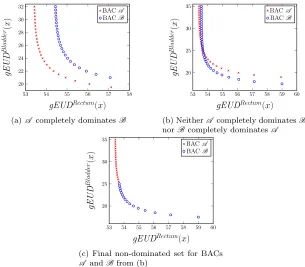
Figure 1: Dominance relations between sets of non-dominated points. gEUDof the tumour is fixed
2006). Scalarisation methods such as the well-known-constraint method men-tioned before also give sub-problems that are convex, and so we can use IPOPT to obtain a set of truly efficient solutions for this problem. Having this guarantee of optimality for this sub-problem is likely to result in better quality solutions being produced for the full MO-BAO problem.
In the framework of judgement functions, we are optimising the multi-objective judgement function fOq(A) with q = 1, . . . , Q defined in (9) over allN-element BACsA ∈ PN(K). One difficulty in solving the BAO problem
is to determine whether a BAC is better than another one. When this problem is tackled from a single objective point of view, a decision about which BAC is better is made using the single objective judgement function value. Thus, a BAC will be better than another one if its single objective optimal fluence map leads to a better judgement function value. However, when this problem is tackled from a MO point of view, comparison of different BACs is not a trivial task. In the MO case, we need to decide between two setsYNA andYNB rather than single optimal values. Figures 1(a) and 1(b) show two sets YNA and YNB
y≤y0. Therefore, we can say that BACA completely dominates BACBand, consequently, it leads to better fluence maps.
Unfortunately this situation is not as common as the one presented in Figure 1(b). In this case there is at least one y ∈ YNA that dominates at least one
y0∈YNB and vice versa. Thus, we need to keep all vectorsy ∈YNA ∪YNB that are non-dominated as in Figure 1(c).
As mentioned in Section 2, generating a set containing many non-dominated points YNA for a large number of BACs A ∈ PN(K) is not possible because
of the time that it requires. Therefore, we propose to consider only one non-dominated point s∈ YNA to represent the BACA and make the assumption that the quality of BACA corresponds to the quality of s. We callsa sample point. The sample point corresponds to the optimal solution of a single objective FMO problem. This means thats=z(x) with z being the objective function of the MO-FMO problem in (10) whereasxis the optimal solution of a single objective FMO problem using BACA.
Comparison between two BACs is done by using a single objective judgement functionhas in (2). Thus, a BAC A will be considered better than BAC B iff h(A) < h(B). We need to state at this point that the single objective judgement functionhin (2) is only used to determine a subset of “potentially” good quality BACs. However, the final approximation to the set of efficient BACs ˆAand its corresponding set of (approximately) efficient fluence maps ˆXE
are calculated using the MO formulation based on thegEUDfunction presented in Equations (9) and (10). We would expect that our heuristic approach is more likely to find useful sample points ifhhas a strictly monotone objective function, i.e. ifz(x) dominatesz(x0) then h(A)< h(A0) withx∈X(A) and
x0 ∈X(A0), so its optimal solution is also an efficient solution of the MO-FMO problem in (10) (Miettinen, 1999).
It is clear that using different single objective judgement functions h may lead to different sample points for the same BAC. The next sub-section presents twogEUD-based judgement functions that are considered in this paper for the generation of locally optimal BACs.
3.2
Judgement Functions
In this paper we consider two single objective judgement functions. The first one is related to an unconstrained FMO model presented originally by Wu et al (2002) and reformulated by Olafsson et al (2005). This model, also known as thelogistic model, has been widely studied in the literature (Cabrera G. et al, 2012; Choi and Deasy, 2002; Olafsson et al, 2005). According to the majority of these studies, solutions obtained using this model irradiate the tumour in a similar way to dose-volume models but with better OAR sparing.
Equations (11), (12), and (13) show this model.
min
x∈X(A)z1(x) =−lnL x;T,vT,eud T 0
−
Q X
q=1
lnUx;Oq,vOq,eud Oq 0
where
L x;T, νT,eud0T
=
1 +
eudT
0
gEUDT(x)
νT−1
, and (12)
Ux;Oq, νOq,eud Oq 0
= 1 + gEUD
Oq(x)
eudOq 0
!νOq!−1
. (13)
ParameterseudT
0 andeud
Oq
0 correspond to the prescribedgEUDvalues for tumour and OARs, respectively, andνT, νOq >0 are user-defined parameters that indicate the importance of the tumour and the q-th OAR, respectively. While−ln(L) is a convex function ofgEUDT(x), function−ln(U) is monoton-ically increasing ingEUDOq(x), but not convex. However, we observe that the second derivative of−ln(U) is strictly positive for 0<gEUDOq(x)< U00
+ where
U+00= νOq−1
1/νOqeudOq
0 .
In practice, we would not be interested in values ofgEUDOq(x) that exceeded this upper bound, and so −ln(U) and hence (11) is convex for allx values of practical interest. We see this in our computational results (see Section 5) where all thegEUDvalues obtained by our optimisation runs (see Table 2 and Figure 4a) fall within the convex regions of the U functions we used (see Table 1). For a comprehensive analysis of the logistic function readers are referred to Olafsson et al (2005) .
Because the MO-FMO problem (10), and consequently the MO-BAO prob-lem (9), have a constraint on thegEUD value of the tumour, we need to make some changes to the logistic model presented in Equations (11), (12), and (13), in order to include this constraint. We must set the gEUD of the tumour to be greater than or equal to its prescribed doseeudT
0 , thus we do not need to considerLin (11) and (12) but, instead we need to include a constraint for the
gEUDT. Due to the conflict betweengEUDT(x) andgEUDOq(x), this constraint will always be active at an optimal solution. Thus, the logistic FMO problem given some BACA is now
h1(A) = minz1(x) =−
Q X
q=1
lnUx;Oq, vOq, eud
Oq 0
s.t. gEUDT(x)=eudT0
x∈X(A),
(14)
whereh1is the judgement function associated with FMO problem with objective functionz1. SincegEUDT(x) is a convex function ofxand−ln(U) is convex in
gEUDT(x) for the region of interest, the problem in (14) is also convex, and so solutions found by the IPOPT solver will be optimal for problems of practical interest.
is to identify the OAROrwhich the planner would like to spare the most among
all OARs considered in the treatment planning process. We call this judgement functionlexicographic. Equation (15) shows this FMO model:
h2(A) = minz2(x) =gEUDOr(x) s.t. gEUDT(x)=eudT0
x∈X(A),
(15)
whereh2is the judgement function associated with FMO problem with objective functionz2 .
Using mathematical programming techniques we can obtain optimal fluence maps of a BAC for both single objective FMO problems (14) and (15). As we mentioned before, one key feature of these problems is that their optimal solu-tions are also efficient solusolu-tions of the MO-FMO problem in (10), as they both have strongly decreasing objective functions (Miettinen, 1999). Thus, based on their single objective judgement function value, we can hopefully identify good BACs. The fact that optimal solutions of (14) and (15) are also efficient solu-tions to (10) gives us some confidence that we can compare different BACs from a MO point of view. Sample points are obtained evaluating optimal solutions of (14) and (15) with the MO functionz in (10).
In this paper we propose a two-phase approach which allows us, firstly, to find a set of locally optimal BACs based on the obtained sample points and, secondly, to generate a set of approximately efficient BACs of the MO-BAO problem in (9) and its corresponding set of approximately efficient fluence maps. This two-phase approach is presented in the next section.
4
The Two-phase Approach
One challenge that algorithms solving the BAO problem must face is the large number of possible combinations of beam angles to explore. Several strategies have been proposed in order to improve the computational efficiency of the algo-rithms proposed so far in the literature. Most of them try to reduce the number of alternatives by means of rankings or score functions. For instance, Pugachev and Xing (2002) rank beam angles prior to the optimisation process based on beam’s-eye-view dosimetrics (Pugachev and Xing, 2001), i.e. the portion of the target that can be irradiated by each beam angle. Then, based on both geomet-ric and dosimetgeomet-ric information that is available before the optimisation process starts, the beam’s-eye-view can guide the search. Although the authors do not ban any beam angle a priori, they avoid the FMO step for those configurations that have a low beam’s-eye-view score.
In this paper we do not consider any reduction of the set of possible BACs. Instead, we propose a two-phase strategy that is based on the concept of sample points. Before presenting the two-phase approach we need to introduce some specific notation we will use here. Let A∗ be a set of locally optimal BACs
be a set containing an optimal fluence map for each BAC in A∗. Let S =
{z(x) :x∈X∗}, withz being the objective function of the MO-FMO problem in (10), be the set of all generated sample points. It is important to note here that we record only one optimal fluence map for eachA ∈ A∗. Consequently,
there is only one sample point inSfor each BAC inA∗. In case two BACs have
the same sample point (i.e. the same objective function values) both points will be considered. Let SN ⊆ S be the set of non-dominated sample points
with respect to points in S under the objectives of the MO-FMO problem in Equation (10). Thus, all elements ofSN are pairwise non-dominated.
Our two-phase approach is presented in the next sections.
4.1
First Phase: Deterministic Local Search
The main goal of the first phase of our strategy is to generate a set of promising BACs,A∗, using one of the single objective judgement functions presented
be-fore (h1orh2). In order to generate such a set we perform a deterministic local search algorithm. As with any other local search approach, our algorithm needs a neighbourhoodN to be defined by means of a neighbourhood movement. Our local search defines its neighbourhood by a one-degree-move in one of the beam angles. Mathematically, neighbourhoodN(A), i.e. the neighbourhood of BAC
A, is as follows:
N(A) ={B∈ PN(K) :A
j=Bj±π/180for somej∈ {1, . . . , N}and
Ai=Bi for alli= 1, . . . , N, wherei6=j}.
Although in this paper we only consider coplanar angles, our approach can be extended to non-coplanar angles by changing the neighbourhood definition N to, for example, one of the neighbourhood definitions used in Lim and Cao (2012) or Miˇsi´c et al (2010).
Although we start with a randomly generated initial BAC, the local search implemented here is deterministic in the sense that, given an initial BAC, it always converges to the same local optima (see Algorithm 1). The initial BAC meets some geometric constraints such as having a minimum distance between any two beam angles and not having any two beam angles with a difference of 180 degrees. Elements of the neighbourhoodN(A) do not need to meet these constraints. We could also start the local search using BACs commonly used in clinical practice. If that is the case, the two-phase approach will lead to a result that is at least as good as the one provided by well-known BACs. In other words, treatment plans obtained by those BACs commonly used in clinical practice can be considered as upper bounds of our two-phase approach.
BAC with the best judgement function value (A0 in Algorithm 1). If this value is better than the judgement function value of the current BAC then we set the best neighbour as the current BAC. The neighbourhood of the current BAC is then generated and we repeat this process until the single objective judgement function value of the best neighbour is no better than that of the current BAC. In this case, we have found a locally optimal BAC with respect to the judgement function that was considered. This BAC is added to the set of locally optimal BACsA∗. We repeat this process several times starting from different randomly
generated initial BACs. Each fluence mapx∈ X∗ is represented as a sample point s ∈ S in the objective space of the MO-FMO problem. Once we have generated the entire set of locally optimal BACs (and its corresponding sample points) we perform a dominance analysis over the set of sample pointsSso only sample points that are not dominated by any other sample point are considered in the next phase (isDominated() function in Algorithm 1). Algorithm 1 shows the pseudocode of the deterministic local search.
Algorithm 1:Phase 1: Deterministic Beam Angle Local Search
Input: N (Number of angles in a BAC),`(Number of local optima to be
generated)
Output: A∗ (Set of locally optimal approximately efficient BACs)
begin
A∗ ={}; // initially empty
repeat
A = initialRandomSolution(PN(K)) ;
localOptimum =false; repeat
N = generateNeighbourhood(A);
A0 = argmin
B∈N
h(B);
if h(A0)< h(A)then
A =A0 else
localOptimum =true;
untillocalOptimum;
AddA to A∗;
until`local optima have been generated;
foreachA ∈ A∗do
if isDominated(A,A∗)then
RemoveA fromA∗;
return(A∗);
We need to point out that the BACs in A∗ obtained during Phase 1 do
approaches that select only the BAC with the best judgement function value.
4.2
Second Phase: Exact Optimisation of the MO-FMO
Problem
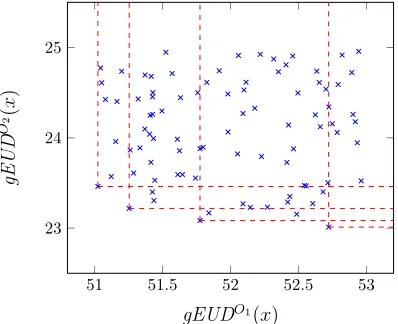
During the second phase of our approach we solve the associated MO-FMO problem for the set of locally optimal BACs found in Phase 1. Figure 2 shows an example of a set of sample points S generated during Phase 1. This set includes`= 100 sample points. Each point corresponds to an optimal solution of a single objective FMO problem and is associated with a locally optimal BAC obtained in the previous phase. The area dominated by each non-dominated sample points ∈ SN is delimited by dashed lines. BACs associated with the
sample points are locally optimal with respect to the single objective judgement function considered in Phase 1 of the procedure.
The goal of the second phase is to find a set of BACs ˆAthat approximates the actual set of efficient BACs. As Algorithm 2 shows, we need, firstly, to generate a setXEA of efficient fluence maps of the MO-FMO problem in (10) for each BAC A ∈ A∗. To do that we can use scalarisation methods such
as the ε-constraint method (Haimes et al, 1971) or the adaptive ε-constraint method (Eichfelder, 2008) (SolveMO-FMO() method in Algorithm 2). In this paper we use a procedure similar to the one presented in Cabrera G. et al (2014) to generate the setXEA, which is based on the ε-constraint method and is specific to unconstrained MO-FMO problems with positively homogeneous objectives. This procedure begins by computing lexicographic solutions for the MO-FMO problem. After that, a set of non-dominated points is generated using
51 51.5 52 52.5 53
23 24 25
gEUDO1(x)
gEUD
O2
(
x
[image:18.612.209.408.443.605.2])
Algorithm 2:Phase 2: Efficient Set Generation.
Input: A∗(Set of locally optimal approximately efficient BACs)
Output: ˆA ⊆ A∗(Refined set of approximately efficient BACs)
begin ˆ
A={};// initially empty set of BACs
ˆ
XE ={};// initially empty set of fluence maps
foreachA ∈ A∗do
XEA =SolveMO-FMO(A); ˆ
XE = merge
ˆ
XE, XEA
;
Update ˆAXˆE
;
returnA;ˆ
theε-constraint method given a predefined set of bounds for each objective to be used as constraints during the optimisation process. Again, since the MO-FMO problem in (10) is a convex MO problem, treatment plans found by the
ε-constraint method are truly efficient treatment plans for the corresponding BAC. Depending on the number of objectives we consider, the ε-constraint method might need to be performed several times minimising different objective functions. As a result of applying this procedure on a given BACA we have a set of efficient treatment plansXEA. For each BACA, we merge both sets of fluence mapsXEA and ˆXE (merge() method in Algorithm 2) by eliminating
those fluence maps that are dominated by another one in the union of the sets to be merged. After we merge these two sets, only potentially efficient fluence maps remain in the resulting set ˆXE. The set ˆXE is initialised empty. Since
fluence maps in ˆXE might change at each iteration, set ˆA is updated so only
BACs that have at least one fluence map x ∈ XˆE will be in ˆA (UpdateA()ˆ in Algorithm 2). Set ˆA approximates the actual set of efficient BACs of the MO-BAO problem in Equation (9).
For the example of Figure 2, setA∗generated during the first phase will only
consider the four non-dominated sample points that have dashed lines indicating their dominated area.
5
Computational Experiments
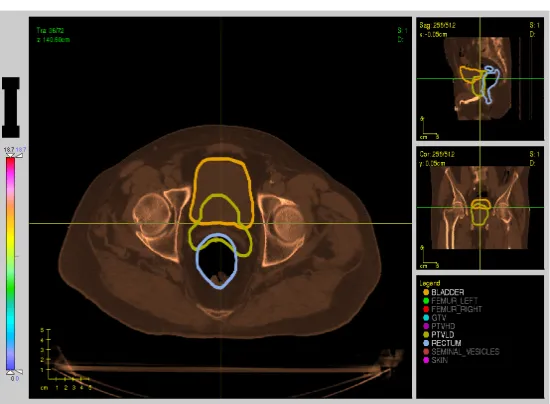
A prostate case has been considered in this study. This case is included in the CERR package (Deasy et al, 2003). Figure 3 shows this case. Boundaries of the target volume (tumour + margin), rectum and bladder (OARs) are highlighted as the regions of interest in this study. Table 1 shows the desiredgEUD values (eudr
Figure 3: Prostate case from CERR. Two OARs (bladder and rectum) are considered
used in Olafsson et al (2005). Different values might be needed in clinical practice. In this prostate case, the target volume has more than 7,000 voxels,
Table 1: Parameters for FMO models
r ar νr eudr
0 U
00
+
Tumour -10 12 75 –
Rectum 8 8 50 63.77
Bladder 2 5 50 65.98
the rectum about 5,500 and the bladder around 9,500. Although the same multi-leaf collimator is used for all beam angles the number of beamlets considered in the optimisation process depends on each beam angle. This is because those beamlets that do not irradiate at least one voxel of the target are not considered as decision variables in the optimisation process. Thus, the number of decision variables (beamlets) depends on the BAC and ranges between 160 and 220. The number of beam angles N considered in a BAC is equal to 5. The dose deposition matrixA is given. We consider 360 beam angles, all of which are on the same plane. As we mentioned before, we use IPOPT as a solver for all non-linear optimisation problems.
[image:20.612.222.387.432.484.2]the positive homogeneity of the gEUD, as was explained in Section 3, one of the objectives (maximisation of thegEUD of the tumour) was converted into an inequality constraint which we know to be binding and, consequently, it is not included as an axis.
Figure 4(a) shows the setS whenh1is used as judgement function. In this case there are only three non-dominated sample points inSN. Therefore only
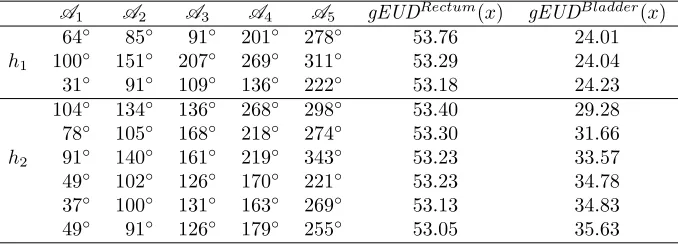
three BACs are passed on to the second phase of our approach. Table 2 lists these three BACs and the corresponding gEUD values for the rectum and the bladder. Figure 4b shows the setS when the gEUD value of the rectumh2 is used as a judgement function. In this case there are six non-dominated sample points inSN. Therefore, only six BACs are considered. These BACs are also
listed in Table 2. In both cases, non-dominated sample points inSN represent
only a small fraction (56%) of the entire setS.
Table 3 shows the set of (approximately) efficient BACs obtained by the
53.2 53.4 53.6 53.8 54 24
25 26 27 28
gEUDRectum(x)
gEUD
B
ladder
(
x
)
h1
(a) Sample points found using judgement functionh1
53 53.2 53.4 53.6 53.8 54 30
35 40 45 50 55
gEUDRectum(x)
gEUD
B
ladder
(
x
)
h2
(b) Sample points found using judgement functionh2
[image:21.612.141.470.313.453.2]Figure 4: Sample points corresponding to the locally optimal BACs found by the local search algorithm for the prostate case using five beam angles
Table 2: BACs corresponding to the non-dominated sample points for judgement functionh1and h2 and the gEUD values of the OARs (i.e. the sample points).
A1 A2 A3 A4 A5 gEUDRectum(x) gEUDBladder(x)
64◦ 85◦ 91◦ 201◦ 278◦ 53.76 24.01
h1 100◦ 151◦ 207◦ 269◦ 311◦ 53.29 24.04 31◦ 91◦ 109◦ 136◦ 222◦ 53.18 24.23 104◦ 134◦ 136◦ 268◦ 298◦ 53.40 29.28
78◦ 105◦ 168◦ 218◦ 274◦ 53.30 31.66
[image:21.612.137.476.542.664.2]53 54 55 56 57 58 20
25 30 35
gEUDRectum(x)
gEUD
B
ladder
(
x
) AB
(a) Approximately non-dominated points obtained usingh1.A (crosses) corresponds to the first BAC in Table 3 (100◦−151◦− 207◦−269◦−311◦) and B(circles) corre-sponds to the second one
53 54 55 56 57 58
20 25 30 35
gEUDRectum(x)
gEUD
B
ladder
(
x
) AB
[image:22.612.320.470.125.248.2](b) Approximately non-dominated points obtained usingh2. A (crosses) corresponds to the first BAC in Table 3 (37◦−100◦− 131◦−163◦−269◦) andB (circles) corre-sponds to the second one
Figure 5: Final sets of (approximately) non-dominated points obtained using the two-phase approach and the resulting approximately efficient BACs
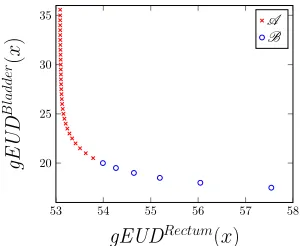
two-phase approach using judgement functions h1 and h2 introduced before. Table 3 also shows the number of non-dominated points (column NDP) for each (approximately) efficient BAC.
Results in Table 3 show also that (approximately) efficient BACs contribute five or more non-dominated points to the final set ˆYN. This means that those
BACs with a significant number of non-dominated points y ∈ YˆN cover an important part of the approximation in the objective space of the FMO problem. We can see this situation in Figure 5. We need to point out that we only found a finite number of non-dominated points (efficient solutions) of the MO-FMO problem (10) for each locally optimal BAC found during Phase 1. We want to recall the fact that the set of efficient BACs we found at the end of our algorithm is just an approximation of the truly efficient solution set of the MO-BAO problem, as it is not possible to evaluate the entire set of feasible BACs.
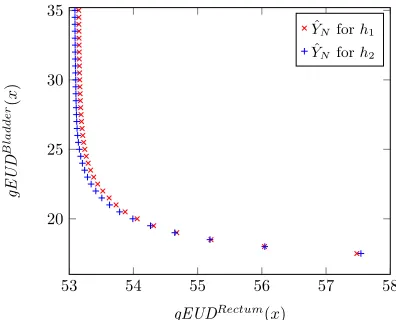
[image:22.612.139.289.125.247.2]As we can see in Figure 6, neither does the set of non-dominated points gen-erated using judgement functionh1 completely dominate the one generated by
Table 3: Final set of (approximately) efficient BACs for h1 and h2 and the number of non-dominated points (NDP) belonging to the corresponding BAC
Function A1 A2 A3 A4 A5 NDP
h1 100◦ 151◦ 207◦ 269◦ 311◦ 9 31◦ 91◦ 109◦ 136◦ 222◦ 27
[image:22.612.181.426.600.664.2]53 54 55 56 57 58 20
25 30 35
gEUDRectum(x)
gEUD
B
ladder
(
x
)
ˆ
YNforh1 ˆ
[image:23.612.204.402.125.285.2]YNforh2
Figure 6: Comparison between sets ˆYN obtained usingh1 andh2
using judgement functionh2nor does the set of non-dominated points generated usingh2completely dominates the one generated usingh1. Thus we cannot say one judgement function (eitherh1 orh2) is better than the other.
5.1
ε
-dominance
It is clear that including more BACs during Phase 2 will increase our chances of producing a better approximation to the set of efficient BACs. However, solving the MO-FMO problem for the entire set of locally optimal BACs obtained during Phase 1 is quite time consuming. Moreover, our results above suggest that most of these BACs do not lead to any improvement in the final approximation obtained at the end of Phase 2. Although the dominance criterion considered in this study is very effective at finding those BACs that are part of the final approximation, it could happen that the sample point of a BACA that should be part of the final approximation is dominated by the sample point of some other BACBand consequently the BACA is not passed on to Phase 2. Hence we may not generate the best possible approximation given the set of locally optimal BACs generated during Phase 1. For this reason we need to find a way to include BACs that lead to improvements in the final approximation without making the number of BACs passed on to Phase 2 too large. We seek to achieve this using the concept ofε-dominance.
In the ε-dominance concept (Loridan, 1984; White, 1986) the main idea is to make the Pareto dominance criterion presented in Section 3 more (or less) restrictive. For this study, we want to modify the Pareto dominance test so that more sample points s ∈ S are passed on to Phase 2. White (1986) and Laumanns et al (2002) defineε-dominance as follows: Letf, g∈Rp andε >0.
(1−ε)fr≤grfor allr= 1, . . . ,|R|. (16)
We denote the set of sample points that are notε-dominated by any other sample point as SNε. Unfortunately using a single ε value is not possible in the context of radiotherapy due to the differences in magnitude among the objectives. Because of that, we consider a vector ε ∈ R|R| and we slightly
modify the definition in Equation 16 as follows: f is said toε-dominategif
(1−εr)fr≤gr for allr= 1, . . . ,|R|. (17)
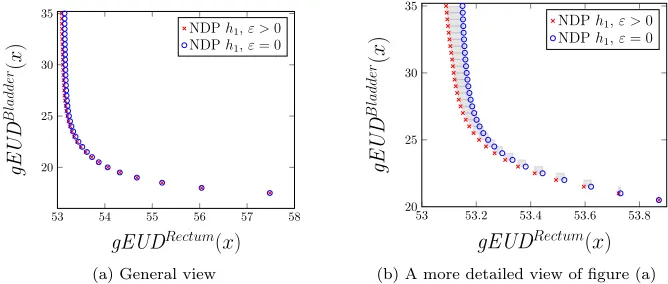
Table 4 shows theεvectors used in this study to show howε-dominance can be used to improve the final approximation obtained by the two-phase approach. In order to measure the improvement obtained when using each ε vector, we consider the well-known hypervolume metric proposed in Zitzler (1999). The hypervolume can be defined as the p-dimensional area below some reference point that is dominated by a set of points in objective space (Zitzler, 1999). The hypervolume of a set of non-dominated points is expressed as a percentage of the maximum hypervolume that can be covered. A set with a larger hypervolume is preferred as it is likely to present a better set of trade-offs than one with a smaller hypervolume. It is clear that if we set all εr, r = 1, . . . ,|R|, large
enough we would obtain the same set of BACs we would get if all sample points were passed to Phase 2, whereas forεr= 0 this will be the set of nondominated
sample points as suggested in Algorithm 1.
As mentioned before Table 4 shows the hypervolume value obtained for five differentεvectors. For eachεvector,ε-values for rectum and bladder are shown (columns εgEUDRectum and εgEUDBladder respectively). |A∗| is the number of BACs in the set of locally optimal BACsA∗ found at the end of the Phase 1.
|A|ˆ is the number of BACs in the set of (approximately) efficient BACs ˆA of the MO-BAO problem.
Table 4: Different ε vectors and their corresponding hypervolumes for both judgement functionsh1 andh2. For eachεvector the number of BACs in the set of locally optimal BACs|A∗| and the number of (approximately) efficient
BACs|A|ˆ are shown.
Logistic Function (h1)
εgEUDRectum εgEUDBladder |A|ˆ |A∗| Hypervolume
0 0 2 3 87.87%
0.00025 0.005 3 14 88.49% 0.00050 0.010 4 24 88.59% 0.00130 0.028 5 66 88.62% ≥0.015 ≥0.16 5 100 88.62%
Lexicographic Function (h2)
εgEUDRectum εgEUDBladder |A|ˆ |A∗| Hypervolume
0 0 2 5 89.55%
≥0.017 ≥0.34 2 100 89.55%
approach in finding good quality BACs based only on non-dominated sample points obtained during the Phase 1.
53 54 55 56 57 58
20 25 30 35
gEUDRectum(x)
gEUD
B
ladder
(
x
) NDPNDPhh11,,ε >ε= 00
(a) General view
53 53.2 53.4 53.6 53.8 20
25 30 35
gEUD
Rectum(
x
)
gEUD
B
ladder
(
x
)
NDPh1,ε >0
NDPh1,ε= 0
[image:25.612.174.434.180.322.2](b) A more detailed view of figure (a)
Figure 7: Comparison between final approximations using εgEUDRectum = 0,
εgEUDBladder = 0 (ε= 0, circles) andεgEUDRectum =0.015,εgEUDBladder=0.16 (ε > 0, crosses) based on S obtained using judgement function h1. Figure 7b is a more detailed view of Figure 7a that also shows the difference in the hypervolumes for these two cases.
6
Conclusions and Future Work
[image:25.612.138.472.376.518.2]objective judgement function. Each locally optimal BAC is represented by a sample point in the objective space of the MO-FMO problem. The first phase ends by determining the BACs with pairwise non-dominated sample points among the set of locally optimal BACs. Then, during the second phase we generate a large set of non-dominated points of the MO-FMO problem for all the BACs found in the first phase. As a result, we obtain a set of (approxi-mately) non-dominated points belonging to one or more BACs. These BACs are our approximation to the set of truly efficient BACs for the MO-BAO prob-lem. This is substantially different from previous approaches where only one BAC is presented as the “best one” based only on its judgement function value. Unlike those single objective approaches, in this work once a set of locally op-timal BACs is obtained by means of a single objective local search, a subset of them is selected based on a dominance criterion. Selected BACs are then further processed to solve their associated MO-FMO problem to determine a final approximation to the set of efficient BACs. Anε-dominance strategy was also considered to relax the dominance-based selection criterion allowing the algorithm to pass a larger number of promising locally optimal BACs onto the second phase, which leads to a better quality final set of approximately efficient BACs.
In our example, we have shown that the non-dominated points we generate are associated not with just a single BAC, but instead with a set of BACs. Thus, single-objective optimisation is not enough to find the “right BAC”. By consid-ering multiple objectives during its search, our algorithm can better describe the trade-off between objectives and can therefore provide more (and better quality) alternatives for treatment planners to choose from.
6.1
Future Work
In future work, we intend to use MO judgement functions instead of single ob-jective ones to find a set of good quality BACs. Using a MO judgement function would allow us to identify a set of potentially efficient BACs directly in a heuris-tic algorithm. In that case, MO strategies such as Pareto local search (Paquete et al, 2004) could be used instead of single objective approaches. Moreover, results show that different judgement functions lead to different sets of non-dominated points YN. Thus, other judgement functions should be evaluated
using the two-phase approach. Also, other MO-BAO models such as dosimetric ones could be tested within our framework.
References
Aleman D, Kumar A, Ahuja R, Romeijn H, Dempsey J (2008) Neighbor-hood search approaches to beam orientation optimization in intensity modu-lated radiation therapy treatment planning. Journal of Global Optimization 42(4):587–607
Amols H, Ling C (2002) EUD but not QED. International Journal of Radiation Oncology Biology Physics 52(1):1–2
Azizi-Sultan AS (2010) Automatic selection of beam orientations in intensity-modulated radiation therapy. Electronic Notes in Discrete Mathematics 36:127 – 134
Bangert M, Ziegenhein P, Oelfke U (2012) Characterizing the combinatorial beam angle selection problem. Physics in Medicine and Biology 57(20):6707– 6723
Bertsimas D, Cacchiani V, Craft D, Nohadani O (2013) A hybrid approach to beam angle optimization in intensity-modulated radiation therapy. Comput-ers & Operations Research 40(9):2187–2197
Bortfeld T, Schlegel W (1993) Optimization of beam orientations in radiation therapy: some theoretical considerations. Physics in Medicine and Biology 38(2):291–304
Breedveld S, Storchi P, Keijzer M, Heemink A, Heijmen B (2007) A novel ap-proach to multi-criteria inverse planning for IMRT. Physics in Medicine and Biology 52:6339–6353
Breedveld S, Storchi PRM, Heijmen BJM (2009) The equivalence of multi-criteria methods for radiotherapy plan optimization. Physics in Medicine and Biology 54(23):7199
Breedveld S, Storchi PRM, Voet PWJ, Heijmen BJM (2012) icycle: Integrated, multicriterial beam angle, and profile optimization for generation of coplanar and noncoplanar IMRT plans. Medical Physics 39(2)
Cabrera G G, Chica M, Ehrgott M, Mason A (2012) Mathematical program-ming and metaheuristic approaches applied to biological-based fluence map optimization in radiotherapy. In: Haywood J (ed) Proceedings of the ORSNZ 46th Annual Conference Proceedings, Wellington, New Zealand, pp 47–56
Cabrera G G, Ehrgott M, Mason A, Philpott A (2014) Multi-objective optimi-sation of positively homogeneous functions and an application in radiation therapy. Operations Research Letters 42:268–272
Choi B, Deasy J (2002) The generalized equivalent uniform dose function as a basis for intensity-modulated treatment planning. Physics in Medicine and Biology 47(20):3579–3589
Craft D (2007) Local beam angle optimization with linear programming and gradient search. Physics in Medicine and Biology 52:127–135
Craft D, Halabi T, Shih HA, Bortfeld T (2007) An approach for practical multi-objective IMRT treatment planning. International Journal of Radiation On-cology Biology Physics 69(5):1600 – 1607
Das S, Cullip T, Tracton G, Chang S, Marks L, Anscher M, Rosenman J (2003) Beam orientation selection for intensity-modulated radiation therapy based on target equivalent uniform dose maximization. International Journal of Ra-diation Oncology Biology Physics 55(1):215–224
Deasy J, Blanco A, Clark V (2003) CERR: A computational environment for radiotherapy research. Medical Physics 30(5):979–985
Deb K, Pratap A, Agarwal S, Meyarivan T (2002) A fast and elitist multiob-jective genetic algorithm: Nsga-ii. IEEE Transactions on Evolutionary Com-putation 6(2):182–197
Dias J, Rocha H, Ferreira B, Lopes M (2014) A genetic algorithm with neu-ral network fitness function evaluation for IMRT beam angle optimization. Central European Journal of Operations Research 22(3):431–455
Dirscherl T, Alvarez-Moret J, Bogner L (2011) Advantage of biological over physical optimization in prostate cancer? Zeitschrift f¨ur Medizinische Physik 21(3):228–235
Djajaputra D, Wu Q, Wu Y, Mohan R (2003) Algorithm and performance of a clinical IMRT beam-angle optimization system. Physics in Medicine and Biology 48(19):3191
Ehrgott M, Johnston R (2003) Optimisation of beam directions in intensity modulated radiation therapy planning. OR Spectrum 25:251–264
Ehrgott M, Holder A, Reese J (2008) Beam selection in radiotherapy design. Linear Algebra and its Applications 428(5):1272–1312
Ehrgott M, G¨uler C, Hamacher HW, Shao L (2009) Mathematical optimiza-tion in intensity modulated radiaoptimiza-tion therapy. Annals of Operaoptimiza-tions Research 175(1):309–365
Eichfelder G (2008) Adaptive scalarization methods in multiobjective optimiza-tion. Springer-Verlag, Berlin
Haimes YY, Lasdon L, Wismer D (1971) On a bicriterion formulation of the problems of integrated system identification and system optimization. IEEE Transactions on Systems, Man and Cybernetics 1(3):296–297
Hamacher H, K¨ufer KH (2002) Inverse radiation therapy planning a multiple objective optimization approach. Discrete Applied Mathematics 118(1):145– 161
Kalantzis G, Apte A (2014) A novel reduced-order prioritized optimization method for radiation therapy treatment planning. IEEE Transactions on Biomedical Engineering 61(4):1062–1070
K¨ufer KH, Scherrer A, Monz M, Alonso F, Trinkaus H, Bortfeld T, Thieke C (2003) Intensity-modulated radiotherapy a large scale multi-criteria program-ming problem. OR Spectrum 25(2):223–249
Lahanas M, Schreibmann E, Milickovic N, Baltas D (2003) Intensity modulated beam radiation therapy dose optimization with multiobjective evolutionary algorithms. In: Fonseca C, Fleming P, Zitzler E, Thiele L, Deb K (eds) Evo-lutionary Multi-Criterion Optimization, Lecture Notes in Computer Science, vol 2632, Springer Berlin Heidelberg, pp 648–661
Laumanns M, Thiele L, Deb K, Zitzler E (2002) Combining convergence and diversity in evolutionary multiobjective optimization. Evolutionary Compu-tation 10(3):263–282
Li Y, Yao D (2006) Accelerating the radiotherapy planning with a hybrid method of genetic algorithm and ant colony system. In: Jiao L, Wang L, Gao X, Liu J, Wu F (eds) Advances in Natural Computation, Lecture Notes in Computer Science, vol 4222, Springer Berlin Heidelberg, pp 340–349
Li Y, Yao J, Yao D (2004) Automatic beam angle selection in IMRT planning using genetic algorithm. Physics in Medicine and Biology 49(10):1915
Li Y, Yao D, Chen W (2005a) A particle swarm optimization algorithm for beam angle selection in intensity-modulated radiotherapy planning. Physics in Medicine and Biology 50(15):3491–3514
Li Y, Yao D, Chen W, Zheng J, Yao J (2005b) Ant colony system for the beam angle optimization problem in radiotherapy planning: A preliminary study. In: Corne D (ed) Proceedings of the IEEE Congress on Evolutionary Computation (CEC), IEEE, pp 1532–1538
Lim G, Cao W (2012) A two-phase method for selecting IMRT treatment beam angles: Branch-and-prune and local neighborhood search. European Journal of Operational Research 217(3):609–618
Loridan P (1984)ε-solutions in vector minimization problems. Journal of Opti-mization Theory and Applications 43(2):265–276
Miettinen K (1999) Nonlinear Multiobjective Optimization, International Series in Operations Research and Management Science, vol 12. Kluwer Academic Publishers, Dordrecht
Miˇsi´c V, Aleman D, Sharpe M (2010) Neighborhood search approaches to non-coplanar beam orientation optimization for total marrow irradiation using IMRT. European Journal of Operational Research 205(3):522–527
Nahum A, Uzan J (2012) (Radio)biological optimization of external-beam ra-diotherapy. Computational and Mathematical Methods in Medicine 1:13
Niemierko A (1997) Reporting and analyzing dose distributions: A concept of equivalent uniform dose. Medical Physics 24(1):103–110
Olafsson A, Jeraj R, Wright S (2005) Optimization of intensity-modulated ra-diation therapy with biological objectives. Physics in Medicine and Biology 50(22):5357–5379
Paquete L, Chiarandini M, St¨utzle T (2004) Pareto local optimum sets in the biobjective traveling salesman problem: An experimental study. In: Gandibleux X, Sevaux M, Srensen K, Tkindt V (eds) Metaheuristics for Mul-tiobjective Optimisation, Lecture Notes in Economics and Mathematical Sys-tems, vol 535, Springer Berlin Heidelberg, pp 177–199
Preciado-Walters F, Rardin RL, Langer M, Thai V (2004) A coupled column generation, mixed integer approach to optimal planning of intensity modu-lated radiation therapy for cancer. Mathematical Programming 101(2):319– 338
Preciado-Walters F, Langer M, Rardin R, Thai V (2006) Column generation for IMRT cancer therapy optimization with implementable segments. Annals of Operations Research 148(1):65–79
Pugachev A, Xing L (2001) Pseudo beams-eye-view as applied to beam orienta-tion selecorienta-tion in intensity-modulated radiaorienta-tion therapy. Internaorienta-tional Journal of Radiation Oncology Biology Physics 51(5):1361–1370
Pugachev A, Xing L (2002) Incorporating prior knowledge into beam orientaton optimization in IMRT. International Journal of Radiation Oncology Biology Physics 54(5):1565–1574
Pugachev A, Boyer A, Xing L (2000) Beam orientation optimization in intensity-modulated radiation treatment planning. Medical Physics 27(6):1238–1245
Romeijn H, Dempsey J (2008) Intensity modulated radiation therapy treatment plan optimization. TOP 16(2):215–243
Romeijn H, Dempsey J, Li J (2004) A unifying framework for multi-criteria flu-ence map optimization models. Physics in Medicine and Biology 49(10):1991– 2013
Rowbottom C, Webb S, Oldham M (1998) Beam orientation optimiza-tion in intensity-modulated radiaoptimiza-tion treatment planning. Medical Physics 25(7):1171–1179
Schreibmann E, Lahanas M, Xing L, Baltas D (2004) Multiobjective evolu-tionary optimization of the number of beams, their orientations and weights for intensity-modulated radiation therapy. Physics in Medicine and Biology 49(5):747
Stein J, Mohan R, Wang X, Bortfeld T, Wu Q, Preiser K, Ling C, Schlegel W (1997) Number and orientation of beams in intensity-modulated radiation treatments. Medical Physics 24:149–160
Thomas E, Chapet O, Kessler M, Lawrence T, Ten Haken R (2005) Benefit of using biologic parameters (EUD and NTCP) in IMRT optimization for treat-ment of intrahepatic tumors. International Journal of Radiation Oncology Biology Physics 62(2):571–578
W¨achter A, Biegler L (2006) On the implementation of a primal-dual inte-rior point filter line search algorithm for large-scale nonlinear programming. Mathematical Programming 106(1):25–57
Webb S (2010) The Physics of Three Dimensional Radiation Therapy: Confor-mal Radiotherapy, Radiosurgery and Treatment Planning. Series in Medical Physics and Biomedical Engineering, Taylor & Francis
White D (1986) Epsilon efficiency. Journal of Optimization Theory and Appli-cations 49(2):319–337
Wu Q, Mohan R, Niemierko A (2000) IMRT optimization based on the gen-eralized equivalent uniform dose (EUD). In: Enderle J (ed) Engineering in Medicine and Biology Society, 2000. Proceedings of the 22nd Annual Inter-national Conference of the IEEE, IEEE, vol 1, pp 710–713
Wu Q, Mohan R, Niemierko A, Schmidt-Ullrich R (2002) Optimization of intensity-modulated radiotherapy plans based on the equivalent uniform dose. International Journal of Radiation Oncology Biology Physics 52(1):224–235
Wu Q, Djajaputra D, Wu Y, Zhou J, Liu H, Mohan R (2003) Intensity-modulated radiotherapy optimization with gEUD-guided dose-volume objec-tives. Physics in Medicine and Biology 48(3):279–291