ISSN Print: 2157-9423
DOI: 10.4236/pp.2018.97018 Jul. 18, 2018 242 Pharmacology & Pharmacy
“New-Look” Opioids: Biased Ligands
Joseph V. Pergolizzi
1, Michael H. Ossipov
2, Robert Taylor
1, Robert B. Raffa
3,41NEMA Research Inc., Naples, FL, USA
2College of Medicine, University of Arizona, Tucson, AZ, USA 3College of Pharmacy, University of Arizona, Tucson, AZ, USA 4Temple University, School of Pharmacy, Philadelphia, PA, USA
Abstract
Between the illicit use of opioids and attendant overdoses, and accidental overdoses with prescribed drugs, overuse of opioids has become a serious problem. At the same time, finding that fine balance between minimizing the risk of opioid misuse and abuse while at the same time providing access to treatment for patients who need pain control presents an ongoing challenge. Efforts to discover and develop better agents have led to what we term “new-look” opioids. We summarize here one such approach—known as bi-ased ligands. By targeting a subset of GPCR signal transduction, this approach attempts to increase the separation between therapeutic and adverse effects.
Keywords
Pain, Analgesic Drugs, Opioids, G Protein-Coupled Receptors, Biased Ligands
1. Introduction
1.1. Global Burden of Pain and the Need for Pain Medications
Chronic (or persistent) pain—generally loosely defined as pain persisting for more than three months—remains among the leading causes of disability, and years lived with disability (YLD). According to The Global Burden of Diseases, Injuries, and Risk Factors Study2016, of the 59 conditions with a global preva-lence exceeding 1%, seven of these are primary pain conditions: tension-type headache, migraine, lower back pain, neck pain, “other musculoskeletal condi-tions”, osteoarthritis, and urolithiasis (kidney stones) [1] [2]. Taking into ac-count both severity and prevalence, the YLDs provide an overall picture of dis-ease burden. Globally, low back pain and migraine were the two leading causes of YLDs, responsible for 57.6 million and 45.1 million total YLDs, respectively
How to cite this paper: Pergolizzi, J.V., Ossipov, M.H., Taylor, R. and Raffa, R.B. (2018) “New-Look” Opioids: Biased Li-gands. Pharmacology & Pharmacy, 9, 242-249.
https://doi.org/10.4236/pp.2018.97018
Received: June 12, 2018 Accepted: July 15, 2018 Published: July 18, 2018
Copyright © 2018 by authors and Scientific Research Publishing Inc. This work is licensed under the Creative Commons Attribution International License (CC BY 4.0).
DOI: 10.4236/pp.2018.97018 243 Pharmacology & Pharmacy
[1]. Chronic neck pain and “other musculoskeletal disorders” were each respon-sible for 29 million YLDs and osteoarthritis for 16 million YLDs [1]. The burden of chronic pain is actually even greater than this, because these numbers do not reflect conditions such as cancers, sickle cell anemia, diabetic neuropathy, neu-ropathic conditions, and many others, where pain is but one of many symptoms
[2]. Thus, chronic pain is a global problem that severely impacts the quality of life of those suffering from it, and it exacts a significant socioeconomic toll. Lost productivity due to pain is measured in the billions of dollars.
1.2. Increase in Opioid Use for Non-Cancer Chronic Pain and
Potential Consequences
Prior to the late 1970’s and 1980’s the management of non-cancer chronic pain, and even of some cancer pains, was almost absent. Opioids were generally only used for postoperative pain, severe acute pain, and end-of-life care. And even as late as 2008, The World Cancer Declaration felt the need to include a target to make effective pain control more accessible [3]. The use of opioids for chronic non-cancer pain, although still considered to have unproven efficacy, consis-tently increased over the past two decades [4].
Although several randomized clinical trials have supported short-term use of opioids for chronic non-cancer pain, including neuropathic pain, long-term use of opioids has not been as rigorously studied [5]. An observational, descriptive study of 84 patients with intractable, severe, daily non-cancer chronic pain that was conducted over one year found that these patients reported at least 50% or greater pain relief and a moderate improvement in disability [5]. In that select population, problematic opioid use, tolerance and serious adverse effects were not considered to be “major issues.” Thus, opioids used in accordance with es-tablished guidelines, carefully monitored, and used in a multidisciplinary chron-ic pain practchron-ice can be a safe and effective approach to treating chronchron-ic pain. This is an important caveat. Realistically, though, most opioid prescriptions are not written by chronic pain specialists, but by primary care physicians who may have incomplete understanding of these drugs, and an overconfidence in their relative safety [4] [6]. Indeed, a perception arose that opioids are virtually risk-free if taken as directed by a physician, which is not true. This is reflected in a comprehensive review that found that 20% of opioid-related deaths occurred in patients on low-dose opioid therapy of 100 mg of morphine equivalent dose or less per day and 40% in those receiving morphine of over 100 mg per day [7]. The remaining 40% of deaths occurred in individuals abusing the drugs obtained through multiple prescriptions, doctor shopping, and drug diversion. In the same study, it was reported that only 16% of users of non-therapeutic opioids reported that they obtained the drug by prescription from a doctor, while more than half of individuals reported obtaining the drug from a friend or relative.
DOI: 10.4236/pp.2018.97018 244 Pharmacology & Pharmacy
associated with a contemporaneous increase in opioid overdoses, emergency room visits, and deaths, as well as an increase in admissions for treatment of opioid use disorders. [4][6]. The rise in opioid prescriptions reached a peak in 2012, and has since declined, but the rise in opiate overdoses has continued. This is partly due to the increased use of illicit heroin and fentanyl (and congeners). The role of increased availability of prescription drugs to the current opioid epi-demic has not been rigorously examined, and the causes are multiple and com-plex. Use or misuse/abuse of opioid analgesics was responsible for more deaths than suicide and motor vehicle accidents together, or from cocaine and heroin combined [7]. This is not a new dilemma. We are reminded that the invention of the hypodermic needle in the mid 1800’s, permitting morphine injection, was a boon to soldiers suffering from horrific wounds during the Civil War. But this blessing was followed by the curse of “Soldier’s Disease”—Civil War veterans who had become addicted to morphine.
1.3. Approaches to Better Opioids
The rather dramatic rise in opioid use disorders and opioid-related deaths, re-gardless of cause, has spurred several approaches to develop or reconsider novel, safer opioid drugs. Approaches include pharmacodynamics, influencing the ac-tion of opioids at the opioid receptor, pharmacokinetic, such as limiting the abil-ity of the drug to cross the blood-brain barrier, combination therapies to limit the exposure to opioids, and preparation of abuse-resistant formulations. We call these “new-look” opioids, and present a summary of one of these approaches here. We present the conceptual framework for this approach rather than a list of the compounds in development. We discuss one drug as a representative ex-ample.
2. The Opioid Receptor and Opioid Analgesic Activity
DOI: 10.4236/pp.2018.97018 245 Pharmacology & Pharmacy
receptors and their functions increased, the development of safer, highly effec-tive analgesics with little to no abuse liability would follow. There were several attempts at developing analgesics acting at the κ and δ opiate receptors, but they were abandoned because of adverse effects such as dysphoria (κ) and convul-sions (δ). However, recent discoveries relating to the intracellular mechanisms associated with the μ-opioid receptor may led us closer to this holy grail of pain management.
2.1. Molecular Biology and Signaling Pathways of the
μ
-Opioid
Receptor
The functioning of the μ-opioid receptor, a member of the G protein-coupled receptor (GPCR) superfamily, has received considerable attention [8] [9] [10] [11]. These receptors consist of seven-transmembrane domains, an extracellular
N-terminal, and an intracellular C-terminal. The extracellular terminal and loops of the transmembrane segments form the receptor binding and recogni-tion sites. The intracellular porrecogni-tions of the receptor bind to the inhibitory G protein, consisting of Gαi/o, Gβ, and Gγ subunits. Binding of an opioid agonist to
the receptor releases the G protein complex, and Gαi/o can activate inward
recti-fying K+ channels, while the G
β/γ subunits inhibit Ca2+ channels, leading to
hyperpolarization and decreased neuronal excitability (Figure 1). In addition, the Gαi/o subunit inhibits adenylate cyclase, decreasing cyclic adenosine
mono-phosphate production (cAMP), and thus inhibiting downstream signaling cas-cades dependent on cAMP. The attachment of the agonist to the receptor also allows phosphorylation of the intracellular segments of the receptor by protein kinase A or C (PKA or PKC), or by a corresponding GPCR kinase (GRK). The phosphorylated receptor recruits β-arrestins, so named since they arrest the ac-tivity of the receptor. Once bound to the receptor, the β-arrestins complex with components of the receptor endocytotic process, resulting in internalization and recycling of the receptor.
They inhibit the influx of presynaptic Ca2+, thereby decreasing
neurotrans-mitter release and firing of postsynaptic neurons, and they hyperpolarize post-synaptic neurons, thereby rendering them less likely to fire in response to exci-tatory input from presynaptic neurons.
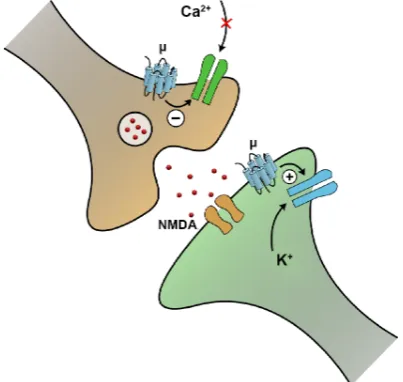
The binding of an agonist to µ-opioid receptors in presynaptic neurons results in inhibition of Ca2+ influx, and thus less neurotransmitter release, in pain-
sensing/transmitting pathways. The binding of an agonist to µ-opioid receptors in postsynaptic neurons results in enhanced K+ efflux, hyperpolarization, and
less responsiveness in pain-sensing/transmitting pathways. Illustration is from Wikimedia Commons.
2.2. “Biased” Signaling
DOI: 10.4236/pp.2018.97018 246 Pharmacology & Pharmacy Figure 1. Opioids produce presynaptic and postsynaptic
effects that decrease response to excitatory (pain) input. They inhibit presynaptic Ca2+ influx, decreasing
neuro-transmitter release, and hyperpolarize postsynaptic neu-rons, rendering them less likely to fire in response to ex-citatory input. The binding of agonist to µ-opioid recep-tors in presynaptic neurons inhibits Ca2+ influx and thus
neurotransmitter release. The binding of agonist to
µ-opioid receptors in postsynaptic neurons enhances K+
efflux and hyperpolarizes postsynaptic neurons. Illustra-tion from Wikimedia Commons
DOI: 10.4236/pp.2018.97018 247 Pharmacology & Pharmacy Figure 2. Biased ligand concept. Selectively targeting the G protein-mediated pathway, and avoiding the β-arrestin pathway, increases the separation between the desired thera-peutic and the unwanted adverse effects of a drug. From
http://www.trevena.com/technology.php.
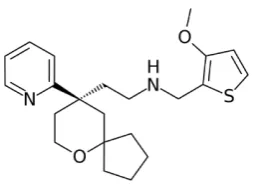
Figure 3. Chemical structure of the biased ligand oliceridine (TRV130).
have broader therapeutic windows. It is hoped that studies such as this one helps further the development of safer alternatives to current opioid therapeutics.
3. Current Status
Oliceridine (TRV130) (Figure 3) was developed by Trevena Inc. as a G protein based ligand at the μ-opioid receptor [12]. In preclinical studies, it produced less respiratory depression and gastrointestinal dysfunction than morphine at equianalgesic doses. In a phase II trial in patients following abdominoplasty, intravenous oliceridine produced a lower prevalence of nausea, vomiting, and depressed respiratory function compared to morphine [15]. Oliceridine received Breakthrough Therapy Designation from the U.S. Food and Drug Administra-tion (FDA), and the New Drug ApplicaAdministra-tion for the i.v. formulaAdministra-tion is currently under review by the FDA. These developments suggest that biased ligands may provide an avenue to a safer, potent, and efficacious opioid analgesic.
4. Perspective and Conclusions
[image:6.595.310.437.273.365.2]re-DOI: 10.4236/pp.2018.97018 248 Pharmacology & Pharmacy
lievers. But the traditional opioids suffer from a questionable safety profile. Re-searchers are actively searching for “new-look”—safer—opioid analgesics. Bi-ased-ligand is one such promising approach. The regulatory fate and clinical proof-of-principle are eagerly awaited.
References
[1] Vos, T., Abajobir, A.A., Abate, K.H., Abbafati, C., Abbas, K.M., Abd-Allah, F., et al.
(2017) Global, Regional, and National Incidence, Prevalence, and Years Lived with Disability for 328 Diseases and Injuries for 195 Countries, 1990-2016: A Systematic Analysis for the Global Burden of Disease Study 2016. TheLancet, 390, 1211-1259 https://doi.org/10.1016/S0140-6736(17)32154-2
[2] Rice, A.S., Smith, B.H. and Blyth, FM. (2016) Pain and the Global Burden of Dis-ease. PAIN, 157, 791-796. https://doi.org/10.1097/j.pain.0000000000000454
[3] National Collaborating Centre for Cancer (2012) Opioids in Palliative Care: Safe and Effective Prescribing of Strong Opioids for Pain in Palliative Care of Adults. NHS NICE Clinical Guideline. https://www.ncbi.nlm.nih.gov/pubmed/23285502 [4] Tolba, R., Meselhy, E. and Guerra, C.E. (2018) The Opioid Epidemic and Pain
Medicine Specialists: Where to Begin and What Is Next? The Ochsner Journal,18, 20-22.
[5] Watson, C.P., Watt-Watson, J. and Chipman, M. (2010) The Long-Term Safety and Efficacy of Opioids: A Survey of 84 Selected Patients with Intractable Chronic Non-cancer Pain. Pain Research and Management,15,213-217.
https://doi.org/10.1155/2010/867201
[6] Brown, R.E. and Sloan, P.A. (2017) The Opioid Crisis in the United States: Chronic Pain Physicians Are the Answer, Not the Cause. Anesthesia & Analgesia, 125, 1432-1434. https://doi.org/10.1213/ANE.0000000000002417
[7] Manchikanti, L., Helm 2nd, S., Fellows, B., Janata, J.W., Pampati, V., Grider, J.S., et al. (2012) Opioid Epidemic in the United States. Pain Physician,15, ES9-ES38. [8] Raehal, K.M., Schmid, C.L., Groer, C.E. and Bohn, L.M. (2011) Functional
Selectiv-ity at the μ-Opioid Receptor: Implications for Understanding Opioid Analgesia and Tolerance. Pharmacological Reviews,63, 1001-1019.
[9] Childers, S.R. (1991) Opioid Receptor-Coupled Second Messenger Systems. Life Sciences,48, 1991-2003.
[10] Knapp, R.J., Malatynska, E., Collins, N., Fang, L., Wang, J.Y., Hruby, V.J., et al.
(1995) Molecular Biology and Pharmacology of Cloned Opioid Receptors. FASEB Journal,9, 516-525.https://doi.org/10.1096/fasebj.9.7.7737460
[11] Al-Hasani, R. and Bruchas, M.R. (2011) Molecular Mechanisms of Opioid Recep-tor-Dependent Signaling and Behavior. Anesthesiology,115, 1363-1381.
[12] Schmid, C.L., Kennedy, N.M., Ross, N.C., Lovell, K.M., Yue, Z., Morgenweck, J., et al. (2017) Bias Factor and Therapeutic Window Correlate to Predict Safer Opioid Analgesics. Cell,171, 1165-1175. e13. https://doi.org/10.1016/j.cell.2017.10.035 [13] DeWire, S.M., Yamashita, D.S., Rominger, D.H., Liu, G., Cowan, C.L., Graczyk,
T.M., et al. (2013) A G Protein-Biased Ligand at the μ-Opioid Receptor Is Potently Analgesic with Reduced Gastrointestinal and Respiratory Dysfunction Compared with Morphine. Journal of Pharmacology and Experimental Therapeutics, 344, 708-717.
Pa-DOI: 10.4236/pp.2018.97018 249 Pharmacology & Pharmacy
radigm in GPCR Drug Discovery. Bioorganic & Medicinal Chemistry Letters,26, 241-250. https://doi.org/10.1016/j.bmcl.2015.12.024
[15] Singla, N., Minkowitz, H.S., Soergel, D.G., Burt, D.A., Subach, R.A., Salamea, M.Y.,