Classifying ReachOut posts with a radial basis function SVM
Chris Brew
Thomson Reuters Corporate Research and Development
1 Mark Square
London EC2A 4EG, UK
[email protected]
Abstract
The ReachOut clinical psychology shared task challenge addresses the problem of provid-ing an automatic triage for posts to a sup-port forum for people with a history of men-tal health issues. Posts are classified into
green, amber, red and crisis. The
non-green categories correspond to increasing levels of urgency for some form of interven-tion. The Thomson Reuters submissions arose from an idea about self-training and ensem-ble learning. The availaensem-ble labeled training set is small (947 examples) and the class dis-tribution unbalanced. It was therefore hoped to develop a method that would make use of the larger dataset of unlabeled posts provided by the organisers. This did not work, but the performance of a radial basis function SVM intended as a baseline was relatively good. Therefore, the report focuses on the latter, aiming to understand the reasons for its per-formance.
1 Introduction
The ReachOut clinical psychology shared task chal-lenge addresses the problem of providing an auto-matic triage for posts to a support forum for people with a history of mental health issues. Posts are
clas-sified intogreen,amber,redand crisis. The
non-green categories correspond to increasing levels of urgency for some form of intervention, and can be
regarded as positive. Greenmeans “all clear”, no
need for intervention. Table 1 includes
manually-created examples of posts from each class.1
1These are made-up examples, for reasons of patient confi-dentiality. They are also much shorter than typical posts.
Class Example
green sitting in my armchair listening to the birds
amber Not over that old friendship.
red What’s the point of talking to anyone?
crisis Life is pointless. Should call psych.
Table 1:Examples of possible posts
The entry from Thomson Reuters was planned to be a system in which an ensemble of base classi-fiers is followed by a final system combination step in order to provide a final answer. But this did not pan out, so we report results on a baseline classi-fier. All of the machine learning was done using
scikit-learn(Pedregosa et al., 2011). The first step, shared between all runs, was to split the la-beled data into a training partition of 625 examples (Train) and two development sets (Dev_test1
and Dev_test2) of 161 examples each. There were two development sets only because of the plan to do system combination. This turns out to have been fortunate. All data sets were first transformed into Pandas (McKinney, 2010) data-frames for convenient onward processing. When the test set be-came available, it was similarly transformed into the
test data-frame (Test).
The first submitted run was an RBF SVM, in-tended as a strong baseline. This run achieved a bet-ter score than any of the more elaborate approaches, and, together with subsequent analysis, sheds some light on the nature of the task and the evaluation met-rics used.
2 An RBF-based SVM
This first run used the standard
scikit-learn (Pedregosa et al., 2011)
SVM2, with a radial basis function kernel.
scikit-learn provides a grid search function that uses stratified cross-validation to tune the classifier parameters.
The RBF kernel is:
K(x, x0) = e−γ||x−x0||2
whereγ = 1
2σ2 and the objective function is:
min12||w||2+CX
i ξi
where||w||2is the`2-norm of the separating
hyper-plane andξi is an indicator variable that is 1 when
theith point is misclassified. TheC parameter
af-fects the tradeoff between training error and model
complexity. A smallC tends to produce a simpler
model, at the expense of possibly underfitting, while a large one tends to fit all training data points, at the expense of possibly overfitting. The approach to multi-class classification is the “one versus one” method used in (Knerr et al., 1990). Under this ap-proach, a binary classifier is trained for each pair of classes. The winning classifier is determined by vot-ing.
2.1 Features
The features used were:
• single words and 2-grams weighted with
scikit-learn’s TFIDF vectorizer,using a vocabulary
size limit (|V|) explored by grid search. The
last example post would,inter alia, have a
fea-ture for ‘pointless’ and another for ‘call psych’
• a feature representing the author type
pro-vided by ReachOut’s metadata. This indicates whether the poster is a ReachOut staff member, an invited visitor, a frequent poster, or one of a number of other similar categories.
• a feature providing the kudos that users had
as-signed to the post. This is a natural number reflecting the number of ‘likes’ a post has at-tracted.
2A Python wrapper for LIBSVM (Chang and Lin, 2011)
Counts
dev test1 dev test2 test train
green 92 95 166 362
amber 47 38 47 164
red 14 23 27 73
crisis 8 5 1 26
Percentages
dev test1 dev test2 test train
green 57.14% 59.00% 68.88% 57.92%
amber 29.19% 23.60% 19.50% 26.24%
red 8.69% 14.29% 11.20% 11.68%
[image:2.612.314.541.78.259.2]crisis 4.97% 3.11% 0.41% 4.16%
Table 2: Class distribution for training, development and test sets.
• a feature indicating whether the post being
con-sidered was the first in its thread. This is de-rived from the thread IDs and post IDs in each post.
2.2 Datasets, class distributions and evaluation metrics
Class distributions We have four datasets: the two sets of development data, the main training set and the official test set distributed by the organis-ers. Table 2 shows the class distributions for the three evaluation sets and the training set are differ-ent. In particular, the final test set used for official
scoring has only one instance of the crisis
cate-gory, when one might expect around ten. Of course, none of the teams knew this at submission time. The class distributions are always imbalanced, but it is a surprise to see the extreme imbalance in the final test set.
Evaluation metrics The main evaluation metric used for the competition is a macro-averaged
F1-score restricted toamber,redandcrisis. This
is very sensitive to the unbalanced class distribu-tions, since it weights all three positive classes equally. A classifier that correctly hits the one
positive example for crisis will achieve a large
pos-itive classes, might have proven a more stable tar-get. An alternative is the multi-class Matthews cor-relation coefficient (Gorodkin, 2004). Or, since the labels are really ordinal, similar to a Likert scale, quadratic weighted kappa (Vaughn and Jus-tice, 2015) could be used.
2.3 Grid search with unbalanced, small datasets
Class weights Preliminary explorations revealed that the classifier was producing results that over-represented the ’green’ category. To rectify this, the grid search was re-done using a non-uniform class weight vector of 1 for ’green’ and 20 for ’cri-sis’,’red’ and ’amber’. The effect of this was to increase by a factor of 20 the effective classifica-tion penalty for the three positive classes. The grid
search used for the final submission set γ=0.01,
C at 15 logarithmically spaced locations between
1and 1000 inclusive, all vocabulary size limits in
{10,30,100,300,1000,3000,10000} and assumed that author type, kudos and first in thread were al-ways relevant and should alal-ways be used. The scor-ing metric used for this grid search was mean accu-racy. The optimal parameters for this setting were
estimated to be:C=51.79,|V|=3000.
The role of luck in feature selection This classi-fier is perfect on the training set, suggesting overfit-ting (see section 4 for a deeper dive into this point). Classification reports for the two development sets are shown in table 3. After submission a more com-plete grid search was conducted allowing for the possibility of excluding the author type, kudos and first in thread features. All but kudos were excluded.
Comparing usingDev_test1the second classifier
would have been chosen, but usingDev_test2we
would have chosen the original. The major reason for this difference is that the second classifier hap-pened to correctly classify one of the 8 examples forcrisisinDev_test1, but missed all the five
examples of that class inDev_test2. In fact, on
the actual test set, the first classifier is better. The
choice to tune onDev_test1 was arbitrary, and
fortunate. The choice not to consider turning off the metadata features was a pure accident. Tuning via grid search is challenging in the face of small train-ing sets and unbalanced class distributions, and in
Dev test1
class precision recall f1-score support
green 0.88 0.93 0.91 92
amber 0.73 0.64 0.68 47
red 0.29 0.43 0.34 14
crisis 1.00 0.12 0.22 8
Dev test2
class precision recall f1-score support
green 0.81 0.95 0.87 95
amber 0.59 0.50 0.54 38
red 0.53 0.39 0.45 23
crisis 0.00 0.00 0.00 5
Table 3: Classification reports for Dev test1 and
Dev test2.
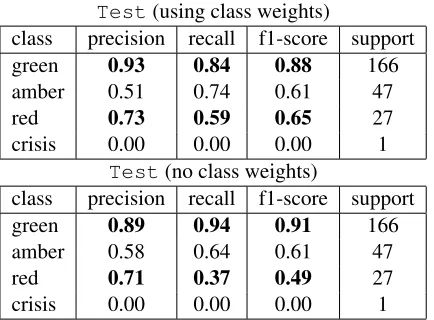
Test(using class weights)
class precision recall f1-score support
green 0.93 0.84 0.88 166
amber 0.51 0.74 0.61 47
red 0.73 0.59 0.65 27
crisis 0.00 0.00 0.00 1
Test(no class weights)
class precision recall f1-score support
green 0.89 0.94 0.91 166
amber 0.58 0.64 0.61 47
red 0.71 0.37 0.49 27
[image:3.612.313.530.263.423.2]crisis 0.00 0.00 0.00 1
Table 4:Classification reports forTestwith and without class weights.
this case would have led the classifier astray. Once optimal parameters had been selected, the classifier was re-trained using on the
concatena-tion ofTrain,Dev_test1andDev_test2, and
predictions were generated forTest.
3 Results on official test set
Table 4 contains classification reports for the class-weighted version that was submitted and a non-weighted version that was prepared after submis-sion. The source of the improved official score achieved by the class-weighted version is a larger
F-score on the red category, at the expense of a
smaller score on the greencategory, which is not
0 100 200 300 400 500 600 700 Training examples
0.0 0.2 0.4 0.6 0.8 1.0
Score (macro F1)
Train Xval
0 100 200 300 400 500 600
Total SVs
[image:4.612.333.535.67.270.2]n SVs
Figure 1:Learning curve (macro F1) (left) and number of sup-port vectors (right)
4 Analysis
The left axis of figure 1 shows how the perfor-mance changes as a function of the number of ex-amples used. This graph uses the parameter set-tings and class weights from the main submission
(i.e|V|=3000,C=51.79,γ=0.01). The lower curve
(green) shows the mean and standard deviation of the official score for test sets selected by cross-validation. The upper curve (red) shows perfor-mance on the (cross-validated) training set, which is always at ceiling. The right axis corresponds to the blue curve in the middle of figure 1 and indi-cates the number of support vectors used for various sizes of training set. Almost every added example is being catered for by a new support vector, sug-gesting overfitting. There is just a little
generalisa-tion for thegreenclass, almost none for the others.
Figure 2 shows the variation in macro-F1 withCand
γ. The scoring function for grid search is the official
macro-averaged F1 restricted to non-green classes, in contrast to the average accuracy used elsewhere. The optimal value selected by this cross-validation
isC=64 andγ=0.0085. This is roughly the same
asC=51.79,γ=0.01 chosen by cross-validation on
average accuracy.
5 Discussion
The ReachOut challenge is evidently a difficult problem. The combination of class imbalance and an official evaluation metric that is very sensitive to performance on sparsely inhabited classes means that the overall results are likely to be unstable.
It is not obvious what metric is the best fit for the
0.00010.00020.00030.00040.00070.00120.00190.00320.00520.00850.01390.02280.03730.06110.1
γ
2.0 4.0 8.0 16.0 32.0 64.0 128.0 256.0 512.0 1024.0 2048.0 4096.0 8192.0 16384.0 32768.0
C
Validation accuracy
[image:4.612.87.281.77.198.2]0.100 0.125 0.150 0.175 0.200 0.225 0.250 0.275 0.300 0.325
Figure 2:Heat map of variation of macro-F1 as a function ofγ
andC(with|V|=3000)
therapeutic application, because the costs of mis-classification, while clearly non-uniform, are diffi-cult to estimate, and the rare classes are intuitively important. It would take a detailed clinical outcome study to determine exactly what the tradeoffs are be-tween false positives, false negatives and misclassi-fications within the positive classes.
The labeled data set, while of decent size, and rep-resentative of what can reasonably be done by anno-tators in a small amount of time, is not so large that the SVM-based approach, with the features used, has reached its potential. The use of the class weight vector does appear to be helpful in improving the
of-ficial score by trading off performance on the red
label against a small loss of performance on the
greenlabel.
Acknowledgments
References
Chih-Chung Chang and Chih-Jen Lin. 2011. LIBSVM: A library for support vector machines. ACM
Transac-tions on Intelligent Systems and Technology, 2:27:1–
27:27. Software available athttp://www.csie.
ntu.edu.tw/˜cjlin/libsvm.
J. Gorodkin. 2004. Comparing two K-category assign-ments by a K-category correlation coefficient.
Com-putational Biology and Chemistry, 28:367374.
Stefan Knerr, L´eon Personnaz, and G´erard Dreyfus. 1990. Single-layer learning revisited: a stepwise pro-cedure for building and training a neural network. In
Neurocomputing, pages 41–50. Springer.
Wes McKinney. 2010. Data structures for statistical computing in python. In St´efan van der Walt and Jar-rod Millman, editors,Proceedings of the 9th Python in
Science Conference, pages 51 – 56.
F. Pedregosa, G. Varoquaux, A. Gramfort, V. Michel, B. Thirion, O. Grisel, M. Blondel, P. Prettenhofer, R. Weiss, V. Dubourg, J. Vanderplas, A. Passos, D. Cournapeau, M. Brucher, M. Perrot, and E. Duches-nay. 2011. Scikit-learn: Machine learning in Python.
Journal of Machine Learning Research, 12:2825–
2830.