Human Language Technologies: The 2015 Annual Conference of the North American Chapter of the ACL, pages 694–704,
Subsentential Sentiment on a Shoestring:
A Crosslingual Analysis of Compositional Classification
Michael Haas and Yannick Versley Institute for Computational Linguistics
University of Heidelberg
{haas,versley}@cl.uni-heidelberg.de
Abstract
Sentiment analysis has undergone a shift from
document-level analysis, where labels ex-presses the sentiment of a whole document or whole sentence, to subsentential approaches, which assess the contribution of individual phrases, in particular including the composi-tion of sentiment terms and phrases such as negators and intensifiers.
Starting from a small sentiment treebank mod-eled after the Stanford Sentiment Treebank of Socher et al. (2013), we investigate suitable methods to perform compositional sentiment classification for German in a data-scarce set-ting, harnessing cross-lingual methods as well as existing general-domain lexical resources.
1 Introduction
In sentiment classification, we find a general ten-dency from document-level classification towards more fine-grained approaches that yield a more de-tailed appraisal of the judgement performed in the text - in particular, using composition over syntac-tic structure to get a more detailed approach over phrases.
For English movie reviews, work using the Stan-ford Sentiment Treebank (SSTb) has shown that such subsentential sentiment information can yield approaches with both very high accuracy (Socher et al., 2013; Dong et al., 2014; Hall et al., 2014) and precise information about the role of each phrase – information which can subsequently used for ex-tracting or summarizing the sentiment expressed in the text.
The effort for creating a sentiment treebank such as the SSTb, however, seems prohibitive if we
wanted to create such a resource for each pair of relevant domain and language: Compared to document-level annotations for sentiment, which are easy to come by (e.g., star ratings), annotating indi-vidual syntactic phrases requires considerable effort. The main focus of this paper is the question if and how it is possible to reach sensible per-formance for compositional sentiment classifica-tion when we only have limited resources to spend on an in-language, in-domain sentiment treebank. For this goal, we use a new resource, the Hei-delberg Sentiment Treebank (HeiST), which is a German-language counterpart to the Stanford Senti-ment Treebank in the sense that it makes explicit the composition of sentiment expression over syntactic phrases. Our experiments on HeiST provide a di-rect comparison of different techniques for harness-ing cross-lharness-ingual, cross-domain, or cross-task infor-mation, and are the first of this kind to specifically targetcompositionalsentiment analysis.
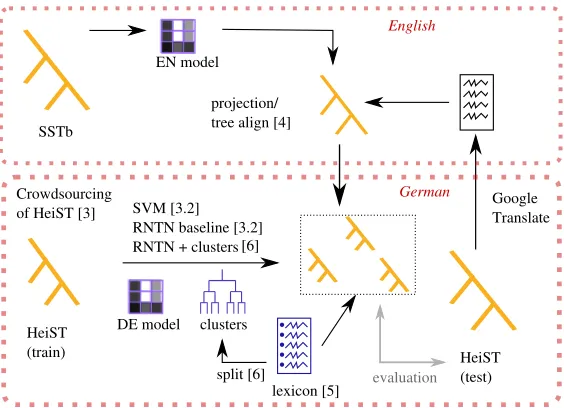
Figure 1 (next page) shows a schematic overview of the experiments: beyond supervised baseline ex-periments using SVM classification and a super-vised RNTN model (section 3), we evaluated cross-lingual projection (section 4), lexicon-based proaches (section 5), as well as semi-supervised ap-proaches based on word clusters (section 6).
2 Related Work
HeiST (train) Crowdsourcing
of HeiST [3] SVM [3.2] RNTN baseline [3.2] RNTN + clusters
Google Translate EN model
SSTb
English
HeiST (test) projection/
tree align [4]
[6]
DE model clusters
lexicon [5] split [6]
German
[image:2.612.166.448.66.270.2]evaluation
Figure 1: Plan to the experiments described in this paper
fashion from datasets that only have document-level sentiment annotation.
On the same dataset as Socher et al., Wang and Manning (2012) later demonstrated that unigram and bigram features in an SVM-based classification framework can reach a greater accuracy than the earlier recursive neural network approach of Socher et al. (2011, 2012), which calls into question the as-sumption that sentiment composition can be learned purely from sentence-level annotations.
Compositionality through Tensors In subse-quent work, Socher et al. (2013) introduce the Stan-ford Sentiment Treebank, which contains detailed annotations of sentiment values for individual syn-tactic phrases in a binarized tree, and an approach based on recursive neural tensor networks (RNTN) which yields significant improvements over the ear-lier approaches using token-level features.
The RNTN represents the contribution of individ-ual nodes as vectors of reals and achieves its preci-sion by using a tensor V[1:d] ∈ R2d×2d×d as well
as a matrixW ∈R2d×dto capture second-order
de-pendencies between the two children of a node in the tree (with vectorsa,b), yielding first a vectorhby
hi= ha
b
iT
V[i]habi+Wi ha
b
i
then using a monotonic nonlinear function on h
(here: tanh) to yield the vector for this node. The
sentiment label of a node is then gained by multi-plying thesehidden vectorsby a matrixWs,
yield-ing a five-dimensional vector with the classification. Using hidden vectors for each node and capturing second-order interaction between the two child vec-tors a and b, the RNTN model achieves descrip-tive power greater than that of TreeCRFs (Nakagawa et al., 2010), and similar to latent-variable models that have been very successful in syntactic parsing (Petrov et al., 2006).
In later work, Zhu et al. (2014) show that the RNTN’s lexicalized modeling of negators and their behaviour leads to increased descriptive power of the model, which results in an improved treatment of negation. Dong et al. (2014) introduce an ap-proach that chooses between multiple composition tensors (AdaMC-RNTN), which yields further gains with respect to RNTN performance.
In contrast to the lexicalized and high-dimensional RNTN model, there are several lines of work that attempt to work in a more data-scarce setting.
nega-tors/shifters as well as nonveridical moods affect the sentiment of a phrase, they show that it is possible to reach good results across different domains.
Choi and Cardie (2009) show that it is possible to adapt an existing general-domain sentiment lexi-con to a specific domain using an approach that opti-mizes a joint objective of classification loss, sparsity of the changes made to the lexicon, and ambiguity of lexicon entries. Their approach yields apprecia-ble gains over the general-domain lexicon, both with CRF-based machine learning classification and with a simpler “vote & flip” algorithm that is based on majority voting and negators.
Crosslingual Sentiment Analysis involves the usage of a dataset in one language to perform sen-timent analysis in another language; in their work, Banea et al. (2013) show that translating text in the target language to the source language and applying a well-tuned sentiment classification system works better than either translating the training corpus or the lexicon used by the system.
In research by other groups, Wan (2009) ad-vocates a bootstrapping approach that combines source-side and target-side features in one classi-fier; Duh et al. (2011) note that crosslingual senti-ment analysis techniques always incur a loss due to the shift in language from the source language texts to the target language even though the general do-main is the same. Popat et al. (2013) argue that full machine translation is not useful for resource-scarce languages, and propose to use cross-lingual clus-tering both to improve the generalization capability within a single language as well as for crosslingual projection, which works better than machine trans-lation with the English-Hindi language pair.
It should be noted that most of the work presented in the last two paragraph works with document-level sentiment, or (in the case of Choi and Cardie) with shallower annotations, and offers additional chal-lenges in the case of sentiment composition.
3 Low-Budget Treebanking for Sentiment For both supervised training and for evaluation, we created a German dataset that is close in domain to the Stanford Sentiment treebank (Socher et al., 2013), covering opinionated sentences from movie reviews with phrase-level sentiment annotations.
--0 Was what
--0 mir me
--0 schwer
heavy
-auf
on 0
0 die the
0 Nerven
nerves 0 geht goes
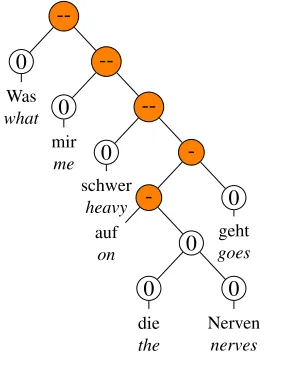
[image:3.612.362.505.63.248.2]“What really gets on my nerves . . .”
Figure 2: A multiword expression in HeiST
The original Stanford Sentiment Treebank is based on the dataset of Pang and Lee (2005), which includes 10,662 sentences from excerpts of movie reviews published onrottentomatoes.com. It should be noted that these excerpts are much more likely to express an opinion than general text or even the main body of a movie review since they contain precisely a summary of the opinion.
In order to match both domain and role of these sentences most precisely, we collected creative-commons-licensed reviews from a German movie review site, filmrezensionen.de, and used only the summary part of these documents, yielding 1184 sentences, for which we crowdsourced annota-tion for each individual phrase in the binary tree (see Figure 2 for an example tree fragment).
For the purpose of getting binary phrase trees, sentences were processed with the Berkeley Parser (Petrov et al., 2006), NP nodes were added inside PPs (Samuelsson and Volk, 2004) and the result-ing parse trees binarized usresult-ing the head table in CoreNLP (Rafferty and Manning, 2008), yielding 14,321 unique phrases.
Experiment A: Features, Confidence Prec Recl
SentiWS 0.882 0.959
SentiWS+Regression 0.894 0.967
SentiWS+Regression, @50% 0.935 0.985
SentiWS+Regression+POS 0.912 0.960
SentiWS+Regression+POS, @50% 0.978 0.997
Experiment B: Classifier (@50%) Prec Recl
Linear SVM 0.975 0.980
Random Forest 0.984 0.992
[image:4.612.319.534.62.211.2]Gradient Boosting 0.978 0.997
Table 1: Filtering out objective phrases
The HeiST treebank, as well as the code used in these experiments, are available for research pur-poses.1
3.1 Selecting Subjective Phrases
One possible approach to reduce annotation effort would be to annotate only those phrases that a clas-sification model deems to have sentiment content in the first place. As a more extreme example of such an approach, consider the MLSA sentiment dataset for German, where 270 sentences were selected that already contained two words from an existing senti-ment lexicon (Clematide et al., 2012), with the goal of getting sentences with interesting interactions be-tween sentiment words. Given the potential benefits (getting more data for the same annotation effort), an approach that filters out non-interesting (confidently objective) phrases would be highly appealing.
For the pre-classification experiment, we used cross-validation on 20 to assess the potential im-pact of strategies for saving. For the corresponding classifier, we used features from a German general-domain sentiment lexicon, a regression model for document-level sentiment (see section 5.2), as well as part-of-speech tag features in a gradient boosting classifier. As seen in table 1, the sentiment lexicon, especially in conjunction with the regression model and a POS-based filter, would allow to detect unin-teresting (objective) phrases with high accuracy. We limit ourselves to the 50% of most confident clas-sifications, and as a measure of caution, the filter is bypassed for any phrase that contains a word in one of several sentiment dictionaries (see section 5). The classifier has a precision of 96.5% for objective
1http://www.cl.uni-heidelberg.de/ ˜versley/HeiST/
System Node Acc. Root Acc.
HeiST, only pos+neg sentences
supervised
RNTN (tuned) 0.776 0.687
SVM (unigrams, coarse) 0.850∗∗ 0.774∗∗
SVM (unigrams, fine) 0.835∗∗ 0.735
cross-lingual
CLSA (simple feat.) 0.823∗∗ 0.737
CLSA (complex feat.) 0.810∗∗ 0.738∗
Comparison: HeiST, all sentences
supervised
RNTN (tuned) 0.803 0.703
[image:4.612.73.297.62.185.2]*/**: significantly better than RNTN (p <0.05/p <0.005)
Table 2:HeiST baseline, cross-lingual projection, SVM.
System Node Acc. Root Acc. Comparison: SSTb sample, pos+neg sentences lexicon-based
General Inquirer 0.824 0.715 SubjectivityClues 0.820 0.695 supervised
RNTN, 500 sent. 0.704 0.526 RNTN, 1000 sent. 0.738 0.539 RNTN, 1500 sent. 0.756 0.569 SVM, 500 sent. 0.803 0.652 SVM, 1000 sent. 0.814 0.675 SVM, 1500 sent. 0.823 0.683 RNTN, 6920 sent.a 0.876 0.854 SVM, 6920 sent.a 0.846 0.794 a: published figures from Socher et al. (2013)
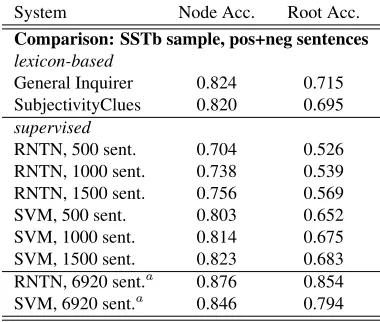
Table 3: Comparison figures on subsets of the Stanford Sentiment Treebank
phrases while catching about 66.7% of all objective nodes. While this would correspond to substantial savings (about a quarter of all nodes would be as-signed the “neutral” label and not annotated), we would also lose a fraction of non-neutral phrase and introduce an unwanted bias (towards lexicon-based resources) into our dataset.
3.2 Baseline results
[image:4.612.331.521.259.420.2]Tables 2 and 3). We evaluate our results as in Socher et al. (2013): we consider the recall of positive and negative nodes while ignoring both neutral nodes and the difference between positive (+) and strongly positive (++) or between negative (-) and strongly negative (--) nodes, respectively. Socher et al. re-move sentences with neutral overall sentiment in training as well as in testing, which seems to worsen the RNTN performance on our dataset (see Table 2), although other methods seem to be less affected by it. For comparability reasons, all other reported figures are based on Socher’s non-neutral-sentences-only setting. In comparison results on SSTb (see Ta-ble 3), classification experiments from the English data also show poor results for the RNTN classifier at small data sizes, in parallel with anecdotal evi-dence on recurrent neural networks having trouble with small dataset sizes.2
4 Crosslingual Projection for Compositional Sentiment
Our crosslingual approach follows Banea et al. (2013) in assuming that machine translation of the target documents to the source language, then ap-plying a source-language sentiment analysis, and fi-nally projecting the result back to the target side will yield usable sentiment classification. In difference to previous approaches for cross-lingual sentiment analysis, however, our annotation transfer concerns not just analysis results for the complete sentence, but for individual syntactic nodes.
After translating the target-language trees us-ing the Google Translate API, we parsed the sen-tences using the English model of the Stanford parser, and applied the RNTN model of Socher et al. (2013) trained on the English Stanford Sen-timent Treebank, yielding a labeling for each syn-tactic node with a sentiment value. We then per-formed word alignment using the PostCAT word aligner (Ganchev et al., 2008) with a model trained on the OPUS version of the EuroParl corpus (Tiede-mann, 2012), and alignment of syntactic nodes us-ing the Lingua::Align toolbox for tree align-ment Tiedemann (2010) with a model trained on the Smultron parallel treebank (Volk et al., 2010).
2Alec Radford (2015): General Sequence Learn-ing usLearn-ing Recurrent Neural Nets, https://indico.io/blog/ general-sequence-learning-using-recurrent-neural-nets/
System Node Acc. Root Acc.
Vote-only
Klenneret al. 0.769 0.646
GermanPolarityClues 0.815 0.648
SentiWS 0.815 0.711
SentiMerge [0.0] 0.660 0.577
SentiMerge [0.23] 0.718 0.604
SentiMerge [0.4] 0.724 0.604
Amazon+Lasso 0.499 0.426
Vote-and-flip
Klenneret al. 0.780 0.646
GermanPolarityClues 0.802 0.680
SentiWS 0.807 0.665
SentiMerge [0.0] 0.653 0.582
SentiMerge [0.23] 0.717 0.607
SentiMerge [0.4] 0.723 0.603
[image:5.612.322.530.66.271.2]Amazon+Lasso 0.471 0.413
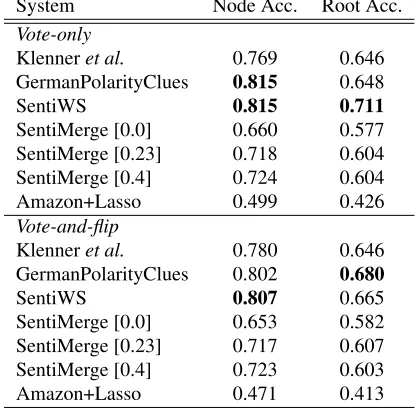
Table 4: Lexicon-based phrase labeling
Using the word alignment and our Lingua::Align model, we are able to map 98.6% of the target-language nodes to a correspond-ing node on the source (English) side, whereas the remaining nodes are assigned the same sentiment label as the root. As can be seen in table 2, a model that uses simpler features for Lingua::Align works less well than the full feature model. Con-sidering that the RNTN on the Stanford Sentiment Treebank reaches 87.6% node accuracy and 85.4% root accuracy, we see that the crosslingual pro-jection step induces a loss in accuracy, but still performs well in comparison to the approaches that use the HeiST training data.
5 Lexicon-based Approaches
Considering that the size of HeiST creates a sparse data problem for the RNTN learner, it is natural to ask whether we can improve the generalization capabilities of the system by either using a less-supervised approach or by generalizing over individ-ual word forms to alleviate the sparse data problem.
5.1 General-domain lexicon
Klenner et al. (2009) created their polarity lexi-con by semiautomatic extension of an existing one: starting from a set of 2866 adjective seeds, they looked for adjectives that often co-occur in coor-dinations with known sentiment-bearing adjectives, which were added to the lexicon after a manual fil-tering step. The current version of Klenner et al.’s PolArt lexicon also contains other parts of speech, and a list ofshiftersandintensifiersthat interact with subjective terms.
The GermanPolarityClues lexicon of Waltinger (2010a) combines translation from English lexicons with a semi-automatic approach for merging and manually correcting lexicon entries.
The SentiWS lexicon (Remus et al., 2010) con-tains translations of the English General Inquirer (Stone et al., 1966), which have been translated via Google Translate, as well as a small number of terms that were mined from positive and negative product reviews, expanded using a collocation dictionary.
Finally, the SentiMerge lexicon (Emerson and Declerck, 2014) has been constructed as a Bayesian combination (i.e., averaging with imputation for missing entries) of the three resources above together with the German SentiSpin resource of Waltinger (2010b), which contains automatic (dictionary-based) translations of the SentiSpin lex-icon of Tamura et al. (2005).
We tested all lexicons using two approaches: In thevote-onlyapproach, the sentiment of a phrase is determined by the sum of the scores of the words in that phrase as they are assigned in the sentiment lexicon. In the vote-and-flip approach, we con-sider the average of the sentiment terms, but in-vert the sentiment value whenever a term from the
shiftercategory of Klenner et al.’s lexicon is found within the yield of the node. A similar strategy was used in many papers on sentiment composition, usu-ally with a performance rather close to the best sys-tem (see e.g. the CompoMC baseline in Choi and Cardie, 2008, or the Vote-and-Flip baseline in Choi and Cardie, 2009).
5.2 Near-domain lexicon construction
While the filmrezensionen web site offers a good number of reviews, the final collection is rather small. To complement our small in-domain dataset we use the most common way of
get-ting text with document-level annotations, namely customer-written reviews from the movies section of amazon.deweb site.
Perhaps expectedly, customer reviews do not fo-cus exclusively on the film and its performance. Rather, it often occurs that customer reviews include a discussion of the physical (or other) medium that the film came on:3
(1) I am with Lovefilm (now Prime) and tried to stream the series. Terrible! Always [issues with] loading time and loss of the stream. It seems that Amazon hasn’t come to terms with the technology yet.
Other reviews on Amazon match our domain fairly well, as in the following:
(2) If this is truly a sequel to “Speed”, it only shows in the second hour of the film. It’s only then that deBont shows why he would be an action [film] specialist. Admittedly, even then we don’t get the same tension as in the predecessor, but in any case it’s better than the first hour of the film.
While we found that a small quantity of data (20+20 hand-classified sentences) together with a 300-class LDA representation was sufficient to reach 100% ac-curacy in separating content-related versus media-related text, we found that filtering out the irrelevant texts made no difference for the mean square error, in sharp contrast to L1/Lasso regularization, which allows to learn a sparse lexicon.
6 Variants of the RNTN Model
While the RNTN model certainly performs well on the full Stanford Sentiment Treebank, it is likely that its performance on HeiST is suffering from sparse data problems, and that both words and particular constructions can be novel and unseen.
In syntactic parsing, Koo et al. (2008) and Candito and Seddah (2010) have shown that using Brown clusters can be beneficial for alleviating sparse data problems in parsing. In a similar vein, Popat et al. (2013) have successfully applied crosslingual clus-tering to generalizing over potentially unseen words
System Node Acc. Root Acc.
supervised baseline
RNTN, supervised 0.776 0.687
RNTN + clusters
newspaper text+Brown 0.708 0.649
movie reviews+Brown 0.780 0.677
features+k-means 0.755 0.674
RNTN + split movie-review clusters
splitSentiWS 0.774 0.676
splitGermanPolarityClues 0.807 0.689
RNTN + lexicon-based replacement
replace-gold 0.844 0.730
repl-GermanPolarityClues 0.789∗∗ 0.681
repl-SentiMerge[0.23] 0.780∗ 0.648
Table 5: Incorporating additional information
in (document-level) sentiment analysis for English, Hindi and Marathi.
In our experiments, we follow Candito and Sed-dah (2010) in simply replacing words by clusters: in their experiments, even this simple procedure can yield an improvement, with improved results when the unlabeled data stems from the target domain. Since Brown clusters are mostly syntactic/semantic in nature and do not automatically distinguish pos-itive or negative sentiment, we additionally per-formed multiple experiments to use clusters while incorporating additional sentiment information:
On one hand, we try to incorporate the judge-ments on the Amazon near-domain dataset more di-rectly into the clusters by using the repeated bisect-ing K-Means algorithm as implemented in CLUTO (Zhao and Karypis, 2005), with previous/next word, part-of-speech tag, and the score of the containing review as features. On the other hand, we split the Brown clusters according to the sentiment value that they have in a particular sentiment lexicon (e.g. Sen-tiMerge), yielding three clusters 01101+,
01101-and01101?instead of the original cluster01101. As a final experiment, we consider replacingonly sentiment words by a concatenation of their part-of-speech and the sentiment class (turning “a great film” into “a JJ++ film”), and leaving neutral words intact. As an upper baseline for this approach, we can get words’ sentiment polarity directly from training and testing data, which yields the replace-goldentry in table 5.
rule type # in SSTb # in HeiST
AVG 119468 19228
INV 2158 289
INT 6614 646
[image:7.612.342.508.62.133.2]MWE 18235 1936
Table 6: Rule types in SSTb and HeiST
7 Results and Error analysis
Looking at the results in tables 2, 4 and 5, we see that simple support vector machine classification is very effective for reproducing the positive/negative senti-ment of nodes and complete sentences, followed by crosslingual projection and a simple averaging ap-proach; we also see that handling negation in the
vote-and-flipapproach seems to lower the score, just as the best model with word clusters and splitting (using the GermanPolarityClues lexicon) performs better than the word-based RNTN approach, but less well than the lexicon by itself. Even the replace-gold upper baseline – replacing sentiment-carrying words by their sentiment label, which raises the per-formance substantially – gives results below the sim-pler SVM approach, which is counterintuitive.
7.1 Is it about Compositionality?
One motivation for using sub-sentence structure both in approaches for rule-based composition (as, e.g. in Taboada et al. (2011) and other lexicon-based approaches) as well as in more complex learning approaches such as RNN (Socher et al., 2011) and RNTN (Socher et al., 2013) is the idea that such ap-proaches are able to model the interaction between sentiment-bearing words and sentiment-modifying words. An example for investigations based on this assumption is the work by Zhu et al. (2014), who contrast different lexicon-based approaches for han-dling negation with an RNTN model of negation and a modification of said model.
For our analysis, we grouped the production rules
sp → slsr in a sentiment treebank into one of the
following categories:
AVG A production is said to beaveragingif the par-ent category is within the range of either daugh-ter category. (e.g.mind-numbingly goodwould be the composition of a negative term and a positive term to a positive term, which still fits the averaging heuristic).
INV A production is said to be inverting if one daughter category is neutral and the other daughter category is on the other side on the spectrum (e.g. “not great” landing on the nega-tive side)
INT A production is said to be intensifying if the parent category is on the same side of the scale as the daughters but more extreme.
MWE A production is said to be amulti-word produc-tion if the daughter categories are classified as neutral while the parent category is not.4
As can be seen in table 6, the number of invert-ingandintensifyingproductions is dwarfed, both for the SST and for HeiST, by the number ofmulti-word
rules. While it is likely that these counts are slightly distorted by noise in the annotation (as both datasets are the product of crowdsourcing), this fact is re-markable and merits further investigation.
Types of multiword expressions If we try to group the nodes with a “multiword” production, we can distinguish at least the following categories:
• aspect descriptions: In some cases, an adjec-tive is specifically used to describe a (posiadjec-tive or negative) aspect of the movie, such as an
elaborate continuation, or anexpanded vision, where individual words have a neutral senti-ment label (and conceivable could have been used in a non-aspect-specific way to convey a neutral or negative sentiment, such as an elab-orate perversion, or an expanded nightshift). Similarly, wenig Handlung (not much action) 4The MWE category also contains a small number – about 5% of total MWE productions – of positive-to-neutral and negative-to-neutral productions, which we found to be predom-inantly noise from the crowdsourcing process.
has a negative meaning as a construction de-spite “wenig” (few/not much) not having a neg-ative meaning itself.
• expression strengthening is a phenomenon that occurs when a term is judged as neutral by annotators by itself, but gains a sentiment value when paired with an intensifier or nega-tor. For example,intrusivewas labeled as neu-tral in SSTb, butsimply intrusiveas negative. • comparatives are a very regular construction
where too much of something is almost always bad:too long,too insistent,too much,too many
are all negative in SSTb, just as zu viel (too many) and zu wenig (not enough) and other counterparts in HeiST are negative.
• true constructionssuch asplot holesor histor-ically significantin SSTB, or ruhigen Gewis-sens(with a calm conscience) andFinger weg
(don’t touch it) in HeiST are both a problem for approaches relying purely on composition and not regular enough that we would expect to model it as a regular construction.
Some of the positive or neutral-to-negative transitions don’t seem well-motivated and may be regarded as artifacts from the crowdsourc-ing, as does n’t, is n’t and are n’t are negative in SSTb whereas’s not,do n’tanddid n’tget a neutral label. In HeiST, nicht immer (not always) as well asnicht ganz(not quite) are negative, whereasauch nicht(neither) andnicht so(not as) ornicht unbed-ingt(not necessarily) are neutral.
TheMWEproductions seem to overlap with well-known linguistic phenomena – consider Fahrni and Klenner (2008) and their claim that most adjec-tives have a polarity that is dependent on the tar-get they modify instead of having a ‘prior’ polar-ity that holds independently of the target, or the observation of Su and Markert (2009) that senti-ment should be dependent on word senses instead of word forms (which would capture a large num-ber of examples within theexpression strengthening
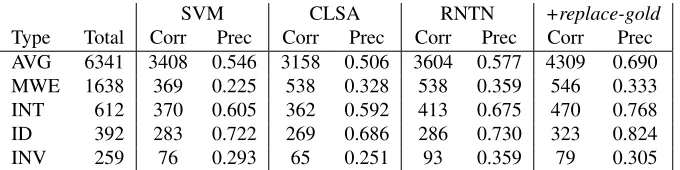
SVM CLSA RNTN +replace-gold
Type Total Corr Prec Corr Prec Corr Prec Corr Prec
AVG 6341 3408 0.546 3158 0.506 3604 0.577 4309 0.690
MWE 1638 369 0.225 538 0.328 538 0.359 546 0.333
INT 612 370 0.605 362 0.592 413 0.675 470 0.768
ID 392 283 0.722 269 0.686 286 0.730 323 0.824
[image:9.612.138.478.62.147.2]INV 259 76 0.293 65 0.251 93 0.359 79 0.305
Table 7: Precision of rules with non-neutral parent label (ID: daughters and parent have identical labels)
enough of it – because of the way the Stanford Sen-timent Treebank is constructed, phrases always have the same (context-independent) label, while we may get a more accurate (and possibly different) picture from introducing additional means of quality control (which in turn increases the necessary investment for such a sentiment treebank).
7.2 Contrasting SVM and RNTN behaviour In table 7, we tabulated the classification accuracy for the parent node in different types of productions in HeiST. In this evaluation, we counted a produc-tion as correct whenever the parent node has the right sentiment label (in parallel with the labeled recallin syntactic evaluation), ignoring for the mo-ment the question whether the production produced by a system falls into the same category. It is easy to see thatAVG-type productions are the least error-prone for all classifiers, whereasMWEandINV pro-ductions pose a significant challenge for the models. We also see that on these challenging production, the RNTN performs better than the other methods.
8 Summary
We presented a novel dataset for subsentential sen-timent classification, which uses the same conven-tions as the Stanford Sentiment Treebank (SSTb), which is the only German resource of this type besides the smaller (270 sentences) MLSA corpus (Clematide et al., 2012). We performed a system-atic exploration into supervised, cross-lingual, and lexicon-based approaches on this dataset and found that, paradoxically, the performance of the state-of-the-art recursive neural tensor network (RNTN) models are severely impeded in this data-sparse situ-ation, unlike latent-variable models for syntax which can deal with such conditions quite well: Lavelli and Corazza (2009), for example, reports that the best
results for parsing on the very small TUT treebank (slightly more than 2000 sentences) can be achieved using a PCFG-LA model.
We showed that a wide variety of models – from lexicon-based sentiment prediction over SVM with unigram features to crosslingual classification – per-forms better than the RNTN, and that methods to improve RNTN performance that work in other set-tings (syntax) do not offer any easy fix.
In a second step, we took a closer look at the crowdsourced data in order to explain certain coun-terintuitive results (such as the fact that most senti-ment lexicons do not benefit from negation handling, or that theupperbaseline achievable with the RNTN by getting gold-standard information on positive and negative words is at about the same level as our SVM classifier), and found that SSTb-type resources show marked differences from e.g., the MLSA dataset as they incorporate multiword items, but seem to be challenging for the study of compositionality due to noise that is not present in expert-annotated re-sources.
References
Banea, C., Mihalcea, R., and Wiebe, J. (2013). Port-ing multilPort-ingual subjectivity resources across lan-guages. IEEE Transactions on Affective Comput-ing, 2(4):211–225.
Candito, M.-H. and Seddah, D. (2010). Parsing word clusters. InProceedings of the First Work-shop on Statistical Parsing of Morphologically-Rich Languages (SPMRL 2010).
Choi, Y. and Cardie, C. (2009). Adapting a polar-ity lexicon using integer linear programming for domain-specific sentiment classification. In Pro-ceedings of the 2009 Conference on Empirical Methods in Natural Language Processing. Clematide, S., Gindl, S., Klenner, M., Petrakis, S.,
Remus, R., Ruppenhofer, J., Waltinger, U., and Wiegand, M. (2012). MLSA – a multi-layered reference corpus for german sentiment analysis. In Proceedings of the Eigth International Con-ference on Language Resources and Evaluation (LREC 2012).
Dong, L., Wei, F., Zhou, M., and Xu, K. (2014). Adaptive multi-compositionality for re-cursive neural models with applications to senti-ment analysis. InAAAI 2014.
Duh, K., Fujino, A., and Nagata, M. (2011). Is machine translation ripe for cross-lingual senti-ment classification. In Proceedings of the 49th Annual Meeting of the Association for Computa-tional Linguistics:shortpapers.
Emerson, G. and Declerck, T. (2014). SentiMerge: Combining sentiment lexicons in a Bayesian framework. In Proceedings of the Workshop on Lexical and Grammatical Resources for Lan-guage Processing.
Fahrni, A. and Klenner, M. (2008). Old wine or warm beer: Target-specific sentiment analysis of adjectives. In Affective Language in Human and Machine (AISB 2008).
Ganchev, K., Graca, J., and Taskar, B. (2008). Better alignments = better translations? InProcecedings of the 46th Annual Meeting of the Association of Computational Linguistics (ACL 2008).
Hall, D., Durrett, G., and Klein, D. (2014). Less grammar, more features. InACL 2014.
Klenner, M., Petrakis, S., and Fahrni, A. (2009). PolArt: A robust tool for sentiment analysis. In
NODALIDA 2009.
Koo, T., Carreras, X., and Collins, M. (2008). Sim-ple semi-supervised dependency parsing. InACL 2008.
Lavelli, A. and Corazza, A. (2009). The Berkeley Parser at the EVALITA constituency parsing task.
InProceedings of the Workshop on Evaluation of NLP Tools for Italian (EVALITA 2009).
Nakagawa, T., Inui, K., and Kurohashi, S. (2010). Dependency tree-based sentiment classification using crfs with hidden variables. InHuman Lan-guage Technologies: The 2010 Annual Confer-ence of the North American Chapter of the ACL. Pang, B. and Lee, L. (2005). Seeing stars:
Exploit-ing class relationships for sentiment categoriza-tion with respect to rating scales. InACL 2005. Petrov, S., Barett, L., Thibaux, R., and Klein, D.
(2006). Learning accurate, compact, and inter-pretable tree annotation. InCOLING-ACL 2006. Popat, K., Balamurali, A. R., Bhattacharyya, P., and
Haffari, G. (2013). The haves and the have-nots: Leveraging unlabelled corpora for sentiment anal-ysis. InProceedings of ACL 2013.
Rafferty, A. and Manning, C. D. (2008). Parsing three German treebanks: Lexicalized and unlexi-calized baselines. InACL’08 workshop on Pars-ing German.
Remus, R., Quasthoff, U., and Heyer, G. (2010). SentiWS - a publicly-available German-language resource for sentiment analysis. In Proceedings of the 7th International Language Resources and Evaluation Conference (LREC 2010).
Samuelsson, Y. and Volk, M. (2004). Automatic node insertion for treebank deepening. In Pro-ceedings of the 3rd Workshop on Treebanks and Linguistic Theories (TLT 2004).
Socher, R., Hurval, B., Manning, C. D., and Ng, A. Y. (2012). Semantic compositionality through recursive matrix-vector spaces. InEMNLP 2012. Socher, R., Pennington, J., Huang, E. H., Ng, A. Y.,
and Manning, C. D. (2011). Semi-supervised re-cursive autoencoders for predicting sentiment dis-tributions. InEMNLP 2011.
Socher, R., Perelygin, A., Wu, J., Chuang, J., Man-ning, C., Ng, A., and Potts, C. (2013). Recur-sive deep models for semantic compositionality over a sentiment treebank. InConference on Em-pirical Methods in Natural Language Processing (EMNLP 2013).
The General Inquirer: A Computer Approach to Content Analysis. MIT Press.
Su, F. and Markert, K. (2009). Subjectivity recogni-tion on word senses via semi-supervised mincuts. InProceedings of NAACL 2009.
Taboada, M., Brooke, J., Tofilofski, M., Voll, K., and Stede, M. (2011). Lexicon-based methods for sentiment analysis. Computational Linguis-tics, 37(2):267–307.
Tamura, H., Inui, T., and Okumura, M. (2005). Ex-tracting semantic orientation of words using spin model. InProceedings of the 43rd Annual Meet-ing of the Association for Computational LMeet-inguis- Linguis-tics (ACL 2005).
Tiedemann, J. (2010). Lingua-align: An experimen-tal toolbox for automatic tree-to-tree alignment. InProceedings of LREC 2010.
Tiedemann, J. (2012). Parallel data, tools and inter-faces in OPUS. In Proceedings of the 8th Inter-national Conference on Language Resources and Evaluation (LREC’2012).
Volk, M., G¨ohring, A., Marek, T., and Samuels-son, Y. (2010). SMULTRON (version 3.0) – The Stockholm MULtilingual paral-lel TReebank. http://www.cl.uzh. ch/research/parallelcorpora/ paralleltreebanks_en.html.
Waltinger, U. (2010a). GermanPolarityClues: A lexical resource for German sentiment analy-sis. In Proceedings of the 7th International Language Resources and Evaluation Conference (LREC 2010).
Waltinger, U. (2010b). Sentiment analysis reloaded - an empirical study on machine learning.based sentiment classification using polarity clues. In
Proceedings of the 6th International Conference on Web Information Systems and Technologies (WEBIST 2010).
Wan, X. (2009). Co-training for cross-lingual sen-timent classification. In Proceedings of the 47th Annual Meeting of the ACL and the 4th IJCNLP of the AFNLP (ACL-IJCNLP 2009).
Wang, S. and Manning, C. D. (2012). Baselines and bigrams: Simple, good sentiment and topic clas-sification. InProceedings of ACL 2012.
Yessenalina, A. and Cardie, C. (2011). Composi-tional matrix-space models for sentiment analy-sis. InEMNLP 2011.
Zhao, Y. and Karypis, G. (2005). Hierarchical clus-tering algorithms for document datasets. Data Mining and Knowledge Discovery, 10:141–168. Zhu, X., Guo, H., Mohammad, S., and Kiritchenko,