Does the Geometry of Word Embeddings Help Document Classification?
A Case Study on Persistent Homology Based Representations
Paul Michel∗ Carnegie Mellon University [email protected]
Abhilasha Ravichander∗ Carnegie Mellon University [email protected]
Shruti Rijhwani∗ Carnegie Mellon University [email protected]
Abstract
We investigate the pertinence of meth-ods from algebraic topology for text data analysis. These methods enable the de-velopment of mathematically-principled isometric-invariant mappings from a set of vectors to a document embedding, which is stable with respect to the geometry of the document in the selected metric space. In this work, we evaluate the utility of these topology-based document represen-tations in traditional NLP tasks, specifi-cally document clustering and sentiment classification. We find that the embed-dings do not benefit text analysis. In fact, performance is worse than simple tech-niques like tf-idf, indicating that the ge-ometry of the document does not provide enough variability for classification on the basis of topic or sentiment in the chosen datasets.
1 Introduction
Given a embedding model mapping words ton di-mensional vectors, every document can be repre-sented as a finite subset of Rn. Comparing
doc-uments then amounts to comparing such subsets. While previous work shows that the Earth Mover’s Distance (Kusner et al.,2015) or distance between the weighted average of word vectors (Arora et al.,
2017) provides information that is useful for clas-sification tasks, we wish to go a step further and investigate whether useful information can also be found in the ‘shape’ of a document in word em-bedding space.
Persistent homology is a tool from algebraic topology used to compute topological signatures (calledpersistence diagrams) on compact metric
∗
*The indicated authors contributed equally to this work.
spaces. These have the property of being sta-ble with respect to the Gromov-Haussdorff dis-tance (Gromov et al.,1981). In other words, com-pact metric spaces that are close, up to an isometry, will have similar embeddings. In this work, we ex-amine the utility of such embeddings in text clas-sification tasks. To the best of our knowledge, no previous work has been performed on using topo-logical representations for traditional NLP tasks, nor has any comparison been made with state-of-the-art approaches.
We begin by considering a document as the set of its word vectors, generated with a pretrained word embedding model. These form the metric space on which we build persistence diagrams, us-ing Euclidean distance as the distance measure. The diagrams are a representation of the docu-ment’s geometry in the metric space. We then per-form clustering on the Twenty Newsgroups dataset with the features extracted from the persistence diagram. We also evaluate the method on senti-ment classification tasks, using the Cornell Sen-tence Polarity (CSP) (Pang and Lee, 2005) and IMDb movie review datasets (Maas et al.,2011).
As suggested byZhu (2013), we posit that the information about the intrinsic geometry of doc-uments, found in the persistence diagrams, might yield information that our classifier can leverage, either on its own or in combination with other rep-resentations. The primary objective of our work is to empirically evaluate these representations in the case of sentiment and topic classification, and assess their usefulness for real-world tasks.
2 Method
2.1 Word embeddings
As a first step we compute word vectors for each document in our corpus using a word2vec (Mikolov et al.,2013) model trained on the Google
News dataset1. In addition to being a widely used
word embedding technique, word2vec has been known to exhibit interesting linear properties with respect to analogies (Mikolov et al.,2013), which hints at rich semantic structure.
2.2 Gromov-Haussdorff Distance
Given a dictionary of word vectors of dimension
n, we can represent any document as a finite subset ofRn. TheHaussdorff distancegives us a way to
evaluate the distance between two such sets. More precisely, the Haussdorff distancedHbetween two
finite subsetsA, BofRnis defined as: dH(A, B) = max(sup
a∈Ad(a, B),supb∈Bd(b, A))
whered(x, Y) = infy∈Y kx−yk2 is the distance
of pointxfrom setY.
However, this distance is sensitive to transla-tions and other isometric2transformations. Hence,
a more natural metric is theGromov-Haussdorff distance(Gromov et al.,1981), simply defined as
dGH(A, B) = inf
f∈EndH(A, f(B))
whereEnis the set of all isometries ofRn.
Figure 1 provides an example of practical Gromov-Haussdorff (GH) distance computation between two sets of three points each. Both sets are embedded in R2 (middle panel) using
isome-tries i.e the distance between points in each set is conserved. The Haussdorff distance between the two embedded sets corresponds to the length of the black segment. The GH distance is the min-imum Haussdorff distance under all possible iso-metric embeddings.
We want to compare documents based on their intrinsic geometric properties. Intuitively, the GH distance measures how far two sets are from being isometric. This allows us to define the geometry of a document more precisely:
Definition 1 (Document Geometry) We say that two documents A, B have the same geometry if dGH(A, B) = 0, ie if they are the same up to an isometry.
Mathematically speaking, this amounts to defin-ing the geometry of a document as its equivalence class under the equivalence relation induced by the GH distance on the set of all documents.
1https://code.google.com/archive/p/word2vec/
2f :Rn−→Rnisisometricif it is distance preserving,
ie∀x, y∈Rn,kf(x)−f(y)k
2=kx−yk2. Rotations,
[image:2.595.317.515.59.173.2]trans-lations and reflections are examples of (linear) isometries.
Figure 1: Gromov-Haussdorff distance between two sets (red, green). The black bar represents the actual distance (given that the isometric embed-ding is optimal).
Comparison to the Earth Mover Distance :
Kusner et al. (2015) proposed a new method for computing a distance between documents based on an instance of the Earth Mover Distance ( Rub-ner et al., 1998) called Word Mover Distance (WMD). While WMD quantifies the total cost of matching all words of one document to another, the GH distance is the cost, up to an isometry, of the worst-case matching.
2.3 Persistence diagrams
Efficiently computing the GH distance is still an open problem despite a lot of recent work in this area (M´emoli and Sapiro, 2005; Bronstein et al.,
2006;M´emoli,2007;Agarwal et al.,2015). Fortunately, Carri`ere et al. (2015) provides us with a way to derive a signature which is stable with respect to the GH distance. More specifi-cally, given a finite point cloudA ⊂Rn, the
per-sistence diagram of the Vietori-Rips filtration on
A, Dg(A), can be computed. This approach is inspired by persistent homology, a subfield of al-gebraic topology.
The rigorous definition of these notions is not the crux of this paper and we will only present them informally. The curious reader is invited to refer toZhu(2013) for a short introduction. More details are inDelfinado and Edelsbrunner(1995);
Edelsbrunner et al.(2002);Robins(1999). A persistence diagram is a scatter plot of 2-D points representing the appearance and disappear-ance of geometric features3 under varying
reso-lutions. This can be imagined as replacing each point by a sphere of increasing radius.
We use the procedure described inCarri`ere et al.
Figure 2: Method Pipeline
(2015) to derive fixed-sized vectors from persis-tence diagrams. These vectors have the follow-ing property: if A and B are two finite sub-sets of Rn, Dg(A) and Dg(B) are their
persis-tence diagrams, N = max(|Dg(A)|,|Dg(B)|) andVA, VB ∈RN(N2−1), then
kVA−VBk2 6p2N(N−1)dGH(A, B)
In other words, the resulting signaturesVAandVB
are stable with respect to the GH distance. The size of the vectors are dependent on the underlying setsA andB. However, as is argued inCarri`ere et al.(2015), we can truncate the vectors to a di-mension fixed across our dataset while preserving the stability property (albeit losing some of the representative ability of the signatures).
3 Experiments 3.1 Experiments
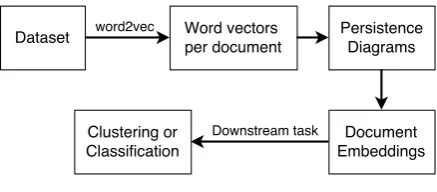
The pipeline for our experiments is shown in Fig-ure 2. In order to build a persistence diagram, we convert each document to the set of its word vectors. We then use Dionysus (Morozov,2008– 2016), a C++ library for computing persistence di-agrams, and form the signatures described in2.3. We will subsequently refer to these diagrams as Persistent Homology (PH) embeddings. Once we
have the embeddings for each document, they can be used as input to standard clustering or classifi-cation algorithms.
As a baseline document representation, we use the average of the word vectors for that document (subsequently called AW2Vembeddings).
For clustering, we experiment with K-means and Gaussian Mixture Models (GMM) on a sub-set4 of the Twenty Newsgroups dataset. The
sub-set was selected to ensure that most documents are from related topics, making clustering non-trivial, and the documents are of reasonable length to compute the representation.
4alt.atheism, sci.space and talk.religion.misc categories
For classification, we perform both sentence-level and document-sentence-level binary sentiment classi-fication using logistic regression on the CSP and IMDb corpora respectively.
4 Results
4.1 Hyper-parameters
Our method depends on very few hyper-parameters. Our main choices are listed below.
Choice of distance We experimented with both euclidean distance and cosine similarity (angular distance). After preliminary experiments, we de-termined that both performed equally and hence, we only report results with the euclidean distance.
Persistence diagram computation The hyper-parameters of the diagram computation are mono-tonic and mostly control the degree of approxima-tion. We set them to the highest values that al-lowed our experiment to run in reasonable time5.
4.2 Document Clustering
We perform clustering experiments with the base-line document features (AW2V),tf-idf and our PH
signatures. Figure 3 shows the B-Cubed preci-sion, recall and F1-Score of each method (metrics as defined inAmig´o et al.(2009)). To further as-sess the utility of PHembeddings, we concatenate
them with AW2V to obtain a third representation,
AW2V+PH.
With GMM and AW2V+PH, the F1-Score of
clustering is0.499. In terms of F1 and precision, we see that tf-idf representations perform better than PH, for reasons that we will discuss in later
sections. In terms of recall, PHas well as AW2V
perform fairly well. Importantly, we see that all the metrics for PHare significantly above the
ran-dom baseline, indicating that some valuable infor-mation is contained in them.
4.3 Sentiment Classification
4.3.1 Sentence-Level Sentiment Analysis
We evaluate our method on the CSP dataset6. The
results are presented in Table1. For comparison, we provide results for one of the state of the art models, a CNN-based sentence classifier (Kim,
5Selected such that the computation of the diagram of the
longest file in the training data took less than 10 minutes.
6For lack of a canonical split, we use a random 10% of
Figure 3: Results for clustering on 3 subclasses of the Twenty Newsgroups dataset
Model Accuracy
CNN Non-Static 81.5% PH+ LogReg 53.19%
AW2V+ LogReg 77.13%
[image:4.595.98.266.256.326.2]AW2V+ PH+ LogReg 77.13%
Table 1: Performance on the CSP dataset
Model Accuracy
Paragraph Vector 92.58% PH+ LogReg 53.16%
AW2V+ LogReg 82.94%
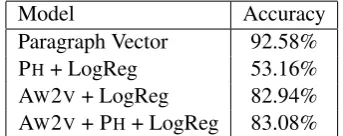
AW2V+ PH+ LogReg 83.08%
Table 2: Performance on the IMDb dataset
2014). We observe that by themselves, PH
em-beddings are not useful at predicting the sentiment of each sentence. AW2V gives reasonable
perfor-mance in this task, but combining the two repre-sentations does not impact the accuracy at all.
4.3.2 Document-Level Sentiment Analysis
We perform document-level binary sentiment clas-sification on the IMDb Movie Reviews Dataset (Maas et al., 2011). We use sentence vectors in this experiment, each of which is the average of the word vectors in that sentence. The results are presented in Table2. We compare our results with the paragraph-vector approach (Le and Mikolov,
2014). We observe that PH embeddings perform
poorly on this dataset. Similar to the CSP dataset, AW2V embeddings give acceptable results. The
combined representation performs slightly better, but not by a margin of significance.
5 Discussion and Analysis
As seen in Figure 3, the PH representation does
not outperformtf-idf or AW2V, and in fact often
doesn’t perform much better than chance.
One possible reason is linked to the nature of our datasets: the computation of the persistence diagram is very sensitive to the size of the docu-ments. The geometry of small documents, where the number of words is negligible with respect to the dimensionality of the word vectors, is not very rich. The resulting topological signatures are very sparse, which is a problem for CSP as well as documents in IMDb and Twenty Newsgroups that contain only one line. On the opposite side of the spectrum, persistence diagrams are intractable to compute without down-sampling for very long documents (which in turn negatively impacts the representation of smaller documents).
We performed an additional experiment on a subset of the IMDb corpus that only contained documents of reasonable length, but obtained sim-ilar results. This indicates that the poor perfor-mance of PH representations, even when
com-bined with other features (AW2V), cannot be
ex-plained only by limitations of the data.
These observations lead to the conclusion that, for these datasets, the intrinsic geometry of doc-uments in the word2vec semantic space does not help text classification tasks.
6 Related Work
[image:4.595.95.267.366.434.2]sen-tence/paragraph level Le and Mikolov (2014);
Kiros et al. (2015) or purely word vector based methodsArora et al.(2017).
Document classification and clustering (Willett,
1988;Hotho et al., 2005;Steinbach et al., 2000;
Huang,2008;Xu and Gong, 2004; Kuang et al.,
2015;Miller et al., 2016) and sentiment classifi-cation (Nakagawa et al.,2010;Kim,2014;Wang and Manning,2012) are relatively well studied.
Topological data analysis has been used for var-ious tasks such as 3D shapes classification (Chazal et al.,2009) or protein structure analysis (Xia and Wei, 2014). However, such techniques have not been used in NLP, primarily because the theory is inaccessible and suitable applications are scarce.
Zhu (2013) offers an introduction to using per-sistent homology in NLP, by creating represen-tations of nursery-rhymes and novels, as well as highlights structural differences between child and adolescent writing. However, these techniques have not been applied to core NLP tasks.
7 Conclusion
Based on our experiments, using persistence di-agrams for text representation does not seem to positively contribute to document clustering and sentiment classification tasks. There are certainly merits to the method, specifically its strong math-ematical foundation and its domain-independent, unsupervised nature. Theoretically, algebraic topology has the ability to capture structural con-text, and this could potentially benefit syntax-based NLP tasks such as parsing. We plan to in-vestigate this connection in the future.
Acknowledgments
This work was supported in part by the Defense Advanced Research Projects Agency (DARPA) Information Innovation Office (I2O) under the Low Resource Languages for Emergent Incidents (LORELEI) program issued by DARPA/I2O un-der Contract No. HR0011-15-C-0114. The views expressed are those of the authors and do not re-flect the official policy or position of the Depart-ment of Defense or the U.S. GovernDepart-ment.
We are grateful to Matt Gormley, Hyun Ah Song, Shivani Poddar and Hai Pham for their sug-gestions on the writing of this paper as well as to Steve Oudot for pointing us to helpful references. We would also like to thank the anonymous ACL reviewers for their valuable suggestions.
References
Pankaj K Agarwal, Kyle Fox, Abhinandan Nath, Anas-tasios Sidiropoulos, and Yusu Wang. 2015. Com-puting the gromov-hausdorff distance for metric trees. In International Symposium on Algorithms and Computation. Springer, pages 529–540. Enrique Amig´o, Julio Gonzalo, Javier Artiles, and
Felisa Verdejo. 2009. A comparison of extrinsic clustering evaluation metrics based on formal con-straints. Information retrieval12(4):461–486. Sanjeev Arora, Yingyu Liang, and Tengyu Ma. 2017.
A simple but tough-to-beat baseline for sentence em-beddings. InInternational Conference on Learning Representations. To Appear.
Alexander M Bronstein, Michael M Bronstein, and Ron Kimmel. 2006. Efficient computation of isometry-invariant distances between surfaces.
SIAM Journal on Scientific Computing28(5):1812– 1836.
Mathieu Carri`ere, Steve Y Oudot, and Maks Ovs-janikov. 2015. Stable topological signatures for points on 3d shapes. InComputer Graphics Forum. Wiley Online Library, volume 34, pages 1–12. Fr´ed´eric Chazal, David Cohen-Steiner, Leonidas J
Guibas, Facundo M´emoli, and Steve Y Oudot. 2009. Gromov-hausdorff stable signatures for shapes using persistence. In Computer Graphics Forum. Wiley Online Library, volume 28, pages 1393–1403. Cecil Jose A Delfinado and Herbert Edelsbrunner.
1995. An incremental algorithm for betti numbers of simplicial complexes on the 3-sphere. Computer Aided Geometric Design12(7):771–784.
Herbert Edelsbrunner, David Letscher, and Afra Zomorodian. 2002. Topological persistence and simplification. Discrete and Computational Geome-try28(4):511–533.
Mikhael Gromov, Jacques Lafontaine, and Pierre Pansu. 1981. Structures m´etriques pour les vari´et´es riemanniennes .
Andreas Hotho, Andreas N¨urnberger, and Gerhard Paaß. 2005. A brief survey of text mining. InLdv Forum.
Anna Huang. 2008. Similarity measures for text doc-ument clustering. In Proceedings of the sixth new zealand computer science research student confer-ence (NZCSRSC2008), Christchurch, New Zealand. pages 49–56.
Yoon Kim. 2014. Convolutional neural networks for sentence classification. InIn EMNLP.
Ryan Kiros, Yukun Zhu, Ruslan R Salakhutdinov, Richard Zemel, Raquel Urtasun, Antonio Torralba, and Sanja Fidler. 2015. Skip-thought vectors. In
Da Kuang, Jaegul Choo, and Haesun Park. 2015. Non-negative matrix factorization for interactive topic modeling and document clustering. In Partitional Clustering Algorithms, Springer, pages 215–243. Matt J Kusner, Yu Sun, Nicholas I Kolkin, Kilian Q
Weinberger, et al. 2015. From word embeddings to document distances. InICML. volume 15, pages 957–966.
Quoc V. Le and Tomas Mikolov. 2014. Distributed rep-resentations of sentences and documents. In Pro-ceedings of the 31th International Conference on Machine Learning, ICML 2014, Beijing, China, 21-26 June 2014. pages 1188–1196.
Andrew L. Maas, Raymond E. Daly, Peter T. Pham, Dan Huang, Andrew Y. Ng, and Christopher Potts. 2011.Learning word vectors for sentiment analysis. In Proceedings of the 49th Annual Meeting of the Association for Computational Linguistics: Human Language Technologies. Association for Computa-tional Linguistics, Portland, Oregon, USA, pages 142–150. http://www.aclweb.org/anthology/P11-1015.
Facundo M´emoli. 2007. On the use of gromov-hausdorff distances for shape comparison .
Facundo M´emoli and Guillermo Sapiro. 2005. A the-oretical and computational framework for isometry invariant recognition of point cloud data. Founda-tions of Computational Mathematics5(3):313–347. Tomas Mikolov, Ilya Sutskever, Kai Chen, Greg S
Cor-rado, and Jeff Dean. 2013. Distributed representa-tions of words and phrases and their compositional-ity. InAdvances in neural information processing systems. pages 3111–3119.
Timothy A Miller, Dmitriy Dligach, and Guergana K Savova. 2016. Unsupervised document classifica-tion with informed topic models. ACL.
Dmitriy Morozov. 2008–2016. Dyonisus : a c++ li-brary for computing persistent homology. http: //mrzv.org/software/dionysus/. Tetsuji Nakagawa, Kentaro Inui, and Sadao
Kuro-hashi. 2010. Dependency tree-based sentiment classification using crfs with hidden variables. In Human Language Technologies: The 2010 Annual Conference of the North American Chapter of the Association for Computational Linguis-tics. Association for Computational Linguistics, Stroudsburg, PA, USA, HLT ’10, pages 786–794.
http://dl.acm.org/citation.cfm?id=1857999.1858119. Bo Pang and Lillian Lee. 2005. Seeing stars:
Exploit-ing class relationships for sentiment categorization with respect to rating scales. InProceedings of the ACL.
Vanessa Robins. 1999. Towards computing homology from finite approximations. In Topology proceed-ings. volume 24, pages 503–532.
Yossi Rubner, Carlo Tomasi, and Leonidas J Guibas. 1998. A metric for distributions with applications to image databases. In Computer Vision, 1998. Sixth International Conference on. IEEE, pages 59–66. Michael Steinbach, George Karypis, Vipin Kumar,
et al. 2000. A comparison of document clustering techniques. InKDD workshop on text mining. Sida Wang and Christopher D. Manning. 2012.
Baselines and bigrams: Simple, good sentiment and topic classification. In Proceedings of the 50th Annual Meeting of the Association for Com-putational Linguistics: Short Papers - Volume 2. Association for Computational Linguistics, Stroudsburg, PA, USA, ACL ’12, pages 90–94.
http://dl.acm.org/citation.cfm?id=2390665.2390688. Peter Willett. 1988. Recent trends in hierarchic
docu-ment clustering: a critical review. Information Pro-cessing & Management24(5):577–597.
Kelin Xia and Guo-Wei Wei. 2014. Persistent ho-mology analysis of protein structure, flexibility, and folding. International journal for numerical meth-ods in biomedical engineering30(8):814–844. Wei Xu and Yihong Gong. 2004. Document
clustering by concept factorization. In Pro-ceedings of the 27th Annual International ACM SIGIR Conference on Research and Devel-opment in Information Retrieval. ACM, New York, NY, USA, SIGIR ’04, pages 202–209.
https://doi.org/10.1145/1008992.1009029.