Finding Representations for Memory-Based Language
Abstract
Constructive induction transforms the representation of instances in order to produce a more accurate model of the concept to be learned. For this purpose, a vari- ety of operators has been proposed in the literature, including a Cartesian product operator forming pair- wise higher-order attributes. We study the effect of the Cartesian product operator on memory-based lan- guage learning, and demonstrate its effect on general- ization accuracy and data compression for a number of linguistic classification tasks, using k-nearest neighbor learning algorithms. These results are compared to a baseline approach of backward sequential elimination of attributes. It is demonstrated that neither approach consistently outperforms the other, and that attribute elimination can be used to derive compact representa- tions for memory-based language learning without no- ticeable loss of generalization accuracy.
I n t r o d u c t i o n
Learning
Stephan Raaijmakers
r a a i j m a k e r s @ i n l , n l
I n s t i t u t e for D u t c h L e x i c o l o g y ( I N L ) P . O . B o x 9515
2300 R A L e i d e n T h e N e t h e r l a n d s
Daelemans et al., 1997]. Successful attribute elimina- tion leads to compact datasets, which possibly increase classification speed. Constructive induction, on the other hand, tries to exploit dependencies between at- tributes, by combining them into complex attributes that increase accuracy of the classifier. For instance- based algorithms, this approach has been demonstrated to correct invalid independence assumptions made by the algorithm [Pazzani, 1998]: e.g., for the Naive Bayes classifier (Duda & Hart, 1973), the unwarranted as- sumption that in general the various attributes a, = v, are independent, and form a joint probability model for the prediction of the class C:
It is a widely held proposition that inductive learn- ing models, such as decision trees [Quinlan, 1993] or k- nearest neighbor models [Aha, Kibler & Albert, 1991], are heavily dependent upon their representational bi- ases. Both decision tree algorithms and instance-based algorithms have been reported to be vulnerable to ir- relevant or noisy attributes in the representation of ex- emplars, which unnecessarily enlarge the search space for classification [John, 1997]. In general, there are two options for dealing with this problem. Attribute elimination (or selection) can be applied in order to find a minimal set of attributes that is maximally in- formative for the concept to be learned. Attribute elimination can be seen as a radical case of attribute weighting [Scherf & Brauer, 1997, Aha, 1998], where attributes are weighted on a binary scale, as either rel- evant or not; more fine-grained methods of attribute weighting take information-theoretic notions ifito ac- count such as information gain ratio [Quinlan, 1993.
l-I
P(a,=
v,I
C)
P(C)
t
P ( C I a~ = v ~ A . . . A a , = v,) = P ( a ~ = v~ A . . . ^ a,, = v,) (I) Constructive induction thus can be used to invent re- lationships between attributes that, apart fl'om possi- bly offering insight into the underlying structure of the learning task, m a y boost performance of the resulting
classifier. Linguistic tasks are sequential by nature, as language processing is a linear process, operating on sequences with a temporal structure (see e.g. Cleere- mans (1993) for motivation for the temporal structure of finite-state grammar learning). Learning algorithms like k-nearest neighbor or decision trees abstract away from this linearity, by treating representations as multi- sets of attribute-value pairs, i.e. permutation-invariant lists. Using these algorithms, constructive induction cannot be used for corrections on the linearity of the learning task, but it can be used to study attribute in- teraction irrespective of ordering issues.
instances from linguistic instance bases tends to harm generalization accuracy. In this study, we apply edit- ing on the level of instance representation. The central question is whether it is more preferable to correct lin- guistic tasks by combining (possibly noisy or irrelevant) attributes, or by finding informative subsets.
Representation Transformations
John (1997) contains presentations of various attribute selection approaches. In Yang & Honovar (1998), a genetic algorithm is used for finding informative at- tribute subsets, in a neural network setting. Cardie (1996) presents an attribute selection approach to nat- ural language processing (relative pronoun disambigua- tion) incorporating a small set of linguistic biases (to be determined by experts).
Many operators have been proposed in the litera- ture for forming new attributes from existing ones. Pa- gallo & Hauser (1990) propose boolean operators (like conjunction and negation) for forming new attributes in a decision tree setting. Aha (1991) describes IB3- CI, a constructive indiction algorithm for the instance- based classifier IB3. Aiming at reducing similarity be- tween an exemplar and its misclassifying nearest neigh- bor, IB3-CI uses a conjunctive operator forming an at- tribute that discriminates between these two. Bloedorn & Michalski (1991) present a wide variety of mathe- matical and logical operators within the context of the AQ17-DC1 system. A general perspective on construc- tive induction is sketched in Bloedorn, Michalski & Wnek (1994). Keogh & Pazzani (1999) propose correla- tion arcs between attributes, augmenting Naive Bayes with a graph structure.
Pazzani (1998) proposes a Cartesian product oper- ator for joining attributes, and compares its effects on generalization accuracy with those of attribute elimina- tion, for (a.o.) the Naive Bayes and PEBLS (Cost & Salzberg, 1993) classifiers. The Cartesian product oper- ator joins two attributes At and A2 into a new, complex attribute At..42, taking values in the Cartesian product {<
a,,aj
>1a i e Values(At) ^ aj E Values(A.,_)}
(2) whereValues(A)
is the value set of attribute A. The Cartesian product operator has an intrinsic linear in- terpretation: two features joined in a Cartesian prod- uct form an ordered pair with a precedence relation (the ordered pair < a, b > differs from the ordered pair < b, a >). This linear interpretation vanishes in learn- ing algorithms that do not discern internal structure in attribute values (like standard nearest neighbor).Pazzani's
backward sequential elimination and join-
b~g
algorithm (BSEJ) finds the optimal representation transformation by considering each pair of attributesin turn, using leave-one-out cross-validation to deter- mine the effect on generalization accuracy. Attribute joining carries out an implicit but inevitable elimina- tion step: wiping out an attribute being subsumed by a combination. This reduces the dimensionality of the result dataset with one dimension. Following success- ful joining, the BSEJ algorithm carries out an
explicit
elimination step, attempting to delete every attribute in turn (including the newly constructed attribute) look- ing for the optimal candidate using cross-validation. The algorithm converges when no more transforma- tions can be found that increase generalization accu- racy. This approach is reported to produce significant accuracy gain for Naive Bayes and for PEBLS. Pazzani contrasts BSEJ with a
backward sequential ehmination
algorithm (BSE,
backward sequential elimination,
pro- gressively eliminating attributes (and thus reducing di- mensionality) until accuracy degrades. He also investi- gates forward variants of these algorithms, which suc- cessively build more complex representations up to con- vergence. Both for PEBLS and Naive Bayes, attribute joining appears to be superior to elimination, and the backward algorithms perform better than the forward algorithms. For k-nearest neighbor algorithms based on the unweighted overlap metric, BSEJ did not out- perform BSE.Conditioning representation transformations oil the performance of the original classifier implements a wrapper approach (John, 1997; Kohavi & John, 1998), which has proven an accurate, powerful method to mea- sure the effects of data transformations on generaliza- tion accuracy. The transformation process is wrapped around the classifier, and no transformation is carried out that degrades generalization accuracy.
In this study, two algorithms, an implementation of BSE and a simplification of the BSEJ algorithm, were wrapped around three types of classifiers: IBI-IG, IB1- IG&MVDM (a classifier related to PEBLS in using MVDM) and IGTREE [Daelemans et
al.,
1997]. All of these classifiers are implemented in the TiMBL package [Daelemanset al,
1999ii]. IBI-IG is a k-nearest neigh- bor algorithm using a weighted overlap metric, where the attributes of instances have their information gain ratio as weight. For instances X and l ' , distance is computed asn
ACX, Y ) = y ~ wdiCxi. Yi)
(3)t = l
where 6 is the overlap metric, and w, is the information gain ratio (Quinlan, 1993) of attribute i.
(1993). The MVDM defines the difference between two values x and y respective to a class
C, as
5(x,y) = Z
[ P(C,
ix) -P(C,
[y) [ (4)z----I
i.e., it uses the probabilities of the various classes conditioned on the two values to determine overlap. Attribute weighting of IBI-IG&MVDM (information gain ratio based) differs from PEBLS: PEBLS uses performance-based weighting based on class predicyion strength, where exemplars are weighted according to an accuracy or reliability ratio.
IGTREE is a tree-based k-nearest neighbor algo- rithm, where information gain is used as a heuristic to insert nodes in the tree. For every non-terminal node, a default classification is stored for the path leading to it. Whenever no exact match can be found for an un- known instance to be classified, the default classification associated with the last matching attribute is returned as classification for the instance. Although IGTREE sometimes lags behind IBI-IG in accuracy, it provides for much faster, high quality classifiers.
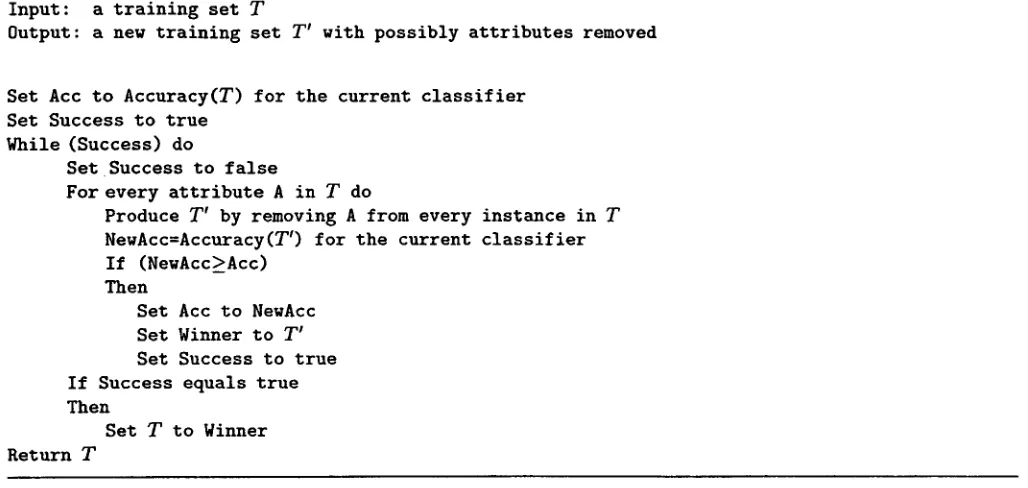
An implementation of the BSE algorithm is outlined in figure . It is akin in spirit to the backward elimi- nation algorithm of John (1997). During every pass, it measures the effects on generalization accuracy of elimi- nating every attribute in turn, only carrying out the one which maximizes accuracy. A simplified version of the BSEJ algorithm called
backward sequential joining with
information gain ratio
(BSJ-IG) is outlined in figure.N!
It checks the ~ ordered combinations for N fea- tures during each pass, and carries out the one resulting in the maximum gain in accuracy (as a consequence of the permutation im, ariance, the total search space of N! possible combinations can be halved). Any two joined attributes are put on the position with the max- imum information gain ratio of both original positions, after which the remaining candidate position is wiped out. Again, as the used classifiers are all permutation- invariant with respect to their representations, this is only a decision procedure to find a target position for the attribute combination; all candidate positions are equivalent target positions.
Unlike the original BSEJ algorithm, BSJ-IG omits the additional explicit attribute elimination step di- rectly after every attribute joining step, in order to seg- regate the effects of attribute joining as much as possi- ble from those of attribute elimination.
Both BSE and BSJ-IG algorithms are hill-climbing algorithms, and, as such, are vulnerable to local lnin- ima. Ties are resolved randomly by both.
E x p e r i m e n t s
The effects of forming Cartesian product attributes on generalization accuracy and reduction of dimen- sionality (compression) were compared with those of backward sequential elimination of attributes. The following 7 linguistic datasets were used. STRESS is a selection of secondary stress assignment patterns from the Dutch version of the Celex lexical database [Baayen, Piepenbrock & van Rijn, 1993], on the basis of phonemic representations of syllabified words. At- tribute values are phonemes. Also derived from Celex is the DIMIN task, a selection of diminutive formation patterns for Dutch. This task consists of assigning Dutch diminutive suffixes'to a noun, based on phonetic properties of (maximally) the last three syllables of the noun. Attribute values are phoneme representations as well as stress markers for the syllables. The WSJ- NPVP set consists of part-of speech tagged Wall Street Journal material (Marcus, Santorini & Marcinkiewicz, 1993), supplemented with syntactic tags indicating noun phrase and verb phrase boundaries (Daelemans et
al,
1999iii). wsJ-POS is a fragment of the Wall Street Journal part-of-speech tagged material (Marcus, San- torini and Marcinkiewicz, 1993). Attributes values are parts of speech, which are assigned using a window- ing approach, with a window size of 5. INL-POS is a part-of-speech tagging task for Dutch, using tl~e Dutch- Tale tagset [van der Voort van der Kleijet al.,
1994], attribute values are parts of speech. Using a window- ing approach, on the basis of a 7-cell window, part of speech tags are disambiguated. GRAPHON consti- tutes a grapheme-to-phoneme learning task for English, based on the Celex lexical database. Attribute values are graphemes (single characters), to be classified as phonemes. PP-ATTACH, finally, is a prepositional phrase (PP) attachment task for English.. where PP's are at- tached to either noun or verb projections, based on lexical context. Attribute values are word forms for verb, the head noun of the following nouu phrase, the preposition of the following PP, and the head noun of the PP-internal noun phrase (like b r i n g a t t e n t i o n t o problem). The material has been extracted by Rat- naparkhiet al.
(1994) from the Penn Treebank Wall Street Journal corpus. Key numerical characteristics of the datasets are summarized in table 1.!
Procedure BSE
Input: a training set T
Output: a new training set T' with possibly attributes removed
S e t Acc t o Accuracy(T) f o r t h e c u r r e n t c l a s s i f i e r
S e t Success t o t r u e
While (Success) do
S e t S u c c e s s to false
For every attribute A in T do
Produce T' by removing A from every instance in T
NewAcc=Accuracy(T') for the current classifier
If (NewAcc>Acc)
Then
Set Acc to NewAcc
Set Winner to T'
Set Success to true
If Success equals true
Then
Set T to Winner
Return T
Figure h A wrapper implementation of Backward Sequential Elimination (BSE).
events. In order to assess the effects of smoothing, the following additional experiments were carried out. Em- beddded into BSE and BSJ-IG, the PEBLS approxima- tion IBI-IG with MVDM was applied to three datasets: STRESS, DIMIN and PP-ATTACH, for three values of k (1, 3, 7), the size of the nearest neighbor set. Values for k larger than 1, i.e. non-singleton nearest neighbor sets. have been found to reproduce some of the smoothing in- herent to statistical back-off models (Daelemans et al..
1999ii; Zavrel & Daelemans, 1997).
Generalization accuracy for every attribute joining or elimination step was measured using 10-fold cross- validation, and significance was measured using a two- tailed paired t-test at the .05 level. All experiments were carried out on a Digital Alpha XL-266 (Linux) and a Sun UltraSPARC-IIi (Solaris). Due to slow perfor- mance of the IBI-IG model on certain datasets with the used equipment, IBI-IG experiments with %VSJ-NPVP could not be completed.
R e s u l t s
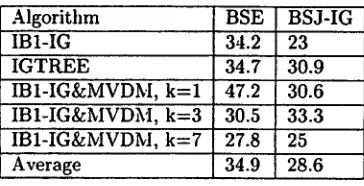
The results show, first of all, that the compression rates obtained with BSE (average 34.9%) were consis- tently higher than those obtained with BSJ-IG (average 28.6%) (table 2).
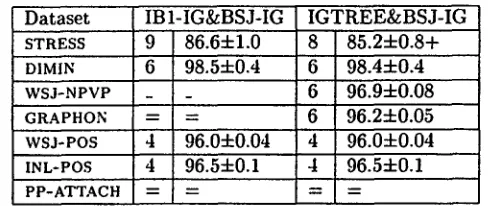
Secondly, BSE and BSJ-IG have com~)arable effects on accuracy. BSE generally boosts IGTREE perfor- mance to IBI-IG level, and leads to significant accu- racy gains for two datasets, STRESS and PP-A.TTACH (tabel 3). BSJ-IG does so for the STRESS set (tabel 4). Neither BSE nor BSJ-IG produce any significant gain in accuracy for the IBI-IG classifier. This general- izes the findings of Pazzani (1998) ibr classifiers based on unweighted overlap metrics to classifiers based oll a weighted overlap metric.
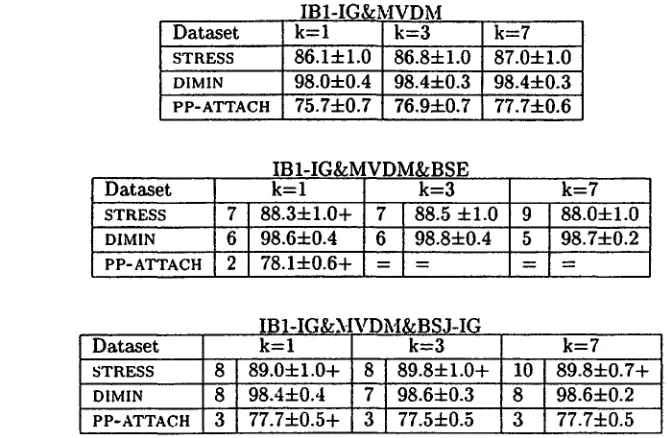
For the classifier IBI-IG&MVDM. the situation is more complex (table 5). First, for k = 1. BSE and BSJ- IG have comparable accuracy. For the STRESS and PP- ATTACH sets, both algorithms produce significant and comparable accuracy gains. Second, compression by BSE is significantly higher than compression oy BSJ- IG (47.2% vs. 30.6%).
For the larger values for k (3, 7), BSJ-IG produces significant higher accuracies on the STRESS set, outper- forming BSE. Moreover, BSJ-IG yields a compression rate comparable to BSE. BSE compression drops from 47.2% to 27.8%.
[image:4.612.49.563.99.343.2]Procedure BSJ-IG
Input: a training set T
Output: a new training set T' with possibly higher-order induced attributes
S e t Acc t o A c c u r a c y ( T ) f o r t h e c u r r e n t c l a s s i f i e r S e t S u c c e s s t o t r u e
While ( S u c c e s s ) do
S e t S u c c e s s t o f a l s e
F o r e v e r y o r d e r e d c o m b i n a t i o n o f two a t t r i b u t e s At and Aj i n T do
P r o d u c e T ' f r o m T by j o i n i n g Ai and A~, p u t t i n g them on t h e p o s i t i o n k 6 { i , j } w i t h t h e l a r g e s t i n f o r m a t i o n g a i n r a t i o .
N e w A c c = A c c u r a c y ( T ' ) f o r t h e c u r r e n t c l a s s i f i e r
If (NewAcc~Acc) Then
Set Acc to NewAcc
Set Winner to T'
Set Success to true
If Success equals true
Then
Set T to Winner
Return T
Figure 2: A w r a p p e r implementation of Backward Sequential Joining with Information Gain ratio ( B S J - I G )
* ( B S J - I G ) I B I - I G & B S J - I G and I G T R E E & B S J - I G only agree on wsJ-POS: they b o t h join the same at- tributes. For the other datasets, there is no overlap a t all.
• (BSE) For the wsJ-POS set, BSE deletes exactly the s a m e two features t h a t are joined by BSJ-IG for IB1- IG and I G T R E E . For the DIMIN set, I B I - I G & B S E and I G T R E E & B S E delete 4 common features. For STRESS, all features deleted by I B I - I G & B S E are deleted by I G T R E E & B S E as well. On the INL-POS set, three c o m m o n features are deleted. Frequently, BSE was found to delete an a t t r i b u t e joined by BSJ- IG.
• ( I B I - I G & M V D M , B S J - I G ) BSJ-IG produces no over- lap for D1MIN for the three different classifiers (k =
1,3,7). For STRESS, the k = 1, k = 3 and k = 7 classifiers join one c o m m o n pair of attributes. This is the pair consisting of the nucleus and coda of the last syllable, indeed a strong feature for stress assign- m e n t (Daelemans, p.c.). For PP-ATTACH, the k = 1, k - 3 and k = 7 classifiers identify a t t r i b u t e 4 (the head noun of the P P - i n t e r n a l noun phrase) for .join- ing with a n o t h e r attribute. Attribute 4 clearly intro-
duces sparseness in the dataset: it has 5~695 possible values, opposed to maximally 4,405 values for the other attributes. T h e k = 3 and k = 7 classifiers agree fully here.
• ( I B I - I G & M V D M , BSE) On the DIMIN set, the k = 1 and k = 3 classifiers differ in 1 a t t r i b u t e elimination only. T h e y display no overlap with k = 7, which elim- inates entirely other attributes. For STRESS, k = 1
and k = 3 classifiers overlap on 3 attributes. T h e three classifiers delete 1. c o m m o n a t t r i b u t e (not the nucleus or coda). For PP, the k = 3 and k = 7 clas- sifters do not eliminate attributes; the k = 1 classi- fier deletes the a t t r i b u t e 4 (PP-internal head noun), and even the first verb-valued attribute. In doing so, it constitutes a strongly lexicalised model for P P - a t t a c h m e n t taking only into account the first head noun and the following preposition.
Dataset Instances Attributes IBI-IG IGTREE
STRESS
DIMIN
W S J - N P V P
GRAPHON
W S J - P O S
INL-POS
PP-ATTACH
3,000 3,000 200,000 350,000 399,925 250,004 20,801
12 12 8 7 5 7 4
85.9+0.8 98.2+0.4 97.1±0.08 96.6+0.04 95.9±0.04 96.3+0.1 81.3±0.5
81.6+1.0 98.2±0.5 96.5±0.08 96.2±0.06 95.9±0.04 96.3±0.1 78.3+0.4
Table 1: Number of instmlces, attributes and original accuracies for the datasets.
Algorithm BSE BSJ-IG IBI-IG 34.2 23 IGTREE 34.7 30.9 IBI-IG&MVDM, k = l 47.2 30.6 IBI-IG&MVDM, k=3 30.5 33.3 IBI-IG&MVDM, k=7 27.8 25 Average 34.9 28.6
Table 2: Average compression rates.
trapped as well; this lies outside the scope of this study. Although firm conclusions cannot be drawn on the basis of three datasets only, the compact and accurate results of the k = 3 and k = 7 classifiers may indicate a ten- dency for smoothing algorithms to compensate better for eventual non-optimal attribute combinations than for eliminated attributes. This would be in agreement with Pazzani's findings for PEBLS and Naive Baves.
Frequently, cases were observed where BSE elimi- nates attributes that were used for joining by BSJ-IG. This indicates that at least some of the advantages of attribute joining originate from implicit attribute elim- ination rather than combination, which has also been noted by Pazzani (1998): removing an attribute may improve accuracy more than joining it to another at- tribute.
C o n c l u s i o n s
The effects of two representation-changing algorithms on generalization accuracy and data compression were tested for three different types of nearest neighbor clas- sifters, on 7 linguistic learning tasks. As a consequence of the permutation-invariance of the used classifiers and the use of hill-climbing algorithms, a practical sampling of the search space of data transformations was applied. BSE. an attribute elimination algorithm, was found to produce accurate classifiers, with consistently higher data compression rates than BSJ-IG, an attribute join- ing algorithm. The generalization accuracy of BSE is comparable to that of BSJ-IG.
Some evidence hints that attribute joining may be more succesful - both for compression and accuracy - for classifiers employing smoothing techniques, e.g. PEBLS-Iike algorithms which select a nearest neighbor from a nearest neighbor set using frequency informa- tion. This type of classifier was able to trap at least one important attribute interaction in the STRESS do- main, offering extended insight in the underlying learn- ing task. Further evidence is needed to confirm this conjecture, and may shed further li6ht on the question whether and how linguistic learning tasks could benefit from attribute interaction. An alternative line of re- search to be pursued will address cla~ssifier models that allow for linear encoding of linguistic learning tasks: these models will allow investigations into corrections on the linearity of linguistic tasks.
A c k n o w l e d g e m e n t s
I would like to thank Michael Pazzani for helpful com- ments, as well as the anonynmus reviewers. Thanks go to the Induction of Linguistic Knowledge group of Tilburg University (Antal van den Bosch, Sabine Buch- holz, Walter Daelemans, Jorn Veenstra and Jal~ub Za- vrel) for valuable feedback and datasets. INL is ac- knowledged for the INL-POS dataset and access to Sun equipment.
[image:6.612.161.437.61.159.2] [image:6.612.204.386.198.291.2]R e f e r e n c e s
Dataset IBI-IG&BSE STRESS 10 86.24-1.0 DXMIN 4 98.54-0.4
W S J - N P V P _ _ G R A P H O N = ---
ws~-POS 3 96.14-0.04 INL-POS 3 96.54-0.09 PP-ATTACH 3 82.04-0.7
IGTREE&BSE 6 84.94-1.0+ 5 98.44-0.5 7 96194-0.07
3 96.14-0.04 3 96.54-0.09 3 81.94-0.7+
Table 3: Number of remaining attributes and accuracies for BSE. A '+' indicates a siguificant increase in accuracy compared to the original algorithm; a '_' indicates the experiment could not be completed.
Dataset
S T R E S S D I M I N W S J - N P V P G R A P H O N W S . I - P O S I N L - P O S P P - A T T A C H
IBI-IG&BSJ-IG IGTREE&BSJ-IG 9 86.64-1.0 8 85.24-0.8+ 6 98.54-0.4 6 98.4-t-0.4
6 96.94-0.08 6 96.24-0.05 4 96.04-0.04 4 96.04-0.04 4 96.54-0.1 4 96.54-0.1
Table 4: Number of remaining attributes and accuracies for BSJ-IG. A '+' indicates a significant increase in accuracy compared to the original algorithm; a '=' indicates no difference with respect to the original algorithm; a '_' indicates the experiment could not be completed.
ings of the 8th Machine Learning Workshop.
[image:7.612.220.458.60.163.2] [image:7.612.205.449.212.315.2][Aha, Kibler & Albert, 1991] Aha, D. , Kibler, D. & Albert, M. (1991). Instance-based learning algo- rithms. Machine Learning, 6, 37-66.
[Aha, 1998] Aha, D. (1998). Feature weighting for lazy learning algorithms. In Liu, H. & Motoda. H. (eds.), Feature Extraction, Construction and Se- lection. Boston: Kluwer.
[Baayen, Piepenbrock & van Rijn, 1993] Baayen, H . . Piepenbrock, R. & van Rijn, H. (1993). The
CELEX lexical database on CD-ROM. Linguistic Data Consortium. Philadelphia, PA.
[Bloedorn&Michalski, 1991] Bloedorn, E. & Michalski, R.S. (1991). Constructive Induction from Data in AQ17-DC1. MLIgl-12. Artificial Intelligence Cen- ter, George Mason University.
[Bloedorn, Michalski&Wnek] Bloedorn, E., Michalski, R. & Wnek, J. (1994). Matching Methods with Problems: A Comparative Analysis of Constructive Induction Approaches. MLI94-12. Artificial Intelli- gence Center, George Mason University.
[Cardie, 1996] Cardie, C. (1996). Automating feature set selection for case-based learning of linguistic
knowledge. Proceedings of the Conference on Em- pirical Methods in Natural Language Processing.
University of Pennsylvania.
[Cleeremans, 1993] Cleeremans, A. (1993). Mecha- nisms of implicit learning: connectionist models of sequence processing. Cambridge, Mass.: MIT Press.
[Cost&Salzberg, 1993] Cost, S. & Salzberg, S. (1993) A weighted nearest neighbor algorithm for learning with symbolic features. Machine Learning, 10, 57-
78.
[Daelemans et al., 1997] Daelemans, W., vail den Bosch, A. & Zavrel, J. (1997). IGTREE: using trees for compression and classification in lazy learning algorithms. Artificial Intelligence Review, 11, 407-423.
[Daelemans et al., 1999i] Daelemans, W., van den Bosch, A. & Zavrel, J. (1999i). Forgetting ex- ceptions is harmful in language learning. Machine Learning, 11, 11-43.
IBI-IG&MVDM
Dataset k = l k=3 k=7
STRESS 86.14-1.0 86.84-1.0 87.04-1.0 DIMIN 98.04-0.4 98.44-0.3 98.44-0.3 PP-ATTACH 75.74-0.7 76.94-0.7 77.74-0.6
IBI-IG&MVDM&BSE
Dataset k = l k=3 k=7
STRESS 7 88.34-1.0+ 7 88.5 4-1.0 9 88.04-1.0 DIMIN 6 98.64-0.4 6 98.84-0.4 5 98.7+0.2 PP-ATTACH 2 78.14-0.6+
IBI-IG&MVDM&BSJ-IG
Dataset k= 1 k=3 k= 7
STRESS 8 89.0+1.0+ 8 89.84-1.0+ 10 89.84-0.7+ DIMIN 8 98.44-0.4 7 98.64-0.3 8 98.64-0.2 PP-ATTACH 3 77.74-0.5+ 3 77.54-0.5 3 77.7+0.5
Table 5: Number of remaining attributes and accuracies for IBI-IG with MVDM, IBI-IG with MVDM and BSE. and for IBI-IG with MVDM and BSJ-IG, for k = l , 3, and 7. A '+' indicates a significant increase in accuracy compared to the original algorithm; a ' = ' indicates no difference with respect to the original algorithm.
TiMBL: Tilburg Memory Based Learner, ver- sion 2.0, Reference Guide. Tilburg: Induc- tion of Linguistic Knowledge. Available from
http://ilk, kub. nl/-ilk/papers/ilk9901, ps. gz.
[Daelemans, Buchholz & Veensira, 1999iii]
Daelemans, W., Buchholz, S. & Veenstra, J. (1999iii). Memory-based shallow parsing. Paper ILK, Tilburg.
[Duda&Hart, 1973] Duda, R. & Hart, P. (1973). Pat- tern Classification and Scene Analysis. Wile)" Press.
[John, 1997] John, G. H., 1997. Enhancements to the data mining process. Ph.D. dissertation. Stanford University.
[Kohavi & John, 1998] Kohavi, R. & John, G.H. (1998). The wrapper approach. In Liu, H. & Mo- toda, H. (eds.), Feature Extraction, Construction and Selection. Boston: Kluwer.
[Keogh&Pazzani, 1999] Keogh, E. J. & M. J. Paz- zani, 1999. Learning augmented Bayesian clas- sifters: a comparison of distribution-based and classification-based approaches. Proceedings 7th International Workshop on A I and Statistics, 225- 230. Ft. Lauderdale, Florida.
[.Marcus. Santorini & Marcinkiewicz, 1993] Marcus.. .M.. Santorini. B. & Marcinkiewicz (1993). Build-
ing a large annotated corpus of English: the Penn Treebank. Computational Linguistics 19". 313-330. [Pagallo& Hauser, 1990] Pagallo, G., Haussler, D. (1990). Boolean feature discovery in empirical learning. Machine Learning, 5, 71-99.
[Pazzani, 1998] Pazzani, Michael J. (1998). Construc- tive Induction of Cartesian Product Attributes. In Liu, H. & Motoda, H. (eds.), Feature Extraction, Construction and Selection. Boston: Kluwer. [Quinlan, 1993] Quinlan, J. R. (1993). C4.5: Programs
for Machine Learning. San Mateo, CA.: Morgan Kaufmann.
[Ratnaparkhi eta/., 1994] Ratnaparkhi. A.. Reynar, J. & Roulos, S. (1994). A maxinmm entropy model for Prepositional Phrase Attachment. Proceedings ARPA Workshop on Human Language Technology.
Plainsboro.
[Scherf & Brauer, 1997] Scherf, M.. Brauer, W. (1997). Feature selection by means of a feature weight- ing approach. Technical report No. FKI-221-97, Forschungsberichte Kiinstliche Intelligenz. Institut fiir Informatik, Technische Universitiit Miinchen.
[van der Voort van der Kleij et al., 1994]
[image:8.612.108.442.68.287.2]van (1994). Een automatisch geanalyseerd corpus
hedendaags Nederlands in een flexibel retrievalsys-
teem.
(An automatically analysed corpus of con-temporary Dutch in a flexible retrieval system,
in
Dutch.)
Proceedings lnformatiewetenschap 1994.Tilburg.
[Yang & Honovar, 1998] Yang, J. & Honovar, V.
(1998). Feature subset selection using a genetic al-
gorithm. In Liu, H. & Motoda, H. (eds.),
FeatureExtraction, Construction and Selection.