SemEval-2010 Task 1: Coreference Resolution in Multiple Languages
Marta Recasens? Llu´ıs M`arquez† Emili Sapena† M. Ant`onia Mart´ı?
Mariona Taul´e?V´eronique Hoste‡ Massimo Poesio Yannick Versley??
?: CLiC, University of Barcelona,{mrecasens,amarti,mtaule}@ub.edu
†: TALP, Technical University of Catalonia,{lluism,esapena}@lsi.upc.edu
‡: University College Ghent,[email protected]
: University of Essex/University of Trento,[email protected]
??: University of T¨ubingen,[email protected]
Abstract
This paper presents the SemEval-2010 task onCoreference Resolution in Multi-ple Languages. The goal was to evaluate and compare automatic coreference reso-lution systems for six different languages (Catalan, Dutch, English, German, Italian, and Spanish) in four evaluation settings and using four different metrics. Such a rich scenario had the potential to provide insight into key issues concerning corefer-ence resolution: (i) the portability of sys-tems across languages, (ii) the relevance of different levels of linguistic information, and (iii) the behavior of scoring metrics.
1 Introduction
The task of coreference resolution, defined as the identification of the expressions in a text that re-fer to the same discourse entity (1), has attracted considerable attention within the NLP community.
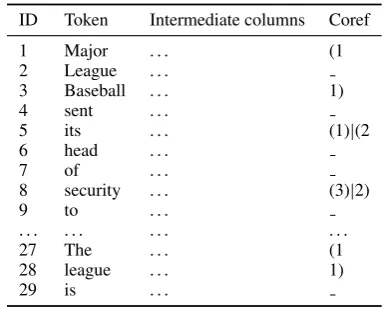
(1) Major League Baseballsentitshead of se-curity to Chicago to review the second in-cident of an on-field fan attack in the last seven months. The leagueis reviewing se-curity at all ballparks to crack down on spectator violence.
Using coreference information has been shown to be beneficial in a number of NLP applications including Information Extraction (McCarthy and Lehnert, 1995), Text Summarization (Steinberger et al., 2007), Question Answering (Morton, 1999), and Machine Translation. There have been a few evaluation campaigns on coreference resolution in the past, namely MUC (Hirschman and Chinchor, 1997), ACE (Doddington et al., 2004), and ARE (Orasan et al., 2008), yet many questions remain open:
• To what extent is it possible to imple-ment a general coreference resolution system portable to different languages? How much language-specific tuning is necessary?
• How helpful are morphology, syntax and se-mantics for solving coreference relations? How much preprocessing is needed? Does its quality (perfect linguistic input versus noisy automatic input) really matter?
• How (dis)similar are different coreference evaluation metrics—MUC, B-CUBED, CEAF and BLANC? Do they all provide the same ranking? Are they correlated?
Our goal was to address these questions in a shared task. Given six datasets in Catalan, Dutch, English, German, Italian, and Spanish, the task we present involved automatically detecting full coreference chains—composed of named entities (NEs), pronouns, and full noun phrases—in four different scenarios. For more information, the reader is referred to the task website.1
The rest of the paper is organized as follows. Section 2 presents the corpora from which the task datasets were extracted, and the automatic tools used to preprocess them. In Section 3, we describe the task by providing information about the data format, evaluation settings, and evaluation met-rics. Participating systems are described in Sec-tion 4, and their results are analyzed and compared in Section 5. Finally, Section 6 concludes.
2 Linguistic Resources
In this section, we first present the sources of the data used in the task. We then describe the auto-matic tools that predicted input annotations for the coreference resolution systems.
1http://stel.ub.edu/semeval2010-coref
Training Development Test
#docs #sents #tokens #docs #sents #tokens #docs #sents #tokens
Catalan 829 8,709 253,513 142 1,445 42,072 167 1,698 49,260
Dutch 145 2,544 46,894 23 496 9,165 72 2,410 48,007
English 229 3,648 79,060 39 741 17,044 85 1,141 24,206
German 900 19,233 331,614 199 4,129 73,145 136 2,736 50,287
Italian 80 2,951 81,400 17 551 16,904 46 1,494 41,586
[image:2.595.71.530.64.155.2]Spanish 875 9,022 284,179 140 1,419 44,460 168 1,705 51,040
Table 1: Size of the task datasets.
2.1 Source Corpora
Catalan and Spanish The AnCora corpora
(Re-casens and Mart´ı, 2009) consist of a Catalan and a Spanish treebank of 500k words each, mainly from newspapers and news agencies (El Peri´odico, EFE, ACN). Manual annotation exists for ar-guments and thematic roles, predicate semantic classes, NEs, WordNet nominal senses, and coref-erence relations. AnCora are freely available for research purposes.
Dutch The KNACK-2002 corpus (Hoste and De
Pauw, 2006) contains 267 documents from the Flemish weekly magazine Knack. They were manually annotated with coreference information on top of semi-automatically annotated PoS tags, phrase chunks, and NEs.
English The OntoNotes Release 2.0 corpus
(Pradhan et al., 2007) covers newswire and broad-cast news data: 300k words from The Wall Street Journal, and 200k words from the TDT-4 col-lection, respectively. OntoNotes builds on the Penn Treebank for syntactic annotation and on the Penn PropBank for predicate argument structures. Semantic annotations include NEs, words senses (linked to an ontology), and coreference informa-tion. The OntoNotes corpus is distributed by the Linguistic Data Consortium.2
German The T¨uBa-D/Z corpus (Hinrichs et al.,
2005) is a newspaper treebank based on data taken from the daily issues of “die tageszeitung” (taz). It currently comprises 794k words manually anno-tated with semantic and coreference information. Due to licensing restrictions of the original texts, a taz-DVD must be purchased to obtain a license.2
Italian The LiveMemories corpus (Rodr´ıguez
et al., 2010) will include texts from the Italian Wikipedia, blogs, news articles, and dialogues 2Free user license agreements for the English and German
task datasets were issued to the task participants.
(MapTask). They are being annotated according to the ARRAU annotation scheme with coref-erence, agreement, and NE information on top of automatically parsed data. The task dataset included Wikipedia texts already annotated.
The datasets that were used in the task were ex-tracted from the above-mentioned corpora. Ta-ble 1 summarizes the number of documents (docs), sentences (sents), and tokens in the train-ing, development and test sets.3
2.2 Preprocessing Systems
Catalan, Spanish, English Predicted lemmas
and PoS were generated using FreeLing4 for
Catalan/Spanish and SVMTagger5 for English.
Dependency information and predicate semantic roles were generated with JointParser, a syntactic-semantic parser.6
Dutch Lemmas, PoS and NEs were
automat-ically provided by the memory-based shallow parser for Dutch (Daelemans et al., 1999), and de-pendency information by the Alpino parser (van Noord et al., 2006).
German Lemmas were predicted by TreeTagger
(Schmid, 1995), PoS and morphology by RFTag-ger (Schmid and Laws, 2008), and dependency in-formation by MaltParser (Hall and Nivre, 2008).
Italian Lemmas and PoS were provided by
TextPro,7 and dependency information by
Malt-Parser.8
3The German and Dutch training datasets were not
com-pletely stable during the competition period due to a few er-rors. Revised versions were released on March 2 and 20, re-spectively. As to the test datasets, the Dutch and Italian doc-uments with formatting errors were corrected after the eval-uation period, with no variations in the ranking order of sys-tems.
4http://www.lsi.upc.es/ nlp/freeling 5http://www.lsi.upc.edu/ nlp/SVMTool 6http://www.lsi.upc.edu// xlluis/?x=cat:5 7http://textpro.fbk.eu
3 Task Description
Participants were asked to develop an automatic system capable of assigning a discourse entity to every mention,9 thus identifying all the NP
men-tions of every discourse entity. As there is no standard annotation scheme for coreference and the source corpora differed in certain aspects, the coreference information of the task datasets was produced according to three criteria:
• Only NP constituents and possessive deter-miners can be mentions.
• Mentions must be referential expressions, thus ruling out nominal predicates, appos-itives, expletive NPs, attributive NPs, NPs within idioms, etc.
• Singletons are also considered as entities (i.e., entities with a single mention).
To help participants build their systems, the task datasets also contained both gold-standard and automatically predicted linguistic annotations at the morphological, syntactic and semantic lev-els. Considerable effort was devoted to provide participants with a common and relatively simple data representation for the six languages.
3.1 Data Format
The task datasets as well as the participants’ answers were displayed in a uniform column-based format, similar to the style used in previous CoNLL shared tasks on syntactic and semantic de-pendencies (2008/2009).10 Each dataset was
pro-vided as a single file per language. Since corefer-ence is a linguistic relation at the discourse level, documents constitute the basic unit, and are de-limited by “#begin document ID” and “#end doc-ument ID” comment lines. Within a docdoc-ument, the information of each sentence is organized verti-cally with one token per line, and a blank line after the last token of each sentence. The information associated with each token is described in several columns (separated by “\t” characters) represent-ing the followrepresent-ing layers of lrepresent-inguistic annotation.
ID (column 1). Token identifiers in the sentence.
Token (column 2). Word forms.
9Following the terminology of the ACE program, a
men-tionis defined as an instance of reference to an object, and anentityis the collection of mentions referring to the same object in a document.
10http://www.cnts.ua.ac.be/conll2008
ID Token Intermediate columns Coref
1 Major . . . (1
2 League . . .
3 Baseball . . . 1)
4 sent . . .
5 its . . . (1)|(2
6 head . . .
7 of . . .
8 security . . . (3)|2)
9 to . . .
. . . .
27 The . . . (1
28 league . . . 1)
[image:3.595.319.513.61.216.2]29 is . . .
Table 2: Format of the coreference annotations (corresponding to example (1) in Section 1).
Lemma (column 3). Token lemmas.
PoS (column 5). Coarse PoS.
Feat (column 7). Morphological features (PoS type, number, gender, case, tense, aspect, etc.) separated by a pipe character.
Head (column 9). ID of the syntactic head (“0” if the token is the tree root).
DepRel (column 11). Dependency relations
cor-responding to the dependencies described in the Head column (“sentence” if the token is the tree root).
NE (column 13). NE types in open-close notation.
Pred (column 15). Predicate semantic class.
APreds (column 17 and subsequent ones). For
each predicate in the Pred column, its seman-tic roles/dependencies.
Coref (last column). Coreference relations in
open-close notation.
The above-mentioned columns are “gold-standard columns,” whereas columns 4, 6, 8, 10, 12, 14, 16 and the penultimate contain the same information as the respective previous column but automatically predicted—using the preprocessing systems listed in Section 2.2. Neither all layers of linguistic annotation nor all gold-standard and predicted columns were available for all six lan-guages (underscore characters indicate missing in-formation).
token). For tokens belonging to more than one mention, a pipe character is used to separate mul-tiple entity IDs. The resulting annotation is a well-formed nested structure (CF language).
3.2 Evaluation Settings
In order to address our goal of studying the effect of different levels of linguistic information (pre-processing) on solving coreference relations, the test was divided into four evaluation settings that differed along two dimensions.
Gold-standard versus Regular setting. Only
in the gold-standard setting were participants al-lowed to use the gold-standard columns, includ-ing the last one (of the test dataset) with true mention boundaries. In the regular setting, they were allowed to use only the automatically pre-dicted columns. Obtaining better results in the gold setting would provide evidence for the rel-evance of using high-quality preprocessing infor-mation. Since not all columns were available for all six languages, the gold setting was only possi-ble for Catalan, English, German, and Spanish.
Closed versusOpen setting. In the closed
set-ting, systems had to be built strictly with the in-formation provided in the task datasets. In con-trast, there was no restriction on the resources that participants could utilize in the open setting: sys-tems could be developed using any external tools and resources to predict the preprocessing infor-mation, e.g., WordNet, Wikipedia, etc. The only requirement was to use tools that had not been de-veloped with the annotations of the test set. This setting provided an open door into tools or re-sources that improve performance.
3.3 Evaluation Metrics
Since there is no agreement at present on a stan-dard measure for coreference resolution evalua-tion, one of our goals was to compare the rank-ings produced by four different measures. The task scorer provides results in the two mention-based metrics B3 (Bagga and Baldwin, 1998) and
CEAF-φ3 (Luo, 2005), and the two link-based
metrics MUC (Vilain et al., 1995) and BLANC (Recasens and Hovy, in prep). The first three mea-sures have been widely used, while BLANC is a proposal of a new measure interesting to test.
The mention detection subtask is measured with recall, precision, and F1. Mentions are rewarded
with 1 point if their boundaries coincide with those
of the gold NP, with 0.5 points if their boundaries are within the gold NP including its head, and with 0 otherwise.
4 Participating Systems
A total of twenty-two participants registered for the task and downloaded the training materials. From these, sixteen downloaded the test set but only six (out of which two task organizers) sub-mitted valid results (corresponding to nine system runs or variants). These numbers show that the task raised considerable interest but that the final participation rate was comparatively low (slightly below 30%).
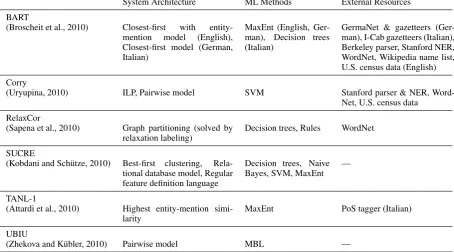
The participating systems differed in terms of architecture, machine learning method, etc. Ta-ble 3 summarizes their main properties. Systems like BART and Corry support several machine learners, but Table 3 indicates the one used for the SemEval run. The last column indicates the exter-nal resources that were employed in the open set-ting, thus it is empty for systems that participated only in the closed setting. For more specific details we address the reader to the system description pa-pers in Erk and Strapparava (2010).
5 Results and Evaluation
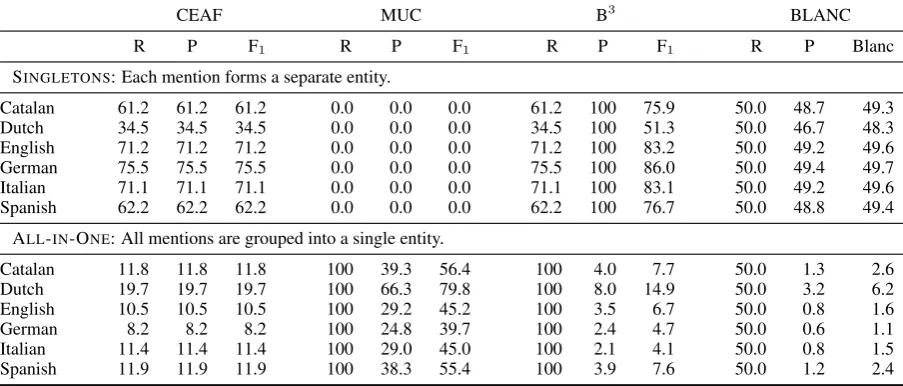
Table 4 shows the results obtained by two naive baseline systems: (i) SINGLETONSconsiders each mention as a separate entity, and (ii) ALL-IN-ONE groups all the mentions in a document into a sin-gle entity. These simple baselines reveal limita-tions of the evaluation metrics, like the high scores of CEAF and B3 for SINGLETONS. Interestingly
enough, the naive baseline scores turn out to be hard to beat by the participating systems, as Ta-ble 5 shows. Similarly, ALL-IN-ONEobtains high scores in terms of MUC. Table 4 also reveals dif-ferences between the distribution of entities in the datasets. Dutch is clearly the most divergent cor-pus mainly due to the fact that it only contains sin-gletons for NEs.
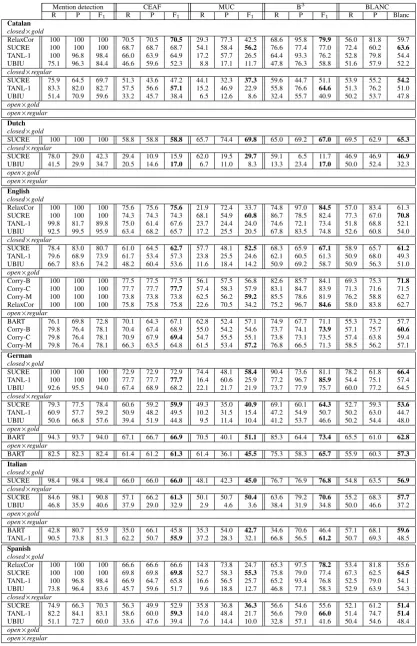
Table 5 displays the results of all systems for all languages and settings in the four evaluation met-rics (the best scores in each setting are highlighted in bold). Results are presented sequentially by lan-guage and setting, and participating systems are ordered alphabetically. The participation of sys-tems across languages and settings is rather irreg-ular,11thus making it difficult to draw firm
System Architecture ML Methods External Resources BART
(Broscheit et al., 2010) Closest-first with entity-mention model (English), Closest-first model (German, Italian)
MaxEnt (English, Ger-man), Decision trees (Italian)
GermaNet & gazetteers (Ger-man), I-Cab gazetteers (Italian), Berkeley parser, Stanford NER, WordNet, Wikipedia name list, U.S. census data (English) Corry
(Uryupina, 2010) ILP, Pairwise model SVM Stanford parser & NER, Word-Net, U.S. census data
RelaxCor
(Sapena et al., 2010) Graph partitioning (solved by
relaxation labeling) Decision trees, Rules WordNet SUCRE
(Kobdani and Sch¨utze, 2010) Best-first clustering, Rela-tional database model, Regular feature definition language
Decision trees, Naive Bayes, SVM, MaxEnt —
TANL-1
(Attardi et al., 2010) Highest entity-mention
simi-larity MaxEnt PoS tagger (Italian)
UBIU
[image:5.595.72.527.69.321.2](Zhekova and K¨ubler, 2010) Pairwise model MBL —
Table 3: Main characteristics of the participating systems.
sions about the aims initially pursued by the task. In the following, we summarize the most relevant outcomes of the evaluation.
Regarding languages, English concentrates the most participants (fifteen entries), followed by German (eight), Catalan and Spanish (seven each), Italian (five), and Dutch (three). The number of languages addressed by each system ranges from one (Corry) to six (UBIU and SUCRE); BART and RelaxCor addressed three languages, and TANL-1 five. The best overall results are obtained for En-glish followed by German, then Catalan, Spanish and Italian, and finally Dutch. Apart from differ-ences between corpora, there are other factors that might explain this ranking: (i) the fact that most of the systems were originally developed for English, and (ii) differences in corpus size (German having the largest corpus, and Dutch the smallest).
Regarding systems, there are no clear “win-ners.” Note that no language-setting was ad-dressed by all six systems. The BART system, for instance, is either on its own or competing against a single system. It emerges from par-tial comparisons that SUCRE performs the best in closed×regularfor English, German, and Italian, although it never outperforms the CEAF or B3
sin-gleton baseline. While SUCRE always obtains the best scores according to MUC and BLANC, Re-laxCor and TANL-1 usually win based on CEAF
and B3. The Corry system presents three variants
optimized for CEAF (Corry-C), MUC (Corry-M), and BLANC (Corry-B). Their results are consis-tent with the bias introduced in the optimization (see English:open×gold).
Depending on the evaluation metric then, the rankings of systems vary with considerable score differences. There is a significant positive corre-lation between CEAF and B3 (Pearson’sr= 0.91,
p<0.01), and a significant lack of correlation be-tween CEAF and MUC in terms of recall (Pear-son’s r= 0.44, p<0.01). This fact stresses the importance of defining appropriate metrics (or a combination of them) for coreference evaluation.
Finally, regarding evaluation settings, the re-sults in thegoldsetting are significantly better than those in theregular. However, this might be a di-rect effect of the mention recognition task. Men-tion recogniMen-tion in the regular setting falls more than 20 F1 points with respect to the gold setting
(where correct mention boundaries were given). As for theopenversusclosedsetting, there is only one system, RelaxCor for English, that addressed the two. As expected, results show a slight im-provement fromclosed×goldtoopen×gold.
6 Conclusions
CEAF MUC B3 BLANC
R P F1 R P F1 R P F1 R P Blanc
SINGLETONS: Each mention forms a separate entity.
Catalan 61.2 61.2 61.2 0.0 0.0 0.0 61.2 100 75.9 50.0 48.7 49.3
Dutch 34.5 34.5 34.5 0.0 0.0 0.0 34.5 100 51.3 50.0 46.7 48.3
English 71.2 71.2 71.2 0.0 0.0 0.0 71.2 100 83.2 50.0 49.2 49.6
German 75.5 75.5 75.5 0.0 0.0 0.0 75.5 100 86.0 50.0 49.4 49.7
Italian 71.1 71.1 71.1 0.0 0.0 0.0 71.1 100 83.1 50.0 49.2 49.6
Spanish 62.2 62.2 62.2 0.0 0.0 0.0 62.2 100 76.7 50.0 48.8 49.4
ALL-IN-ONE: All mentions are grouped into a single entity.
Catalan 11.8 11.8 11.8 100 39.3 56.4 100 4.0 7.7 50.0 1.3 2.6
Dutch 19.7 19.7 19.7 100 66.3 79.8 100 8.0 14.9 50.0 3.2 6.2
English 10.5 10.5 10.5 100 29.2 45.2 100 3.5 6.7 50.0 0.8 1.6
German 8.2 8.2 8.2 100 24.8 39.7 100 2.4 4.7 50.0 0.6 1.1
Italian 11.4 11.4 11.4 100 29.0 45.0 100 2.1 4.1 50.0 0.8 1.5
[image:6.595.72.524.64.257.2]Spanish 11.9 11.9 11.9 100 38.3 55.4 100 3.9 7.6 50.0 1.2 2.4
Table 4: Baseline scores.
The goal of the task was to evaluate and compare automatic coreference resolution systems for six different languages in four evaluation settings and using four different metrics. This complex sce-nario aimed at providing insight into several as-pects of coreference resolution, including portabil-ity across languages, relevance of linguistic infor-mation at different levels, and behavior of alterna-tive scoring metrics.
The task attracted considerable attention from a number of researchers, but only six teams submit-ted their final results. Participating systems did not run their systems for all the languages and evalu-ation settings, thus making direct comparisons be-tween them very difficult. Nonetheless, we were able to observe some interesting aspects from the empirical evaluation.
An important conclusion was the confirmation that different evaluation metrics provide different system rankings and the scores are not commen-surate. Attention thus needs to be paid to corefer-ence evaluation. The behavior and applicability of the scoring metrics requires further investigation in order to guarantee a fair evaluation when com-paring systems in the future. We hope to have the opportunity to thoroughly discuss this and the rest of interesting questions raised by the task during the SemEval workshop at ACL 2010.
An additional valuable benefit is the set of re-sources developed throughout the task. As task organizers, we intend to facilitate the sharing of datasets, scorers, and documentation by keeping them available for future research use. We believe that these resources will help to set future
bench-marks for the research community and will con-tribute positively to the progress of the state of the art in coreference resolution. We will maintain and update the task website with post-SemEval contri-butions.
Acknowledgments
We would like to thank the following peo-ple who contributed to the preparation of the task datasets: Manuel Bertran (UB), Oriol Borrega (UB), Orph´ee De Clercq (U. Ghent), Francesca Delogu (U. Trento), Jes´us Gim´enez (UPC), Eduard Hovy (ISI-USC), Richard Johans-son (U. Trento), Xavier Llu´ıs (UPC), Montse Nofre (UB), Llu´ıs Padr´o (UPC), Kepa Joseba Rodr´ıguez (U. Trento), Mihai Surdeanu (Stan-ford), Olga Uryupina (U. Trento), Lente Van Leu-ven (UB), and Rita Zaragoza (UB). We would also like to thank LDC and die tageszeitung for dis-tributing freely the English and German datasets.
Mention detection CEAF MUC B3 BLANC
R P F1 R P F1 R P F1 R P F1 R P Blanc
Catalan
closed×gold
RelaxCor 100 100 100 70.5 70.5 70.5 29.3 77.3 42.5 68.6 95.8 79.9 56.0 81.8 59.7 SUCRE 100 100 100 68.7 68.7 68.7 54.1 58.4 56.2 76.6 77.4 77.0 72.4 60.2 63.6 TANL-1 100 96.8 98.4 66.0 63.9 64.9 17.2 57.7 26.5 64.4 93.3 76.2 52.8 79.8 54.4 UBIU 75.1 96.3 84.4 46.6 59.6 52.3 8.8 17.1 11.7 47.8 76.3 58.8 51.6 57.9 52.2
closed×regular
SUCRE 75.9 64.5 69.7 51.3 43.6 47.2 44.1 32.3 37.3 59.6 44.7 51.1 53.9 55.2 54.2 TANL-1 83.3 82.0 82.7 57.5 56.6 57.1 15.2 46.9 22.9 55.8 76.6 64.6 51.3 76.2 51.0 UBIU 51.4 70.9 59.6 33.2 45.7 38.4 6.5 12.6 8.6 32.4 55.7 40.9 50.2 53.7 47.8
open×gold open×regular
Dutch
closed×gold
SUCRE 100 100 100 58.8 58.8 58.8 65.7 74.4 69.8 65.0 69.2 67.0 69.5 62.9 65.3
closed×regular
SUCRE 78.0 29.0 42.3 29.4 10.9 15.9 62.0 19.5 29.7 59.1 6.5 11.7 46.9 46.9 46.9 UBIU 41.5 29.9 34.7 20.5 14.6 17.0 6.7 11.0 8.3 13.3 23.4 17.0 50.0 52.4 32.3
open×gold open×regular
English
closed×gold
RelaxCor 100 100 100 75.6 75.6 75.6 21.9 72.4 33.7 74.8 97.0 84.5 57.0 83.4 61.3 SUCRE 100 100 100 74.3 74.3 74.3 68.1 54.9 60.8 86.7 78.5 82.4 77.3 67.0 70.8 TANL-1 99.8 81.7 89.8 75.0 61.4 67.6 23.7 24.4 24.0 74.6 72.1 73.4 51.8 68.8 52.1 UBIU 92.5 99.5 95.9 63.4 68.2 65.7 17.2 25.5 20.5 67.8 83.5 74.8 52.6 60.8 54.0
closed×regular
SUCRE 78.4 83.0 80.7 61.0 64.5 62.7 57.7 48.1 52.5 68.3 65.9 67.1 58.9 65.7 61.2 TANL-1 79.6 68.9 73.9 61.7 53.4 57.3 23.8 25.5 24.6 62.1 60.5 61.3 50.9 68.0 49.3 UBIU 66.7 83.6 74.2 48.2 60.4 53.6 11.6 18.4 14.2 50.9 69.2 58.7 50.9 56.3 51.0
open×gold
Corry-B 100 100 100 77.5 77.5 77.5 56.1 57.5 56.8 82.6 85.7 84.1 69.3 75.3 71.8 Corry-C 100 100 100 77.7 77.7 77.7 57.4 58.3 57.9 83.1 84.7 83.9 71.3 71.6 71.5 Corry-M 100 100 100 73.8 73.8 73.8 62.5 56.2 59.2 85.5 78.6 81.9 76.2 58.8 62.7 RelaxCor 100 100 100 75.8 75.8 75.8 22.6 70.5 34.2 75.2 96.7 84.6 58.0 83.8 62.7
open×regular
BART 76.1 69.8 72.8 70.1 64.3 67.1 62.8 52.4 57.1 74.9 67.7 71.1 55.3 73.2 57.7 Corry-B 79.8 76.4 78.1 70.4 67.4 68.9 55.0 54.2 54.6 73.7 74.1 73.9 57.1 75.7 60.6 Corry-C 79.8 76.4 78.1 70.9 67.9 69.4 54.7 55.5 55.1 73.8 73.1 73.5 57.4 63.8 59.4 Corry-M 79.8 76.4 78.1 66.3 63.5 64.8 61.5 53.4 57.2 76.8 66.5 71.3 58.5 56.2 57.1 German
closed×gold
SUCRE 100 100 100 72.9 72.9 72.9 74.4 48.1 58.4 90.4 73.6 81.1 78.2 61.8 66.4 TANL-1 100 100 100 77.7 77.7 77.7 16.4 60.6 25.9 77.2 96.7 85.9 54.4 75.1 57.4 UBIU 92.6 95.5 94.0 67.4 68.9 68.2 22.1 21.7 21.9 73.7 77.9 75.7 60.0 77.2 64.5
closed×regular
SUCRE 79.3 77.5 78.4 60.6 59.2 59.9 49.3 35.0 40.9 69.1 60.1 64.3 52.7 59.3 53.6 TANL-1 60.9 57.7 59.2 50.9 48.2 49.5 10.2 31.5 15.4 47.2 54.9 50.7 50.2 63.0 44.7 UBIU 50.6 66.8 57.6 39.4 51.9 44.8 9.5 11.4 10.4 41.2 53.7 46.6 50.2 54.4 48.0
open×gold
BART 94.3 93.7 94.0 67.1 66.7 66.9 70.5 40.1 51.1 85.3 64.4 73.4 65.5 61.0 62.8
open×regular
BART 82.5 82.3 82.4 61.4 61.2 61.3 61.4 36.1 45.5 75.3 58.3 65.7 55.9 60.3 57.3 Italian
closed×gold
SUCRE 98.4 98.4 98.4 66.0 66.0 66.0 48.1 42.3 45.0 76.7 76.9 76.8 54.8 63.5 56.9
closed×regular
SUCRE 84.6 98.1 90.8 57.1 66.2 61.3 50.1 50.7 50.4 63.6 79.2 70.6 55.2 68.3 57.7 UBIU 46.8 35.9 40.6 37.9 29.0 32.9 2.9 4.6 3.6 38.4 31.9 34.8 50.0 46.6 37.2
open×gold open×regular
BART 42.8 80.7 55.9 35.0 66.1 45.8 35.3 54.0 42.7 34.6 70.6 46.4 57.1 68.1 59.6 TANL-1 90.5 73.8 81.3 62.2 50.7 55.9 37.2 28.3 32.1 66.8 56.5 61.2 50.7 69.3 48.5 Spanish
closed×gold
RelaxCor 100 100 100 66.6 66.6 66.6 14.8 73.8 24.7 65.3 97.5 78.2 53.4 81.8 55.6 SUCRE 100 100 100 69.8 69.8 69.8 52.7 58.3 55.3 75.8 79.0 77.4 67.3 62.5 64.5 TANL-1 100 96.8 98.4 66.9 64.7 65.8 16.6 56.5 25.7 65.2 93.4 76.8 52.5 79.0 54.1 UBIU 73.8 96.4 83.6 45.7 59.6 51.7 9.6 18.8 12.7 46.8 77.1 58.3 52.9 63.9 54.3
closed×regular
SUCRE 74.9 66.3 70.3 56.3 49.9 52.9 35.8 36.8 36.3 56.6 54.6 55.6 52.1 61.2 51.4 TANL-1 82.2 84.1 83.1 58.6 60.0 59.3 14.0 48.4 21.7 56.6 79.0 66.0 51.4 74.7 51.4 UBIU 51.1 72.7 60.0 33.6 47.6 39.4 7.6 14.4 10.0 32.8 57.1 41.6 50.4 54.6 48.4
open×gold open×regular
[image:7.595.90.508.79.726.2]References
Giuseppe Attardi, Stefano Dei Rossi, and Maria Simi. 2010. TANL-1: coreference resolution by parse analysis and similarity clustering. In Proceedings of SemEval-2.
Amit Bagga and Breck Baldwin. 1998. Algorithms for scoring coreference chains. In Proceedings of the
LREC Workshop on Linguistic Coreference, pages
563–566.
Samuel Broscheit, Massimo Poesio, Simone Paolo Ponzetto, Kepa Joseba Rodr´ıguez, Lorenza Ro-mano, Olga Uryupina, Yannick Versley, and Roberto Zanoli. 2010. BART: A multilingual anaphora res-olution system. InProceedings of SemEval-2.
Walter Daelemans, Sabine Buchholz, and Jorn Veen-stra. 1999. Memory-based shallow parsing. In
Pro-ceedings of CoNLL 1999.
George Doddington, Alexis Mitchell, Mark Przybocki, Lance Ramshaw, Stephanie Strassel, and Ralph Weischedel. 2004. The Automatic Content Extrac-tion (ACE) program – Tasks, data, and evaluaExtrac-tion.
InProceedings of LREC 2004, pages 837–840.
Katrin Erk and Carlo Strapparava, editors. 2010. Pro-ceedings of SemEval-2.
Johan Hall and Joakim Nivre. 2008. A dependency-driven parser for German dependency and con-stituency representations. InProceedings of the ACL
Workshop on Parsing German (PaGe 2008), pages
47–54.
Erhard W. Hinrichs, Sandra K¨ubler, and Karin Nau-mann. 2005. A unified representation for morpho-logical, syntactic, semantic, and referential annota-tions. InProceedings of the ACL Workshop on Fron-tiers in Corpus Annotation II: Pie in the Sky, pages 13–20.
Lynette Hirschman and Nancy Chinchor. 1997. MUC-7 Coreference Task Definition – Version 3.0.
InProceedings of MUC-7.
V´eronique Hoste and Guy De Pauw. 2006. KNACK-2002: A richly annotated corpus of Dutch written text. In Proceedings of LREC 2006, pages 1432– 1437.
Hamidreza Kobdani and Hinrich Sch¨utze. 2010. SU-CRE: A modular system for coreference resolution. InProceedings of SemEval-2.
Xiaoqiang Luo. 2005. On coreference resolution performance metrics. In Proceedings of
HLT-EMNLP 2005, pages 25–32.
Joseph F. McCarthy and Wendy G. Lehnert. 1995. Us-ing decision trees for coreference resolution. In
Pro-ceedings of IJCAI 1995, pages 1050–1055.
Thomas S. Morton. 1999. Using coreference in ques-tion answering. InProceedings of TREC-8, pages 85–89.
Constantin Orasan, Dan Cristea, Ruslan Mitkov, and Ant´onio Branco. 2008. Anaphora Resolution Exer-cise: An overview. InProceedings of LREC 2008. Sameer S. Pradhan, Eduard Hovy, Mitch
Mar-cus, Martha Palmer, Lance Ramshaw, and Ralph Weischedel. 2007. Ontonotes: A unified rela-tional semantic representation. In Proceedings of the International Conference on Semantic
Comput-ing (ICSC 2007), pages 517–526.
Marta Recasens and Eduard Hovy. in prep. BLANC: Implementing the Rand Index for Coreference Eval-uation.
Marta Recasens and M. Ant`onia Mart´ı. 2009. AnCora-CO: Coreferentially annotated corpora for Spanish and Catalan. Language Resources and Evaluation, DOI:10.1007/s10579-009-9108-x.
Kepa Joseba Rodr´ıguez, Francesca Delogu, Yannick Versley, Egon Stemle, and Massimo Poesio. 2010. Anaphoric annotation of Wikipedia and blogs in the Live Memories Corpus. In Proceedings of
LREC 2010, pages 157–163.
Emili Sapena, Llu´ıs Padr´o, and Jordi Turmo. 2010. RelaxCor: A global relaxation labeling approach to coreference resolution for the SemEval-2 Corefer-ence Task. InProceedings of SemEval-2.
Helmut Schmid and Florian Laws. 2008. Estimation of conditional probabilities with decision trees and an application to fine-grained POS tagging. In
Pro-ceedings of COLING 2008, pages 777–784.
Helmut Schmid. 1995. Improvements in part-of-speech tagging with an application to German. In
Proceedings of the ACL SIGDAT Workshop, pages
47–50.
Josef Steinberger, Massimo Poesio, Mijail A. Kabad-jov, and Karel Jeek. 2007. Two uses of anaphora resolution in summarization. Information
Process-ing and Management: an International Journal,
43(6):1663–1680.
Olga Uryupina. 2010. Corry: A system for corefer-ence resolution. InProceedings of SemEval-2. Gertjan van Noord, Ineke Schuurman, and Vincent
Vandeghinste. 2006. Syntactic annotation of large corpora in STEVIN. InProceedings of LREC 2006. Marc Vilain, John Burger, John Aberdeen, Dennis Con-nolly, and Lynette Hirschman. 1995. A model-theoretic coreference scoring scheme. In
Proceed-ings of MUC-6, pages 45–52.