UTurku: Drug Named Entity Recognition and Drug-Drug Interaction
Extraction Using SVM Classification and Domain Knowledge
Jari Bj¨orne, Suwisa Kaewphan and Tapio Salakoski
Turku Centre for Computer Science (TUCS) Department of Information Technology
University of Turku
Joukahaisenkatu 3-5B, 20520 Turku, Finland
Abstract
The DDIExtraction 2013 task in the SemEval conference concerns the detection of drug names and statements of drug-drug interac-tions (DDI) from text. Extraction of DDIs is important for providing up-to-date knowl-edge on adverse interactions between co-administered drugs. We apply the machine learning based Turku Event Extraction Sys-tem to both tasks. We evaluate three fea-ture sets, syntactic feafea-tures derived from deep parsing, enhanced optionally with features de-rived from DrugBank or from both DrugBank and MetaMap. TEES achieves F-scores of 60% for the drug name recognition task and 59% for the DDI extraction task.
1 Introduction
Drug-drug interactions (DDI) refer to one drug af-fecting the function of another when they are co-administered. These interactions are often adverse, frequently not well known and a source of poten-tially life-threatening unintended consequences for the patients. Databases such as DrugBank and Mi-cromedex have been developed to store informa-tion about known DDIs, but at present their cover-age remains limited and there can be inconsistencies in supplementary information (Knox et al., 2011; Wong et al., 2008). Text mining has been proposed as a solution for providing not only lists of DDIs but also a connection to the scientific evidence and supplementary information in the literature (Tari et al., 2010). Several groups of researchers are devel-oping text-mining techniques to extract DDIs from
literature and pharmaceutical documents (Tari et al., 2010; Segura-Bedmar et al., 2011a).
The DDIExtraction 2013 shared task concerns the detection of drug mentions and statements of DDIs from unannotated text (Segura-Bedmar et al., 2013). The first version of the DDIExtraction shared task was organized in 2011, with 10 teams participat-ing from various universities (Segura-Bedmar et al., 2011b). The best result of 65.74% was achieved by team WBI of Humboldt University of Berlin (Thomas et al., 2011). University of Turku partic-ipated also in this task, placing 4th with an F-score of 62.99%, using the Turku Event Extraction System (Bj¨orne et al., 2011).
The Turku Event Extraction System (TEES)1 is an open source program for extracting events and re-lations from biomedical texts. It was originally de-veloped for extracting events in the BioNLP Shared Task scheme, and it models event extraction as a graph generation task, where keywords are nodes and the event arguments connecting them are edges. The system can be directly applied to pairwise re-lation extraction, representing rere-lations as edges and the words they connect as nodes. The node detection system is somewhat similar to named entity recog-nition (NER) tools, and while quite flexible, can in many tasks exhibit lower performance and higher processing requirements than dedicated NER sys-tems.
In the DDIExtraction 2013 task we apply the Turku Event Extraction system to detecting both drug name entities (task 9.1) as well as drug-drug interactions (task 9.2). We evaluate three different
1http://jbjorne.github.com/TEES/
feature sets for both tasks. As a baseline system deep syntactic parsing is used to generate large graph-based feature sets. For additional features, we test the impact of labeling examples with information from external sources. We test both the DrugBank Open Data Drug & Drug Target database (Knox et al., 2011) as well as the MetaMap tool to enrich the features derived from the corpus text.
MetaMap is a publicly available program devel-oped at NLM for automatic mapping of texts to UMLS Metathesaurus concepts (Aronson, 2001). The UMLS Metathesaurus is an extensive reposi-tory of biomedical vocabularies that is derived from NLM databases and other external sources that con-tain information about biomedical concepts, syn-onyms and the relationship among them (Bodenrei-der, 2004).
The version of TEES used in the 2011 DDIEx-traction task had been publicly available as an open source project since July 2012, but as small mod-ifications were required for compatibility with the 2013 task, we published an updated 2.1 version that task participants could use. To simplify utilization of the numerous analyses TEES produces we also pro-vided our drug-drug interaction predictions freely available for all DDIExtraction 2013 task partici-pants in the hope of encouraging further participa-tion in this interesting shared task.
We demonstrate that TEES has good performance for both drug name detection as well as drug-drug interaction detection, achieving an F-score of 60% in the drug name detection task 9.1 and an F-score of 59% in the drug-drug interaction detection task 9.2. We show that external information from DrugBank and MetaMap can considerably improve extraction performance, but observe that the use of such in-formation must always depend on the exact require-ments of each text mining task.
2 Methods
We present a unified approach to drug name and DDI extraction, utilizing largely the same machine learning approaches in both tasks. We develop three variants for tasks 9.1 & 9.2 each, testing the base-line performance of TEES for these tasks, as well as the impact of using external databases as additional
2.1 Turku Event Extraction System
The Turku Event Extraction System is described in detail in Bj¨orne et al. (2012). Here we give a gen-eral overview about applying the system for the cur-rent task. TEES processes text in a pipeline of com-ponents, starting from preprocessing tasks such as NER and parsing and proceeding to the multiple, consecutive steps of event extraction. As tasks 9.1 and 9.2 are independent of each other the entity and interaction detection components of TEES are used independently, and for preprocessing, only the pars-ing is done (See Figure 1).
2.2 Training data preparation
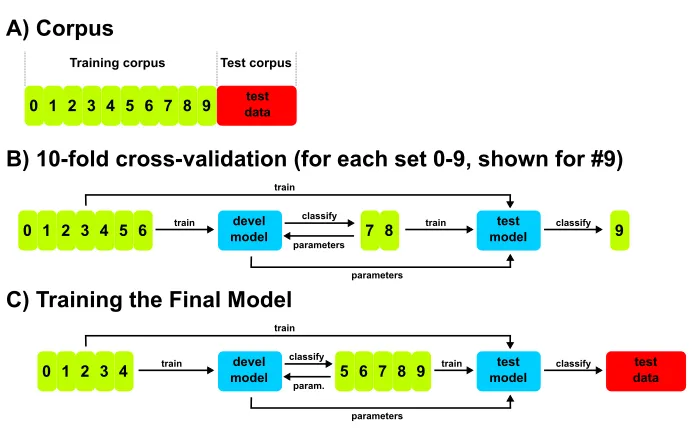
TEES is a machine learning system based on sup-port vector machines (SVM) (Tsochantaridis et al., 2005). To train the system for a new task, two datasets are required: a training set on which the SVM model is trained, and a development set on which the newly trained model is tested to deter-mine parameter settings for optimal performance (See Figure 2). The optimal model can then be used to detect what it was trained for on unannotated datasets, such as the hidden shared tasktestset.
Drug
Aminoglutethimide the of
Drug coumarin and
Drug varfarin .
diminishes effect
effect
effect
A
B
NN DT IN NN CC .
conj_and>
<dobj
prep_of>
NN
prep_of> VBZ
<nsubj <det NN
punct>
Drug (Aminoglutethimide)
Drug (coumarin) effect
Drug (warfarin) effect neg
Figure 1: TEES graph representation for drug name and interaction extraction, with example sentence DDI-DrugBank.d372.s2from the DDIExtraction 2013 training corpus. A) Both the annotation (above the sentence) and the syntactic parse (below the sentence) are represented as graphs. Tokens form the nodes and dependencies the edges of the syntactic parse graph. Drug names form the nodes and DDIs the edges of the annotation graph. Drug name entities are linked to their syntactic head tokens, connecting the two graphs and allowing the parse to be used as a source of features. For DDI edges, most features are derived from theshortest path of dependenciesconnecting the two drug entities. B) For DDI extraction, one example is generated for each interaction type for each undirected pair of drug entities. The graynegclass edge is a negative example.
A) Corpus
train classify
param.
train classify
parameters train
devel model
test model
test data test
data Training corpus Test corpus
C) Training the Final Model
0 1 2 3 4 5 6 7 8 9
train classify
parameters
train classify
parameters train
devel model
test model
B) 10-fold cross-validation (for each set 0-9, shown for #9)
9
0 1 2 3 4 5 6 7 8
[image:3.612.77.538.88.207.2]0 1 2 3 4 5 6 7 8 9
[image:3.612.133.480.379.595.2]tion. While close to the DDIExtraction 2013 format, some differences exist, so we preprocess the corpora for compatibility with TEES. Namely,ddielements are renamed asinteractionelements,entityelements in task 9.2 are tagged with thegivenattribute to mark them as pre-annotated data for TEES and all charac-ter offsets are converted to the TEES format by in-creasing the end offset by one, resulting in spans de-noted with the beginning character and end charac-ter plus one, a common convention in programming languages such as Java and Python.
Before use, all DDIExtraction 2013 corpora are parsed with the TEES preprocessing pipeline, using the BLLIP parser with David McClosky’s biomodel to produce a Penn-tree style parse which is con-verted with the Stanford parser tools to the collapsed CC processed Stanford dependency scheme (Char-niak and Johnson, 2005; McClosky, 2010; de Marn-effe et al., 2006).
2.3 Drug name recognition with TEES
For drug name recognition the TEES entity detector module is used. Baseline syntactic features (model 1) are generated from the parse, using both informa-tion on the tokens and their linear context, as well as dependency chains starting from the entity head token. External data is added to the head token fea-tures, from where it is combined into more complex features. One example is generated for each token in the sentence, and these are classified into negatives or one of the positive classes.
As a new feature we generate all substrings start-ing from the first and last characters of the drug name, with the intention of detecting common pre-fixes and sufpre-fixes among the drug names.
2.4 Drug-drug interaction detection with TEES
For DDI extraction we use the TEES edge detec-tor module. DDIs are typed, undirected edges, so one example is generated for each undirected pair of drug name entities present in the sentence (See Fig-ure 1). The baseline syntactic featFig-ures (model 1) are generated mostly from the shortest path of depen-dencies connecting the pair of drug name entities’ head tokens. From this shortest path several feature groups are generated, includingN-grams of various lengths, governor–dependent information for
depen-name entities, and combined into the path features. We also use the TEES modification from DDIEx-traction 2011 task whereconj anddependencies are ignored when calculating the shortest path, with the aim of including more of the relevant interaction words in the path.
2.5 Using DrugBank for Domain Knowledge
DrugBank2 is a public database of information on
drugs and drug targets. We use the downloadable XML version of the database.
For drug name recognition, for each candidate to-ken, we add as features its presence as a known drug name in DrugBank and the synonym, brand,
groupandcategoryannotations this drug may have. We also mark whether the candidate token exactly equals an annotation of one of these types, indicating cases where the token is e.g. a known brand name.
For DDI extraction, we mark as a feature whether the drug name pair is listed in DrugBank as having interactions or not. We also mark if one of the drug names is not listed in DrugBank.
2.6 Using MetaMap for Domain Knowledge
The MetaMap program has been used extensively for a wide array of BioNLP studies, such as auto-matic indexing of biomedical literature and concept-based text summarization (Reeve et al., 2007; Quanzhi and Yi-Fang Brook, 2006). For drug-related information extraction, two recent applica-tions demonstrated that integrating the MetaMap program to their existing systems produces high overall performance in i.) identification and clas-sification of the pharmaceutical substances and ii.) extraction of drug indication information (Segura-Bedmar et al., 2008; Fung et al., 2013).
MetaMap’s interpretation of the text.
The MetaMap program can be run both lo-cally and remotely3. We ran the current version, MetaMap2012, remotely via the batch mode facil-ity by converting the sentences of the DDIExtrac-tion corpora into the MetaMap input format. Many of the applications that integrate MetaMap into their systems use the default settings that are claimed to be suitable for general purposes. However, we ap-plied different options with the aim of increasing the coverage of Metathesaurus concepts found by MetaMap. The parameter set that influences the performance of MetaMap included; using a relaxed model, selecting the NLM2012AB Metathesaurus version, including all derivational variants, enabling unique acronym/abbreviation variants only, allow-ing candidates from one or two character words, pre-ferring multiple concepts and using word sense dis-ambiguation.
The Relaxed Model is provided by MetaMap in addition to the strict model which is offered as a default setting in which all types of filterings are applied. However, we chose the relaxed model in which only manual and lexical filterings are used. While the strict model is most appropriate for exper-iments that require the highest accuracy, it covers only 53% of the Metathesaurus strings. As we con-sider high coverage of concepts an important factor, we applied the relaxed model which consists of up to 83% of Metathesaurus strings.
The versions of Metathesaurus, Base, USAbase and NLM, provided with MetaMap are different in their Metathesaurus coverage and the license type required for using vocabulary sources. The NLM2012AB version which is offered at no cost for research purposes and covers all of the provided Metathesaurus was used in our work.
Variants, such as inflectional and derivational variants, are computed by MetaMap to account for the textual variation in the text. With this setting, many types of variants are generated recursively, and only acronyms and abbreviations are restricted to the unique ones. In addition, the candidates also include words that can be prepositions, conjunctions or de-terminers if they occur often enough in Metathe-saurus.
3http://metamap.nlm.nih.gov/
Prefer multiple concepts causes MetaMap to
score the mappings with more concepts higher than those with fewer concepts. This option is useful for discovering higher-order relationships among con-cepts found in the text and as such is assumed to be helpful for discovering the DDIs.
Word sense disambiguationattempts to solve lex-ical ambiguities by identifying the correct meaning of a word based on its context. By using this option in MetaMap, the program attempts to solve the am-biguities among equally scoring concepts by choos-ing the concept(s) based on semantic type.
We use the XML version of the MetaMap out-put which is post-processed by TEES to extract rel-evant features; candidate concepts, preferred con-cepts, CUI (Concepts Unique Identifier), score, se-mantic types and sources.
For drug name recognition, these are added as bi-nary features for the candidate token, with the ex-ception of the score, the value of which is normal-ized into the [0, 1] range. For DDI extraction, the binary features are added for the two drug names, and combined into the shortest path features.
2.7 Public analyses
The TEES 2.0 system used in DDIExtraction 2011 Shared Task has been public since summer 2012. While only small modifications are needed to make the DDIExtraction 2013 corpus usable with the TEES system, these can be complicated for new users. Therefore, to make sure our public DDIEx-traction 2011 system is usable not only in theory, but easy enough to use in practice, we updated the system into the 2.1 version capable of automatically converting the DDIExtraction 2013 corpus and pro-vided with precalculated models for DDI prediction. To improve usability, we provided fully precal-culated analysis files for the DDIExtraction 2013 corpus, produced using TEES 2.1. These analyses contain the TEES drug-drug interaction predictions, BLLIP Penn tree-bank style parses (using the Mc-Closky biomodel), Stanford dependency parses (in the collapsed CC processed format) and syntactic head offsets for drug entities.
continuation of the 2011 task for which the public TEES system was already available.
The analyses for the DDIExtraction 2013 corpus were made available on February 25th 2013. De-spite being published quite late in the training pe-riod there was interest in this supporting data, and before the task result submission deadline the analy-ses were downloaded 14 times. The test set analyanaly-ses were provided for registered DDIExtraction 2013 participants during the test period.
3 Results and Discussion
Three feature sets were used to produce the results. The baseline set (model 1) consisted of the TEES entity and edge detectors which build a large feature set from syntactic parses. Model 2 adds DrugBank features to this baseline and model 3 further extends model 2 with MetaMap information.
Three runs using these models were submitted for both tasks 9.1 and 9.2. The results indicate the sys-tem was capable of detecting both drug names and drug-drug interactions with reasonable performance. The best F-scores were 60% for task 9.1 drug name detection and 59% for task 9.2 DDI extraction.
As task 9.1 is completely new, and task 9.2 was extended from the 2011 DDI extraction task with typed interactions and MEDLINE abstracts, the cur-rent results are not directly comparable with the 2011 ones. The evaluation metric closest to the 2011 task is task 9.2 DDI detection regardless of type, us-ing only the DrugBank subset of the corpus. With this metric, our system achieved an F-score of 72% in 2013 vs. 62.99% in 2011, which may indicate higher baseline performance, potentially influenced by a larger training dataset.
3.1 Drug name recognition
The decision to not attempt detection of more than one token per drug entity proved to be not too detri-mental to the final performance. In the training cor-pus, there are 14,765 drug name entities of which only 2,768 (18.7%) consist of more than one to-ken, and of these only 38 are disjoint (not form-ing a continuous span). For our best performform-ing drug name detection model (number 3) typed, par-tial span matching was at 78% F-score vs. typed,
only a single token per entity resulted in a maximum loss of 13 percentage points (pp), but considering that a scheme designed to detect multi-token entities would be inherently more complex, potentially hav-ing lower performance, and that not all of the spans would be correctly detected, we feel this tradeoff in performance is worth it for the considerably more simple system design it allows.
Adding the external datasets to the classifier mod-els proved to have a considerable impact on the task performance (See Table 1). The baseline system reached an F-score of 47% which was increased by 9 percentage points when including DrugBank infor-mation and a further 4 percentage points when also MetaMap information was included.
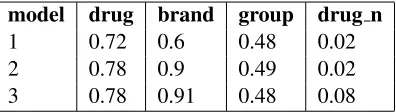
As seen from the type-specific F-scores (on the training corpus), brand class entity detection was improved by 30 pp when DrugBank information was added, and increased slightly further with MetaMap information (See Table 2). DrugBank lists brand names for many drugs, and when this information is added as a feature for each detected drug, deter-mining the type of the drug is greatly improved.
The official primary metric in both tasks 9.1 and 9.2 is a macro-averaged F-score, which gives equal weight to performance in each class, emphasizing the importance of detecting also the difficult, small classes. In particular, the classdrug n (active sub-stances not approved for use in humans for medical purposes) was very difficult to detect for our system. While performance remained low for all three mod-els, including the MetaMap information gave a large relative increase in drug n detection performance, increasing it from 2% F-score to 8% (See Table 2). With the macro-averaged overall performance, this resulted in model three with the MetaMap informa-tion having notably higher performance.
cate-M task P R F
1 9.1 0.48 (0.70) 0.46 (0.51) 0.47 (0.59) 2 9.1 0.6 (0.77) 0.52 (0.59) 0.56 (0.67) 3 9.1 0.69 (0.76) 0.54 (0.59) 0.6 (0.66) 1 9.2 0.73 (0.69) 0.47 (0.44) 0.57 (0.54) 2 9.2 0.76 (0.69) 0.48 (0.45) 0.59 (0.55) 3 9.2 0.73 (0.68) 0.48 (0.44) 0.58 (0.53)
Table 1: Official results for TEES in the DDIExtrac-tion 2013 task and in parentheses corresponding 10-fold cross-validation results on the training corpus. The three models (M) used are 1) baseline syntactic features, 2) baseline with DrugBank features and 3) baseline with both DrugBank and MetaMap features.
Task rules allowed using the test corpus of task 9.2 (with annotated entities) as additional training data for task 9.1. Due to time constraints we did not use it for training, but it is likely that performance could be further enhanced by using it.
3.2 Drug-drug interaction extraction
Performance of the three feature sets in the 9.2 DDI extraction task are much closer than in the 9.1 drug name recognition task. Still, additional informa-tion from DrugBank and MetaMap slightly increase performance, but DrugBank alone outperforms us-ing both MetaMap and DrugBank. With the perfor-mance difference range between the models being only 2 pp, we think the results remain inconclusive. That external data did not provide a further in-crease might indicate that drug-drug interaction de-tection is mostly a matter of interpreting the syn-tactic parse, whereas drug-name recognition benefits more from dictionary matching methods.
As with task 9.1, we analyse the classification er-rors on the 10-fold classification performed on the training dataset for which annotations are publicly available (See Table 4). None of the DDI classes are as hard to detect as the drug name classdrug n, but the int class has much lower performance than the other classes, with most examples classified incor-rectly as negatives.
4 Conclusions
We applied the Turku Event Extraction System 2.1 to detection of both drug names and drug-drug in-teractions in the DDIExtraction 2013 task. The
sys-model drug brand group drug n
[image:7.612.329.527.57.113.2]1 0.72 0.6 0.48 0.02 2 0.78 0.9 0.49 0.02 3 0.78 0.91 0.48 0.08
Table 2: Per-class micro-average scores for the drug name recognition task 9.1.
tem showed good performance for both tasks, but we must consider that name and interaction detection were evaluated in isolation. In real world text min-ing tasks, these steps will be consecutive and as such result in lower overall performance. TEES achieves good performance using deep syntactic parsing, but this is a computationally expensive processing step. When drug names are detected with TEES, all in-put sentences need to be parsed, but if some other method is used for drug name recognition, TEES can parse just the sentences with drug names, as only they can potentially contain DDIs, enabling much faster DDI extraction.
We showed that adding external data from the DrugBank database and from MetaMap prepro-cessing can considerably increase extraction perfor-mance. However, we assume this makes the sys-tem more dependent on such data being available for candidate drug names and DDIs in the text be-ing processed, potentially makbe-ing it harder to detect completely new names and interactions. Therefore, using external data is likely to introduce a tradeoff of higher performance vs. wider detection. Use of such data should be chosen according to the task, as in some cases the goal is to retrieve documents with known drugs and interactions, in others to maximize detection of information not yet in the databases.
As with previous TEES versions, we will pro-vide our source code freely available under an open source license at the TEES project repository4. We will also include a wrapper for using the MetaMap tool via the TEES preprocessing pipeline, allowing it to be easily integrated into event and relation ex-traction tasks.
Acknowledgments
We thank CSC — IT Center for Science Ltd, Espoo, Finland for providing computational resources.
[image:7.612.71.305.57.156.2]neg brand drug n group drug neg 99.57 99.60 99.60 0.04 0.03 0.03 0.00 0.00 0.01 0.15 0.14 0.14 0.24 0.22 0.22 brand 21.43 8.91 8.63 67.92 89.70 89.98 0.07 0.07 0.07 0.63 0.21 0.28 9.95 1.11 1.04
[image:8.612.181.433.82.306.2]drug n 49.70 63.27 65.27 2.79 0.00 0.00 12.18 15.37 15.37 0.40 1.00 1.20 34.93 20.36 18.16 group 13.80 14.13 14.04 0.12 0.00 0.06 0.03 0.03 0.06 85.15 84.97 85.00 0.90 0.87 0.84 drug 6.71 5.60 6.20 0.69 0.27 0.32 0.10 0.08 0.08 0.75 0.79 0.69 91.75 93.27 92.72
Table 3: Task 9.1 drug name classification errors for the training corpus. Each cell in the table lists from top to bottom results for models one to three (baseline, baseline+DrugBank, baseline+DrugBank+MetaMap). The results are percentage of SVM examples of each class (vertical) classified into each potential class (horizontal).
neg int advise effect mechanism
neg 97.27 97.32 97.40 0.02 0.03 0.03 0.52 0.49 0.47 1.09 1.06 1.04 1.09 1.09 1.05 int 61.70 61.70 70.74 22.87 23.40 19.15 0.53 0.00 0.00 9.57 8.51 7.45 5.32 6.38 2.66 advise 34.50 34.02 33.54 0.12 0.24 0.24 60.17 60.05 60.77 4.24 4.36 4.36 0.97 1.33 1.09 effect 38.59 38.41 39.18 0.41 0.41 0.41 3.85 3.73 3.68 54.06 54.30 53.59 3.08 3.14 3.14 mechanism 50.34 48.75 52.16 0.15 0.15 0.23 2.05 1.82 1.29 5.08 5.08 5.00 42.38 44.20 41.32
[image:8.612.158.454.408.632.2]References
Alan R Aronson. 2001. Effective mapping of biomed-ical text to the UMLS Metathesaurus: the MetaMap program. In Proceedings of the AMIA Symposium, page 17. American Medical Informatics Association. Jari Bj¨orne, Antti Airola, Tapio Pahikkala, and Tapio
Salakoski. 2011. Drug-drug interaction extraction from biomedical texts with SVM and RLS classifiers. In Proc. of the 1st Challenge task on Drug-Drug In-teraction Extraction (DDIExtraction 2011) at SEPLN 2011, volume 761, pages 35–42, Sept 5.
Jari Bj¨orne, Filip Ginter, and Tapio Salakoski. 2012. University of Turku in the BioNLP’11 Shared Task.
BMC Bioinformatics, 13(Suppl 11):S4.
Olivier Bodenreider. 2004. The unified medical lan-guage system (UMLS): integrating biomedical termi-nology. Nucleic acids research, 32(suppl 1):D267– D270.
Eugene Charniak and Mark Johnson. 2005. Coarse-to-fine n-best parsing and MaxEnt discriminative rerank-ing. InProceedings of the 43rd Annual Meeting of the Association for Computational Linguistics (ACL’05), pages 173–180. Association for Computational Lin-guistics.
Marie-Catherine de Marneffe, Bill MacCartney, and Christopher Manning. 2006. Generating typed depen-dency parses from phrase structure parses. In Proceed-ings of LREC-06, pages 449–454.
Kin Wah Fung, Chiang S Jao, and Dina Demner-Fushman. 2013. Extracting drug indication informa-tion from structured product labels using natural lan-guage processing. Journal of the American Medical Informatics Association.
Craig Knox, Vivian Law, Timothy Jewison, Philip Liu, Son Ly, Alex Frolkis, Allison Pon, Kelly Banco, Christine Mak, Vanessa Neveu, Yannick Djoumbou, Roman Eisner, Anchi Guo, and David S. Wishart. 2011. Drugbank 3.0: a comprehensive resource for omics research on drugs. Nucleic Acids Research, 39(Database-Issue):1035–1041.
David McClosky. 2010. Any domain parsing: auto-matic domain adaptation for natural language pars-ing. Ph.D. thesis, Department of Computer Science, Brown University.
Sampo Pyysalo, Antti Airola, Juho Heimonen, Jari Bj¨orne, Filip Ginter, and Tapio Salakoski. 2008. Comparative analysis of five protein-protein interac-tion corpora. BMC bioinformatics, 9(Suppl 3):S6. Li Quanzhi and Wu Yi-Fang Brook. 2006. Identifying
important concepts from medical documents. Journal of Biomedical Informatics, 39(6):668 – 679.
Lawrence H Reeve, Hyoil Han, and Ari D Brooks. 2007. The use of domain-specific concepts in biomedical text
summarization. Information Processing & Manage-ment, 43(6):1765–1776.
Isabel Segura-Bedmar, Paloma Mart´ınez, and Mar´ıa Segura-Bedmar. 2008. Drug name recognition and classification in biomedical texts: a case study out-lining approaches underpinning automated systems.
Drug discovery today, 13(17):816–823.
Isabel Segura-Bedmar, Paloma Mart´ınez, and C´esar de Pablo-S´anchez. 2011a. A linguistic rule-based ap-proach to extract drug-drug interactions from pharma-cological documents. BMC bioinformatics, 12(Suppl 2):S1.
Isabel Segura-Bedmar, Paloma Mart´ınez, and Daniel S´anchez-Cisneros. 2011b. The 1st DDIExtraction-2011 challenge task: extraction of drug-drug interac-tions from biomedical texts. InProceedings of the 1st Challenge Task on Drug-Drug Interaction Extraction 2011: 7 Sep 2011; Huelva, Spain, pages 1–9.
Isabel Segura-Bedmar, Paloma Mart´ınez, and Maria Herrero-Zazo. 2013. Semeval-2013 task 9: Extrac-tion of drug-drug interacExtrac-tions from biomedical texts. In Proceedings of the 7th International Workshop on Semantic Evaluation (SemEval 2013).
Luis Tari, Saadat Anwar, Shanshan Liang, James Cai, and Chitta Baral. 2010. Discovering drug–drug inter-actions: a text-mining and reasoning approach based on properties of drug metabolism. Bioinformatics, 26(18):i547–i553.
Philippe Thomas, Mariana Neves, Ill´es Solt, Domonkos Tikk, and Ulf Leser. 2011. Relation extraction for drug-drug interactions using ensemble learning. In
Proc. of the 1st Challenge task on Drug-Drug Interac-tion ExtracInterac-tion (DDIExtracInterac-tion 2011) at SEPLN 2011, page 11–18, Huelva, Spain, Sept 5.
Ioannis Tsochantaridis, Thorsten Joachims, Thomas Hof-mann, and Yasemin Altun. 2005. Large margin methods for structured and interdependent output vari-ables. Journal of Machine Learning Research (JMLR), 6(Sep):1453–1484.