81
Cross-lingual Subjectivity Detection for Resource Lean Languages
Aida Amini1, Samane Karimi2, 3, and Azadeh Shakery2, 4
1School of Computer Science and Engineering, University of Washington
2School of Electrical and Computer Engineering, College of Engineering, University of Tehran 3Computer Science Department, University of Houston
4School of Computer Science, Institute for Research in Fundamental Sciences (IPM)University of Tehran
{samanekarimi, shakery}@ut.ac.ir
Abstract
Wide and universal changes in the web con-tent due to the growth of web 2 applications increase the importance of user-generated
con-tent on the web. Therefore, the related
re-search areas such as sentiment analysis, opin-ion mining and subjectivity detectopin-ion receives much attention from the research commu-nity. Due to the diverse languages that web-users use to express their opinions and senti-ments, research areas like subjectivity detec-tion should present methods which are practi-cable on all languages. An important prerequi-site to effectively achieve this aim is consider-ing the limitations in resource-lean languages. In this paper, cross-lingual subjectivity detec-tion on resource lean languages is investigated using two different approaches: a language-model based and a learning-to-rank approach. Experimental results show the impact of dif-ferent factors on the performance of subjectiv-ity detection methods using English resources to detect the subjectivity score of Persian
doc-uments. The experiments demonstrate that
the proposed learning-to-rank method outper-forms the baseline method in ranking docu-ments based on their subjectivity degree.
1 Introduction
Rapid growth of web 2 applications lead to an in-crease in textual content generated by users such as comments, reviews and any kind of textual data reflecting peoples opinions. In text mining lit-erature, this kind of data is known as subjective data. Consequently, many automatic methods for detecting this kind of data from objective ones and in the next step, for detecting the polarity of sub-jective data have been proposed. These methods form one of the main research areas in text mining called subjectivity and sentiment analysis. Most papers in this area propose methods for sentiment analysis on English whereas users of web 2
ap-plications are from a wide range of languages so there is a serious need for making sentiment anal-ysis possible on other languages. This goal is achieved by different approaches proposed in this research area. Some papers present methods for sentiment analysis on non-English languages such that English resources are translated to the target language using dictionaries, machine translation or other tools, then a sentiment analysis method is proposed for the non-English language using the translated resources.
Some other papers propose a cross-lingual framework for sentiment analysis. In this ap-proach, passing the language boundaries is an in-ternal step which is situated within the whole pro-cedure. Some other papers address sentiment anal-ysis on multi-lingual environments. The main goal in these papers is to employ all useful information from different languages to facilitate subjectivity detection and sentiment analysis on multi-lingual documents.
In this paper, the problem of subjectivity de-tection in cross-lingual case is studied to see how the sentiment resources in resource-rich lan-guages like English can be used to achieve high performance in subjectivity detection systems of resource-lean languages like Persian. The meth-ods employed as subjectivity detection methmeth-ods in this paper are a language-model-based method and a method based on learning-to-rank techniques that are implemented in cross-lingual case.
Our experiments show that some factors includ-ing translation direction and translation unit have an impact on the performance of cross-lingual sub-jectivity detection methods. Furthermore, experi-mental results show that learning to rank approach leads to high performance in subjectivity detection task.
subjectivity detection and sentiment analysis area are reviewed. Section 3 describes two subjectivity detection methods implemented in this paper. Ex-perimental results are explained in section 4. The paper is concluded by future work and conclusion section.
2 Related Work
Most of previous studies in sentiment analysis area has been applied to English data. Sentiment anal-ysis on other languages and on multi-lingual en-vironments and in cross-lingual settings which is using resources of one language like English to do sentiment analysis on another language, has at-tracted a great deal of attention in recent years so a large number of papers focus on these areas. Pre-vious studies related to these areas are explained in the rest of this section.
2.1 Cross-lingual Sentiment analysis
Ku et al. (Ku et al., 2006) propose algorithms for opinion extraction and summarization for nese. To this aim, they provide the necessary Chi-nese sentiment lexicon by translating the avail-able English one, namely General Inquirer. In an Italian one, Esuli and Sebastiani (Esuli and Se-bastiani,2009) propose an opinion extraction sys-tem using lexical resources to improve the perfor-mance of the proposed opinion extraction system. Banea et al. (Banea et al.,2008) have studied the performance of automatic translation in a sen-timent analysis system where training sources are in a resource-rich language and test sources are in another language. Authors have done compara-tive evaluations on Romanian and Spanish through three different experiments. In all three experi-ments, English is used as a source language which both a manually annotated corpus (MPQA) and a subjectivity analysis tool (OpinionFinder) is avail-able.
Another paper on Spanish sentiment analysis is proposed by Brooke (Brooke et al.,2009). In this paper, a lexicon-based sentiment analysis system is adapted to Spanish such that semantic orienta-tion of each word in Spanish is computed using the translated lexicon.
Steinberger et al. (Steinberger et al., 2011a) propose a method that starts by construction of a sentiment dictionary in two languages (English and Spanish). In the next step, parallel data from English and Spanish are translated to the third
lan-guage (Arabic, Czech, French, German, Italian and Russian) and the new sentiment dictionary is obtained from the intersection of the translations.
In another paper of Steinberger et al. ( Stein-berger et al.,2011b), the construction and employ-ment of a parallel corpus with sentiemploy-ment labels is studied. This paper proposes to detect the po-larity of opinions that are about entities like per-sons, organizations and concepts across different languages. A simple method is selected for polar-ity detection in this paper, which adds up positive and negative scores in six-word windows around the entities. The sentiment scores of the words are computed using the sentiment dictionaries cre-ated by triangulation method (Steinberger et al.,
2011a).
Bautin et al. (Bautin et al., 2008) propose a method to detect the sentiment label of news ar-ticles gathered from online newspapers in nine languages including Arabic, Chinese, English, French, German, Italian, Japanese, Korean, and Spanish. In this paper, machine translation is used to transfer textual documents into English. Then, a sentiment analysis system entitled Lydia is em-ployed to detect the translated documents labels.
Wei and Pal (Wei and Pal, 2010) propose a cross-lingual sentiment analysis system that uses SCL(Structural Correspondence Learning) tech-nique to find an efficient representation for doc-uments which is shared in both languages.
One of the latest papers in this area address the aspect-based sentiment analysis in cross-lingual setting (Lambert, 2015). In this paper, Lambert propose a method which translates opinionated segments of the source language under some con-straints such that their translation in target lan-guage would not be reordered.
2.2 Multi-lingual sentiment analysis
Banea et al. (Banea et al.,2014) uses classifica-tion methods for subjectivity detecclassifica-tion in a multi-lingual environment using the alignments between word senses in different languages from wordNet, namely English and Romanian.
results show that the machine translation method can lead to high performance in sentiment detec-tion and classificadetec-tion similar to the performance in the original language (English).
In Banea et al. (Banea et al.,2010) a labeled En-glish dataset is translated to five other languages including Romanian, Spanish, French, German and Arabic. Then some multilingual versions of the English datasets based on all possible combi-nations of these six languages are generated and used to train Nave Bayes classifiers with unigram features.
Wan (Wan, 2009) propose a sentiment analy-sis system whose idea is similar to (Banea et al.,
2010). Authors in (Wan, 2009) use the multi-lingual views to the dataset by automatic transla-tion of reviews. The English reviews are trans-lated to Chinese and the paper illustrates that the proposed cross-lingual sentiment analysis system outperforms the mono-lingual one.
To evaluate the multi-lingual comparability of multi-lingual subjectivity analysis systems, Kim et al. (Kim et al.,2010) have presented an evaluation method. In this method, performance of different subjectivity analysis systems including a corpus-based method, a lexicon-corpus-based method and Opin-ionFinder (a well-known tool for subjectivity anal-ysis) is measured on multi-lingual data on English, Korean, Japanese and Chinese.
3 Methodology
The main aim of this paper is to distinguish sub-jective text from obsub-jective ones. The task of iden-tifying documents containing subjective text is ap-pealing due to the fact that subjectivity detection is a preliminary step before other sentiment analysis tasks such as polarity detection. In many subjec-tivity detection methods there is a need for a col-lection of documents with two labels: subjective and objective. The main aim of this paper is to ex-plore and investigate different methods for making the full use of labeled datasets from resource rich languages like English (as train data) to improve quality of subjectivity detection in resource lean languages like Persian (as test data).
Having both test and train datasets in the same language, would cause less ambiguities in subjec-tivity detection results in comparison with having them in different languages. Consequently, bet-ter subjectivity detection performance is expected when both train and test datasets are in the same
language.
In cross-lingual domains, the similarity between the source and target language and the quality of translation tool are critical in the performance. Each language has its own ambiguities. For ex-ample, both words “milk” and “lion” translate to the same word in Persian or the word “pretty” has two meanings in English. Each of these ambigui-ties affect both monolingual and cross-lingual re-sults. However, these effects may be more catas-trophic in cross-lingual cases since we are deal-ing with ambiguities in both languages and the er-rors caused by incorrect translations. In this paper, two different approaches for crossing the language borders are investigated:
In the first approach, resources of the source language are translated to the target language, then a model is built using the translated data and fi-nally the model is applied on the test data (source translation).
The second approach uses an inverse transla-tion directransla-tion. In this approach, first, a model is built using the data in the source language. Simul-taneously, the data in the target language is trans-lated to the source language. Finally, the model is applied on the translated test data (target transla-tion).
These two approaches are studied by means of two different subjectivity detection methods in-cluding a language-model based method and a learning-to-rank method. In the following sec-tions, the details related to each of the mentioned methods are further discussed.
3.1 Cross lingual Subjectivity Detection
In cross lingual subjectivity detection, the test data is form the resource lean language(Persian) and the train data is from the resource rich lan-guages(English). Due to the different languages of the train and test data, there is a need to cross the language borders in one of the steps of cross lingual subjectivity detection process. Translation phase adds some more challenges to the problem in terms of translation direction and unit.
Translation direction is one of the factors that affects the translation quality due to the different ambiguities in each language.
the the ambiguity of words’ different meanings. Therefore, the translation unit can be another fac-tor to be considered. These two facfac-tors are con-sidered in each of the proposed methods, i.e. the language-model based method and the learning-to-rank method.
3.1.1 Language-Model based method
Language modeling is an approach which has been widely used in Information retrieval recently. In this paper, we employed the language-model based subjectivity detection method proposed in (Karimi and Shakery,2017). In (Karimi and Shak-ery,2017), each test document is assigned a sub-jectivity score based on its similarity to the lan-guage models of subjective and objective train datasets. This score is computed from the differ-ence of the similarity between the test document language model and the language model of subjec-tive train dataset (subjecsubjec-tive model), simsubj(d), and the similarity between the test document lan-guage model and the lanlan-guage model of objective train dataset (objective model),simobj(d).
score(d) =simsubj(d)−simobj(d) (1)
The subjective and objective models are built over the unigrams of subjective and objective doc-uments in the train dataset. Each unigram in each model is assigned a value representing the its oc-currence probability in the subjective or objective documents. In this approach, the effect of each word on the subjectiveness and objectiveness of the document is measured. For example the word “opinion” would appear more frequently in sub-jective documents. In addition to that, the ef-fect of neutral words(propositions or modal verbs) can be ignored with the usage of an appropriate scoring formula since these words are present al-most equally in both categories. In our method, we utilize this approach to compute the subjec-tivity score of a document in a cross-lingual set-ting. The details of how the similarity values (i.e. simsubj(d) and simobj(d)) are computed in our method are explained in the rest of this section.
As mentioned before, the translation unit and translation direction are two important factors af-fecting cross-lingual subjectivity detection per-formance. The proposed language-model based method is explained considering these two fac-tors. Words and documents are two translation units considered in this paper:
• Word level translation: In this case, the transla-tion phase follows the training phase. The trans-lation can be done in two directions.
From English to Persian (source translation):
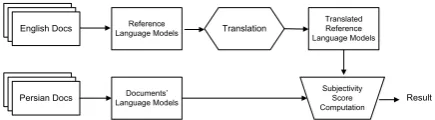
In this case, the translation should be applied to the reference language models, namely subjec-tive and objecsubjec-tive models. These models consist of unigrams and their occurrence probability, so the translation can be easily applied to the mod-els. The translated reference language models are computed as follows.
p(f|θsubj) =
X
w
p(f|w, θsubj)p(w|θsubj)
≈X
w
p(f|w)p(w|θsubj)
(2)
p(f|θobj) =
X
w
p(f|w, θobj)p(w|θobj)
≈X
w
p(f|w)p(w|θobj)
(3)
p(w|θsubj) =
P
d∈Dsubjc(w, d)
P
d∈Dsubj|d|
(4)
p(w|θobj) =
P
d∈Dobjc(w, d)
P
d∈Dobj|d|
(5)
wherec(w, d)represents the frequency of word w in documentd and|d| is the length of doc-umentd. DSubj andDobj represent the set of subjective and objective documents in the train dataset respectively. f,wandp(f|w)represent a Persian word, an English word and the proba-bility thatf translates towusing the employed translation tool (i.e. translation probability) re-spectively. p(w|θsubj)andp(w|θobj)stands for the occurrence probability of wordwin the pri-mal (before translation) subjective and objective language models that are calculated using the Eq. (4) and the Eq. (5). Accordingly,p(f|θsubj) andp(f|θobj)represent the word probabilities in the translated subjective and objective language models respectively.
Translation
Result English Docs
Persian Docs
Reference Language Models
Translated Reference Language Models
Documents’ Language Models
[image:5.595.71.289.62.122.2]Subjectivity Score Computation
Figure 1: Language model-based subjectivity detection from English to Persian
namely, the translated subjective and objective models which can be used for computing the subjectivity score of a test documentd. To this aim, first, we need to calculate the similarity be-tween the language model ofdand the subjec-tive model, i.e.simsubj(d), and also the similar-ity between the document’s language model and the objective model, i.e. simobj(d). The sim-ilarity between the language models are mea-sured using kl-divergence formula according to the Eq. (6) and the Eq. (7):
simsubj(d) =
X
f∈d
−p(f|θd).log
p(f|θd)
p(f|θsubj) (6)
simobj(d) =
X
f∈d
−p(f|θd).log
p(f|θd)
p(f|θobj) (7)
Figure1illustrates this procedure in more de-tails.
Persian to English (target translation): In this case, the Persian unigrams are mapped to the model. For each of the Persian documents, the unigrams are derived and translated to En-glish. Therefore, the model in the source lan-guage can be used over the translated unigram language model of the test document. In this case, the reference language models are com-puted the same as mono-lingual case using the Eq. (4) and the Eq. (5) and the documents lan-guage model is translated according to the Eq. (
8).
p(w|θd) =
X
f
p(w|f, θd)p(f|θd))
≈X
f
p(w|f)p(f|θd)
(8)
where p(w|θd) represents the word probabili-ties in the translated document language model and p(f|θd) represents the word probabilities in the primal (before translation) document lan-guage model. Final subjectivity score is com-puted according to the Eq. (1).
• Document level translation: This level of trans-lation is independent of the direction of the translation. So, the translation is applied as a preprocessing step. Then, the training and test-ing steps would be similar to monoltest-ingual situ-ation.
3.1.2 Learning to rank
Learning to rank approach in information retrieval refers to a method using machine learning tech-niques to rank documents based on their relevance to a query. Therefore, to use this approach in sub-jectivity detection task a query list is needed. In this paper, for each language a list of subjective terms is specified as the query list. These lists are the subjective portion of a sentiment lexicon in each language which is specified by selecting terms with higher subjectivity weights. Then, the relevance of documents to the queries in the list is used as a measure of their subjectivity level. In other words, the learning to rank method computes the relevance degree of each test document to the query and the final result is a ranked list of docu-ments for each query. The query set used in this paper is a sentiment lexicon constructed in ( De-hdarbehbahani et al.,2014) which is employed in two manners:
• List query level: In this manner, all of the words in the sentiment lexicon are assumed to be one enormous query.
• Term query level: The assumption of having a query with the length of more than 1000 words can be inane. Therefore, in this sec-tion, each term of the lexicon is used as a sep-arate query so the number of feature vectors would be the multiplication of the number of queries and documents. The final output should be the scores assigned to the test doc-uments. As mentioned above, there would be q*d feature vectors, hence, q*d individual scores. To compute a single score for each test document, as the desired output of the subjectivity detection method, a weighted av-erage over scores obtained from each query term qi of the query q can be computed in this manner as below:
score(d, q) =X
qi∈q
w(qi).score(d, qi)
|q| (9)
the score of each test documentdwith query term , qi obtained from the learning to rank method.
In this approach, the translation can be done via two procedures. These procedures are figured based on the feature set used in the learning to rank method as explained below:
• Translated Unigrams: In the first procedure which unigrams are used as query independent features, the translation phase is performed sim-ply on the unigrams of the train dataset.
• Query dependent features: These features are computed using the probabilistic translations for query terms as described below:
a) Term Frequency: This feature is calculated according to the following relations in cross lingual situation:
T F(fi, df) =c(fi, df) (10)
CLT F(ej, df) =
X
fi
p(fi|ej).T F(fi, df) (11)
CL F eat1(d, e) =X
ej∈e
log(CLT F(ej, d)) (12)
wheredf represents the document in Per-sian, ej represents the query term in En-glish and e represents the whole query, fi represents theith translation ofej,p(fi|ej) shows the translation probability ofej tofi andc(fi, df)represents the frequency of the query wordfiin documentdf.
b) Inverse Document Frequency: This feature is calculated as below:
IDF(ej) =
N |d∈D|ej∈D|
(13)
CLIDF(ej) =
X
fi
p(fi|ej).IDF(fi) (14)
CL F eat2(e) = X
ej∈e
log(CLIDF(ej)) (15)
where N represents the number of doc-uments in the collection, d represents the test document, D represents the collection of documents,ej represents the query term anderepresents the whole query.
c) BM25: This feature provides a measure-ment of the relevance degree of the docu-ment to the query. This feature is calculated as below:
CL F eat3(d, q) =
X
qi∈q
CLIDF(qi)×
c(qi, d).(k1+ 1)
c(qi, d) +k1.(1 +b−b. |d|
avg(dl))
(16)
Where|d|represents the document length and avg(dl) is the average length of the documents in the collection and c(qi, d) is the frequency of query term qi in docu-ment and d. k1 andbare constant
parame-ters used for determining the effect of query term frequency and normalizing the docu-ment length respectively.
d) KL-Divergence: This feature that shows the relevance degree of the document to the query is computed according to the Eq. (8) where the document language model is computed based on the probabilistic trans-lation (Azarbonyad et al.,2012).
e) Document length: this feature shows the length of the document.
4 Experimental Results and Discussion
4.1 Datasets
The datasets used in this paper consist of docu-ments about movies. Movie is a difficult domain to analyze since it contains a great variety of words based on the movie story while comments regard-ing other products can mostly be narrowed to a set of technical words that are used in the products domain. The datasets used in this paper are in two languages:
English Dataset : This dataset (Ku et al.,
2006) contains 5000 movie reviews from Rot-ten Tomatoes that form subjective documents and 5000 movie summaries from the Internet Movie Database that form objective documents of the dataset. The average document length in this dataset is 11 words.
yasserbayani.persianblog.ir. To ensure that all documents gathered from these websites are opin-ionated, only some specific URL patterns are fol-lowed. More than 7500 subjective documents are accumulated using these URLs. For the objective part of this dataset, Wikipedia is used as the main information resource. This website poses informa-tion regarding the movies that are produced over the past century so it contains objective data about movies. To ensure that none of documents con-tains any opinions, only the textual content under specific titles are collected. These titles are Ac-tors/Actresses, Awards and Movie Story. All these data, if existed, are considered as one document. In addition to Wikipedia content, the paragraphs that start with movie story title from naghdefarsi website are also added to the objective dataset. In total, 3500 objective documents are gathered. The average document length in this dataset is 83.
Language Differences There are major distinc-tions between Persian and English languages in-cluding the difference in the sentence structure, negative and modal verb formations, and the use of adjectives. In contrast to English language, the verb in Persian appears at the end of the sentence. Negative verbs are constructed by addingneto the beginning of the verb in contrast of having sepa-ratenot. The usage of adjectives, which are also critical in subjectivity detection, are different in a way that they usually appear after the word they are describing.
4.2 Translators
Translators accuracy has a great impact on the fi-nal results. The more accurate the translator, the closer to mono lingual results would be. In ad-dition, based on the methodology employed, dif-ferent kinds of information regarding the transla-tion are needed. For the language-model based method, Google translate is used as the transla-tion tool. The source text is sent to this tool in packages via 100 separate threads. In word level translation, the unigrams of the dataset are sub-mitted as input and the outcome is the list of pos-sible translations. In this case, the first tion is considered to be the most probable transla-tion. In the document level translation, the whole documents are extracted and sent for translation. The result would be the whole document in the target language that does not include different possible translations so the returned document is
Runs MAP
LM-EToP-W 0.693
[image:7.595.364.470.61.107.2]LM-PToE-W 0.849
Table 1: The comparison of EToP-W and
LM-PToE-W in terms of MAP.
used as the translated document. In the learning-to-rank method, the probabilistic translations are needed. The Moses translator is used for this pur-pose (Koehn et al.,2007). This translator is built over the Wikipedia corpus in Intelligent Informa-tion Systems Lab in University of Tehran. All pos-sible translations with their probabilities are con-sidered in our learning to rank method.
4.3 Experimental results
In this section, two different methods for cross-lingual subjectivity detection are evaluated through different experiments investigating their different characteristics. These methods are language-model based method and learning-to-rank method which are explained in section3. In the rest of this section, experiments related to each of the methods are presented.
4.3.1 Language-model based method
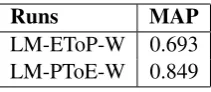
In this section, experimental results of the language-model based method are represented. In this experiment, the English dataset is used to build the reference language models and the Per-sian dataset is used as the test data. Translation is applied on both directions, in other words on both English and Persian datasets and top translation is chosen for each word. Furthermore, translation is done on both document level and word level. In word level, based on the direction of translation, unigrams of the language models in the source language are translated to the target language and used to be compared with the other language mod-els according to the methods formulas explained in section3.1.1. Table1shows the results of this ex-periment which contains MAP values of the cross-lingual word level runs namely LM-EToP-W and LM-PToE-W which only differ in the direction of translation.
Runs MAP
LM-EToP-D 0.800
[image:8.595.130.233.61.107.2]LM-PToE-D 0.483
Table 2: The comparison of EToP-D and
LM-PToE-D in terms of MAP.
subsequently are subject to translation errors. As the methods performance basically depends on the quality of subjective and objective reference lan-guage models, the results would be reasonable.
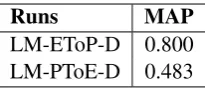
In the next experiment, translation is applied in document level. The documents are translated to the target language in a preprocessing step and the rest of the experiment is similar to a monolingual problem. LM-EToP-D and LM-PToE-D are two runs executed in this section with document level translation from English to Persian and Persian to English respectively.
The results in Table 2 show that in document level translation, translation from English to Per-sian is more accurate than from PerPer-sian to En-glish, contrary to word level translation. The rea-son is that the translation tool failed in translating most of the Persian documents, while in translat-ing from English to Persian more documents are translated correctly by the machine translation tool so the MAP value of LM-EToP-D is higher than LM-PToE-D
4.3.2 Learning-to-Rank method
To obtain the results of our learning-to-rank method, a query list is needed. In this paper, the Persian query list is selected from the lexicon con-structed in (Dehdarbehbahani et al., 2014). The lexicon contains 7491 terms and one tenth of it which has higher weights are selected as the Per-sian query list. The English query list which is selected from the Sentiwordnet (Baccianella et al.,
2010) contains 156581 terms.
As explained in section 3.1.2, the queries are used via two approaches. In the first approach, the whole list is considered as one big query. In the second approach, each term in the query list is considered as an individual query and final sub-jectivity detection result is obtained by aggregat-ing the results of each query weighted by the querys subjectivity weight. We employed SVM-rank (Joachims,2006) and RankLib (Dang) to im-plement our learning-to-rank based method. In computations of the second feature set, BM25 fea-ture has two parameters, including k and b, which
Runs MAP
AD-EToP-LQ 0.675
AD-PToE-LQ 0.708
AD-EToP-TQ 0.929
[image:8.595.361.471.62.132.2]AD-PToE-TQ 0.764
Table 3: The comparison of AD-EToP-LQ, AD-PToE-LQ, AD-EToP-TQ and AD-PToE-TQ in terms of MAP.
are set to 1.5 and 0.8 respectively.
In the following experiments, the English dataset is used as the train set and the Persian dataset as the test set, MAP value is reported and the translation is applied in word level.
In the next experiment, ADARank algorithm is executed using the RankLib tool by four runs: 1) Using the whole query list of subjective words as one query while the translation direction is from English to Persian (AD-EToP-LQ). 2) Using the whole query list as one query while the translation direction is from Persian to English (AD-PToE-LQ). 3) Using each word of the query list as an individual query while the translation direction is from English to Persian (AD-EToP-TQ) 4) Using each word of the query list as an individual query while the translation direction is from Persian to English (AD-PToE-TQ). The results of this exper-iment are shown in table3.
According to Table 3, using each word of the list as a separate query leads to better results than using one big query containing all subjective words as AD-EToP-TQ and AD-PToE-TQ out-perform AD-EToP-LQ and AD-PToE-LQ respec-tively. Since words may have different translations and the selected translation may be incorrect, in AD-PToE-TQ and AD-EToP-TQ runs, the trans-lation error only affects the single search corre-sponding to that query term but in AD-PToE-LQ and AD-EToP-LQ runs, the translation error of query terms would affect the whole query and it leads to lower results in the search corresponding to the list of query terms.
In the next experiment, we compare the results of the learning-to-rank based method with a base-line method. As a basebase-line method for ranking documents according to their subjectivity score, the language-model based method explained in section3.1.1can be a good choice since:
Runs MAP
LM-PToE-W 0.849
AD-EToP-TQ 0.929
Table 4: The comparison of AD-EToP-TQ and LM-PToE-W in terms of MAP.
• In previous papers, this method has been used for detecting positive documents from nega-tive ones (Hu et al., 2007) and also for de-tecting subjective documents from objective ones (Karimi and Shakery,2017).
To do the comparison, the best results of each method obtained in the experiments is selected. According to the results reported in previous ta-bles, the best result of the language-model based method is achieved when translation is from Per-sian to English and translation units are words (namely LM-PToE-W). The best result of the learning-to-rank based method is obtained when each word of the list is used as an individual query while the translation direction is from English to Persian and the ADARank algorithm is employed (namely AD-EToP-TQ). These results are shown in table4.
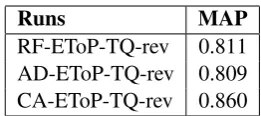
According to the results in table4, in case trans-lation tools are available, subjectivity detection using the learning-to-rank based method outper-forms the language-model based method. The next experiment is designed to check if the re-sults are biased to the dataset. Therefore, the Per-sian and English datasets are used interchange-ably. In other words, in this experiment, the Per-sian dataset is used as the train set and the En-glish dataset is used as the test set. Hence, the direction of translation is from Persian to En-glish and term query level is used in this ex-periment. In this experiment, three learning to rank algorithms using Ranklib tool including Ran-dom Forests (RF-EToP-TQ-rev), ADARank (AD-EToP-TQ-rev) and Coordinate Ascent(CA-EToP-TQ-rev) are used and the MAP values are mea-sured. Table 5 shows the results of these three runs.
As table 5 shows, Coordinate Ascent out-performs both other algorithms while Random Forests and ADARank performs similarly.
Runs MAP
[image:9.595.350.481.60.118.2]RF-EToP-TQ-rev 0.811 AD-EToP-TQ-rev 0.809 CA-EToP-TQ-rev 0.860
Table 5: The comparison of RF-EToP-TQ-rev,
AD-EToP-TQ-rev and CA-AD-EToP-TQ-rev in terms of MAP.
5 Conclusion
In this paper, we propose an extensive investi-gation on the cross-lingual subjectivity detection problem. Our main focus is to employ of En-glish resources to rank Persian documents based on their subjectivity degree. In this study, two methods are employed as subjectivity detection systems. The first method is a language-model based method which computes the subjectivity score of each test document based on the similar-ity between the statistical language model of the test document and a reference subjective model and a reference objective model. The reference subjective and objective models are built using the labeled English data. Moreover, a cross-lingual subjectivity detection method is proposed which employs learning-to-rank techniques to rank doc-uments according to their subjectivity score. In this method, the terms of a sentiment lexicon are used as query terms and the documents of the train data with subjective labels are considered as rel-evant documents to the query terms. Based on these definitions, the learning-to-rank framework is employed to rank test documents in resource-lean languages benefiting from resources includ-ing sentiment lexicon or labeled data in resource-rich languages. These two methods are evalu-ated using various translation directions and dif-ferent translation units. Experimental results show how different parameters impact on the methods performance. Experiments also demonstrate that the proposed learning-to-rank based method out-performs the language-model based approach as a baseline method of ranking document according to their subjectivity degree. One of the future works for this research is studying the impact of transla-tion on the performance of subjectivity detectransla-tion in other resource lean languages.
References
[image:9.595.127.236.61.107.2]par-allel corpora based cross language information
re-trieval. Inproceedings of 20th European Conference
on Artificial Intelligence (ECAI), pages 79–84.
Stefano Baccianella, Andrea Esuli, and Fabrizio Sebas-tiani. 2010. Sentiwordnet 3.0: An enhanced lexical resource for sentiment analysis and opinion mining. volume 10.
Alexandra Balahur and Marco Turchi. 2014. Compar-ative experiments using supervised learning and ma-chine translation for multilingual sentiment analysis.
Computer Speech & Language, 28(1):56–75.
Carmen Banea, Rada Mihalcea, and Janyce Wiebe.
2010. Multilingual subjectivity: Are more
lan-guages better? In Proceedings of the 23rd
in-ternational conference on computational linguistics, pages 28–36. Association for Computational Lin-guistics.
Carmen Banea, Rada Mihalcea, and Janyce Wiebe. 2014. Sense-level subjectivity in a multilingual
set-ting. Computer Speech & Language, 28(1):7–19.
Carmen Banea, Rada Mihalcea, Janyce Wiebe, and Samer Hassan. 2008. Multilingual subjectivity
anal-ysis using machine translation. In Proceedings of
the Conference on Empirical Methods in Natural Language Processing, pages 127–135. Association for Computational Linguistics.
Mikhail Bautin, Lohit Vijayarenu, and Steven Skiena. 2008. International sentiment analysis for news and
blogs. InICWSM.
Julian Brooke, Milan Tofiloski, and Maite Taboada. 2009. Cross-linguistic sentiment analysis: From
en-glish to spanish. InRANLP.
Van Dang.The lemur project-wiki-ranklib.
Iman Dehdarbehbahani, Azadeh Shakery, and Hes-haam Faili. 2014. Semi-supervised word polarity
identification in resource-lean languages. Neural
networks : the official journal of the International Neural Network Society, 58:50–59.
Andrea Esuli and Fabrizio Sebastiani. 2009. Enhanc-ing opinion extraction by automatically annotated
lexical resources. In Language and Technology
Conference, pages 500–511. Springer.
Yi Hu, Ruzhan Lu, Xuening Li, Yuquan Chen, and
Jianyong Duan. 2007. A language modeling
ap-proach to sentiment analysis. InComputational
Sci-ence – ICCS 2007, pages 1186–1193, Berlin, Hei-delberg. Springer Berlin HeiHei-delberg.
Thorsten Joachims. 2006. Training linear svms in
lin-ear time. volume 2006, pages 217–226.
Samaneh Karimi and Azadeh Shakery. 2017. A
language-model-based approach for subjectivity de-tection. Journal of Information Science, 43(3):356– 377.
Jungi Kim, Jinji Li, and Jong-Hyeok Lee. 2010. Eval-uating multilanguage-comparability of subjectivity
analysis systems. InACL, page 595.
Philipp Koehn, Hieu Hoang, Alexandra Birch, Chris Callison-Burch, Marcello Federico, Nicola Bertoldi, Brooke Cowan, Wade Shen, Christine Moran, Richard Zens, Chris Dyer, Ondej Bojar, Alex
Con-stantin, and Evan Herbst. 2007. Moses: Open
source toolkit for statistical machine translation.
Lun-Wei Ku, Yu-Ting Liang, and Hsin-Hsi Chen. 2006. Opinion extraction, summarization and tracking in
news and blog corpora. In Proceedings of AAAI,
pages 100–107.
Patrik Lambert. 2015. Aspect-level cross-lingual
sen-timent classification with constrained smt. In
Pro-ceedings of the 53rd Annual Meeting of the Associ-ation for ComputAssoci-ational Linguistics and the 7th In-ternational Joint Conference on Natural Language Processing, pages 781–787.
Josef Steinberger, Polina Lenkova, Mohamed Ebrahim, Maud Ehrmann, Ali Hurriyetoglu, Mijail Kabadjov, Ralf Steinberger, Hristo Tanev, Vanni Zavarella, and Silvia V´azquez. 2011a. Creating sentiment
dictio-naries via triangulation. InProceedings of the 2nd
workshop on computational approaches to subjec-tivity and sentiment analysis, pages 28–36. Associa-tion for ComputaAssocia-tional Linguistics.
Josef Steinberger, Polina Lenkova, Mijail A. Kabad-jov, Ralf Steinberger, and Erik Van der Goot. 2011b. Multilingual entity-centered sentiment
anal-ysis evaluated by parallel corpora. InRANLP.
Xiaojun Wan. 2009. Co-training for cross-lingual
sen-timent classification. In Proceedings of the Joint
Conference of the 47th Annual Meeting of the ACL and the 4th International Joint Conference on Natu-ral Language Processing of the AFNLP: Volume 1-volume 1, pages 235–243. Association for Compu-tational Linguistics.
Bin Wei and Christopher Joseph Pal. 2010. Cross lin-gual adaptation: An experiment on sentiment