Towards Full Text Shallow Discourse Relation Annotation: Experiments
with Cross-Paragraph Implicit Relations in the PDTB
Rashmi Prasad
University of Wisconsin-Milwaukee
Katherine Forbes Riley University of Pittsburgh
[email protected] Alan Lee
University of Pennsylvania
Abstract
Full text discourse parsing relies on texts comprehensively annotated with discourse relations. To this end, we address a signif-icant gap in the inter-sentential discourse relations annotated in the Penn Discourse Treebank (PDTB), namely the class of cross-paragraph implicit relations, which account for 30% of inter-sentential rela-tions in the corpus. We present our anno-tation study to explore the incidence rate of adjacent vs. non-adjacent implicit rela-tions in cross-paragraph contexts, and the relative degree of difficulty in annotating them. Our experiments show a high in-cidence of non-adjacent relations that are difficult to annotate reliably, suggesting the practicality of backing off from their annotation to reduce noise for corpus-based studies. Our resulting guidelines follow the PDTB adjacency constraint for implicits while employing an underspeci-fied representation of non-adjacent implic-its, and yield 62% inter-annotator agree-ment on this task.
1 Introduction
Empirical approaches for modeling discourse lations rely on corpora annotated with such re-lations, such as the PDTB (Prasad et al., 2008), the RST-DT (Carlson et al.,2003), and the ANN-ODIS corpus (Afantenos et al.,2012). The PDTB is currently the largest of these annotated corpora and widely used for theoretical and empirical re-search on discourse relations. However, it does not provide exhaustive annotation of its source texts (Prasad et al.,2014). A critical kind of gap is found within the class of inter-sentential rela-tions, i.e., relations with arguments in different sentences. In particular, while the PDTB
pro-vides annotations of explicit inter-sentential rela-tions within and across paragraphs, and of implicit relations between adjacent sentences within para-graphs, it ignores cross-paragraph implicit rela-tions. Ex. (1) illustrates the problem in a PDTB-annotated text, showing 6 sentences (S1-S6) in the first four paragraphs of a longer article. (Empty lines indicate paragraph boundaries.) While all annotation elements are not shown here, the key issue to note is that the relations of sentences S2 and S3 with the prior text are leftunannotated be-cause they are paragraph-initial sentences lacking any inter-sentential explicit connectives.
(1) S1:As competition heats up in Spain’s crowded bank market, Banco Exterior de Espana is seeking to shed its image of a state-owned bank and move into new activ-ities.
(unannotated)
S2:Under the direction of its new chairman, Francisco Luzon, Spain’s seventh largest bank is undergoing a tough restructuring that analysts say may be the first step toward the bank’s privatization.
(unannotated)
S3:The state-owned industrial holding company Insti-tuto Nacional de Industria and the Bank of Spain jointly hold a 13.94% stake in Banco Exterior.
(Conjunction)
S4: The government directly owns 51.4% and Fac-torex, a financial services company, holds 8.42%. (Conjunction)
S5:The rest is listed on Spanish stock exchanges. (Contrast)
S6:Some analysts are concerned, however, that Banco Exterior may have waited too long to diversify from its traditional export-related activities.
There are more than 12K such unannotated to-kens in the current version of PDTB (PDTB-2), constituting 30% of all inter-sentential discourse contexts and 87% of all cross-paragraph inter-sentential contexts. Furthermore, research on dis-course parsing shows that there is value in filling these gaps. For example, Pitler et al. (2009) re-port improvements in implicit relation sense clas-sification with a sequence model. And more
cent systems, including the best systems (Wang and Lan, 2015; Oepen et al., 2016) at the re-cent CONLL shared tasks on PDTB-style shal-low discourse parsing (Xue et al., 2015, 2016), while not using a sequence model, still incorpo-rate features about neighboring relations. Such systems have many applications, including sum-marization (Louis et al., 2010), information ex-traction (Huang and Riloff, 2012), question an-swering (Blair-Goldensohn, 2007), opinion anal-ysis (Somasundaran et al.,2008), and argumenta-tion (Zhang et al.,2016).
This paper describes our experiments in an-notating cross-paragraph implicit relations in the PDTB (Section 2), with the goal of producing a set of guidelines (Section3) to annotate such rela-tions reliably (Section4) and produce a represen-tative dataset annotated with complete sequences of inter-sentential relations.
Our main findings from the experiments are as follows:
• The ratio of cross-paragraph implicit rela-tions between non-adjacent sentences and be-tween adjacent sentences is almost 1 to 1 (47% vs 51% in our experiment). This is sim-ilar to the distribution of cross-paragraph ex-plicit relations (Prasad et al.,2010). Hence, non-adjacency is a non-trivial factor to con-sider when annotating cross-paragraph im-plicit relations.
• Inter-annotator agreement for the non-adjacent cross-paragraph implicits is substantially lower compared to their ad-jacent counterparts (47% versus 68%). Furthermore, the disagreements, while possible to resolve through discussion, are time-consuming and therefore prohibitive to large-scale annotation.
On the basis of these findings, we established the following guidelines for our annotation of cross-paragraph implicit relations:
• We fall back to the PDTB strategy of fully annotating only adjacent implicit rela-tions, while also employing an underspeci-fied marking of non-adjacent ones.
• We introduce new guidelines to (a) better rep-resent the inter-dependency of relations in a
text, (b) represent new senses we have en-countered, and (c) better represent the rela-tion of entity-based coherence. These new guidelines are discussed at various points in Section 3.
We achieve a final overall agreement of 62% with our guidelines.
We discuss related work in Section5and con-clude in Section6, outlining our goals for this task and future work beyond.
2 A Brief Review of PDTB
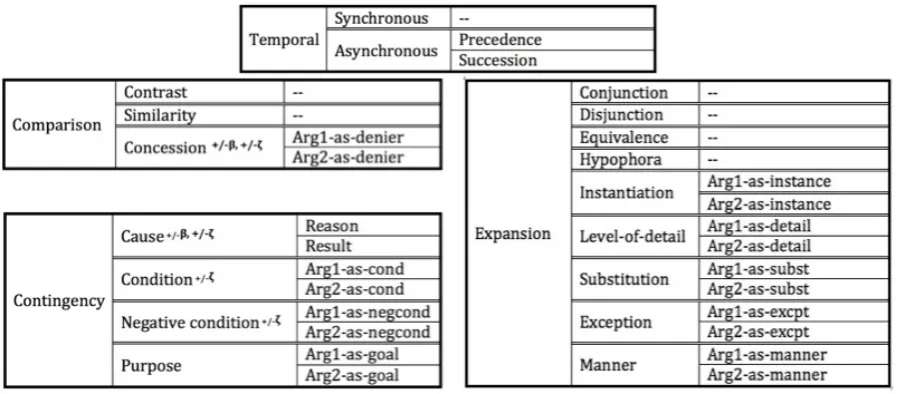
Our study is carried out within the annota-tion framework of the PDTB, and incorporates the most recent PDTB (PDTB-3) sense hierarchy (Webber et al., 2016), shown in Fig.1 (with two modifications – see Section3.2). Annotated over the ˜1 million word WSJ corpus (Marcus et al., 1993), the PDTB follows a lexically-grounded ap-proach to the representation of discourse relations (Webber et al., 2003) while remaining theory-neutral in its annotation approach. Discourse rela-tions are taken to hold between two abstract object arguments, named Arg1 and Arg2 using syntac-tic conventions, and are triggered either byexplicit
connectives (Ex.2) or, otherwise, by adjacency be-tween clauses and sentences. (Throughout the pa-per, the expression of a relation is underlined, its Arg2 isbolded, its Arg1 isitalicized, and its type and sense are in parentheses.)
(2) The Manhattan U.S. attorney’s office stressed crimi-nal cases from 1980 to 1987, averaging 43 for every 100,000 adults.
(Explicit, Contrast)
Butthe New Jersey U.S. attorney averaged 16.
(3) So far, the mega-issues are a hit with investors. (Implicit, Arg2-as-instance, For example)
Earlier this year, Tata Iron & Steel Co.’s offer of $355 million of convertible debentures was oversub-scribed.
(4) When the plant was destroyed, ”I think everyone got concerned that the same thing would happen at our plant,” a KerrMcGee spokeswoman said.
(AltLex, Reason)
That prompted Kerr-McGee to consider moving the potentially volatile storage facilities and cross-blending operations away from town.
(5) The proposed petrochemical plant would use naph-tha to manufacture the petrochemicals propylene and ethylene and their resin derivatives, polypropylene and polyethylene.
(EntRel)
Figure 1: PDTB-3 Sense Hierarchy (Webber et al.,2016) Modified to Include Arg1/Arg2-as-instance and Hypophora. Only asymmetric relations are specified further at Level-3, to differentiate directionality of the arguments. Superscript symbols on Level-2 senses indicate features for implicit beliefs (+/-β) and speech-acts (+/-ζ) that may or may not be associated with one of the defined arguments of the relation.
(6) The executive producer of ”Saturday Night With Con-nie Chung,” Andrew Lack, declines to discuss re-creations as a practice or his show, in particular. ”I don’t talk about my work,” he says.
(NoRel)
The president of CBS News, David W. Burke, didn’t return numerous telephone calls.
In adjacent contexts not related by a connective, an inferred relation is annotated as either an im-plicit relation (Ex. 3) when it can be expressed by inserting a connective, or an AltLex (alterna-tively lexicalized) relation (Ex.4) if insertion of a connective leads to a perception of relation redun-dancy, indicating the presence of some alternative lexico-syntactic marking of the relation. When a discourse relation is not inferred, the context is an-notated as EntRel(Ex.5) if an entity-based rela-tion is perceived, and asNoRel(Ex.6) otherwise. Section3.2discusses in further detail how the En-tRel and NoRel relations are used in PDTB.
Where a relation’s arguments can be annotated depends on the type of relation. The Arg2 of explicit relations is always some part of the sen-tence or clause containing the connective, but the Arg1 can be anywhere in the prior text. For all other relation types, Arg1 and Arg2 are only an-notated when adjacent. Arguments can be ex-tended to include additional clauses/sentences in all cases except NoRel, but a minimality constraint requires inclusion of only the minimally necessary text needed to interpret the relation.
3 The Experiment
To identify challenges and explore the feasibility of annotating cross-paragraph implicit relations on a large scale, texts from the PDTB corpus were selected to cover a range of sub-genres (Webber, 2009) and lengths. These texts contained 440 cur-rent paragraph first sentence (CPFS) tokens (ex-cluding the first sentence in each text) not already related to the prior text by an inter-sentential ex-plicit connective. These tokens were annotated in the PDTB Annotation Tool (Lee et al.,2016) over the three phases described below.
3.1 Phase One
[image:3.595.77.526.65.262.2]distri-bution of cross-paragraph implicits was similar to that of cross-paragraph explicits, which are also non-adjacent roughly half (51%) the time (Prasad et al.,2010). Thus, whether this would be shown more generally became a hypothesis to explore in Phase Two.
Second, it was found that working together, the two annotators could isolate and agree upon the arguments not only of the adjacent implicit rela-tions, but also the non-adjacent ones. Therefore, and also because of the observed high incidence of non-adjacent relations, a second hypothesis to ex-plore in Phase Two became whether both adjacent and non-adjacent Arg1s could be reliably identi-fied and annotated. Ex. (7) shows a CPFS (Arg2) and its Arg1 in a non-adjacent Contrast relation. In this case, the intervening material is excluded because of the minimality constraint: it only pro-vides further detail about the Arg1 eventuality and can thus be excluded without loss of interpretation.
(7) Kidder, Peabody & Co. is trying to struggle back.
Only a few months ago, the 124-year-old securities firm seemed to be on the verge of a meltdown, racked by internal squabbles and defections.Its relationship with parent General Electric Co. had been frayed since a big Kidder insider-trading scandal two years ago. Chief executives and presidents had come and gone. (Contrast, But)
Now, the firm says it’s at a turning point.By the end of this year, 63-year-old Chairman Silas Cathcart – the former chairman of Illinois Tool Works who was de-rided as a ”tool-and-die man” when GE brought him in to clean up Kidder in 1987 – retires to his Lake Forest, Ill., home, possibly to build a shopping mall on some land he owns.
3.2 Phase Two
Based on Phase One observations, we decided in Phase Two to fully explore the feasibility of reli-ably annotating adjacentandnon-adjacent cross-paragraph implicits. To this end, a further 103 to-kens (10 texts) were separately annotated by each annotator for type, sense and minimal argument spans, regardless of whether arguments were adja-cent or non-adjaadja-cent.
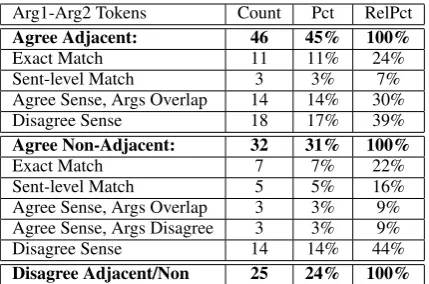
Table 1 presents the results of the Phase Two study. As shown, the adjacency distribution of arguments in the 76% (45%+31%) tokens agreed to be adjacent (46/103) or non-adjacent (32/103) supports our hypothesis that non-adjacent cross-paragraph implicit relations occur with high fre-quency (32/78, 41%), approaching half of all agreed tokens. For each of these agreed tokens, we computed sense and argument agreement to obtain
Arg1-Arg2 Tokens Count Pct RelPct
Agree Adjacent: 46 45% 100%
Exact Match 11 11% 24%
Sent-level Match 3 3% 7%
Agree Sense, Args Overlap 14 14% 30%
Disagree Sense 18 17% 39%
Agree Non-Adjacent: 32 31% 100%
Exact Match 7 7% 22%
Sent-level Match 5 5% 16%
Agree Sense, Args Overlap 3 3% 9% Agree Sense, Args Disagree 3 3% 9%
Disagree Sense 14 14% 44%
Disagree Adjacent/Non 25 24% 100%
Table 1: Cross-Paragraph Implicit Relations, Phase Two Agreement Counts, Percentages over all Tokens (Pct) and Relative Percentages over Subgroups (RelPct). 103 Tokens, 10 Texts.
(a) ‘Exact Match’, i.e., fully agreed for type, sense, and argument spans, (b) ‘Sent-level match’, i.e., slightly relaxing the minimality constraint sub-sententially to include tokens agreed for type and sense whose argument boundaries only disagreed inside a sentence boundary (e.g. because one an-notator included an adjunct clause the other ex-cluded), (c) ‘Agree Sense, Args Overlap’, i.e., re-laxing the minimality constraint supra-sententially to include tokens agreed for type and sense whose Arg1 and Arg2 boundaries overlapped but did not exactly match (e.g. because one annotator in-cluded additional sentence(s) the other considered non-minimal), (d) ‘Agree Sense, Args Disagree’, i.e., agreed for type and sense but unmatched in all of the aforementioned ways, which can only occur for non-adjacent relations and not adjacent rela-tions, and (e) ‘Disagree Sense’, i.e., disagreed as to type or sense, although arguments may or may not have matched in some way.
[image:4.595.310.525.61.203.2]Discussion of the disagreements showed that while it was almost always possible to reach con-sensus, the time and effort required was often much greater for non-adjacent relations – twice the amount of time required for adjacent relations – and therefore prohibitive to large-scale annota-tion. Therefore a decision was made to maintain the PDTB adjacency constraint and focus on full annotation of only adjacent relations. Tokens per-ceived as forming a non-adjacent implicit relation would be annotated as NoSemRel, as described below, providing an underspecified marking to in-dicate its presence.
Also based on the Phase Two findings, two further enhancements were made to the PDTB-2 guidelines. First, two new senses were introduced (Fig. 1), as illustrated in Exs. (8-9). Our texts provide evidence of both directionalities for the asymmetric Instantiation sense, and so its Level-3 labels,Arg1-as-instanceandArg2-as-instance, were introduced. Arg2-as-instance is the more common case. In addition, a Hypophora la-bel was introduced as a placeholder for question-answer pairs, until further study can shed light on the appropriate senses to capture their semantics.
(8) NBC’s re-creations are produced by Cosgrove-Meurer Productions, which also makes the successful prime-time NBC Entertainment series Unsolved Mysteries. (Arg1-as-instance, More generally)
The marriage of news and theater, if not exactly in-evitable, has been consummated nonetheless.
(9) How can we turn this situation around?
(Hypophora)
Reform starts in the Pentagon.
The second enhancement involves a refinement of the EntRel and NoRel labels. In the absence of a semantic discourse relation between adjacent sentences, the PDTB-2 labels the relation between them as follows: (a)as EntRel if an entity-based coherence relation holds between Arg1 and Arg2 and the discourse is expanded around that entity in Arg2, either by continuing the narrative around it or supplying background about it;(b)as EntRel if (a) doesn’t hold but some entity co-reference ex-ists between Arg1 and Arg2 (even if an implicit re-lation also holds between Arg2 and a non-adjacent sentence);(c)as NoRel if neither (a) nor (b) holds (even if an implicit relation also holds between Arg2 and a non-adjacent sentence); and (d) as NoRel if none of (a)-(c) hold, which occurs when
Arg2 is not part of the discourse (e.g., bylines or the start of a new article in a single WSJ file).
However, given our goal to encode the presence of non-adjacent implicit relations, the manner in which these labels are currently assigned is a prob-lem because this information is spread across both labels, by way of scenarios (b) and (c) above. Fur-ther, (a) and (b) confound the presence of a seman-tic coherence relation with the presence of corefer-ence. Both of these considerations therefore led us to create two new labels for our task:SemEntRel (Semantic EntRel) for scenario (a), to unambigu-ously identify cases of entity-based coherence re-lations, andNoSemRelfor scenarios (b) and (c), to unambiguously identify cases of non-adjacent implicit relations. To maintain consistency with the PDTB-2 corpus, the EntRel label for (b) was noted as a comment feature where relevant. Sce-nario (d) continued to be labeled as NoRel.
A SemEntRel relation is shown in Ex. (10), where Arg2 provides background about the ”hu-manitarian assistance” conceptual entity in Arg1. Though not yet applied to the rest of PDTB-2, we find Semantic Entrels occur quite frequently in cross-paragraph contexts (see Section4). An ex-ample of a NoSemRel relation is the underspec-ified annotation of the non-adjacent relation of Ex. (7), shown below as Ex. (11).
(10) And important U.S. lawmakers must decide at the end of November if the Contras are to receive the rest of the$49 million in so-called humanitarian assistance under a bipartisan agreement reached with the Bush administration in March.
(SemEntRel)
The humanitarian assistance, which pays for sup-plies such as food and clothing for the rebels amassed along the Nicaraguan border with Hon-duras, replaced the military aid cut off by Congress in February 1988.
(11) Only a few months ago, the 124-year-old securities firm seemed to be on the verge of a meltdown, racked by internal squabbles and defections. Its relationship with parent General Electric Co. had been frayed since a big Kidder insider-trading scandal two years ago.
Chief executives and presidents had come and gone.
(NoSemRel)
Now, the firm says it’s at a turning point.By the end of this year, 63-year-old Chairman Silas Cathcart – the former chairman of Illinois Tool Works who was de-rided as a ”tool-and-die man” when GE brought him in to clean up Kidder in 1987 – retires to his Lake Forest, Ill., home, possibly to build a shopping mall on some land he owns.
3.3 Phase Three
CPFS-PPLS implicit relation tokens from 34 texts were separately annotated by the two annotators in Phase Three for type, sense and minimal argument spans. However, prior to initiating the Phase Three annotation, all Phase One and Phase Two texts were reannotated by the two annotators according to the enhanced guidelines, and a close analysis of the disagreements was performed. This yielded three recurring patterns of disagree-ments as well as procedures for resolving them via careful application of the guidelines, detailed below.
a) Multi-sentential or discontinuous argu-ments may exclude supporting relations. Mini-mality requires that all and only the semantic ma-terial minimally needed to interpret a relation be specified by its arguments. Therefore, relations that support Arg1 and Arg2 but aren’t necessary for their interpretation should be excluded from those arguments’ boundaries. Common support-ing relations typically excluded include Arg2-as-Instance, Arg2-as-Detail, and Reason, as well as Semantic Entrel or Temporal relations that sup-ply background information. Ex. (12) shows sup-porting sentences after the CPFS that are excluded from Arg2 for minimality.
(12) Although bullish dollar sentiment has fizzled, many currency analysts saya massive sell-off probably won’t occur in the near future.
(Implicit, Reason, because)
While Wall Street’s tough times and lower U.S. in-terest rates continue to undermine the dollar, weak-ness in the pound and the yen is expected to offset those factors. ”By default,” the dollar probably will be able to hold up pretty well in coming days, says Francoise Soares-Kemp, a foreign-exchange adviser at Credit Suisse. ”We’re close to the bottom” of the near-term ranges, she contends.
b) A CPFS may appear to relate to both an adjacent and a non-adjacent unit. Often, how-ever, the adjacent unit will be providing support-ing content to the non-adjacent unit, rather than continuing the more global narrative flow. The stronger relation in this case will be the non-adjacent one. E.g., in Ex. (13), Arg2 creates an In-stantiation relation regarding the names of specific judges to be included. Some annotators may per-ceive this relation as capable of being formed with the prior adjacent sentence or the non-adjacent italicized one. However, the prior adjacent sen-tence itself provides supporting detail on the ital-icized one, concerning the number of judges to
be included. Thus, the adjacent sentence and the bolded sentence are neither directly related them-selves, nor advancing the more global narrative flow. Therefore, this token is labeled NoSemRel. (13) Several organizations, including the Industrial
Biotechnical Association and the Pharmaceutical Manufacturers Association, have asked the White House and Justice Department to name candidates with both patent and scientific backgrounds. The associations would like the court to include between three and six judges with specialized training.
(NoSemRel)
Some of the associations have recommended Dr. Alan D. Lourie, 54, a former patent agent with a doctorate in organic chemistry who now is associate general counsel with SmithKline Beckman Corp. in Philadelphia.
c) Multiple tokens can relate differently to the same sentence. Often in the PDTB, texts begin with a single complex sentence followed by other sentences or paragraphs each discussing some aspect of it. By minimality, tokens should only be grouped into a single Arg2 if they share the same relation to the same Arg1 unit. The text in Ex.7provides an illustration of this. The itali-cized and bolded CPFSs together form the Arg2 of an Arg2-as-detail relation with the first sen-tence, providing detail on the eventuality of the company trying to struggle back. In contrast, in Ex. (14), the bolded Arg2 in the first CPFS pro-vides detail on the trade deficit worsening in the first sentence. The bolded Arg2 in the second CPFS, on the other hand, displays entity coref-erence with the first bolded unit, but more gen-erally and strongly, continues the global narrative flow about the Treasury Department’s statement, that is, it is in a SemEntRel relation with the non-adjacent Arg1 (in italics). Given the new guide-lines for Phase Three, the relation is thus labeled NoSemRel.
(14) The Treasury Department said the U.S. trade deficit may worsen next year, after two years of significant im-provement.
(Implicit=Arg2-as-detail)
In its report to Congress on international economic policies, the Treasury saidthat any improvement in the broadest measure of trade, known as the cur-rent account, ”is likely at best to be very modest,” and ”the possibility of deterioration in the current account next year cannot be excluded.”
(NoSemRel)
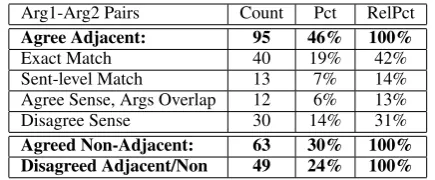
Arg1-Arg2 Pairs Count Pct RelPct
Agree Adjacent: 95 46% 100%
Exact Match 40 19% 42%
Sent-level Match 13 7% 14%
Agree Sense, Args Overlap 12 6% 13%
Disagree Sense 30 14% 31%
Agreed Non-Adjacent: 63 30% 100% Disagreed Adjacent/Non 49 24% 100%
Table 2: Cross-Paragraph Implicit Relations, Phase Three Agreement, 207 Tokens, 34 Texts.
4 Results and Discussion
Table2presents the Phase Three inter-annotator agreement results. As shown, agreement on whether a relation was adjacent (95) or non-adjacent (63) was approximately the same as in Phase Two, at 76% (46%+30%), Furthermore, over these 158 (95+63) tokens, the proportion of non-adjacent tokens (63/158, 40%) was similar to Phase Two, again supporting our hypothesis about their high frequency. Because of the backoff to annotating only adjacent cross-paragraph implicit relations, overall agreement with the most relaxed metric on argument spans1 is higher in Phase
Three (62%) than in Phase Two (43%). However, there is also substantial improvement in the sense annotation of the adjacent discourse relations, from 61% in Phase Two to 69% (42%+14%+13%) in this phase,2which we attribute partly to our
en-hanced guidelines for annotating SemEntRel. The increase in tokens agreed on sense also more ac-curately represents the agreement on arguments. Exactly matched arguments show an increase to 42% from 24% in Phase Two and there are fewer disagreements due to supra-sentential overlapping spans, which have reduced to 13% from 30% in Phase Two. The number of sentence-level dis-agreements increased to 14% from 7% in Phase Two, but most of these reflect minor syntactic dif-ferences (e.g., inclusion/exclusion of adjuncts or attributions) rather than semantic ones.
Following Phase Three, gold standard annota-tions were produced through consensus labeling over all phases. Table 3 shows the counts and percentages for each token type. Of the 440 to-kens, 207 (47%) conveyed a non-adjacent relation and thus the adjacent relation was labeled NoSem-1Exact Match + Sent-Level Match + Agree Sense, Args
Overlap + Agreed Non-Adjacent
2The sense agreement for this task is on par with the
agreement for intra-paragraph implicit relations reported in Miltsakaki et al.(2004).
Implct AltLex SemEnt NoSmRel NoRel
Ct 152 8 62 207 11
[image:7.595.72.290.61.151.2]Pct 35% 2% 14% 47% 3%
Table 3: Gold Cross-Paragraph Implicit Relation Counts and Percentages Across All Phases, 440 Tokens, 54 Texts.
Rel, confirming our initial hypothesis of an almost equal distribution of cross-paragraph adjacent and non-adjacent implicit relations. Among the re-maining 233 (53%) tokens, 153 (35%) were of the Implicit type in that a connective could be inserted to express the relation, while 8 (2%) conveyed the relation through an AltLex. 62 (14%) tokens were annotated as SemEntRels, and 11 (3%) were an-notated as NoRels. Table 4 presents the counts and percentages for the Implicit and AltLex gold-labeled senses. As shown, Arg2-as-Detail occurs most frequently but still accounts for only 40% of the relations. Six other senses occurring with 5% or greater frequency account for 45% of the tokens, and include Conjunction (12%), as-instance (9%), Reason (7%), Result (6%), Arg2-as-denier (6%) and Contrast (5%). The remaining 15% of the tokens occurring with less than 5% fre-quency are spread across nine different senses. 5 Related Work
Given that the end goal of this research is to pro-duce full-text annotation of discourse relations, in this section we compare our work with two related approaches to full text discourse relation annotation, focusing on how they handle non-adjacent discourse relations, or in other words, long-distance discourse relation dependencies.
Types Senses (Count/Relative Percent of 160)
Detail2 Conjunction Instance2 Reason Result Denier2 Contrast Precedence
Implicit 62/39% 18/11% 13/8% 11/7% 10/6% 9/6% 8/5% 7/4%
AltLex 2/1% 1/<1% 2/1% 0 0 0 0 0
Equivalence Reason+β Detail1 Instance1 Synchronous Hypophora Result+β Succession
Implicit 3/2% 3/2% 2/1% 2/1% 1/<1% 1/<1% 1/<1% 1/<1%
[image:8.595.72.525.61.144.2]AltLex 0 1/<1% 0 0 1/<1% 0 0 1/<1%
Table 4: Gold Cross-Paragraph Adjacent Implicit and AltLex Sense Counts and Relative Percentages Across All Phases, 160 Tokens. Detail(1/2) = Arg(1/2)-as-detail; Instance(1/2) = Arg(1/2)-as-instance; Denier2 = Arg2-as-denier.
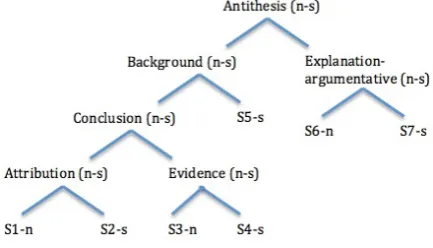
Figure 2: RST Structure for Ex. (15). Intra-sentential relations are not shown. Nodes are la-beled with RST mononuclear (n-s) or multinuclear (n-n) relations and leaves are anchored by sen-tences IDs marked with their nuclearity status.
seems to hold between S3 and S6, but this does not fall out from the RST-DT annotation, where S1 is promoted as the nucleus of the S1-S5 complex, not S3.
(15) S1: FEDERAL PROSECUTORS are concluding fewer criminal cases with trials.
S2:That’s a finding of a new study of the Justice De-partment by researchers at Syracuse University.
S3:David Burnham, one of the authors, says fewer tri-als probably means a growing number of plea bargains.
S4:In 1980, 18% of federal prosecutions concluded at trial; in 1987, only 9% did.
S5:The study covered 11 major U.S. attorneys’ offices – including those in Manhattan and Brooklyn, N.Y., and New Jersey – from 1980 to 1987.
S6: The Justice Department rejected the implication that its prosecutors are currently more willing to plea bargain.
S7:”Our felony caseloads have been consistent for 20 years,” with about 15% of all prosecutions going to trial, a department spokeswoman said.
Like the RST-DT corpus, The SDRT-based (Asher and Lascarides, 2003) ANNODIS corpus (Afantenos et al.,2012) also constructs hierarchi-cal structures - termed complex discourse units
(CDUs) - out of EDUs. A structure like Fig. 2 is thus possible in that corpus. However, CDUs are explicitly distinguished from EDUs in ANN-ODIS and there is at present no analogous con-cept of nuclearity within the theory that would promote some EDU(s) to become the prominent nucleus of the complex. The problem of iden-tifying minimal arguments in long-distance de-pendencies is therefore sidestepped in the cor-pus; instead, the whole CDU serves as the ar-gument. Nevertheless, identifying minimal argu-ments based on some principle, whether through annotation guidelines such as PDTB’s “minimal-ity constraint” or through theoretical mechanisms such as RST-DT’s “nuclearity principle”, is im-portant in eliminating noise from the arguments. For example, a learning algorithm extracting fea-tures from non-minimal argument spans for sense labeling would wind up with a lot of extrane-ous or conflicting data. It is also an open ques-tion as to whether the speaker/hearer retains or re-quires such hierarchically-structured non-minimal complex units when establishing/interpreting dis-course relations in speech/text. In many other re-spects, however, the ANNODIS approach is on par with the one addressed in this paper. Relations are defined in semantic terms, and long-distance relations are annotated regardless of whether or not they may lead to crossing dependencies in the
emergentcomposite discourse structures.
6 Conclusion and Future Work
[image:8.595.72.289.222.346.2]of our future work is to annotate ˜200 texts of the PDTB corpus with adjacent cross-paragraph im-plicit relations, following the enhanced guidelines developed here, and publicly distribute the anno-tations via github.3The subset of texts to be
anno-tated contain approximately 700 tokens of cross-paragraph implicit relations, which we have esti-mated (from our Phase1 to Phase3 annotations) to require 3 minutes per token on average, i.e., ap-proximately 35 hours of annotation time per an-notator. Once this corpus is completed, we can then study the distribution of senses and patterns of senses in the texts, along the lines ofPitler et al. (2008), but now over full text relation sequences. In addition, the high incidence of the underspec-ified implicit non-adjacent relations found in this study suggests the value of developing guidelines for their more difficult annotation to ensure it can be done reliably, and thus, this is a goal of our fu-ture work as well.
More generally, our study is the first to quan-titatively assess the difficulty of annotating long-distance discourse relation dependencies. We find that annotating non-adjacent cross-paragraph im-plicit relations is difficult and time-consuming. Another future goal is, therefore, to develop more effective tools and methodologies to increase an-notation ease, speed and reliability. These in-clude enhancements to the PDTB annotation tool to better allow simultaneous visualization of inter-sentential relations and their arguments in a text. In addition, a two-pass annotation methodology would allow the more difficult cross-paragraph non-adjacent implicit relations to be annotated in a second pass. Sequences of inter-sentential rela-tions from the first pass could then reveal system-atic structures to inform the second pass.
Acknowledgments
This work was partially supported by NSF grant IIS-1421067.
References
Stergos Afantenos, Nicholas Asher, Farah Benamara, Myriam Bras, Ccile Fabre, Lydia-Mai Ho-Dac, Anne Le Draoulec, Philippe Muller, Marie-Paule Pry-Woodley, Laurent Prevot, Josette Rebeyrolle, Ludovic Tanguy, Marianne Vergez-Couret, and Laure Vieu. 2012. An empirical resource for discov-ering cognitive principles of discourse organisation:
3http://www.github.com
the ANNODIS corpus. InProceedings of the 8th In-ternational Conference on Language Resources and Evaluation. Istanbul, Turkey, pages 2727–2734. Nicholas Asher and Alex Lascarides. 2003. Logics of
conversation. Cambridge University Press.
Sasha J. Blair-Goldensohn. 2007. Long-Answer Ques-tion Answering and Rhetorical-Semantic RelaQues-tions. Ph.D. thesis, Columbia University.
Lynn Carlson, Daniel Marcu, and Mary Ellen Okurowski. 2003. Building a discourse-tagged cor-pus in the framework of Rhetorical Structure The-ory. In Jan van Kuppevelt and Ronnie Smith, edi-tors,Current Directions in Discourse and Dialogue, Kluwer Academic Publishers, pages 85–112. Ruihong Huang and Ellen Riloff. 2012. Modeling
tex-tual cohesion for event extraction. InProceedings of the 26th Conference on Artificial Intelligence. Toronto, Canada, pages 1664–1670.
Alan Lee, Rashmi Prasad, Bonnie Webber, and Ar-avind Joshi. 2016. Annotating discourse relations with the PDTB annotator. In Proceedings of the 26th International Conference on Computational Linguistics: System Demonstrations. Osaka, Japan, pages 121–125.
Annie Louis, Aravind Joshi, and Ani Nenkova. 2010. Discourse indicators for content selection in summa-rization. InProceedings of the 11th Annual Meeting of the Special Interest Group on Discourse and Dia-logue. Tokyo, Japan, pages 147–156.
William C. Mann and Sandra A. Thompson. 1988. Rhetorical structure theory. Toward a functional the-ory of text organization. Text8(3):243–281. Mitchell Marcus, Beatrice Santorini, and Mary Ann
Marcinkiewicz. 1993. Building a large annotated corpus of English: The Penn TreeBank. Computa-tional Linguistics19(2):313–330.
Eleni Miltsakaki, Rashmi Prasad, Aravind Joshi, and Bonnie Webber. 2004. Annotating discourse con-nectives and their arguments. InProceedings of the HLT/NAACL Workshop on Frontiers in Corpus An-notation. Boston, MA, pages 9–16.
Stephan Oepen, Jonathon Read, Tatjana Scheffler, Uladzimir Sidarenka, Manfred Stede, Erik Vell-dal, and Lilja Øvrelid. 2016. OPT: Oslo-Potsdam-Teesside pipelining rules, rankers, and classifier en-sembles for shallow discourse parsing. In Proceed-ings of the CoNLL-16 shared task on Multilingual Shallow Discourse Parsing. Berlin, Germany, pages 20–26.
Emily Pitler, Mridhula Raghupathy, Hena Mehta, Ani Nenkova, Alan Lee, and Aravind Joshi. 2008. Eas-ily identifiable discourse relations. InProceedings of the 22nd International Conference on Computa-tional Linguistics. Manchester, UK, pages 87–90. Rashmi Prasad, Nikhil Dinesh, Alan Lee, Eleni
Milt-sakaki, Livio Robaldo, Aravind Joshi, and Bonnie Webber. 2008. The Penn Discourse TreeBank 2.0. In Proceedings of the 6th International Conference on Language Resources and Evaluation. Marrakech, Morocco, pages 2961–2968.
Rashmi Prasad, Aravind Joshi, and Bonnie Webber. 2010. Exploiting scope for shallow discourse pars-ing. InProceedings of the 7th International Confer-ence on Language Resources and their Evaluation. Valletta, Malta, pages 2076–2083.
Rashmi Prasad, Bonnie Webber, and Aravind Joshi. 2014. Reflections on the Penn Discourse TreeBank, comparable corpora and complementary annotation.
Computational Linguistics40(4):921–950.
Swapna Somasundaran, Janyce Wiebe, and Josef Rup-penhofer. 2008. Discourse level opinion interpre-tation. In Proceedings of the 22nd International Conference on Computational Linguistics, Volume 1. Manchester, U.K., pages 801–808.
Manfred Stede. 2012.Discourse processing. Synthesis Lectures on Human Language Technologies (series editor, Graeme Hirst). Morgan & Claypool Publish-ers.
Jianxiang Wang and Man Lan. 2015. A refined end-to-end discourse parser. InProceedings of the CoNLL-2015 Shared Task. Beijing, China, pages 17–24. Bonnie Webber. 2009. Genre distinctions for discourse
in the Penn TreeBank. InProceedings of the Joint Conference of the 47th Annual Meeting of the ACL and the 4th International Joint Conference on Nat-ural Language Processing of the AFNLP. Suntec, Singapore, page 674–682.
Bonnie Webber, Aravind Joshi, Matthew Stone, and Alistair Knott. 2003. Anaphora and discourse struc-ture. Computational Linguistics29(4):545–587. Bonnie Webber, Rashmi Prasad, Alan Lee, and
Ar-avind Joshi. 2016. A discourse-annotated corpus of conjoined VPs. InProceedings of the 10th Linguis-tic Annotation Workshop. ACL, Berlin, Germany, pages 22–31.
Nianwen Xue, Hwee Tou Ng, Sameer Pradhan, Rashmi Prasad, Christopher Bryant, and Attapol Rutherford. 2015. The CoNLL-2015 shared task on shallow dis-course parsing. In Proceedings of the CoNLL-15 shared task. Beijing, China, pages 1–16.
Nianwen Xue, Hwee Tou Ng, Attapol Rutherford, Bon-nie Webber, Chuan Wang, and Hongmin Wang. 2016. The CoNLL-2016 shared task on multilin-gual shallow discourse parsing. InProceedings of
the CoNLL-16 shared task. Berlin, Germany, pages 1–19.