A Feature Structure Algebra for FTAG
Alexander Koller Saarland University
Abstract
FTAG, the extension of TAG with fea-ture strucfea-tures, lags behind other feafea-ture- feature-based grammar formalisms in the avail-ability of efficient chart parsers. This is in part because of the complex interaction of adjunction and unification, which makes such parsers inconvenient to implement. We present a novel, simple algebra for fea-ture strucfea-tures and show how FTAG can be encoded as an Interpreted Regular Tree Grammar using this algebra. This yields a straightforward, efficient chart parsing al-gorithm for FTAG.
1 Introduction
Like many other grammar formalisms, tree-adjoining grammars (TAG) have been extended with feature structures to model linguistic phe-nomena such as agreement conveniently. The FTAG formalism of Vijay-Shanker and Joshi (1988) equips each node in each elementary tree with a “top” and “bottom” feature structure. These are unified with each other at the end of the deriva-tion if no auxiliary tree is adjoined at this node; otherwise they are unified with feature structures from the root and foot node of such an auxiliary tree. FTAG has been used successfully in large-scale grammar engineering, such as in the XTAG grammar (XTAG Research Group,2001).
One aspect in which FTAG has lagged behind other feature grammar formalisms, such as HPSG and LFG, is in parsing. Recent efficient parsers for TAG, such as MICA (Bangalore et al.,2009) and Alto (Koller and Kuhlmann,2012;Groschwitz et al., 2016), do not support feature structures. The recent TuLiPA parser (Kallmeyer et al.,2010) does support feature structures in FTAG parsing, but can be inefficient in practice because it
enu-merates all TAG derivation trees and then checks each of them for feature structure violations indi-vidually, instead of checking features on the parse chart directly. On the theoretical side, Schmitz and Le Roux (2008) explain FTAG through a feature-based formalism for describing languages of derivation trees, with unclear implications for parsing efficiency. Overall, the sense is that be-cause of the complex interaction of unification and adjunction in FTAG, implementing efficient FTAG parsers is uncomfortable and something that tends to get avoided.
In this paper, we offer a simple and modular approach to efficient parsing with FTAG. We en-code an FTAG grammar into an Interpreted Reg-ular Tree Grammar (IRTG,Koller and Kuhlmann (2011)) by extending the TAG-to-IRTG encoding ofKoller and Kuhlmann(2012) with an additional interpretation into feature structures. This inter-pretation maps each derivation tree into a term over a novel algebra of feature structures, in a similar way as c-structures are mapped into f-structures in LFG (Kaplan and Bresnan, 1982). This term can be evaluated to a value in the al-gebra if and only if all unifications required by the grammar succeed. We then show how known al-gorithms for IRTG chart parsing – which can be efficient for TAG (Groschwitz et al.,2016) – ex-tend naturally to FTAG parsing.
We offer a view on FTAG which brings it more in line with other feature-based grammar for-malisms, in that the distinction between top and bottom feature structures is represented correctly, but requires no special treatment by the parser. This simplifies, for instance, the use of existing unification algorithms. At the same time, we offer a very general and modular approach to checking feature unification on a parse chart; no unpacking of the individual derivation trees is required in our algorithm. This approach generalizes
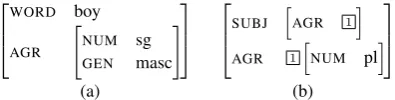
WORD boy AGR
"
NUM sg GEN masc
#
SUBJ hAGR 1 i
AGR 1 h
NUM pli
[image:2.595.310.527.62.144.2](a) (b)
Figure 1: Two example feature structures.
wardly to other mechanisms for filtering deriva-tion trees, as long as they can be expressed in terms of finite-state constraints on trees.
Plan of the paper. We will review FTAG in Sec-tion2and IRTGs and the TAG-to-IRTG encoding in Section3. We will then define the feature struc-ture algebra and show how it can be used to encode FTAG in Section4. We show how to do efficient and modular chart parsing for FTAG in Section5. Section6concludes.
2 TAG and feature structures 2.1 Feature structures
Feature structures (Shieber, 1986; Kasper and Rounds,1986;Carpenter,1992) are used in many grammar formalisms to represent grammatical in-formation. Intuitively, a feature structure (FS) as-signs values to a finite set of features; these val-ues may either be atomic, or they may be fea-ture strucfea-tures themselves. For instance, the FS in Fig.1a specifies that theWORD feature has the atomic value ‘boy’, and the value of theAGR fea-ture is a feafea-ture strucfea-ture with the feafea-tures NUM andGEN.
Technically, feature structures represent di-rected, acyclic graphs in which both the top-level FS and all of the FSs it contains are nodes. If F
has a featureFT, and the value of this feature inF
isG, then there is an edge (with labelFT) from the nodeF to the nodeG. We define afeature pathto
be a sequenceF1.F2. . . . .Fnof featuresFi. Then
if F is a feature structure, we write F.f1. . . . .fn
for featureselection, i.e. for the node inF that is
reached by the given feature path. We define the
depthof an FS as the length of the longest defined feature path.
As a special case, it can happen that the same node is reachable via two different feature paths, i.e. we haveF.p1 = F.p2 for feature paths p1 6= p2. This is called a reentrancy in F. We
repre-sent reentrancies in the attribute-value matrix no-tation of Fig. 1 by marking the endpoints of the reentrant feature paths with the same number. In Fig.1b, the marker 1 indicates thatF.SUBJ.AGR
S
NP↓ VP
sleeps NP
boy NP
the NP*
bot: [num: X = sg] top: [num: X]
bot: [num: sg, det: -] top: [det: +] top: [num: X, det: +]
bot: [num: X, det: -]
α1
α2 β1
Figure 2: An example FTAG derivation.
and F.AGR are the same node. Thus, we have F.SUBJ.AGR.NUM=pl.
We say that the FSF subsumesthe FSGif all
the information that F specifies, including
reen-trancies, is also present in G. The unification FtGofF andGis the least informative FS that
is subsumed both byF and G. Not all FSs can
be unified. For instance, the two example FSs in Fig.1cannot be unified because they specify con-tradictory values for the feature pathAGR.NUM, so no feature structure can be subsumed by both.
2.2 Feature TAG
Vijay-Shanker and Joshi(1988) extend TAG with feature structures, obtaining Feature-Based TAG (FTAG). The core point about FTAG is that every node in every elementary tree is decorated with two feature structures (FSs) – one for the “top” half of the node and one for the “bottom” half. If no auxiliary tree is adjoined at a given nodeu,
these two feature structures must be unified with each other. However, if an auxiliary treeβ is
ad-joined, then the top FS of u will be unified with
the top FS of the root ofβ, and the bottom FS of
u will be unified with the bottom FS of the foot
node. Finally, substitution unifies the top FSs of the substitution node and the root of the initial tree. This makes unification consistent with adjunction, and allows an elegant encoding of obligatory and selective adjunction constraints in terms of FSs.
FTAG assumes that the value of each feature in each top or bottom FS is an atomic value, ensuring that all FSs have depth one. This makes the set of possible FSs finite, and thus the expressive capac-ity of FTAG is the same as that of TAG without features.
An example derivation of FTAG is shown in Fig. 2. This derivation combines three elemen-tary trees α1, α2, β1 by substituting α2 into the
substitution node ofα1 and then adjoiningβ1into
the root of α2. Every node in these elementary
[image:2.595.85.283.63.113.2]structure; feature structures whose value is>, the trivial feature structure which subsumes all other feature structures, are not shown in the figure. The top and bottom FSs of the root ofα2cannot be
uni-fied with each other because they require different values for the “det” feature; thus a derivation tree in which nothing is adjoined into this node would be ungrammatical. By adjoiningβ1into this node,
we instead unify the top FS ofα2’s root with the
top FS ofβ1’s root, and the bottom FS ofα2’s root
with the bottom FS ofβ1’s foot node. Both
unifi-cations succeed.
FTAG requires that multiple occurrences of the same variable (such as X) within the FSs of the
same elementary tree must be instantiated with the same value. Thus when the occurrence ofXin the
bottom FS ofβ1’s foot node is bound to ‘sg’, the
occurrence of X in the top FS of β1’s root gets
the value ‘sg’ too. Further unifications percolate this value into the occurrence ofXinα1, which is
consistent with the requirement defined atα1’s V
node. By contrast, an elementary tree for “boys” would assign ‘pl’ to the “num” feature at its root node, making this unification fail and establishing ungrammaticality of “boys sleeps”.
The decision to assign feature structures to nodes (and not elementary trees), and to assign
two of them to each node, is necessary to make unification consistent with adjunction. However, it makes implementing parsers inconvenient, be-cause we do not even know what FSs need to be unified with each other before we have decided whether and what to adjoin at each node. One way to read this paper is as an illustration that these decisions are not so inextricably linked with each other as it may seem at first glance. Instead, unifi-cations can simply be performed bottom-up at the level of the derivation tree, enabling efficient chart parsing.
We identify the nodes in an elementary tree α
through their node addresses, i.e. words π ∈ N∗
such thatis the address of the root, andπkis the
address of thek-th child ofπ. Given an
elemen-tary treeαin an FTAG grammar, we writetopα(π)
for the top FS at the nodeπ andbotα(π) for the
bottom FS. We combine the two into the feature structure
φα(π) =
"
TOP topα(π)
BOT botα(π)
#
We drop the subscriptα if the elementary tree
is clear from the context.
3 Interpreted Regular Tree Grammars We tackle FTAG parsing below by encoding it as an Interpreted Regular Tree Grammar (IRTG, Koller and Kuhlmann(2011)). IRTG is a grammar formalism in which a language of derivation trees is described using aregular tree grammar(RTG, (Comon et al.,2008)) or, equivalently, afinite tree automaton, and each derivation tree is then inter-pretedin one or more algebras. Different grammar formalisms can be encoded into IRTG by varying the algebras; for instance, (Koller and Kuhlmann, 2012) encoded TAG into IRTG by introducing two novel algebras for strings and trees.
An IRTG which encodes the TAG grammar un-derlying the derivation in Fig.2is shown in Fig.3. The first column contains an RTG G which de-scribes a languageL(G) of derivation trees. The
RTG contains one rule for each elementary tree
α in the TAG grammar, expanding a nontermi-nal symbol of the formXS ifα is an initial tree
with root symbolX, or of the formXAifαis an
auxiliary tree (cf. Schmitz and Le Roux(2008)). Each rule also specifies the substitutions that must and the adjunctions that may take place at this el-ementary tree. Each of these nonterminals must be expanded by applying another RTG rule, corre-sponding to performing the respective substitution and adjunction. We can choose not to adjoin an auxiliary tree at a node where an adjunction could take place by expanding the nonterminalXAwith
the rule nopX. One derivation tree t ∈ L(G) is
shown in Fig.4; note the obvious correspondence to the derivation tree underlying the TAG deriva-tion in Fig.2.
This derivation tree can now be mapped into a term over an algebra, and evaluated there into an object of this algebra. In general, an algebra
over the signature Σ of operation symbols is a
structure A = (A,I) consisting of a set A (the domain of A) and an interpretation function I. This function assigns to each operation symbol
f ∈ Σof arityka functionI(f)that takesk
ar-guments fromAand returns a value inA. Thus, a
termτ over the signatureΣcan be evaluated to a
valueJτKrecursively by lettingJf(τ1, . . . , τk)K= I(f)(Jτ1K, . . . ,JτkK).
The second column of Fig.3shows how the ex-ample IRTG interprets derivation trees into strings. This assumes the TAG string algebra As = (As,Is)defined byKoller and Kuhlmann(2012).
RTG rule string homomorphismhs FS homomorphismhF
SS→α1(NPS,SA,VPA) wrap21(x2,conc11(x1,wrap21(x3,sleeps))) unify(cα1,embi1(x1),emba(x2),emba2(x3))
NPS→α2(NPA) wrap21(x1,boy) unify(cα2,emba(x1))
NPA→β1(NPA) wrap21(x1,conc12(the,∗)) unify(cβ1,emba(x1))
[image:4.595.366.468.174.277.2]XA→nopX ∗ cnop
Figure 3: The FTAG from Fig.2, encoded as an IRTG. There is anoprule for each nonterminalX ∈ {S,VP,NP}.
string pairs over a given alphabet; in the example, the alphabet contains the words “sleeps”, “boy”, and “the”. The signature ∆s contains a constant
for each of these words, a constant * denoting the pair (, ) of empty strings, plus a number
of binary operations which combine strings and string pairs. In particular, Is(conc11) is a
func-tion which takes two strings as arguments and concatenates them; Is(conc12) takes a string v
and a string pair (w1, w2)as arguments and
con-catenates them into the string pair(vw1, w2); and Is(wrap21)takes a string pair(v1, v2)and a string was arguments, and then “wraps” the string pair
around the string, yielding the stringv1wv2. Now
the IRTG G has an interpretation (hs,As). A
derivation tree tis recursively mapped to a term hs(t) by the tree homomorphism hs, and then hs(t) is evaluated to a value Jhs(t)K in As. In
this way,tdescribes a string. For instance, for the
derivation treet in Fig. 4, we obtainJhs(t)K =
“the boy sleeps”.
In general, an IRTG G =
(G,(h1,A1), . . . ,(hn,An)) consists of an
RTG G and n ≥ 1 interpretations. It describes
the language L(G) = {(Jh1(t)K, . . . ,Jhn(t)K) | t∈L(G)}. Thus, if we consider only the first and
second column in the example grammar in Fig.3, we have a grammar which describes a language of strings, and captures precisely the TAG part of the grammar underlying Fig.2. The third column is for the feature structure interpretation we define below, and extends the IRTG into an encoding of an FTAG grammar.
4 A feature structure algebra for FTAG As the grammar in Fig.3illustrates, the basic intu-ition of the TAG-to-IRTG encoding is to traverse the derivation tree bottom-up, calculating an in-terpretation for each node in the derivation tree. Each rule of the IRTG specifies the function by which the interpretation for the parent is calcul-cated from those of the children; so for instance, the second column of Fig.3expresses for each
el-α1
nopVP nopS
α2
β1
nopNP
Figure 4: Derivation tree of the IRTG in Fig. 3, representing the (F)TAG derivation of Fig.2.
ementary tree of the TAG grammar how it com-bines the strings of its children with each other.
We will follow the same intuition here and spec-ify how the feature structure for a subtree of the derivation tree is computed out of the FSs of its parts. We will first introduce an algebraFfor fea-ture strucfea-tures, with novel operations that are suit-able for FTAG, and then show how an FTAG can be converted into an IRTG over this algebra.
4.1 A feature structure algebra
We define an algebra F = (F,I) consisting of
a setF of feature structures and an interpretation functionI. We letFcontain all feature structures
whose feature paths have the formπ tb f, where π ∈ N∗ ∪ {RT,FT}is either a node address in an
elementary tree or a special feature for the root or foot node, respectively;tb∈ {TOP,BOT}; andfis
a feature from an FTAG grammar, as in Section2. The value reached under each feature path is either an atomic value, such as ‘sg’, or the placeholder
>, which unifies with any atomic value. We as-sume that every feature structure in F contains a RTfeature; it may or may not contain aFTfeature as well.
We define I to provide interpretations for the
following four classes of function symbols.
• Any constant c is interpreted as a feature
tree. We assume thatFhas a constantcF with I(cF) =F for each of these.
• For any path π ∈ N∗, we have a
func-tion symbol embiπ for initial-tree embed-ding. Given a feature structureF ∈ F, we let
I(embiπ) =EIπ with EIπ(F) = [π F.RT].
• For any path π ∈ N∗, we have a function
symbolembaπ forauxiliary-tree embedding.
Given a feature structure F ∈ F, we let I(embaπ) =EAπ with
EAπ(F) =
π
"
TOP F.RT.TOP BOT F.FT.BOT
#
• The binary function symbolunifyrepresents
unification of two feature structures. For any two arguments F, G ∈ F, we let
I(unify)(F, G) = F tG if F and G can
be unified; otherwise I(unify)(F, G) is
un-defined.
Note thatFis a partial algebra, in that not every term over the algebra has a value. This happens in particular if theunify operation attempts to unify two feature structures which cannot be unified. We say thatJtKis undefined in such a case.
4.2 Encoding FTAG with the feature structure algebra
We will now use this algebra to encode arbitrary FTAG grammars into IRTGs. We extend the TAG-to-IRTG encoding ofKoller and Kuhlmann(2012) with an additional interpretation (hF,F) into the
feature structure algebra (see the third column of Fig. 3). This means that we need to define, for each elementary treeαin the FTAG grammar, an
imagehF(α) for the homomorphism into the FS
algebra, which specifies howα combines the FSs
of its children.
Let us say that the elementary tree α
was encoded into an IRTG rule N → α(NS(1), . . . , NS(k), NA(k+1), . . . NA(n)) by the
con-version in Section3, withkchild nonterminals for
substitution andn−kfor adjunction. The
homo-morphic image hF(α) will select the RT and FT
entries of the FSs for the child nonterminals and unify them with one large FS T(α) representing
the functional behavior ofα; we will defineT(α)
below. Letcα be the constant withI(cα) =T(α)
(assumed to exist above). Then we let
hF(α) = unify(cα,
embiπ1(X1), . . . ,embiπk(Xk),
embaπk+1(Xk+1), . . . ,embaπn(Xn)),
where we abbreviate then−1binaryunify
opera-tions that are needed to combine the arguments by simply writingunifyonce.
We constructT(α) = F(α)tI(α)tN(α)t
R(α) by unifying four smaller feature structures,
each of which encodes one specific aspect ofα:
1. A feature structureF(α)which captures the
top and bottom feature structures at each node ofα. For any nodeπ ofα,F(α)
con-tains an entry[π φα(π)].
2. A feature structure I(α) which enforces the
coindexations for features in α that share
variables. If a variableXoccurs both at fea-turef1in thetb1feature structure of the node π1 (wheretb1 ∈ {TOP,BOT}) and at feature f2in thetb2FS of the nodeπ2, we let
π1
tb1
h
f1 1
i
π2
tb2
h
f2 1
i
subsumeI(α).
3. A feature structure N(α) which unifies the
top and bottom feature structures at nodes where nothing can be adjoined. This includes all foot nodes, as well as all nodes explicitly marked with a null adjunction constraint. The IRTG rule contains no child nonterminal for adjoining at this node; thus without N(α),
the top and bottom FSs at these nodes would not get unified at all. For all such nodesπ,
we let
π
"
TOP 1
BOT 1
#
subsumeN(α). Note that substitution nodes do not generate entries in N(α), as this
would unify the top and bottom FS of the root of an initial tree substituted there.
4. A feature structure R(α) which makes the
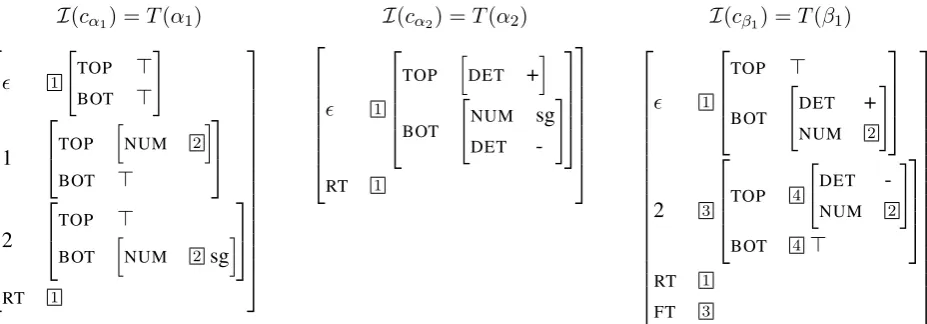
I(cα1) =T(α1) I(cα2) =T(α2) I(cβ1) =T(β1) 1 " TOP > BOT > # 1 TOP h NUM 2 i BOT > 2
TOP >
BOT hNUM 2 sg
i RT 1 1
TOP hDET +i
BOT " NUM sg DET -# RT 1 1 TOP > BOT " DET + NUM 2 # 2 3 TOP 4 " DET -NUM 2 #
BOT 4 >
[image:6.595.88.552.61.223.2] RT 1 FT 3
Figure 5: Feature structure encodings for the elementary trees in Fig.2.
tree, we let
R(α) =
" RT 1
1
#
Ifαis an auxiliary tree with its foot node at
addressπ, we let
R(α) =
RT 1 FT 2 1 π 2
In addition to rules that encode elementary trees, the IRTG also contains rules XA → nopX
for every nonterminal symbolX. For these
sym-bols, we let hF(nopN) = cnop, with a constant cnopwhich evaluates to the feature structure
I(cnop) =Fnop =
RT hTOP 1
i
FT hBOT 1
i
Thus, whenever we choose not to adjoin an aux-iliary tree at a certain node, the IRTG encodes this with a nopoperation. When the FS for this nop
operation is unified into the parent FS using an
embaπ operation, this unifies the top and bottom
feature structures ofπ, as required in FTAG.
4.3 An example
We illustrate this construction with the example FTAG grammar from Fig.2. The homomorphism
hF is shown in the third column of Fig.3; it uses
constants cα1, cα2, cβ1, whose values are the FSs shown in Fig.5.
unify emba2 cnop unify emba cnop unify embi1 unify emba unify emba cnop
cβ1
cα2
[image:6.595.335.494.257.442.2]cα1
Figure 6: The termhF(t)over the feature structure
algebra for the derivation treetfrom Fig.4.
Note first that all three FSs have one feature for each (non-lexical) node in the respective elemen-tary tree, with aTOPandBOTfeature nested below, representing the upper and lower feature structure of that node. This part of the feature structure is contributed byF(α). Any two occurrences of the
same variable are coindexed throughI(α); see e.g.
the index 2 inT(α1)and the index 2 inT(β1).
Furthermore, all nodes where no adjunction can take place have had their top and bottom feature structure coindexed byN(α). The index 4 for the
foot node at position 2 inβ1 was introduced like
this. Finally, all three FSs have aRTfeature, con-tributed byR(α)and coindexed with thefeature
for the root node of the elementary tree. Because
β1is an auxiliary tree,T(β1)also has aFTfeature,
coindexed with the foot node at position 2. Now consider the IRTG derivation tree t in
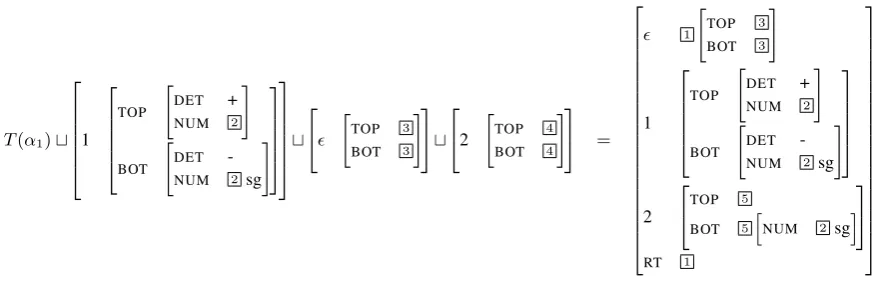
T(α1)t 1 TOP " DET + NUM 2 # BOT " DET -NUM 2 sg
# t " TOP 3 BOT 3 # t 2 " TOP 4 BOT 4 # = 1 " TOP 3 BOT 3 # 1 TOP " DET + NUM 2 # BOT " DET -NUM 2 sg
# 2 TOP 5
BOT 5 h
[image:7.595.79.517.72.214.2]NUM 2 sg i RT 1
Figure 7: Computing the valueJhF(t)Kof the term in Fig.6.
The homomorphism hF mapst to a term hF(t)
over the FS algebraF, shown in Fig.6. We have marked with a box the root of each subtreehF(t0)
where t0 is a subtree of t. Observe that each “block” between two boxed nodes has a consis-tent shape, in that it unifiescα with a number of
FSs, each of which is obtained by embedding the FS for a subtree into the features ofT(α).
The termhF(t)can then be evaluated to a
fea-ture strucfea-ture JhF(t)K in the algebra F. The last
step of computing JhF(t)K for the entire term hF(t) in Fig. 6 is shown in Fig. 7. We
per-form three unification operations, with the first argument being I(cα1) = T(α1) and the sec-ond being the value of the sub-derivation-tree
α2(β1(nopNP)), embedded at the substitution
node 1. The other two arguments come from the
nop nodes, embedded at the appropriate features
throughembaπoperations. Notice that the top and
bottom feature structures at 1 are not coindexed, because we adjoined β1 into the root of α2, and
the top and bottom features are not coindexed in
T(β1).
5 Parsing
We now turn to the issue of FTAG parsing. By en-coding an FTAG grammar as an IRTG with an in-terpretation into the FS algebra, we can apply stan-dard methods from IRTG parsing to FTAG pars-ing. We will first compute a parse chart for the input string while ignoring the feature structures, and then intersect it with an RTG that carries out the unifications.
The specific parsing problem we solve is as fol-lows: Given an IRTGG= (G,(hs,As),(hF,F))
and an input string w, find a compact
represen-tation Cw of the set parses(w) = {t ∈ L(G) |
Jhs(t)K=wandJhF(t)Kis defined}– that is, the
derivationtmust be grammatical according toG;
it must map to the input string under the string in-terpretation; and all unifications required by the feature structure interpretation succeed. We will represent thisparse chartCwas an RTG such that L(Cw) =parses(w).
5.1 Parsing without feature structures
In a first step, we apply standard methods from IRTG parsing (Koller and Kuhlmann,2011; Groschwitz et al.,2016) to obtain a parse chart of all grammatical derivation trees that interpret tow.
We do this by computing adecomposition gram-marDwforwin the TAG string algebra – i.e., an
RTG such thatL(Dw) is the set of all terms over
the TAG string algebra that evaluate tow. We then
look at the set LI = h−s1(L(Dw))of derivation
trees t such that hs(t) ∈ L(Dw), i.e. of
deriva-tion trees that interpret tow. Because regular tree languages are closed under inverse tree homomor-phisms (Comon et al.,2008), we can calculate an RTGIw such thatL(Iw) = LI. Because regular
tree languages are also closed under intersection, we can then intersectIw withGto obtain an RTG C0
w such that L(Cw0) = {t ∈ L(G) | Jhs(t)K = w}. We callCw0 thepre-chartforw.
Consider, by way of example, the pre-chartCw0
for the input string w = “the boy sleeps” and
our example grammar; seeKoller and Kuhlmann (2012) for details. The nonterminals of Cw0 are
pairs of nonterminals of the derivation tree RTG
Gand nonterminals ofIw. Nonterminals ofIw of
the formi−kcan derive terms which evaluate to
the substring of w from positioni to k−1; we
nonter-minals as[Ns, i−k]. Nonterminals ofIw can also
be of the form(i−j, k−l), for terms which
evalu-ate to a pair of substrings ofw(from positionito j−1and fromktol−1respectively). We write pairs of nonterminalsNAwith such nonterminals
ashNa, i−j, k−li. Note that a spani−irepresents
an empty string at positioni. Some of the rules in Cw0 are as follows:
hNPA,1−1,3−3i → nopNP hNPA,2−2,3−3i → nopNP
hNPA,1−2,3−3i → β1(hNPA,1−1,3−3i)
[NPS,2−3] → α2(hNPA,2−2,3−3i)
[NPS,1−3] → α2(hNPA,1−2,3−3i)
Using these rules, we can derive both the sub-derivation-treet1 =α2(nopNP), which evaluates
to the string “boy” (as an NP) on the string in-terpretation of the IRTG, and the sub-derivation-treet2 =α2(β1(nopNP)), which evaluates to “the
boy”. Notice that while both of these subtrees are allowed by the underlying TAG grammar, only
hF(t2) can be evaluated over the FS algebra. To
evaluatehF(t1), we would have to unify the top
and bottom FS at the root ofα2, which fails.
5.2 Feature structure filtering
In order to exclude t1 from the language of the
chart, while retaining t2, we can define an RTG
FG, which tracks feature structures and filters out trees with unification failures. The nonterminals of FG are symbols [F], where F is any feature structure inF; this is a finite set because we have limited the depth of these feature structures to three. We can then define rules for FG which sim-ply interpret the function symbols ofF:
[I(c)] → c for constantsc
[EIπ(F)] → embiπ([F])
[EAπ(F)] → embaπ([F])
[FtG] → unify([F],[G]) if defined
We add a start symbolSFG and rulesSFG →[F]
for all feature structures F. Then the language L(FG)consists exactly of all termsτ overFsuch thatJτKis defined. As a consequence, we can
in-tersectCw0 withh−F1(FG)to obtain the chartCw,
which describes only derivation trees that can be interpreted in the FS algebra, i.e. where all unifi-cations succeed.
In our example, the intersectionCwofCw0 with
FG contains (among others) the following rules:
hNPA,1−1,3−3, Fnopi → nopN
hNPA,2−2,3−3, Fnopi → nopNP
hNPA,1−2,3−3, F1i → β1(hNPA,1−1,3−3, Fnopi)
[NPS,1−3, F2] → α2(hNPA,1−2,3−3, F1i)
[NPS,1−3, SFG] → [NPS,1−3, F2],
where F1 = T(β1) t EA(Fnop) and F2 = T(α2) tEA(F1); we have already seen F2 as
the second argument of the unification in Fig. 7. One can think of these rules as copies of the rules fromC0
w, each decorated with a feature structure.
Observe that the rule for[NPS,1−3],
correspond-ing to “the boy”, is simply extended with the FS
F2. The chart has further rules (not shown above)
which derive the derivation tree t from Fig. 4, which contains t2 as a subtree, we we find that t∈L(Cw) =parses(w).
By contrast, Cw does not contain decorated
rules for[NPS,2−3]. This is becauseJhF(t1)Kis
undefined in F, and thereforet1 is not inL(FG),
and the pre-chart rule for[NPS,2−3]is filtered out
by the intersection algorithm.
5.3 Discussion
Our parsing algorithm computes the full parse chart in two steps: We first parse the input into the pre-chart and then refine the pre-chart into a chart by intersecting it with an RTG which fil-ters out derivation trees that do not unify. The filter grammar FG and the intersection algorithm can be implemented in a way that does not require us to compute all rules of FG beforehand (which would be extremely expensive). Instead, the in-tersection algorithm can query the rules of FG as it goes along, which essentially amounts to eval-uating the operations ofFon the feature structure decorations.
5.4 Implementation
We have implemented the FS algebra and the fil-ter grammar described above in the context of the Alto IRTG parser (Gontrum et al., 2017). Alto is available open-source from https:// bitbucket.org/tclup/alto.
Our implementation uses well-known efficient algorithms for unification (Tomabechi,1991) and subsumption checking (Malouf et al.,2000). Sub-sumption checking is needed because as the inter-section algorithm discovers new candidate rules for Cw, it has to check whether another rule
with an equal feature structure already exists; this equality checking is performed by testing whether each FS subsumes the other one. Parsing effi-ciency could be improved further by replacing this with asymmetric subsumption checks and retain-ing only the chart rule with the less informative FS (Zhang et al.,2007).
6 Conclusion
We have defined an algebra of feature structures and used it to encode FTAG grammars into IRTG grammars with two interpretations – one over a TAG string algebra and one over the feature struc-ture algebra. We have shown how to do FTAG parsing by intersecting a parse chart with respect to the input string with an RTG which attempts to carry out the unifications required by the FTAG grammar. This yields a clean, LFG-style sepa-ration of the derivation process of TAG (includ-ing adjunction) from unification, and an efficient parsing algorithm that performs unifications on the chart and not the individual derivation trees.
One advantage of our FS algebra is that it can be combined freely with any other grammar formal-ism that can be encoded in IRTG. It should, for in-stance, be straightforward to define feature-based LCFRS by adding variants of embaπ for rules
of higher fan-out. By adding further interpreta-tions, we can also build feature-basedsynchronous
grammars, e.g. for semantic parsing (Peng et al., 2015; Groschwitz et al., 2015). An interesting challenge would be to attempt to encode LFG into IRTG, using a string interpretation for the c-structure and a variant of the FS algebra intro-duced here for the f-structure. This would require dealing with arbitrarily deep feature structures (as opposed to ones of bounded depth as in FTAG), and encoding LFG’s completeness and coherence constraints into a filter grammar.
Acknowledgments. I am grateful to the review-ers for their insightful and constructive com-ments, and to Jessica Grasso, Jonas Groschwitz, Christoph Teichmann, and Stefan Thater for dis-cussions. I am also indebted to the students in my Grammar Formalisms classes at the University of Potsdam for demanding a faster FTAG parser, and those at Saarland University for being the first users of the system described here.
References
Srinivas Bangalore, Pierre Boullier, Alexis Nasr, Owen Rambow, and Benoit Sagot. 2009. MICA: A prob-abilistic dependency parser based on Tree Insertion Grammars. In Proceedings of NAACL HLT 2009: Short Papers.
Bob Carpenter. 1992. The logic of typed feature struc-tures. Cambridge University Press.
Hubert Comon, Max Dauchet, Remi Gilleron, Florent Jacquemard, Denis Lugiez, Christof Lding, Sophie Tison, and Marc Tommasi. 2008. Tree automata techniques and applications. Available onhttp: //tata.gforge.inria.fr/.
Johannes Gontrum, Jonas Groschwitz, Alexander Koller, and Christoph Teichmann. 2017. Alto: Rapid prototyping for parsing and translation. In Proceedings of the 15th Conference of the European Chapter of the Association for Computational Lin-guistics (EACL): Demo Session.
Jonas Groschwitz, Alexander Koller, and Mark John-son. 2016. Efficient techniques for parsing with tree automata. InProceedings of the 54th Annual Meet-ing of the Association for Computational LMeet-inguistics (ACL).
Jonas Groschwitz, Alexander Koller, and Christoph Te-ichmann. 2015. Graph parsing with s-graph gram-mars. In Proceedings of the 53rd Annual Meet-ing of the Association for Computational LMeet-inguistics (ACL-IJCNLP).
Laura Kallmeyer, Wolfgang Maier, Yannick Parmen-tier, and Johannes Dellert. 2010. TuLiPA – Pars-ing extensions of TAG with Range Concatenation Grammars. Bulletin of the Polish Academy of Sci-ences – Technical SciSci-ences58(3):377–391.
Ronald Kaplan and Joan Bresnan. 1982. Lexical-functional grammar: A formal system for grammat-ical representation. In Joan Bresnan, editor, The Mental Representation of Grammatical Relations, MIT Press, Cambridge, MA, pages 173–381.
Alexander Koller and Marco Kuhlmann. 2011. A gen-eralized view on parsing and translation. In Pro-ceedings of the 12th International Conference on Parsing Technologies (IWPT).
Alexander Koller and Marco Kuhlmann. 2012. De-composing TAG algorithms using simple alge-braizations. InProceedings of the 11th TAG+ Work-shop.
Robert Malouf, John Carroll, and Ann Copestake. 2000. Efficient feature structure operations with-out compilation. Natural Language Engineering 6(1):29–46.
Xiaochang Peng, Linfeng Song, and Daniel Gildea. 2015. A synchronous hyperedge replacement gram-mar based approach for AMR parsing. In Proceed-ings of the Nineteenth Conference on Computational Natural Language Learning (CoNLL).
Sylvain Schmitz and Joseph Le Roux. 2008. Feature unification in TAG derivation trees. InProceedings of the 9th TAG+ Workshop.
Stuart Shieber. 1986. An introduction to unification-based approaches to grammar. CSLI Publications.
Hideto Tomabechi. 1991. Quasi-destructive graph uni-fication. In Proceedings of the 29th Annual Meet-ing of the Association for Computational LMeet-inguistics (ACL).
K. Vijay-Shanker and Aravind Joshi. 1988. Feature structures based tree-adjoining grammar. In Pro-ceedings of COLING.
XTAG Research Group. 2001. A lexicalized tree adjoining grammar for english. Technical Report IRCS-01-03, IRCS, University of Pennsylvania. ftp://ftp.cis.upenn.edu/pub/xtag/ release-2.24.2001/tech-report.pdf.
Yi Zhang, Stephan Oepen, and John Carroll. 2007. Ef-ficiency in unification-basedn-best parsing. In