Proceedings of the 12th International Workshop on Semantic Evaluation (SemEval-2018), pages 679–688
SemEval-2018 Task 7: Semantic Relation Extraction and Classification in
Scientific Papers
Kata G´abor1, Davide Buscaldi1, Anne-Kathrin Schumann2, Behrang QasemiZadeh3, Ha¨ıfa Zargayouna1, Thierry Charnois1
1 LIPN, CNRS (UMR 7030), Universit´e Paris 13
2 ProTechnology GmbH, Dresden
annek [email protected]
3 DFG SFB 991, Heinrich-Heine University, Dsseldorf
Abstract
This paper describes the first task on seman-tic relation extraction and classification in sci-entific paper abstracts at SemEval 2018. The challenge focuses on domain-specific seman-tic relations and includes three different sub-tasks. The subtasks were designed so as to compare and quantify the effect of different pre-processing steps on the relation classifica-tion results. We expect the task to be relevant for a broad range of researchers working on extracting specialized knowledge from domain corpora, for example but not limited to sci-entific or bio-medical information extraction. The task attracted a total of 32 participants, with 158 submissions across different scenar-ios.
1 Introduction
One of the emerging trends of natural language technologies is their use for the humanities and sci-ences. Recent works in the semantic web (Osborne and Motta,2015;Wolfram,2016) and natural lan-guage processing (Tsai et al., 2013;Luan et al.,
2017;Augenstein and Søgaard,2017;Kim et al.,
2010) aimed to improve the access to scientific literature, and in particular to respond to informa-tion needs that are currently beyond the capabilities of standard search engines. Such queries include finding all papers that address a problem in a spe-cific way, or discovering the roots of a certain idea. This ambition involves the identification and classi-fication of concepts, and the relations connecting them.
The purpose of the task is to automatically iden-tify relevant domain-specific semantic relations in a corpus of scientific publications. In particular, we search for and classify relations that provide snippets of information such as ”a (new) method is proposed for a task”, or ”a phenomenon is found
in a certain context”, or ”results of different exper-iments are compared to each other”. Identifying such semantic relations between domain-specific concepts allows us to detect research papers which deal with the same problem, or to track the evolu-tion of results on a certain task.
2 Related Work
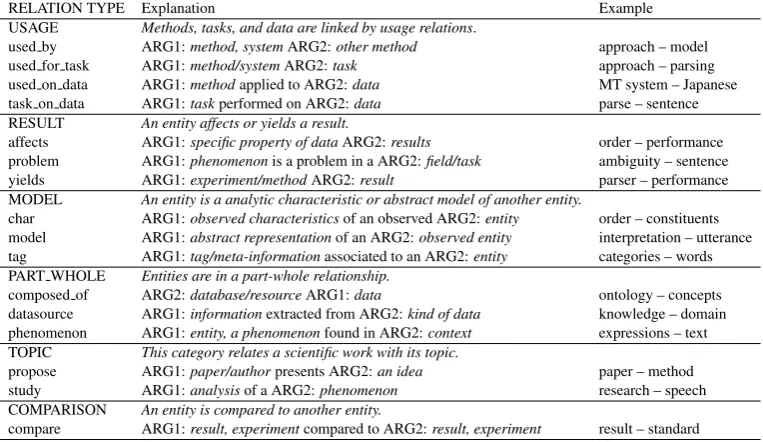
SemEval 2010 Task 8 (Hendrickx et al., 2010) proposed a discrete classification of word pairs into 9 semantic relations, however, this task was not tailored to the needs of scientific text analysis as neither relation types nor the vocabulary were domain-specific. SemEval 2012 Task 2 (Jurgens et al.,2012) proposed a gradual notion of relational similarity: the task was to quantify the similarity between examples of relation instances. The data set was aimed at evaluating specific semantic rep-resentations for relational similarity, but does not fit our task: in this task, entity pairs were treated as static class instances; in particular, they were presented without any context. However, the re-lation types we deal with are contextual: e.g., a specificmachine learning methodis trained on a specific data set to perform an NLP task in the context of a given experiment reported by a pa-per. Finally, the most closely related to our task is SemEval 2017 Task 10 (Augenstein et al.,2017), which responds to the growing interest towards the semantic analysis of scientific corpora. This task focuses mostly on keyword extraction and cate-gorization. The subtask concerned with relation classification proposes 3 categories of taxonomic relations (synonym, hypernym, unrelated). Our task goes a step further by proposing a more fine-grained and, thus, more informative set of semantic relations (see Table 1). The relation types were selected and annotated based on a careful corpus study and are intended to represent the major
lations that define the information content of the abstract of a scientific paper.
3 Task description
The task consists in identifying and classifying in-stances of semantic relations between concepts in a set of 6 discrete categories. The relations are spe-cific to the science domain and their instances can frequently be found in the abstract/introduction of scientific papers. The task is split into three sub-tasks. This is done to provide a framework for the systematic evaluation of the steps that are necessary for full information extraction from scientific text, i. e. relation extraction and relation classification. Two of the subtasks focus solely on the classifica-tionof relation instances into 6 relation categories. Another subtask includes both theextractionof re-lation instances and theirclassification. The data we provide is presented as complete abstracts of scientific papers. An abstract contains about 100 words on average. Entities are annotated in both the training and the test data. Furthermore, in the classification subtasks, the relation instances (en-tity pairs that belong to one of the relation classes) as well as the directionality of the relation (argu-ment1, argument2) are given in the training and test data. In the extraction subtask, relation instances are not provided in the test data. The training data for each subtask contains 350 annotated abstracts with the corresponding relation instances and their categories1. The test data consists of 150 abstracts2.
Participants were allowed three submissions/sub-task/team.
3.1 Relation classification scenario
Given a pair of entities in an abstract, the task con-sists in classifying the semantic relation between them. A pre-defined list of relations is given (see Table1), together with training examples for each relation.
• Subtask 1.1 : Relation classification on
clean data.
Entity occurrences aremanuallyannotated in both the training and the test data. In the train-ing data, semantic relations are manually an-notated between entities. In the test data, only
1The training data for subtask 1.1 and subtask 2 were
identical.
2After the end of the competition, the complete dataset
was published athttps://lipn.univ-paris13.fr/ ˜gabor/semeval2018task7/
entity annotations and unlabeled relation in-stances are given. The task is to predict the semantic relation between the entities. The following example shows a text snippet with the information provided in the test data :
Korean, a <entity id=”H01-1041.10”>verb final language</en-tity>with <entity id=”H01-1041.11”>overt case markers</en-tity>(...)
A relation instance is identified by the unique identifier of the entities in the pair, e.g. (H01-1041.10, H01-1041.11). The informa-tion to be predicted is the relainforma-tion class la-bel: MODEL-FEATURE(1041.10, H01-1041.11).
• Subtask 1.2 : Relation classification on
noisy data.
Entity occurrences are automatically anno-tated in both the training and the test data. Delimitation errors may occur in the entity annotation. In the training data, semantic re-lations are manually annotated between the entities. In the test data, only automatic entity annotations and unlabeled relation instances are given. The task is to predict the semantic relation between the entities. The following example shows a text snippet with the infor-mation provided in the test data:
This <entity
id=”L08-1203.8”> paper </entity> in-troduces a new <entity id=”L08-1203.9”>architecture</entity>(...) The relation instance is (1203.8, L08-1203.9). The information to be predicted is
the relation class label: TOPIC(L08-1203.8, L08-1203.9)
3.2 Relation extraction and classification scenario
Given an abstract with annotated entities, the sub-task consists in:
• identifying instances of semantic relations be-tween entities in the same sentence,
RELATION TYPE Explanation Example USAGE Methods, tasks, and data are linked by usage relations.
used by ARG1:method, systemARG2:other method approach – model used for task ARG1:method/systemARG2:task approach – parsing used on data ARG1:methodapplied to ARG2:data MT system – Japanese task on data ARG1:taskperformed on ARG2:data parse – sentence RESULT An entity affects or yields a result.
affects ARG1:specific property of dataARG2:results order – performance problem ARG1:phenomenonis a problem in a ARG2:field/task ambiguity – sentence yields ARG1:experiment/methodARG2:result parser – performance MODEL An entity is a analytic characteristic or abstract model of another entity.
char ARG1:observed characteristicsof an observed ARG2:entity order – constituents model ARG1:abstract representationof an ARG2:observed entity interpretation – utterance tag ARG1:tag/meta-informationassociated to an ARG2:entity categories – words PART WHOLE Entities are in a part-whole relationship.
composed of ARG2:database/resourceARG1:data ontology – concepts datasource ARG1:informationextracted from ARG2:kind of data knowledge – domain phenomenon ARG1:entity, a phenomenonfound in ARG2:context expressions – text TOPIC This category relates a scientific work with its topic.
propose ARG1:paper/authorpresents ARG2:an idea paper – method study ARG1:analysisof a ARG2:phenomenon research – speech COMPARISON An entity is compared to another entity.
[image:3.595.108.490.63.284.2]compare ARG1:result, experimentcompared to ARG2:result, experiment result – standard
Table 1: Semantic relation typology. The six major relation types result from a finer grained classification which was used in manual annotation.
The training data we provide contains the same information as in the classification scenario, i.e. manually annotated entities, and labeled seman-tic relations holding between entities. The test data contains only abstracts with annotated entities: both the entity pairs and their relation type are to be predicted.
3.3 Evaluation
Submissions are evaluated differently for the indi-vidual subtasks. A dedicated gold standard contain-ing entity and relation annotations is used.
3.3.1 Metrics for the classification scenario (subtasks 1.1 and 1.2)
Submissions for scenario 1 are assessed by means of standard metrics:
• Class-wise evaluation: Precision, recall, and F1 (β= 1) for each relation type.
• Global evaluation:
– Macro-average of the F1 scores obtained for every relation type.
– Micro-average of the F1 scores obtained for every relation type.
The official ranking of submissions is performed according to themacro-average F1 score.
3.3.2 Metrics for the extraction and classification scenario (Subtask 2)
Evaluation of submissions for scenario 2 is carried out in two steps:
• Evaluation of relation extraction: Extrac-tion evaluaExtrac-tion assesses the quality of identi-fied relation instances. Relation labels and di-rectionality are ignored in this step.Precision
is calculated as the percentage of correctly connected entity pairs.Recallis calculated as the percentage of gold entity pairs found by the system. The officialF1 scoreis calculated as the harmonic mean of precision and recall.
• Evaluation of relation classification: Clas-sification evaluation considers only correctly identified relation instances as per step 1. For these instances, the same evaluation metrics are calculated as for task 1. The official score for this task ismacro-average F1.
4 Data Preparation
The task is carried out on abstracts from published research papers in computational linguistics. Two existing high-quality corpora were used as start-ing points for data creation, namely ACL RD-TEC 2.0 (QasemiZadeh and Schumann,2016) and ACL-RelAcS (G´abor et al.,2016a). Both resources are based on the ACL Anthology Reference Corpus (Bird et al.,2008). In ACL RD-TEC 2.0 entities were annotated manually, and it was used for the ”clean” subtasks (subtasks 1.1 and 2). In
4.1 Entity annotation
Manual (”clean”) entity annotations were carried out in accordance with the ACL RD-TEC anno-tation guidelines (Schumann and QasemiZadeh,
2015). Thus, for subtasks 1.1 and 2 (training data) termhood is defined by a combination of semantic, linguistic, and formal criteria. The formal criteria, for instance, aim at making the annotations maxi-mally useful for real-world extraction scenarios by accounting for various contextual usage patterns of terminological units in scientific prose. There-fore, annotators are instructed to annotate maximal noun phrases, abbreviations, and their contextual variants, including variants with incorrect spelling. Still, entity annotation proves to be a non-trivial task even for human expert annotators: Qasemi-Zadeh and Schumann(2016) show that agreement scores are satisfactory (e.g.,κ >0.7) only after a thorough annotation training phase and the subse-quent refinement of the annotation guidelines.
To extend the set of abstracts that were already available in ACL RD-TEC with double entity an-notations, expert annotators were recruited from amongst the task organizers. Annotators were asked to read the ACL RD-TEC annotation guide-lines. A training phase was carried out, during which each annotator carried out test annotations on unseen data. To facilitate annotations, abstracts were pre-annotated automatically using the auto-matic entity annotator of the ACL-RelAcS corpus (see below). Annotators were asked to correct the automatic annotations, in particular, to correct the boundary of the identified entity. Individual feed-back was provided to novice annotators and an-notation difficulties were clarified. Anan-notations were consistently monitored and potential causes for disagreement discussed and corrected.
The ACL RD-TEC already provided 171 double-annotated and 129 single-double-annotated abstracts. While double-annotations could directly be passed over to manual relation annotation, more single-pass annotations had to be performed to create a fully double-annotated training set. The remaining 150 abstracts for the test set of subtask 1.1 were single-annotated. It should be noted that, due to their origin from ACL RD-TEC, abstracts for sub-task 1.1 contain not only entity annotations, but also information about the the semantic class of the annotated entity. This information was not ex-plicitly included in the provided data, but was ac-cessible to participants through the original ACL
RD-TEC corpus.
The ”noisy” subtask (1.2) was carried out on data coming from the ACL-RelAcS corpus 1.0 (G´abor et al.,2016a). The corpus consists of 4.2 million words from the abstract and introduction sections of papers in the ACL Anthology Corpus, with an automatic annotation of entities. This automatic annotation is based on a gazetteer which, in turn, was created using a combination of terminology extraction tools and ontological resources. As a domain specific resource, the domain models and topic hierarchies in the NLP domain from Saffron Knowledge Extraction Framework3(Bordea,2013; Bordea et al.,2013) were included. Terminology extraction was performed with TermSuite (Daille et al., 2013) and the resulting list of terms was filtered by part of speech and looked up in BabelNet (Navigli and Ponzetto,2012). The extracted terms that were found in BabelNet were added to the gazetteer and used for automatic annotation.
4.2 Relation annotation
The work was divided as 1) defining the typology of semantic relations, 2) validation of the typology and of the annotation guidelines and 3) annotation. A data-driven approach was adopted to identify the relation types and define a typology (G´abor et al.,
2016b). Domain experts studied the abstracts with entity annotation and were instructed to read the text and indicate the semantic relations that are explicit and relevant for the understanding of the abstract. They annotated entity pairs and the text span between them which explicitly indicates the relation.
Instances of explicit relations were thus discov-ered and manually annotated in a sample of 100 ab-stracts from ACL-RelAcS. A fine-grained typology of domain-specific relations was set up. The fine-grained relation types (see Table1) were defined very precisely and specifically, e.g. using strict constraints on which types of entities the relations take as argument. The manual annotation used this typology; the relations were then automatically converted to the 6 types used in the classification tasks.
Only explicit relations were annotated, between already annotated entities. Entity annotation itself is never modified or corrected manually during the relation annotation phase. On the textual level, a semantic relation is conceived as a text span
ing two annotated instances of concepts within the same sentence. On the semantic level, relation types need to be specific enough to be easily distin-guished from each other by a domain expert. Anno-tation was carried out by one of the organizers and two NLP student annotators who were subjected to a training of three weeks during which they anno-tated 100 abstracts under supervision. This train-ing material was not included in the future dataset. Weekly feedback was given and difficult instances were discussed. If the annotation quality in the 100 abstracts was judged satisfactory, the annotator was allowed to carry on, and their subsequent annota-tions were included in the dataset (two out of three annotator candidates passed this phase).
Inter-annotator agreement was calculated using a double annotation on a sample of 150 abstracts from subtask 1.1 by two annotators. The overall class label agreement rate on these annotations was 90.8%. We also calculated the macro-averaged F1 score across classes, taking one of the annotators as ”gold standard”. The result was 0.91 (the per-formance of the best ranking system on this task is 0.81). When comparing agreement for individ-ual relations, it turns out that the relation with the lowest agreement (F1=0.83) is PART WHOLE, fol-lowed by RESULT (F1=0.89).
5 Results
5.1 Baseline system
As a baseline, we created a simple memory-based k-nearest neighbor (k-nn) search (Daelemans and van den Bosch,2005) which relies on a small set of hand-crafted features.
Given a sentencesannotated with an ordered set ofe1. . . enentities appearing in it, we first pull
out all tuples(ei, ej), in which j −i ≤ 2. For
each tuple(ei, ej), we encode their co-occurrence
context using a set of 5 vectors of low dimension-ality (n= 100). These vectors encode information about (a) tokens that appear before ei in s (we
use simple white-space tokenization), (b) tokens that appear betweenei andej, (c) tokens
appear-ing afterej, as well as (d) two additional vectors
that capture the context ofei andej occurrences in
the ACL Anthology Reference Corpus (Bird et al.,
2008). To encode information about these context-token occurrences into low-dimensional vectors, we use positive-only random projections ( Qasemi-Zadeh and Kallmeyer,2016). Additionally, feature vectors in each of the above-mentioned categories
are weighted using positive pointwise mutual infor-mation with respect to the collected co-occurrence information in vectors for each category for all the tuples in the training and test data (for each subtask). Finally, the weighted vectors are concate-nated to form a500dimensional feature vector for each entity pair.
For each subtask, all the(ei, ej)extracted from
the sentences in the training set are added to the k-nn’s training instance memoryT: if(ei, ej)is
annotated with a relation, then the fetched label is assigned to it, otherwise it is marked as a negative example. Given the feature vector~v for a tuple (ex, ey) in the test set, the similarity between~v
and all the training instancesti ∈T is computed
using the Pearson’s correlation to find thekmost
similarti. Finally, we assign(ex, ey)to the relation
categoryly using a majority voting.
Results obtained from this baseline system are listed in Tables5,7,6, and8in the Appendix. We choosek= 5based on the observed performances over the development dataset.
5.2 Summary of participating systems and results
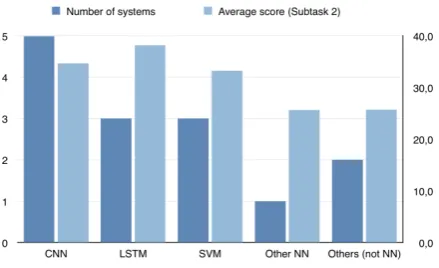
par-Figure 1: Popularity of methods chosen by participants (as number of systems that used the method, left) and average F1 score obtained for each method (right) in Subtask 1.1 and 1.2.
ticipants exploited the possibility of aggregating training data from subtask 1.1 and subtask 1.2.
[image:6.595.75.293.63.193.2]Word embeddings were used as features by the majority of systems (13 systems). Some partici-pants chose to calculate the embeddings on domain-specific corpora, such as ACL (4 systems) and arXiv (3systems), sometimes in combination with pre-trained embeddings. Pre-trained embeddings alone were used by a minority of participants, with TakeLab highlighting some problems in dealing with out-of-vocabulary words. Apart from the cor-pora dedicated to training the embeddings, partic-ipants didn’t use external resources, with the ex-ception of one system which employed VerbNet and two systems that used WordNet synonyms and hypernyms.
Figure 2: Popularity of methods chosen by participants (as number of systems that used the method, left) and average F1 score obtained for each method (right) in Subtask 2.
Among the chosen features, positional embed-dings were quite popular (5systems), to account for the relative position of the left and right entities.
Only three participants recurred to syntactic fea-tures, in particular dependency trees, despite their apparent relevance for the task.
SpaCy4and CoreNLP5 were the most popular
tools to analyze and preprocess text, with a slight preference for the first one (4 participants vs. 2).
6 Analysis of Results
6.1 Which processing step is the most difficult?
From the overall task results provided in the Ap-pendix (Tables5–8), it seems straightforward to conclude that the reliable identification of seman-tic relation instances is by far the most difficult step in the complete processing pipeline: Whereas systems reached an average F1 score of 47.28 in subtask 1.1 and 62.51 in subtask 1.2, performance scores drop rather sharply in scenario 2, namely to an average F1 of 30.8 for the extraction task and 20.34 for the extraction+classification task.
6.2 Which relation types are the most difficult to classify?
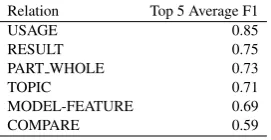
We examined whether there were relation types that were more difficult for the systems to clas-sify, and whether it is possible to relate this to the semantics of the relations. For instance, the class MODEL-FEATURE is broad because it en-compasses relatively different sub-classes: mod-els, parts of models (such as a representation, a tag used for a word), or attributes (frequency of a phenomenon). To analyze this, we calculated the average recall by relation type over a sample of submissions to subtask 1.1 (70 submissions) and 1.2 (42 submissions) and the characteristic predic-tion error types by relapredic-tion, if any (Table2). We also calculated the average F1 score by relation type of the five top scoring systems from different participants (Tables3and4).
Our analysis suggests that rather than the seman-tics of the relation types, it is their distribution in the data that poses difficulties. Class distribution is very imbalanced. Moreover, the distribution of classes in training and test data of subtask 1.1 and 1.2 is different. This difference is due to the na-ture of entities annotated automatically and those annotated manually. Because of the terminology extraction process and the resources that were used
4https://spacy.io/
5https://stanfordnlp.github.io/
[image:6.595.72.292.509.643.2]Relation Average recall Frequently mistaken for Training frequency Test frequency Subtask 1.1
USAGE 73% MODEL-FEATURE 483 175
TOPIC 66% - 18 3
MODEL-FEATURE 51% USAGE, PART WHOLE 326 66
PART WHOLE 44% USAGE, MODEL-FEATURE 234 70
COMPARE 42% USAGE 95 21
RESULT 40% USAGE 72 20
Subtask 1.2
TOPIC 77% - 243 69
USAGE 72% PART WHOLE 470 123
COMPARE 66% - 41 3
RESULT 65% USAGE 123 29
PART WHOLE 64% USAGE 196 56
[image:7.595.124.471.62.206.2]MODEL-FEATURE 52% USAGE, PART WHOLE 175 75
Table 2: Relations: results and distribution.
for annotation, entities in subtask 1.2 are typically shorter terms with an intermediate level of speci-ficity. On the other hand, entities in the clean sce-nario are more complex and more specific to the NLP domain. For instance, the TOPIC relation is more frequent in 1.2 than in 1.1 because entities like ”paper” or ”article” were annotated by the au-tomated process, but not in the manual annotation. Another aspect is that certain classes are lexi-cally less varied than others and this might well affect the ”difficulty” of the classification task. For instance, the TOPIC class has the lowest type-token ratio of all classes in subtask 1.26. This does not
seem surprising. Neither does it seem surprising that in subtask 1.2, TOPIC has gained the best av-erage recall (2) and the highest F1 score among the top-5 systems (4). TOPIC is also much more frequent in subtask 1.2 than in subtask 1.1 and this effect is one likely cause for the difference in per-formance achieved over subtasks 1.1 and 1.2.
Relation Top 5 Average F1
USAGE 0.85
RESULT 0.75
PART WHOLE 0.73
TOPIC 0.71
MODEL-FEATURE 0.69
COMPARE 0.59
Table 3: Relations: Task 1.1 average results top 5 sys-tems.
6.3 The effects of entity annotation
Entity annotation has a demonstrable effect on sys-tem performance. As stated earlier, annotation deci-sions have direct consequences for the distribution of certain types in the data and thus influence mea-surable system performance.
6In this analysis, a tuple of two entities pertaining to a
certain relation class was counted as a ”type”.
Relation Top 5 Average F1
TOPIC 0.97
RESULT 0.91
USAGE 0.87
COMPARE 0.80
PART WHOLE 0.80
MODEL-FEATURE 0.79
Table 4: Relations: Task 1.2 average results top 5 sys-tems.
A maybe rather surprising result of this task is the difference in system performance for sub-tasks 1.1 and 1.2. While ”clean” entities can, with some plausibility, be considered more useful for a potential human user of the extracted informa-tion, ”noisy” entity annotations seem to be more machine-friendly. The difference in the distribution of the TOPIC relation between subtasks 1.1 and 1.2 has already been pointed out as one potential cause for this effect. Moreover, the complexity of clean entities in subtask 1.1 could also have con-tributed to the performance gap. Manually anno-tated entities, in most cases, are long noun phrases, whereas automatically annotated entities in subtask 1.2 are generally shorter, partial (and therefore less specific!) entity matches. This also means that more training examples are likely to be found for automatically annotated entities. Moreover, some instances of automatic annotations in subtask 1.2 included explicit verbal relation cues. These cues sometimes explicitly state the type of the semantic relation, but they were not annotated in subtask 1.1. Verbal cues (e. g. the well-known Hearst patterns (Hearst,1992)) have typically been used in earlier work on relation classification and, in fact, several teams participating in the task describe recurrent verbal elements between relation arguments.
[image:7.595.114.250.525.595.2]de-serves further exploration for the following reasons: Firstly, highly specialized, complex terminological units are the main units of knowledge representa-tion in specialized domains. Secondly, task results clearly show that a careful handling of lexical in-formation improves performance: many successful systems in the task used domain-specific training data. The only system that treated complete spe-cialized entities as semantic units, UWNLP, ranked first in the relation extraction task. None of the systems participating in subtasks 1.1 or 2 used se-mantic class information available for annotated entities from ACL RD-TEC, although it may be hypothesized that this feature helps to generalize lexical instance information.
7 Conclusion and Future Work
We presented the setup and results of SemEval 2018 Task 7: Semantic relation extraction and clas-sification in scientific papers. The task is divided into three subtasks: classification on clean data, classification on noisy data, and a combined extrac-tion and classificaextrac-tion scenario. We also presented the dataset used for the challenge: a subset of ab-stracts of published papers in the ACL Anthology Reference Corpus, annotated for domain specific entities and semantic relations.
32 participants submitted to one or more sub-tasks. The most popular methods include Convo-lutional Neural Networks and Long Short Term Memory networks, with word embedding based features, often calculated on domain-specific cor-pora. Although it was allowed, only a minority of the participants used external knowledge resources. The results show that while good results can be obtained on the supervised multi-class classifica-tion of relaclassifica-tion instances, the extracclassifica-tion of such instances remains very challenging. Moreover, the quality and type of entity annotation also plays an important role in determining relation extraction and classification results.
Knowledge extraction from a special domain poses specific challenges, such as working with a smaller corpus, dealing with specialized vocabular-ies, and the scarcity of annotated data and available domain-specific resources. One of the important future directions is to explore domain adaptation techniques to address these issues.
Acknowledgments
This work was generously supported by the program ”Investissements d’Avenir” overseen by the French National Research Agency, ANR-10-LABX-0083 (Labex EFL). Behrang QasemiZadeh is funded by the Deutsche Forschungsgemeinschaft through the ”Collaborative Research Centre 991 (CRC 991): The Structure of Representations in Language, Cognition, and Science”.
References
Isabelle Augenstein, Mrinal Das, Sebastian Riedel, Lakshmi Vikraman, and Andrew McCallum. 2017.
Semeval 2017 task 10: ScienceIE - extracting keyphrases and relations from scientific
publica-tions. In Proceedings of the 11th International
Workshop on Semantic Evaluation (SemEval-2017), pages 546–555, Vancouver, Canada. Association for Computational Linguistics.
Isabelle Augenstein and Anders Søgaard. 2017. Multi-task learning of keyphrase boundary classification. In Proceedings of the 55th Annual Meeting of the Association for Computational Linguistics (ACL). Steven Bird, Robert Dale, Bonnie Dorr, Bryan Gibson,
Mark Joseph, Min-Yen Kan, Dongwon Lee, Brett Powley, Dragomir Radev, and Yee Fan Tan. 2008. The ACL Anthology Reference Corpus: A Refer-ence Dataset for Bibliographic Research in Compu-tational Linguistics. In Proceedings of the 6th In-ternational Conference on Language Resources and Evaluation (LREC 2008). European Language Re-sources Association.
Georgeta Bordea. 2013. Domain Adaptive Extraction of Topical Hierarchies for Expertise Mining. Phd thesis, National University of Ireland, Galway. Georgeta Bordea, Paul Buitelaar, and Tamara Polajnar.
2013. Domain-independent term extraction through domain modelling. In 10th International Confer-ence on Terminology and Artificial IntelligConfer-ence (TIA 2013).
Walter Daelemans and Antal van den Bosch. 2005.
Memory-Based Language Processing. Studies in Natural Language Processing. Cambridge Univer-sity Press.
Beatrice Daille, Christine Jacquin, Laura Monceaux, Emmanuel Morin, and Jerome Rocheteau. 2013. TTC TermSuite : Une chaine de traitement pour la fouille terminologique multilingue. In Proceed-ings of the Traitement Automatique des Langues Na-turelles Conference (TALN).
for the automatic analysis of scientific literature. In Proceedings of the International Conference on Language Resources and Evaluation (LREC), pages 3694–3701.
Kata G´abor, Hafa Zargayouna, Isabelle Tellier, Davide Buscaldi, and Thierry Charnois. 2016b. A typology of semantic relations dedicated to scientific literature analysis. In SAVE-SD Workshop at the 25th World Wide Web Conference. Lecture Notes in Computer Science 9792, pages 26–32.
Marti Hearst. 1992. Automatic acquisition of hy-ponyms from large text corpora. In COLING ’92, pages 539–545.
Iris Hendrickx, Su Nam Kim, Zornitsa Kozareva, Preslav Nakov, Diarmuid Saghdha, Sebastian Pad, Marco Pennacchiotti, Lorenza Romano, and Stan Sz-pakowicz. 2010. Semeval-2010 task 8: Multi-way classification of semantic relations between pairs of nominals. In Proceedings of the Workshop on Se-mantic Evaluations (SemEval-2010).
David A. Jurgens, Peter D. Turney, Saif M. Moham-mad, and Keith J. Holyoak. 2012. SemEval-2012 Task 2: Measuring degrees of relational similarity. InProceedings of the Workshop on Semantic Evalu-ations.
Su Nam Kim, Olena Medelyan, Min-Yen Kan, and Timothy Baldwin. 2010. Semeval-2010 task 5: Au-tomatic keyphrase extraction from scientific articles. InProceedings of SemEval 2010.
Yi Luan, Mari Ostendorf, and Hannaneh Hajishirzi. 2017. Scientific information extraction with semi-supervised neural tagging. InEMNLP 2017.
Roberto Navigli and Simone Paolo Ponzetto. 2012. Ba-belNet: The automatic construction, evaluation and application of a wide-coverage multilingual seman-tic network. Artificial Intelligence, 193:217–250.
F. Osborne and E. Motta. 2015. Klink-2: Integrat-ing multiple web sources to generate semantic topic networks. InProceedings of the 14th International Conference on The Semantic Web - ISWC 2015 - Vol-ume 9366, pages 408–424, New York, NY, USA. Springer-Verlag New York, Inc.
Behrang QasemiZadeh and Laura Kallmeyer. 2016.
Random Positive-Only Projections: PPMI-enabled
incremental semantic space construction. In
Pro-ceedings of the Fifth Joint Conference on Lexi-cal and Computational Semantics, pages 189–198, Berlin, Germany. Association for Computational Linguistics.
Behrang QasemiZadeh and Anne-Kathrin Schumann. 2016. The ACL RD-TEC 2.0: A language resource for evaluating term extraction and entity recogni-tion methods. In Proceedings of the International Conference on Language Resources and Evaluation (LREC).
Anne-Kathrin Schumann and Behrang QasemiZadeh. 2015. The ACL RD-TEC Annotation Guideline: A Reference Dataset for the Evaluation of Automatic Term Recognition and Classification. Technical re-port.
Chen-Tse Tsai, Gourab Kundu, and Dan Roth. 2013. Concept-based analysis of scientific literature. In
ACM Conference on Information and Knowledge Management ACM, pages 1733–1738.
Dietmar Wolfram. 2016. Bibliometrics, information retrieval and natural language processing: Natural
synergies to support digital library research. In
Appendix: Competition Results
Rank Participant Macro-F1 Score
1 ETH-DS3Lab 81.7
2 UWNLP 78.9
3 SIRIUS-LTG-UiO 76.7
4 ClaiRE 74.9
5 Talla 74.2
6 MIT-MEDG 72.7
7 TakeLab 69.7
8 Texterra 64.9
9 GU IRLAB 60.9
10 sbuNLP 49.7
11 IRCMS 49.1
12 OhioState 48.1
13 NTNU 47.4
14 danish037 45.7
15 HeMu 45.2
16 UniMa 44.0
17 LaSTUS/TALN 43.2
18 LIGHTREL 39.9
19 LTRC 37.3
N/A Baseline 34.4
20 BIT NLP 32.9
21 likewind 1234 29.3
22 Vitk 29.0
23 hccl 28.1
24 xingwang 27.8
25 SciREL 20.3
26 UKP 19.3
27 NEUROSENT-PDI 18.0
[image:10.595.75.255.539.717.2]28 angelocsc 15.0
Table 5: Results for subtask 1.1.
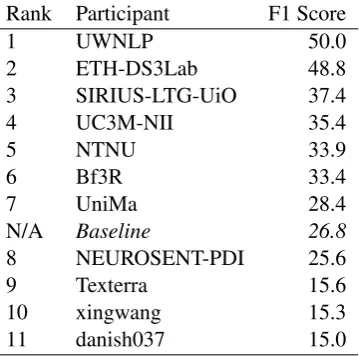
Rank Participant F1 Score
1 UWNLP 50.0
2 ETH-DS3Lab 48.8
3 SIRIUS-LTG-UiO 37.4
4 UC3M-NII 35.4
5 NTNU 33.9
6 Bf3R 33.4
7 UniMa 28.4
N/A Baseline 26.8
8 NEUROSENT-PDI 25.6
9 Texterra 15.6
10 xingwang 15.3
11 danish037 15.0
Table 6: Results for subtask 2: Extraction.
Rank Participant Macro-F1 Score
1 ETH-DS3Lab 90.4
2 Talla 84.8
3 SIRIUS-LTG-UiO 83.2
4 MIT-MEDG 80.6
5 GU IRLAB 78.9
6 ClaiRE 78.4
7 TakeLab 75.7
8 OhioState 74.7
9 Texterra 74.4
10 IRCMS 71.1
11 LaSTUS/TALN 69.5
12 LIGHTREL 68.2
13 NTNU 66.0
14 LTRC 65.7
N/A Baseline 53.5
15 likewind 1234 45.8
16 BIT NLP 40.7
17 hccl 38.0
18 xingwang 26.7
19 NEUROSENT-PDI 21.8
20 UKP 15.3
Table 7: Results for subtask 1.2.
Rank Participant Macro-F1 Score
1 ETH-DS3Lab 49.3
2 UWNLP 39.1
3 SIRIUS-LTG-UiO 33.6
4 Bf3R 20.3
5 UC3M-NII 18.5
6 NTNU 17.0
N/A Baseline 12.6
7 Texterra 9.6
8 xingwang 8.3
9 danish037 4.6
10 NEUROSENT-PDI 3.1