
3-(Pyridin-3-yl)propionic acid
Andreas Lemmerer
Molecular Sciences Institute, School of Chemistry, University of the Witwatersrand, Private Bag, PO WITS, 2050 Johannesburg, South Africa
Correspondence e-mail: [email protected]
Received 1 December 2010; accepted 14 December 2010
Key indicators: single-crystal X-ray study;T= 173 K; mean(C–C) = 0.002 A˚;
Rfactor = 0.040;wRfactor = 0.115; data-to-parameter ratio = 17.1.
In the crystal of the title compound, C8H9NO2, molecules
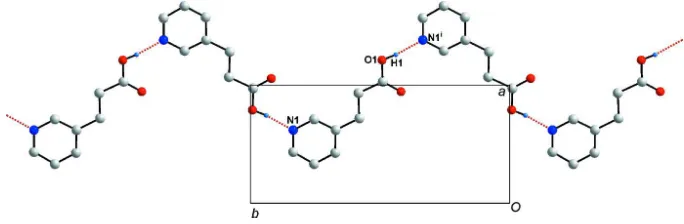
assemble to formC(8) chains along thebaxis by N—H O hydrogen bonds, supported by weaker C—H O hydrogen bonded-interactions between adjacent chains.
Related literature
For use of the title compound in coordination polymers, see: Wanget al.(2006). For graph-set nomenclature of hydrogen bonds, see: Bernsteinet al.(1995).
Experimental
Crystal data
C8H9NO2 Mr= 151.16 Monoclinic,P21=c a= 6.7157 (4) A˚ b= 14.6544 (13) A˚ c= 7.2993 (6) A˚ = 92.566 (5)
V= 717.64 (10) A˚3 Z= 4
MoKradiation = 0.10 mm1 T= 173 K
0.420.270.04 mm
Data collection
Nonius KappaCCD area-detector diffractometer
Absorption correction: integration (XPREP; Bruker, 1999) Tmin= 0.967,Tmax= 0.995
10553 measured reflections 1729 independent reflections 1341 reflections withI> 2(I) Rint= 0.051
Refinement
R[F2> 2(F2)] = 0.040 wR(F2) = 0.115 S= 1.02 1729 reflections
101 parameters
H-atom parameters constrained max= 0.26 e A˚3
min=0.26 e A˚3
Table 1
Hydrogen-bond geometry (A˚ ,).
D—H A D—H H A D A D—H A
O1—H1 N1i
0.84 1.75 2.5868 (13) 172
C3—H3 O1ii
0.95 2.47 3.3468 (15) 154
C5—H5 O2iii
0.95 2.63 3.3328 (15) 131
Symmetry codes: (i) xþ2;y1 2;zþ
1
2; (ii) x1;yþ 3 2;z
1 2; (iii)
xþ1;yþ1;z.
Data collection: COLLECT (Nonius, 1998); cell refinement:
DENZO(Otwinowski & Minor, 1997) andCOLLECT; data reduc-tion:DENZO andCOLLECT; program(s) used to solve structure:
SHELXS97(Sheldrick, 2008); program(s) used to refine structure:
SHELXL97 (Sheldrick, 2008); molecular graphics: ORTEP-3 for Windows (Farrugia, 1997) and DIAMOND (Brandenburg, 1999); software used to prepare material for publication:WinGX(Farrugia, 1999) andPLATON(Spek, 2009).
The University of the Witwatersrand and the Molecular Sciences Institute are thanked for providing the infrastructure and financial support to do this work.
Supplementary data and figures for this paper are available from the IUCr electronic archives (Reference: FJ2372).
References
Bernstein, J., Davis, R. E., Shimoni, L. & Chang, N.-L. (1995).Angew. Chem. Int. Ed. Engl.34, 1555–1573.
Brandenburg, K. (1999).DIAMOND. Crystal Impact GbR, Bonn, Germany. Bruker (1999).XPREP. Bruker AXS Inc., Madison, Wisconsin, USA. Farrugia, L. J. (1997).J. Appl. Cryst.30, 565.
Farrugia, L. J. (1999).J. Appl. Cryst.32, 837–838.
Nonius (1998).COLLECT. Nonius BV, Delft, The Netherlands.
Otwinowski, Z. & Minor, W. (1997). Methods in Enzymology, Vol. 276, Macromolecular Crystallography, Part A, edited by C. W. Carter Jr & R. M. Sweet, pp. 307–326. New York: Academic Press.
Sheldrick, G. M. (2008).Acta Cryst.A64, 112–122. Spek, A. L. (2009).Acta Cryst.D65, 148–155.
Wang, Y.-H., Suen, M.-C., Lee, H.-T. & Wang, J.-C. (2006).Polyhedron,25, 2944–2952.
Acta Crystallographica Section E
Structure Reports Online
supporting information
Acta Cryst. (2011). E67, o215 [https://doi.org/10.1107/S1600536810052384]
3-(Pyridin-3-yl)propionic acid
Andreas Lemmerer
S1. Comment
The molecule 3-pyridinepropionic acid (I) has been used as a ligand to make coordination polymers using Ag, Cu and Zn
(Wang et al., 2006). The crystal structure of the molecule itself has not been reported. The solid state packing involves
forming chains of molecules, generated by hydrogen bonding interactions from the carboxylic acid H to the lone pair of
the pyridine N atom. The chain, described using graph set notation (Bernstein et al., 1995) as C(8), is generated by the
twofold screw axis inherent in the spacegroup P21/c, and runs along the crystallographic b axis (See Fig 2). Adjacent
chains are stabilized by two C—H···O hydrogen bonds (See Table 1).
S2. Experimental
Crystals where grown by slow evaporation at ambient conditions of a methanol solution of 3-pyridinepropionic acid.
S3. Refinement
The C-bound H atoms were geometrically placed (C—H bond lengths of 0.95 (aromatic CH) and 0.99 (CH2) Å) and
refined as riding with Uiso(H) = 1.2Ueq(C). The O-bound H atom were geometrically placed and refined as riding with
[image:2.610.131.478.435.602.2]Uiso(H) = 1.5Ueq(O).
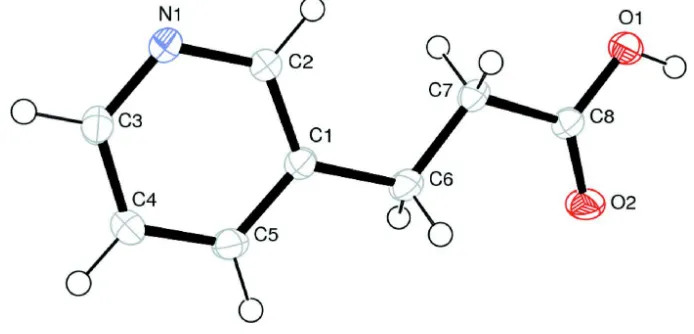
Figure 1
Figure 2
Hydrogen bonding C(8) chain of (I) using N—H···O hydrogen bonds (red dashed lines), generated by the twofold screw
axis. Symmetry code: (i) -x + 2, y - 1/2, -z + 1/2.
3-(Pyridin-3-yl)propionic acid
Crystal data
C8H9NO2
Mr = 151.16 Monoclinic, P21/c Hall symbol: -P 2ybc
a = 6.7157 (4) Å
b = 14.6544 (13) Å
c = 7.2993 (6) Å
β = 92.566 (5)°
V = 717.64 (10) Å3
Z = 4
F(000) = 320
Dx = 1.399 Mg m−3
Mo Kα radiation, λ = 0.71073 Å Cell parameters from 3866 reflections
θ = 0.4–30.0°
µ = 0.10 mm−1
T = 173 K Plate, colourless 0.42 × 0.27 × 0.04 mm
Data collection
Nonius KappaCCD area-detector diffractometer
2.0° π and ω scans
Absorption correction: integration (XPREP; Bruker, 1999)
Tmin = 0.967, Tmax = 0.995 10553 measured reflections
1729 independent reflections 1341 reflections with I > 2σ(I)
Rint = 0.051
θmax = 28°, θmin = 3.0°
h = −8→7
k = −19→19
l = −9→9
Refinement
Refinement on F2 Least-squares matrix: full
R[F2 > 2σ(F2)] = 0.040
wR(F2) = 0.115
S = 1.02 1729 reflections 101 parameters
0 restraints
H-atom parameters constrained
w = 1/[σ2(F
o2) + (0.0616P)2 + 0.1772P] where P = (Fo2 + 2Fc2)/3
(Δ/σ)max < 0.001 Δρmax = 0.26 e Å−3 Δρmin = −0.26 e Å−3
Special details
Experimental. Numerical integration absorption corrections based on indexed crystal faces were applied using the
XPREP routine (Bruker, 1999)
Fractional atomic coordinates and isotropic or equivalent isotropic displacement parameters (Å2)
x y z Uiso*/Ueq
C1 0.61989 (17) 0.67074 (7) 0.12796 (15) 0.0187 (3)
C2 0.71028 (18) 0.75445 (8) 0.16533 (16) 0.0198 (3)
H2 0.8419 0.755 0.2186 0.024*
C3 0.43377 (18) 0.83489 (8) 0.05545 (16) 0.0229 (3)
H3 0.3693 0.8916 0.0312 0.028*
C4 0.33224 (19) 0.75458 (8) 0.01309 (18) 0.0242 (3)
H4 0.2003 0.7561 −0.0395 0.029*
C5 0.42692 (18) 0.67253 (8) 0.04903 (16) 0.0221 (3)
H5 0.3602 0.6169 0.0198 0.026*
C6 0.71897 (18) 0.57984 (8) 0.16581 (17) 0.0236 (3)
H6A 0.7149 0.5443 0.0503 0.028*
H6B 0.6391 0.5461 0.2543 0.028*
C7 0.93261 (17) 0.58303 (8) 0.24056 (16) 0.0215 (3)
H7A 0.9366 0.6121 0.3631 0.026*
H7B 1.0116 0.6214 0.159 0.026*
C8 1.02756 (18) 0.48938 (7) 0.25664 (16) 0.0206 (3)
N1 0.61911 (15) 0.83489 (6) 0.12917 (14) 0.0212 (3)
O1 1.21073 (13) 0.49226 (6) 0.32765 (13) 0.0294 (3)
H1 1.2566 0.439 0.3362 0.044*
O2 0.94438 (13) 0.41935 (6) 0.20706 (13) 0.0315 (3)
Atomic displacement parameters (Å2)
U11 U22 U33 U12 U13 U23
C1 0.0190 (6) 0.0172 (6) 0.0201 (6) 0.0000 (4) 0.0022 (4) 0.0003 (4)
C2 0.0191 (6) 0.0182 (6) 0.0220 (6) −0.0004 (4) −0.0009 (4) 0.0008 (4)
C3 0.0229 (6) 0.0203 (6) 0.0255 (6) 0.0032 (5) 0.0000 (5) 0.0035 (4)
C4 0.0187 (6) 0.0262 (6) 0.0273 (6) −0.0001 (5) −0.0029 (5) 0.0026 (5)
C5 0.0214 (6) 0.0195 (6) 0.0254 (6) −0.0038 (4) 0.0007 (5) −0.0011 (4)
C6 0.0223 (6) 0.0152 (5) 0.0334 (7) −0.0005 (4) 0.0004 (5) −0.0006 (5)
C7 0.0224 (6) 0.0145 (5) 0.0276 (6) 0.0003 (4) 0.0002 (5) 0.0002 (4)
C8 0.0218 (6) 0.0173 (6) 0.0228 (6) −0.0006 (4) 0.0017 (5) −0.0001 (4)
N1 0.0231 (5) 0.0166 (5) 0.0238 (5) −0.0002 (4) −0.0004 (4) 0.0011 (4)
O1 0.0255 (5) 0.0153 (4) 0.0462 (6) 0.0024 (3) −0.0115 (4) −0.0022 (4)
O2 0.0256 (5) 0.0172 (4) 0.0510 (6) −0.0014 (3) −0.0074 (4) −0.0048 (4)
Geometric parameters (Å, º)
C1—C2 1.3903 (16) C5—H5 0.95
C1—C5 1.3947 (17) C6—C7 1.5127 (16)
C1—C6 1.5090 (16) C6—H6A 0.99
C2—N1 1.3489 (15) C6—H6B 0.99
C2—H2 0.95 C7—C8 1.5156 (15)
C3—N1 1.3338 (16) C7—H7A 0.99
C3—H3 0.95 C8—O2 1.2157 (14)
C4—C5 1.3798 (17) C8—O1 1.3140 (15)
C4—H4 0.95 O1—H1 0.84
C2—C1—C5 117.00 (10) C1—C6—H6A 108.2
C2—C1—C6 123.91 (10) C7—C6—H6A 108.2
C5—C1—C6 119.09 (10) C1—C6—H6B 108.2
N1—C2—C1 122.84 (11) C7—C6—H6B 108.2
N1—C2—H2 118.6 H6A—C6—H6B 107.4
C1—C2—H2 118.6 C6—C7—C8 112.89 (9)
N1—C3—C4 122.01 (11) C6—C7—H7A 109
N1—C3—H3 119 C8—C7—H7A 109
C4—C3—H3 119 C6—C7—H7B 109
C5—C4—C3 118.62 (11) C8—C7—H7B 109
C5—C4—H4 120.7 H7A—C7—H7B 107.8
C3—C4—H4 120.7 O2—C8—O1 123.65 (10)
C4—C5—C1 120.44 (11) O2—C8—C7 123.72 (11)
C4—C5—H5 119.8 O1—C8—C7 112.62 (9)
C1—C5—H5 119.8 C3—N1—C2 119.09 (10)
C1—C6—C7 116.24 (10) C8—O1—H1 109.5
C5—C1—C2—N1 0.27 (18) C5—C1—C6—C7 176.33 (10)
C6—C1—C2—N1 179.56 (11) C1—C6—C7—C8 −174.20 (10)
N1—C3—C4—C5 0.09 (19) C6—C7—C8—O2 3.16 (17)
C3—C4—C5—C1 0.63 (18) C6—C7—C8—O1 −177.75 (10)
C2—C1—C5—C4 −0.79 (18) C4—C3—N1—C2 −0.62 (18)
C6—C1—C5—C4 179.88 (10) C1—C2—N1—C3 0.43 (18)
C2—C1—C6—C7 −2.95 (17)
Hydrogen-bond geometry (Å, º)
D—H···A D—H H···A D···A D—H···A
O1—H1···N1i 0.84 1.75 2.5868 (13) 172
C3—H3···O1ii 0.95 2.47 3.3468 (15) 154
C5—H5···O2iii 0.95 2.63 3.3328 (15) 131
![Crystal structure of 3 (3 oxo 2,3,4,4a,5,6 hexahydrobenzo[h]cinnolin 2 yl)propionic acid](data:image/gif;base64,R0lGODlhAQABAIAAAP///wAAACH5BAEAAAAALAAAAAABAAEAAAICRAEAOw==)