Table 1
Publication Year Title Author
1978 Black Macho and the Myth of the Superwoman Michele Wallace
1984 The myth of the Strong Black Woman Marcia Ann Gillespie
1998 Willow Weep for Me: A Black Woman’s Journey Through Depression
Meri Nana-Ama Danquah 1998 What the Blues is All About: Black Women Overcoming
Stress and Depression
Mitchell 2000 The Icon of the Strong Black Woman: The Paradox of
Strength
Regina E. Romero 2000 Black Feminist Thought: Knowledge, Consciousness,
and the Politics of Empowerment
Patricia Hill Collins 2009 Behind the Mask of the Strong Black Woman Tamara Beauboeuf-
Lafontant 2007 You have to show strength: An exploration of gender,
race and depression
Tamara Beauboeuf- Lafontant
2011 Sister Citizen: Shame, stereotypes and Black Women in America
Melissa-Harris Perry
Table 2
Author (Year of Publication) and Title
Research Question Design and Demographic Data
Frameworks/ Scales Used
Findings Limitations Implications
“Toward the Development of the Stereotypic Roles for Black Women Scale”
(Thomas, Witherspoon, &
Speight, 2004)
Purpose: assess whether the stereotypic roles assigned to African American women according to the legacy of slavery could be empirically measured
Q2: What is the relationship between the four stereotypic roles and self-esteem?
H2: Mammy, sapphire, and Jezebel scaled would be negatively related to self- esteem scores, and the superwoman scale would be positively related to self- esteem scores.
Q3: asks whether the SRBW account for more variance in self-esteem than racial identity attitudes?
186 African American women recruited from 2 universities and from churches in the Midwest
Age range 18-63 (M = 27.9, SD = 11.1) 65% undergraduate students
17% completed baccalaureate degrees 5% some graduate coursework 3% graduate degrees 33% income levels between U.S. $15,000 – U.S. $31,000 21% $31,000 -
$50,000
39% less than $15,000 4% more than $50,000
Racial Identity Attitude Scale-B – measures attitudes associated with the racial identity development model (Parham & Helms, 1981) Rosenberg Self-Esteem Scale (RSE) – participants respond to positive and negative self-statement – higher scores indicate more positive self esteem (Rosenberg, 1989) Stereotypic Roles for Black Women – 61-item scale designed by the researchers for the study to examine perceptions and stereotypes of African American women
The 4-factor model has the greatest degree of fit
Mammy, Jezebel, and Sapphire were negatively correlated to self-esteem.
Contrary to the hypothesis, the super woman image was also negatively correlated to self-esteem
“individuals with anti-Black attitudes or with low salience to race have lower levels of self-esteem.”
“racial pride and integration of racial identity, as measured by
internalization attitudes, are associated with higher self-esteem.”
Stereotyping of African American women contributes to the variation within self-esteem scores
Needs further validation with a larger and more
representative sample.
Exploration of the connection between endorsement of the strong Black woman/superwoman stereotype and psychological symptoms
Socialization of youth surrounding these stereotypes
Superwoman Schema: African American Women’s Views on Stress, Strength, and Health (Woods- Giscombe, 2010)
Develop a framework to operationalize the Superwoman Role and to develop an instrument to measure this phenomenon and empirically examine its impact on health
8 Focus Groups
Community based sample of African American women in a large metropolitan area in the southeastern region of the U.S.
Age Range 19-72 years (Median age 29 and average age 34) 18% Did not complete high school
10% Completed high school
17% completed trade school/technical school/associate’s degree
18.8% some college 17.4% 4-year degree 14.6% master’s or terminal professional degree
64% employed 40% current students 35% not working 60% Single 10% married 15% Committed relationship 15% Divorced, widowed, separated 65% Mothers Annual Income 34% earned $26,000-
$50,000
41% less than $15,000
Superwoman role (Beauboeuf-Lafontant, 2009)
(Beauboeuf-Lafontant, 2003, 2007)
Group Process (Merton, Kendall, &
Lowenthal, 1990) (Farquhar & Das, 1999)
Led to the preliminary development of the Superwoman Schema Framework
Characterization of the Superwoman Role: Obligation to manifest strength, Obligation to suppress emotions, resistance to being vulnerable or dependent, determination to succeed despite limited resources, obligation to help others
Sample population Method of recruitment (may have self-selected Black women that have higher stress levels)
Enhance the ability of HCP to integrate appropriate methods of patient education and counseling Examine how Superwoman role may contribute to the
underutilization of mental health care among African American women
Enhance exploratory models of stress, coping, and physical or mental health among African American women
Isolated characteristic of Superwoman role may be a risk factor for undesirable health outcomes
Differences to be explored between women who do and do not endorse the superwoman role
“Trauma, Binge Eating, and the
“Strong Black Woman”
(Harrington, Crowther, &
Shipherd, 2010)
Hypotheses:
Relationship between trauma and endorsement of the SBW Response to trauma if SBW stereotype internalized Binge eating is the coping strategy
179 African American female trauma survivors completed questionnaires 27.7% mid-size urban hospital clinic 52.0% undergraduate courses at a
Midwestern university 14.1% faculty/staff mailings
6.2% Word of mouth
Strong Black Woman Ideology
Stereotypic Roles for Black Women Scale:
Mammy stereotype and Superwoman Stereotype Subscales(Thomas et al., 2004)
Life Stressors Checklist – Revised
(Wolfe & Kimerling,
SBW mediates the relationship between trauma exposure/distress and emotional inhibition/regulation (Sobel test statistic = 3.36, p<.001) and the relationship between Trauma exposure/distress and self-silencing (Sobel = 3.27, p<.01)
Emotional Inhibition/Regulation Difficulties mediated the relationship between SBW ideology and eating for psychological reasons (Sobel = 2.34, p<.05)
Study was underpowered to reject model fit hypothesis Some measures’ validity and cultural relevance, given that some scales (e.g., Difficulties in Emotion Regulation Scale, Emotional eating scale) were developed and normed on primarily Caucasian samples SBW Ideology factors’
construct validity is unclear
This study can inform assessment, treatment, and prevention Findings suggest specific intervention strategies and targets for African American trauma survivors with binge eating such as mindfulness-based interventions and cognitive restructuring to address internalization.
Model should be replicated in a larger diverse sample of African
77.4% some college, trade school, or associate’s degree 46.6% annual household incomes
<$25,000
24.5% incomes 25-50k 24.6% incomes 50k- 100k
4.3% >100k Types of Traumas 44.1% Witnessing family violence before 16
Sexual harassment – 34.1%
Emotional abuse/neglect 27.4%
Serious accident or accident related injury – 26.8%
Abuse/Physical attack by acquaintance – 24%
1997)
Sexual Experiences Survey
(M P Koss & Gidycz, 1985; Mary P. Koss &
Oros, 1982) Binge Eating Scale (Gormally, Black, Daston, & Rardin, 1982) The Eating Disorder Diagnostic Scale (Stice, Fisher, & Martinez, 2004;
Stice, Telch, & Rizvi, 2000)Efficacy of Help- Seeking Scale (Eckenrode, 1983) Courtald Emotional Control Scale (Subscales:
Anger, depressed mood, and anxiety)
(M. Watson & Greer, 1983)
Difficulties in Emotional Regulation Scale (Gratz & Roemer, 2004) Silencing the Self Scale (Jack & Dill, 1992) Eating Expectancies Inventory (Subscales:
Eating Helps Manage Negative Affect; Eating Leads to Feeling out of Control)
(Hohlstein, Smith, &
Atlas, 1998) Eating in Response to Trauma
(Harrington, Crowther, Payne Henrickson, &
Mickelson, 2006) Emotional Eating Scale
Eating for psychological reasons mediated the relationship between emotional inhibition/regulation difficulties and binge eating (Sobel = 2.53, p<.05)
Trauma exposure/distress appears to influence how strongly SBW ideology is internalized, which in turn influences binge eating through its effects on emotion regulation and eating for psychological reasons.
Results suggest that emotion regulation difficulties and using eating to fulfill psychological needs are crucial mechanisms through which SBW ideology impacts African American trauma survivors’
binge eating
Sample comprised volunteers who may not be
representative of African American women in general, limiting generalizability Specificity of their model remains unclear, the degree to which the model fits better for African American women than for other groups of women she be examined in future research
American trauma survivors Culturally accepted buffering factors (spirituality, religious coping, social support, etc.) should be examined
Investigate functional relationships among trauma-related distress, PTSD symptoms, and binge eating
Total
(Arnow, Kenardy, &
Agras, 1995) Stress and
Mental Health Moderating the Role of the Strong Black Woman (Donovan &
West, 2015)
“investigates one possible mechanism through which SBW, stress and mental health may be associated.”
Does SBW moderate the relationship between stress and mental health?
Hypotheses:
“those who report moderate and high levels of SBW endorsement demonstrate a stronger relationship between stress and anxious symptoms and stress and depressive symptoms versus those who report low levels of SBW endorsement.”
Quasi-experimental Black female college students at a diverse New England University
N = 92
Age range 18 to 47 (N=87, M=23.32, SD
= 6.02, Mdn=21) 41% African American 18% West Indian Caribbean
15% African or Cape Verdean
3% Hispanic Black 7%
Multiracial/Biracial 17% Other
89% Full time students 79% working while attending school (M=20.81 hours per week)
The Depression Anxiety Stress Scale (DASS-21) (Lovibond & Lovibond, 1995)
Stereotypic Roles for Black Women Scale (SRBWS)
(Thomas et al., 2004)
Strong Black Women moderated the relationship between stress and depressive symptoms. Moderate and high levels of SBW endorsement increased the positive relationship between stress and depressive symptoms. Low levels of SBW did not
Small, regionally specific sample and cross-sectional study design limit predictive and causal conclusions Self-reporting measures require a level of self- awareness of their internal experiences which may not be present.
Pronoun use in the questionnaire may have led participants to endorse the stereotype but not on a personal level
Black female college students who endorse SBW might have difficulty admitting they need therapy much less seek it.
SBW façade may mask their level of pain and suffering
Support groups led by culturally competent Black female therapists could provide a safe space to openly and honestly address the benefits and challenges of SBW endorsement
“Negotiating the Welfare Queen and the Strong Black Woman:
African- American Middle-Class Mothers work and family Perspectives”
(Dow, 2015)
Question 1: What images of motherhood do African American middle- and upper- middle class mothers navigate when they make decisions related to work and family?
Question 2: How do they respond to, and understand, their decision making in light of these circumstances?
Qualitative Study – Interviews
60 African American women
Income $50,000- 300,000
Minimum 2 years of college
Currently raising at least one child that is younger than 10 years- old
Lives in San Francisco Bay Area
Age Range 25-49 years-old
Strong Black Woman and The Welfare Queen (Collins, 2000; Blacke 2012; Gilliam 1991;
Hancock 2003; Johnson 1995; Littlefield 2008;
Nadasen 2007; Stein 2013; Wagmiller 2006)
“The mothers in my sample believed that they had to overcome the image of the Welfare Queen to gain acceptance within predominantly white middle-class childrearing and parenting settings.”
“Many mothers admitted that the image of the SBW left them feeling like failures as mothers if they admitted to being overwhelmed or needing help.”
“My data complicate the meaning of this image [SBW] by demonstrating that some African-American middle- and upper-middle class mothers, most notably those who stay at home, experience this ideal as oppressive and as an obstacle when negotiating changes in their household division of labor.”
None discussed Interpreted:
Sample may not be generalizable due geographic constraints
None Discussed Interpreted:
Research should explore the dynamic endorsement of the super woman role in different classes
“Anxiety and Depression Among African American Women: The costs of strength and negative attitudes towards psychological help-seeking”
(N. N. Watson &
Hunter, 2015)
Hypotheses:
H1: Greater endorsement of the SBW race-gender schema to predict greater anxiety and greater depression
H2: endorsement of the SBW race-gender schema in association with low indifference to stigma, low endorsement of psychological openness, and low
endorsement of help-seeking propensity, respectively, would increase anxiety and increase depression H3: high indifference to stigma, high psychological openness, and high endorsement of help-seeking propensity will buffer the negative effects of the SBW race-gender schema on anxiety and depression H4: positive attitudes towards help-seeking dimensions (i.e.
indifference to stigma, psychological openness, and help-seeking propensity) will predict less anxiety and less depression
95 participants from local Midwest university and rural community
Age 18-65 (M= 20.91, SD = 7.27)
N=88 participants reported attending a 4- year university Annual household income ranged from
“less than $24,999” to
“more than $100,000”
N=38 reported that they did not know their annual income range
N=91 reported being single/never married N=83 not having children
Strong Black Woman Race-Gender Schema Combined the 11-item Superwoman Subscale and the 5-item Mammy subscale to measure the SBW race-gender schema (Harrington et al., 2010;
Thomas et al., 2004) Inventory of Attitudes Toward Seeking Mental Health Services: 24 items with 3 subscales:
psychological openness, help-seeking propensity, and indifference to stigma
Psychological Distress:
Mood and anxiety symptom questionnaire – (Fischer, & Turner, 1970) (Mackenzie, Knox, Gekoski, & Macaulay, 2004; Philipp, Washington, Raouf, &
Norton, 2008; D. Watson et al., 1995)
Anxious arousal subscale - 17 item scale that measures symptoms of somatic tension and arousal
Anhedonic subscale – 22 item scale that measures loss of interest in life
Participants reports of psychological openness, help-seeking propensity, and indifference to stigma were below the adult female normative ranges.
Model for Anxiety:
Endorsement of SBW race-gender schema significantly increased anxiety (b*=.29) even in the presence of demographic variables such as age and income
High indifference to stigma significantly (b*= -.28) predicted low anxiety
Psychological openness (b* = .08) and help seeking propensity (b* = . 10) did not significantly predict anxiety
Model for Depression:
There is a positive relationship between SBW race-gender schema and depression (b* = .32) None of the dimensions of help- seeking (psychological openness, indifference to stigma, or help seeking propensity) predicted depression
Dimensions of help-seeking did not moderate the relationship between the SBW race-gender schema and depression for the African American women in this sample
“the current study primarily consisted of college-age students and women from the Midwest region of the United States who primarily reported being single/never married;
therefore, the generalizability of the findings is limited.”
“because of the current study’s cross-sectional design, causality cannot be inferred from the results.”
“we may have been underpowered to detect significant interactions, especially because power decreases when reliabilities are less than perfect.”
African American women may not present as affected by their various stressors, thus clinicians may underrate their stress.
Clinicians should be careful in their questioning to assess their endorsement of emotional states, African American women may feel threatened by some of these Goals for emotional expression should be established in
conjunction with African American woman
Research concerning psychological help-seeking disparities
Potential risks encountered when adhering to culturally abnormal psychological attitudes and behaviors
Research the connection between stressful life experiences, attitudes toward professional help-seeking and whether this is modified by internalization of SBW
“I Had to Be Strong”:
Tensions in the Strong Black Woman Schema (N. N. Watson &
Hunter, 2016)
How do African American women experience the tensions associated with the SBW race-gender schema?
In what ways do these findings converge across a diverse sample of African American women?
Qualitative using Critical-Realist Paradigm N = 13 (7 college, 6 community members) Local school and community in Midwest
Age 18 to 65 (M = 30, SD= 15.8)
4 out of 6 community
Strong Black Woman race-gender schema (Thomas et al., 2004;
Woods-Giscombe, 2010) Critical-Realist Paradigm
(Camilli, Elmore, Green,
& Smith, 2006) (Maxwell & Mittapalli, 2010)
3 Tensions identified:
Be psychologically durable yet do not engage in behaviors that preserve psychological durability.
Be equal yet oppressed Be feminine yet reject traditional feminine norms
Findings cannot be generalized to women from middle and upper middle- class backgrounds Participants from Midwest region, although findings did not conflict with a similar study done in the southeast region
All of the participants identified as heterosexual and only one was married – future studies should include women
Development of authentic identities outside of the stereotypes guided by clinicians
Clinicians should highlight the connection between social isolation and psychological symptoms Challenge the obgligation to forsake self-care by teaching new skills such as mindfulness-based stress reduction
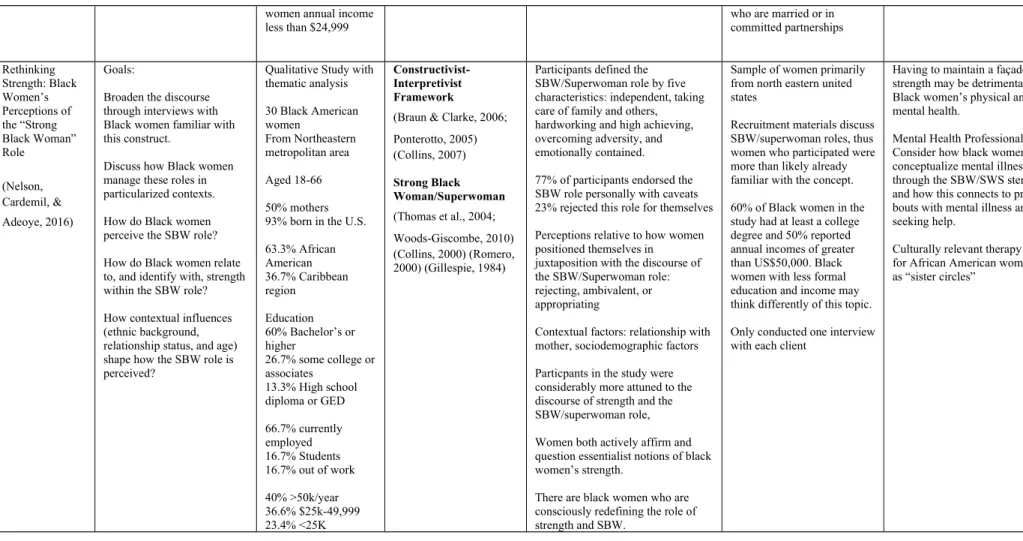
women annual income less than $24,999
who are married or in committed partnerships
Rethinking Strength: Black Women’s Perceptions of the “Strong Black Woman”
Role (Nelson, Cardemil, &
Adeoye, 2016)
Goals:
Broaden the discourse through interviews with Black women familiar with this construct.
Discuss how Black women manage these roles in particularized contexts.
How do Black women perceive the SBW role?
How do Black women relate to, and identify with, strength within the SBW role?
How contextual influences (ethnic background, relationship status, and age) shape how the SBW role is perceived?
Qualitative Study with thematic analysis 30 Black American women
From Northeastern metropolitan area Aged 18-66 50% mothers 93% born in the U.S.
63.3% African American 36.7% Caribbean region
Education 60% Bachelor’s or higher
26.7% some college or associates
13.3% High school diploma or GED 66.7% currently employed 16.7% Students 16.7% out of work 40% >50k/year 36.6% $25k-49,999 23.4% <25K
Constructivist- Interpretivist Framework
(Braun & Clarke, 2006;
Ponterotto, 2005) (Collins, 2007) Strong Black Woman/Superwoman (Thomas et al., 2004;
Woods-Giscombe, 2010) (Collins, 2000) (Romero, 2000) (Gillespie, 1984)
Participants defined the SBW/Superwoman role by five characteristics: independent, taking care of family and others, hardworking and high achieving, overcoming adversity, and emotionally contained.
77% of participants endorsed the SBW role personally with caveats 23% rejected this role for themselves Perceptions relative to how women positioned themselves in juxtaposition with the discourse of the SBW/Superwoman role:
rejecting, ambivalent, or appropriating
Contextual factors: relationship with mother, sociodemographic factors Particpants in the study were considerably more attuned to the discourse of strength and the SBW/superwoman role, Women both actively affirm and question essentialist notions of black women’s strength.
There are black women who are consciously redefining the role of strength and SBW.
Sample of women primarily from north eastern united states
Recruitment materials discuss SBW/superwoman roles, thus women who participated were more than likely already familiar with the concept.
60% of Black women in the study had at least a college degree and 50% reported annual incomes of greater than US$50,000. Black women with less formal education and income may think differently of this topic.
Only conducted one interview with each client
Having to maintain a façade of strength may be detrimental for Black women’s physical and mental health.
Mental Health Professionals should Consider how black women may conceptualize mental illness through the SBW/SWS stereotypes and how this connects to previous bouts with mental illness and seeking help.
Culturally relevant therapy settings for African American women, such as “sister circles”