AENSI Journals
Australian Journal of Basic and Applied Sciences
ISSN:1991-8178
Journal home page: www.ajbasweb.com
Corresponding Author: Z. Ahsan, Universiti Kebangsaan Malaysia, Department of Civil and Structural Engineering, Faculty of Engineering & Built Environment Bangi, Malaysia.
Ph:(+6-01111219362) E-mail: [email protected]
The Relationship of Particle Gradation and Relative Density with Soil Shear Strength Parameters from Direct Shear Tests
1Z. Ahsan, 1Z. Chik, 2Z. Abedin
1Universiti Kebangsaan Malaysia, Department of Civil and Structural Engineering, Faculty of Engineering & Built Environment Bangi, Malaysia.
2Bangladesh University of Engineering and Technology, Department of Civil Engineering, Bangladesh
A R T I C L E I N F O A B S T R A C T
Article history:
Received 15 April 2014 Received in revised form 22 May 2014
Accepted 25 October 2014 Available online 10 November 2014
Keywords:
Angle of internal friction; direct shear test; particle gradation; relative density.
Background: Soil shear strength is an essential parameter for any kind of geo- structural design or stability analysis. Therefore it is important to understand the influence of other soil properties such as particle gradation and relative density on its shear strength parameters. Objective: This paper discusses the effects of different particle gradations and relative densities reconstituted in laboratory on the shear strength of coarse grained soil (sand). As for cohesion less soil the value of c is zero, only angle of internal friction was determined. Because of the simplicity and wide use of direct shear method, the angle of internal friction was determined using this method.
Tests were conducted on sylhet sand with 3 different gradations and at 3 different relative densities. Results: Results show that for gradation with higher uniformity coefficient soil shear strength tends to increase linearly while for higher coefficient of curvature it follows a decreasing trend. With increasing value of the uniformity vs curvature coefficient, angle of internal friction follows a increasing path. These relationships are similar at all relative densities. Conclusion: Strong linear increasing correlation was found between angle of internal friction and relative density. Two separate equations were proposed to calculate direct shear strength of sand using gradation parameters and relative density respectively.
© 2014 AENSI Publisher All rights reserved.
To Cite This Article: Z. Ahsan, Z. Chik, Z. Abedin., The Relationship Of Particle Gradation And Relative Density With Soil Shear Strength Parameters From Direct Shear Tests. Aust. J. Basic & Appl. Sci., 8(19): 271-275 2014
INTRODUCTION
Determining the shear strength of soil is of great importance for civil and geotechnical engineering works.
It is an essential parameter for designing footings and foundations, to calculate bearing capacity of footings and foundations, for analyzing and solving slope stability problems, asses the stability of embankments and earth dams, calculating earth pressure etc. Soil shear strength is dependent on its cohesion parameter c and angle of internal friction parameter ϕ. For cohesionless soils like sand the value of c being zero the shear strength value is entirely dependent on its angle of internal friction ϕ. The shear strength behavior of soil is greatly influenced by many soil properties such as soil 3 particle gradation (Hamidi, A., 2012; Ogbonnaya, I., 2009; Ogbonnaya, I., 2012; Kokusho, T., 2004), grain size and shape (Siang, A.J.L.M., 2012; Yasin, S.J.M. and A.M.M. Shafiullah, 2003), soil moisture content (Blahova, K., 2013) particle crushing (Hamidi, A., 2012) relative density (Liu, C., J.B. Evett, 2005) etc. Shear strength value can also change depending on the test method used (Thermann, K., 2006). Direct shear tests, triaxial tests and torsional direct shear tests are the most common laboratory tests conducted for determining the shear strength of soils.
Density is one of the major factors controlling soil shear strength. Liu and Evett (2005) showed that a soil in its densest state exhibits the highest shear strength as the void ratio at that state is the lowest . In contrast, loosest sand has the highest void ratio resulting in low shear strength. Ogbonnaya I. , Kyoji S. And Hiroshi F. (2012) also concluded that increase in relative density leads to higher shear strength. However for a particular density it was also observed that soil with different particle size, shape and gradation exhibits variation in its shear strength value. Hamidi,A.; Azini,E.; and Masoudi,B. (2012) conducted 27 direct shear tests to investigate the shear strength and dilatancy of well graded sandgravel mixtures.The test results show that gradation affects the soil shear strength by a change in maximum friction angle. Ogbonnaya I. , Kyoji S. And Hiroshi F.(2012) investigated the influence of grain size distribution on the shear behavior of sand specimen in loose, medium and dense states. Their analysis showed that well graded specimens in medium-and dense states have higher
peak but lower residual strength than intermediate and gap graded specimens. Researchers have explained that in well graded soil the finer particles fill the void formed by coarse particles resulting in a more compacted material and providing more interlocking within the material than in gap graded or uniformly graded soils.
Hence a well graded soil is more likely to impart higher shear strength (Hamidi,A.; Azini,E.; and Masoudi,B.(2012), Ogbonnaya I. , Kyoji S. And Hiroshi F. (2009; 2012), Kokusho,T.; Hara,T.; and Hiraoka,R.(2004).
However proper relationship between shear strength parameters and the gradation parameters such as uniformity coefficient and coefficient of curvature is yet to establish. As soil gradation is based on these parameters, their effect on soil shear strength should be studied to predict the most suitable soil particle distribution for achieving optimum shear strength. This paper focuses on the relationship of angle of internal friction of a sandy soil with the soil gradation parameters. 3 different types of gradation for the same soil sample were used. As relative density has profound effect on shear strength value, its relationship with direct shear strength and influence of particle gradation on this relationship was also studied.
Experimental Procedure:
In this experimental research, cohesionless soil (Sylhet sand) was used for sample preparation. Samples were prepared by drying in an oven and then cooling before weighting. Sieve analysis was performed according to ASTM standard D421 test procedure. Then the sample of desired gradation was prepared by weighting around 200 gm each for shear test. Total 9 samples of 3 different gradations of the same fineness modulus 2.63 from the sylhet sand were prepared. Direct shear tests (strain controlled) were performed on dry soil for each sample according to ASTM standard D3080. Relative density tests were conducted for each gradation to determine the maximum and minimum density according to ASTM standard D 4253 and 4254 respectively. The grain size distribution was represented by uniformity coefficient, Cu and coefficient of curvature, Cz. The uniformity coefficient Cu varies from 3.07 to 15.67 and the coefficient of curvature Cz varies from 0.57 to 1.77.
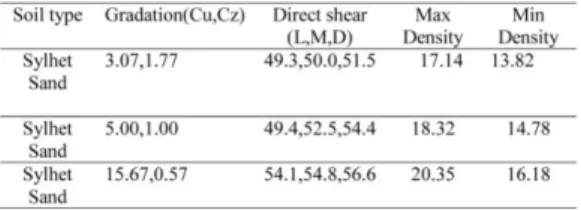
The levels of compaction used for preparation of samples were at relative densities 40%, 60% 80%. A constant normal load of 16 kg (approximately 50 kN/m) was applied on each sample. Table 1 shows the test results of Cu, Cz, maximum density, minimum density and shear strength values for all the samples.
RESULT AND DISCUSSION Table 1: Summary of test results.
Effect of Soil Gradation on Angle of Internal Friction:
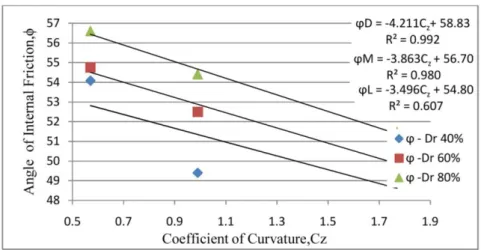
According to the USCS (Universal Soil Classification System) cohesionless soil gradation is dependent primarily on the uniformity coefficient (Cu) and the coefficient for curvature (Cz). Figure 1 and Figure to graphically represent the relationship of angle of internal friction with uniformity and curvature coefficient respectively.
Fig. 1: Variation of angle of internal friction with Uniformity coefficient,Cu
Fig. 2: Variation of angle of internal friction with Cz.
Figure1 shows that there is a linear increasing trend in the ϕ value with higher uniformity coefficient.
However the variation in angle of internal friction at a certain compaction level is not large. Hence compaction level has significant affect on soil strength. Figure 2 shows that with the increasing value of coefficient of curvature (Cz), the angle of internal friction decreases for all compaction levels. As soil gradation is defined by both the Cu and Cz values, a coefficient k was introduced as an indicator of gradation. k is theratio of uniformity coefficient vs curvature coefficient. Figure 3 represents the relationship between the gradation coefficient k (Cu/Cz) and the angle of internal friction (ϕ). It was observed that though separately the uniformity coefficient andcurvature coefficient vs angle of internal friction curves follow completelyopposite trend to each other, when the coefficient k was introduced, withincreasing k value the angle of internal friction increases. This increasing trendwas similar at all 3 relative densities (40%, 60% and 80%). Hence it can be saidthat a sandy soil with higher k value can exhibit higher shear strength at a certaincompaction level. Figure 4 represents a linear relationship with correlation factorR2 = 0.885 between k value and the average value of angle of internal friction.The average value was calculated from the angle of internal friction at differentcompaction levels. Thus a linear equation has been proposed for this particularsoil type, which can predict the shear strength value from the k value of the soil.
The equation is,
Φ = 0.109k + 51.27 (1)
Fig. 3: Variation of angle of internal friction with k=(Cu/Cz ratio).
Effect of Relative Density on Angle of Internal Friction:
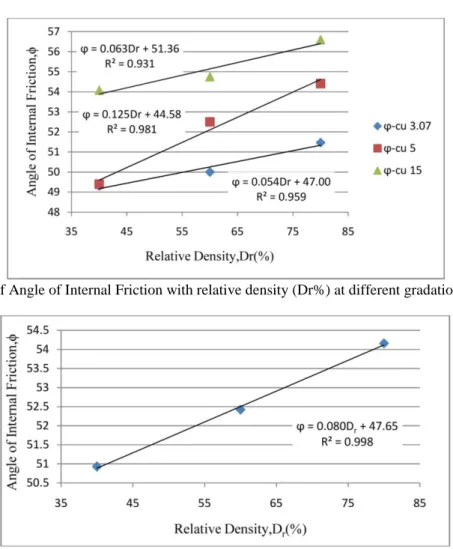
Figure 5 shows the relationship of angle of internal friction with the various levels of compaction. It was observed that with increasing level of compactness the shear strength value of soil increases which supports the previous research studies. The relationship follows a linear trend with a good correlation irrespective of the differences in particle gradation. Figure 6 represents a linear relationship between relative density and average of angle of internal friction excluding the effect of gradation. A strong linear correlation existed between relative density and angle of internal friction. However, this relation is not unique for all coarsenesses of soil. For our test soil that is sylhet sand with fineness modulus 2.63, the coefficient of correlation is 0.996, hence for this
particular soil the angle of internal friction can be calculated from relative density value using the following equation,
Φ = 0.1080Dr + 47.64 (2)
Fig. 4: Relation between angle of internal friction and k (Cu/Cz ratio).
Fig. 5: Variation of Angle of Internal Friction with relative density (Dr%) at different gradations.
Fig. 6: Relation between Angle of Internal Friction and relative density (Dr %) for sylhet sand with FM 2.63.
Conclusion:
This paper focuses on the experimental investigation of relationship of angle of internal friction for a sandy soil with different relative densities and gradation parameters like uniformity coefficient and coefficient of curvature. Test results show that:
• At a certain relative density angle of internal friction tends to increase with increasing value of uniformity coefficient Cu. The angle of internal friction however shows a decreasing trend when plotted against the coefficient of curvature Cz.
• As soil gradation is dependent on both the Cu and Cz parameters, a coefficient k was introduced which is the ratio of uniformity coefficient and coefficient of curvature. When plotted against k values, the angle of internal friction shows a increasing trend with a good correlation at all relative densities.
• An equation was proposed to calculate shear strength of this particular soil using its k value.
• Strong linear correlation was obtained between relative density and angle of internal friction. It was also observed that particle gradation has no significant affect on their relationship.
• An equation was proposed for this soil type to calculate shear strength using the relative density irrespective of the gradation.
• However, the relationships established in this paper were only for this specific sylhet sand. The relationship may vary depending on the soil type and fineness or coarsenesses of the soil.
ACKNOWLEDGEMENT
The authors would like to thank The Geotechnical laboratory of Bangladesh University of Engineering and Technology for their kind assistance.
REFERENCES
Blahova, K., L. Sevelova and P. Pilarova, 2013. Influence of water content on the shear strength parameters of clayey soil in relation to stability analysis of a hillside in brno region, Acta Universitatis Agriculturae Et Silviculturae Mendelianae Brunensis, LXI: 174.
Hamidi, A., E. Azini and B. Masoudi, 2012. Impact of gradation on the shear strength-dilation behavior of well graded sand-gravel mixtures, Scientia Iranica, 19(3): 393-402.
Hara, T. and T. Kokusho, 2000. Effect of particle gradation on liquefaction and post-liquefaction strength by means of triaxial test, Journal of Geotech. Engrg., JSCE, 645(�-50): 245-53.
Kokusho, T., T. Hara and R. Hiraoka, 2004. Undrained shear strength of granular soils with different particle gradations, 13th World Conference on Earthquake Engineering Vancouver, B.C., Paper No. 144.
Liu, C., J.B. Evett, 2005. Soils and Foundations, Pearson Printice-Hall.
Ogbonnaya, I., S. Kyoji and F. Hiroshi, 2009. The geotechnical properties of sands with varying grading in a stress-controlled ring shear tests, Electronic Journal Of Geotechnical Engineering.
Ogbonnaya, I., S. Kyoji and F. Hiroshi, 2012. The effect of relative density and confining stress on shear properties of sand with varying grading, Geotechnical and Geological Engineering, 30(5): 1207-1229.
Siang, A.J.L.M., D.C. Wijeyesekera, A. Zainorabidin and I. Bakar, 2012. The effects of particle morphology (shape and sizes) characteristics on its engineering 10 behaviour and sustainable engineering performance of sand, International Journal of Integrated Engineering - Special Issue on ICONCEES, 4(3): 27- 37.
Thermann, K., C. Gau and J. Tiedemann, 2006. Shear strength parameters from direct shear tests – influencing factors and their significance. In: IAEG – International Association For Engineering Geology and the Environment: Engineering Geology for Tomorrow's Cities.Nottingham: The Geological Society of London.
Yasin, S.J.M. and A.M.M. Shafiullah, 2003. Effect of particle characteristics on the strength and volume change behaviour of sand, Journal Of Civil Engineering, The Institute Of Engineers Bangladesh, 31(2).