The Expert Group on Future
Skills Needs Statement of
Activity 2010
Foreword
Ireland’s recovery will depend crucially on the skills and flexibility of the labour market. It is essential that the education and training system is aligned with future skills needs to ensure that people can capitalise fully on
opportunities that arise. It is now widely accepted that the return to economic growth will be export led and based on improvements in productivity, a strategy that served Ireland well in the past and now must be re-instated at the centre of enterprise policy. The availability of skills and talent will help drive that objective, ensuring business and employment growth.
The consequences of overreliance on construction and domestic services in recent years have had severe implications for many people in the Irish labour market. Current high unemployment, driven primarily by the decline in these sectors, highlights the imperative to upskill and re-skill large numbers of people to other sectors of the economy that will drive economic growth. It is likely that in many cases a significant amount of retraining may be needed before many of the long term unemployed are able to secure jobs. Coupled with this trend are the increasing influences of technology and regulation, even in roles that in the past may have been considered low skilled, resulting in higher skills and qualifications requirements. More recently, employment declines have been more broadly based affecting a wider range of occupations and sectors. However, one
constant that emerges is the link between higher skills and qualifications levels and the likelihood of retaining employment, which reinforces the upskilling imperative laid out in the National Skills Strategy.
To cope with these demands, we need an education and training system that can react flexibly and adapt accordingly. Investment in education and training at all levels must remain a priority and those in the education and training system must ensure that what they offer is appropriate to the needs of the learner in advancing them to employment ‘readiness’.
In conjunction with enterprise, the Expert Group on Future Skills Needs has continued to identify the specific skills needs for many key sectors of the economy. Over the past 18 months, we have reported on the future skills needs of enterprises in the green economy, the
biopharma/pharmachem sector, and the wholesale and retail sector. The Expert Group also continues to highlight current skills shortages through the National Skills Bulletin, ‘difficult to fill vacancies’ through the Recruitment Agency Survey and provides a detailed picture of output from across the education and training system through the Monitoring Ireland’s Skills Supply publication. In addition, the EGFSN also undertook research on the role of Recognition of Prior Learning in
work aims to highlight the gaps that exist between education and enterprise in order to ensure optimal outcomes for learners, employees and enterprises.
Through its research and its advice to Government over the past number of years, the Expert Group has observed a number of skills issues consistently emerging that impact on the ability of
enterprises to reach their potential. The key policy requirements are to:
Improve the quality of learning experience at primary and second level education: The origins of an effective National Skills Strategy are traceable to the quality of the learning experience within the primary and second-level school system. Reform of teaching methods and curriculum content, especially for the learning of maths and science, and the development of critical thinking, problem solving and independent learning skills will have a positive impact on educational outcomes.
Increase the STEM skills supply pipeline at second and third level: There is continuing strong demand for graduates who are competent in ICT, engineering, mathematics, science, financial and multi-lingual skills. Currently there are a range of specific skills recruitment difficulties for ICT companies due in large part to the continued business growth of their Irish based
operations. A number of initiatives are being explored including one to sustain the number of CAO acceptances at third level ICT and engineering courses, and measures to address shortages including utilising the labour market programmes to upskill the current labour.
Develop Mathematical Proficiency: The quality and level of mathematical knowledge outcomes for all levels of national mathematical proficiency needs to improve. Specifically, the numbers of students taking Higher Level Leaving Certificate maths must be increased. This will ensure a sufficient supply pool from which to attract students into science, engineering and technology and business courses.
Alignment of Programmes with Skills Needs: Upskilling and reskilling education and training programmes must be based on employer and employee identified training needs and be aligned with national labour market policy objectives, with a focus on outcomes.
Management Development: Improved management practice will lead to increased performance in productivity and output. Management capability has a positive effect on the level of
upskilling undertaken by employees.
Work Placements: Structured internships and opportunities providing work experience opportunities within enterprise are hugely valuable in improving the employability of students and job–seekers. Internships should have identified goals and outcomes with credits awarded towards the achievement of qualifications.
The Expert Group believes that a focused and integrated approach by Government in tackling these issues will make considerable in-roads to addressing enterprise skills needs and contribute to economic recovery. I would like to thank the members of the Expert Group on Future Skills Needs, both past and present for their commitment to this important work. I would also like to thank Forfás and FÁS for the research and analysis support that they provide to the Group.
Una Halligan
Members of the Expert Group on Future Skills Needs
Una Halligan, Chairperson, Director, Government & Public Affairs for Ireland, Hewlett Packard Marie Bourke, Department Manager, Education, Skills and Labour Market Policy Department, Forfás (Head of Secretariat)
Inez Bailey, Director, National Adult Literacy Agency
George Bennett, Departmental Manager, Clean Tech, IDA Ireland Liz Carroll, Training and Development Manager, ISME
Terry Corcoran, Director of Planning and Research, FÁS Ned Costello, Chief Executive, Irish Universities Association Margaret Cox, Director, I.C.E. Group and Pitman Training
Tony Donohoe, Head of Education, Social and Innovation Policy, IBEC Brendan Ellison, Principal Officer, Department of Finance
Anne Forde, Principal Officer, Department of Education and Skills Pat Hayden, Principal Officer, Department of Education and Skills Gary Keegan, Director, Acumen
Enda McDonnell, Policy and Corporate Development, Enterprise Ireland John Martin, Director for Employment, Labour & Social Affairs, OECD Dermot Mulligan, Assistant Secretary, Department of Education and Skills Frank Mulvihill, Former President, Institute of Guidance Counsellors Dr Brendan Murphy, President, Cork Institute of Technology
Alan Nuzum, CEO, Skillnets
Muiris O’Connor, Higher Education Authority Peter Rigney, Industrial Officer, ICTU Martin Shanahan, Chief Executive, Forfás
Introduction
Established in 1997, the Expert Group on Future Skills Needs (EGFSN) is a body appointed by the Irish Government to advise it on aspects of education and training related to the future skills requirements of the enterprise sector of the Irish economy. The Group is composed of
representatives of business, employees, education, training, Government departments and State agencies.
The Group’s mandate provides that it will act as the central national resource on skills and labour supply for the enterprise sector and on overall strategy for enterprise training in Ireland.
Specifically, the Group carries out systematic and detailed analyses in order to:
Advise Government on projected skills requirements at national and sectoral levels and make recommendations on how best to address identified needs;
Advise Government on associated priority training requirements and the most cost effective ways of responding to them;
Advise on any skills requirements that cannot be met internally in Ireland at a given time and so must be met through inward migration;
Advise on developments in content and delivery systems that support excellence in training quality elsewhere and on adaptations necessary to incorporate such developments into training provision here;
Respond to any request for advice from the Minister for Enterprise, Trade and Employment on training programmes that are supported through the National Training Fund; and
Report on progress made in the implementation of its recommendations.
The following Statement of Activity provides details of the Group’s output and activity in 2010, forthcoming work in 2011, and information on the Group’s research and analysis resources.
Activities of the Expert Group in 2010
Future Skills Needs of Enterprise within the Green Economy in Ireland
The EGFSN report, Future Skills Needs of Enterprise within the GreenEconomy in Ireland, was published in November 2010. The aim of the study was to identify the future skill requirements of enterprises engaged with the ‘green economy’ in Ireland and to propose a range of measures to ensure that their skills base will drive employment and business growth and sustain competitiveness.
The ‘green economy’ has been identified as an area of potential business and employment growth across many countries – including Ireland. The sector includes companies created specifically to service the environmental goods and services market as well as those within
more traditionally defined sectors, such as engineering, that are diversifying in response to growing market opportunities. Six sub-sectors, identified as having business and employment growth
potential, are included in the study. These are: renewable energies; efficient energy use and management; water and waste water treatment; waste management, recovery and recycling; environmental consultancy services; and green ICT applications and software.
The report includes specific recommendations in the following areas:
Align current education and training provision with the skills needs of enterprise;
Develop managers’ export marketing and sales skills to support increased export growth;
Focus education and training provision for the sector on the development of core engineering skills with emerging areas such as wind, wave, solar, geothermal being specialisations on top of the core qualification;
Develop technicians’ skills capability e.g. electro-mechanical/ICT skills for installation, servicing and maintenance of renewable energy power sources;
Develop skilled workers’ capability e.g. system knowledge of lighting and heating, anticipate demand arising from water metering and from electric vehicles;
Develop operative skills in areas such as retrofitting, anaerobic digestion, customer service;
Build up expertise within specific Universities/Colleges for the design of new modules and qualifications. These modules should then be shared within the system;
Provide well structured internships and graduate placement opportunities;
Communicate attractive career opportunities on offer within the sector;
Enhance Mathematical and Science skills of the workforce.
‘replacement’ demand, around 14,500 employment opportunities could arise over the next five years - with much of the demand for higher-skilled staff.
Future Skills Requirements of the Biopharma-Pharmachem Sector
The EGFSN report, Future Skills Requirements of theBiopharma-Pharmachem Sector, was published in November 2010. The overarching aim of this study was to assess the demand for skills in the biopharma-pharmachem sector in the period 2010-2015, and identify what actions needed to be taken to ensure that the supply of these skills is available to drive the future growth of the sector in Ireland.
The report examines how the industry is likely to change, the implications this has for future employment and skills, and approaches to education and training in three international locations – North Carolina, Singapore and Switzerland - where skills have been a key factor in developing successful pharmaceutical and biopharmaceutical industries.
The sector comprises pharmaceutical and biopharmaceutical companies, and has a high economic impact in the Irish economy. The sector employs 25,300 people, with approximately 24,000 employed in support services to the industry, and contributed more than €1 billion in corporation tax in 2008. Provisional figures for 2009 indicate exports of €42.2 billion, representing 50% of total goods exported from Ireland.
The biopharma-pharmachem sector is currently facing significant global challenges. Cost pressures, patent expirations, the rise of competition from generic drugs, a shrinking research pipeline, an increasingly global market, biotechnology, technological advances and converging technologies, increasing and changing regulation, and mergers and acquisitions are the key drivers of change that are fundamentally altering the structure of the industry. The challenge for the Irish biopharma-chemical sector now is to embrace the concepts of manufacturing and supply-chain excellence, as well as those of on-site innovation such as process and product development, linking research directly to manufacturing and supply. An appropriately skilled workforce will be an important ingredient to meet these challenges.
The study recommends a number of specific actions to address the sector’s skills requirements including:
Strengthen business skills within the sector - Business skills, such as, innovation, entrepreneurship, IT and lean skills, should be embedded in science and technology
Align education and training programmes with industry’s requirements - Informatics, bio-informatics, and generic skills will need to be embedded into S&T programmes. CPD provision should continually meet industry needs and be delivered in a flexible manner.
Enhance Industry-Academia Collaboration - Formal structures and processes should be put in place to ensure industry involvement in programme design and revision. Industry engagement should be criteria considered for faculty appointments and promotion and higher education staff could also be encouraged to take sabbaticals to gain industry experience. Industry professionals should be used where appropriate in the delivery of course modules where the main expertise is in industry. Industry collaboration should be a criterion for funding of HEI programmes.
Develop Structured Postgraduate Programmes at masters and PhD levels in biopharma-pharmachem disciplines that would include taught courses as an integral part of the programme, and a student work placement of at least 6 months.
Develop a standardised student work placement for all higher education
biopharma-pharmachem related disciplines -placements should be of 6-9 months duration in companies or education/research institutes in Ireland or abroad. Subject areas where the main expertise is in industry should be covered during the student work placement e.g. commercial awareness, business development, communication skills, problem-solving and compliance.
Address the strategic development of the Pharmachem sector by providing dedicated research and training in areas such as process development, synthesis, process analytical technologies (PAT) and formulation to address the strategic development of the sector.
Develop an operative up-skilling programme - Operatives will need to be flexible and skilled in a number of areas, including information technology, analytical offline testing, mechanical changing of equipment, chemical engineering and chemistry and will need to develop team-working skills.
Future Skills Needs of the Wholesale and Retail Sector
The Expert Group on Future Skills Needs was requested by the then Department of Enterprise, Trade and Employment to provide an in-depth study of the wholesale and retail sector. The report, Future Skills Needs of the Wholesale and Retail Sector, was published in May 2010.The main objective of the study was to assess the skills requirements of the sector in Ireland over the period to 2016, particularly considering the upskilling targets of the National Skills Strategy, and the challenges of the recession and rising unemployment. A steering group comprising representatives of major retailers, retail trade associations, education and training providers and EGFSN members was set up to oversee the report.
The report highlights that wholesale and retail sector is a dynamic and innovative sector. It is also a vital sector for entrepreneurship and small Irish businesses offering a broad spectrum of career paths to people at all skill levels. While employment growth is not forecast to return to the wholesale and retail sector in the short term, the sector continues to provide significant employment accounting for over 14 per cent of jobs in the country.
The report highlights a range of skills issues currently affecting the sector that need to be
addressed. These include poor public perceptions of the sector as a career choice, underdeveloped career paths and lack of formal recognition of workplace training. The central proposal of the report is to develop, nationally recognise and promote a skills framework for the sector that works across all levels of the National Framework of Qualifications. The skills framework has the potential to allow employees to identify training needs and obtain national qualifications on the basis of meeting competency standards, without requiring employers to make fundamental changes to the training they provide.
The skills framework will be used in a number of ways:
It will provide a common set of standards for skills in the sector;
It will provide a means to communicate careers opportunities in wholesale and retail to potential recruits;
It will provide transparent career progression routes for those already working within the sector;
It will provide a means of identifying gaps in provision to address skills shortages;
The framework could play a useful role in labour market activation for upskilling those that lost jobs in the sector and training those who are unemployed for future jobs within the sector;
By addressing the skills gaps, current and future, the wholesale and retail sector will be in a position to respond quickly to the return of growth in the Irish economy.
Monitoring Ireland’s Skills Supply: Trends in Education and Training Output 2010
This report, published in July 2010, is the fifth in a series of reportsproduced annually by the Skills and Labour Market Research Unit, FÁS, on behalf of the EGFSN.
The report compiles all available information on inflows and outflows from the Irish education system across the ten National Framework of Qualifications levels. This edition also incorporates a detailed profile of higher education participants, including an analysis of the first
destination and economic status of young graduates.
The main findings arising from the research were:
There were almost 200,000 awards made in the academic year 2008/2009 across all levels on the National Framework of Qualifications (NFQ) - a 2% rise on the preceding year. 84,000 people received awards in further education and training (major awards) and higher education. 31% of those were at NFQ level 8 (honours bachelor degree) which is almost the same as the previous year. 18% were postgraduate awards - a 4% increase on the previous year. The largest increase was for the number of FETAC (major) awards, which increased by almost 20%.
Students are more likely than ever before to sit the Junior and Leaving Certificate examinations with retention rates of 96.1% and 81.3% respectively (based on the latest data from the
Department of Education and Science). The adjusted Leaving Certificate retention rate, which takes into account students who transfer to non-State-aided schools, was 84.7%.
The numbers of older learners participating in further education and training or higher education has increased and this is set to continue. The share of FETAC award holders in the older age cohorts (aged 30 and over) made up 54% of the total in 2009, compared to 48% in 2007. The number of CAO acceptors aged 23 and over is also increasing.
Part-time awards in higher education accounted for more than a fifth of the total in 2008; the share of part-time awards increased at all levels except level 8 which remained unchanged.
There are promising signs for technology subjects at higher education, excluding construction. CAO acceptances increased for computing, science and engineering which will impact positively on graduate output in the medium term. 1,100 PhD awards were made in 2008 – almost a 50% increase since 2004; almost 50% were in technology-related subjects.
The National Skills Bulletin 2010
The latest National Skills Bulletin, published in July 2010, is the sixth in a series of annual reports produced by the Skills and Labour Market Research Unit in FÁS on behalf of the EGFSN. The Bulletin provides a statistical analysis of the employment data for all the main occupations in the economy. The principal objective of this report is to identify imbalances in the Irish labour market at occupational level by drawing on the data in the National Skills Database maintained by FÁS.
Labour Market Overview
During 2009, employment decreased in most sectors of the economy, with the greatest decline recorded in construction, manufacturing,
agriculture, wholesale and retail. However, employment increased in the ICT sector, with modest increases also recorded in the transport, food and health sectors. In addition, as a result of the deregulation and the growth of the renewable energy sector, employment increased in the energy sector (electricity and gas). In 2009, males, under-25s, early school leavers, non-Irish nationals, residents of the South-East region and construction workers (craft persons and labourers) were at a greater risk of unemployment than their counterparts.
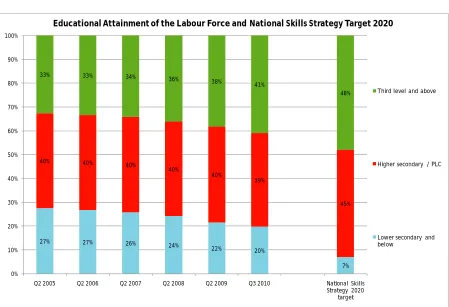
Progress toward the National Skills Strategy targets continued in 2009, with the share of third level graduates in the labour force increasing by 2 percentage points to 39% between quarter 4 2008 and quarter 4 2009, making good progress towards the target of 48% by 2020. There has been some progress at Levels 1-3 (Junior Certificate and below) with the percentage of the labour force at these levels falling from 27% to 20%.
Skills Shortages
The number of vacancies advertised through each of the three sources considered (FÁS, the Irish Times, and IrishJobs.ie) declined in 2009 compared to 2008. In addition, the findings from the FÁS (SLMRU) recruitment agency survey indicated that there was an excess supply of labour for most occupations and a general absence of difficult to fill vacancies. Nonetheless, some recruiters reported difficult to fill vacancies in the areas of IT, sales, health, finance, engineering and management (production, marketing, finance).
Other Activities & Policy Inputs by the EGFSN in 2010
National Skills Database
The National Skills Database (NSD), developed and maintained by the Skills and Labour Market Research Unit (SLMRU) of FÁS, collates all available information on the supply and demand of skills in Ireland. It represents an effective tool for timely analysIs and forecasting of the labour market at sectoral and occupational level. Potential imbalances between the demand and supply of skills can be assessed using the wide range of indicators gathered in the NSD.
During 2010 the NSD was updated to include the latest statistics and information on the following:
Employment
Education and training output
Immigrant labour force
Notified job vacancies (for example: The Irish Times, Irish Jobs.ie, FÁS)
Labour force forecasting model
Occupational employment forecasting models
Recruitment agency survey (SLMRU).
The latest NACE coding, adopted by the CSO, has also been incorporated in to the NSD.
Recruitment Agency Survey
The Recruitment Agency Survey is administrated by the SLMRU (FÁS). A web based questionnaire, designed to capture recruiters’ opinions and experiences regarding any existing skills shortages, is sent to recruitment agencies operating in Ireland. The main purpose of this survey is to supplement the information available from the National Skills Bulletin by incorporating the views of recruitment agencies in the assessment of the balance between the demand and supply of skills in the Irish labour market.
The survey was first run in April 2008 and has been carried out every six months thereafter. While the timeframe is yet too short for a comprehensive trend analysis, it is nevertheless possible to monitor the changes in the labour market. The survey of April 2009, indicated that, for the first time, some recruiters stated that they had no vacancies which were difficult to fill.
Although some recruiters reported more activity in April 2010, the demand for labour remained weak, with 15% of respondents reporting no vacancies which were difficult to fill.
At the same time, though few in numbers, certain vacancies remained difficult to fill; these were concentrated at the higher end of the skills spectrum: more than a half of all difficult to fill mentions were for managerial or professional occupations.
Recruiting agencies reported the following issues with the supply of Irish candidates:
lack of relevant experience for the position in question;
a preference for permanent employment by candidates and a slow up-take of temporary job offers;
reduced labour mobility (geographical or intra-occupational) resulting from increased economic uncertainty;
some of the jobs on offer were deemed not attractive (accounting for 10% of difficult to fill mentions);
recruiting from abroad has continued - most of the difficult to fill vacancies were apparently filled by non-Irish candidates.
The occupations mentioned as difficult to source were:
Senior software engineers and developers (e.g. Java, .NET, C++, system networking, PHP , specific industry applications (e.g. LIFE/400 administration solution for insurance industry); computer systems managers; IT professionals with business acumen;
Managers: marketing, industry specific sales/procurement (e.g. bio-pharma) and financial;
Scientists (e.g. biologists, chemists);
Engineers: design, production, quality control and validation, process (e.g. biotech/bio-pharma, medical devices), water and waste treatment, energy (e.g. wind energy) and grid supply (e.g. high voltage electrical);
Healthcare professionals and associate professionals: specialist doctors (e.g. GPs, non-consultant hospital doctors, non-consultant radiologists); senior clinical psychologists; senior therapists (occupational, speech and language), radiographers; nurses (advanced nursing practitioners in theatre nursing, radiology, diabetes, renal medicine and midwifery);
Sales representatives: telesales with language skills (i.e. Nordic languages, German); sales representatives with technical skills and relevant industry knowledge;
Developing Recognition of Prior Learning (RPL) in the context of the National
Skills Strategy Upskilling Objectives
At the request of the Department of Education and Skills the EGFSN was asked to consider the role that Recognition of Prior Learning could play in progressing the upskilling targets in the National Skills Strategy. A policy paper was prepared by the EGFSN research and analysis team in Forfás with significant input and material from the National Qualifications Authority of Ireland (NQAI)
Executive.
A wide range of stakeholders were consulted in the process (education and training providers, unions, qualifications bodies, guidance/adult education organisations and the Department, employer organisations). The growing emphasis on lifelong learning and upskilling in Ireland and internationally has given increased prominence to the potential of RPL as a mechanism that can contribute to a range of social and economic goals including:
Labour Market Activation - the need to reduce unemployment, particularly those that are long-term unemployed and those with relatively low levels of qualifications as outlined in the National Skills Strategy Implementation Statement, 2010.
Effective and efficient use of resources - the need to utilise education and training resources as effectively as possible at a time of unprecedented demand.
Upskilling/reskilling - the need to continue to upskill the labour force (employed and unemployed) as other countries continue to do so, and facilitate access and participation in lifelong learning.
Flexible delivery - the need to provide an education and training service for people and enterprises that is flexible, relevant and appropriate to their needs.
National policy targets - contribute to targets to increase retention/participation rates in education and training, driven by the National Skills Strategy, the National Plan for Equity of Access in Higher Education and the National Plan for Social Inclusion.
EGFSN Submission to the Department of Education and Skills on Basic Workplace
Skills in the Food & Beverage and Retail & Wholesale & Sectors
The EGFSN reports on the food and beverage industry and the retail and wholesale sector,
emphasised the importance of training and development for these industry, particularly given the low levels of educational attainment prevalent in both sectors.
Of the 47,400 people employed in the food and beverage sector in 2009, approximately 4,800 (10%) have no formal or primary school education. A further 6,600 employees (14%) have junior level secondary education. Likewise in the retail and wholesale sector, approximately 14,270 (6%) employees have not completed primary education, with 30,350 (16%) retail employees and 8,177 (17%) wholesale employees having lower secondary education as their highest educational
attainment level. This compares with 7% of the labour force in the economy as a whole, with no formal or primary education and 13% with lower secondary education. These employees are therefore ill equipped to meet the competitive challenges faced by these sectors, making their continued employment vulnerable.
The EGFSN reports for these two sectors recommended that FÁS would deliver the required upskilling, however, as FÁS no longer has a budgetary allocation for this training, other options to deliver this training require to be explored. The EGFSN considers that the Workplace Basic
Education Fund may be the most appropriate vehicle to improve the basic workplace skills of those in the food and beverage and retail/wholesale sectors. The EGFSN and made a submission to the Department of Education and Skills in October 2010 proposing that an allocation to upskill this cohort be made within the fund’s 2011 budget and thereafter until significant inroads are made to enhance the basic education needs of employees in these sectors.
Alignment of Education and Training Needs
The EGFSN, at the request of the Department of Education and Skills, produced a policy discussion document as input to labour market activation measures during 2010. The document:
Examines progress towards the upskilling targets of the National Skills Strategy;
Analyses output from further education and training and higher education and alignment with future skills needs of the economy.
The discussion document produced by the EGFSN encompasses:
A profile of those participating in further education and training and higher education;
An overview of the fields of learning and disciplines that people are engaging in;
An analysis of the provision in further education and training collegese and higher education institutes;
An assessment of whether or not current provision is aligned with current and future labour market needs.
Dissemination of Labour Market Information
During 2010, the EGFSN has continued to work with stakeholders to ensure that key labour market data is disseminated to all relevant parties. The Group made presentations on a wide range of labour market issues at a number of conferences and fora, including to the Institute of Guidance Counsellors, Trainers Network, ISME, REAP, Institutes of Technology and Vocational Educational Committees. In addition, the Group’s output has been utilised by stakeholders such as Careers Portal, Qualifax and Career Directions to inform their target audiences.
In addition, the sectoral reports are widely disseminated to stakeholders. Those identified with the responsibility of implementing the recommendations are formally notified and invited to inform the EGFSN six months after publication of the report of progress on implementation.
The steering groups for the following reports will reconvened in 2011 to review progress on implementation of the recommendations in the reports:
Future Skills Needs of Enterprise within the Green Economy in Ireland (published November 2010)
Future Skills Requirements of the Biopharma-Pharmachem Sector (published November 2010)
Progress on the National Skills Strategy 2020 targets
The key proposals in the National Skills Strategy for 2020 are that:
48 percent of the labour force should have qualifications at National Framework of Qualifications (NFQ) levels 6-10 – i.e. from higher/advanced certificate to PhD level;
45 percent should have qualifications at NFQ levels 4 and 5 – Awards equivalent to upper secondary level education; and
The remaining 7 percent are likely to have qualifications at NFQ levels 1 to 3 (equivalent or below Junior Certificate) while aiming to make the transition to higher levels of educational attainment.
In order to achieve these objectives, action is required at a number of levels:
An additional 500,000 individuals within the workforce will need to progress by at least one level on the National Framework of Qualifications. More specifically, the targets will entail up-skilling 70,000 from NFQ levels 1 & 2 to level 3; 260,000 up to levels 4 & 5; and 170,000 to levels 6 to 10.
The proportion of the population aged 20-24 with NFQ level 4 or 5 awards should be increased to 94 percent, either through completion of the Leaving Certificate or through equivalent, more vocationally oriented programmes. The retention rate at Leaving Certificate should reach 90 percent by 2020.
The progression rate to third level education will have to increase from 55 to 72 percent.
Progress on headline target
Figure 1 Labour Force by Educational Attainment and NSS Target
27% 27% 26% 24%
22% 20% 7% 40% 40% 40% 40% 40% 39% 45%
33% 33% 34% 36%
38% 41% 48% 0% 10% 20% 30% 40% 50% 60% 70% 80% 90% 100%
Q2 2005 Q2 2006 Q2 2007 Q2 2008 Q2 2009 Q3 2010 National Skills Strategy 2020
target
Educational Attainment of the Labour Force and National Skills Strategy Target 2020
Third level and above
Higher secondary / PLC
Lower secondary and below
Source: CSO Quarterly National Household Survey
The percentage of those in the labour force with Higher Education qualifications (NFQ Levels 6-10) has increased from 33% in 2005 to 41% in 2010. Specifically, there are 203,400 more people in the labour force in Q3 2010 with Higher Education Level qualifications than there were in 2005. The prospects for meeting the target of 48% of the labour force possessing a Higher Education Level qualification by 2020 set out in the National Skills Strategy would appear to be good based on current trends.
In relation to Levels 4 & 5 (Upper Secondary including Leaving Certificate), the percentage declined marginally between 2005 and 2010 from 40% to 39%. In absolute terms, the number of those within the labour force with Upper Secondary/PLC level education has increased by 28,200 since 2005. This is the net effect of:
improvements in progression and retention rates:
à the percentage of the population aged 20-24 with at least Upper Secondary level education increased from 86% in 2005 to 89% by 20101, compared to the 2020 target of 94%.
à retention at Leaving Cert for the latest available cohort of entrants (2001 entrants) has also risen from 81.3% to 84.7%, compared to a 2020 target of 90%.
Some people moving up from Levels 4 & 5 to higher levels and others moving up to Levels 4 & 5 from lower Levels.
There still remains a considerable challenge in closing the gap with the National Skills Strategy target at level 4&5.
There has been some progress at Levels 1-3 (Junior Certificate and below) with the percentage of the labour force at these levels falling from 27% to 20%. Specifically, there are 97,800 less people in the Labour Force with only a Junior Cert qualification or below compared with 2005. Some of this decline is due to people moving up to higher levels in the National Framework of Qualifications, however, some is also due to older cohorts with a lower qualifications profile retiring from the labour force in addition to declining participation rates amongst those at these lower qualification levels in the past two years. The progress made so far indicates that the most significant challenge for the period to 2020 is upskilling those at Levels 1-3 to Levels 4 & 5.
The following table summarises progress in each of the headline National Skills Strategy targets.
Progress towards achieving the National Skills Strategy targets
NSS Target
National Skills Strategy Baseline2
Current
Position Progress Data source
48 % of LF at levels 6-10 33 % 41 % +8 % CSO QNHS Q3 2010
45 % of LF at levels 4-5 40 % 39 % -1% CSO QNHS Q3 2010
7 % will be at levels 1-3 27 % 20% +7 % CSO QNHS Q3 2010
94% of 20-24 population should have at
least NFQ Levels 4/5 86% 89% +3%
CSO Q2 2010, Module on Educational Attainment
The retention rate at Leaving Certificate
should reach 90 % by 2020. 81.3% 84.7 % +3.4 %
Department of Education
The progression rate to Third Level should
increase to 72 percent 55% 60% +5%
ESRI School Leaver’s Survey 2007
Upskilling 500,000 people within the Labour Force
At present, there is no data available which shows whether a person has moved up the National Framework of Qualifications in a given year. The most appropriate measurement of progress towards the National Skills Strategy is by the CSO Quarterly National Household Survey data on educational attainment presented previously, which reflects the output of education and training activity in the State. Other broad indicators include:
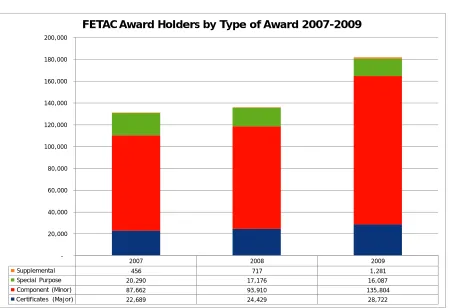
Within Further Education and Training, there has been a substantial increase in 2009 in the number of people to whom awards were made. In 2009, there were 174,870 award holders, an increase of 43,781 on 2008 and 46,246 compared to 2007. The majority of the increase in 2009
2 NFQ Profile of the Labour Force Targets are measured from a baseline year of Q2 2005. The 94 percent target for 20-24 year olds is from a baseline year of 2005
compared to previous years is due to a significant increase in the number of minor award holders, which is 41,894 (55 percent) higher in 2009 compared to 2008.
Figure 2 FETAC Award Holders by Type of Award 2007-2009
2007 2008 2009
Supplemental 456 717 1,281
Special Purpose 20,290 17,176 16,087
Component (Minor) 87,662 93,910 135,804
Certificates (Major) 22,689 24,429 28,722
-20,000 40,000 60,000 80,000 100,000 120,000 140,000 160,000 180,000 200,000
FETAC Award Holders by Type of Award 2007-2009
Source: FETAC Statistics3
There has also been a significant increase in the number of major award holders, with 6,000 more FETAC major awards in 2009 compared to 2007, particularly at NFQ Levels 1-2, 3 and 5.
Further Education and Training Major Awards 2007-2009
Levels 1/2 Level 3 Level 4 Level 5 Level 6 Total
2007 1,100 1,700 13,500 6,600 22,900
2008 60 1,420 1,780 14,210 6,970 24,440
2009 270 2,500 1,680 17,440 6,900 28,790
Source: FETAC statistics
Within Higher Education institutes supported by the Higher Education Authority, overall graduate output declined slightly from 2007 to 2009. This is driven mainly by a decline in awards at levels 6/7, while there have been significant relative increases at levels 9 and 10.
Graduate output from Higher Education 2007-2009
2007 2008 2009
Level 10 1,055 1,091 1,210
Level 9 13,597 14,086 14,762
Level 8 25,985 26,150 25,742
Levels 6/7 15,481 13,970 12,657
0 10,000 20,000 30,000 40,000 50,000 60,000
Graduates from HEA supported institutes 2007-2009
Source: HEA4
It must also be noted that despite a marginal decline in graduate output over these years, enrolments for higher education are at record numbers. CAO acceptances have increased by 17 percent in 2009 compared to 2006. This gives a positive outlook for the graduate pipeline, with the number of graduates set to increase considerably in the coming years. This, coupled with increasing numbers of Leaving Certificate candidates within the school population pipeline, should ensure further growth in higher education output in future years. The Department of Education and Skills project that from 2009 to 2018 the number of full time students enrolled in higher education is expected to increase from 155,000 to 204,000.
In summary:
There has been a significant increase in activity since 2007 within Further Education and Training, with the number of award holders increasing by 46,000 in that timeframe.
Within higher education, graduate output has remained relatively stable, with significant relative increases at levels 9-10. The demand for higher education is expected to grow
significantly in the next decade. Quarterly National Household Survey figures show the number of higher education graduates within the labour force continues to rise.
The main challenge for the education and training system is to ensure that providers can respond flexibly to skills needs of enterprise, particularly given high structural unemployment and the need to re-skill people to key growth sectors.
Implementation of Recommendations in EGFSN Reports
Future Skills Requirements of the Food and Beverage Sector
There has been important progress in the implementation of the EGFSN report Future Skills Requirements of the Food and Beverages Sector, published November 2009. A meeting of the steering group for the report was called six months after publication in May 2010 to review progress on implementation of the recommendations. Progress was reported as follows:
The Department of Agriculture, Food & Fisheries had secured funding of €9.5m in the 2010 budget that has allowed Enterprise Ireland, Bord Bia and Teagasc to implement the upskilling programmes recommended by the Expert Group in the areas of management development and supply chain management.
In the case of Supply Chain Management, Enterprise Ireland has already begun rolling out supports to SMEs which includes programmes in lean techniques.
Bord Bia has initiated a programme with UCD to address a gap in market knowledge in target retail markets.
On management development, Enterprise Ireland is launching a Leadership for Growth programme targeted at food companies and will continue to include food companies in its Transform Programme.
Interventions to improve commercial acumen in the food sector are also being rolled out by Bord Bia and Teagasc which include a Diploma in Marketing Management aimed at middle management in SMEs and a Management Development Programme.
Raising National Mathematical Achievement
In December 2008 the EGFSN published the statement Raising National Mathematical Achievement. In the statement, the EGFSN highlighted the critical importance of mathematics for our economy and the need for a focused and long term approach to improve the quality and numbers of our mathematical achievement.
of technology announced that 25 bonus points for students taking Leaving Certificate higher level maths are to be introduced from 2012.
Higher Education Labour Market Activation Guidelines
In Budget 2010, it was announced that €20 million of additional labour market activation funding would be available for an open call for proposals. The fund is specifically intended to assist in the creation of training and education provision targeting specific priority groups among the
unemployed, namely - the low skilled, and those formerly employed in declining sectors – such as construction, retail and manufacturing sectors, with particular emphasis on the under 35’s and the long-term unemployed, and will involve:
Up-skilling programmes that provide qualifications up to NFQ Level 5
Re-skilling programmes that provide qualifications up to NFQ Level 8
As part of the development of the Call for Proposals, a set of guiding principles for submission of proposals, informed by skills needs identified by the EGFSN, was compiled in order to provide information on the skills requirements of the economy relevant to the two target cohorts as
guidance to education and training providers responding to the Request for Tenders. The paper also provided advice by way of objectives for the fund; performance metrics; and guiding principles for allocation of funding based on enterprise skills needs.
Forthcoming EGFSN Publications in 2011
Key Skills for Enterprise to Trade Internationally
This study will examine the key skills required for enterprises to trade internationally - specifically on the need for Marketing and Sales Skills, Language Fluency Skills, Entrepreneurship Skills and Cultural Awareness of different traditions.
It will also examine related requirements including the need to form strong business and client relationships, the protection of Intellectual Property, knowledge of Standards and Regulations and for due diligence and contractual knowledge.
Objectives of the study are:
To identify the skills required by enterprise to maximise export growth potential; and
To propose proactive measures with regard to education and training provision and continuing professional development of employees to ensure that the future skills base of enterprise will help drive export growth.
The National Skills Bulletin 2011
Produced annually by the Skills and Labour Market Research Unit in FÁS, the National Skills Bulletin outlines key labour market statistics with the objective to assist policy formulation in the areas of employment, education and training, and immigration. The Bulletin also aims to provide
information for students, career guidance advisors and other interested parties relating to developments in the Irish labour market at occupational level. The next edition of the National Skills Bulletin is scheduled for release mid-2011.
Monitoring Ireland’s Skill Supply: Trends in Education and Training Output 2011
Undertaken annually by the Skills and Labour Market Research Unit of FÁS on behalf of the EGFSN, the report compiles all available statistics pertaining to the inflows and outflows from the Irish education and training system across levels 1-10 of the National Framework of Qualifications (NFQ), and provides an indication of the supply of skills to the Irish labour market from the formalResearch and Analysis
The work of the EGFSN is managed by Marie Bourke, Manager of the Education, Skills and Labour Market Policy Department in Forfás.
Research, analysis and administration support to the EGFSN is provided by Forfás and the Skills and Labour Market Research Unit, FÁS.
Appendix I
Recent Publications by the Expert Group on Future Skills
Needs
Report Date of
Publication
Developing Recognition of Prior Learning: The Role of RPL In the Context of the National Skills Strategy Upskilling Objectives
April 2011
Vacancy Overview 2010 March 2011
Future Skills Needs of Enterprise within the Green Economy in Ireland November 2010
Future Skills Requirements of the Biopharma-Pharmachem Sector November 2010
Monitoring Ireland's Skills Supply - Trends in Education and Training Outputs 2010
July 2010
National Skills Bulletin 2010 July 2010
Future Skills Needs of the Wholesale and Retail Sector May 2010
Future Skills Requirements of the Food and Beverage Sector November 2009
Skills in Creativity, Design and Innovation November 2009
Monitoring Ireland’s Skill Supply – Trends in Education and Training Outputs 2009
November 2009
National Skills Bulletin 2009 July 2009
A Quantitative Tool for Workforce Planning in Healthcare: Example Simulations
June 2009
A Review of the Employment and Skills Needs of the Construction Industry in Ireland
December 2008
Statement on Raising National Mathematical Achievement December 2008
National Skills Bulletin 2008 November 2008
All-Island Skills Study October 2008
Monitoring Ireland’s Skills Supply: Trends in Education/Training Outputs 2008 July 2008
The Expert Group on Future Skills Needs Statement of Activity 2007 June 2008
Future Requirement for High-Level ICT Skills in the ICT Sector June 2008
Future Skills Needs of the Irish Medical Devices Sector February 2008
Survey of Selected Multi-National Employers’ Perceptions of Certain Graduates from Irish Higher Education
December 2007
The Future Skills and Research Needs of the International Financial Services Industry