Route Recommendation Method Based on Driver’s
Intention Estimation Considering the Route
Selection When Using the Car Navigation
Keisuke Hamada, Shinsuke Nakajima, Daisuke Kitayama, and Kazutoshi Sumiya
Abstract—Nowadays, car navigation systems are widely used for providing directions to drivers’ destination. However, they do not always recommend a route that perfectly matches the driver’s intent. Even when drivers intentionally change the driving route from the recommended one to another, most of car navigation systems lead them back to the original recommended route. Such recommendations may not adequately reflect the driver’s intent. Therefore, in our previous work, we have proposed a route recommendation method based on estimating driver’s intent by comparing the characteristics of the route selected by driver and the route not selected by driver but recommended by car navigation system. However, the method could take into account only one kind of traveling cost of each road. Thus, in this paper, we propose a method that can consider multiple costs and learn drivers’ concept of values for each cost.
Index Terms—recommendation, route search, difference am-plification, car navigation.
I. INTRODUCTION
I
N recent years, car navigation systems are widely used as shipped over 58 million units per year[1]. Accordingly, there have been a lot of studies on car navigation systems, especially on route planning[2]. For instance, techniques based on Dijkstra algorithm and genetic algorithms have been proposed. Namely, it have become possible to provide the shortest path to the driver according to the starting point and the destination set by the driver, based on several factors that are actual distance, time distance, condition of traffic snarl-up and distance to highway entrance.However, it is possible that the driver selects the different way from the route recommended by car navigation system because s/he does not travel the wrong way but travel the different way meaningly. In such a case, the system often recommended a route returning to original recommendation, which is not to reflect the intent of the driver. In other words, it is difficult for conventional can navigation system to re-recommend a route matching with the driver’s intent when choosing a different route from the route recommended by car navigation system.
We proposed an algorithm for estimating the driver’s intent of route selection and also for setting the optimal
Manuscript received January 8, 2014; revised February 4, 2014. K. Hamada and S. Nakajima are with Faculty of Computer Sci-ence and Engineering, Kyoto Sangyo University, Motoyama, Kamig-amo, Kita-ku, Kyoto-city, Kyoto, 603-8555, Japan e-mail: ({g1044903, nakajima}@cse.kyoto-su.ac.jp).
D. Kitayama is with Faculty of Information Studies, Kogakuin Univer-sity, 1-24-2 Nishishinjuku, Shinjyuku-ku, Tokyo, 163-8677, Japan e-mail: ([email protected]).
K. Sumiya is with School of Human Science and Environment, University of Hyogo, 1-1-12 Shinzaike-honcho, Himeji-city, Hyogo, 670-0092, Japan e-mail: ([email protected]).
route according to the intent, in order to such problem of car navigation system. We believe that it is possible to estimate the driver’s intent of route selection by analyzing differences between features of selected route and unselected but recommended route. Thus, our method can set the optimal route by feeding back to route setting parameters based on amplifying the differences (Fig.1). In addition, we apply the difference-amplification algorithm[3] as the method for estimating driver’s intent. The difference-amplification algorithm is the method that can estimate what the user origi-nally demand based on comparing and amplifying difference between “what the user selected” and “what the user do not selected”. We have already proven the algorithm effective based on experimental evaluation[4].
In our previous work[4], our method can consider only one kind of cost when recommending suitable route to a driver. However, most drivers consider several kinds of costs such as the distance to destination, the road width and the number of turning points, when driving on roads in the real world. Therefore, we propose a route recommendation method based on driver’s intention estimation by considering multiple costs related to route selection when using the car navigation.
II. RELATED WORK
Fig. 1. Outline of Optimal Route Setting Algorithm Considering Driver’s Intent.
route search algorithm by considering multiple criteria to find optimal route matching with driver’s preferences. They use given parameter such as traveling time, major road or minor road and kinds of turn. Their algorithm can detect suitable route to given parameter. However, driver have to specify these parameter. We think that it is difficult for drivers to specify these parameters, because these parameters are different between the driving contexts such as driver’s knowledge for the route and traffic conditions. Therefore, we re-calculate costs of route based on driver’s selected route for reflecting driver’s intention while driving. Tanaka et al.[12] proposed a destination prediction method based on past driving histories. Their method estimate driver’s intention of destination using past driven path histories and past driven context histories such as time of day, weather, number of passengers, and so on. Their aim is to display additional information of destination point at non-navigated situation. On the other hand, our method aims to estimate driver’s intention against route search conditions such as distance, traveling time, road width, and so on.
III. ROUTE RECOMMENDATION METHOD BASED ON DIFFERENCE-AMPLIFICATION
A. Route recommendation method based on difference-amplification algorithm
We adopt the basic idea of Difference Amplification algorithm[3] and explain a method that can estimate driver’s intent and recommend another route matching with the driver’s intent when choosing a different route from the route originally recommended by car navigation system. Furthermore, we assume that the destination is fixed even if driving route is changed. Because the driver’s destination does not change when the driver uses route recommendation function of car navigation system. The Difference Amplifi-cation algorithm is a method that tries to estimate what the user originally demand based on comparing and amplifying difference between “what the user selected” and “what the user do not selected”. Thus, we try to recommend new route matching with user’s intent by re-calculating traveling cost of each route based on Difference Amplification between “the route that navigation system has not recommended but the user has been traveled” and “the route that the user has not been traveled but navigation system has recommended”.
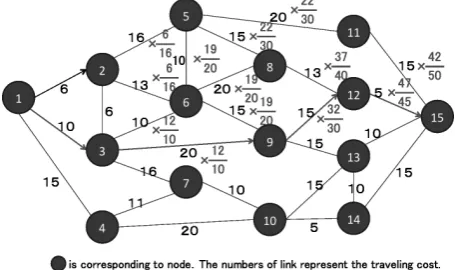
[image:2.595.312.540.198.358.2]Fig.2 shows an example of traveling cost and the shortest route. In FIg.2, nodes are corresponding to intersections, links are corresponding to roads between intersections, and
Fig. 2. Example of Traveling Cost of each Road and the Shortest Route.
Fig. 3. Example of Re-calculating traveling costs when driving from node 1 to not node 3 but node 2.
numbers of links are corresponding to traveling cost on the links. We may regard 10 traveling cost as 10 minutes driving time temporarily. The route(1 → 3 → 9 → 12 → 15)
[image:2.595.312.540.411.546.2]Hence, we focus on difference between “route that driver selected” and “route that driver do not selected”, and then recommend new route matching with driver’s intent by recalculating the supposition traveling cost of each links. In the case that a driver select not the recommended route from stoxbut the route from nodestoy, formula for computation of the supposition traveling cost from node i to node ? is shown below. The supposition traveling cost is calculated based on driver’s intent. The cost of a route estimated that driver wants to travel on it, get bigger than the original cost. the cost of a route estimated that driver does not want to travel on it, get bigger than the original cost.
Ci0→?= (Cs→y→i
Cs→x→i
)α·Ci→? (1)
Ca→b→c corresponds to traveling cost from nodeatoc via b.
Ci→? corresponds to traveling cost from node ito one hop away.
Ci0→? corresponds to supposition traveling cost from nodei to one hop away.
[image:3.595.311.541.237.368.2]αcorresponds to amplification coefficient.
Fig.3 shows example of calculating the supposition trav-eling costs when travtrav-eling to not node 3 but node 2. The amplification coefficientαis set as 1 in Fig.3.
At first, we focus on the link(3→9). The original cost of this link is 20. In this example, you can imagine that the cost means driving time. In order to drive on this link(3 → 9), the driver should travels on the link(1→3)(the cost is 10) in original recommended route. In contrast, the driver should travels on the route(1 → 2 → 3) (the cost is 12) in order to drive on the link(3 →9) after driving the link(1 → 2). Namely, the traveling cost to the link(3→ 9) from node 1 become 1210times if the driver selects the link(1→2)against the recommended route. Thus, the supposition traveling cost become 1210times of 20 of original cost. This is the method for calculating the supposition traveling cost based on Difference Amplification algorithm.
Next, let’s focus on the link(2→5). The original cost of this link is 16. The driver should travel the link(1→3→2)
(the cost is 16) in order to drive this link(2 → 5) after traveling on the link(1→3)of original recommended route. In contrast, the cost to reach the link(2 → 5) became 6 because the driver selected the link(1 → 2). Namely, the traveling cost to the link(2 → 5) from node 1 become
6
16 times if the driver selects the link(1 → 2) against the recommended route. If the driver does not want to travel on link(2 → 5), s/he must travel on the link(1 → 3) in the recommended route. Thus, the supposition traveling cost become 166 times of 16 of original cost.
In that way, we can calculate the supposition traveling cost of the each link based on Cs→y→i
Cs→x→i. We can adjust the amplification coefficient by changing α. The amplification rate becomes bigger when 1 < α and it becomes smaller when 0< α <1.
As the result of re-estimating the shortest route from node 2 to node 15 based on the supposition traveling cost shown in Fig.3, the cost of the original shortest route(2 → 3 → 9 →12→15)become 51.22 from 46, and the cost of the
route(2→5→11→15)become 32.67 from 51. This is the shortest route after re-estimating based on Difference Ampli-fication algorithm. We believe that our proposing method can recommend the optimal route matching with driver’s intent without forcing to go back to original recommended route by means of such re-calculating the shortest route if the driver meaningly select different route from recommended route car navigation system.
B. Evauation using a simulator of the proposed method
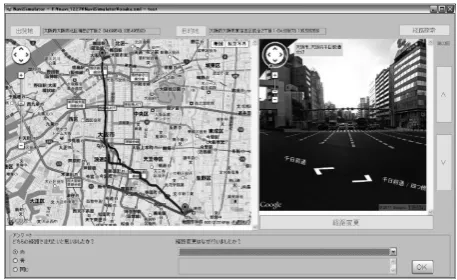
We evaluate effectiveness of our algorithm of difference amplification by following experiment. We use the simulator that developed by C# for this experiment(Fig.4, 5). (see [4] for the detail of the simulator)
[image:3.595.311.540.413.553.2]Fig. 4. GUI of the Simulator(Start-up).
Fig. 5. GUI of the Simulator(After Changing Driving Route).
The right region shows the Google street view, and the left region shows Google Maps. Google Maps is a substitution for car navigation screen. Then, Google street view is a substitution for the field of vision through a windshield. We use Open Street Map1 as the data of the roadway network. We use the Dijkstra’s algorithm for route recommendation.
Simulator can record operation logs. When participants input user id to simulator, recording operation log is started. The logs are recorded when user specify changing point, operate Street view and input a questionnaire. We take a screen shot of simulator for consideration of reason for changing route when the logs are recorded.
We set regions for simulation as Tokyo, Kyoto, Osaka, Nagoya, Yokohama, Fukuoka, Hiroshima and Sapporo that are famous cities in Japan.
Through the experiment, we collected data for 975 tasks. The result of the evaluation showed that concordance rate of the driver’s intent used route recommendation method based on difference-amplification algorithm was 82.3%[4].
IV. ROUTE RECOMMENDATION METHOD BASED ON DIFFERENCE-AMPLIFICATION ALGORITHM CONSIDERING
MULTIPLE COSTS
In this section, we describe the method for considering multiple costs in the route recommendation method based on difference amplification algorithm. For treating multiple costs in our proposed method, we have two problems. The first one is how to integrate the costs that have different unit each other. Thus, we have to adopt a certain normalization to each cost. The second one is how the method learns drivers’ preferences that are different between drivers.
Thus, we take up “Integration method of multiple different types of costs” in the section IV-A and “Learning method of weight for each cost for every driver” in the section IV-B.
A. Integration method of multiple different types of costs
We deal with “distance”, “road width” and “number of signals” as costs in our proposed car navigation method. Fur-thermore, we define a road as a route between an intersection and next intersection. A road have each costs such as the cost of distance, the cost of road width and the cost of number of signals.
We calculate a total cost as the sum of costs of each roads from the starting point to the destination point. The total cost is used for route recommendation. The characteristics of each cost are mentioned as follows:
• Cost of distance
We define the cost of distance as the length(meter, m) of a target road.
• Cost of road width
We define the cost of road width as “the assumed biggest road width −the actual target road width”. In this paper, we assume that biggest road width is 21m. The reason of 21m is described as follows: The max value of one lane width is about3.5min Japan[13]. The number of average lanes in a general road of large width is 3. Therefore, we determine the assumption biggest road is21 = 3.5×3×2.
• Cost of number of signals
We define the cost of number of signals as the number of signals of a target road.
Then, we describe integration method of multiple different types of costs such as the distance, the road width and the number of signals. Specifically, the total costs(cost from the starting point to the destination point) are calculated per each type of costs, and then, they are integrated into a total cost after their normalization by considering the deviation value of each type of costs. Thus, the total cost is calculated based on the following expression.
ST =α·SR+β·SW +γ·SS (2)
ST corresponds to total score. SR corresponds to score of distance.
SW corresponds to score of road width. SS corresponds to score of number of signals.
α, β, γ corresponds to weighting factor of distance, road width and number of signals for the target driver.
However α+β+γ= 1
In this way, it is possible to recommend optimal routes to drivers based on the driver’s sense of values(weighting factor) for each type of costs.
B. Learning method of weighting for each cost for every driver
In this section, we describe our learning method of weight-ing factor for each type of costs. In the case that a driver accepts a route recommended by car navigation system, his/her weighting factor of each type of costs do not have to be changed because the driver seems to be satisfied with the route recommended by car navigation system. Thus, when the driver drove on another route from a route recommended by car navigation system, the driver’s weighting factor for each type of costs should be changed. Here, we describe how to learn the weighting factor which is more important for the driver than before, and how to learn the weighting factor which is less important for the driver than before.
Our proposed method can judge each weighting factor as more important or less important based on the cost ratio of “the recommended route” against “the selected route by the driver.” The system judges the weighting factor as more important if the cost ratio is bigger than1. In the same way, it judges the weighting factor as less important if the cost ratio is smaller than1.
The ratio of the costs of distance is calculated by the following expression.
RL= CL1
CL2 (3)
CL1 corresponds to cost of distance of route recommended by car navigation system.CL2corresponds to cost of distance of route selected by driver. RL corresponds to the ratio of costs of distance.
First, we describe how to learn the weighting factor in order to make it bigger. The expression for calculating new weighting factor is given below.
α0=α·(CL1
CL2)
k (4)
α0 corresponds to new weighting factor after learning for cost of distance. α corresponds to weighting factor before learning for cost of distance. CL1 corresponds to cost of distance of route recommended by car navigation system. CL2 corresponds to cost of distance of route selected by driver.kcorresponds to the learning coefficient.
Next, we describe how to learn the weighting factor in order to make it smaller. The sum of weighting factor is always 1.0 byα+β+γ= 1. Thus, an increase of weighting factorαshould equals the decrease of sum ofRW andRS. Thus, the expression for calculating new weighting factor is given below.
β0=β−∆α·(RW
β0 corresponds to weighting factor after learning for cost of road width.βcorresponds to weighting factor before learning for cost of road width. ∆α corresponds to the amount of difference between before learning and after learning α (∆α=α0−α).ΣRcorresponds to the sum of the cost ratio of lower important cost. (Example isΣR=RW +RS.RS is the ratio of number of signals.)
When weighting factor for each type of costs is changed, weighting factor for cost of distance becomes larger, weight-ing factor for cost of road width and weightweight-ing factor for cost of number of signals becomes small. Thus, at the next driving, our proposed method can provide better routes matching with the driver’s actual sense of values.
[image:5.595.307.547.55.202.2]C. Verification of proposed method based on simple experi-ment
[image:5.595.50.281.265.395.2]Fig. 6. Driving Map of Route1.
Fig. 7. Driving Map of Route2.
We describe the experiment to verify “integration method of multiple different types of costs” and “learning method of weighting for each cost for every driver” explained in section IV-A and IV-B.
In the experiment, our proposed method recommends routes by using three simple maps, Fig.6, Fig.7 and Fig.8. All of edges in these maps has the three kinds of costs such as distance, road width and number of signals. In these maps, all of black nodes are regarded as intersections having signals
Fig. 8. Driving Map of Route3.
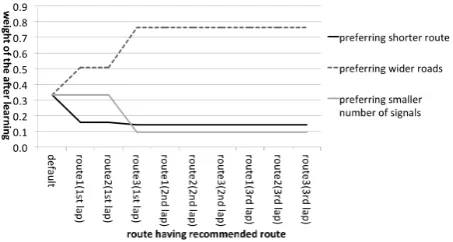
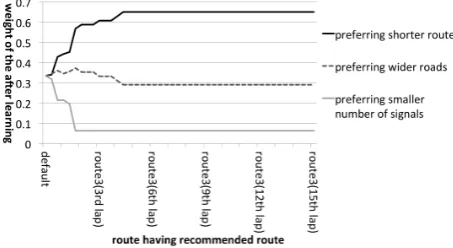
and all of gray nodes are regarded as intersections having no signals. Moreover, the length of each edge represents the distance and the thickness represents the road width. The ratio of initial weighting factor for each cost is (distance : road width : number of signals) = (1 : 1 : 1). The number of actual weighting factor set to distance = 0.3333, road width = 0.3333 and number of signals = 0.3333 because the total of weighting factor is set as 1.0. In this experiment, we adopt a driver who cares the cost of road width than others and a driver who cares the cost of distance. Moreover, we performed the learning experiments with learning coefficient as 1.0 and 0.5.
Next, we describe the flow of the experiment. At first, our proposed system recommend a route to a driver by using the route 1 in Fig.6 based on integration method of multiple costs shown in section IV-A. If the recommended route is not acceptable for the driver, he/she change the route. In the case that the driver changes his/her route, the weighting factor for each cost is modified by the learning method explained in section IV-B. Continuously, it performs similarly in the route 2 and route 3. The flow to route 1∼route 3 is regarded as one set, and these sets are repeated several times.
Fig. 9. Changing Processes of Weighting Factor (Preferring Wider Roads,
k= 1).
[image:5.595.52.284.468.629.2] [image:5.595.313.540.536.657.2]Fig. 10. Changing Processes of Weighting Factor (Preferring Wider Roads,
[image:6.595.311.538.55.180.2]k= 0.5).
Fig. 11. Changing Processes of Weighting Factor (Preferring Shorter Route,
k= 1).
value of weighting factor to each type of costs in each experiment is shown in Table I.
In the case that learning coefficient is k = 1.0, since weighting factor to each type of costs changes a lot in the learning process, the difference between convergence values of weighting factors to each type of costs is larger than in the case that learning coefficient is k= 0.5.
Although learning coefficient k should be a moderately-big value in order to converge the weighting factor, it may be over-learning if the learning coefficient is too big. In our future work, we are going to find the adequate learning co-efficient value based on experimental evaluations. Moreover, we try to develop car navigation simulator using actual maps based on our proposed method.
V. CONCLUSION
We proposed route recommendation method based on driver’s intention estimation considering the route selection when using the car navigation. In our previous work[4], our method can consider only one kind of costs when recommending suitable route to a driver. In this paper, we proposed a method that can consider multiple costs and can learn the important cost for a driver. According to the section IV-C, it was found that our proposed method is useful to learn which kind of costs is the most important for a driver.
ACKNOWLEDGMENT
This work was supported in part by MICWARE CO., LTD. and by Mr. Yoshitaka Sushita who graduated from Kyoto Sangyo University.
Fig. 12. Changing Processes of Weighting Factor (Preferring Shorter Route,
k= 0.5).
TABLE I
CONVERGENCE VALUE OF WEIGHTING FACTOR.
learning coefficient
Preferring shorter
route
Preferring wider roads
Preferring smaller number of
signals driver giving priority k= 1 0.1420 0.7630 0.0950 to road width k= 0.5 0.1190 0.6580 0.2230 driver giving priority k= 1 0.6490 0.2890 0.0622 to distance k= 0.5 0.6160 0.2840 0.1000
REFERENCES
[1] Road Bureau of Ministry of Land, Infrastructure, Transport and Tourism, “Shipments of Car navigation System and VICS”, 2013. [2] National Center for Industrial Property Information and Training “Route
Search Technology by Car Navigation System”, 2005.
[3] Shinsuke Nakajima, Shinichi Kinoshita, Katsumi Tanaka,Amplifying the Differences between Your Positive Samples and Neighbors, IEEE International Conference on Multimedia & EXPO (ICME2003) v. I, pp441–444, July 2003.
[4] Shinsuke Nakajima, Daisuke Kitayama, Yoshitaka Sushita, Kazutoshi Sumiya, Naiwala P. Chandrasiri and Kazunari Nawa. “Route Recom-mendation Method for Car Navigation System based on Estimation of Driver’ s Intent”. Proc. of the 2012 IEEE International Conference on Vehicular Electronics and Safety (ICVES 2012), pp.318-323, Istanbul, Turkey, July 24-27, 2012
[5] E. W. Dijkstra.: “A note on two problems in connexion with graphs”,
Numerische Mathematik, vol. 1, no. 1, pp. 269–271, Dec. 1959. [6] P. Hart, N. Nilsson, and B. Raphael.: “A Formal Basis for the Heuristic
Determination of Minimum Cost Paths”,IEEE Transactions on Systems Science and Cybernetics, vol. 4, no. 2, pp. 100–107, 1968.
[7] H. Kanoh and K. Hara, “Hybrid genetic algorithm for dynamic multi-objective route planning with predicted traffic in a real-world road network”, in Proceedings of the 10th annual conference on Genetic and evolutionary computation. ACM, 2008, pp. 657-664.
[8] H. Kanoh, “Dynamic route planning for car navigation systems using virus genetic algorithms”, International Journal of Knowledge-based and Intelligent Engineering Systems, vol. 11, no. 1, pp. 65-78, 2007. [9] H. Kanoh and H. Kozuka, “Evaluation of GA-based dynamic route
guidance for car navigation using celluar automata”,Intelligent Vehicle Symposium, 2002., vol. 1, pp. 178-183, 2002.
[10] F. Wen and C. Lin, “Multiobjective Route Selection Model and Its Solving”,Information Systems, vol. 5, no. 2, pp-1-8, 2010.
[11] M. K. Mainali and K. Shimada, “Multi-objective optimal route search for road networks by dynamic programming”,SICE Annual, no. i, pp. 628-632, 2008.
[12] K. Tanaka, Y. Kishino, T. Terada and S. Nishio, “A destination pre-diction method using driving contexts and trajectory for car navigation systems”, in Proceedings of the 2009 ACM symposium on Applied Computing, ACM, 2009, pp. 190-195
[image:6.595.55.282.226.350.2]