Place of technology management as a key
process area within construction process
improvement: A critical analysis
Keraminiyage, KP, Amaratunga, RDG and Haigh, RP
Title Place of technology management as a key process area within construction process improvement: A critical analysis
Authors Keraminiyage, KP, Amaratunga, RDG and Haigh, RP
Type Conference or Workshop Item
URL This version is available at: http://usir.salford.ac.uk/9930/
Published Date 2005
USIR is a digital collection of the research output of the University of Salford. Where copyright permits, full text material held in the repository is made freely available online and can be read, downloaded and copied for noncommercial private study or research purposes. Please check the manuscript for any further copyright restrictions.
PROCESS AREA WITHIN UK CONSTRUCTION PROCESS
IMPROVEMENT: A CRITICAL ANALYSIS
Kaushal Keraminiyage, Dilanthi Amaratunga and Richard Haigh
Research Institute for the Built and Human Environment, the University of Salford, UK
ABSTRACT
Process improvement has been identified as an important strategy to address the current unpredictability and under-achievements of the UK construction industry. Within the technological view of process improvement, information technology (IT) has been identified as a key enabler.
Various studies about the information technology in construction have revealed that construction show a slow IT adoptability and IT has failed to convince the stakeholders of the construction industry. Within some of these researches, it has been argued that immature processes within the construction industry are responsible for this unsatisfactory level of performance of IT. On the other hand, it has also been argued that, Information Technology is a primary stimulant of process improvement, thus process maturity can be driven by the IT push. Leading to a dilemma, this indicates that new information technological innovations could use by immature organisations within their process improvement strategies. This dilemma triggered the necessity to evaluate the place of the Technology Change Management within the construction context. Thus, a literature survey was conducted to identify the construction process improvement initiatives and its relationship with the IT usage in construction with a special emphasis on the SPICE approach, which has provided the basis for this critical analysis. The SPICE is a five levelled framework based on the popular Software Capability Maturity Model (CMM), and presents an assessment tool for the maturity of construction process. However, within the CMM the Technology Change Management has been considered as a key process area within the fifth maturity level, indicating that this is a concern of matured organisations. However, the IT usage within construction shows that the immature construction organisations have successfully adopted IT in an ad-hoc manner with the aim of achieving short term benefits. On the other hand construction literature have criticised this ad-hoc IT usage and linked that to the relative slow IT adoptability in construction. This in effect challenges the allocation of a fixed place for Technology Change Management as a Key Process Area with the construction process improvement, from the organisation maturity point of view.
Keywords: construction IT, construction process improvement, IT maturity, process maturity.
INTRODUCTION
Background
1998; Egan 1998; Latham 1994). Fragmentation and confrontational relationships are sharpened due to the traditional functional view of construction projects, where the tasks are assigned to individuals based on their functions with minimum attention given to the integration issues (Fairclough 2002; Holt et al 2000).
Having identified this nature, Egan (1998) highlighted that “focusing on the customer” and “integrating the process and the team around the product” as two of the key drivers to achieve the desired change within the UK construction industry. This emphasises the need of deviating from functionally oriented project structures towards a customer focused, process oriented project delivery mechanisms. It appears that the above recommendations from Egan are based on the view that the process improvement is the way forward to improve the performance of the UK construction industry (Sarshar et al 2000a).
Process concept in construction
Performance improvement through process improvement is neither a new nor a construction unique strategy. In fact industries with linear production lines like manufacturing and services have pioneered the process improvement as a performance improvement strategy and have demonstrated successful achievements. Despite these success stories, the direct applicability of this strategy within construction is debated (see: Santos and Powell 2001; Love and Li 1998; Egan 1998). It is argued that the principles of process improvement of the industries like manufacturing and services are not readily applicable within the construction context, due to the “unique” nature of the construction product and un-repetitive nature of the construction process. Further, the complex supply chain arrangements and project based product delivery systems have also been identified as inhibits for process improvement initiatives within construction. Contrary to the “unique” view of the construction product, some argued that the construction involves a set of repetitive processes when viewing from the whole organisational point of view, considering the total product lifecycle (Egan 1998). This argument further emphasises that the project based nature of construction should not be a barrier for process improvement initiatives as projects can also be viewed from a process perspective. Strengthening the above argument, being a project based industry; software has exemplified a successful implementation of a process improvement initiative to improve its performance and the product quality, details of which have further been discussed later within this paper. In effect, this suggests that there are similarities between the construction industry and other industries which have success stories in process improvement where the construction industry can learn lessons from.
However, the above argument does not suggest that the innovations and improvement initiatives within other industries can readily applicable within a construction environment. As Lillrank (1995) have pointed out, the core idea of an innovation in one industry should be abstracted and then recreated in a form, which it fits in local conditions. The problem then becomes how to recreate process improvement initiatives and innovations of other industries within the UK construction environment.
CONSTRUCTION PROCESS IMPROVEMENT INITIATIVES
capabilities of organisations to assess their standards and prioritise their process improvements appropriately. Further, absence of clear guidance at the macro level hinders the repeatability and benchmarking capabilities of individual performance improvements (if any) at industry level (Sarshar et al 2000a). Thus it is important to establish a structured, common approach to construction process assessment and improvement based on the current capabilities of the organisation.
CMM and SPICE
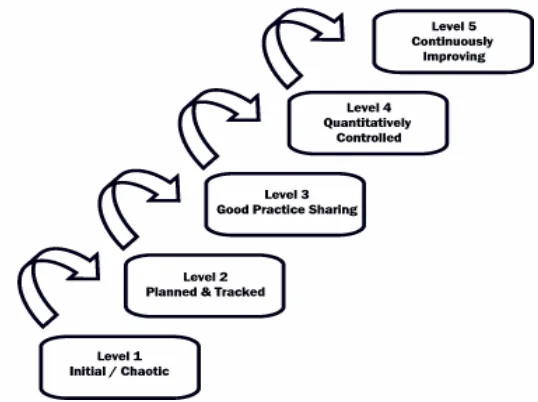
As a process improvement initiative the Software Capability Maturity Model (CMM) has demonstrated its success within the software industry. CMM was developed for the US department of Defence (DoD) who is a major software purchaser (Sarshar et al 1998). The use of CMM includes the evaluation of software manufacturing organisations prior to award them contracts. CMM is based on a five levelled structure. Within this, organisations are ranged from level 1 to level 5 based on their maturity. Within this framework, a maturity level has been defined as “a well defined evolutionary plateau towards achieving mature processes. Each maturity level provides a layer in the foundation for continuous process improvement” (Paulk et al 1993). Level 1 organisations are the least matured organisations where as level 5 organisations are the most matured organisations. In order to achieve a specified maturity level, organisations must satisfy all the “key processes” defined within the immediate below maturity level. The organisations are tested against “key enablers” to determine weather they have satisfied each key process within a maturity level. Through this framework, organisations are guided to adopt stepwise process improvements and ensure that the organisation in question is ready for the next level of process improvement. This, intern initialise a process improvement culture within the organisation and guides the procedures and the people towards improvements, using the available and potential tools.
[image:4.595.70.339.528.729.2]Sarshar et al (1998) have attempted to apply the principles of this model within the construction industry. This attempt was named as the Structured Process Improvement in Construction Enterprises (SPICE). The similarities between a software development projects and construction projects have laid the foundation for the SPICE to consider CMM as its base. Adopting the five level architecture of the CMM, the SPICE framework has also organised the process improvements of a construction organisation into five maturity levels. These five levels can be illustrated as follows.
It has also stated within the SPICE framework (as same as the CMM) that the organisation cannot skip maturity levels while progressing. As an example, to achieve third level maturity, organisations have to go through the second maturity level and cannot advance directly from first maturity level to third maturity level. In addition to the SPICE framework, the SPICE project has produced a mechanism of testing the maturity of an organisation. The mechanism is basically a questionnaire and a series of interviews, through which an organisation can evaluate their position against requirements of key processes and key process enablers within a given maturity level.
The SPICE was a phased research project. The initial phase was aiming at improving processes at individual construction projects and concentrated on the development of level 2 characteristics and Key Process Areas. Level 1 organisations have been identified as organisations which use ad-hoc processes during their day to day activities. And generally these organisations are surviving or performing due to the ability of some individual characters within the organisation. And generally these organisations are trying to survive the day rather than planning for the future. Level 2 has been identified as planned and tracked. At this level there is a degree of project predictability. A level 2 organisation has established policies and procedures for managing the major project-based processes (Sarshar et al 2000b). After publishing the first iteration in 2000, due to the increased interest of industrialists, the second phase of SPICE was commissioned in 2002 focusing on process improvement across the construction organisation. During this phase the third level characteristics and Key Processes Areas were evaluated. Level 3 is identified as “Well Defined” level. Within this, practices are well defined and institutionalised. Knowledge capturing and sharing mechanisms are established within these organisations to institutionalise the good practices and processes. After this institutionalisation, a high level of predictability can be expected towards future projects of an organisation. After this phase there were no major developments of the SPICE framework, leaving the level 4 and level 5 characteristics and Key Process Areas relatively unexplored. According to the software CMM, level 4 and 5 are the levels in which the organisations start to experience performance improvements as level 4 and 5 are specifically aiming at quantitative controlling and continuous improvements, the exploration of the dynamics of these levels is essential within the construction context, to achieve the desired performance improvements.
TECHNOLOGY CHANGE MANAGEMENT FOR PROCESS
IMPROVEMENT
the software industry and the construction industry with the aim of identifying the validity of the above presumption.
Technology usage in software and construction
When evaluating the above presumption, it is important to identify what the “new technologies” are, both within the construction industry and the software industry. Considering the potential “new technologies” within the construction context, Information Technology (IT) plays a major role as a strategic and an operational tool. While process improvement is not purely a technological endeavour, some authors have identified Information Technology as a key process improvement enabler (Davenport and Short 1990; Hammer and Champy 1993; Davenport 1993). This triggers the necessity to consider the role of IT within the Technology Change Management Key Process Area in construction process improvements. Thus the role of “Technology” is looked at from the role of “Information Technology” perspective as the discussion basis for this paper.
Place of Technology Change Management and IT usage
When evaluating the usage of IT within the construction industry, it is visible that it is driven by short term tangible benefits rather than by strategic long term benefits. According to a survey carried out by the Construction Industry Computing Association (CICA 1998a) using 73 construction related organisations, general client expectations / requirements attracted 68.5% response rate as a driver for IT investments where as only 17.8% have indicated strategic board level decisions as a driver for IT investments in construction. This intern indicates that IT usage in construction is largely generic application based and used to ease or automate the repetitive and tedious management, administrative and some function specific tasks. Within this context, it has been argued that the new advancements of IT triggers new operational and management processes within organisations, creating a technology push for process improvements. As an example, it is difficult to identify a an organisation today, which uses any report producing, letter writing mechanisms or tools other than personal computer based word processing solutions even within highly immature organisations. Further, emails have become a powerful and commonly used communication media commercially and individually. Being construction specific, a survey conducted by Construction Industry Computing Association (CICA 1998b) based on over 400 construction organisations revealed that 97% of the construction organisations have access to email. Further, computer aided drafting tools such as AutoCAD have shown influential impacts during the recent past, and traditional drawing boards are becoming redundant rapidly. Above examples provide evidence to the fact that, irrespective of the maturity of the organisation or the processes in place, IT has influenced organisations to change their work patters and processes. This initiates a necessity to re-evaluate the place of Technology Change Management as a Key Process Area within the construction process improvement context.
However, apart from the technology push for process improvements, some processes in place can create demand for new technological innovations to enhance their performances. This is apparent especially within the matured organisations as these organisations are continuously seeking for opportunities for improvements. This creates a process pull for technological advances. This reveals a concept of duality between the process improvement and use of information technology (Moony et al 2001; Hinks et al 1998). This duality suggests that both the matured organisations and immature organisations need to embark on, and can be benefited from adopting new technologies.
the construction industry. Within the software industry, the main application of IT is not based on generic applications to ease the administrative or management tasks, rather new IT innovations are core to the main product of the industry. Due to this reason, main processes of a software project (e.g. coding, testing) is unlikely to be benefited from an ad-hoc use of IT tools at operational levels. Rather it might lead to complications and compatibility issues between various modules produced. Thus, adoption of new IT tools within a software production environment is more visible as a strategic level structured decision. As an example, if a software company need to adopt a new programming language it is highly unlikely that an individual programmer can do it himself alone in an ad-hoc manner at operational level, rather it has to be a strategic level structured decision. Within this context, the software CMM decision to consider Technology Change Management as a fifth level Key Process Area is justifiable. Further, this in effect suggests that the place of Technology Change Management as a process improvement Key Process Area depends on the type and the usage of the technology.
Place of Technology Change Management and IT adoptability
Even though the above exemplifies the ad-hoc usage of IT at operational levels within construction, it does not mean that construction cannot or should not use IT at strategic levels with long term objectives in mind. More strategic use of IT leads to successful adoption of IT to the organisation concerned. However, some studies have revealed that a slow IT adoption is visible within the construction industry compared to most of the other industries (O’Conner and Yang 2004). Further more; the industry has become frustrated with the falling of IT as many companies have invested in the wrong technologies without addressing the business needs (Aouad et al 1999). This suggests that there is a need within the construction to manage the IT adoption. Thus, it is worthwhile evaluating the impact of the place of Technology Change Management as a process improvement Key Process Area within this context.
The slow IT adoptability does not mean that the construction industry lags in implementing IT systems; rather, it suggests that the construction industry lags the other industries in impact of IT to the business (Clark et al 1999). This in effect refers to the strategic use of IT within construction. Even though the issue has been identified as lack of awareness of how to exploit technology, an in-depth analysis about the “lack of awareness” relates the problem to the roots of “processes”, as often immature management processes are responsible for internal and external communication gaps. In other words this suggests that, proper processes have to be in place in order to harness the actual benefits of the IT capabilities within construction organisations.
Several researches have witnessed that this IT adoptability pushed purely by technological capabilities, either rejected by the organisation or used for a different purposes other than the intended purpose (Williams et al 2000; Proctor et al 1999). This suggests that IT adoptability in a particular industry or an organisation, especially with the intention of improving its performance, should not depend entirely on the capabilities of the technology in question. Rather, the organisation and industry specific characteristics and processes in place will have to be investigated prior adopting such technologies.
potential. Most of the modern project management software programmes (e.g. MS Project) are capable of analysing financial capabilities and requirements (e.g. cash flows forecasts) of organisations along with the programme. But at point of usage of these project management software programmes, it is often limited to the functions of the project planner. Since often there is minimal communication and interaction between the project planner and the quantity surveyor, due to the fragmented nature of the industry, at functional level, these valuable features are often neglected. This complies a classical example of need for an industry wide, process based approach to IT implementation strategies within the construction industry. The above situation drives the construction industry to a dilemma, in terms of process improvements and use of IT within the construction industry. It is important to have matured processes that support IT integration to enhance the maximum benefits from IT capabilities, and at the same time, new IT capabilities lay solid foundations for successful process improvements. This dilemma has been identified by Hinks et al (1998), as they highlight,
“Information technology can assist the attainment and maintenance of a new process operating within new relational parameters if the incoming new processes and mechanism of change are sufficiently prescribed and detailed to allow industry-specific information systems and information technology applications to be designed and applied.
Conversely, the diversity of emergent IT is what helps stimulate change in existing practices. So here also there appears to be an inter-dependent / pre-requisite paradox for maturation, in the context of Construction IT application.”(Hinks et al 1998)
This dilemma directly influences the place of Technology Change Management Key Process Area within the construction process improvement. If this Key Process Area is to be placed at a higher maturity level as in the software CMM, the impact of ad-hoc IT usage within construction will receive minimum attention from the process improvement perspective. On the other hand if this Key Process Area placed within lower maturity levels, the strategic use of IT within construction will not be addressed properly, thus will enhance the construction IT adoptability issues. This demands closer consideration of the two extremes of this dilemma from the place of Technology Change Management Key Process Area point of view.
It is visible form the above that the IT usage within construction is to be of two folds:
1. Ad-hoc use of application based IT usage at operational level for management, administrative and functional tasks
2. Strategic use of IT for integration and enhancement of existing processes.
1. Established used systems and technologies – Office automated tools, Computer aided planning, estimating, purchasing, etc.
2. Existing systems and technologies with little influence – Knowledge based systems, neural networks, case based technologies, etc.
3. Emerging systems and technologies still considered as research tools – VR, 3D modelling, CASE tools, etc.
4. Future technologies – Robotics, automated tools, etc.
5. Communication and standards systems and technologies – STEP, IAI, EDI, COBRA, VRML, IP (Hinks et al 1998)
It is suggested that these technologies when integrated, could provide a mechanism for a technology push of the process. And with a wide acceptance and profound applications of emerging and existing information technologies will initiate the major impacts on processes (Hinks et al 1998).
This model of relationship between IT and processes at the interface, visualises the impact of first four categories of technologies above explained on processes, through the technology interface, in addition to the fact that each technology has to become an established used technology to enhance the maximum potential. And also it illustrates how communication and standard systems technologies contribute to this maturity of IT. Further they explain technology maturation in a stepwise structure taking CMM as the underlying concept:
1. Emerging
2. Initial – Ad-hoc use of technology (3D, VR)
3. Applied – Applied technology (CAD, Project planning, etc) 4. Integrated – Standard, consistent technology
5. Managed – Reliable technology
6. Matured – Continuously improving technology
They have also tried to synchronise the process maturity and technology maturity, while defining technology push and process pull scenarios within the model. This creates a synergetic influence to the SPICE framework, as both the frameworks share a common platform. Further, the technology management has been discussed as a key process area within CMM higher maturity levels, where SPICE has not explored the impact within the construction context yet. This highlights a need to explore the possibility dynamics of process – IT co-maturation phenomenon within SPICE higher maturity levels in particular. Further, this builds a favourable foundation to answer the phenomenon of the capabilities of people, procedures and tools in an integrated manner within the construction process improvement environments.
However, it is visible from the above that the place of Technology Change Management as a Key Process Area in construction process improvement cannot be allocated a straight forward place from the organisational maturity point of view due to the nature of the IT usage within the industry. Considering the relationship between the process and IT maturity demonstrated within the construction in addition to the advantages discussed above, a parallel integration of the co-maturation model is more justifiable to address the process improvement and the technology change management phenomena within the construction context.
CONCLUSION
direct applicability of those initiatives within a construction environment. Identification of these characteristics enables the construction industry to evaluate other industries experiences within a construction specific framework. Success stories of process improvement within the industries like software then provide a platform within the construction to learn process improvement lessons form other industries.
The Software Capability Maturity Model (CMM), a successful process improvement initiative used within the software industry has provided the basis for the construction process improvement initiative “The Structured Process Improvement in Construction Enterprises (SPICE)”. Within CMM the Technology Change Management has been identified as a Key Process Area, within the highest most maturity level indicating that the technology change management is a concern of matured organisations. Considering the use of Information Technology (IT) within both the industries it can be argued that even though software industry might be able to attach its technology change management to an agenda within matured organisations, construction industry needs attention in Technology Change Management within both mature and immature organisations. This leads the construction to consider Technology Change Management not as a Key Process Area fixed to a particular maturity level, but as a parallel, synchronised performance improvement attempt with the process improvement initiatives. Within this context, the process - IT co-maturation model (Hinks et al 1998; Aouad et al 1999) provide a basis to start construction Technology Change Management from a different perspective.
REFERENCES
Amaratunga, D, Sarshar, M and Baldry, D (2002) Process Improvement in Facilities Management: The SPICE Approach. Business Process Management Journal, 4(8), 318-337.
Anderson, J, Rungtusanatham, M and Schroeder, R (1994) A Theory of Quality Management Underlying the Deming Management Method. The Academy of Management Review,19(3), 472-509.
Aouad, G, Kagioglou, M, Cooper, R, Hinks, J, and Sexton, M. (1999) Technology Management of IT in Construction: A Driver or Enabler? Logistics Information Management, 12(1-2), 130-137.
Bessant, J and Francis, D (1999) Developing Strategic Continuous Improvement Capability. International Journal of Operations and Production Management, 19(11), 1106-1119.
Bower, D, Hinks, J, Wright, H, Hardcastle, C. and Cuckow, H. (2001) ICTs, videoconferencing and the construction industry: opportunity or threat? Construction Innovation, 1, pp. 129-144.
Bower, D, Reid, M, Barry, N and Ibbotson, T (2000) Aligning process and meaning: innovating in complex healthcare delivery systems. International Journal of Innovation Management 4, 299–317.
Burgelman, R, Maidique, M and Wheelwright, S (1996) Strategic Management of Technology and Innovation. 2nd Ed. London: Irwin Professional Publishing.
Cao, G, Clarke, S and Lehaney, B (2001) A Critique of BPR from a Holistic Perspective. Business Process Management Journal, 7(4), 332-339.
Carr, D (1993) Managing for Effective Business Process Redesign. Journal of Cost Management, 7(3), 16-21.
CICA (1998a) IT usage in construction team [online], Available from:
http://www.cica.org.uk/ITUsageforConstruction.htm [Accessed 10th February 2005]
Clark, A, Atkin, B, Betts, M and Smith, D (1999) Benchmarking the Use of IT to Support Supplier Management in Construction. IT con,4, 1- 16.
Davenport, T(1993) Process Innovation, Reengineering Work through Information Technology. Boston: Harvard Business School Press.
Davenport, T and Short, J (1990) The New Industrial Engineering: Information Technology and Business Process Redesign. Sloan Management Review, 31(4), 11-27.
Deakins, E Makgrill, H (1997) What Killed BPR? Some Evident from the Literature. Business Process Management Journal,3(1), 81-107.
Dosi, G, Teece, D and Chytry, J (1998) Technology, Organisation and Competitiveness. Oxford: Oxford University Press.
Egan, J (1998) Rethinking Construction, Department of Environment. Transport and the Regions
Fairclough, J (2002) Re thinking construction innovation and research: A review of Government R&D policies and practices. DTLR
Green, D and May, C (2003) Re-engineering Construction: Going Against Grain. Building research and information, 31(2), 97-106.
Hammer, M and Champy, J (1993) Re-engineering the Corporation: a Manifesto for Business Revolution. London: Brealey Publishing.
Harrington, H (1991) Improving Business Processes. TQM Magazine, 2, 39-44.
Hinks, J, Aouad, G, Cooper, R, Sheath, D, ,Kagioglou, M and Sexton, M (1998) IT and The Design and Construction Process: A Conceptual Model of Co-Maturation. The International Journal of Construction IT, 5(1), 1-25.
Holt, D, Love, D and Nesan, F (2000) Employee Empowerment in Construction: An Implementation Model for Process Improvement. Team performance Management: An International Journal, 6 (3/4), 47-51.
Koskela, L, Ballard, G, and Howell, G, (2003) Achieving Change in Construction. Virginia: International Group of Lean Construction.
Latham, M (1994) Constructing the Team, HMSO.
Lillrank, P (1995) The Transfer of Management Innovations from Japan. Organisation Studies, 16(6), 971-89.
Love, D and Li, H (1998) From BPR to CPR – Conceptualising Re-Engineering in Construction. Business Process Management Journal, 4(4), 291-305.
Love, D, Li, I, Irani, Z and Li, H (2000) Total Quality Management and the Learning Organisation: A Dialogue for Change in Construction. Construction Management and Economics, 18, 321-331.
Mowatt, G, Bower, D, Brebner, J, Cairns, J, Grant, A and McKee, L (1997) When and how to assess fast-changing technologies : a comparative study of six medical applications of four generic technologies. Health Technology Assessment 1, 1–149.
O’Conner, T and Yang, L (2004) Project Performance verses Use of Technologies at Project and Phase Levels. Journal of Construction Engineering and Management, 130(3), 322-329.
Paulk, C, Weber, C, Garcia, S, Chrissis, B and Bush, M (1993) Key Practices of the Capability Maturity Model. Pittsburgh: Software Engineering Institute.
Santos, A and Powell, J (2001) Assessing the Level of Teamwork in Brazilian and English Construction Sites. Leadership and Organization Development Journal, 22(4), 166-174.
Santos, A Powell, J and Formoso, C (2000) Setting Stretch Targets for Driving Continuous
Improvement in Construction: Analysis of Brazilian and UK practices. Work Study, 49(2), 50-58.
Sarshar, M, Haigh, R, Finnemore, M, Aouad, G, Barrett, P, Baldry, D and Sexton, M (2000) SPICE: A Business Process Diagnostics Tool for Construction Projects. Engineering Construction & Architectural Management,7(3), 241-250.
Sarshar, M, Hutchinson, A, Aouad, G, Barrett, P, Minnikin, J and Shelley, C (1998) Standardised Process Improvement for Construction Enterprises (SPICE). IN: Proceedings of 2nd European Conference on Product and Process Modelling, Watford.
Talwar, R (1993) Business Re-Engineering – A Strategy-Driven Approach. Long Range Planning, 26(6), 22-40.
Yoxen, E (1987) Seeing with sound: a study of the development of medical images. In Bijker, W E,Hughes, T and Pinch, T (ed). The social construction of technological systems. Cambridge, MA: MIT Press, 281–306.