Review Article
Physical Sciences of the Ocean: A report to IAPSO/IUGG
S PRERNA
1, B PAUL
1, P A FRANCIS
1and S S C SHENOI
1,*1
Indian National Centre for Ocean Information Services, Hyderabad 590 090, India
(Received on 02 March 2018; Accepted on 09 July 2018)
A brief sketch of the advances in the oceanographic research in India that deals with physical, chemical and biological processes in the ocean during the period 2000-2018 are highlighted in this report. It is found that there have been significant progress in the research activities in this field with more than 2300 research papers published during the past 18 years. About 4827 Indian researchers were involved in authoring/authoring these papers and many publications were co-authored with foreign researchers spread across 44 countries. Notable achievements in the field of ocean sciences in the recent past are (a) a revolutionary understanding on the coupled processes over the tropical ocean and atmosphere, (b) enhanced capability in the numerical ocean modeling and data assimilation, (c) advancements in remote sensing techniques, algorithms and applications, (d) progress in our knowledge on coastal processes, and (e) marine bio-geochemistry.
Keywords: Ocean; IAPSO/IUGC; Physical, Chemical and Biological Sciences; Publications
*Author for Correspondence: E-mail: [email protected]
Proc Indian Natn Sci Acad
85 No. 2 June 2019 pp. 421-429
Printed in India
.
DOI: 10.16943/ptinsa/2018/49515
3.
Climate change (85)
4.
Coastal studies (94)
5.
Estuaries and nearshore waters (260)
6.
Marine ecosystem (38)
7.
Ocean acoustics (15)
8.
Ocean circulation (227)
9.
Ocean modeling and data assimilation (205)
10.
Ocean optics (75)
11.
Physical processes (97)
12.
Potential fishing zones (44)
13.
Remote sensing (205)
14.
Sediment transport (68)
15.
Tides, Storm-surges and Sea-level (261)
16.
Tsunami (142)
17.
Waves (308)
Introduction
There has been significant advancement in research
and development activities in the field of Physical
Sciences of the Oceans in India in the 21st century.
Since January 2000 to February 2018, 2345 research
papers were published in this field. About 4827 Indian
researchers were involved in authoring/co-authoring
these papers in collaboration with 44 foreign countries.
The steady growth in the number of papers published
in different areas of physical sciences of oceans can
be seen in Fig. 1 which depicts the number of papers
published each year. The number of publications
steadily rose from about 30 in 2000 to more than
hundred in 2006-2007 and then increased rapidly to
240 papers per year in 2015. The same number
continued in the later years also. Research areas
within the broad category of physical sciences of the
oceans, in which significant research have been
carried out in India can be further classified as follows
(number of publications in each category are given in
brackets).
1.
Air sea interaction (95)
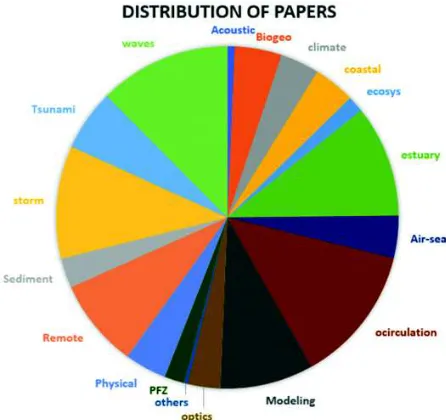
Topic wise distribution of publication is shown
in Fig. 2. It is interesting to note that maximum number
of papers were published in the field of tides, storm
surge and sea-level changes (261) and this is closely
followed by research in estuaries and nearshore
waters (260) and ocean modeling and data assimilation
(205). Ocean remote sensing (205), Tsunami (142)
and ocean biogeochemistry (104) are the other areas
which witnessed significant amount of research in
the branches of physical sciences of the oceans.
Discussion
A large number of papers were published on the
physical processes in the Indian Ocean, which mainly
described the large-scale oceanic circulation including
that in the coastal waters of India, equatorial Indian
Ocean and Southern Indian Ocean. These studies
reported the basic mechanisms involved in the
observed variability in physical parameters in the Indian
Ocean. The deployment of Acoustic Doppler Current
Profilers (ADCPs) in the shelf and slope regions in
the coastal waters around the country has been
providing continuous high-frequency data of coastal
currents for the past 10 years and that has enhanced
our insights in the variability of coastal circulation.
Similarly, the data from Ocean Data Buoys deployed
in the deep and shallow waters in the Indian Ocean
also helped in improving the understanding of Indian
Ocean variability and air-sea interaction processes.
Research publications based on the data from
observational campaigns in the Indian Ocean, the
Arabian Sea Monsoon Experiment (ARMEX),
Continental Tropical Convergence Zone (CTCZ), Bay
of Bengal Boundary Layer Experiment (BoBBLE),
Ocean Mixing and Monsoon (OMM), International
Indian Ocean Expedition-II (IIOE-II), etc., have also
contributed significantly to the increased number of
publications in this category.
[image:2.612.67.296.82.205.2]Numerical Ocean Modeling has been one of the
key research areas among the Indian researchers.
217 papers were published in this area. Access to
high performance computational facilities, availability
of ocean observations and exposure to state-of-art
numerical ocean models have contributed significantly
to this achievement. Supported by the ocean modeling
activities, Indian National Centre for Ocean
Information Services (INCOIS) has setup India’s first
Operational Ocean Forecast System (INDian Ocean
Forecast System, INDOFOS) in 2010, which
comprises a suit of numerical ocean models and that
has now evolved into one of the leading ocean forecast
system in the world. INCOIS is now providing
real-time ocean analysis for the global oceans and
short-term ocean forecasts for the Indian Ocean. Very
high-resolution coastal forecasts are also being provided
now by INCOIS for the waters around India.
Publications in the field of ocean modeling describe
the results of the studies on how the ocean models
could be improved by incorporating various physical
processes and by using improved atmospheric
forcings. Ocean models were also used to study the
specific oceanographic features and the processes
responsible for the genesis of the ocean features.
Ocean data assimilation has also been a focus of
Fig. 1: Year-wise number of publications in the field ofOceanography for the period 2000 to present
[image:2.612.318.541.83.293.2]research in the last two decades. Fifty seven papers
were published on data assimilation, including the
studies that described the methodologies of data
assimilation and how the data assimilation improved
the ocean analysis and forecasts. One of the significant
studies in this field described how the ocean analysis
in the pre-Argo era are contaminated due to the
assimilation of data from the bounded observational
network like Tropical Atmosphere Ocean (TAO)
moorings in the Pacific.
Publications on air-sea interactions, including
those focused on the response of oceans on tropical
cyclones and monsoon have also contributed
significantly to the growth of research publications in
the recent years. Many papers in the field of air-sea
interaction also discussed the influence of oceans on
tropical cyclones and Indian and South Asian monsoon.
The increase in the number of publications on air-sea
interaction processes in the Indian Ocean could be
largely attributed to the discovery of Indian Ocean
Dipole (IOD) in late 1990’s and Equatorial Indian
Ocean Oscillation (EQUINOO) in early 2000’s.
These discoveries have revived the research interests
in the field of tropical coupled air-sea interaction
processes and their influence on the Indian summer
monsoon. Several papers were published on the
potential impacts of Indian Ocean Dipole, EQUINOO,
El Nino and Southern Oscillation (ENSO) on Indian
monsoon. Several other studies focused on the
processes involved in the initiation and evolution of
IOD. Some of the papers revisited the relationship
between sea surface temperature and convection.
Studies on Marine Bio-geochemistry also have
shown considerable growth in the past two decades.
109 papers were published during this period on
Bio-geochemistry which dealt with geochemical and
biological processes mostly focusing on studies of
Carbon, Nitrogen and Oxygen elements. Several
papers were also published focusing the sources, sinks
and internal cycles of the trace elements as they have
important applications in chronology,
paleo-oceanography and ocean mixing. Substantial number
of studies on zooplanktons and phytoplanktons
described their spatial and temporal distributions. The
role of mesoscale dynamics in regulating the
phytoplankton biomass by modulating the nutrient input
to the surface layer and the mixed layer depth were
the focus of some of the publications in this area.
Several papers were published on the marine
ecosystems. Some publications brought out the need
for the conservation of Mangroves and Seagrass
Ecosystems. Group level classification of zooplankton
and phytoplankton, study of plankton taxonomy, their
behavior and adoption to the anthropogenic effects
were also studied. Around forty publications came
from Indian authors on marine ecosystem during this
period. Some of them dealt on how to improve the
Potential Fishing Zones (PFZ) identified based on the
satellite remote sensed sea surface temperature and
Chlorophyll concentrations in the sea water. The
additional information on ocean circulation and marine
ecosystem parameters are shown to improve the
identification of PFZ.
Considerable number of research papers were
published on climate change by Indian authors since
2000. They included Indian Ocean warming, sea level
changes, changes in primary productivity related to
global change, sea surface salinity and hydrographic
changes owing to climate change. Some papers
reported the Climate Change and Sea-Level Rise and
impact on agriculture. Studies using ocean
observations and global coupled ocean–atmosphere
model simulations have shown that besides the direct
contributions from greenhouse warming, the long-term
warming trend of the western Indian Ocean during
summer depends on the asymmetry in El
Niño-Southern Oscillation (ENSO) teleconnection, and the
positive SST skewness associated with ENSO during
the recent decades.
There are several publications on the changes
taking place on the shoreline of India. Most of them
focused on mapping and monitoring of coastline
changes associated with the Indian Ocean tsunami
and tropical cyclones. Few papers reported on coastal
pollution and erosion and their implications. The papers
on estuaries and nearshore waters of Indian coast
described some of the physical and biogeochemical
processes with the help of observations and models.
Few publications dealt on the mangroves and sea
grass. Some papers discussed on the influence of
hydrological and anthropogenic factors controlling the
abundance and variability of enteropathogens in the
estuaries.
field of coastal engineering, estimation of sea surface
temperature, chlorophyll content, suspended sediment
concentration, algal blooms, wave characteristics,
identification of Potential Fishing Zones (PFZ), etc.
Many papers reported the use of remote sensing and
GIS in the mapping and monitoring of coastal
resources, detecting shoreline changes, studying
coastal landforms etc. The advancement in
technology and the availability of high resolution data
has attracted many researchers in this field which is
highlighted by the increased number of publications
in the last decade. Several papers were also published
on the algorithms used for the retrieval of various
parameters using remote sensing data. Studies on
bio-optics also witnessed remarkable growth in the recent
years. Papers describing the superiority of regional
algorithms for the retrieval of oceanographic
parameters using remote sensing methods were also
published. Some of the studies described the effective
use of statistical and computer aided tools like Wavelet
Analysis, Neural Network, etc. for the accurate
retrieval of geophysical parameters.
The Indian Ocean Tsumani in 2004 has dragged
the attention of many researchers in this field. Indian
researchers published 35 papers based on 2004
tsunami. Several studies described how the Indian
Ocean tsunami affected various islands in the Indian
Ocean and the vulnerability of coasts and estuaries
to such natural disasters. Few papers were published
on the tsunami early warning system and few
addressed the socio economic impacts and mitigation
of tsunami. There have been several papers in the
field of Paleo-tsunami as well. Overall 120 papers
were published from India related to tsunami after
2000.
Acknowledgements
Scopus and Mendley are extensively used for
extracting and managing the refrences. Authors are
thankful to Dr. Arnab Mukherjee and Dr. Abhisek
Chhaterjee for their suggestions in categorizing the
research articles.
References
Acharyya T, Sarma V V S S, Sridevi B, Venkataramana V, Bharathi M D, Naidu S A, Kumar B S K, Prasad V R, Bandyopadhyay D, Reddy N P C and Kumar M D (2012) Reduced river discharge intensifies phytoplankton bloom in Godavari estuary, India in Mar Chem 132-133 15-22 Al Saafani M A, Shenoi S S C, Shankar D, Aparna M, Kurian J,
Durand F and Vinayachandran P N (2007) Westward movement of eddies into the Gulf of Aden from the Arabian Sea in J Geophys Res-Oceans 112
Amol P, Shankar D, Aparna S G, Shenoi S S C, Fernando V, Shetye S R, Mukherjee A, Agarvadekar Y, Khalap S, Satelkar N P (2012) Observational evidence from direct current measurements for propagation of remotely forced waves on the shelf off the west coast of India in J Geophys Res-Oceans 117
Andrade V, Rajendran K and Rajendran C P (2014) Sheltered coastal environments as archives of paleo-tsunami deposits: Observations from the 2004 Indian Ocean tsunami in J Asian Earth Sci 95 331-341
Antony M K, Swamy G N and Somayajulu Y K (2002) Offshore limit of coastal ocean variability identified from hydrography and altimeter data in the eastern Arabian Sea in Cont Shelf Res 22 2525-2536
Aparna S G, McCreary J P, Shankar D and Vinayachandran P N
(2012) Signatures of Indian Ocean Dipole and El Niño-Southern Oscillation events in sea level variations in the Bay of Bengal in J Geophys Res-Oceans 117
Arora A, Rao S A Chattopadhyay R, Goswami T, George G and Sabeerali C T (2016) Role of Indian Ocean SST variability on the recent global warming hiatus in Global Planet Change
143 21-30
Bange H W, Naqvi S W A and Codispoti L A (2005) The nitrogen cycle in the Arabian Sea in Prog Oceanogr65 145-158 Basu S, Sharma R, Agarwal N, Kumar R and Sarkar A (2009)
Forecasting of scatterometer-derived wind fields in the north Indian Ocean with a data-adaptive approach in J Geophys Res-Oceans 114
Behara A and Vinayachandran P N (2016) An OGCM study of the impact of rain and river water forcing on the Bay of Bengal in J Geophys Res-Oceans 121 2425-2446 Behera H, Das S and Sahoo T (2018) Wave propagation through
mangrove forests in the presence of a viscoelastic bed in
Wave Motion
Behera P K and Padhy S N (2012) Physico-chemical studies on water quality characteristics of bahuda estuary, Bay of Bengal in Nature Environment and Pollution Technology
11 117-120
the western Indian Ocean in J Mar Res64 393-406 Bhaskaran P K, Gayathri R, Murty P L N, Bonthu S and Sen D
(2014) A numerical study of coastal inundation and its validation for Thane cyclone in the Bay of Bengal in Coast Eng83 108-118
Bhaskaran P K, Nayak S, Bonthu S R, Murty P L N and Sen D (2013) Performance and validation of a coupled parallel ADCIRC-SWAN model for THANE cyclone in the Bay of Bengal in Environ Fluid Mech13 601-623
Bhat G S (2003) Measurement of air-sea fluxes over the Indian Ocean and the Bay of Bengal in J Climate16 767-775 Bhat G S and Fernando H J S (2016) Remotely Driven Anomalous
Sea-Air Heat Flux Over the North Indian Ocean During the Summer Monsoon Season in Oceanography29 232-241
Bhat G S, Vecchi G A and Gadgil S (2004) Sea surface temperature of the Bay of Bengal derived from the TRMM microwave imager in J Atmos Ocean Tech21 1283-1290
Cao L, Duan L, Bala G and Caldeira K (2016) Simulated long-term climate response to idealized solar geoengineering in
Geophys Res Lett43 2209-2217
Chakraborty A, Sharma R, Kumar R and Basu S (2015) Joint assimilation of Aquarius-derived sea surface salinity and AVHRR-derived sea surface temperature in an ocean general circulation model using SEEK filter: Implication for mixed layer depth and barrier layer thickness in J Geophys Res-Oceans120 6927-6942
Chakraborty K, Gupta A, Lotliker A A and Tilstone G (2016) Evaluation of model simulated and MODIS-Aqua retrieved sea surface chlorophyll in the eastern Arabian Sea in Estuar Coast Shelf S181 61-69
Chakravorty S, Chowdary J S and Gnanaseelan C (2014) Epochal changes in the seasonal evolution of tropical Indian Ocean warming associated with El Niño in Clim Dynam42 805-822
Chatterjee A, Shankar D, McCreary Jr J P and Vinayachandran P N (2013) Yanai waves in the western equatorial Indian Ocean in J Geophys Res-Oceans 118 1556-1570 Chatterjee A, Shankar D, McCreary J P, Vinayachandran P N and
Mukherjee A (2017) Dynamics of Andaman Sea circulation and its role in connecting the equatorial Indian Ocean to the Bay of Bengal in J Geophys Res-Oceans 122 3200-3218
Chatterjee M, Shankar D, Sen G K, Sanyal P, Sundar D, Michael G S, Chatterjee A, Amol P, Mukherjee D, Suprit K, Mukherjee A, Vijith V, Chatterjee S, Basu A, Das M, Chakraborti S, Kalla A, Misra S K, Mukhopadhyay S, Mandal G, Sarkar K (2013) Tidal variations in the
sundarbans estuarine system, India in J Earth Syst Sci122
899-933
Chowdary J S, Parekh A, Gnanaseelan C and Sreenivas P (2014) Inter-decadal modulation of ENSO teleconnections to the Indian Ocean in a coupled model: Special emphasis on decay phase of El Niño in Global Planet Change 112 33-40
Chowdary J S, Parekh A, Kakatkar R, Gnanaseelan C, Srinivas G, Singh P and Roxy M K (2016) Tropical Indian Ocean response to the decay phase of El Niño in a coupled model and associated changes in south and east-Asian summer monsoon circulation and rainfall in Clim Dynam47 831-844
Chowdary J S, Xie S-P, Tokinaga H, Okumura Y M, Kubota H, Johnson N and Zheng X-T (2012) Interdecadal variations in ENSO teleconnection to the Indo-Western Pacific for 1870-2007 in J Climate25 1722-1744
Currie J C, Lengaigne M, Vialard J, Kaplan D M, Aumont O, Naqvi S W A and Maury O (2013) Indian ocean dipole and El Niño/Southern Oscillation impacts on regional chlorophyll anomalies in the Indian Ocean in Biogeosciences
10 6677-6698
D’Costa P M and Anil A C (2014) Penicillin-mediated changes in viable benthic diatom assemblages - insights about the relevance of bacteria across spatial and seasonal scales in
Mar Freshwater Res65 437-452
Das U, Vinayachandran P N and Behara A (2016) Formation of the southern Bay of Bengal cold pool in Clim Dynam47
2009-2023
Dash S K, Jenamani R K, Kalsi S R and Panda S K (2007) Some evidence of climate change in twentieth-century India in
Climatic Change85 299-321
Durand F, Shankar D, Birol F and Shenoi S S C (2008) Estimating boundary currents from satellite altimetry: A case study for the east coast of India in J Oceanogr64 831-845 Durand F, Shankar D, de Boyer Montégut C, Shenoi S S C,
Blanke B and Madec G (2007) Modeling the barrier-layer formation in the southeastern Arabian Sea in J Climate20
2109-2120
Francis P A, Gadgil S and Vinayachandran P N (2007) Triggering of the positive Indian Ocean dipole events by severe cyclones over the Bay of Bengal in Tellus A59 461-475 Gayathri R, Murty P L N, Bhaskaran P K and Srinivasa Kumar
T (2016) A numerical study of hypothetical storm surge and coastal inundation for AILA cyclone in the Bay of Bengal in Environ Fluid Mech16 429-452
Budget for the Northward Propagating Summer Monsoon Intraseasonal Oscillation (MISO) in the Central Bay of Bengal in J Geophys Res-Oceans122 8841-8854 Girishkumar M S, Ravichandran M and Han W (2013) Observed
intraseasonal thermocline variability in the Bay of Bengal in J Geophys Res-Oceans 118 3336-3349
Girishkumar M S, Ravichandran M and Pant V (2012) Observed chlorophyll-a bloom in the southern Bay of Bengal during winter 2006-2007 in Int J Remote Sens33 1264-1275 Girishkumar M S, Ravichandran M, McPhaden M J and Rao R R
(2011) Intraseasonal variability in barrier layer thickness in the south central Bay of Bengal in J Geophys Res-Oceans 116
Goswami B N, Rao S A, Sengupta D and Chakravorty S (2016) Monsoons to Mixing in the Bay of Bengal Multiscale Air-Sea Interactions and Monsoon Predictability in
Oceanography29 18-27
Haldar D, Raman M and Dwivedi R M (2013) Tsunami - A jolt for Phytoplankton variability in the seas around Andaman Islands: A case study using IRS P4-OCM data in Indian J Mar Sci42 437-447
Harikumar R, Hithin N K, Balakrishnan Nair T M, Sirisha P, Krishna Prasad B, Jeyakumar C, Shenoi S S C (2015) Ocean state forecast along ship routes: Evaluation using ESSO-INCOIS real-time ship-mounted wave height meter and satellite observations in J Atmos Ocean Tech32 2211-2222
Hithin N K, Remya P G, Balakrishnan Nair T M, Harikumar R, Kumar R and Nayak S (2015) Validation and Intercomparison of SARAL/AltiKa and PISTACH-Derived Coastal Wave Heights Using In-Situ Measurements in IEEE J Sel Top Appl8 4120-4129 Joseph S, Wallcraft A J, Jensen T G, Ravichandran M, Shenoi S S
C and Nayak S (2012) Weakening of spring Wyrtki jets in the Indian Ocean during 2006-2011 in J Geophys Res-Oceans 117
Jyothibabu R, Vinayachandran P N, Madhu N V, Robin R S, Karnan C, Jagadeesan L and Anjusha A (2015) Phytoplankton size structure in the southern Bay of Bengal modified by the Summer Monsoon Current and associated eddies: Implications on the vertical biogenic flux in J Marine Syst143 98-119
Keerthi M G, Lengaigne M, Levy M, Vialard J, Parvathi V, De Boyer Montégut C, Muraleedharan P M (2017) Physical control of interannual variations of the winter chlorophyll bloom in the northern Arabian Sea in Biogeosciences14
3615-3632
Khare N, Nigam R, Mayenkar D N and Saraswat R (2017) Cluster
analysis of benthic foraminiferal morpho-groups from the western margin of India reflects its depth preference in
Cont Shelf Res 151 72-83
Krishnamurthy V and Goswami B N (2000) Indian monsoon-ENSO relationship on interdecadal timescale in J Climate
13 579-595
Kumar T S, Mahendra R S, Nayak S, Radhakrishnan K and Sahu K C (2010) Coastal vulnerability assessment for Orissa State East Coast of India in J Coastal Res26 523-534 Kumar T S, Murty P L N, Kumar M P, Kumar M K,
Padmanabham J, Kumar N K, Mohanty P (2015) Modeling Storm Surge and its Associated Inland Inundation Extent Due to Very Severe Cyclonic Storm Phailin in Mar Geod
38 345-360
Levin L A, Ekau W, Gooday A J, Jorissen F, Middelburg J J, Naqvi S W A, Zhang J (2009) Effects of natural and human-induced hypoxia on coastal benthos in Biogeosciences6
2063-2098
Lucas A J, Nash J D, Pinkel R, MacKinnon J A, Tandon A, Mahadevan A, Le Boyer A (2016) Adrift Upon a Salinity-Stratified Sea: A View of Upper-Ocean Processes in the Bay of Bengal During the Southwest Monsoon in
Oceanography29 134-145
Mahendra R S, Mohanty P C, Bisoyi H, Kumar T S and Nayak S (2011) Assessment and management of coastal multi-hazard vulnerability along the Cuddalore-Villupuram, east coast of India using geospatial techniques in Ocean Coast Manage54 302-311
Mehra P, Soumya M, Vethamony P, Vijaykumar K, Balakrishnan Nair T M, Agarvadekar Y, Harmalkar B (2015) Coastal sea level response to the tropical cyclonic forcing in the northern Indian Ocean in Ocean Sci11 159-173
Menon H B, Lotliker A A and Nayak S R (2006) Analysis of estuarine colour components during non-monsoon period through Ocean Colour Monitor in Estuar Coast Shelf S66
523-531
Menon H B, Lotliker A A, Moorthy K K and Nayak S R (2006) Variability of remote sensing reflectance and implications for optical remote sensing - A study along the eastern and northeastern waters of Arabian Sea in Geophys Res Lett33
Menon H B, Lotliker A and Nayak S R (2005) Pre-monsoon bio-optical properties in estuarine, coastal and Lakshadweep waters in Estuar Coast Shelf S63 211-223
and Dwivedi R M (2017) Persistence of productive surface thermal fronts in the northeast Arabian Sea in Reg Stud Mar Sci16 216-224
Mukherjee A, Shankar D, Aparna S G, Amol P, Fernando V, Fernandes R and Vernekar S (2013) Near-inertial currents off the east coast of India in Cont Shelf Res 55 29-39 Murty P L N, Sandhya K G, Bhaskaran P K, Jose F, Gayathri R,
Balakrishnan Nair T M and Srinivasa Kumar T (2014) A coupled hydrodynamic modeling system for PHAILIN cyclone in the Bay of Bengal in Coast Eng93 71-81 Naqvi S W A, Bange H W, Gibb S W, Goyet C, Hatton A D and
Upstill-Goddard R C (2005) Biogeochemical ocean-atmosphere transfers in the Arabian Sea in Prog Oceanogr
65 116-144
Nayak R K, Salim M, Sasamal S K, Mohanthy P C, Bharadwaj R K, Rao K and Dadhwal V K (2016) Assessment of SARAL-ALTIKA Tidal Corrections in the Coastal Oceans Around India in Mar Geod39 331-347
Nisha P G, Muraleedharan P M, Keerthi M G, Sathe P V and Ravichandran M (2012) Does sea level pressure modulate the dynamic and thermodynamic forcing in the tropical Indian Ocean? in Int J Remote Sens33 1991-2002 Patra A and Bhaskaran P K (2016) Trends in wind-wave climate
over the head Bay of Bengal region in Int J Climatol36
4222-4240
Prakash S, Nair T M B, Bhaskar T V S U, Prakash P and Gilbert D (2012) Oxycline variability in the central Arabian Sea: An Argo-oxygen study in J Sea Res71 1-8]
Rajeevan M and Sridhar L (2008) Inter-annual relationship between Atlantic sea surface temperature anomalies and Indian summer monsoon in Geophys Res Lett35
Rakhesh M, Raman A V and Sudarsan D (2006) Discriminating zooplankton assemblages in neritic and oceanic waters: A case for the northeast coast of India, Bay of Bengal in Mar Environ Res61 93-109
Ramana M V, Krishnan P, Muraleedharan Nair S and Kunhikrishnan P K (2004) Experimental observations of air-sea parameters and fluxes associated with anomalous event in the Indian Ocean during 1997-1998 El Niño period in Atmos Res70 21-32
Rao A D, Joshi M and Ravichandran M (2008) Oceanic upwelling and downwelling processes in waters off the west coast of India in Ocean Dynam58 213-226
Rao R R, Girish Kumar M S, Ravichandran M, Rao A R, Gopalakrishna V V and Thadathil P (2010) Interannual variability of Kelvin wave propagation in the wave guides of the equatorial Indian Ocean, the coastal Bay of Bengal and the southeastern Arabian Sea during 1993-2006 in
Deep-Sea Res Pt I57 1-13
Ravichandran M, Behringer D, Sivareddy S, Girishkumar M S, Chacko N and Harikumar R (2013) Evaluation of the Global Ocean Data Assimilation System at INCOIS: The Tropical Indian Ocean in Ocean Model69 123-135
Ravichandran M, Girishkumar M S and Riser S (2012) Observed variability of chlorophyll-a using Argo profiling floats in the southeastern Arabian Sea in Deep-Sea Res Pt I65 15-25
Remya P G, Kumar R and Basu S (2012) Forecasting tidal currents from tidal levels using genetic algorithm in Ocean Eng40
62-68
Remya P G, Vishnu S, Praveen Kumar B, Balakrishnan Nair T M and Rohith B (2016) Teleconnection between the North Indian Ocean high swell events and meteorological conditions over the Southern Indian Ocean in J Geophys Res-Oceans 121 7476-7494
Rengarajan R and Sarma V V S S (2015) Submarine groundwater discharge and nutrient addition to the coastal zone of the Godavari estuary in Mar Chem 172 57-69
Roxy M R, Ritika K, Terray P and Masson S (2014) The curious case of Indian Ocean warming in J Climate27 8501-8509 Sagar N, Hetzinger S, Pfeiffer M, Ahmad S M, Dullo W-C and Garbe-Schoenberg D (2016) High-resolution Sr/Ca ratios in a Porites lutea coral from Lakshadweep Archipelago, southeast Arabian Sea: An example from a region experiencing steady rise in the reef temperature in J Geophys Res-Oceans121 252-266
Sandhya K G, Balakrishnan Nair T M, Bhaskaran P K, Sabique L, Arun N and Jeykumar K (2014) Wave forecasting system for operational use and its validation at coastal Puducherry, east coast of India in Ocean Eng80 64-72
Sandhya K G, Remya P G, Balakrishnan Nair T M and Arun N (2016) On the co-existence of high-energy low-frequency waves and locally-generated cyclone waves off the Indian east coast in Ocean Eng111 148-154
Sanil Kumar V, Anand N M, Ashok Kumar K and Mandal S (2003) Multipeakedness and Groupiness of Shallow Water Waves Along Indian Coast in J Coastal Res19 1052-1065 Saraswat R, Kouthanker M, Kurtarkar S R, Nigam R, Naqvi S W A and Linshy V N (2015) Effect of salinity induced pH/ alkalinity changes on benthic foraminifera: A laboratory culture experiment in Estuar Coast Shelf S153 96-107 Sarma V V S S, Kumar N A, Prasad V R, Venkataramana V,
Sayantani O, Gnanaseelan C and Chowdary J S (2014) The role of Arabian Sea in the evolution of Indian Ocean Dipole in
Int J Climatol34 1845-1859
Sengupta D, Senan R and Goswami B N (2001) Origin of intraseasonal variability of circulation in the tropical central Indian Ocean in Geophys Res Lett28 1267-1270 Shankar D, Aparna S G, McCreary J P, Suresh I, Neetu S, Durand
F, Al Saafani M A (2010) Minima of interannual sea-level variability in the Indian Ocean in Prog Oceanogr84 225-241
Shanmugam P (2011) A new bio-optical algorithm for the remote sensing of algal blooms in complex ocean waters in J Geophys Res-Oceans 116
Shanmugam P, Suresh M and Sundarabalan B (2013) OSABT: An innovative algorithm to detect and characterize ocean surface algal blooms in IEEE J Sel Top Appl 6 1879-1892 Shenoi S S C, Shankar D and Shetye S R (2005) On the accuracy of the Simple Ocean Data Assimilation analysis for estimating heat budgets of the near-surface Arabian Sea and Bay of Bengal in J Phys Oceanogr35 395-400 Shenoi S S C, Shankar D, Michael G S, Kurian J, Varma K K,
Ramesh Kumar M R, … Mahale V (2005) Hydrography and water masses in the southeastern Arabian Sea during March-June 2003 in J Earth Syst Sci114 475-491 Singh A, Gandhi N, Ramesh R and Prakash S (2015) Role of
cyclonic eddy in enhancing primary and new production in the Bay of Bengal in J Sea Res97 5-13
Singh R K and Shanmugam P (2014) A novel method for estimation of aerosol radiance and its extrapolation in the atmospheric correction of satellite data over optically complex oceanic waters in Remote Sens Environ142 188-206
Singh R K and Shanmugam P (2016) A Multidisciplinary remote sensing ocean color sensor: Analysis of user needs and recommendations for future developments in IEEE J Sel Top Appl9 5223-5238
Sivareddy S, Ravichandran M, Girishkumar M S and Prasad K V S R (2015) Assessing the impact of various wind forcing on INCOIS-GODAS simulated ocean currents in the equatorial Indian Ocean in Ocean Dynam65 1235-1247 Thadathil P, Suresh I, Gautham S, Kumar S P, Lengaigne M, Rao
R R, … Hegde A (2016) Surface layer temperature inversion in the Bay of Bengal: Main characteristics and related mechanisms in J Geophys Res-Oceans121 5682-5696 Thamban M, Kawahata H and Rao V P (2007) Indian summer
monsoon variability during the holocene as recorded in sediments of the Arabian sea: Timing and implications in J Oceanogr63 1009-1020
Thangaprakash V P, Girishkumar M S, Suprit K, Kumar N S, Chaudhuri D, Dinesh K, Weller R A (2016) What Controls Seasonal Evolution of Sea Surface Temperature in the Bay of Bengal? in Oceanography29 202-213
Thompson B, Gnanaseelan C, Parekh A and Salvekar P S (2008) North Indian Ocean warming and sea level rise in an OGCM in J Earth Syst Sci117 169-178
Thushara V and Vinayachandran P N (2014) Impact of diurnal forcing on intraseasonal sea surface temperature oscillations in the Bay of Bengal in J Geophys Res-Oceans119 8221-8241
Thushara V and Vinayachandran P N (2016) Formation of summer phytoplankton bloom in the northwestern Bay of Bengal in a coupled physical-ecosystem model in J Geophys Res-Oceans121 8535-8550
Tonani M, Balmaseda M, Bertino L, Blockley E, Brassington G, Davidson F and Wang H (2015) Status and future of global and regional ocean prediction systems in J Oper Oceanogr
8 S201-S220
Udaya Bhaskar T V S, Swain D and Ravichandran M (2012) Determination of sonic layer depth from XBT profiles and climatological salinities in the Arabian sea in Int J Earth Sci 5 35-43
Umesh P A, Bhaskaran P K, Sandhya K G and Balakrishnan Nair T M (2017) An assessment on the impact of wind forcing on simulation and validation of wave spectra at coastal Puducherry, east coast of India in Ocean Eng139 14-32 Venkataramana V, Sarma V V S S and Reddy A M (2017) Impact
of river discharge on distribution of zooplankton biomass, community structure and food web dynamics in the Western coastal Bay of Bengal in Reg Stud Mar Sci16
267-278
Venkatesan R, Lix J K, Reddy P A, Muthiah A M and Atmanand M A (2016) Two decades of operating the Indian moored buoy network: significance and impact in J Oper Oceanogr
9 45-54
Vialard J, Jayakumar A, Gnanaseelan C, Lengaigne M, Sengupta D and Goswami B N (2012) Processes of 30-90 days sea surface temperature variability in the northern Indian Ocean during boreal summer in Clim Dynam38 1901-1916 Vialard J, Shenoi S S C, McCreary J P, Shankar D, Durand F,
Fernando V and Shetye S R (2009) Intraseasonal response of the northern Indian Ocean coastal waveguide to the Madden-Julian Oscillation in Geophys Res Lett36
winter phytoplankton bloom in the northeastern Arabian Sea in J Geophys Res-Oceans 121 6583-6603
Vinayachandran P N and Saji N H (2008) Mechanisms of South Indian Ocean intraseasonal cooling in Geophys Res Lett35