Deciding between mobile implementation platforms
A multi-criteria decision system for implementation platforms for mobile applications
Master thesis Ernst Fluttert June 2013, Enschede
Author
Ernst Fluttert
[email protected] Student number: 0105066 Master Computer Science
Track Information System Engineering
Faculty of Electrical Engineering, Mathematics and Computer Science University of Twente
Enschede
Graduation committee
Pascal van Eck
Information Systems Chair
Faculty of Electrical Engineering, Mathematics and Computer Science University of Twente, Enschede
[email protected] Christiaan Katsma
ERP Implementation and Organizational Change Chair Faculty School of Management and Governance University Twente, Enschede
[email protected] Albert te Boekhorst
Service line: Emerging Solutions Deloitte Consulting, Amstelveen [email protected]
Keywords
mobile; smartphone; mobile apps; native app; hybrid app; web app; app criteria; DSS; decision support tool; mobile implementation platform; mobile OS; native vs hybrid vs web apps;
Document info
Abstract
The current mobile market is segmented into several mobile operating systems: iOS by Apple, Android by Google, WindowsPhone by Microsoft, and BlackBerry by RIM. Each mobile operating system has its own software development kit (SDK), programming language, interface guidelines, and review process. To create a mobile app that works on all of these platforms, called cross-platform apps, there are roughly three options: native apps, web apps, and hybrid apps.
The first option would be to develop a native app for each OS that the organization wants to, which is basically developing one app, four times. The web app option is to develop a mobile-optimized website that can be accessed using a browser, independent of the platform. The last option, hybrid app, uses a wrapper that can extend a web app with native functionality and native distribution. This exploratory research has several goals. The first is to determine criteria for mobile apps, and their relevance towards each implementation platform (native, web, or hybrid). The second goal, and deliverable of this research, is to develop a decision support system to determine the most favorable mobile implementation platform based on a set of criteria. The final goal is to validate this tool on correctness and practical appliance. In the conclusion this answers the main research question: “How to transform mobile application criteria into decisions for mobile implementation platforms using a decision support system?”.
The mobile app criteria were determined by interviewing experts, which was filtered by applying methods from qualitative data processing. Each interview consisted of questions about business drivers, technical requirements, and any other aspect that related to developing mobile apps. The result is a list containing 16 criteria, where the most relevant are: 1) supporting multiple mobile OS’s; 2) offline usage; 3) utilizing device sensors; 4) distribution via application store; 5) require native functionality; 6) type of content.
The foundation for the decision support tool is multiple-criteria decision making (MDCM). This technique evaluates multiple criteria to select the best alternative based on given input set. Two MDCM types were investigated: multi-criteria value function and analytical hierarchy process. The multi-criteria value function is a simple method where each criterion has a weight and the highest scoring alternative is the best. Analytical hierarchy process also includes priority of the criteria, which consumes more time but also gives a finer granularity than the multi-criteria value function. The final prototype was based on a multi-criteria value function, as the tool should be used as an indicator. The prototype was tested by a case at a client and further reviews by experts. This test confirmed that the tool operates well in practice; but also needed some refinement in criteria definitions and weights. Further insight in the outcomes of the tool was done by a sensitivity analysis which calculates all possible combinations of criteria. This revealed that the current set of criteria strongly favor native implementations of apps.
Preface
Since my start at the university, I always had an interest in cutting edge developments of new IT related technology. Reading about something new and exciting just asks for hands-on experiments and experience. This ranges from software programs and utilities to concepts and programming paradigms.
When touch-based smartphones emerged, with concepts of marketplaces and apps, it intrigued me tremendously. Nowadays the smartphone has evolved to something much more than a phone with some apps. It is a personal device, on which you communicate with friends and update info on social media.
The point that interests me most is the mobile app. By being a Computer Science graduate it is second nature to make a program on the newly discovered platform and let it magically show the words “Hello world”. Yet with a bachelor in Business & IT, I also like to think about how new platforms can be used in new business propositions.
With this thesis I explored the transformation between the business side of apps and the technical details of the smartphone platform. It was an exciting journey that I could not have completed without the help of my graduation committee.
I want to thank Pascal and Christiaan for their continuous input, pointers and suggestions. With fast responses and critical notes they contribution was invaluable to my research.
Also I want to thank Albert, who has kept me on track and supervised me at Deloitte. When I was stuck he would let me explain it and give insight in creating order in the overwhelming informational chaos. He also was my main guide for the business aspects of this research.
I had the opportunity to do my research at Deloitte Consulting B.V. which gave me the freedom and support to pursue my research into the field of mobile applications. It was a chance to gain hands-on experience in the consultancy world.
A special mention for the interns at Deloitte, for all the useful insights, feedback and interesting chats!
Furthermore I want to thank my parents, friends and family who have supported me throughout the years or just through this thesis! From small conversations about ideas, to overarching concepts in IT, all of this has contributed to my graduation.
Last but not least my girlfriend Maisha, thank you for all your support, time and patience with me. The future will bring many more apps and technology; let’s see if we can be part of that!
Contents
1 INTRODUCTION ... 9
1.1 App definition ... 10
1.2 Cross-platform ... 11
1.3 Outline... 14
2 RESEARCH SETUP ... 15
2.1 Research goal ... 15
2.2 Research approach... 15
2.2.1 Conceptual models ... 16
2.3 Research questions ... 18
2.4 Methodology ... 19
2.4.1 Literature... 19
2.4.2 Documentation and non-academic sources ... 21
2.4.3 Interviews ... 21
2.4.4 Validation experiment ... 23
2.4.5 Validation review ... 23
2.5 Research sponsor ... 23
2.6 Research summary ... 24
3 IMPLEMENTATION PLATFORMS ... 25
3.1 Implementation platform overview ... 25
3.2 Native platform ... 27
3.3 Web platform ... 29
3.4 Hybrid platform ... 29
4 MOBILE APP CRITERIA ... 30
4.1 Data collection ... 30
4.2 Interview results ... 31
4.3 Criteria relevance ... 33
4.4 Final list of mobile app criteria ... 35
4.5 Criteria favorability for implementation platforms ... 37
5 DECISION SUPPORT SYSTEMS ... 40
5.1 Decision support system theory ... 40
5.2 Multi-attribute value function ... 41
5.3 Analytical hierarchy process ... 42
5.4.1 Multi-attribute value function ... 43
5.4.2 AHP ... 43
6 VALIDATION ... 45
6.1 Validation experiment ... 45
6.1.1 Goal ... 45
6.1.2 Setup ... 45
6.1.3 Interview ... 45
6.1.4 Model testing and reflection... 46
6.1.5 Results from experiment... 46
6.2 Validation sessions ... 48
6.2.1 Setup ... 48
6.2.2 Results ... 48
6.3 Tool analysis ... 50
6.3.1 Results ... 51
6.4 Results of validation ... 52
7 CONCLUSION ... 53
8 DISCUSSION ... 56
8.1 Future research ... 56
9 REFERENCES ... 58
10 APPENDIX A: EXAMPLES OF APPS ... 61
11 APPENDIX B: NATIVE CODE ... 62
12 APPENDIX C: INTERVIEW PROTOCOL ... 64
13 APPENDIX D: SUMMARIES OF INTERVIEWS ... 66
14 APPENDIX E: CODING INTERVIEWS ... 92
15 APPENDIX F: PROTOTYPE SAW ... 103
16 APPENDIX G: PROTOTYPE AHP ... 104
17 APPENDIX H: VALIDATION EXPERIMENT PROTOCOL ... 105
18 APPENDIX I: VALIDATION EXPERIMENT SUMMARY... 110
19 APPENDIX J: VALIDATION SESSION PROTOCOL ... 115
20 APPENDIX K: VALIDATION SESSION SUMMARIES ... 122
List of figures
Figure 1: High level overview of research ... 10
Figure 2: Screenshots of the top5 mobile apps under the Dutch labor force ... 11
Figure 3: The Twitter app on Android, iOS, WP7, and BlackBerry (from left to right) ... 12
Figure 4: Different native screens, Android on the top row, iOS on the bottom row ... 13
Figure 5: Thesis outline ... 14
Figure 6: Conceptual model of research setup, based on (Verschuren and Doorewaard 2007) ... 16
Figure 7: The engineering cycle, adapted from (Wieringa 2009) ... 17
Figure 8: Mapping research methodologies to parts of thesis ... 19
Figure 9: The three approaches: Native, Hybrid, and Web apps ... 25
Figure 10: Positioning of implementation platforms ... 26
Figure 11: Smartphone platform market share, based on (IDC 2012) ... 27
Figure 12: AHP structure for implementation platform based on app criteria ... 42
Figure 13: Prototype example multi-attribute value function ... 44
Figure 14: All possible outcomes of the tool, displayed in percentages ... 51
List of Tables
Table 1: Mapping of subquestions to the engineering cycle ... 18Table 2: Keywords for literature searches ... 20
Table 3: Interview participants list ... 22
Table 4: Mapping research questions to methods ... 24
Table 5: Overview of smartphone and tablet operating systems... 27
Table 6: Criteria discussed during interviews ... 32
Table 7: Overview of the hierarchical ordered criteria ... 34
Table 8: Overview final list of criteria, including the norm and inverse norm. ... 36
Table 9: Weights per criterion per implementation platform ... 37
Table 10: Results from validation experiment ... 47
Table 11: Output for the binary choice (norm or disabled) ... 52
Glossary
Term Description
AHP Analytical hierarchy process (AHP), a decision technique based on
hierarchic ranking of priorities
API Application Programming Interface (API), a specification that developers
can use as an interface for their programs
App See mobile application
Application store The place where mobile apps can be downloaded for a smartphone. Each mobile OS has its own store, examples are: Play (Android); App Store (iOS); Marketplace (WP);
Chromeless browser
A browser without the user interface aspects like menus, buttons, progress bar and address bar
CSS Cascading Style Sheet (CSS) is a language for describing the presentation of
the HTML elements
Feature phone A “dumb-phone”, indicating a mobile phone that is intended for telephony
only: calling, SMS and MMS
HTML Hyper Text Markup Language (HTML) defines the basic building blocks of
webpages
Hybrid app Using web techniques in combinations with SDK-elements, which places
the app between a native and a web app
IDE Integrated Development Environment (IDE) is an application that provides
facilities for software development
Implementation
platform In this thesis an implementation platform is based upon the usage of the presentation layer of the app. This is either native, web, or hybrid;
Mobile application An application that runs on mobile devices, in this case smartphones and
tablets
Native app Mobile application developed with the SDK of the mobile platform in the
default language of the operating system
SDK Software Development Kit (SDK) is a set of development tools for the
creation of applications for a specific platform
Smartphone
A mobile phone that is capable of running general-purpose applications. Usually it has a (large) touchscreen and has continuous connection to the internet.
WDM Weighted decision matrix is multi-criteria decision technique were each
criterion has a weight and the best alternative has the highest score
Web app
Online application that uses web techniques like HTML(5) / CSS and JavaScript for the presentation layer. The entire application runs in a browser. In this thesis it is usually in the form of a mobile-optimized website
WebView See Chromeless browser
1
INTRODUCTION
The mobile market is big and growing: In the first quarter of 2012 a total of 144 million smartphones have been sold. The total market of mobile devices, including feature phones, smartphones, tablets and others, sold a total of 419 million units in the same quarter (Gartner 2012). The sales of smartphones shows an annual increase, which was 44% more in the first quarter 2012 compared to the first quarter of 2011. In Europe mobile device penetration is 83%, this includes feature phones and smartphones. The current smartphone penetration in Europe is 34%, and expected to reach 67% in 2016 (Forrester 2011).
A key capability of a modern smartphone is to customize the experience with mobile apps. These can be searched and downloaded from an online distribution channel, which is by default the vendor’s application store. Deloitte expects that the number of available apps from all application stores will exceed two million in 2012 (Deloitte 2012). The explosive consumption of apps makes it important for organizations to utilize this new and personalized mobile communication channel (Deloitte 2012). These mobile apps are very diverse in nature and range from games to weather forecasts and from social media to banking transactions. An example of the importance of apps is emphasized when the biggest social media site, Facebook, announced that they have started an advertisement program to promote mobile apps (Facebook 2012).
The current mobile market is segmented into several mobile operating systems (OS): iOS by Apple, Android by Google, WindowsPhone by Microsoft, and BlackBerry by RIM. Each mobile OS has its own software development kit (SDK), application programming interface (API), programming language, interface guidelines, application store, and review process. It requires a lot of effort and knowledge to develop an app for all of these platforms in their native implementations, basically developing the same app for each platform. Benefits for native apps are the distribution via the application stores, monetization options, and overall responsiveness.
Probably the most important feature on the smartphone is access to the internet; which in turn boosted the development of the browsers within each mobile OS. Most mobile browsers support web techniques like HTML5, CSS3 and JavaScript. The broad support for the open standards of the internet also led towards the web app: a mobile-optimized website. These apps are platform-independent as they only require a browser to render the app. Another advantage is that the presentation is fully customizable and unrestricted, unlike native apps. Web apps are very suitable for cross-platform mobile applications where multiple OS’s or many different devices are involved. A hybrid compromise are hybrid apps, the core of the app is a platform-independent web app, which is packaged in a wrapper that can extend this web app with native functionality. The gain is that the app can be distributed as a native app and have access to device sensors, without developing a native program for each mobile OS. An example of this approach is an app built with the open-source framework Apache Cordova, better known under the name PhoneGap1.
1
The hybrid app has only recently been emerging in the mobile ecosystem. A consequence is that there is almost no academic research in this area. This is also reflected in the lack of published academic literature about implementation techniques and technical comparisons between mobile platforms. A goal of this thesis is to deliver a contribution to the academic literature concerning mobile applications.
Not only academia, but also organizations would like to gain insight into the opportunities that mobile apps bring. A goal for Deloitte Consulting is to explore possibilities of mobile apps, where the results of the research can be used in practice by consultants and/or clients.
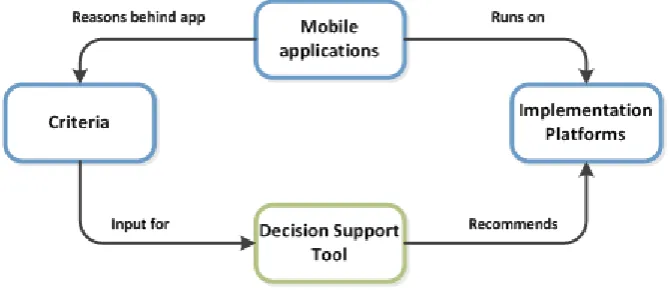
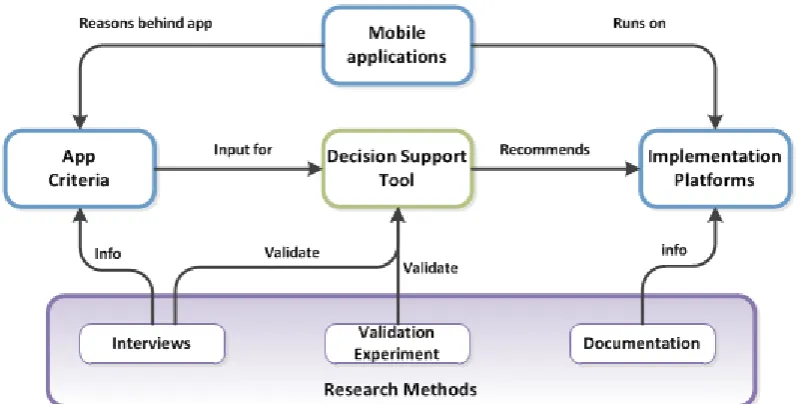
[image:10.595.130.465.351.496.2]The main goal of this thesis is to develop a decision support tool that recommends the best implementation platform (native, web, or hybrid) based upon a set of mobile app criteria. A major component will be to ascertain the criteria for mobile apps. These are collected by conducting interviews with mobile experts; including the client, the business, and the developer perspective. Another part is to relate these criteria to the implementation platforms for mobile apps. A deliverable for this research is a prototype of the decision support tool. This prototype should be validated for correctness of the criteria, but also for practical usage.
Figure 1 visualizes how these main concepts are linked to each other.
Figure 1: High level overview of research
1.1
App definition
According to the Oxford Dictionary2 an app is “a self-contained program or piece of software designed to fulfill a particular purpose; an application, especially as downloaded by a user to a mobile device”.
This definition touches various distinctive aspects for apps: it is a software component that can be downloaded (self-contained program); it is designed for a specific task/function/feature; it is specifically designed or optimized for usage on a mobile device; and the user (experience) should be a central or integrated component. The presentation, functionality, and features can differ greatly between apps.
2
A study (Intelligence Group 2012) under the Dutch labor force in the second quarter of 2012 revealed that the following five mobile apps are the most popular: Facebook, WhatsApp, NU, Wordfeud and Twitter. Screenshots of these apps can be seen in Figure 2; from left to right it shows Facebook (iOS)3, WhatsApp(Android)4, Nu (iOS)5, WordFeud (WindowsPhone)6, and Twitter(Android)7. The mentioned apps have several versions so they are compatible with all major mobile operating systems.
Figure 2: Screenshots of the top5 mobile apps under the Dutch labor force
1.2
Cross-platform
Each mobile platform, like iOS, Android, and WindowsPhone are very different for application development. The used software development kit (SDK), program- and interface guidelines, and program languages are just a few aspects in which they differ. Most businesses want to facilitate their app to the whole mobile channel, but do not take these differences into account. The business desire is to have cross-platform applications, not taking into account that a native cross-platform mobile app consumes a lot of development time and resources. Basically the native app would be developed for each mobile platform from the ground up; thus developing the same app
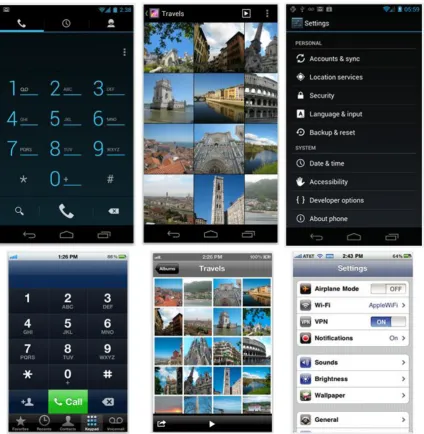
Each mobile operating system has their user interface guidelines (Apple ; Google ; Microsoft) for the presentation of apps to differentiate themselves from competitors. This also makes it necessary for developers to provide a presentation of their app that corresponds to the set of rules for that mobile OS. These include the position of buttons, usage of icons, location of titles, location of menu, and button interaction. Google even showcases the differences between the iOS and Android on Pure Android8 which is displayed in Figure 4.
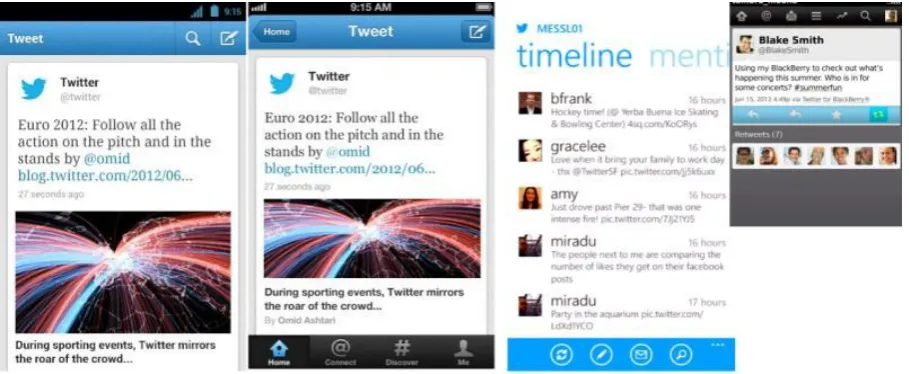
To illustrate the differences between the look & feel in the four mobile OS’s, the Twitter App is displayed in Figure 3, from left to right, in Android, iOS, WindowsPhone, and BlackBerry. Differences can be spotted in the title-bar, tabs, icon usage, text-styling, and screensize. Beyond the
3
http://itunes.apple.com/us/app/facebook/id284882215 4https://play.google.com/store/apps/details?id=com.whatsapp 5
http://itunes.apple.com/us/app/nu/id294726570
6http://www.windowsphone.com/en-US/apps/4c049346-c285-4bde-ba34-1fa5f3df4562 7https://play.google.com/store/apps/details?id=com.twitter.android
8
presentation layer there are hardware differences that influence the input to the app like a physical or software “back-button”. Most BlackBerries include a hardware QWERTY keyboard. Another example can be found in APPENDIX A: EXAMPLES OF APPS on page 61.
Figure 3: The Twitter app on Android, iOS, WP7, and BlackBerry (from left to right)
Not only the presentation layer is different, the underlying OS requires knowledge and experience. The classic tutorial “Hello World” illustrates this further, where the application shows very different programming languages, IDE’s, and use of libraries and API’s. See APPENDIX B: NATIVE CODE on page 62 for the actual examples.
1.3
Outline
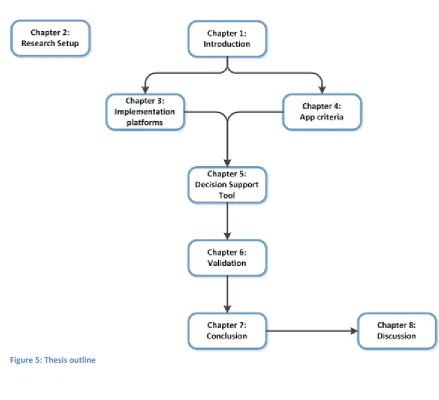
The methods and methodologies used in this thesis are described in the research setup (chapter 2). The methods will be explained in more detail, and their appliance upon this research. In chapter 3 the various implementation platforms are further investigated and compared to each other. App criteria, like drivers and requirements, are collected and analyzed in chapter 4. These two chapters form the input for the decision tool in chapter 5, where the decision model and analysis can be found. In chapter 6 the prototype tool will be validated. The thesis ends with the conclusion in chapter 7 and discussion in chapter 8.
[image:14.595.62.502.302.702.2]The outline of the thesis and how the chapters relate to each other are visualized in Figure 5.
2
RESEARCH SETUP
This chapter explains the overall goals and approach of the research. Then it describes the research questions and the methodologies to be utilized in answering the questions and reaching the overall goals.
2.1
Research goal
This explorative research informs about, and analyzes, the current mobile apps landscape and techniques where special interest is taken into the implementation platforms and frameworks. It determines several factors and criteria that drive organizations to build mobile apps. These criteria range from business oriented criteria, to more specific technical aspects of a mobile app.
Each criterion has a score on how well it is supported by each implementation platform (native, hybrid, and web). Based on these criteria, a decision support system determines the preferred implementation platform for a certain app. This decision support system provides more transparency to which implementation platform is preferable for their specific app; without having to be a mobile and/or technical expert.
The added value to the academic literature is to add information via the thesis for mobile implementation platforms; the current mobile ecosystem; and criteria for mobile apps.
The practical value comes in the form of the decision support system, which can be used to determine the preferred implementation for a mobile app based on the input of the client.
This results in the following research goals:
1. Explore the major criteria for mobile applications and implementation platforms
2. Develop a decision support system in which these criteria can be translated into platform preferences
2.2
Research approach
To create a validated decision support system, it is imperative that it is built on solid theory and methods. As a starting point two general research approaches have been used to setup the research: Designing Research (Verschuren and Doorewaard 2007), and the Engineering Cycle (Wieringa 1996). These methods describe ways to start analyzing the problem that the research tries to solve. It helps to construct valid research questions, conceptual models, and planning.
Designing Research has seven phases in which the research is clearly structured into a usable form (Verschuren and Doorewaard 2007). These phases explore the project framework, create a research model, defines key concepts (and research questions), and determines the strategy and planning. It helps into analyzing the research problem and translating them into a clear game plan and conceptual model.
this research is: The development of a decision support system based on criteria and requirements of mobile applications to determine the most preferred implementation platform through literature study and conducting expert interviews that can be analyzed and processed into a data structure for the tool, which is then validated by follow up interviews and a validation experiment.
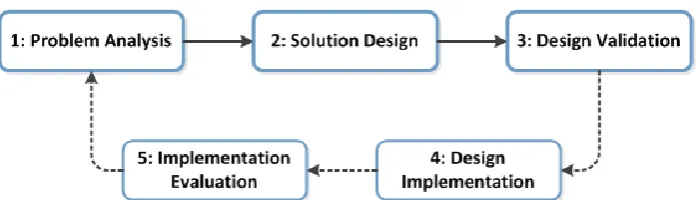
The other starting point is applying the Engineering Cycle (Wieringa 1996), which is a five-phase cycle that can be applied to products and services. The phases are: problem analysis, solution design, design validation, design implementation, and implementation evaluation; see also Figure 7. It is a structured way to analyze the problem that leads to developing, validating and implementing the solution. A main concept in the theory is to state the engineering argument, which describes how the solution and domain interact to reach the goal (Wieringa 2009). For this thesis the argument would be: By increasing the knowledge of mobile applications and implementation platforms with a decision support system, it will help to transform mobile app criteria into deciding for the right platform.
The Engineering Cycle shows the lifecycle of the decision support system that this research delivers. Another reason to use this method is that this research follows the same pattern as the engineering cycle; this also shows a clear relation between the research questions and the phase that the tool is in. This makes conceptualizing and reflecting the steps towards the final prototype tool an easier task.
2.2.1 Conceptual models
Figure 6 visualizes the conceptual model, as described in Research Design (Verschuren and Doorewaard 2007). The vertical arrows are the confrontation between two research object, resulting in a horizontal arrow that is the product or result from this confrontation.
[image:16.595.75.523.575.745.2]There are five distinct consecutive stages in the model, shown in Figure 6. It starts with reading mobile platform documentation, conducting preliminary interviews, and reading literature about mobile apps. This results in an initial list of criteria and implementation platforms, which is then confirmed and updated with experts via interviews. From this a final list of implementation platforms and a final list of app criteria are formulated. Together with literature from Decision Support Systems (DSS) form the foundation for the decision tool. With a validation session and expert opinions the tool is validated and leads to the final conclusion of the thesis.
As mentioned earlier, the Engineering Cycle is used to guide the development of the decision tool. This engineering cycle is visualized in Figure 7, based on the work of Wieringa (Wieringa 1996; Wieringa 2009). The problem analysis phase determines what the (real) problem is by identifying the stakeholders and investigating the problem, which results in requirements for the decision tool. The output of the solution design phase is the artifact itself, in this case a prototype of the decision support tool. In the third phase the tool is validated, by checking if the requirements from the problem analysis phase are met. The design implementation phase is concerned with implementing the proposed solution in the entire organization. The implementation evaluation phase is to check if the design implementation phase meets the requirements that were set earlier. If not the cycle repeats itself, as mostly it will be a continuous process (Wieringa 2009).
In this thesis the first three phases will be followed, which is reflected in the structure of this document and formulating the research questions.
[image:17.595.124.474.438.538.2]Due to the limited period in which this research is carried out, it will not be possible to go through the design implementation phase and the implementation evaluation phase. These last two phases are only relevant when the tool would be incorporated into the business processes and be evaluated. As the goal is to deliver a prototype it is also not necessary to go through these phases.
2.3
Research questions
Based on the research goals and conceptual models, the main research question has been formulated as:
How to transform mobile application criteria into decisions for mobile implementation
platforms using a decision support system?
To further decompose the main research question, six sub questions have been formulated: Q1: What are the implementation platforms in the current mobile ecosystem?
Q2: What are key criteria for mobile applications according to mobile experts? Q3: How do the mobile criteria relate to the mobile implementation platforms?
Q4: What decision support system methods are suited for linking mobile app criteria with the implementation platforms?
Q5: Which decision support system can be transformed into a prototype decision tool? Q6: What is an appropriate way to validate the design?
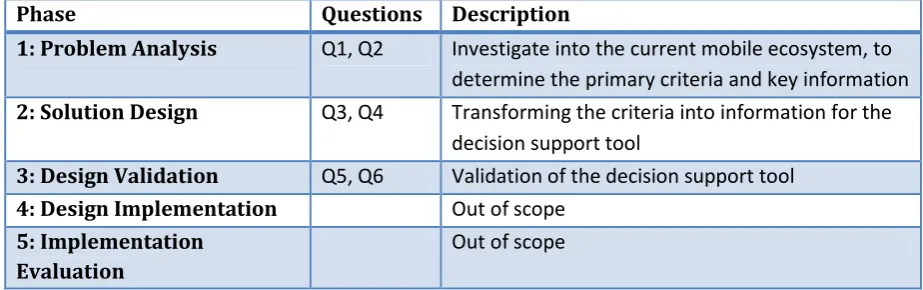
The sub questions can be closely related to the different stages in the engineering cycle. An overview can be seen in Table 1.
Phase Questions Description
1: Problem Analysis Q1, Q2 Investigate into the current mobile ecosystem, to determine the primary criteria and key information
2: Solution Design Q3, Q4 Transforming the criteria into information for the decision support tool
3: Design Validation Q5, Q6 Validation of the decision support tool
4: Design Implementation Out of scope
5: Implementation Evaluation
[image:18.595.64.526.402.547.2]2.4
Methodology
This research employs multiple methods to collect and transform data into usable information. The four methods used are:
Literature study: Scientific articles, journals and books form the backbone of academic theory;
Documentation: Some articles, specifications and blog-items are not considered literature, but still contribute in providing insight and detailed information about some of the subjects; Interviews: To retrieve information from experts, interviews are used to extract, add and
validate key concepts in the decision support models;
Validation experiment: A validation experiment is conducted to see the how prototype behaves in a real-life setting. The experiment is mostly based on a mix of literature from interviews and case studies (Yin 2009).
[image:19.595.98.498.337.539.2]A visual representation of where the methodologies are applied in the thesis subjects can be found in Figure 8. Literature study is not mentioned as it is ubiquitously applied, alongside the other methods.
Figure 8: Mapping research methodologies to parts of thesis
2.4.1 Literature
The review protocol describes what research question is being addressed and which methods are employed in the review process (Budgen and Brereton 2006). It also describes the necessity for a systematic literature review (Kitchenham 2004). In this thesis the research questions for the protocol can be the same as the ones provided in chapter 0. Especially Q1 and Q4 will primarily be based on literature, supported by market analysis reports and other sources.
The search strategy is to start with a general term formulated in the question, read a few relevant papers and refine the search terms with more specific terms or add other terms with the “AND” and “OR” keywords. The results of the search terms were cross-referenced between different scientific search engines: Scopus9, Web of Science10 and Google Scholar11.
The review process consists of steps to determine how relevant the articles are, and how to synthesize data from it (Kitchenham 2004). As the current apps are emerging since around 2007 with the introduction of the iPhone, the related articles should be very recent: from 2008 or newer. Indicators that are used for articles are: the author(s) has published more than one paper on the particular subject; the article comes from peer-reviewed or high quality sources; number of citations; and references from the article.
Table 2 shows the used keywords for certain areas that reflect in some of the research questions. It also includes examples of the found literature from these queries.
Area of search Question related
Search query Examples of found literature sources
Literature approach
- “performing systematic literature review”
(Kitchenham 2004);
(Budgen and Brereton 2006); (Kitchenham, Pearl Brereton et al. 2009);
Mobile ecosystem
Q1 “mobile AND HTML5”
“mobile AND application AND development”
(Padley 2011); (Wasserman 2010);
Key app criteria
Q2 “mobile AND native AND web” “mobile AND application AND criteria”
(Charland and Leroux 2011); (Işıklar and Büyüközkan 2007)
Decision support systems
Q4, Q5 “multi-criteria decision making” “multi-criteria decision making” AND “decision matrix”
“multi-criteria decision making” AND “AHP”
(Saaty 1980);
(Dyer and Sarin 1979);
(Zanakis, Solomon et al. 1998); (Arnott and Pervan 2005);
Validation by experiment
Q6 “validation AND software engineering”
“validation AND case study”
(Zelkowitz and Wallace 1998); (Hevner, March et al. 2004); (Yin 2009)
Table 2: Keywords for literature searches
9http://www.scopus.com/
10http://webofknowledge.com/WOS 11
2.4.2 Documentation and non-academic sources
Due to the limited amount of available academic literature which covers mobile apps, also non-academic resources have been accessed. Key examples are the developer portals12131415 for each mobile operating system which hosts the official documentation and useful resources. These source are used with regard to native apps.
Using the Deloitte network, this research could benefit from the TMT predictions (Deloitte 2012); but also use Gartner and Forrester for analysis of the current markets (Forrester 2011) and (Gartner 2012). These are used in the introduction and parts regarding the general mobile market and mobile operating system market shares, like chapter 3.2.
Other supporting sources like blogs can be used for gathering opinions on subjects, but these should be relatively established and trusted sites. These mainly concern hybrid apps, chapter 3.4.
2.4.3 Interviews
Interviews are used to validate, delete, or add criteria to the model for the decision tool. To extract this information a semi-structured interview approach is used where there is a protocol used to lead the interview. Each interview consisted of five open questions for the experts to gain more knowledge about the aspects that are important to mobile apps.
The conducted interviews were qualitative in nature, in the form of a conversation. A semi-structured interview has the advantage to set out the big picture, while leaving room for (social) interaction: deviation on topics and/or further questioning on specific topics. A structured interview (or questionnaire) is most likely too limited for our goal to gain insight, where we need the flexibility to ask further, go into details, or deviate from the set of questions. An unstructured interview could work, but is not preferred as we would like to loosely compare answers on several topics which require general questions (Saunders, Lewis et al. 2009; Yin 2009).
The complete protocol and questions can be found in APPENDIX C: INTERVIEW PROTOCOL (page 61). There were a total of nine persons that participated in the interviews; the date and their relation to mobile apps are listed in Table 3. It also states when the interview took place and which relation the interviewee has with mobile apps.
Two experts (#8 and #9) were consulted in a follow up interview to give an opinion on the tool, thereby judging and reviewing the tool for validation purposes.
Interview date Relation to mobile apps Interview 1 14 June 2012 General Application development
Interview 2 15 June 2012 Consulting on mobile app development
Interview 3 18 June 2012 Develops in-house application
Interview 4 20 June 2012 Develops in-house application
Interview 5 21 June 2012 App development in specific sector
12
http://developer.apple.com 13http://developer.android.com 14http://developer.windowsphone.com 15
Interview 6 27 June 2012 Manager of mobile website
Interview 7 03 July 2012 General Application development
Interview 8 17 July 2012 General Application development
[image:22.595.66.505.71.141.2]Interview 9 17 July 2012 General Application development Table 3: Interview participants list
Preparing the semi-structured interviews, additional papers were read specializing in interviewing within the computer science realm. Hove and Anda summarized experiences of 280 semi-structured interviews that the authors conducted in the field of software engineering. They describe several activities: scheduling; collecting of background information; preparing interview guides; discussions/meetings; summary writing; transcribing. They also include practical advice, based on recommendation found in literature. The paper describes six types of questions and how these can be applied in different interview techniques (Hove and Anda 2005).
Myers and Newman use the metaphor of a drama play (dramaturgical model) to conceptualize the aspects within an interview: stage, actor, audience, script, entry, exit and performance. This makes many of the intangible aspects more understandable. It describes the assets in detail, gives recommendations, and contains eight guidelines for better qualitative interviews. This literature was also specialized in IS research (Myers and Newman 2007).
All interviews were recorded, transcribed and summarized. The summaries can be found in APPENDIX D: SUMMARIES OF INTERVIEWS (page 66). These will be further analyzed in chapter 4. Using qualitative data processing (Miles and Huberman 1994), the transcripts and summaries from the interviews can be transformed into usable information. For this research it was used to extract relevant criteria from the interviews.
Miles and Huberman suggest that the analysis consists of three procedures. The first is data reduction, where the mass of the qualitative data is reduced and organized in for example summaries where all irrelevant data is discarded. At this stage it is encouraged to start with coding the data. The second procedure is to display the data from the first stage in charts, tables, and other graphical formats; this is essential to draw conclusions. The last procedure is drawing conclusions and validation; the analysis should develop initial conclusions that can be validated by reference of the existing field data or with further data collection.
An important part is coding the summaries of interviews; this is the part where structuring and clustering of the criteria are formed. Based on Saunder, Lewis et al (Saunders, Lewis et al. 2009), the steps in this process are:
1. Transcribe the interview;
2. Mark keywords in each interview, to form categories (open coding); 3. Recognize relationship between categories (axial coding);
4. Defining the criterion and relative weight, which is the integration of categories into theories (selective coding).
2.4.4 Validation experiment
A validation experiment was conducted at a client of Deloitte to test the theoretical models that the research delivered. The experiment consists of several components: a short qualitative interview, model testing, and reflection on the results of the session. This is based on literature from semi-structured interviews as well as case study research (Eisenhardt 1989; Hevner, March et al. 2004; Yin 2009; Thomas 2011). The goal of this experiment was to get hands on experience, determine the practical usage of the prototypes, and to decide which DSS method (simple additive weighted value function; or analytical hierarchy process) should be used in refining the tool.
The qualitative interview is the first stage of the interactive session, where open questions are asked about the app that the customer wants to realize. The interview format gives room to let the client describe the app criteria in their own words, and prevents bias from the interviewer. The open questions are formulated from a business perspective. It is expected that some questions could suggest the usage of one or more app criteria. After the interview the list of criteria is summarized and checked with the client.
The testing component of the experiment is by entering the criteria in the prototypes. These prototypes will return the preferred platform instantly.
The evaluation of the results, in conjunction with the preference and feedback from the client provided valuable input for further improvement on the final prototype.
The results of the experiment are found in chapter 6.1 on page 45. The complete protocol for the experiment can be found in APPENDIX H: VALIDATION EXPERIMENT PROTOCOL on page 105.
2.4.5 Validation review
In addition to the practical experiment, the tool was also reviewed by three mobile experts for further validation of the tool. Two of these reviews were follow-ups with interviewee #8 and interviewee #9 from the first series. The last interviewee was a mobile app expert, which did not have previous knowledge of this research.
Two of sessions are based on semi-structured interviews where the focus lies on validating the criteria and corresponding norms. Another goal is to validate the tool itself and asses the usefulness. For the other sessions, a review package was prepared which was reviewed without the presence of the author. The results of these validation sessions are found in chapter 6.2 on page 48.The complete protocol for these interviews can be found in APPENDIX J: VALIDATION SESSION PROTOCOL on page 115.
2.5
Research sponsor
2.6
Research summary
A structured approach is used to reach the goal of further investigating the relation between mobile app criteria and implementation platforms.
The main research question is:
How to transform mobile application criteria into decisions for mobile implementation
platforms using a decision support system?
This is further divided into the following sub questions:
Q1: What are the implementation platforms in the current mobile ecosystem? Q2: What are key criteria for mobile applications according to mobile experts? Q3: How do the mobile criteria relate to the mobile implementation platforms?
Q4: What decision support system methods are suited for linking mobile app criteria with the implementation platforms?
Q5: Which decision support system can be transformed into a prototype decision tool? Q6: What is an appropriate way to validate the design?
Table 4 shows in the chapters in which the sub question are covered, including the used methods.
Question In chapter(s) Used method(s)
Q1 3, 4 Literature
Q2 4 Interviews with experts
Q3 5 Theory building (based Q1 and Q2)
Q4 5 Literature
Q5 5 Literature
[image:24.595.62.535.386.502.2]Q6 6 Validation Experiment, Interview
3
IMPLEMENTATION PLATFORMS
This research makes the distinction between three implementation platforms: native, web, and hybrid. This is based on the presentation layer of an app; which can use native elements, but also rendering through a browser using web techniques. This choice is related that web techniques are available on each mobile platform and has great potential for cross-platform techniques.
This chapter will explore the three implementation platforms, which extends the information from chapter 1.2. In chapter 4 the criteria for apps for each platform will be investigated.
3.1
Implementation platform overview
[image:25.595.41.549.409.580.2]The first implementation platform is composed of native apps. These apps run only on the OS they were designed for, like specifically for Android, or specifically for iOS. The second implementation platform consists of web apps: mobile-optimized websites that can be accessed by any (mobile) browser. The last implementation platform consists of apps that are a mix of the first two groups, the so called hybrid apps. Third party applications like Phonegap; Appcelerator; Rhodes; and Appspresso; make it possible to wrap web apps into native browsers and/or code, bridging the gap between web and native apps. This is all based on the philosophy of “code once, deploy-to-many”. Figure 9 supplies an overview of the implementation techniques; this figure is deduced upon knowledge from mobile OS’s, but also inspired upon various articles (Google ; W3 Cubes 2011; GeoChalkboard 2012) which describe anatomy of the apps.
Figure 9: The three approaches: Native, Hybrid, and Web apps
The image visualizes that native apps communicate directly with the operating system, using the native application programming interface (API).
The hybrid approach uses a chromeless browser for rendering, but the app can still access the native API by using a native wrapper which facilitates programmable bindings for native functions. A chromeless browser (or WebView) is the native browser without any interface like buttons or progress bars; its main purpose is to render HTML that is given through a native wrapper.
An obvious difference is the methods used to communicate with the mobile operating system (OS). A native implementation of an app provides all features of the application programming interface (API) of the OS. The hybrid approach is limited by the functionality specified in the native wrapper; which mostly acts as an intermediary or as a shell without business logic. The web app is limited by the privileges and functionality of the browser.
Explicitly stated on Figure 9 is communication with the device sensors like GPS, camera, compass, accelerometer, barometer, proximity sensor, etc. The rules that apply on for the mobile OS can be directly translated towards these sensors. A native implementation can take full advantage of all aspects of the sensors, which is a result of programming in the native language of the OS. The hybrid approach is limited by the functionality of the native wrapper, which can be programmed to support various sensors. A web app is fully dependent on the browser and thus its limited access to these. Also important for apps feature is the possibility to access and store data on the phone; for example contacts, user-sessions, preferences, achievements, etc. Also the same principle applies here as with the sensors. A side note is that web-apps and hybrid apps are inclined to store most data online on servers and/or the cloud; but storage on the phone is essential when no connection with the internet is available.
[image:26.595.109.483.503.709.2]Although not stated on the diagram, but one of the typical properties of a mobile app is the distribution through an application store. Native and hybrid apps can use the application store of the mobile OS’s vendor. This also increases the options for monetization, by the applying the store purchase and transaction model. Web apps can only be accessed by a browser, they don’t require distribution.
Figure 10 shows the advantages of each approach, which will be elaborated in chapters 3.2, 3.3 and 3.4.
3.2
Native platform
The current mobile ecosystem is dominated by four big players: Apple (iOS), Google (Android), Microsoft (Windows Phone) and RIM (Blackberry); and each OS has its own development language, SDK, API’s, and application store. Apps that are developed for a specific platform with the associated SDK and API are called native apps. A number of these characteristics are compared in Table 5.
Platform Android iOS Blackberry WindowsPhone
Vendor Google Apple RIM Microsoft
Language Java (ADK) Objective C, C++ Java (J2ME) C#, .NET
App Extension .apk .app .cod .xap
IDE Eclipse XCode Eclipse Visual Studio
Application
Store Play iTunes App World Marketpace
[image:27.595.70.529.166.298.2]Source Open Source Proprietary Proprietary Proprietary Table 5: Overview of smartphone and tablet operating systems
The big advantage of native apps is that they communicate directly with the API of the OS. This ensures that the app-developer is in total control of all aspects of the smartphone. As they communicate with the OS directly, the overhead is minimized and relate to high performance. The main disadvantage of developing for a native platform is that an app cannot be transferred to another platform, so they are not cross-platform. In other words, an iOS application will not run on an Android-phone. Native development requires developers that know the programming language and guidelines for that platform; usually they are specialized in one native platform.
Figure 11 displays the smartphone OS market share based on smartphone sales in the second quarter of 2011 and 2012 (IDC 2012). The total market in the second quarter in 2012 was 154 million smarthphones, which was 46 million more than in 2011(IDC 2012). It also shows how rapid the landscape can change in a relative short period.
[image:27.595.81.520.537.696.2]
In this year Android has increased their market share from 47% to 65%, and is the absolute leading platform. Although Android has the biggest market share, it is fragmented by the many versions that are currently in use. The majority is still on version 2.3 “Gingerbread” with 45%, followed by 4.0 “Ice Cream Sandwich” with 29%. The newest version “Jelly Bean” is only used by 13.6% (Google 2013). The implication for apps is that most Android apps have to be compatible with the relative old “Gingerbread” versions.
iOS from Apple, has a steady market share of around 18%. The iPhone is a high-end smartphone that has almost no fragmentation. Adoption to the newest version is relative high. The current iOS version 6 is adopted by 85%, based on various internet sources16 but no official statistics are known. BlackBerry from RIM saw their market share drop from 11% to 5%, and is still declining. These smartphones have their roots in the business segment, but competitors are catching up quickly. The WindowsPhone platform by Microsoft has recently overhauled and rebranded their entire mobile OS from WindowsMobile to WindowsPhone; which places them in an underdog position. It is unclear at the moment if this radical change will also result in a bigger market share.
A potential fifth player is Nokia’s Symbian, but Nokia will cease to support Symbian and focus on WindowsPhone. This means no, or very few, new smartphones for the Symbian platform, which will eliminate the Symbian platform from the market (Nokia 2011).
16
3.3
Web platform
Web apps are mobile-optimized websites, built with web techniques like HTML5, CSS, and JavaScript. The websites are viewed through the (native) browser, which implicates the smartphone needs to be online and connected to the internet for accessing the web app.
A major advantage is that this approach is platform-independent; it works on any mobile device that has an internet connection and a browser. Any web-developer can create a web app without specific knowledge about the mobile OS’s, as it is basically a website suited for a small display. Responsive and/or fluid designs are often used to display the app universally on different screensizes. Webservices can be used to communicate data between the app and the server.
The main disadvantage of the approach is that the app is limited by the browsers sandbox, so it has limited capabilities to interact with the phone itself. This usually means (very) restricted access to anything non-web. For storage a web app can use the LocalStorage, as defined in the HTML5 specification. There are also proposals for GPS and camera support directly from the browser. Another disadvantage is that a web app cannot be distributed through a vendor’s application store, nor will it be available like a native app on the phone. This also implies that updates to the app are independent of the application store and do not require any update action from the end-user.
3.4
Hybrid platform
4
MOBILE APP CRITERIA
This chapter explores which mobile app criteria can be used for determining a preference between the native, hybrid and web approach. These criteria are collected using semi-structured interviews with mobile experts. First the data collection process is explained, followed by the results from the interview which delivers a list of criteria for mobile apps. It will then present the transformation towards the final list of criteria.
4.1
Data collection
The semi-structured interview had all the same schema; five open questions for the experts to learn which criteria were important for mobile apps.
1. What is your experience with mobile applications and implementation platforms? 2. What are (common) business drivers behind the mobile apps?
3. What are (common) implementation requirements for applications? 4. When is an implementation platform preferred above another platform? 5. How do company competencies impact the choice for a mobile platform?
The first question is important to establish a baseline, to determine the experience with one or more mobile OS’s; but also to determine the experience with the different implementation platforms (native, web, and hybrid). The second question is to determine the drivers of apps; this is why customers want a mobile app. The third question is how they envision the app, based on requirements. The fourth question collects the opinion of the interviewee, to come up with situations where a particular implementation technique would be chosen above the other. The last question is about the constraints that might be coming from the customer, which might not always be directly visible.
The complete interview protocol can be found in APPENDIX C: INTERVIEW PROTOCOL on page 62. Each interview was transcribed, summarized and sent back for approval by the interviewees. Processing and extracting data is based on qualitative data processing as described by Miles and Huberman (Miles and Huberman 1994) , also described in chapter 2.4.3. The processing of the interview has the following steps, according to Saunder, Lewis et al:
1. Transcribe the interview;
2. Mark keywords in each interview, to form categories (open coding); 3. Recognize relationship between categories (axial coding);
4. Defining the criterion and relative weight, this is the integration of categories into theories (selective coding).
4.2
Interview results
An initial set of criteria from preliminary interviews, combined with literature research, was supplemented with the criteria that came up during the interviews. These criteria were distilled using open and axial coding of each interview, which can found in APPENDIX E: CODING INTERVIEWS starting on page 92.
From the interviews the criteria-set was hierarchical ordered, as some criteria overlapped. A total of thirteen aggregated categories for mobile apps are listed below. The detailed hierarchical ordered list can be found in Table 6 which marks the criteria that came up or were discussed with the experts. .
1) User Interface: Criteria that have requirements on the user interface part of an app. The level of responsiveness that is required for app types. The influence of screensizes and how sophisticated a user interface must be
2) Offline access: The importance of online/offline access to apps
3) Device capabilities: The sensors that apps need (GPS, camera, etc) and other wishes for the device
4) Visibility: The visibility in the application store, and the impact of this feature 5) Multiplatform: Running apps on multiple native platforms
6) App development: Aspects of development of apps; from the skills required for developers to open source. From used IDE’s to outsourcing and update cycles
7) Business Model: The business reasons behind an app, like the proposition, budget, and goal of apps
8) Targetgroup: The intended platform and/or ecosystem, aspects like high-end market or budget and BYOD(bring your own device)
9) Security: The security aspects for app, like encryption of data and mobile device management. 10)Platform features: General features for the native/web/hybrid platform.
11)Future proof: How will the app hold up in the near future
12)Preference: Preference of company, executives, and company policy
TOPICS INTERVIEWEE
#1 #2 #3 #4 #5 #6 #7 #8 #9
1. User Interfacea. Responsiveness x x x x x
b. Animations and sophistication: x x x x x x
c. Screensize x x x x
2. Offline access: x x x x
3. Device capabilities:
a. Sensors x x x x x x x x x
b. Special needs x x
4. Visibility x x x x x x x
5. Multiplatform x x x x
a. Portability x x x
6. App development
a. Skillset required by developer x x x x x x
b. Tooling / IDE x
c. In-house vs outsourcing x x x x x x
d. Open source x x x x x
e. Updatability x x x x
7. Business Model
a. Business case x x x x x x
b. Budget x x x x x x
c. Support & SLA x x x x
d. Purpose / goal of app x x
8. Target group
a. Heterogeneity x x x x
b. BYOD (bring your own device) x
c. Hi-end or low-end market? x x
9. Security
a. Mobile Device Management x x
b. Encryption of data x x x x
10. Platform features
a. Ease of back-office integration x x
b. Legal issues (patents)
c. Licenses / Fees / TOS x
d. Distribution x x
11. Future proof x x x x x x
12. Preference x x x x x x x x X
[image:32.595.53.540.86.684.2]13. Personalization x x x x x x x x x
4.3
Criteria relevance
The multi-perspective, from general-purpose mobile app development to consulting and in-house development, gave an insight to the many facets of mobile apps. The scope of the research has a focus on the choices made before the actual app development; this also sets boundaries for the criteria-set. Not all criteria mentioned by the experts are relevant for the choice of implementation platforms.
The criteria that were relevant to implementation platform choice are: user interface, responsiveness, offline access, device capabilities, sensors, multiplatform, portability, updatability, heterogeneity of devices, mobile device management, encryption, future proof, preference, and personalization.
Most of these can be directly linked to an advantage or disadvantage of an implementation platform as described in chapter 3; like platform independence, access to API’s, user interface, update cycles, and performance.
The criteria that might be relevant are: sophistication, screensize, developer skillset, bring your own device, high-end, integration with back-office, and restrictions of content.
These criteria are relevant only in certain scenarios. For example integration with the back-office is only relevant if this back-office cannot provide a webservice.
The criteria that had no influence on the implementation platform choice were: special needs; tooling; outsourcing; business case; support; purpose; remote wipe, and legal issues.
Special needs, like ruggedized devices, is a hardware criteria and thus not applicable to the software choice. Some criteria were not related to the implementation platform choice, but by the operational and strategic vision of the commissioning organization; like business case; support; and purpose. Some criteria are only relevant after the choice is made, or during development: tooling and outsourcing. Legal issues over patents are considered to be between the vendors like Apple, Google, and Microsoft. Remote wipe overlaps with the Mobile Device Management (MDM).
Although budget is one of the most determining criteria, it is also tightly coupled with many of the other criteria. Another reason to exclude this criterion is that it will always get the highest priority and make decisions based on a single criterion instead of an objective view on the model.
Criteria Description Relevant for implementation?
User interface The user interface of an app YES
Responsiveness How fast the interface reacts to input from the user YES
Sophistication The UI sophistications, scrolling and animations Sometimes
Screensize The optimum or minimal screensize Sometimes
Offline access The need for offline access (no internet) YES
Device capabilities Properties of the device YES
Sensors Internal sensors like: GPS and camara YES Special needs Like ruggedized and certifications NO Multiplatform The amount of platforms that the app runs on YES
Portability Re-use of code between platforms YES
App development Development aspects that belong to apps
Developer The skillset and availability of developers Sometimes
Tooling The used IDE and other tooling NO
Outsource Choice between inhouse or outsourcing NO Updatability The ease of control on updating the app YES Business model The business reasons behind an app
Business case The proposition, value model, ROI NO Budget The available budget to cover the investment YES
Support The support or SLA arrangements NO
Purpose How does the app contribute to the user? NO Targetgroup Who is the targetgroup of the app?
Heterogeneity Heterogeneity of devices in the targetgroup YES
BYOD Bring your own device? (internal app) Sometimes
High-end High-end or low-end market? Sometimes
Security Security aspects of the app
MDM Mobile Device Management YES
Remote wipe Option to remote wipe (is an option of MDM) NO Encryption Secure and encrypted data? Datastorage YES Platform features Features of the platform
Integration Integration with other systems like back-office Sometimes
Legal issues Issues over patents NO
Licenses Licenses, in-app-purchase shares YES
Content Restrictions on the content Sometimes
Future proof How will the app hold up in the near future YES Preference Preference of company, executives, company policy,
managers.
YES
[image:34.595.68.527.86.730.2]4.4
Final list of mobile app criteria
Based on the relevant criteria, described in section 4.3, a final transformation is made towards relevant quantifiable criteria that are suitable for the decision support tool. Each criterion should have a norm to which it can be tested. As an addition the inverse norm is also included to indicate the other end of the spectrum for the criterion. The final list of criteria, norms and inverse norms are shown in Table 8.
The final list of mobile app criteria is:
Connectivity determines the level of required internet connectivity for the intended app. It is related to the criteria “Offline access”
Device sensors determines if the app requires any sensors in the app
Market determines if the app is required to be distributed through the vendor’s application store. This is related to the criteria “Platform features”
Platform amount determines if the app should be cross-platform. This is linked with the criteria “Multiplatform”
Mechanisms determines if certain native programming is required for the app, which cannot be built with web techniques. It is based on “Platform features” and “Device capabilities” Content determines what kind of interactivity is required for the content in the app. This is
based on the criteria “Sophistication” and “Platform features”
Updatability determines the lifecycle of the app, focusing on the amount of planned updates. This is based on “Updatability” and “Portability”
Personalization determines the personalization factor of the app; this is based on the uniformity of content for the end-user
Responsiveness determines the acceptable respond time of the user-interface and content loading
Native UI determines if the app should have the native look and feel, or a cross-platform uniform user interface. This is based on “Sophistication” and “BYOD”
Screensize determines the variety of screensizes that the app should support
Heterogeneity of devices determines the amount of different devices the app should support
User expectation determines if the end-users has a certain expectation from the app. This linked with “Preference” and “High-end”
Encrypted data determines the required level of encryption of data for the app Market fee determines the monotization model and fees of the app
Regulations determines if the app has content that can be restricted by vendors