CONSTRUCTIONS OFr-IDENTIFYING CODES AND
(r,≤l)-IDENTIFYING CODES1
R. Dhanalakshmi and C. Durairajan
Department of Mathematics, School of Mathematical Sciences, Bharathidasan University, Tiruchirappalli, Tamilnadu 620 024, India
e-mails: [email protected]; [email protected] (Received 29 June 2017; accepted 26 July 2018)
In binary Hamming space, we constructr-identifying codes from a
rP−1
i=0 ¡n
i
¢
+¡nr−−11¢+ 1-fold r-covering code. By using this construction, we modify the construction ofr-identifying codes of Charon et al. which helps to find codes of greater length. From this modified construction, we improve the upper bound ofM5(23)which is the smallest possible cardinality of a5-identifying code of length23.We also construct(2, ≤l)-identifying codes and we define the length function L(r, l)as the smallest positive integernfor which there exists an(r,≤l)-identifying code inFn2. By using the construction of(2,≤l)-identifying codes, we improve the upper bounds ofL(2, l) for alll ≥ 6. We also improve the upper bounds ofM2(≤l)(n)for alll ≥6and whennis one more than the improved upper bound ofL(2, l). We give the construction for(r,≤l)-identifying codes. From this result, we prove thatMr(≤l)(2r+ 1)≤22rfor certain values ofrandl.
Key words : Binary Hamming spaces; covering codes; code construction; identifying codes; direct sum.
1. INTRODUCTION
LetF2denote the binary field of two elements{0,1}.The binary Hamming spaceFn2 is the cartesian product of F2 taken n times. The Hamming distanced(x, y) between the wordsx, y ∈ Fn2 is the number of coordinates in which they differ. We say that x r-coversy if d(x, y) ≤ r. Since the distance function is a metric,x r-coversyis equivalent toy r-coversx.We denote
Br(x) ={y ∈Fn2 |d(x, y)≤r}
1
The first author wishes to thank the Department of Science and Technology, Government of India, for its financial
as the closed ball inFn2 with center atxand radiusrand it is called as Hamming ball with center at xand radiusr, and
Sr(x) ={y∈Fn2 |d(x, y) =r}.
Also, we denote zeroword by0.The Hamming weightw(x)ofx∈Fn
2 is defined asd(x,0).
A non-empty subsetC ofFn2 is called a code of lengthn. Each element of a code is called a codeword and any element ofFn2 is called as a word. The covering radius ofC is the least positive integerrwithFn2 = S
x∈C
Br(x).
In 1998, Karpovsky et al. [9] introduced identifying codes. The concept of identifying code was motivated for finding malfunctioning processors in a multiprocessor system. In this application, testers are positioned in the processors which are the elements of the identifying code. These testers monitor their neighboring processors and send the number1 to the host if it finds any faulty pro-cessor in its neighbors, otherwise it sends the number0to the host. From this information, one can identify the faulty processors. Fault identification is also applied in environmental monitoring, sensor networks and location detection in hostile environments. More details of applications and theoretical connections of identifying codes are given in [11].
LetC ⊆ Fn2 be a code of lengthn. TheIr-set of a wordx ∈ Fn2 with respect to the codeC is defined to be
Ir(x) =Br(x)∩C.
Moreover, forX={x1, . . . , xk} ⊆Fn2,
Ir(X) = k
[
i=1
Ir(xi)and we setIr(∅) =∅.
A codeCof lengthnis called anr-covering code ifIr(x)6=∅for allx∈Fn2.Letµbe a positive integer. Code C is said to be aµ-foldr-covering code if|Ir(x)| ≥µ for allx∈Fn2.A code is said to be anr-separating code ifIr(x) 6=Ir(y)for allx, y∈Fn2 withx 6=yand anr-identifying code if it is both anr-covering code and anr-separating code.
Letr andlbe positive integers. A code C ⊆ Fn
2 is said to be an (r,≤ l)-identifying code if for allX, Y ⊆Fn2 such that|X| ≤ l,|Y| ≤ landX 6= Y,we haveIr(X) 6= Ir(Y). For example, {0000,0010,0001,1100,1010,1001,0101,0011,1110,1101,0111} is an(1,≤ 2)-identifying code of length4given in [8]. Ifl= 1, then the code is anr-identifying code.
The smallest possible cardinality of an(r,≤l)-identifying code of lengthnis denoted byMr(≤l)(n)
exists for these parameters (for a specific example, see Theorem 4 of [8]). For anr-identifying code, we denote the smallest cardinality byMr(n).
SupposeX ⊆Fn2 is an unknown set of faulty processors with|X| ≤l. Testers positioned in the processors belonging to an(r,≤l)-identifying code check theirr-radius neighborhoods and give us Ir(X). Hence, we can determine X. Using(r,≤ l)-identifying code, we can find at mostl faulty
processors while anr-identifying code determines at most one faulty processor.
Identifying codes now form a topic of their own. In the website [13], there are many papers dealing with identifying codes and closely related topics. For recent development of identifying codes in binary Hamming spaces, see [1, 2, 6, 10].
The structure of our paper is as follows: In Section 2, we give a sufficient condition for a set to be anr-identifying code and using this result, we modify the construction in [2]. By the use of this modification, we can obtain codes of greater lengths and also we improve the upper bound of M5(23). In Section 3, we give a sufficient condition for a set to be a(2,≤l)-identifying code. Given randl, we define the length functionL(r, l)to be the smallest positive integer for which there exists an (r,≤ l)-identifying code in Fn2. Using this result, we improve the upper bound of L(r, l) for r = 2andl ≥ 6. The lower bound ofL(r, l)is obtained from Theorem 4 of [8]. Also, we improve the upper bounds ofM2(≤l)(n) for alll ≥ 6andnis one more than the improved upper bound of L(2, l). We also give the construction for an(r,≤l)-identifying code. From this result, we prove that Mr(≤l)(2r+ 1)≤22rfor certain values ofrandl.
2. PRELIMINARIES
Theorem 2.1 — (Theorem 2.4.8 of [3]). Ifr, s ∈ {0,1, . . . , n}, c1, c2, c3, c4 ∈ Fn2,andd(c1, c2) ≤ d(c3, c4),then
|Br(c1)∩Bs(c2)| ≥ |Br(c3)∩Bs(c4)|.
Futhermore, ifd(c3, c4) = 1 +d(c1, c2)andr+s+d(c1, c2)is odd, equality holds.
Theorem 2.2 — (Theorem 2 of [2]). Let r ≥ 1, p ≥ 1 and letC be an r-identifying code of length nand Xp = {x ∈ Fn2 | d(x, c) ≤ r −p or d(x, c) > r, for allc ∈ C}. Let Yp ⊆ Fn2 be a set such that for every x ∈ Xp,there exists y ∈ Yp with r −p+ 1 ≤ d(x, y) ≤ r. Then
C0= (C⊕Fp2)∪(Yp⊕(Fp2\ {0}))is anr-identifying code of lengthn+p.
d(x, y) ≤r1+r2. ThenC0 = (C⊕F2p)∪(Yp,r2 ⊕(Fp2\ {0}))is an (r1 +r2)-identifying code of lengthn+p.
Corollary 2.4 — (Corollary 4 of [2]). 1. Letr ≥1, p≥1, we have
Mr(n+p)≤
2pM
r(n) if p≥r+ 1
2pM
r(n) + (2p−1)|Yp|
whereYpis the same as in Theorem2of [2].
2. Letr1≥p≥r2 >0,we have
Mr1+r2(n+p)≤
2pM
r1(n) if 0< r2< p
2pM
r1(n) + (2p−1)|Yp,p| if r2=p
whereYp,pis the same as in Theorem3of [2].
Theorem 2.5 — (Theorem 2 of [12]). Letl ≥ 3and letC be (2l−1)-fold1-covering code of lengthn.ThenCis(1,≤l)-identifying code. Hence,M1(≤l)(n)≤K(n,1,2l−1).
Theorem 2.6 — (Theorem 4 of [8]). Letr(n, K)denote the smallest covering radius among all binary codes of lengthnand cardinalityK.Letl < 2n. Ift ≥ r(n, l),then there does not exist a
(t,≤l)-identifying code of lengthn.
Theorem 2.7 — (Theorem 21 of [4]). Supposer ≥1.LetCi ⊆F2ni for1 ≤i≤r be(1,≤ 2)
-identifying codes. ThenC=C1⊕ · · · ⊕Cris an(r,≤2)-identifying code.
Theorem 2.8 — (Theorem 24 of [4]). Supposel ≥ 3.LetCi ⊆Fn2i for1 ≤i ≤r be(1,≤ l) -identifying codes. ThenC=C1⊕ · · · ⊕Cris an(r,≤l)-identifying code.
Theorem 2.9 — (Theorem 14.2.2 of [3]). Suppose r is any positive integer. Then there is anµ-fold r-covering code of length2r+ 1with cardinality22rwhereµ= 12
r
P
i=0 ¡n
i
¢ .
3. CONSTRUCTION OFr-IDENTIFYINGCODES
Lemma 3.1 — Letx, y∈Fn2 andr≥1.Then
|Br(x)∩Br(y)|=
rP−1
i=0 ¡n
i
¢
+¡nr−−11¢ if d(x, y) = 1 or 2 r P i=0 ¡n i ¢
−¡¡nr−−32¢+ 4¡nr−−13¢+¡n−r3¢¢ if d(x, y) = 3 or 4
¡2r
r
¢
if d(x, y) = 2r−1
or 2r
0 ifd(x, y)≥2r+ 1
PROOF: Let x, y ∈ Fn2,then clearlyBr(x)∩Br(y) = ∅ford(x, y) ≥ 2r + 1.Now, let us
determine the cardinality ofBr(x)∩Br(y).Without loss of generality, we can takexas the all-zero
word. Letd(x, y) = w(y) = k,1 ≤ k ≤ 2r. If we changepof the coordinates ofy where it has
1and also changeq of the coordinates ofy where it has0and leave the remaining coordinates ofy unchanged, with0 ≤p ≤k,0 ≤q ≤n−kand0≤ p+q ≤r, then the resulting wordzbelongs toBr(y). In addition, ifpandq satisfyk−p+q ≤r,then the wordzbelongs toBr(x)∩Br(y).
Notice that these words are the only words ofBr(y)which also belong toBr(x)and no other words
ofFn2 belong to the intersection becauseBr(x)∩Br(y)⊆Br(y).
Ifk= 1,we have to find the pairs(p, q)which satisfyp+q ≤r and1−p+q ≤r. Ifp = 0, then1 +q ≤r,that is,q ≤r−1.Ifp = 1,then1−p+q ≤r,that is,q ≤r−1 +p.Therefore, all values ofq satisfy the above two relations whenp = 1.Hence all combinations ofpandqwhich satisfyp+q≤ralso satisfyk−p+q≤rexcept whenp= 0andq=r.Thus we have,
|Br(x)∩Br(y)|= r X i=0 µ n i ¶ − µ 1 0 ¶µ n−1
r 
= r−1 X i=0 µ n i ¶ + µ n−1
r−1
¶ .
Ifk= 3,the values of(p, q)that satisfyp+q ≤rbut not3−p+q ≤rare(0, r),(0, r−1),(0, r−2) and(1, r−1)because ifp= 0then3 +q ≤r,that is,q ≤r−3,and ifp= 1then3−1 +q ≤r, that is,q≤r−2.Therefore,
|Br(x)∩Br(y)|= r X i=0 µ n i ¶ − õ 3 0 ¶µ n−3
r−2
¶ + µ 3 0 ¶µ n−3
r−1
¶ + µ 3 0 ¶µ n−3
r ¶ + µ 3 1 ¶µ n−3
r−1
¶! = r X i=0 µ n i ¶ − õ n−3
r−2

+ 4
µ n−3
r−1

+
µ n−3
r ¶!
Ifk= 2r−1, we have to find the pairs(p, q)which satisfyp+q ≤randk−p+q ≤r. Ifq >0 thenp≤r−qbut2r−1−p+q ≥2r−1−r+q+q =r−1 + 2q > r. Thereforeq= 0. This implies thatp≤rand2r−1−p≤r,that is,p≥r−1. Therefore(r−1,0)and(r,0)are the only values of(p, q)which satisfyp+q ≤randk−p+q≤r. Therefore,
|Br(x)∩Br(y)|=
µ
2r−1
r−1
¶µ
n−(2r−1) 0

+
µ
2r−1
r ¶µ
n−(2r−1) 0

=
µ
2r r

The proof of the result fork= 2,4and2rare immediately follows from Theorem 2.4.8 of [3] with
r=s. 2
Lemma 3.2 — If the intersection of any
rP−1
i=0 ¡n
i
¢
+¡nr−−11¢+ 1distinct Hamming balls of radiusr
is nonempty, then their intersection consists of a single point.
PROOF: Letk=
rP−1
i=0 ¡n
i
¢
+¡nr−−11¢+ 1. Letc1, c2, . . . , ckbe anykwords inFn2 with
k
T
i=1
Br(ci)6=
∅. Supposex, y∈ Tk i=1
Br(ci)withx6=y.Thenx, y∈Br(ci)for alliand henceci ∈Br(x)∩Br(y)
for alliwith1≤i≤k.This implies that|Br(x)∩Br(y)| ≥ k.By Theorem 2.4.8 of [3], we know
that the size of the intersection of two Hamming balls of the same radius does not increases when the distance between their centers increases. From this fact and by Lemma 3.1, we have
|Br(x)∩Br(y)| ≤ r−1 X
i=0 µ
n i 
+
µ n−1
r−1
¶ < k,
a contradiction. Therefore, our supposition is wrong and hence Tki=1Br(ci) consists of a single
point. 2
The following example exhibits the sharpness of the above lemma.
Example 3.3 :
1. Forr= 2andn= 5,let us takeX ={00000,10000,01000,00100,00010,
00001,11000,10100,10010,10001},then T
x∈X
B2(x) ={00000,10000}.
Here|X|= 10<11 = P1 i=0
¡5
i
¢
+¡41¢+ 1.
2. Forr= 3andn= 4,let us takeY ={0000,1000,0100,0010,0001,1100,1010,1001,
0110,0101,0011,1110,1101,1011},then T
y∈Y
B3(y) ={0000,1000}.
Here|Y|= 14<15 = 2 P
i=0 ¡4
i
¢
Theorem 3.4— Letnandr be two positive integers such thatr < n.LetC ⊆Fn2 be such that
|Ir(x)| ≥ rP−1
i=0 ¡n
i
¢
+¡nr−−11¢+ 1for allx∈Fn2, thenCis anr-identifying code.
PROOF: Letk = rP−1 i=0
¡n
i
¢
+¡nr−−11¢+ 1andx ∈ Fn2.Since |Ir(x)| ≥k, Ir(x) 6= ∅and hence
Ir(x)contains at leastkcodewords, say,c1, c2, . . . , ck.Therefore, by Lemma 3.2, k
T
i=1
Br(ci) ={x}.
Suppose that there existsynot equal toxinFn2 such thatIr(y) = Ir(x).Then{x, y} ⊂ k
T
i=1
Br(ci),
a contradiction to the Lemma 3.2. Therefore, Ir(y) 6= Ir(x) for every x 6= y.Hence, C is an
r-identifying code. 2
As an immediate consequence of the above theorem, we have
Corollary 3.5 — (1) Forn≥2,Fn2 is anr-identifying code for allrwith1≤r≤n−1. (2) Let n and r be two integers such that n ≥ 2 and 1 ≤ r ≤ n−1. If X ⊆ Fn2 with
|X| ≤¡n−r1¢−1,thenFn2 \Xis anr-identifying code.
(3) For alln≥3andr∈ {1,2, . . . , n−2}, the setFn2\Y is anr-identifying code whereY ⊆Fn2
with|Y| ≤n−2.
PROOF: (1) LetC =Fn2 and letx∈Fn2.Then|Ir(x)|=|Br(x)|= r
P
i=0 ¡n
i
¢
≥rP−1 i=0
¡n
i
¢
+¡nr−−11¢+
1. By Theorem 3.4,Fn2 is anr-identifying code.
(2) LetX ⊆Fn2 with|X| ≤¡n−r1¢−1and letC=F2n\X.Letx∈Fn2.ThenIr(x) =Br(x)∩C.
IfX ⊆Br(x)then|Br(x)∩C| ≥ r
P
i=0 ¡n
i
¢
−¡n−r1¢+1. Otherwise|Br(x)∩C|> r
P
i=0 ¡n
i
¢
−¡n−r1¢+1.
Therefore|Ir(x)| ≥ r
P
i=0 ¡n
i
¢
−¡n−r1¢+ 1.Again by Theorem 3.4,Cis anr-identifying code.
(2) Letnbe an integer such thatn≥3andY ⊆Fn2 with|Y| ≤n−2and letC =Fn2 \Y.Letr be an integer with1≤r≤n−2. Then|Y| ≤n−2≤¡n−r1¢−1. By (2) of Corollary 3.5,Cis an
r-identifying code. 2
UsingFn2\{0}is anr-separating code for allr∈ {0,1,2, . . . , n−1}andn≥1,the construction of anr-identifying code in [2] relaxes many previous known upper bounds ofMr(n) for variousr
andn.But (3) of Corollary 3.5 above gives betterr-separating codes in terms of size and using these r-separating codes in Theorem 3 of [2], we get the following construction which helps to find codes
Theorem 3.6 — Letr1 ≥p≥r2≥0, p≥3and letCbe anr1-identifying code of lengthnand Xp,r2 ={x∈Fn
2 |d(x, c)≤r1−p+r2or d(x, c)> r1+r2, for allc∈C}. LetYp,r20 ⊆Fn2 be a set such that for everyx∈Xp,r2,there existsy∈Yp,r20 withr1+r2−(p−2)≤d(x, y)≤r1+r2−1. ThenC0 = (C⊕Fp2)∪(Yp,r20 ⊕(Fp2\X))is an(r1+r2)-identifying code of lengthn+pwhere X⊂Fp2with|X|=p−2.
PROOF : The proof thatC0 is (r1 +r2)-covering code is the same as in Theorem 3 of [2] and
(r1+r2)-separating code is also the same except case (iv) of Theorem 3 of [2].
In case (iv)x2 6=y2 andx1 =y1 ∈Xp,r2. By the construction, there is a vectorz ∈Yp,r20 such
thatr1+r2−(p−2)≤d(z, x1) ≤r1+r2−1. Letr=r1+r2−d(z, x1),then1≤r ≤p−2. By (3) of Corollary 3.5, there is a vectorv ∈ Fp2 \X which is within distancer from x2 and not fromy2, or the other way round. Thend(z|v, x1|x2)≤d(z, x1) +r =r1+r2 andd(z|v, x1|y2) > d(z, x1) +r =r1+r2or the other way round, withz|v∈Yp,r20 ⊕(Fp2\X)⊆C0and we have proved thatIr1+r2(x)6=Ir1+r2(y). Hence the result. 2
In particular, ifr2 = 0,we have
Theorem 3.7 — Letr1 ≥ 1, p ≥ 3and let C be anr1-identifying code of lengthnandXp = {x∈Fn
2 |d(x, c)≤r1−p or d(x, c)> r1for allc∈C}. LetYp0 ⊆Fn2 be a set such that for every x∈Xp,there existsy ∈Yp0withr1−p+2≤d(x, y)≤r1−1. ThenC0 = (C⊕Fp2)∪(Yp0⊕(Fp2\X)) is anr1-identifying code of lengthn+pwhereX ⊆Fp2with|X|=p−2.
Using Corollary 4 of [2], our Theorem 3.6 and our Theorem 3.7, we have the following
Corollary 3.8 — 1. Letr1≥1, p≥3, we have
Mr1(n+p)≤
2pM
r1(n) + (2p−1)|Yp|
2pM
r1(n) + (2p−p+ 2)|Yp0|
whereYpandYp0are the same as in Theorem2of [2] and our Theorem 3.7, respectively.
2. Letr1≥p=r2 ≥3,we have
Mr1+r2(n+p)≤
2pM
r1(n) + (2p−1)|Yp,p|
2pMr1(n) + (2p−p+ 2)|Yp,p0 |
whereYp,pandYp,p0 are the same as in Theorem3of [2] and our Theorem 3.6, respectively.
By the following example, we improve the upper bound ofM5(23)calculated from Theorem 2 of [2] and also we find the situation that our Theorem 3.7 gives a better upper bound than Theorem 2 of [2]. Always|Yp| ≤ |Yp0|. If|Yp|=|Yp0|, then our Theorem 3.7 gives obviously a better upper bound
than Theorem 2 of [2]. Otherwise, it is very difficult to compare both the results because it is fully dependent on the cardinality of the two setsYpandYp0 and the value ofp
Example 3.9 : Takep= 4.By using the5-identifying code of length19in
http://perso.telecom-paristech.fr/hudry/newIdentifyingNcube.html with 326 codewords, we have X4 ={181588}, Y4={509268}, Y40 ={517460}
Here elements ofF192 are represented by the corresponding decimal numbers. By Theorem 2 of [2], M5(23)≤24×326 + (24−1)(1) = 5231and by Theorem 3.7,M5(23)≤24×326 + (24−(4−
2))(1) = 5230.(Note that|Y4|= 1 =|Y40|)
4. ON(r,≤l)-IDENTIFYINGCODES
Our Theorems 4.1 and 4.4 below are inspired by [12]. Multiple covering codes are a well studied topic (see Chapter 14 in [3]). In this section, we prove that the upper bound of Mr(≤l)(n) can be
obtained from the upper bound ofK(n, r, µ) which is the smallest possible cardinality of aµ-fold r-covering code of lengthn.The importance of these theorems is given in this section.
Theorem 4.1 — Letl≥6. LetC⊆Fn2 be such that|I2(x)| ≥2n(l−1) + 1for allx∈Fn2.Then Cis a(2,≤l)-identifying code. Hence,M2(≤l)(n)≤K(n,2, µ)whereµ= 2n(l−1) + 1
PROOF: We have to show thatI2(X)6=I2(Y)for any two distinct subsetsXandY ofFn2 where
|X| ≤land|Y| ≤l. Observe thatI2(X)6=∅for allX ⊆Fn2, X 6=∅,since there exists anx ∈X and by our assumtion that|I2(x)| ≥2n(l−1) + 1.
If without loss of generality|Y|<|X|or|X|=|Y| ≤l−1,then|Y| ≤l−1and there exists an elementx∈Xsuch thatx /∈Y. Nowxis2-covered by at least2n(l−1) + 1codewords ofC. By Lemmas 3.1 and 3.2, any element ofY can2-cover at most2nof the words inI2(x). This implies that2n|Y| ≤2n(l−1)<2n(l−1) + 1≤ |I2(x)|. Therefore there existsc∈I2(x)withc /∈I2(Y). SinceI2(x)⊆I2(X), we getI2(X)6=I2(Y).
Suppose there exists an element a0 ∈ Y such that d(x, a0) ≥ 5, then |B2(x)∩B2(a0)| = 0 and hence I2(a0) does not contain any word of I2(x). Therefore 2n(|Y| −1) ≤ 2n(l −1) <
2n(l−1) + 1≤ |I2(x)|. Therefore there exists ac∈I2(x)withc /∈I2(Y) =I2(X),a contradiction. Hence,1≤d(x, a) ≤4for alla∈Y.Analogously,1≤d(y, b)≤4for allb∈ X. Without loss of generality we may assume thatxis the all-zero word. DenoteSibySi(0).
Case 1 : Letd(x, y) = 1. Thenw(y) = 1and there exists ani∈ {1,2, . . . , n}such that thei-th coordinate ofyis1.Since|I2(y)| ≥2n(l−1) + 1and|I2(y)∩(S0∪S1∪S2)|=|I2(y)∩S0|+
|I2(y)∩S1|+|I2(y)∩S2| ≤1 +n+n−1≤2n,we have|I2(y)∩S3| ≥2nl−4n+ 1.
We now claim that every element ofX2-covers at most2n−6elements ofI2(y)∩S3. Ifαis any element of X withd(α, y) ≥3,by Lemma 3.1,αcan2-cover at most6elements inI2(y)∩S3. Ifd(α, y) = 1 or2,thenw(α) ∈ {0,1,2,3}.Ifw(α) = 0,thenαcan not2-cover elements ofS3. Ifw(α) = 1, then there existsj6=isuch that thej-th coordinate ofαis1becauseα 6=y. We must change thei-th coordinate ofαbecause it is zero and the resulting word belongs toI2(y)∩S3. If we changepof the coordinates ofαwhich are having1and also changeqof the coordinates ofαexcept iwhich are zero and leave the remaining coordinates unchanged, thenpandq must satisfy the two relationsp+q ≤1and1−p+q = 2because the resulting word belongs toI2(y)∩S3. Ifp = 1, thenq = 2butp+q = 3 >1. Thereforep = 0. This impies thatq = 1. Thereforeα 2-covers at most¡11¢¡10¢¡n−12¢=n−2words ofI2(y)∩S3. Similarly we can prove that ifw(α) = 2thenαcan
2-cover at mostn−2words ofI2(y)∩S3and ifw(α) = 3, αcan2-cover at most2n−6words of I2(y)∩S3.Therefore every element ofXcan2-cover at most2n−6words ofI2(y)∩S3.
Next we claim that every element ofXexceptx 2-covers at least six words ofI2(y)∩S3. Oth-erwise, there existsα0 ∈X, α0 6=xsuch thatα0 2-covers at most five words ofI2(y)∩S3. Sincex does not2-cover any word ofI2(y)∩S3becausexis the zero word andα0 2-covers at most5words ofI2(y)∩S3and we have already shown that every element of X2-covers at most2n−6elements ofI2(y)∩S3, we get
(2n−6)(|X| −2) + 5 = (2n−6)(l−2) + 5
= 2nl−4n−6l+ 17
≤2nl−4n−36 + 17
= 2nl−4n−19
<2nl−4n+ 1≤ |I2(y)∩S3|.
Now we are going to find an element inX which has distance greater than or equal to3fromy. Since|I2(x)| ≥2n(l−1) + 1andI2(y)contains at most2nwords ofI2(x), the remaining at least
2nl−4n+1words ofI2(x)are from the setA:={z= (z1z2. . . zn)∈Fn2 :w(z) = 2, zi = 0}(where
ihas already been fixed). These words must be2-covered by some elements ofY except y.If all elements ofY exceptyare having weight either1or greater than or equal to2withi-th coordinate1, then we have to prove that any one of these elements can2-cover at mostn−2elements ofA.
Ify0 ∈Y withw(y0) = 1,then there existsj 6=isuch that thej-th coordinate ofy0is1because y0 6=y. We can not change thei-th coordinate ofy0 because the resulting word must be inA,so its i-th coordinate must be zero. If we changep of the coordinates ofy0 which are having1 and also changeqof the coordinates ofy0exceptiwhich are0and leave the remaining coordinates unchanged, thenp andq must satisfy these two relations p+q ≤ 1and1−p+q = 2because the resulting word belongs toA. Ifp = 1then q = 2butp+q = 3 > 1. Thereforep = 0. This impies that q= 1. Thereforey0 2-covers at most¡10¢¡01¢¡n−12¢=n−2words ofA. Similarly, we can prove that y0 2-covers at mostn−2words ofAifw(y0) = 2withi-th coordinate ofy0 being1.Ifw(y0) ≥ 3 withi-th coordinate ofy0 being 1,theny0 can2-cover at most6words ofA becaused(y0, x) ≥ 3. Becausel≥6,(n−2)(|Y|−1) =nl−n−2l+2<2nl−4n+1, a contradiction toI2(X) =I2(Y). Therefore there exists an elementβ ∈Y with2≤w(β)≤4with thei-th coordinate ofβbeing zero.
Ifβ ∈X,we have obtained an element inXwhich has distance greater than or equal to3fromy becaused(β, y)≥3.Ifβ /∈X, then we have to find an element inXwhich has distance greater than or equal to3fromy.We do this now,
Ifw(β) = 2, then we have to prove that inI2(β), there are at most4n−5words such that either these words or some of their2-covers have distance less than or equal to two withy. Sincew(β) = 2, there existj andkin{1,2, . . . , n} withj-th andk-th coordinates ofβ being 1.If we change two of the coordinates ofβexcept thei-th,j-th andk-th coordinates, then the resulting word belongs to B2(β) and it has distance5 fromy and any of its 2-covers have distance at least3 fromy. There are¡30¢¡n−23¢ = ¡n−23¢words in B2(β) such that either these words or any of their 2-covers have
distance≥3fromy.Therefore there are at most 2 P
i=0 ¡n
i
¢
−¡n−23¢= 4n−5words inI2(β)such that
either these words or some of their2-covers have distance less than or equal to two fromybecause I2(β)⊆B2(β).
there exists an elementγ ∈ X such that d(γ, y) ≥ 3. Similarly we can prove that there exists an elementγ ∈Xsuch thatd(γ, y)≥3ifw(β) = 3 or 4.
Thereforew(γ)∈ {2,3,4,5}because1≤d(y, b)≤4for allb∈X.Ifw(γ) = 2,then we have to prove thatγ can2-cover at most one element ofI2(y)∩S3. Sinced(γ, y)≥3andw(γ) = 2,the i-th coordinate ofγis zero, so we must change it because the resulting word must be inI2(y)∩S3and if we changepof the coordinates ofγwhich are having one and also changeqof the coordinates ofγ exceptiwhich are zero and leave the remaining coordinates unchanged, thenpandqmust satisfy the two relationsp+q ≤1and2−p+q = 2and hencep =q. Thereforep= 0andq = 0.Similarly we can prove thatγ can2-cover at most three words ofI2(y)∩S3ifw(γ) = 3 or 4.Because every element ofX except x 2-covers at least six elements of I2(y)∩S3,we havew(γ) = 5.But now
|I2(γ)| ≥2n(l−1) + 1≥10n+ 1,|B2(γ)∩S7|= ¡n−5
2 ¢
and
|I2(γ)∩(∪6i=3Si)| ≤ |B2(γ)∩(∪6i=3Si)|=
2 X
i=0 µ
n i 
−
µ n−5
2

= 6n−14<10n+ 1
and therefore,I2(γ)∩S7 6= ∅. Becausew(a) ≤4for alla∈ Y, the setI2(Y)can not contain the codewords ofI2(γ)∩S7, a contradiction. Consequently,I2(X)6=I2(Y)ifd(x, y) = 1.
Similarly we can prove the result ifd(x, y) = 2.
Case 2 : Letd(x, y) = 3. Hencew(y) = 3and there existi, jandkin{1,2, . . . , n}such that thei-th,j-th andk-th coordinates ofyare1.Now|I2(y)∩S5| ≥2nl−6n+ 6due to the facts that
|I2(y)| ≥2n(l−1) + 1and|I2(y)∩(∪4i=1Si)| ≤ |B2(y)∩(∪4i=1Si)|=
2 P
i=0 ¡n
i
¢
−¡n−23¢= 4n−5.
Now we claim that any element ofXcan2-cover at mostn−4elements ofI2(y)∩S5.Ifx0 ∈Xwith d(x0, y)≥3, then by Lemma 3.1,x0can2-cover at most six elements ofI
2(y)∩S5. Ifx0 ∈X with d(x0, y) = 1 or 2,Clearlyw(x0)∈ {1,2,3,4,5}. Ifw(x0) = 5, then, by|I
2(x0)| ≥2n(l−1) + 1≥
10n+ 1,|B2(x0)∩S7|= ¡n−5
2 ¢
and
|I2(x0)∩(∪6i=3Si)| ≤ |B2(x0)∩(∪6i=3Si)|=
2 X
i=0 µ
n i 
−
µ n−5
2

= 6n−14<10n+ 1
and therefore,I2(x0)∩S7 6=∅. Becausew(a) ≤4for alla∈Y, the setI2(Y)can not contain the codewords ofI2(x0)∩S7, a contradiction toI2(X) =I2(Y).
are zero and leave the remaining coordinates unchanged, thenpandqmust satisfy these two relations p+q ≤ 1 and3−p+q = 4because the resulting word belongs to I2(y)∩S5. Ifp ≥ 1 then q = 4−3 +p ≥2butp+q ≥1 + 2>1.Thereforep= 0.This implies thatq = 1.Thereforex0 can2-cover at most¡11¢¡30¢¡n−14¢=n−4elements ofI2(y)∩S5. Similarly we can prove thatx0can
2-cover at mostn−4elements ofI2(y)∩S5ifw(x0) = 4.Consequently, any word ofXcan2-cover at mostn−4words ofI2(y)∩S5andxdoes not2-cover any element ofS5. Therefore
2nl−6n+ 6≤(n−4)(|X| −1) = (n−4)(l−1)
⇒l(2n−n+ 4)≤6n−6−n+ 4
⇒l(n+ 4)≤5n−2
⇒l≤5 n
n+ 4− 2
n+ 4 <5
n n+ 4 ≤5
a contradiction tol≥6. Consequently,I2(X)6=I2(Y)ifd(x, y) = 3.
Similarly we can prove the result ifd(x, y) = 4. 2
Now we define the length functionL(r, l): Letrandlbe any two positive integers. DefineL(r, l) to be the smallest positive integernfor which there exists an(r,≤l)-identifying code inFn
2 (Such a code exists. See Corollary 4.5 below).
From Theorem 4.1, the upper bound in Table 1 is reduced for allr = 2andl≥6.The improved upper bound ofL(2, l) is the smallest positive integer satisfying1 +n+¡n2¢ ≥ 2n(l−1) + 1by the statement of Theorem 4.1. The improved upper bounds ofL(2, l)are given in Table 2 for small values ofl.
The following results are immediate consequences of Theorem 4.1.
Corollary 4.2 — Letkbe the smallest positive integer satisfying1 +k+¡k2¢≥2k(l−1) + 1. We have,
1. Fn2 is a(2,≤l)-identifying code for alln≥k, l≥6.
2. Fn2 \ X is a (2,≤ l)-identifying code for all n ≥ k, l ≥ 6 where X ⊆ Fn2 with |X| ≤ 3n+¡n2¢−2nl.
PROOF: (1) Letn ≥ k.LetC = F2n and letx ∈ Fn2.Sincekis the smallest positive integer satisfying1 +k+¡k2¢≥2k(l−1) + 1andn≥k,|I2(x)|=|B2(x)|= 1 +n+
¡n 2 ¢
≥2n(l−1) + 1.
(2) Letn ≥kand letX ⊆F2nwith|X| ≤3n+¡n2¢−2nl.LetC =F2n\Xand letx ∈ Fn2. ThenI2(x) = B2(x)∩C. IfX ⊆ B2(x),then|B2(x)∩C| ≥ 1 +n+
¡n 2 ¢
−3n−¡n2¢+ 2nl = 2n(l−1) + 1. Otherwise,|B2(x)∩C|>1 +n+
¡n 2 ¢
−3n−¡n2¢+ 2nl= 2n(l−1) + 1. Therefore
|I2(x)| ≥2n(l−1) + 1.Hence by the Theorem 4.1,Cis an(2,≤l)-identifying code. 2
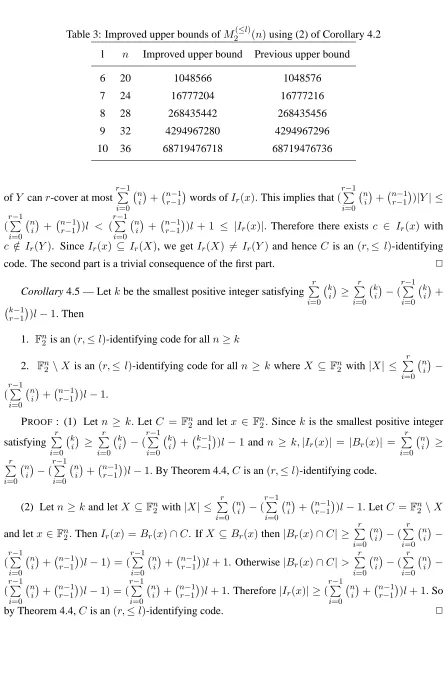
Remark 4.3 : For every integerl≥6, using (2) of Corollary 4.2, we can give(2,≤l)-identifying codes having smaller cardinality than previously known (see Theorem 2 of [12] and Theorem 21, Theorem 24 of [4]) for the length one more than the improved upper bounds ofL(2, l)in Table 2. This is established in Table 3 for small values ofl.
Theorem 4.4 — Letr andlbe any two positive integers. LetC ⊆ Fn2 be such that |Ir(x)| ≥ (rP−1
i=0 ¡n
i
¢
+ ¡nr−−11¢)l + 1for allx ∈ Fn2. Then C is an (r,≤ l)-identifying code. Consequently, Mr(≤l)(n)≤K(n, r, µ)whereµ= (
rP−1
i=0 ¡n
i
¢
+¡nr−−11¢)l+ 1.
PROOF : LetX andY be any two distinct subsets of Fn2 with|X| ≤ land|Y| ≤ l. Without loss of generality we assume that there exists an elementx ∈ X such that x /∈ Y. Nowx is r-covered by at least
µ
rP−1
i=0 ¡n
i
¢
+¡nr−−11¢

l+ 1codewords ofC. By Lemmas 3.1 and 3.2, any element
2The lower bounds of Table 1 are from Theorem 4 of [8] and Table 7.1 of [3].
3 The upper bounds in Table 1 are from Theorem 2 of [12] and Theorem 21, Theorem 24 of [4]. @
@
@@ 6 7 8 9 10 11 12 13
2 11-20 13-24 14-28 15-32 16-36 17-40 19-44 20-48
3 14-30 15-36 16-42 18-48 19-54 20-60 23-66 24-72
4 16-40 17-48 19-56 20-64 21-72 23-80 25-88 26-96
5 19-50 20-60 21-70 22-80 24-90 25-100 27-110 28-120
6 21-60 22-72 23-84 25-96 26-108 27-120 29-132 30-144
7 23-70 24-84 25-98 27-112 28-126 31-140 32-154 33-168
Table 2: Improved upper bounds forL(2, l) from our Theorem 4.1
@ @
@@
r l
6 7 8 9 10 11 12 13
2 19 23 27 31 35 39 43 47
Table 1: Previous lower and upper bounds for L(r, l)
Table 3: Improved upper bounds ofM2(≤l)(n)using (2) of Corollary 4.2 l n Improved upper bound Previous upper bound
6 20 1048566 1048576 7 24 16777204 16777216 8 28 268435442 268435456 9 32 4294967280 4294967296 10 36 68719476718 68719476736
ofY canr-cover at most
rP−1
i=0 ¡n
i
¢
+¡nr−−11¢words ofIr(x).This implies that( rP−1
i=0 ¡n
i
¢
+¡nr−−11¢)|Y| ≤
(rP−1 i=0
¡n
i
¢
+¡nr−−11¢)l < (rP−1 i=0
¡n
i
¢
+¡nr−−11¢)l+ 1 ≤ |Ir(x)|.Therefore there exists c ∈ Ir(x) with
c /∈ Ir(Y). Since Ir(x) ⊆ Ir(X), we getIr(X) 6= Ir(Y)and hence C is an(r,≤ l)-identifying
code. The second part is a trivial consequence of the first part. 2
Corollary 4.5 — Letkbe the smallest positive integer satisfying
r P i=0 ¡k i ¢
≥ Pr i=0
¡k
i
¢
−(rP−1 i=0
¡k
i
¢
+
¡k−1
r−1 ¢
)l−1.Then
1. Fn2 is an(r,≤l)-identifying code for alln≥k
2. Fn2 \X is an(r,≤ l)-identifying code for alln ≥ kwhereX ⊆Fn2 with|X| ≤
r P i=0 ¡n i ¢ −
(rP−1 i=0
¡n
i
¢
+¡nr−−11¢)l−1.
PROOF: (1) Letn ≥ k.LetC = F2n and letx ∈ Fn2.Sincekis the smallest positive integer
satisfying r P i=0 ¡k i ¢
≥ Pr i=0
¡k
i
¢
−(rP−1 i=0
¡k
i
¢
+¡kr−−11¢)l−1andn ≥ k,|Ir(x)| = |Br(x)| = r P i=0 ¡n i ¢ ≥ r P i=0 ¡n i ¢
−(rP−1 i=0
¡n
i
¢
+¡nr−−11¢)l−1.By Theorem 4.4,Cis an(r,≤l)-identifying code.
(2) Letn≥kand letX ⊆Fn2 with|X| ≤
r P i=0 ¡n i ¢
−(rP−1 i=0
¡n
i
¢
+¡nr−−11¢)l−1.LetC =Fn2 \X
and letx∈Fn2.ThenIr(x) = Br(x)∩C. IfX ⊆Br(x)then|Br(x)∩C| ≥ r P i=0 ¡n i ¢
−(Pr i=0
¡n
i
¢
−
(rP−1 i=0
¡n
i
¢
+¡nr−−11¢)l−1) = (rP−1 i=0
¡n
i
¢
+¡nr−−11¢)l+ 1. Otherwise|Br(x)∩C|> r P i=0 ¡n i ¢
−(Pr i=0
¡n
i
¢
−
(rP−1 i=0
¡n
i
¢
+¡nr−−11¢)l−1) = (rP−1 i=0
¡n
i
¢
+¡nr−−11¢)l+ 1. Therefore|Ir(x)| ≥( rP−1
i=0 ¡n
i
¢
+¡nr−−11¢)l+ 1.So
Table 4: gives the values ofkas defined in Corollary 4.5. l k l k
1 3 8 172 2 7 9 221 3 19 10 277 4 37 11 339 5 61 12 407 6 92 13 482 7 129 14 562
Corollary 4.6 — Letl be any positive integer. Letk be the smallest positive integer such that
(kP−1 i=0
¡2k+1
i
¢
+¡k2−k1¢)l+ 1≤ 1 2
k
P
i=0 ¡2k+1
i
¢
.ThenMr(≤l)(2r+ 1)≤22rfor allr≥k.
PROOF: Letr ≥kand letµ = (
rP−1
i=0 ¡2r+1
i
¢
+¡r2−r1¢)l+ 1andγ = 12
r
P
i=0 ¡2r+1
i
¢
.By Theorem
14.2.2 of [3], there exists anγ-foldr-covering codeCof length2r+ 1with cardinality22r.Since r≥kandkis the smallest positive integer such that(
kP−1
i=0 ¡2k+1
i
¢
+¡k2−k1¢)l+1≤ 1 2
k
P
i=0 ¡2k+1
i
¢
, µ≤γ.
Since everyp-foldr-covering code is alsoq-foldr-covering code for all q ≤ p, C is also aµ-fold r-covering code of length2r+ 1with cardinality22r.ThereforeK(2r+ 1, r, µ)≤22r.By Theorem
4.4,Mr(≤l)(2r+ 1)≤22r. 2
In Table 4, we present the smallest possible integerkthat satisfies(kP−1 i=0
¡2k+1
i
¢
+¡k2−k1¢)l+ 1≤
1 2
k
P
i=0 ¡2k+1
i
¢
for small values ofl.Then by Corollary 4.6, we haveMr(≤l)(2r+ 1)≤22rfor allr ≥k.
For example,Mr(≤3)(2r+ 1)≤22rfor allr≥19.
ACKNOWLEDGEMENT
The authors thank Prof. R. Balakrishnan, Adjunct Professor of our department for his valuable sug-gestions and review of this paper.
REFERENCES
2. I. Charon, G. Cohen, O. Hudry, and A. Lobstein, New identifying codes in the binary Hamming space, Eur. J. Combin., 31 (2010), 491-501.
3. G. Cohen, I. Honkala, S. Litsyn, and A. Lobstein, Covering codes, 193, Elsevier, Amsterdam (1997). 4. G. Exoo, V. Junnila, T. Laihonen, and S. Ranto, New bounds on binary identifying codes, Discrete Appl.
Math., 156 (2008), 2250-2263.
5. G. Exoo, V. Junnila, T. Laihonen, and S. Ranto, Upper bounds for binary identifying codes, Adv. Appl. Math., 42 (2009), 277-289.
6. G. Exoo, V. Junnila, T. Laihonen, and S. Ranto, Improved bounds on identifying codes in binary Ham-ming spaces, Eur. J. Combin., 31 (2010), 813-827.
7. G. Exoo, T. Laihonen, and S. Ranto, Improved upper bounds on binary identifying codes, IEEE Trans. Inform. Theory., 53(11) (2007), 4255-4260.
8. I. Honkala, T. Laihonen, and S. Ranto, On codes identifying sets of vertices in Hamming spaces, Des. Codes Cryptogr., 24 (2001), 193-204.
9. M. G. Karpovsky, K. Chakrabarty, and L. B. Levitin, On a new class of codes for identifying vertices in graphs, IEEE Trans. Inform. Theory, 44 (1998), 599-611.
10. J. L. Kim and S. J. Kim, Identifying codes inq-ary hypercubes, Bull. Inst. Combin. Appl., 59 (2010), 93-102.
11. M. Laifenfeld and A. Trachtenberg, Identifying codes and covering problems, IEEE Trans. Inform. Theory, 54(9) (2008), 3929-3950.
12. T. Laihonen, Sequences of optimal identifying codes, IEEE Trans. Inform. Theory, 48(3) (2002), 774-776.
13. A. Lobstein, Watching systems, identifying, locating-dominating and discreminating codes in graphs, Telecom Paris Tech Web., https://www.1ri.fr/ lobstein/debutBIBidetlocdom.pdf.